
Clari Pricing and Value: How Mid-Market Teams Evaluate the Real Cost (and How Weflow Compares)


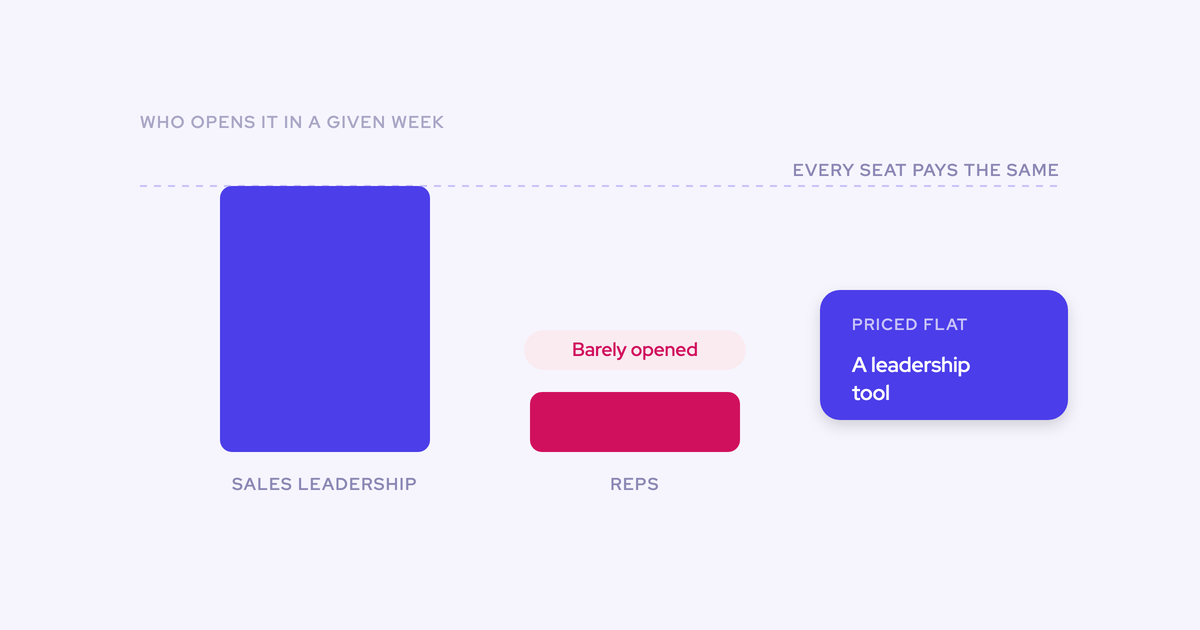
Clari doesn't publish pricing, so the renewal quote sitting on your desk is the first line of the real total, not the total. Professional services, seats nobody logs into, config changes that route back through the vendor, and the board deck someone rebuilds in Tableau every quarter all belong on the cost side. On the value side is whatever your team actually opens.
This article gives you both halves of that math, in the order you'd put them in a renewal decision doc. It's honest about where Clari is genuinely the better product, because that matters more to your CFO than a feature grid does.
Weflow is the Revenue AI Orchestration platform for sales, customer success, and RevOps teams. We publish our prices, so we'll use ourselves as the worked example later on, including forecast submission roll-ups and the two places our forecasting falls short of Clari's. You can run the whole comparison in a spreadsheet without booking a call.
What Clari actually costs: quote-only pricing and reported ranges
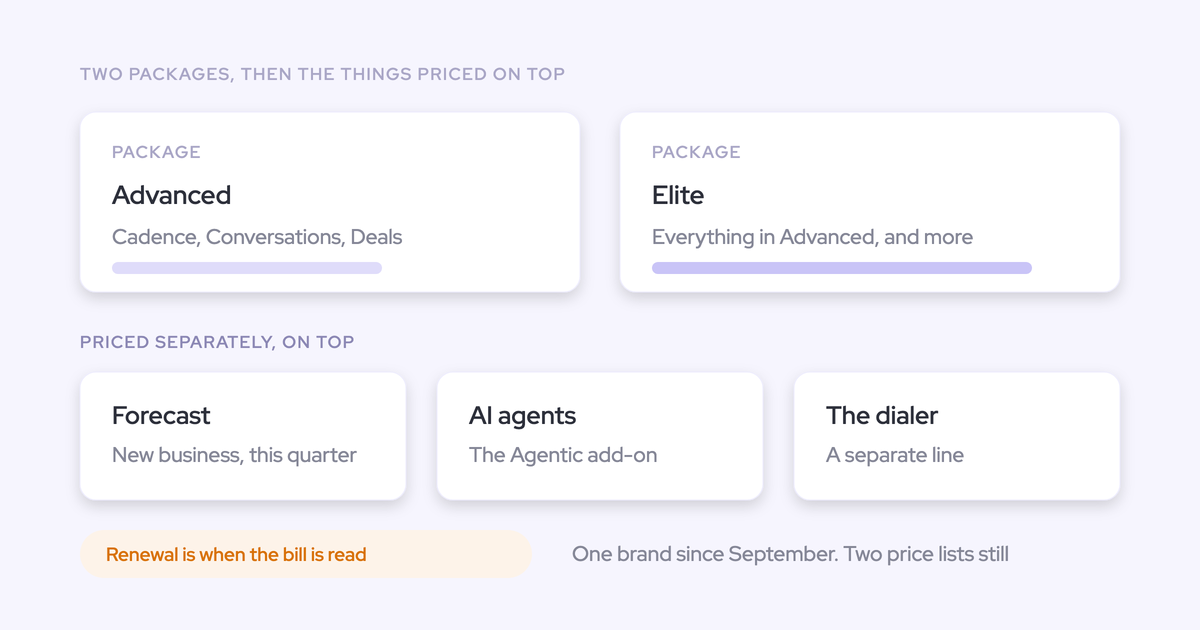
Clari doesn't publish pricing. There's no self-serve signup and no free trial, and the old Copilot trial page now redirects to a demo request, so every number you'll find online comes from buyers and evaluations rather than from Clari.
Here's what's out there, all of it reported and none of it confirmed by Clari:
- Per-seat cost: buyer estimates land in the range of $120 to $180 per user per month, with regular increases at renewal.
- Professional services: reported implementation fees of $15,000 to $50,000, quoted separately from license.
- Time to value: buyers report 8 to 12 weeks to implement, and 10 to 16 weeks to value once change management and RevOps consulting are counted.
- Packaging: products aren't sold standalone, so every licensed user carries the full platform whether they use it or not.
- Deal-size effect: the per-seat number falls sharply as seat count rises. One reported small purchase came in near $46,000 for 26 seats.
That last point is the one mid-market teams feel. Clari's sweet spot is companies from roughly 500 to a few thousand employees, and it rarely serves organizations under 500. If you're at the small end of the seat count, you're paying the highest price per seat in the customer base.
Treat the opacity itself as information. Pricing you can't model is pricing tuned to total contract value, not pricing designed for you to check.
How to total the real cost of a Clari renewal
The license is one line of six. A renewal decision only survives a CFO conversation when the quote is added to the professional services, the change requests, the seats nobody uses, the admin hours, and the BI tool where the real forecast gets assembled.
| Cost line | Why it belongs in the total | How to estimate it from your own records |
| License quote | The only number most people put in the deck | Take the renewal quote, then divide by active users rather than licensed users |
| Professional services and implementation | Reported at $15k to $50k and billed on top of license; it's a real cash line, not a rounding error | Pull the original PS invoices from finance, plus anything billed since |
| PS-gated change requests | New quarter targets, new forecast calls, roll-up changes and column changes route through the vendor, so a ten-minute change takes two weeks and gets billed | Count the change tickets you raised last year and the elapsed time on each |
| Unused seats | A seat that never gets opened is pure cost with a zero on the value side | Ask for a login report by user for the last 90 days and compare it against the license count |
| RevOps admin hours | The tool holds its own logic and mappings alongside Salesforce, so your team maintains a parallel layer and trains users on a second system | Estimate hours per month on mappings, hierarchy and user training, then multiply by a loaded hourly rate |
| The BI tool the board deck gets rebuilt in | If the forecast leaves the tool before it reaches the CFO, you're paying twice for one number | License cost of the BI seat plus the person-days spent rebuilding the consolidation each cycle |
These aren't implementation accidents. They follow from how the product is built: a separate operating layer alongside your CRM, with limited self-service configuration, so change requests go to the vendor by design.
That's the gap between the operator who lives in the tool and the CRO who bought it. One of them files the tickets.
How to measure the value you actually get from Clari
Value is what your team opens, not what the product does. Run this audit on your own instance before the renewal call, and write the honest answer next to each line.
- Which views actually get used? In most deployments it comes down to the pipeline waterfall, the pacing view, and the comparison against the same day in previous quarters. A bad answer is a licensed platform where three views carry all the value.
- Does the seat count match the active users? Pull logins for 90 days. A bad answer is half the license holders logging in only to look.
- Does the forecast leave the tool before the CFO sees it? A bad answer is your worldwide consolidation getting exported and rebuilt every cycle because the native views don't present to that audience.
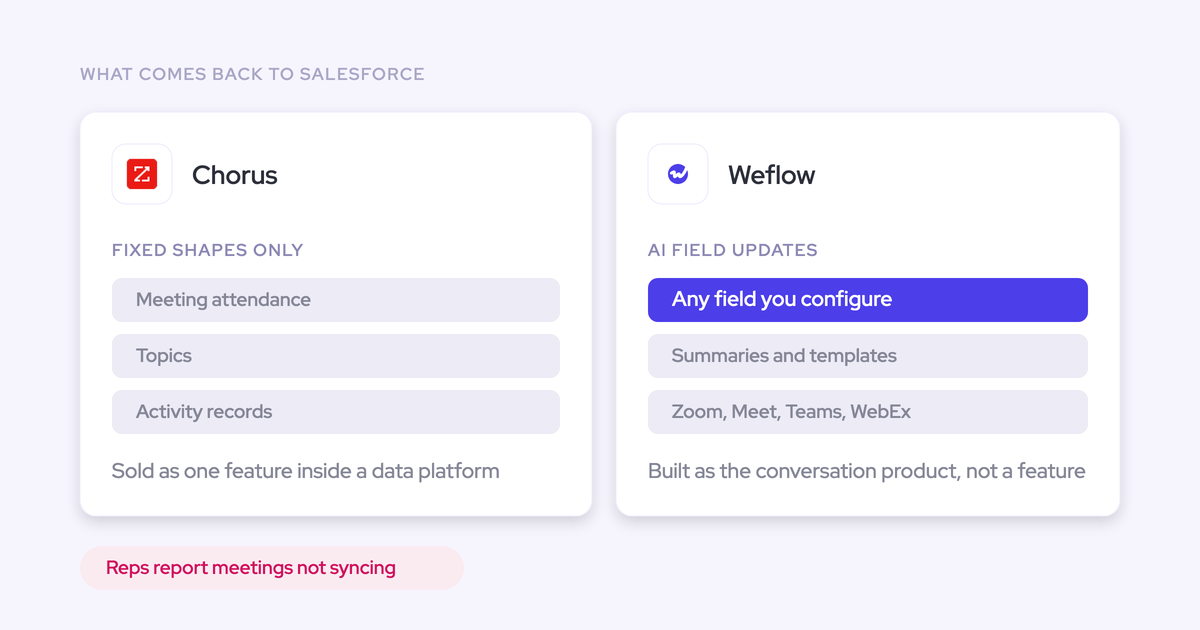
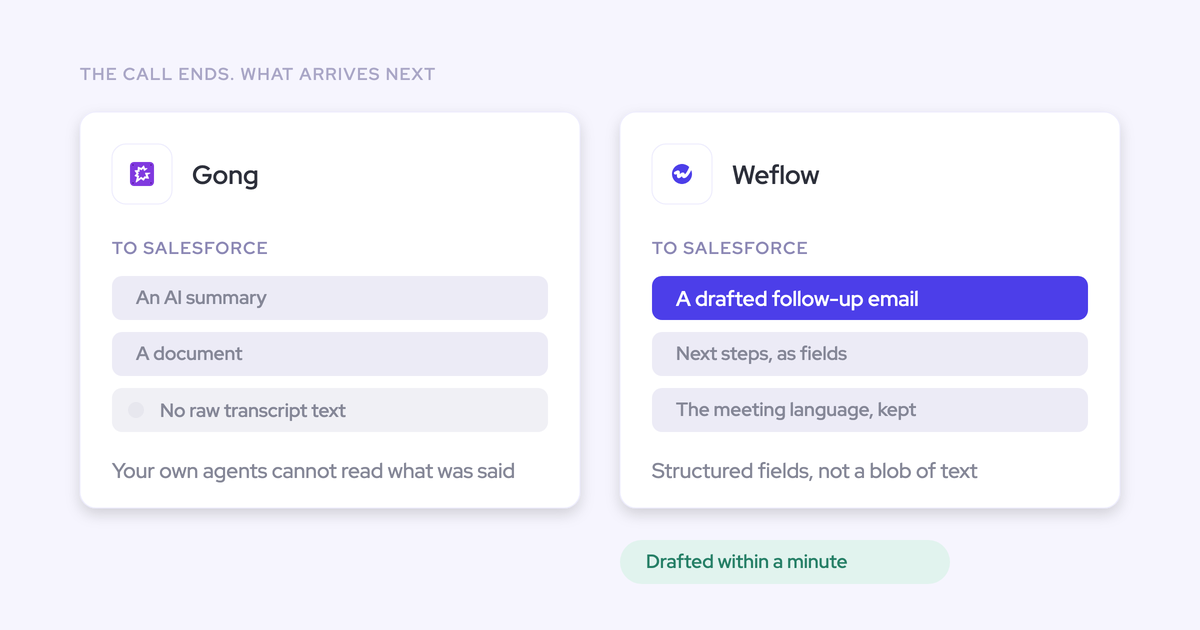
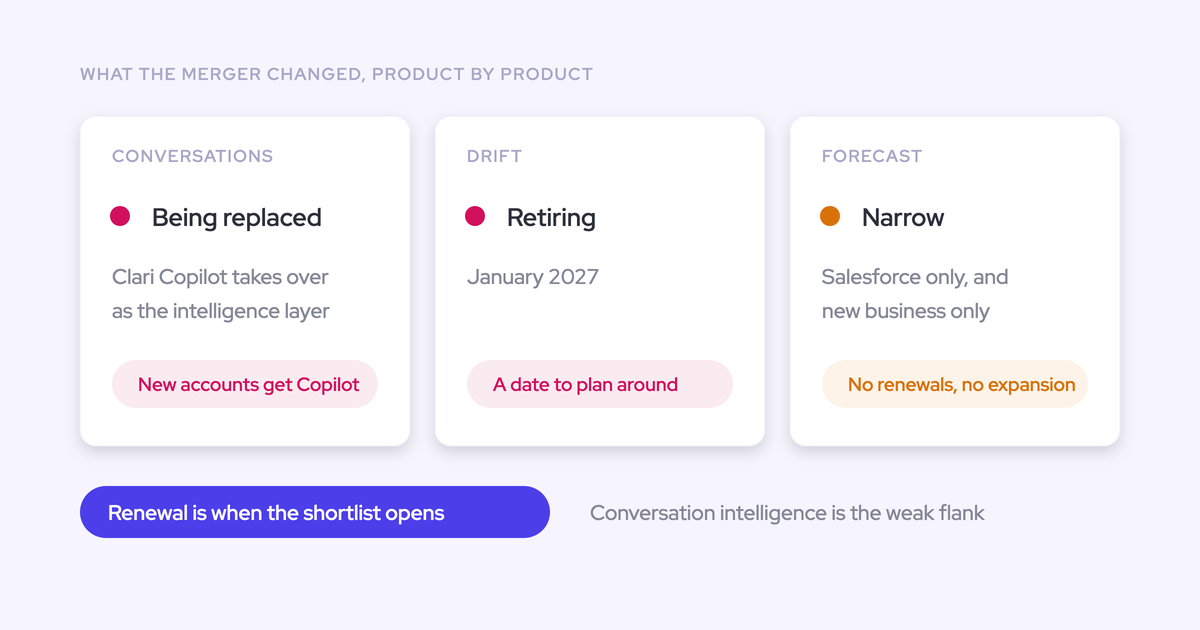
- Does call data inform the forecast at all? Clari's forecasting product and its conversation intelligence product don't share a data layer, so the answer is usually no, and teams end up piping transcripts into a separate AI workspace and hand-feeding insights back.
- Can you find the deals that have been sitting in the pipe forever? A bad answer is that a dead deal and a live one look identical in the roll-up, and the weekly review is spent asking reps what's going on instead of being told.
- Can you say how accurate last quarter's call was? Clari doesn't measure forecast versus actual, so four years in, a team still can't grade its own commits.
- Is every revenue motion in there? New business usually is. Renewals and CS frequently never got implemented, which means the largest part of the revenue base has no forecasting process behind it.
- What shipped in the last two years? A bad answer sounds like the one we hear on switch calls.
Now put the two sides together. If the total from the table above is six figures and the honest value answer is a roll-up plus two views, you don't have a pricing complaint, you have a cost-per-value problem you can show to a CFO on one slide.
Where Clari is genuinely the stronger choice
Clari's roll-up forecasting is its strongest and most defensible product, and at enterprise scale it's ahead of us. Flexible roll-ups across a thousand-plus reps, with multiple hierarchies and cadences, are the real thing, and nobody should pretend otherwise.
Its UX also sets the bar any replacement gets judged against: the inspect view, the Quick Submit action that updates all months and weeks of a quarter in one go, and the quarter-navigation dropdown. Buyers we talk to use those three interactions as the benchmark, and they're right to.
And Clari sells a methodology, not just software. Predictability, repeatability, a process story a CRO can take to a board. That lands, and it's why displacement is as much an internal argument as a technical one.
Renewing is the reasonable call if:
- You run roll-up forecasting across a thousand or more reps with genuinely complex hierarchies, where Clari's flexibility is more mature than ours.
- Usage is high and happy, the views get opened weekly, and nobody upstairs is asking you to justify the line item.
- Your PE sponsor has standardized on Clari across the portfolio. That's a political fight you won't win this year, and coexisting is the smarter play.
- The forecast cadence is new and fragile, and pulling the tool out now would take the process with it.
Clari vs Weflow: pricing and value at a glance
Buyers put these two side by side at renewal because the divergence isn't really a feature list. It's the economics of ownership: how you learn the price, how seats are packaged, what a change costs, and who owns the data underneath the forecast.
| Dimension | Clari | Weflow |
| How you learn the price | Quote only. No published tiers, no self-serve signup, no free trial; the former Copilot trial page redirects to a demo request | Published list prices per product and per bundle, $19 to $79 per user per month, billed annually with a 10-user minimum |
| Packaging | All-in seats. Products aren't sold standalone, so every licensed user carries the full platform (reported by buyers) | Modular by product and by team: Activity & Contact Capture $19, Conversation Intelligence $39, Deal Intelligence & Forecasting $39, or bundles at $49, $59, $79 |
| Implementation and professional services | Buyers report $15k to $50k in professional services, 8 to 12 weeks to implement and 10 to 16 weeks to value | No implementation or platform fees. 30 to 45 minutes of technical setup with a Salesforce admin, 1 to 4 weeks to full value |
| Who makes config changes | Limited self-service. Buyers report quarter targets, forecast calls, roll-up logic and even column changes routing through professional services; custom objects, leads and contacts aren't supported | Self-service admin console. Your admin configures forecast types, cadences, quotas, warning rules, pipeline views and AI templates |
| Where the data lives | Its own logic and mapping layer alongside Salesforce, which RevOps maintains in parallel (reported by buyers on switch calls) | Activity, contacts, transcripts, AI field updates and opportunity edits are written into native Salesforce objects you own. Exception: forecast submissions, targets and roll-up data live in the Weflow app and leave through the public API |
| Enterprise roll-up maturity | Ahead of us. Flexible roll-up forecasting is Clari's strongest product and more mature at 1,000+ reps | Covers the forecasting motion a mid-market team runs weekly. No pipeline flow view, and one opportunity's amount can't be split across two periods |
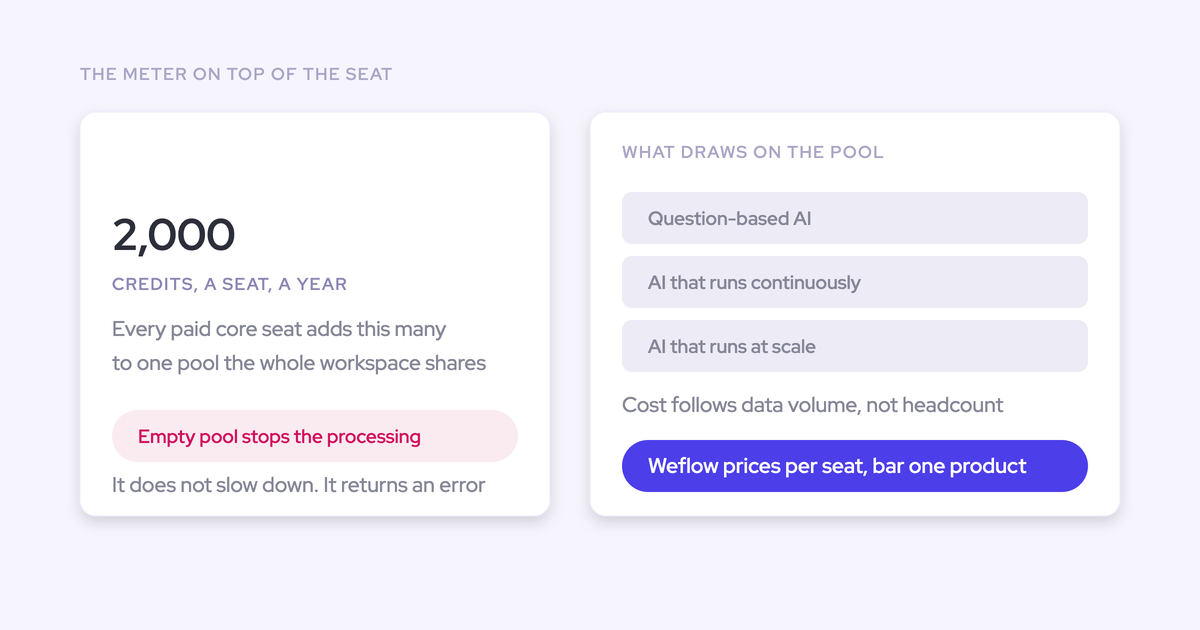
| AI and agents | No agent builder for revenue workflows. Ask AI draws on limited sources and can't produce PDF or CSV outputs | Ask Weflow AI Pro and Agent Builder Free (25 agent actions a month) included in every plan and bundle; recordings, transcripts and AI processing unmetered |
How Weflow's published pricing changes the seat math
Because the prices are public and the products are modular, you can price your exact deployment yourself. Full GTM team on capture and conversation intelligence, forecasting seats only for the people who forecast.
That's the constraint we hear most often from RevOps leaders carrying a forecasting renewal:
Here's how a mixed 180-seat deployment prices out at list:
| Group | Seats | What they get | List price | Monthly |
| Sellers, CSMs, AMs | 150 | Revenue AI Foundation: Activity & Contact Capture, Conversation Intelligence, Mobile Copilot, Ask Weflow AI, Agent Builder | $49 per user | $7,350 |
| Managers and leadership who forecast | 30 | Revenue AI Enterprise: everything above plus Deal Intelligence & Forecasting | $79 per user | $2,370 |
| Finance, product, enablement, execs who only read | Unlimited | View-only access to recordings, summaries, pipeline views and analytics | $0 | $0 |
That's $9,720 a month, or $116,640 a year, at list. Move a seat up a tier and the step is $10 or $20 per user per month, not a second contract.
A few things that belong on the cost side of the same comparison. There's no professional services fee and no platform fee. Technical setup runs 30 to 45 minutes with your Salesforce admin and a Google or Microsoft admin, and the work that actually takes time is business logic: AI templates, forecast types, cadences, quotas, warning rules. Most teams are at full value in one to four weeks.
Being straight about the rest: our list prices are published, and volume discounts plus multi-year terms (10% for two years, 20% for three) are still quoted. Minimum is 10 users, billing is annual. AI usage isn't metered, so recordings, transcripts, AI processing and Ask Weflow AI prompts don't generate a variable line at the end of the quarter. Agent Builder is priced per workspace above the included free tier, at $299 a month for 500 agent actions and $999 for 2,500.
Does Weflow forecasting cover what you rely on in Clari?
You already know a lower price can mean a weaker tool, so this is the section that decides it. Weflow's Deal Intelligence & Forecasting covers the forecasting workflow a mid-market team runs every week, with two gaps a Clari user should weigh before signing anything.
Roll-up submissions: baseline, best case, and versioned overrides
The core Clari workflow, the roll-up, exists in full. Each rep submits a baseline and a best case, either as a total or by selecting the specific opportunities behind each figure, with a free-text comment.
- A reminder email opens the submission window and deep links the rep straight into it.
- Two numbers instead of one separate what's very likely to close from what closes if timing goes their way, and the gap is what the manager coaches into.
- Every submission is versioned, so you can see whether a rep's call moved during the quarter or never moved at all.
- Managers can override without erasing the rep's original number, which keeps accountability attached to the person who made the judgment.
- Deadlines lock the field, and submissions roll up to manager, VP and executive automatically.
- Because the number is tied to named opportunities rather than typed into a box, the forecast review runs deal by deal instead of arguing about a total.
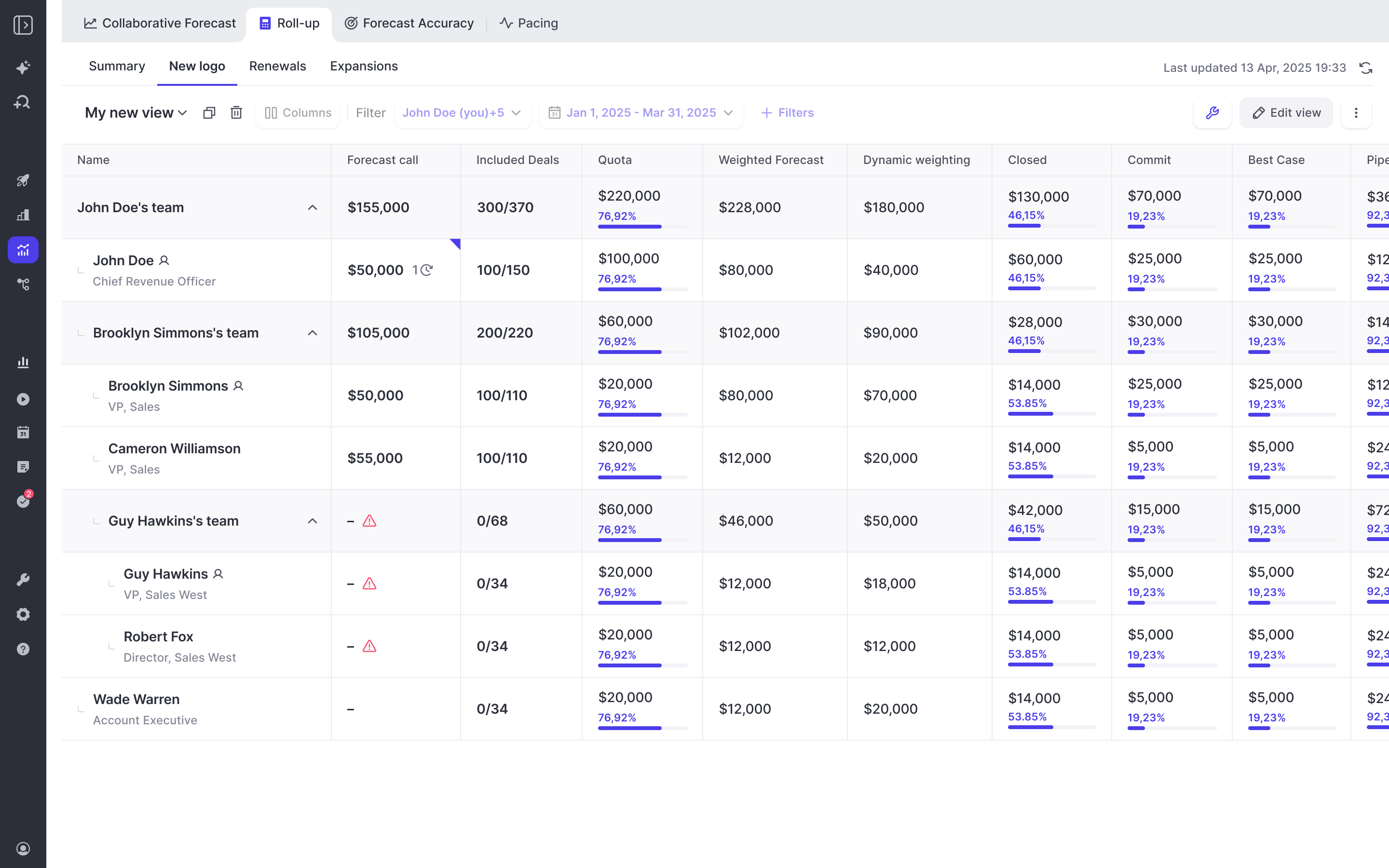
Roll-ups run across your Salesforce role hierarchy, and where the Salesforce hierarchy doesn't match how you forecast, Weflow can hold its own. That's the limit buyers hit most often on the incumbent:
Pipeline views: waterfall and pacing, but no flow view
Of the three views teams actually use, Weflow covers two outright and the third through its own snapshots.
- Pipeline waterfall: covered. Deals created, amounts increased or decreased, moved in, moved out, won, lost, with drill-through to the opportunities in each bucket.
- Pacing: covered, alongside coverage, generation and team benchmarks.
- Quarter-over-quarter and same-day-last-quarter: covered, because Weflow snapshots opportunity records over time rather than relying on Salesforce field history.
- Pipeline flow: not covered. If your team lives in Clari's flow view, count that as a real gap.
One more limit to check against your own model: a forecast setup places the full opportunity amount into the single period its chosen date field falls into. The date field is configurable, but a deal can't be split across two quarters. Businesses recognizing revenue on delivery schedules will see a split in Salesforce that the forecast view doesn't reproduce.
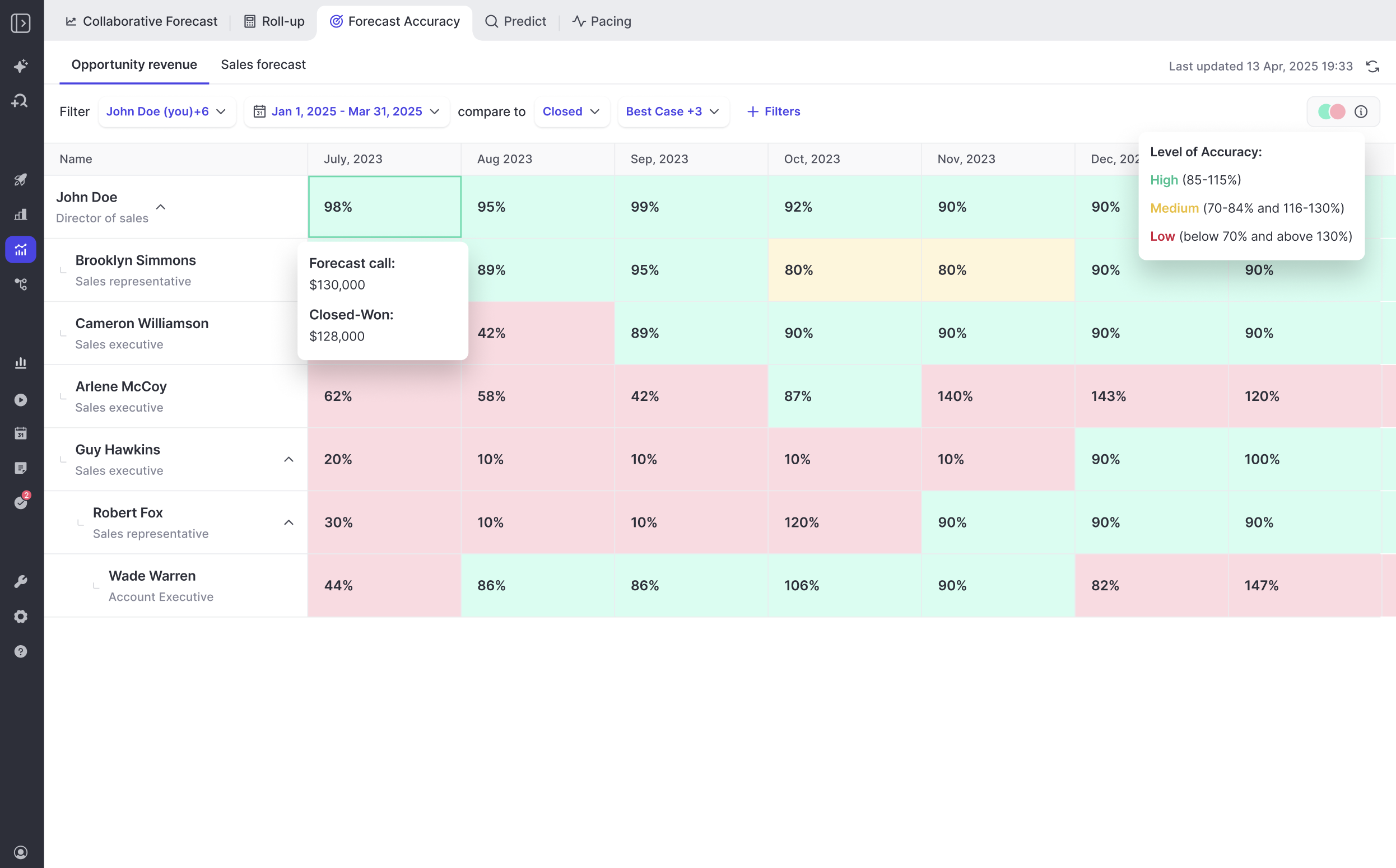
The thing Weflow does that Clari doesn't do at all is grade the forecast. Accuracy is tracked per rep and per manager, submitted call against closed-won, so the weekly cadence produces a number you can improve rather than a number you defend.
Where forecast data lives: Salesforce objects, one exception
Weflow writes activity, contacts, transcripts, AI field updates and opportunity edits into native Salesforce objects, so the data your board reporting runs on is data you own and can report on with your own tools. That's the answer to the Tableau rebuild:
Now the exception, and you should know it before a contract rather than after. Forecast submissions, targets and roll-up data live in the Weflow application, not as Salesforce fields. If you snapshot forecasts into a BI tool, you pull them through Weflow's public API instead of reading them from Salesforce.
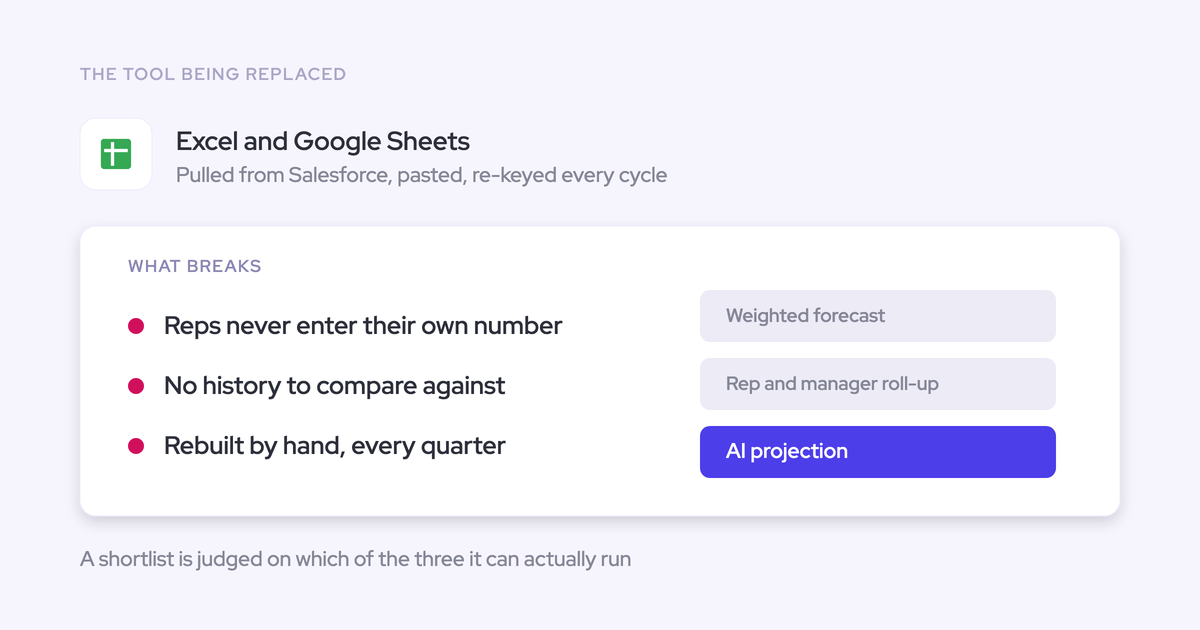
If your team has decided reps only ever work in Salesforce, roll-up submission breaks that rule. The weighted forecast and the AI projection still work for you, because both run off CRM data with no rep input.
Switching off Clari vs coexisting through the renewal
There are two clean paths. Which one fits depends on your renewal calendar and your politics, not on which is technically better.
Path one: replace at renewal.
- Turn the old capture off first. Run one capture engine into Salesforce, never two, or the same meeting and the same email get written twice and every activity metric drifts. Compatibility mode covers the overlap window if a second tool has to stay live.
- Enable Weflow capture and backfill history so in-flight deals don't look artificially dead on day one. Up to 24 months of email and meeting history can be pulled from your own mail tenant, available as an add-on.
- Roll out capture and conversation intelligence first. Both make the rep's life easier without asking anything of them, which is what gets adoption before anything harder arrives.
- Design the forecast with sales leadership in the room: forecast types, cadence, quotas, hierarchy, submission deadlines. This is the part that takes time, and it's a process decision, not a config task.
- Run your first forecast cycle in Weflow while the Clari contract runs out, then cut over at the renewal date.
Path two: coexist through the renewal. Use this when the CFO won't approve two forecasting tools in the same year, which is the objection we hit most often.
- Land Weflow on activity capture and conversation intelligence now. Those sit outside the blocked forecasting line item, so you're not asking anyone to break a contract.
- Make Weflow the single capture infrastructure writing to Salesforce, and switch Clari Capture off. Clari reads activities from Salesforce, so it gets better data, not less.
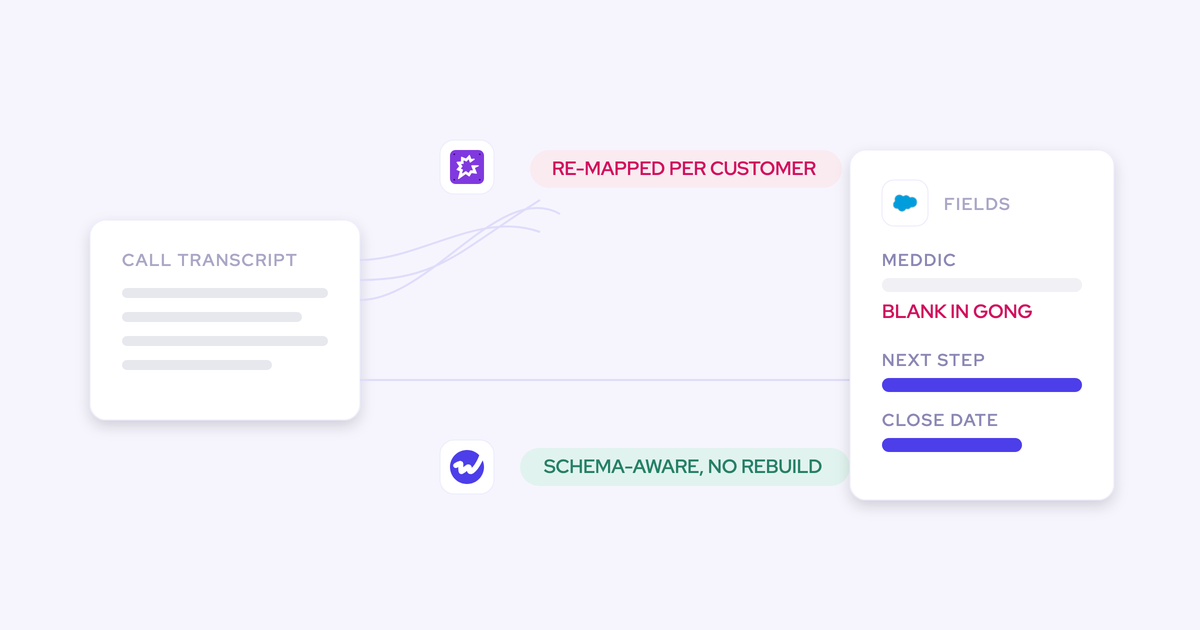
- Use the cycle to build the evidence: complete activity, structured fields written from calls, deal signals on every opportunity.
- Revisit forecasting when the contract opens, priced as a tier step rather than a new procurement cycle.
Where a sponsor has standardized on Clari across a portfolio, coexistence isn't a phase, it's the end state. Own the data layer, let the incumbent consume it, and wait for the political window.
One practical warning from watching these decisions get made. A tool swap doesn't compete against the incumbent vendor, it competes against your RevOps backlog. It gets approved when it arrives as a managed service with a fixed timeline, a named benefit and a price. It stalls the moment it needs your team to project-manage a migration mid-quarter.
Choose Weflow if, stay with Clari if
Choose Weflow if:
- You're mid-market, and the per-seat math on a tool built for 500-to-few-thousand-employee companies is landing hardest on you.
- You're cutting seats at renewal because usage never matched the license count.
- Config changes route through professional services, and your forecast process has ossified around whatever was set at implementation.
- The board deck gets rebuilt in Tableau or Sheets before it reaches the CFO.
- You want the full GTM team on affordable capture and conversation intelligence seats, with forecasting only for the people who forecast.
- You need the data underneath the forecast to sit in Salesforce objects you own, so your own reporting, automations and AI can read it.
- You want conversation data to actually reach the forecast rather than living in a product that doesn't talk to it.
Stay with Clari if:
- You run roll-up forecasting across a thousand or more reps and depend on its flexibility at that scale. We're not ahead of them there.
- Usage is high, the team is happy, and nobody is asking you to defend the line item.
- Your PE sponsor standardized on it. Coexist on capture and conversation data instead, and revisit later from inside a working relationship.
- Pipeline flow is a view your forecasting team genuinely runs on, or your revenue model needs one opportunity split across periods.
Walk through the product yourself, no call required.
FAQ: Clari pricing, renewal, and switching questions
How do I get Clari pricing without going through sales?
You can't. Clari is quote-only, with no published tiers, no self-serve signup and no free trial, and the old Copilot trial page now redirects to a demo request. What exists publicly is buyer-reported ranges, which is why the practical move is to price your renewal quote against the total-cost framework above rather than against a list price that doesn't exist.
Does Clari's conversation intelligence data feed its forecast?
No. Clari's forecasting product and its conversation intelligence product don't share a data layer, so call content doesn't inform the forecast, and customers who own both often pipe transcripts into a separate AI workspace to extract structure and feed it back by hand. The general lesson for any suite evaluation: don't ask how many products the vendor owns, ask which Salesforce object each product writes to, and whether one can filter on a field the other produced.
Is Weflow big enough to support a 30-to-200-seat rollout?
Fair question, and the honest answer is evidence rather than adjectives. Weflow has held SOC 2 Type II since 2021, is GDPR, CCPA and HIPAA compliant, doesn't retain customer data for AI training, and runs a 99.5%-plus uptime SLA with a public status page. ISO 27001 is in progress, not certified, and Weflow is not FedRAMP certified, so US government contractors with that requirement aren't a fit. On rollouts at that shape: KORE Wireless ran a five-phase global deployment with Weflow, starting with activity capture and ending with forecasting, with onboarding owned end to end including live training delivered through a real-time Portuguese translator for the Brazil team.
What happens to our historical activity data if we leave Clari?
Your email and meeting history lives in your own mail tenant and in Salesforce, so it doesn't leave with the tool. Weflow can backfill up to 24 months of it into Salesforce (available as an add-on), which is how a team turns the old capture off in the morning and doesn't have in-flight deals looking inactive that afternoon. Everything Weflow writes from that point lands in native Salesforce objects you own, with the single exception of forecast submissions and roll-up data.
How do I make the case to a CRO who likes Clari?
Separate the process from the tool. The forecast cadence Clari sold your CRO is an operating discipline your team now owns: weekly submissions, deal-by-deal review, a defined commit. None of that leaves with the license. The renewal question is narrower and easier to defend: is this layer the cheapest reliable way to run the cadence we already run? Put the total cost next to the views your team actually opens, and the conversation stops being about loyalty to a vendor and starts being about arithmetic.