
How to run Weflow Activity Capture alongside Clari forecasting (without duplicate activities)


You don't have to replace Clari's forecast to fix the data feeding it. This article isn't going to try to talk you into a rip-and-replace either, because if your renewal is eleven months out and your CFO has already signed it, that conversation is a waste of both our time.
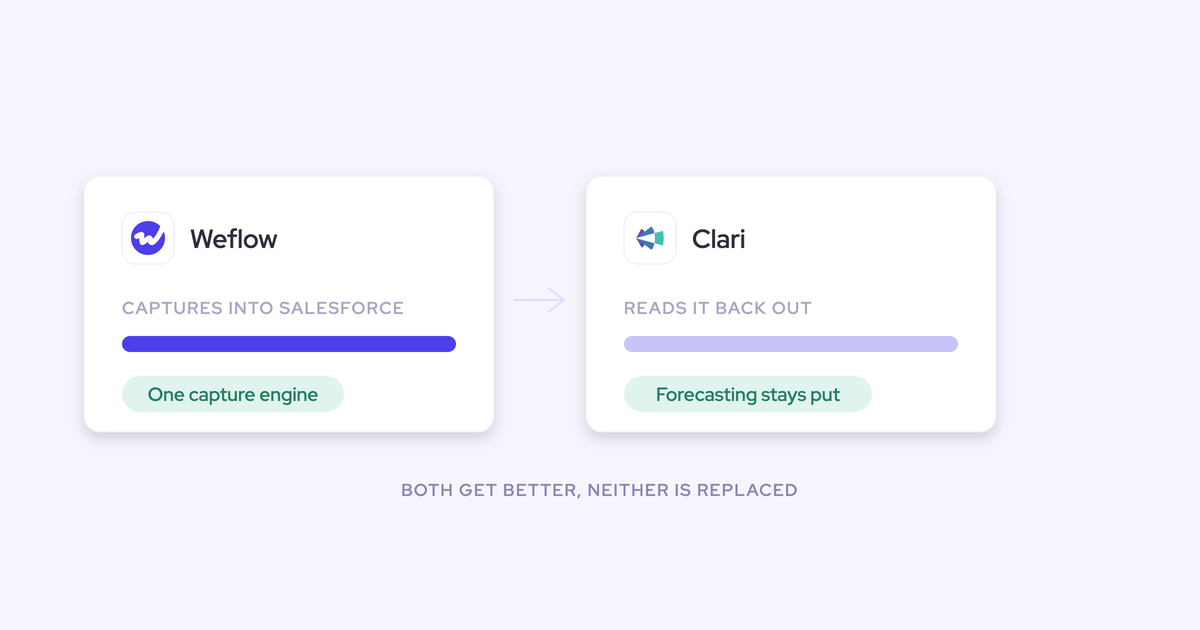
Here's the mechanic that makes coexistence work: Clari reads activity out of Salesforce. So if Weflow owns capture and writes into native Salesforce objects, Clari consumes the cleaner data and forecasts exactly as it did before. Your deal hygiene improves, the forecast improves with it, and nothing about your Clari setup changes.
There's one non-negotiable rule, and it's the whole article: one capture engine, never two. Below is the plumbing that shows why, and the order to roll it out in so you never open a duplicate window.
Why RevOps teams run Weflow alongside Clari
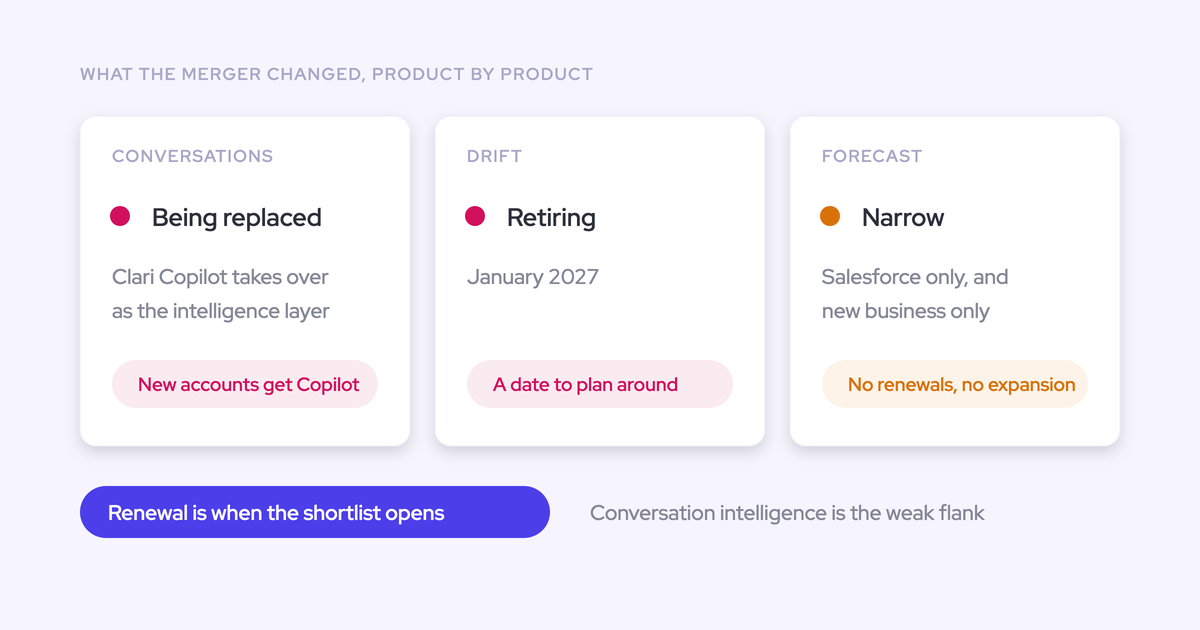
Because forecasting is the best thing Clari does, and capture and conversation intelligence are the weakest. Those two came into the suite by acquisition and the innovation behind them stalled, which is why the forecast can feel solid while the layer underneath it quietly doesn't.
We hear it phrased almost identically on calls:
And the reason replacement isn't on the table usually comes down to three things:
- Renewal timing. The contract is live and the money is spent for this year.
- The CFO. Nobody approves a second forecasting line item while the first one is still running.
- Leadership actually likes it. The forecast is the one screen the CRO opens, and you're not going to win an argument against a tool your exec trusts.
One of our own founders put the trap plainly on a podcast:
Now the part that matters more than the org chart. Clari's engagement timeline and its deal-health signals read Salesforce activity. Clari Capture maps that activity server-side on email domain, so once an account carries more than one open opportunity it has no way to decide which deal a thread belongs to.
The score still renders. It just isn't right. Bad capture doesn't announce itself, it quietly degrades every signal built on top of it, including the ones inside the forecast you trust.
Who does what: Weflow captures, Clari forecasts
In this setup every layer has exactly one owner. Weflow is the Revenue AI Orchestration platform for sales, customer success, and RevOps teams, and here it takes the data foundation only: capture and conversation intelligence, both writing into native Salesforce objects. Clari keeps forecasting and pipeline analytics, reading from Salesforce as it always has.
| Layer | Weflow's role in this setup | Clari's role in this setup |
| Email, meeting and contact capture | Owns it. Server-side capture at the mail tenant, writing to native Salesforce objects in real time | Clari Capture is switched off, so no second engine writes to the same org |
| Activity-to-opportunity mapping | Automated matching plus a rep-facing Outlook add-in and Chrome extension to correct which opportunity an activity lands on | Reads whatever mapping exists in Salesforce; contributes no mapping logic of its own |
| Conversation intelligence | Records, transcribes and scores calls; writes summaries and AI field updates onto the Salesforce record | Copilot switched off, or kept for transcript archive only if the contract already covers it |
| Forecast roll-up and submissions | Not used. No forecasting product purchased, no second forecast line item | Owns it. Rep submissions, roll-up, quota tracking, forecast calls, unchanged |
| Pipeline analytics | Not used in this setup | Owns it. Waterfall, pacing, flow, dashboards |
| Where the data lives | Native Salesforce objects: EmailMessage, Event, Task, and any standard or custom field you map | Reads from Salesforce; keeps its own forecast and analytics layer on top |
Screenshot this into your internal doc. The reason it holds is that only one of these rows has a write path into Salesforce activity, and it's the Weflow row.
Does Clari still read Weflow-captured activity in Salesforce?
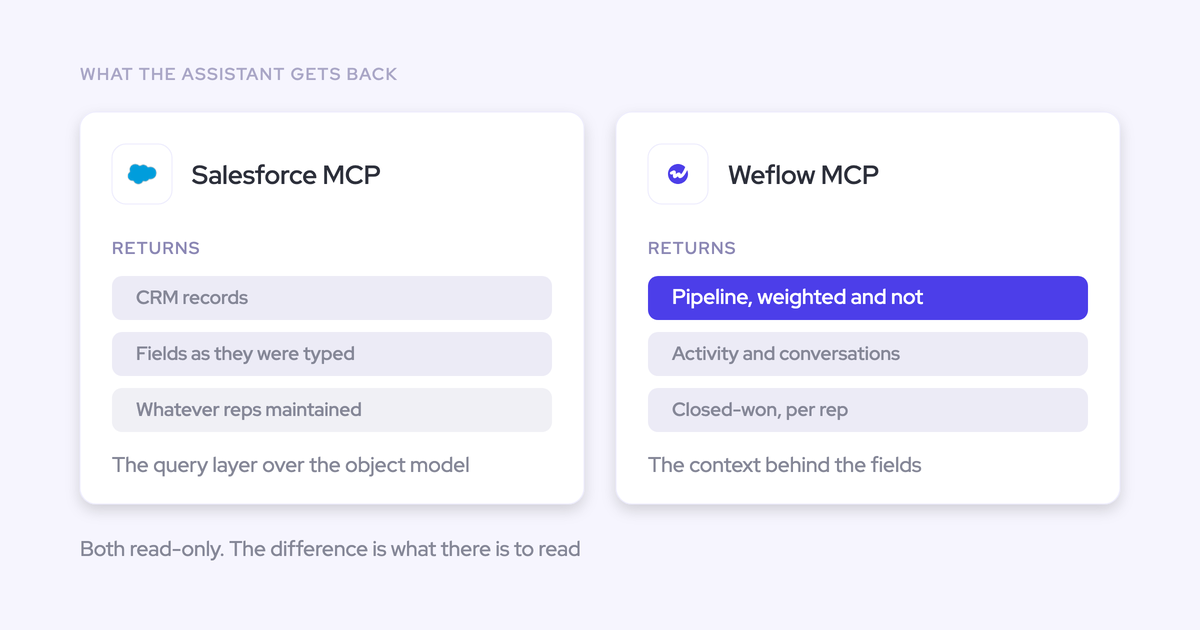
Yes. Clari is an overlay on Salesforce, and it reads activity from the objects in your org. Weflow captures into those same native objects, so Clari sees more activity, mapped better, than it did when Clari Capture was doing the work.
A prospect described the architecture better than our own deck does:
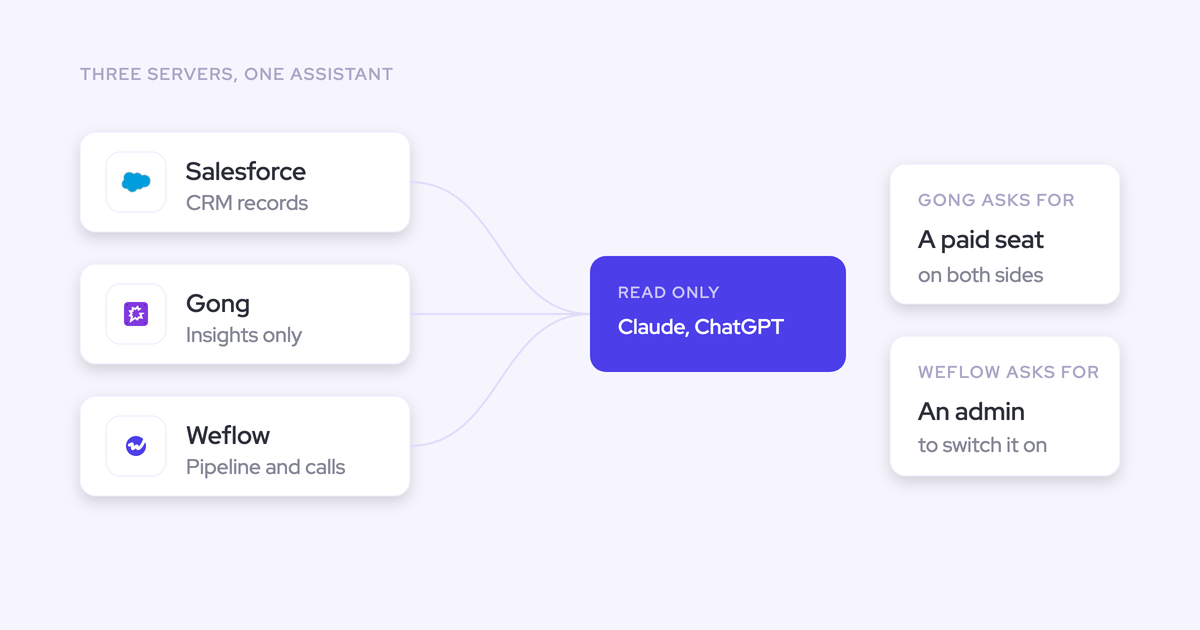
The write-and-read path is short:
- Weflow captures the email or meeting server-side at your Google Workspace or Microsoft tenant.
- Weflow matches it to the account, contact, lead and opportunity, and writes it to the native Salesforce object through your integration user.
- Clari reads that activity from Salesforce and computes its engagement and deal-health signals on it.
- The forecast rolls up in Clari exactly as before, on better inputs.
You don't reconfigure anything in Clari. Your forecast categories, hierarchy, quota settings and forecast calls all sit in the forecasting layer, and the forecasting layer isn't what you're changing. You're changing which engine fills the activity objects underneath it.
One caveat worth knowing before you start: Weflow only logs an activity when it can match it to an existing Salesforce record. It never creates accounts, leads or opportunities to make a match work. If your account data is thin in places, you'll see that show up as unlogged activity rather than as garbage records, which is the failure mode you want.
How to avoid duplicate activities: turn Clari Capture off
Duplicates don't come from coexistence. They come from running two capture engines against the same mailboxes and the same Salesforce org, and then wondering which one wrote the second copy.
So the rule is absolute: Clari Capture goes off before Weflow capture goes on. One engine owns the write path.
| Setup | What you get |
| Clari Capture and Weflow capture both live | Two records per email and meeting. Activity counts inflate, engagement scores drift upward, reply-rate reporting stops meaning anything, and both systems now hold data you can't reconcile |
| Weflow owns capture, Clari Capture off | One record per interaction in native Salesforce objects, mapped to the right opportunity. Clari's timeline and deal-health signals read that single clean set |
There's one transitional case that comes up constantly, and it's usually a sequencer rather than Clari. If Outreach, Salesloft or Apollo is already logging email to Salesforce, Weflow's compatibility mode handles the overlap: you name the other tool's sending domain, Weflow delays its own sync by roughly ten seconds, checks the message for that tool's tracking pattern, and skips it if it finds one. The other system claims the record and Weflow steps back.
Useful, and still a workaround. Compatibility mode exists for the period when a second capture tool is still live. The clean end state is one engine, and every team that gets there stops thinking about duplicates entirely.
How Weflow maps activity on multi-opportunity accounts
The symptom is familiar: the account looks busy, the deal timeline looks dead. Emails and meetings are landing, they're just landing on the account instead of on the opportunity your deal review is about.
The cause is that server-side domain matching cannot pick between two open deals on the same account. Same domain, same contacts, often the same thread. A buyer said it to us in four words:
No algorithm fixes that on its own, and any vendor promising otherwise is guessing. Multiple open opportunities per account is the normal state for anyone selling several product lines or running new business, upsell and renewal as separate record types, so the ambiguous case is the common case.
Weflow's capture is hybrid. Matching runs automatically server-side, and where the match is genuinely ambiguous the rep can see and correct which Salesforce record the activity maps to, from inside Outlook or the browser, without opening Salesforce. The correction sticks for the thread.
That's what makes opportunity-level activity trustworthy, and it's Clari's deal-health signals that benefit from it, since they're reading the same records.

Weflow also creates the Salesforce contacts it detects on threads and invites, attaches them to the matched account and opportunity, and can set the opportunity contact role automatically. Reps almost never add a new participant by hand, which is why buying committees in Salesforce show one champion on deals that actually have five people on the thread.
What Weflow Conversation Intelligence adds that Clari Copilot lacks
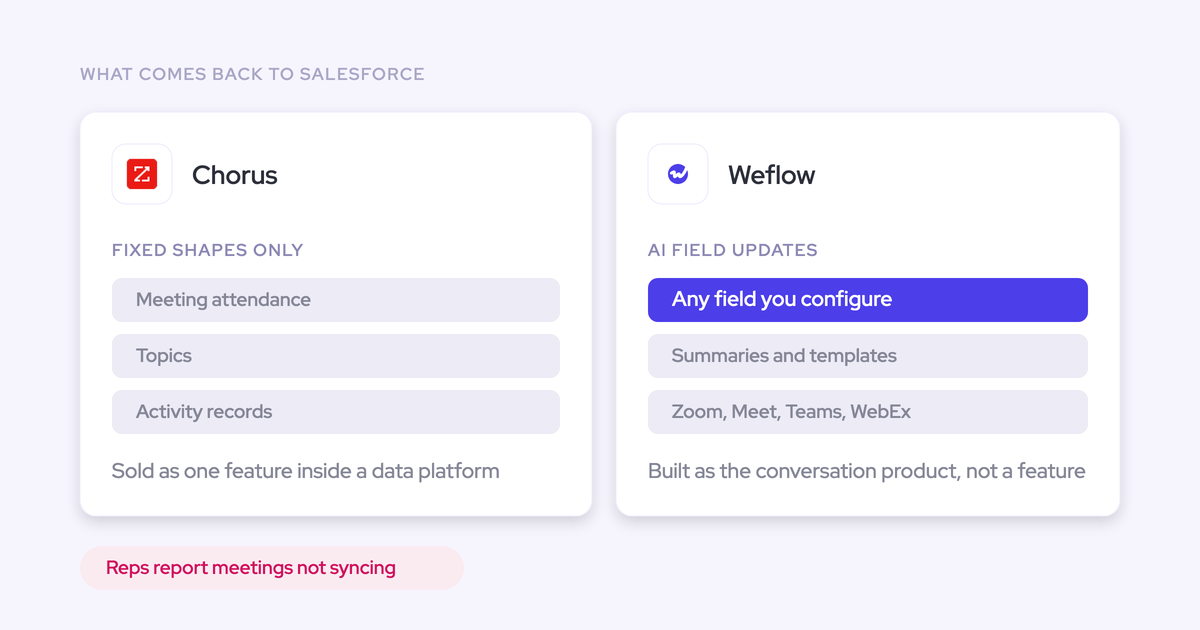
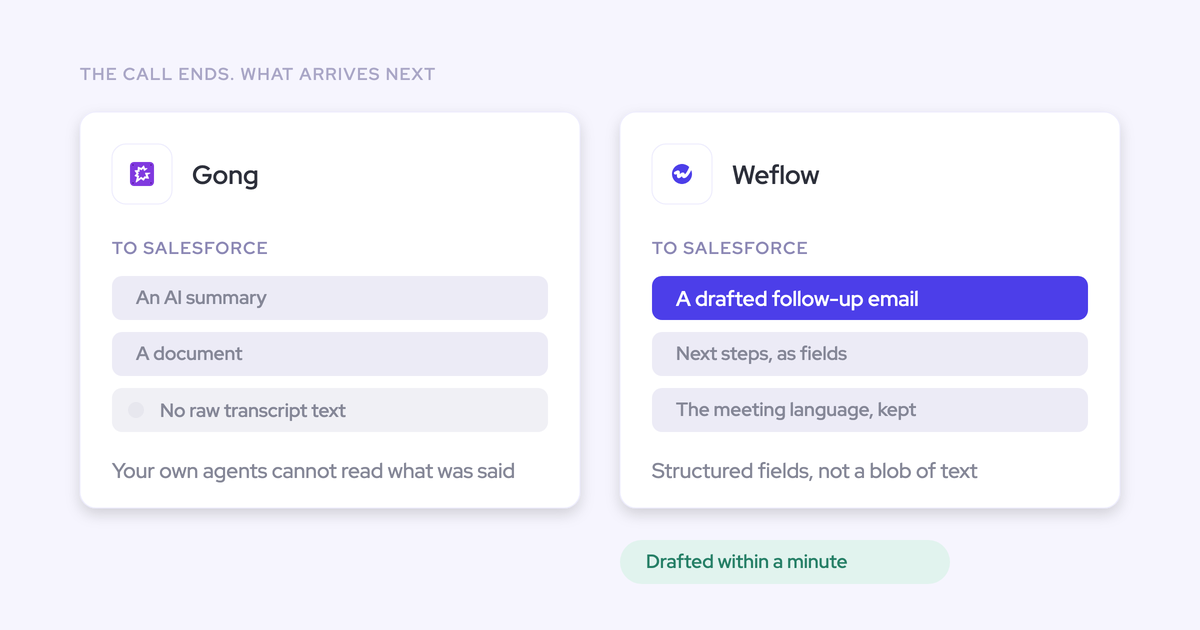
Copilot records, transcribes and gives you a summary. What it doesn't do is write structured data back into the Salesforce fields your team actually reports on, and it has no methodology scorecards.
That gap is the second half of the wedge, because transcription stopped being a differentiator years ago. Everything now transcribes well. The question is what happens to the conversation afterwards.
| Capability | Clari Copilot | Weflow Conversation Intelligence |
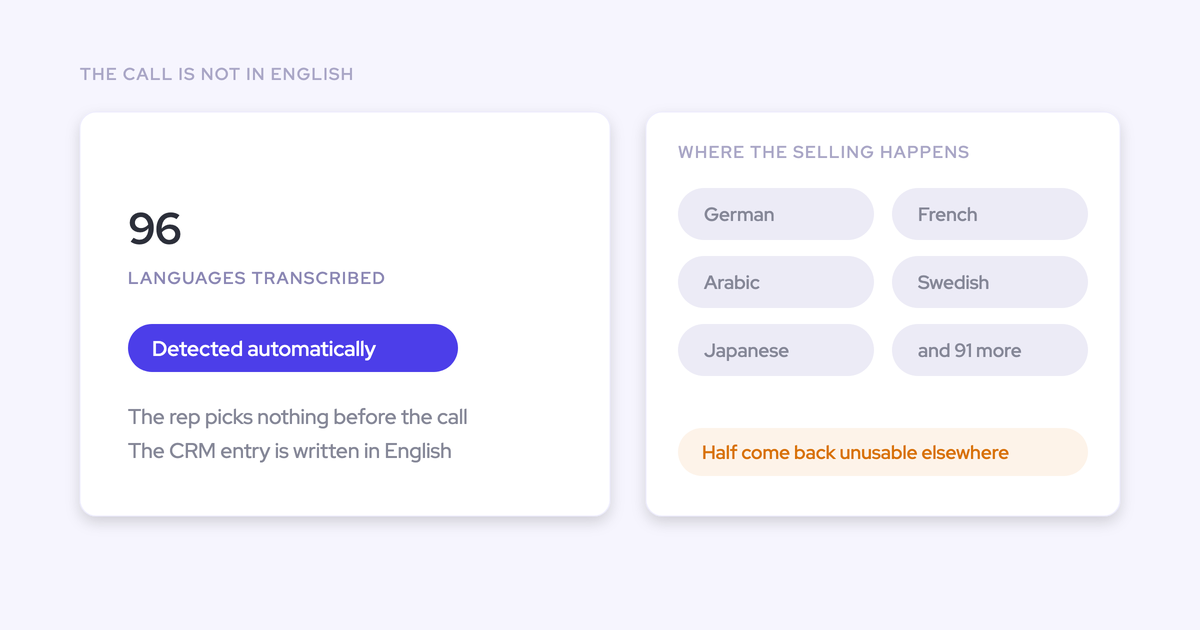
| Recording, transcription, summaries | Yes | Yes, in 96 languages with automatic language detection |
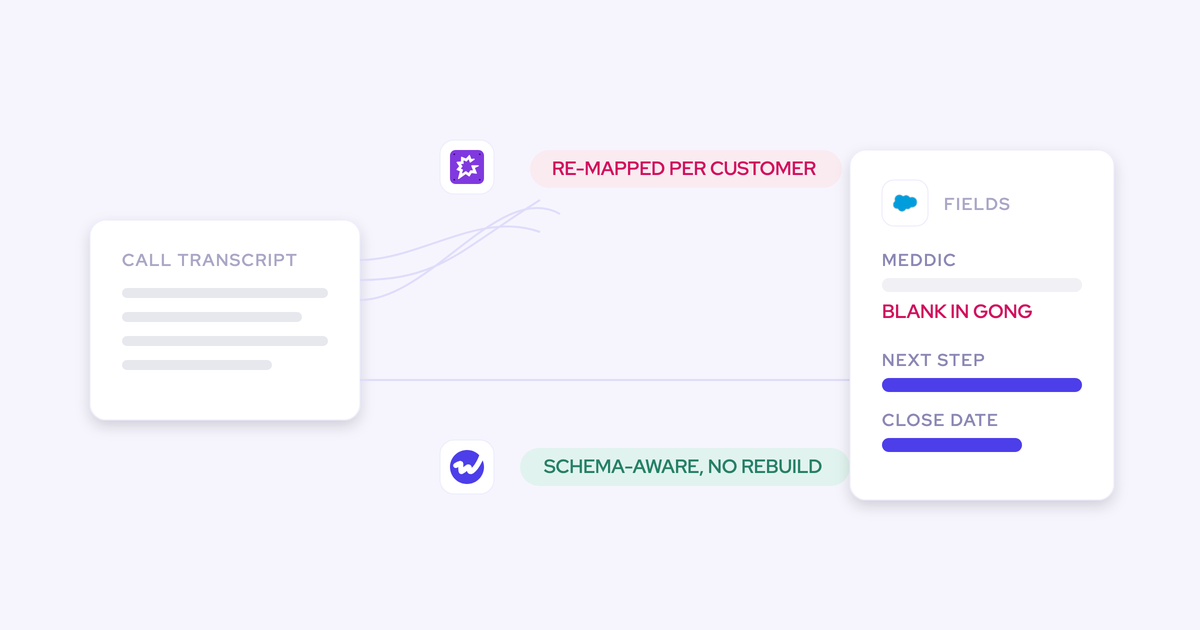
| AI field updates into Salesforce | No writes to Salesforce fields or objects | Writes any standard or custom Salesforce field (except lookup relationships), with admin-controlled mapping and review-before-write or fully automatic mode |
| Methodology scorecards | None | Around thirty methodology templates including MEDDIC, MEDDPICC, SPICED and BANT, plus your own framework encoded as prompts against your own fields |
| Coaching | Limited rep-level coaching insight | Every recorded meeting scored automatically against the team's configured methodology, with manager override |
| Where the output lands | Inside Copilot | On the Salesforce Event, with a link to the recording, so it appears on the opportunity activity timeline |
| Shared data with the forecasting product | Clari's conversation intelligence and forecasting products don't exchange data | Everything lands in Salesforce, which is where Clari reads from |
The practical difference shows up in your MEDDIC fields. You picked a methodology, built the fields, trained the team, and the fields are empty, because reps fill qualification fields last and worst, usually the night before the forecast call and from memory.
Weflow closes that by writing the fields from what was said on the call. Within 30 to 60 seconds of a meeting ending, the rep gets the recording, a summary in your template, a drafted follow-up email, and the proposed Salesforce field updates.
Blacklane runs at 96% of MEDDIC fields populated in Salesforce. That's not a rep-discipline win, it's a by-product of having the conversation.
Where Clari forecasting stays the stronger choice
If Clari's forecast works and the contract is live, keep it. That's not diplomacy, it's the advice we give on calls.
Three honest reasons:
- Forecasting is Clari's strongest product, and the views teams genuinely use, the pipeline waterfall, the pacing view, and the comparison against the same day in previous quarters, are hard to reproduce because they need pipeline state snapshotted over time.
- Weflow has no pipeline flow analytics view. We match pacing and waterfall. Flow is a real gap in a head-to-head, and if your team lives in it, we'd be a downgrade there.
- Mid-contract is the worst possible moment to prove a forecasting replacement. Capture and conversation intelligence prove out in two weeks because they act on meetings and emails already happening. Forecasting needs enough cycles to compare predicted against actual, which is closer to three months.
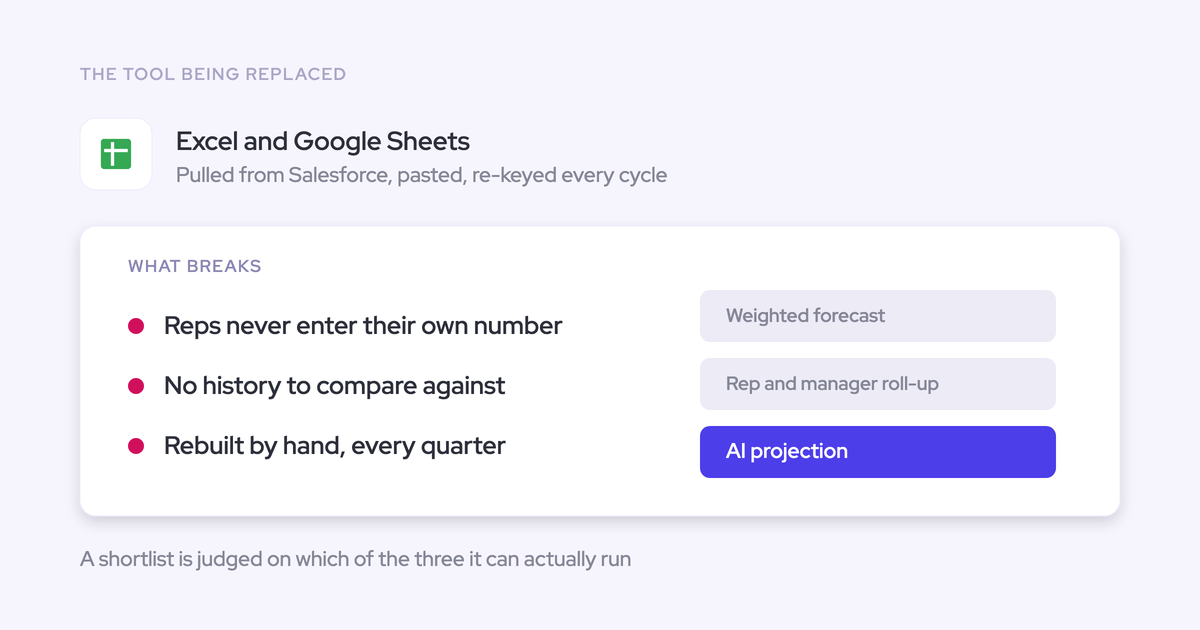
One more thing you'd find out anyway. Weflow's forecast submissions, targets and roll-up data live in the Weflow app rather than being surfaced as Salesforce fields. Everything else we produce, activity, transcripts, summaries, AI field updates, lands in Salesforce. Forecasting is the exception, and for a team whose rule is "reps live in Salesforce only", that matters.
Weflow Deal Intelligence & Forecasting is a real product and it's improved fast. Zeotap forecasts within ±7% on it. But that's a renewal conversation, not this one.
What running Weflow under Clari costs
The entry point is the layer you don't already own, priced so it doesn't collide with the Clari line item.
| Product | Price | What it covers |
| Weflow Activity & Contact Capture | $19 per user per month | Email, meeting and contact capture into native Salesforce objects, smart mapping, contact auto-creation, activity insights and reports, Chrome and Outlook extensions. Historical backfill of up to 24 months is an add-on. Includes Ask Weflow AI and Agent Builder |
| Weflow Conversation Intelligence | $39 per user per month | Recording, transcription, AI summaries, AI field updates into Salesforce, methodology scorecards, coaching, follow-up email drafts, topics and trackers. Includes Mobile Copilot, Ask Weflow AI and Agent Builder |
| Revenue AI Foundation | $49 per user per month | Both products together, 16% cheaper than buying them separately |
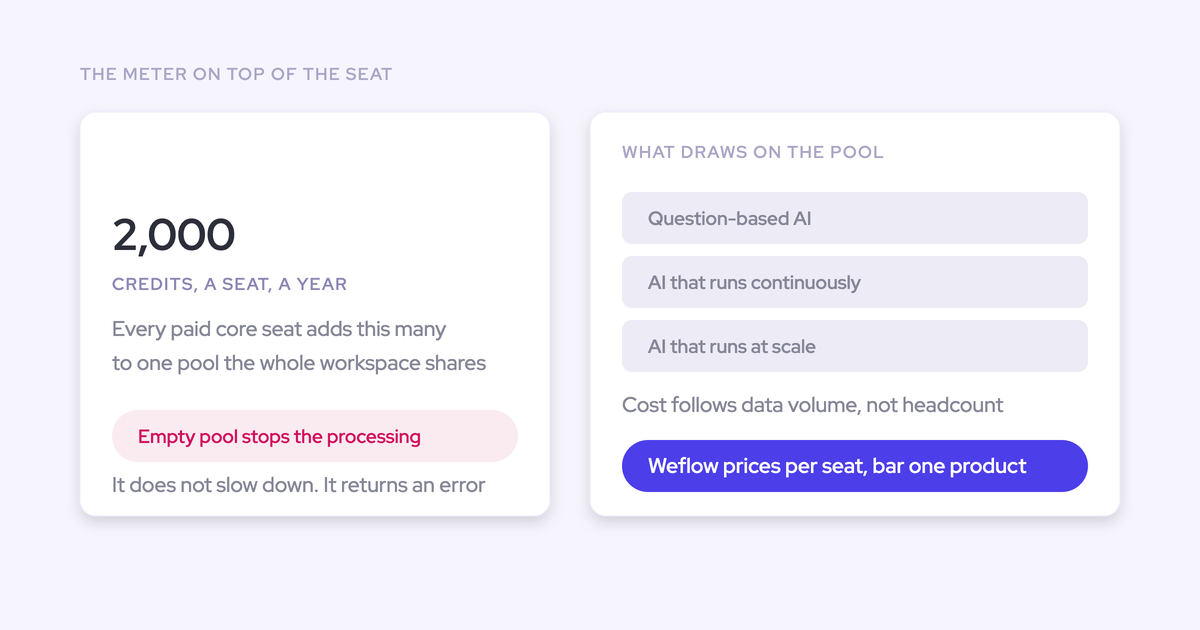
All annual billing, minimum 10 users, no platform fee and no implementation fee. Unlimited view-only licenses are included, so managers and execs who only consume dashboards don't burn a paid seat.
Set that against what a forecasting suite costs. In the deals we see, Clari runs roughly $120 to $180 per user per month with professional services fees on top, and it isn't sold in standalone pieces. So the comparison isn't Weflow versus Clari on your budget line, it's a capability you don't have today at $19 or $39, next to a contract you've already paid for.
That's deliberate. We priced against what a RevOps leader can actually get approved mid-contract rather than against the value of the module in isolation, and we accept a smaller first deal for it.
How to set up Weflow alongside Clari, step by step
The order matters more than the steps. Do these in sequence and you never have two engines live at once.
- Audit what's writing activity to Salesforce today. Clari Capture, Einstein Activity Capture, a sequencer, the Salesforce Outlook add-in. You need the full list before you touch anything, because the duplicate you'll chase later is usually the one you forgot.
- Turn Clari Capture off. Confirm with your Clari admin that server-side capture is disabled for the users in scope. Clari's forecasting and analytics are untouched by this.
- Connect Weflow. Install the managed package, connect the integration user, and install the central Google Workspace or Microsoft Entra app. This is a 30 to 45 minute job with your Salesforce admin and your mail admin in the room.
- Enable capture for a team. Capture runs server-side, rolled out centrally, and asks nothing of your reps. Pick one team of five to ten first.
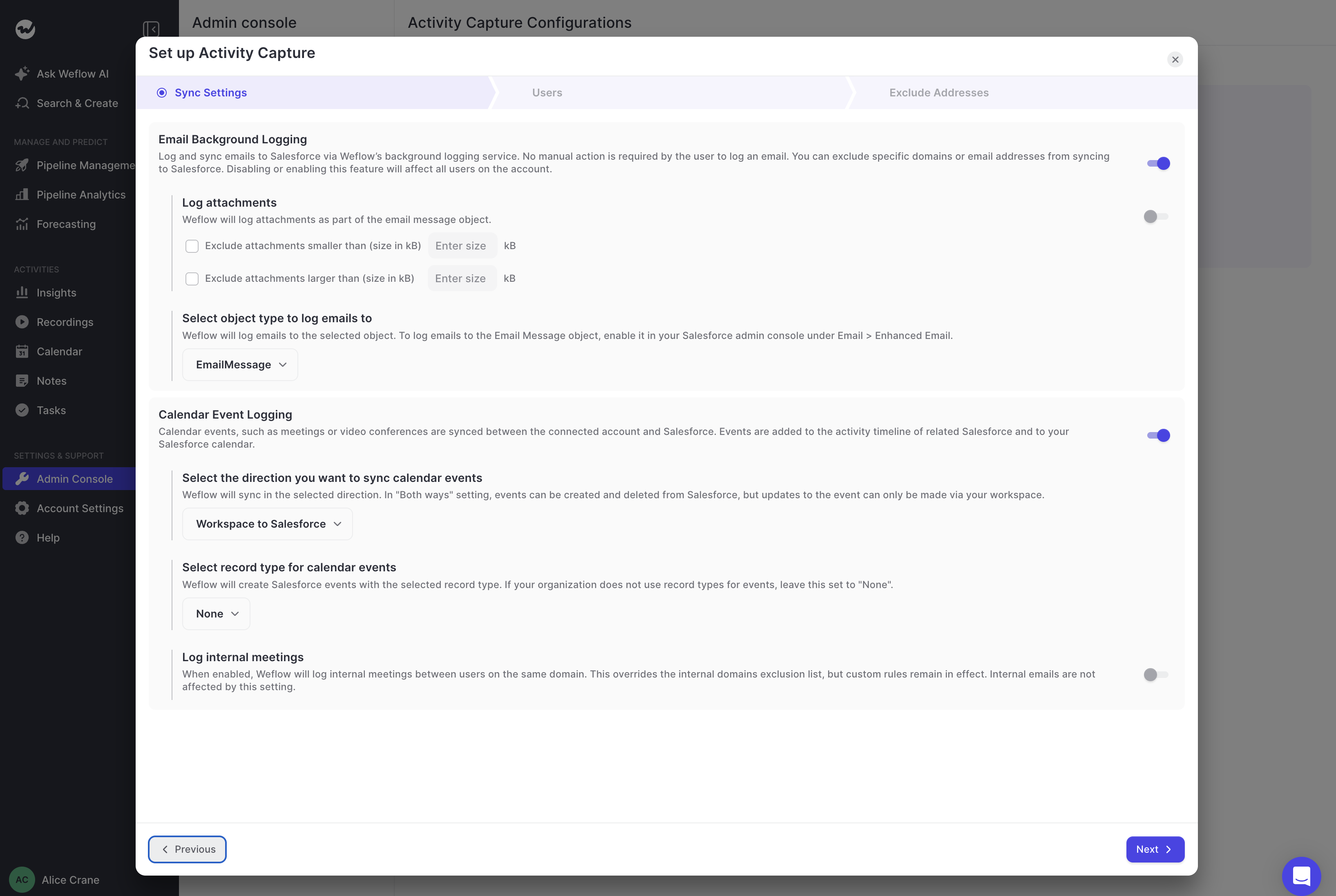
- Set your sync settings. Decide whether email logs to EmailMessage or Task, whether attachments log, whether internal meetings log, and which direction calendar sync runs. These choices decide what you can report on later.
- Backfill history. Sync back historical activity so the timeline doesn't start empty on go-live day. The backfill deduplicates against activity Outreach, Salesloft or Apollo already logged.
- Verify the mapping on multi-opportunity accounts. Open three accounts with two or more open deals and check the activity landed on the right opportunity, not just the account. This is the test that matters. If it fails here, nothing downstream is trustworthy.
- Check Clari's views. Open the engagement timeline on the same deals and confirm Clari is reading the new records. Watch your Salesforce API consumption over the same window.
- Roll out the rest of the teams in phases. Any meeting or email that failed to sync can be recovered and pushed into Salesforce later, so a phased rollout doesn't leave a permanent hole.
You can run all of this in a 14-day trial with implementation done for you, on your own Salesforce org and your own activity rather than a demo instance. With a sync-back you'll see months of real history on day one, which is the only honest way to judge whether the mapping holds on your data.
Is coexistence permanent, or a stepping stone to consolidation?
Both, honestly, and we'd rather say so than pretend.
It's a stable end state. One capture engine feeding native Salesforce objects, conversation data written into the same records, Clari forecasting on top of all of it. Plenty of teams run exactly that and have no reason to change.
It's also, often, what teams run until the Clari renewal. And that's the version worth being clear-eyed about: when the renewal does land, you'll be asking the question with clean opportunity-level data in Salesforce rather than under contract pressure with a forecast nobody can audit. You'll know what the forecast is actually worth, because you'll finally know what's underneath it.
Where we'd land it:
- Keep the coexistence if your team lives in the waterfall, pacing and quarter-over-quarter views, the CRO trusts the forecast, and RevOps isn't filing tickets with professional services every time the business reorganizes.
- Revisit at renewal if your seat count no longer matches the number of people doing the work, the forecast gets rebuilt in a BI tool before it goes to the CFO, or you're paying suite prices for one product you use and two you switched off.
Walk through the product yourself, no call required.
FAQ: running Weflow and Clari together
Do I need to reconfigure my Clari forecast when Weflow takes over capture?
No. Clari's forecasting layer reads from Salesforce, and nothing in that layer changes when you swap the capture engine underneath it. Your forecast categories, hierarchy, quotas and forecast calls stay exactly as configured. The only Clari setting you touch is disabling Clari Capture.
Can I buy Weflow Activity Capture without buying a forecasting product?
Yes. Weflow Activity & Contact Capture is sold standalone at $19 per user per month, and Weflow Conversation Intelligence at $39, both annual with a 10-user minimum. Neither requires Deal Intelligence & Forecasting, so there's no second forecasting line item to defend to your CFO.
Does Weflow respect Salesforce field-level security and record types?
Yes. Weflow follows your org's existing permissions, role hierarchy, validation rules and field dependencies rather than maintaining a parallel logic layer, and it writes into your record types instead of imposing its own. Sign-in happens only through Salesforce authentication, using whatever SSO or two-factor your org already enforces, so deactivating a user in Salesforce removes their Weflow access immediately.
Can Weflow backfill historical activity from before the switch?
Yes. Historical activity can be synced back for up to 24 months as an add-on, and the backfill deduplicates against activity that Outreach, Salesloft or Apollo already logged. Individual emails or meetings that failed to sync can also be recovered and pushed into Salesforce later, so a mapping error during rollout doesn't become a permanent gap in the timeline.
Does Weflow's $19 capture plan include call recording?
No. Recording, transcription and AI field updates live in Weflow Conversation Intelligence at $39 per user per month, not in Activity & Contact Capture. Set that expectation before rollout week one, because it's the assumption that most often bites teams that buy capture alone. If you want both, Revenue AI Foundation bundles them at $49.
What happens to Salesforce API usage when Weflow runs capture?
Weflow captures server-side at your mail tenant and writes to Salesforce through your integration user in real time, rather than through per-rep plugins or a nightly batch. Because you're switching Clari Capture off at the same time, you're replacing one system's write traffic rather than adding a second, but the exact consumption depends on your volume and org. Watch the number during the trial and tune sync settings, such as whether internal meetings log, if it climbs further than you want.