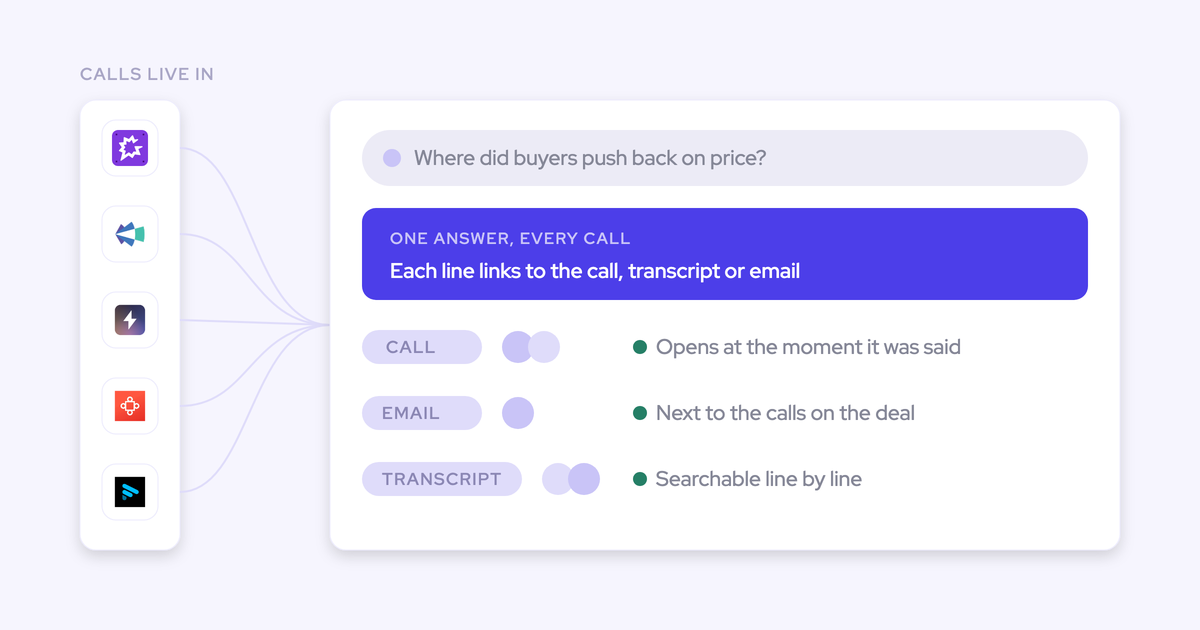
How Many Calls Can Weflow, Gong, and Clari's AI Answer a Question From?
See how many calls Weflow, Gong, and Clari AI read per answer—and which fits your questions.


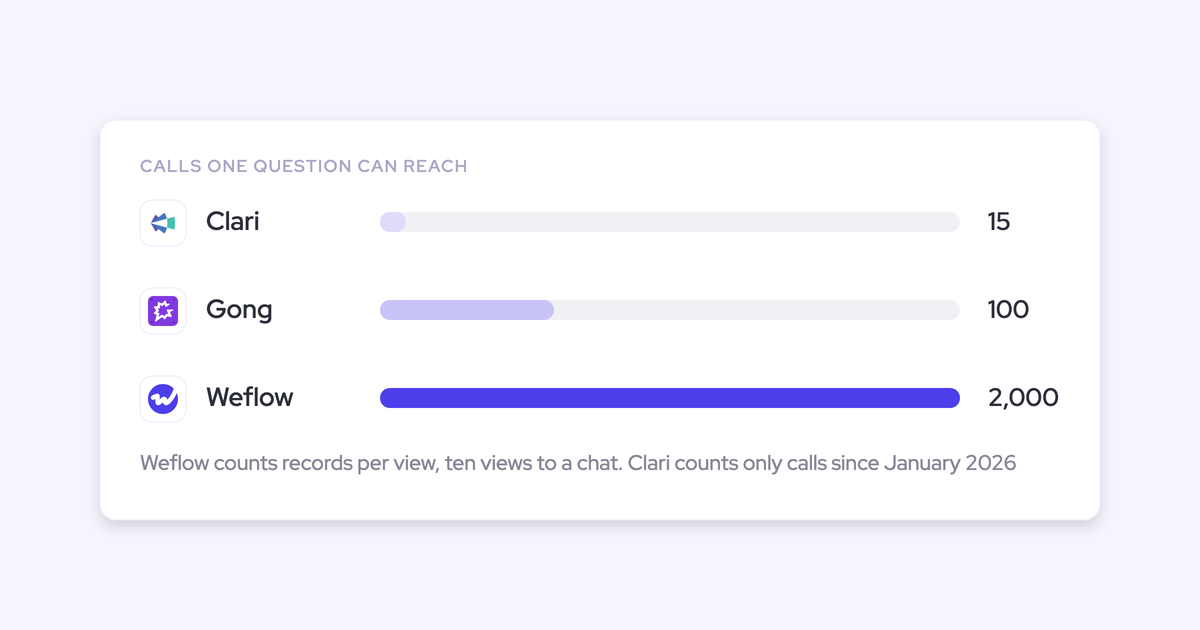

Every AI chat in this category answers from a bounded slice of your calls. The bounds are wildly different between Gong, Clari, and Weflow, and no demo shows them, because a demo shows one call working beautifully.
So here are the four ceilings side by side, as plain numbers, with sources. Weflow's own limit is stated the same way as everyone else's, including the questions our chat can't handle.
If you're running weekly AI-assisted deal reviews for a team of ten, this is the spec that decides whether the tool answers your actual questions or a truncated version of them.
Weflow vs Gong vs Clari AI query limits at a glance
| Dimension | Gong AI Ask Anything | Clari Copilot | Ask Weflow AI |
| How much it reads per question | Top 100 matching calls on a search; up to 60 calls and 500 emails on a deal or account; 10 calls and 80 emails on a contact | At most 15 calls in a single chat; AI Themes analyses up to 1,000 calls per run | Everything in the scope you point it at, up to 2,000 records per view, within a one-million-token ceiling |
| How scope gets set | Automatically, by Gong, per question type | By hand: a person ticks the calls | By you: a call, a deal, an account, a filtered deal board, or up to ten linked views in one chat |
| Date floor on queryable history | Calls and transcripts retained three years by default; library calls kept indefinitely | Ask Copilot only reaches calls recorded on or after 1 January 2026 | No date floor. Migrated call history lands in Salesforce and stays queryable |
| Custom question or preset list | Custom questions | Custom in chat (15 calls); AI Themes answers seven preset questions only | Custom questions, no preset list |
| What it reads besides calls | Emails and, in Gong Assistant on the call page, account, deal and participant data | The conversation layer | Salesforce records, captured emails, meetings and call transcripts in one pass |
| Metered per question | Yes. Credits are consumed by data volume processed | Access tied to licence tier; no per-question meter documented | No. Included with every product and bundle, fair use only |
| Tells you when it truncated | No. Caps aren't surfaced in the answer | Yes, in effect: you picked the calls | Ceiling is stated; whole-book questions belong in an Agent |
Read the first row again and notice what's actually being compared. Gong and Clari bound the question by call count. Weflow bounds it by scope.
That's the difference that decides whether a portfolio question works, because a manager's question is almost never "these fifteen calls." It's "this account, all of it" or "every deal in this filtered board."
Why demos never show how many calls the AI reads
Because the demo is built on one call, and on one call every vendor is excellent.
Conversation intelligence commoditised. Transcription is table stakes, summaries are table stakes, and buyers now say so out loud in the first five minutes of a call after sitting through four near-identical pitches. So vendors moved the competition to the AI query layer, and in the first five minutes those look identical too.
The questions a sales manager actually needs answered are not single-call questions:
- Why did we lose these deals, and how often was it genuinely price rather than what the rep typed into closed-lost under time pressure?
- What are buyers pushing back on this quarter, across every conversation, not the three calls I happened to listen to?
- What did this account say about our security posture over the last six months, across nine calls and two hundred emails?
- Where is this rep consistently weak across every deal they've worked, not on the one call I reviewed on Friday?
Those are corpus questions. And they're exactly where the ceilings live.
The arithmetic is what makes this urgent rather than nice-to-have. A manager of ten reps, each taking three or four hours of calls a day, would need to consume more than a hundred hours of conversation a day to have an opinion of their own. Nobody does that. So the AI's reading scope isn't a spec detail. It's the whole product.
Here's why the ceilings exist. Gong and Clari added AI chat on top of architectures that predate it, and both meter or bound it for reasons that have nothing to do with your question. Gong charges credits by the volume of data processed, so a hard cap per question type is cost control. Clari's fifteen-call chat and its 2026 date floor are product vintage: the feature shipped recently and reaches back only as far as it was built to.
Neither number was set by what a manager needs to ask.
What each AI reads before it answers a question
Same question, three very differently sized evidence bases. Here's the mechanics behind each number.
Gong AI Ask Anything: answers from the top 100 matching calls
Gong AI Ask Anything answers from a capped slice rather than the whole record, and the cap changes with the question type:
- Search question: the top 100 matching calls
- Deal or account question: up to 60 calls and 500 emails in the selected period
- Contact question: 10 recent calls and 80 recent emails
For most accounts, those ceilings are generous enough that you'll never hit them. On a two-year enterprise pursuit with weekly calls, you will.
And here's the part that matters more than the numbers: the caps are per question and they are not surfaced in the answer. You ask about a long-running account, you get a confident, well-written response, and nothing tells you what was cut. On a heavily worked account, the excluded material is usually the older context that explains why the deal is where it is now.
One thing to keep straight in the evaluation: Gong Assistant is not a fix for this. It replaces AI Ask Anything on the call page, where it holds an ongoing chat, reads account and deal data alongside the transcript, and cites back to the exact moment. Accounts, deals, contacts and search keep the older single-shot, capped experience.
So the conversational upgrade landed on the single-call surface, and the portfolio surface stayed as it was.
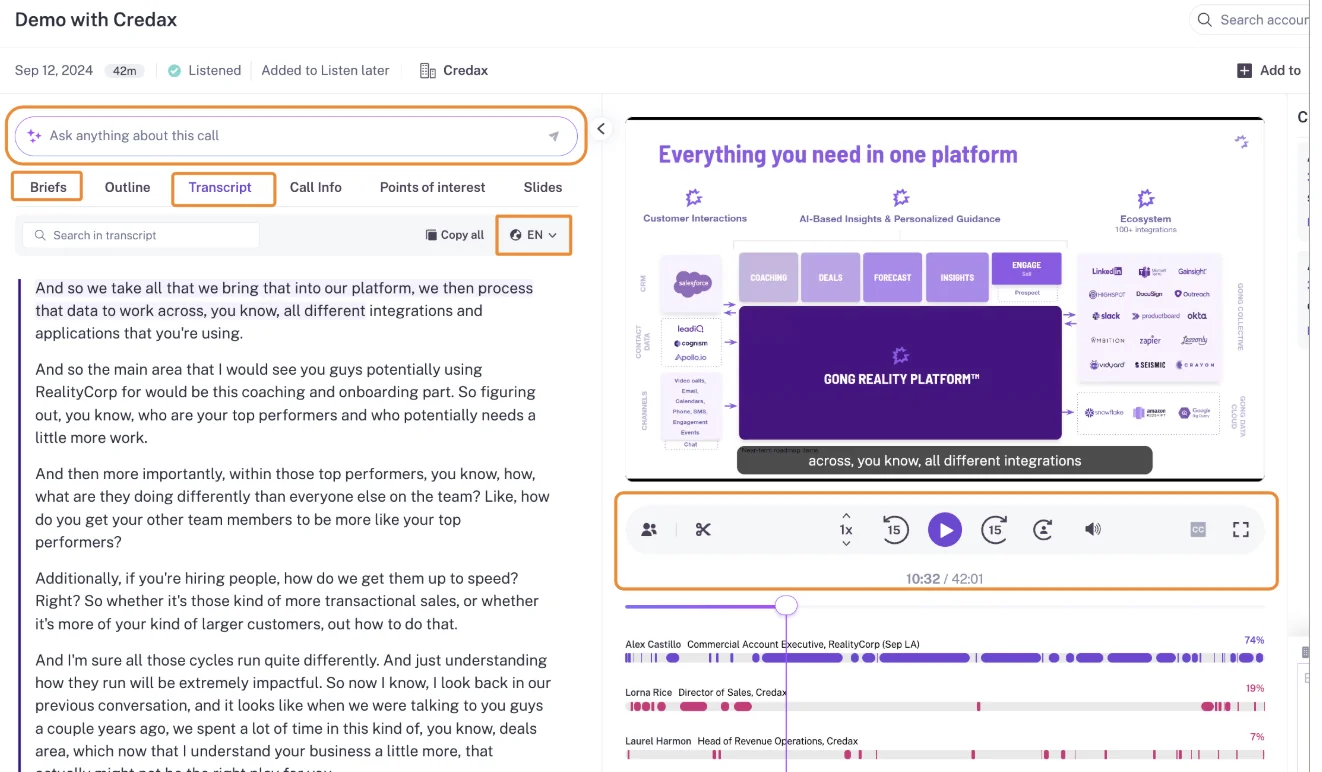
Gong's call page, where "Ask anything about this call" sits above the transcript. This is the surface Gong Assistant now owns.
Clari Copilot: 15 hand-picked calls, recorded after January 2026
Ask Copilot answers across at most 15 calls in a single chat, and a person ticks which ones. It's a hard ceiling chosen by hand, not a retrieval limit hit automatically.
The conditions on top of that:
- Every call must have been recorded on or after 1 January 2026
- Every call must be transcribed and sitting in the Copilot library
- The user must hold view permission on every call they select
Fifteen calls is fine for "what's unresolved on this opportunity." It doesn't stretch to a quarter of activity on a large account, and the January 2026 floor means Copilot can't reach your own history from before that date at all.
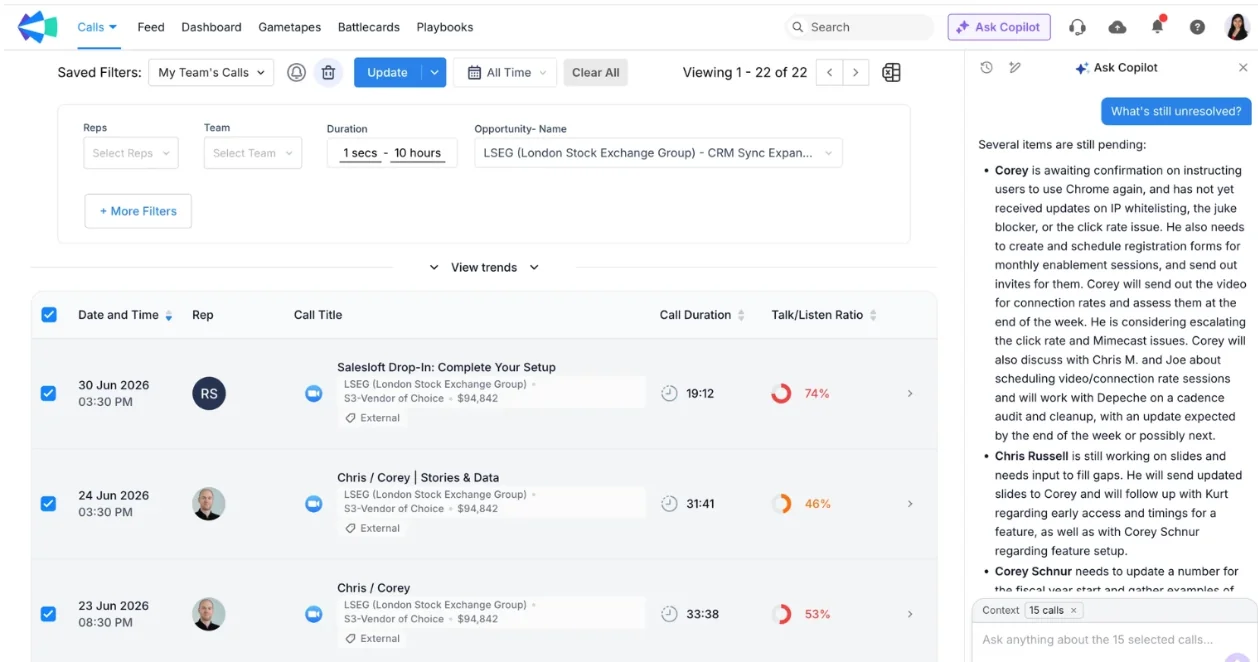
Clari Copilot with every row ticked and the context chip reading 15 calls, the cap on what one chat can span.
Clari's answer to the corpus question is AI Themes, which analyses up to 1,000 calls per run. That's real breadth. The trade is the question itself: AI Themes answers one of seven preset questions only.
Decision Criteria, Customer Pain, Objections, Customer Concerns, Business Goals, Pricing Reactions, Product Feedback. That's the list. You cannot ask a custom question.
The seven cover common discovery ground, so if your question is about a specific integration, a compliance objection, or how a named competitor came up, you're hoping one of the seven happens to surface it. There's also a floor: AI Themes needs a minimum of 100 calls in the filtered scope to run, which puts it out of reach for a new team or a narrow segment.
Ask Weflow AI: 2,000 records per view, ten views per chat
Ask Weflow AI bounds a question by scope rather than by call count. You point it at something and it reads everything on it.
Weflow is the Revenue AI Orchestration platform for sales, customer success, and RevOps teams, and the query layer reflects that: point Ask Weflow AI at a single call, a single deal, an account, or a filtered deal board, and it answers across Salesforce records, captured emails, meetings and call transcripts in one pass. Not the conversation layer alone.
The hard numbers:
- 2,000 records per pipeline view
- Up to ten views linked into a single chat
- One million tokens per query, the ceiling that governs everything above
- No preset question list, and no date floor on history
Point it at an account and it pulls every email, event and transcript attached to that account, including years of email history. Point it at a filtered board and "which of these deals are blocked" applies to exactly the deals in view.
Questions that work well in practice:
- Which competitors came up in the last six months on this account, and what happened when they did?
- What do the closed-lost deals in this view have in common?
- Which open deals in my board are missing methodology information?
- Who is actually the decision maker here, given three years of email traffic?
The reason those land is that Ask Weflow AI queries evidence, not CRM fields. A gap analysis returns what was actually said on the call, not what a rep remembered to type into a picklist on a Friday afternoon.
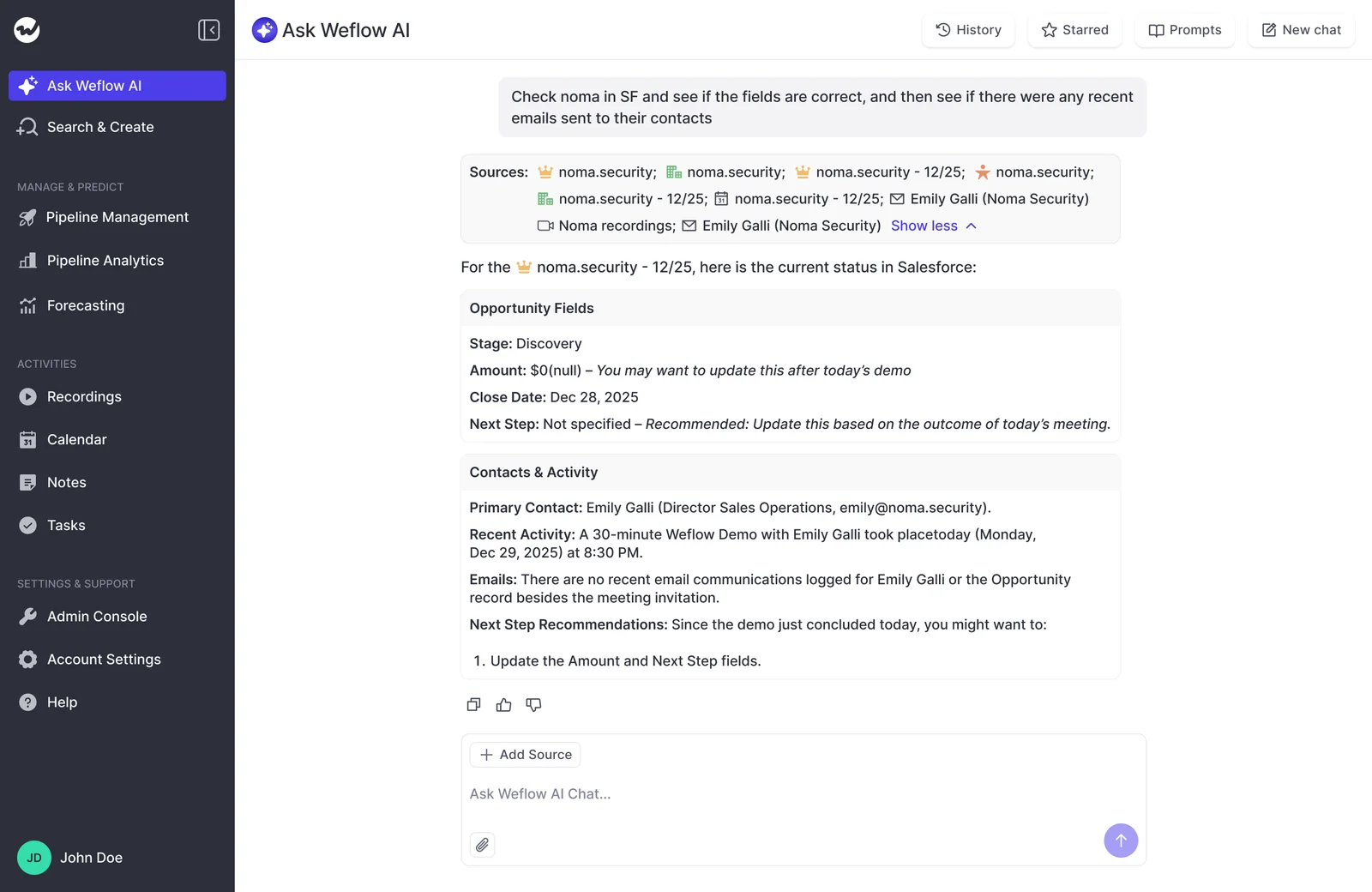
Ask Weflow AI with the Sources row expanded, showing the opportunity, account, contact, calendar, email and recording records the answer was built from.
I love being able to go right to the call, transcript or email and see where something was said that the AI is referencing.
— Scott Jones, SVP of GTM Revenue Intelligence & Enablement, KORE Wireless
Do Gong, Clari, and Weflow disclose when answers are truncated?
They behave differently at the limit, and this is the part of the evaluation that actually matters.
Gong doesn't surface its ceilings in the answer. Ask about an account with 200 calls on it and you get a confident response drawn from 60, with nothing indicating the other 140 exist. The answer isn't wrong, exactly. It's answering a smaller question than the one you asked, and telling you it answered yours.
Clari makes the scope explicit by construction, because you ticked the boxes. Fifteen is restrictive, but you know it's fifteen. There's a real virtue in that, and it's worth naming: a small, visible scope beats a large, invisible one for anything you're going to act on.
Weflow states its ceiling as a number: one million tokens per query. Anything that sweeps the entire book of business exceeds it, and the honest answer to that question is to move it to an Agent rather than force it through the chat.
Here's the reframe I'd carry into your next vendor call. Stop asking "can the AI answer this." Every one of them can answer. Ask "how many of my calls did it read before it answered, and would it have told me if it left some out."
For a manager doing loss analysis, a confident answer built on an undisclosed slice is worse than a refused one. A refusal you can work around. A truncated answer you present in a QBR, and then discover the pattern only existed in the calls that got dropped.
Where Gong is stronger and where Weflow's chat stops
Every tool here has a real strength and a real ceiling. Including ours.
Gong's conversation analytics depth is genuinely stronger
Gong invented this category and still has the deepest conversation analytics in it. Transcription across 96+ languages, a topic model that segments a call into named subjects along the timeline, and a sales engagement product Weflow doesn't have at all.
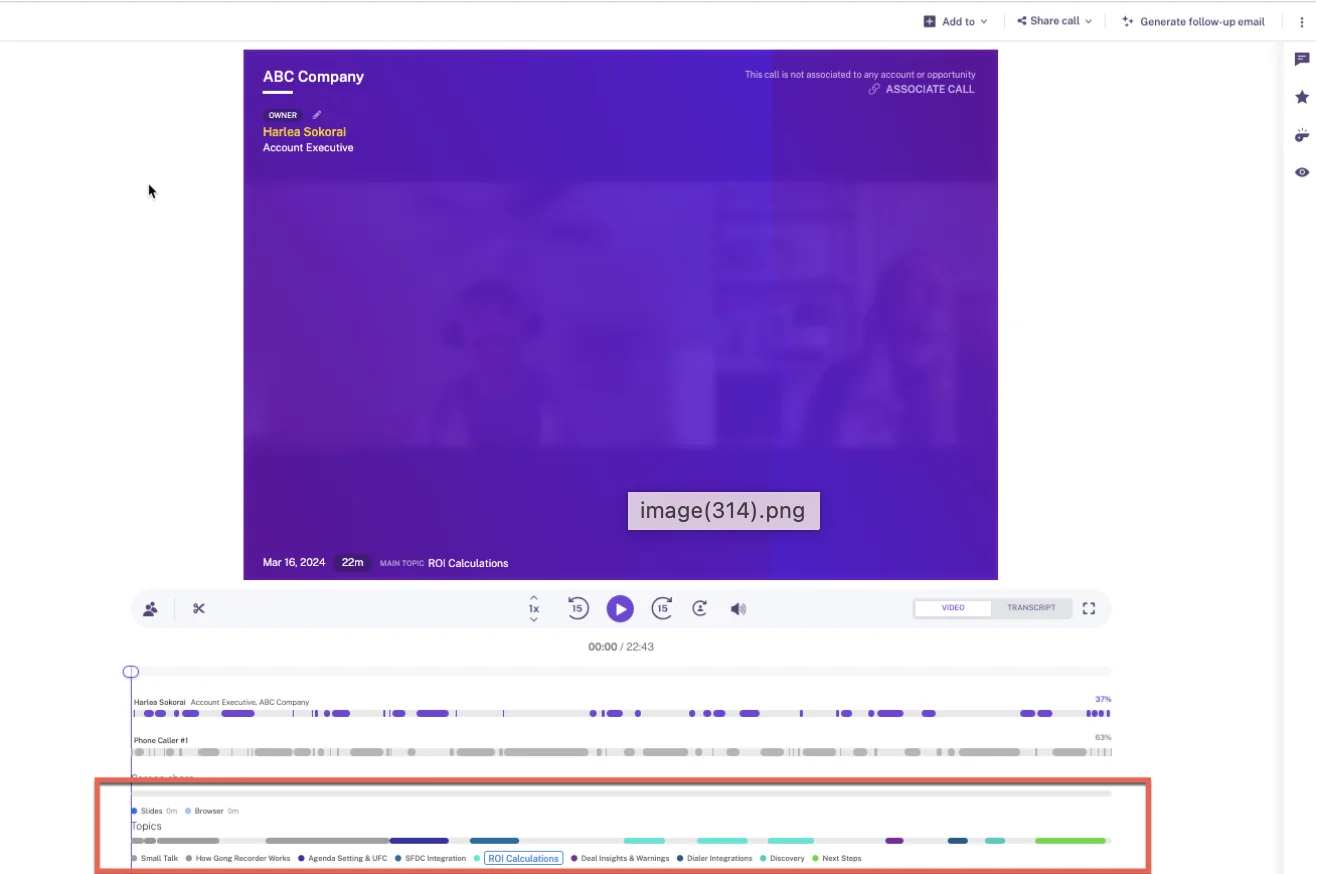
Gong's topic track, segmenting a single call into named subjects along the timeline.
More relevant to you specifically: Gong supports asking for a methodology summary across every call on an account, not just call by call. If your job is reviewing a long cycle and reading the qualification picture spread across many conversations, you already have that, and any tool that only summarises single calls will feel like a downgrade.
If account-level methodology summaries and deep call analytics are the bulk of what you need, that's a legitimate reason to stay where you are.
Whole-book questions belong in a Weflow Agent, not the chat
Ask Weflow AI's one-million-token ceiling is real, and it bites on exactly the broadest question a leader wants to ask.
Every closed-lost deal in a year. Every account in a region. Every call the whole team ran last quarter. Those need either a narrower query or an Agent, and the rule we give customers is blunt: anything spanning the whole book of business belongs in an Agent rather than in the chat.
The reason isn't just size. An Agent that retrieves a constrained record set first, naming the object, the stage and the date window before the AI step ever runs, produces materially better output than the same prompt fired blind.
Run the same prompt without that lookup and you get an empty or unusable report, even when the chat version of it was strong.
So if your headline requirement is a monthly corpus-wide loss-reason sweep across the entire year, that's an Agent build, not a chat session. We'd rather tell you that now than have you find it in week three.
What a question costs: Gong credits vs unmetered Ask Weflow AI
Gong meters AI usage in credits on top of per-seat pricing, and three details in that system determine your bill:
- The pool is company-wide. Each paid core seat contributes 2,000 credits a year into one shared pool, so heavy use by a few people consumes the allowance everyone else depends on.
- Cost follows data volume, not the question. A call over ten minutes costs one credit, a shorter call half, each email a tenth. A broad question across a busy account costs many multiples of a narrow one, and you can't predict the bill from the question.
- Nothing is cached. Every MCP or API request analyses the underlying calls from scratch, so asking the same question twice consumes credits twice.
There's an inversion worth flagging. The same Gong brief is free when a person generates it by hand in the interface and costs credits through the API or MCP server. The meter follows the access method, not the work. So the cost of Gong AI rises specifically as you try to wire it into the rest of your stack, which is the opposite of what automation is supposed to do.
Gong's own guidance on controlling spend is to unpublish trackers that no longer provide value and filter the rest by team or deal stage. That's sensible advice. It also means the breadth of your conversation tracking has become a budget decision.
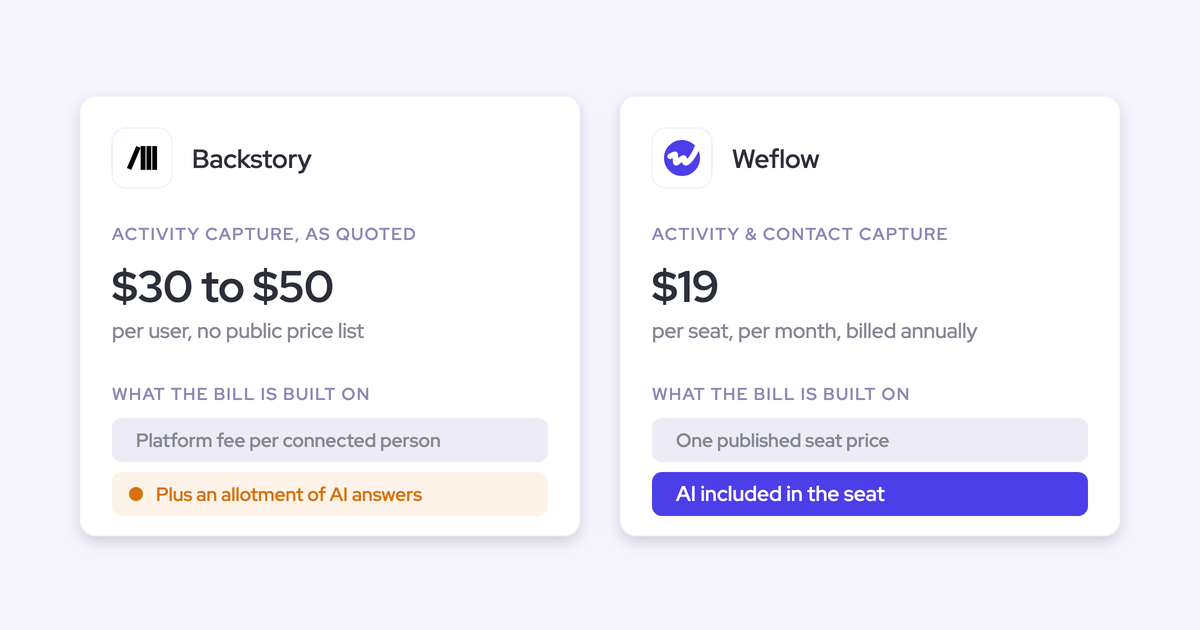
Ask Weflow AI isn't metered or priced separately. It's included with all three Weflow products and all three bundles, governed by a fair use policy no customer has reached. Weflow's pricing is published: Activity & Contact Capture at $19 per user per month, Conversation Intelligence at $39, Deal Intelligence & Forecasting at $39, and the bundles from $49 for Revenue AI Foundation.
On Clari, keep it to what's documented: Copilot access is tied to licence tier, and there's no published per-question meter.
The practical effect of metering isn't the invoice. It's that people start rationing questions, and a manager who hesitates before asking is a manager not using the tool.
Ask AI permission inheritance in Weflow, Gong, and Clari
Your security team will ask whether the AI becomes a way around the permission model. The three answers differ.
Clari is the simplest: the user must hold view permission on every call they select into an Ask Copilot chat. Manual selection makes permission checking straightforward.
Gong depends on which surface you're asking about. On the MCP path, personal access is the default and the setting Gong documents, so each person connects with their own credentials and reaches only what they can already see. But inside Agent Studio, two agents apply opposite models: AI Builder excludes calls its creator can't access, while AI Data Extractor may draw on any non-private call or email in the workspace, including ones the configuring admin cannot open. Gong documents that case explicitly.
So there's no single sentence that covers Gong's permission inheritance. The honest answer depends on which agent you're asking about.
Ask Weflow AI inherits Salesforce permissions as a floor and then narrows further, applying its own guardrails on top and withholding information a user could reach directly in Salesforce. There's also no separate Weflow login to manage: sign-in runs through Salesforce OAuth and whatever SSO the org already enforces, so deactivating a user in Salesforce removes their Weflow access immediately.
For a security review, the narrowing matters more than the floor. The risk being assessed is usually that a conversational interface makes already-reachable data easy to surface at scale, not that it exposes anything new.
How far back each AI can query your call history
History reach is set by architecture, and it's the question that decides whether switching costs you your past.
- Clari Copilot: the chat cannot reach calls recorded before 1 January 2026. Anything older is outside the feature.
- Gong: recorded calls and all related artifacts, transcripts and statistics included, are kept up to three years by default. Calls saved to the library are exempt and preserved indefinitely, which means your effective retention is set by rep behavior rather than admin policy, since any team member can bulk-add calls to a folder with no mention of retention in the flow.
- Weflow: no date floor. Migrated recordings and transcripts land in Salesforce and stay queryable.
On migration, the switching penalty is usually that your call history stops dead at cutover and the old library becomes a folder nobody opens.
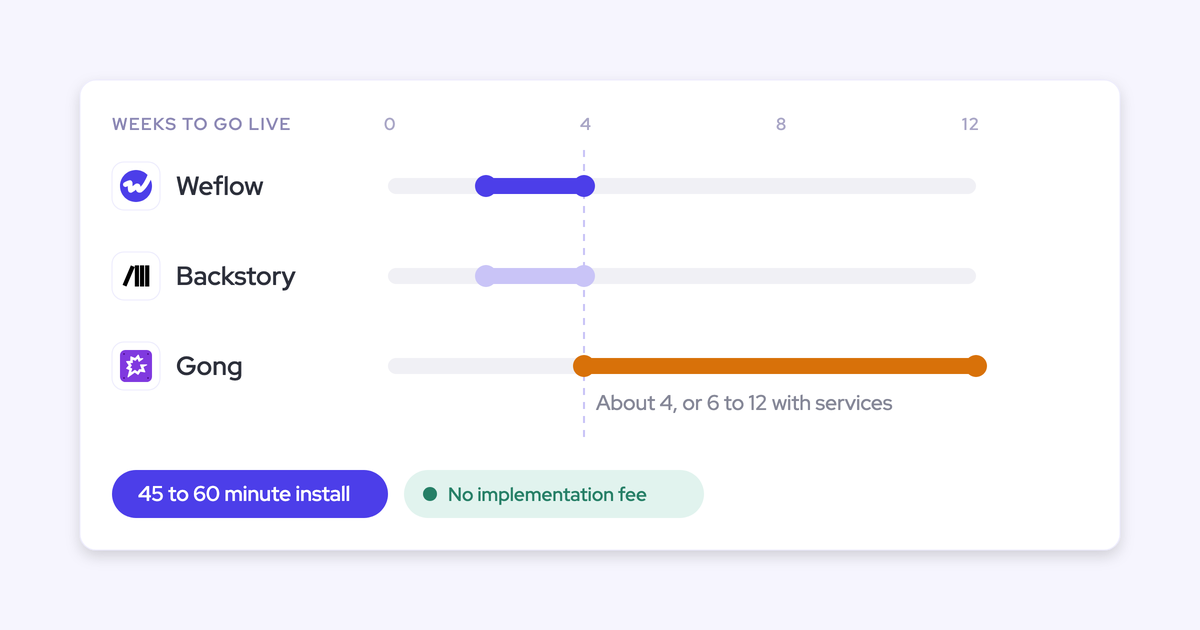
Weflow imports and extracts data from the recordings and transcripts held in the conversation intelligence platform you're leaving, pulling them through that platform's API. No extra cost, and roughly one to two weeks depending on volume.
Because those transcripts land in your own Salesforce, they stay searchable by Ask Weflow AI. A question about how an objection was handled last quarter still answers after the move.
The technical setup either side of that is small: 30 to 45 minutes with a Salesforce admin and a mail admin in the room, then about an hour configuring the workspace. What stretches an implementation is internal alignment on what the system should do, not the product.
Choose Weflow if, choose Gong if, choose Clari if
Which ceiling bites depends entirely on the questions you ask.
Choose Gong if:
- Your core need is account-level methodology summaries across a long cycle, which Gong already does well.
- You need transcription depth and broad language coverage across a multi-region team.
- You want a sales engagement product from the same vendor, which Weflow doesn't offer.
- Your questions are mostly narrow enough that a 60-call or 100-call slice is genuinely the whole picture.
Choose Clari Copilot if:
- Your questions run against small, hand-picked call sets and you value knowing exactly which calls fed the answer.
- Your history need starts in 2026 and doesn't reach back before it.
- The seven AI Themes presets happen to cover the trends you care about, and you have at least 100 calls in scope.
Choose Weflow if:
- Your real questions are portfolio questions: loss trends, objection themes, multi-month account history across every call, email and CRM record in one pass.
- You need history that predates any vendor's launch date, and you want your existing recordings migrated and still queryable.
- You want your whole team asking questions daily without anyone rationing credits.
- You want the conversation data landing in native Salesforce objects you own, reportable alongside everything else in the CRM.
If you're already deep in a Gong or Clari evaluation, take one question into the next call and ask it of all three: how many of my calls did you read before you answered that, and how would I have known if you left some out.
See how Weflow captures activity, updates Salesforce fields from calls, and rolls up your forecast. Book a 30-minute demo, and ask us that question first.
FAQ: AI call limits in Weflow, Gong, and Clari
Can AI answer why deals were lost across every call?
Only where something reads the whole corpus rather than a slice. Gong AI Ask Anything answers a search from the top 100 matching calls, and Clari's chat from at most 15, so neither covers every call in a year.
In Weflow, a corpus-wide sweep of that size runs as an Agent or through the API rather than in the chat, because it exceeds the one-million-token ceiling on a single query. In-chat, you'd scope it: every closed-lost deal in a filtered view, up to 2,000 records.
Does Clari AI Themes let you ask a custom question?
No. Clari Copilot AI Themes answers one of seven preset questions only: Decision Criteria, Customer Pain, Objections, Customer Concerns, Business Goals, Pricing Reactions, and Product Feedback.
A theme on your own territory, a named competitor, a specific integration, a compliance objection, has to fall out of one of the seven or it isn't reachable.
Does Gong Assistant remove the Ask Anything call caps?
No. Gong Assistant replaces AI Ask Anything on the call page only, where it holds an ongoing chat and reads account, deal and participant data alongside the transcript.
Accounts, deals, contacts and search keep the older single-shot, capped behavior, with broader Gong Assistant coverage described as future. The portfolio-level questions stay capped.
Do calls migrated into Weflow stay queryable by Ask AI?
Yes. Weflow imports recordings and transcripts from the platform you're leaving through that platform's API, and they land as Salesforce records.
Because they're in your CRM rather than a vendor archive, Ask Weflow AI reads them like any other transcript. That's what removes the usual switching penalty of losing your history at cutover.
How many calls does Clari AI Themes need to run?
It requires a minimum of 100 calls in the filtered scope and analyses up to 1,000 calls per run.
The floor is the practical constraint: a new team, a recently launched segment, or a narrow territory won't have 100 calls to filter on, so the feature is unavailable exactly where a manager most wants an early read on what buyers are saying.