
Clari Copilot vs Weflow: When Conversation Intelligence Is Just Transcription


Your read on Clari Copilot is probably right. It records, it transcribes, and the coaching layer you expected never showed up.
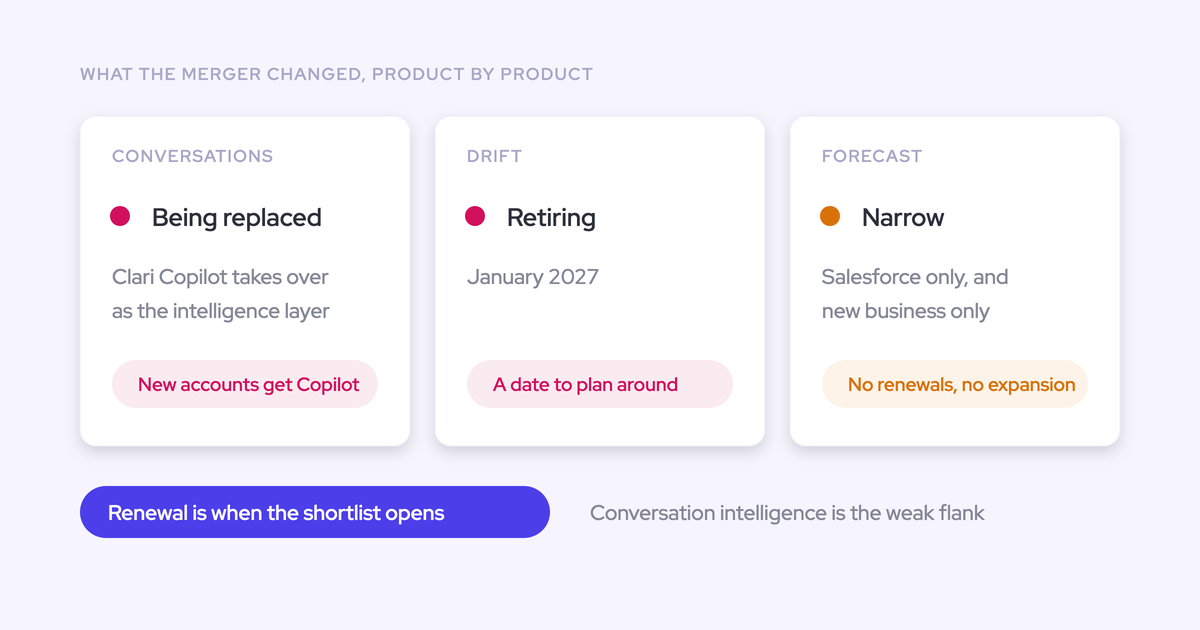
There's a structural reason for that. Copilot came into Clari through an acquisition and stayed bolted on, and Clari's investment went where its buyers were: the roll-up, the forecast call, the board slide. So the forecasting got good and the conversation layer stalled.
Which is why this comparison isn't "rip out Clari." Weflow is the Revenue AI Orchestration platform for sales, customer success, and RevOps teams, and the piece that matters to you here is Weflow Conversation Intelligence: every call scored against your methodology, and the methodology criteria written back into the Salesforce fields your deal review already reads.
Clari's roll-up forecasting is genuinely strong. If that part is working for you, keep it. Read the rest of this as a question about the weak module.
Clari Copilot vs Weflow at a glance
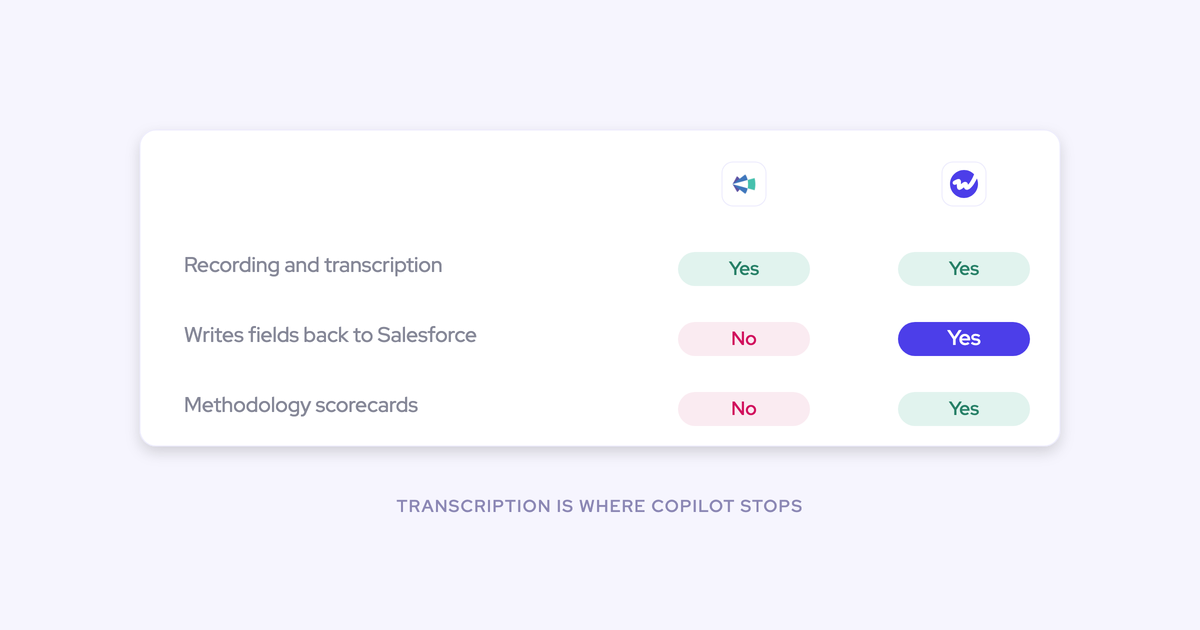
Six dimensions where the two products actually diverge. Recording and transcription is not one of them, and we say so in the table rather than pretending otherwise.
| Dimension | Clari Copilot | Weflow Conversation Intelligence |
| Call coaching and methodology scorecards | No methodology scorecards for MEDDIC or MEDDPICC and no rep-level coaching insights. Managers review calls by hand, so coaching stays anecdotal. | Every recorded meeting scored automatically against the methodology you configure, producing a rep scorecard, a manager review agenda, and a per-rep trend. Managers can override a score. |
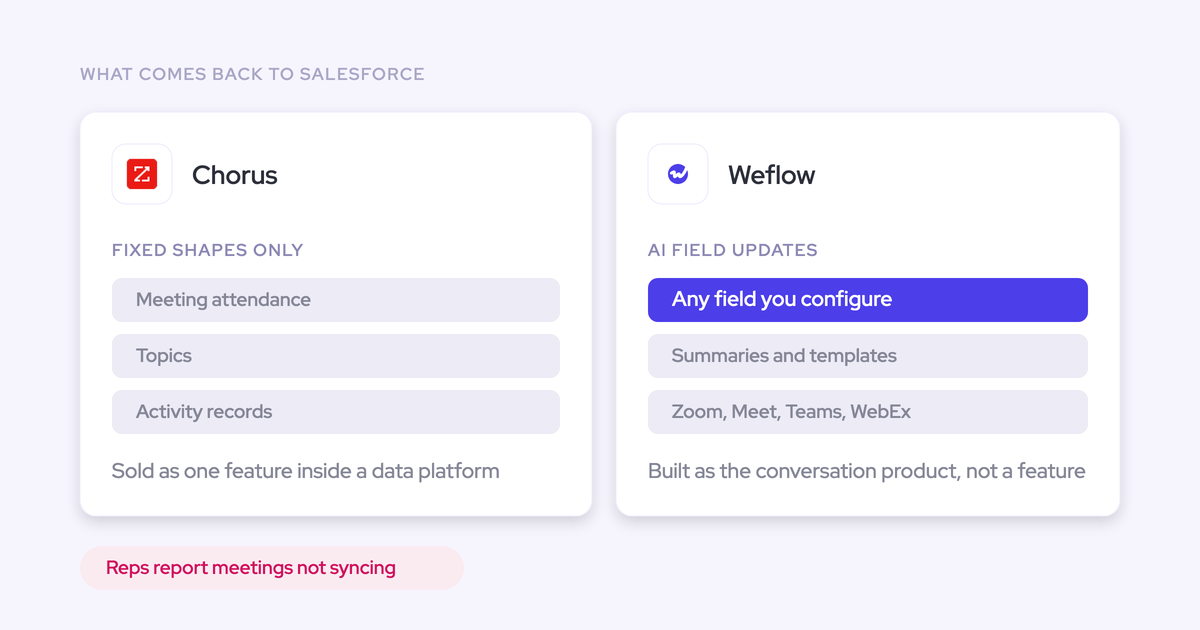
| Salesforce field write-back | No AI field updates into Salesforce fields or objects. The output stays in Copilot. | Any Salesforce field except lookup relationships can be mapped to a prompt. The rep sees the current value beside the suggested value and accepts, edits, or rejects before write-back. |
| Whether call data reaches the deal and the forecast | Copilot and Clari's forecasting product don't share a data layer, so call content doesn't inform the deal record or the roll-up. | Capture, conversation, and deal data land in the same native Salesforce objects, so a methodology gap on an opportunity shows up as a forecast signal. |
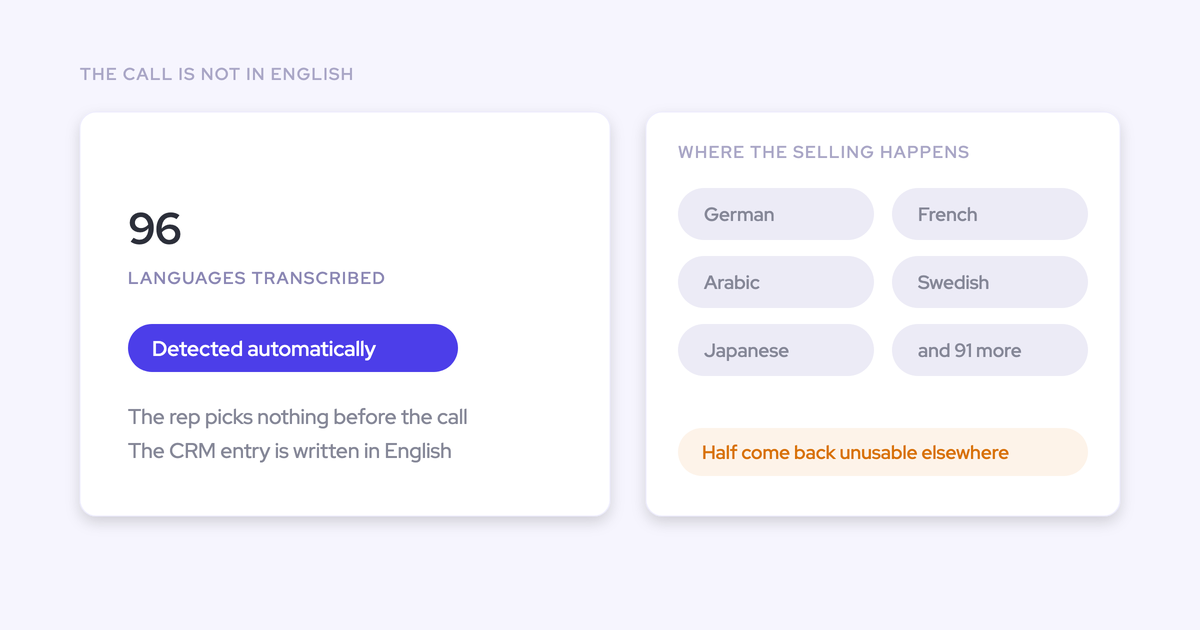
| Recording and transcription | Records and transcribes. This is the part that works, and it's the part every tool in the category now does well. | Notetaker auto-scheduled from the calendar onto external meetings, 96 languages with automatic detection. Parity, not a differentiator. |
| Pricing and implementation fees | Quote-only, reported at $120 to $180 per user per month, sold as a suite rather than standalone modules, with reported professional services fees of $15k to $50k. | Published: Conversation Intelligence $39 per user per month, bundles $49 to $79, 10-user minimum, billed annually. No platform fee, no implementation fee. |
| Evaluation path | No free trial and no self-serve signup. The former Copilot trial page routes to a demo request. | 14-day free trial on your own Salesforce with white-glove setup included at no cost. |
Why sales teams compare Clari Copilot and Weflow
Almost nobody arrives at this comparison unhappy with Clari's forecast. They arrive unhappy with the half of the suite they were told would come with it.
"Clari's conversation intelligence feels like it's more of a transcription rather than anything else."
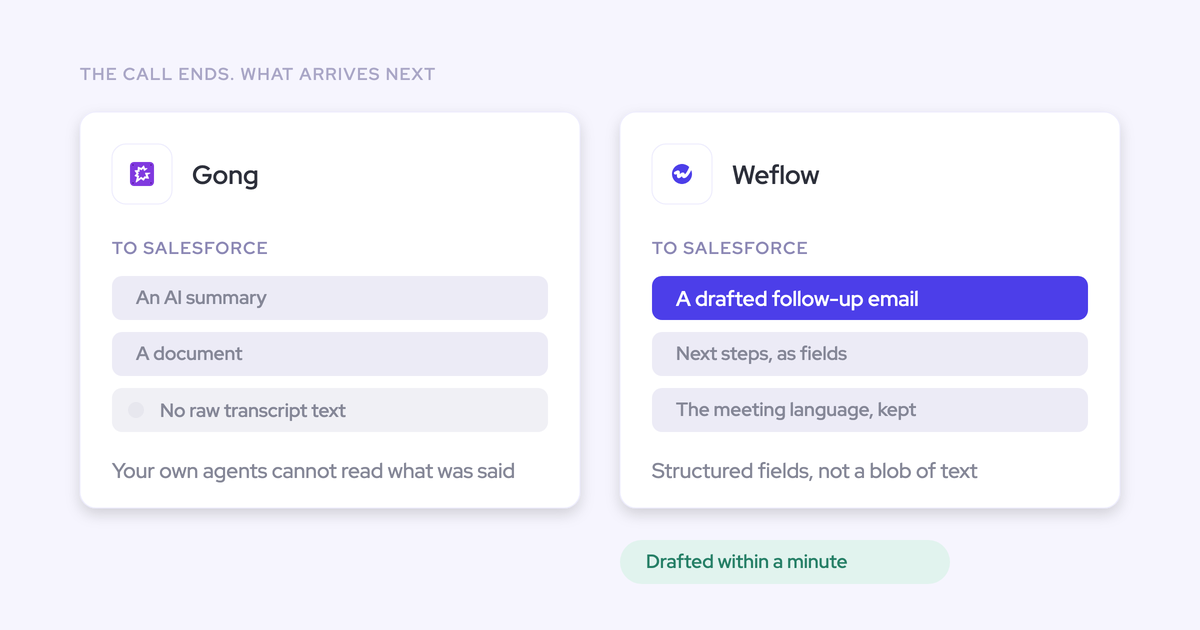
That's the verdict we hear most often, and the cause isn't mysterious. Clari's conversation intelligence wasn't built in the platform; it came in through the acquisition of a separate recording company and remains a collection of tools sitting next to the forecast rather than inside it.
Which produces the second complaint, the one that costs you money:
"I honestly don't see the value today of having copilot and forecast with Clari because they're not talking to each other."
Two products, one vendor, one invoice, and no shared data layer. The lesson experienced buyers take from that is worth keeping: the number of products a vendor sells tells you nothing about whether they read the same data.
There's an adoption dimension too. Clari is deployed as a leadership tool, on AEs and the managers above them, so the rep-facing module rarely gets an internal owner. One team put it plainly: they never had a proper business owner for Copilot, which is why they ended up with no adoption. Licenses everywhere, nobody using them.
Where Clari is stronger: roll-up forecasting and pipeline analytics
Clari's roll-up forecasting is its most mature product, and it's the reason so many teams stay. It's flexible, it holds up at very large rep hierarchies, and the operators who live in it aren't wrong to like it.
What Clari genuinely does well:
- Roll-up forecasting and submissions across hierarchies of a thousand-plus reps, proven over years of quarters.
- The pipeline waterfall, the pacing view, and the comparison of where the quarter stands against the same day in previous quarters. In practice these are the three views revenue teams actually open.
- A pipeline flow view that Weflow does not have. If your team runs on that view, say so early in any evaluation.
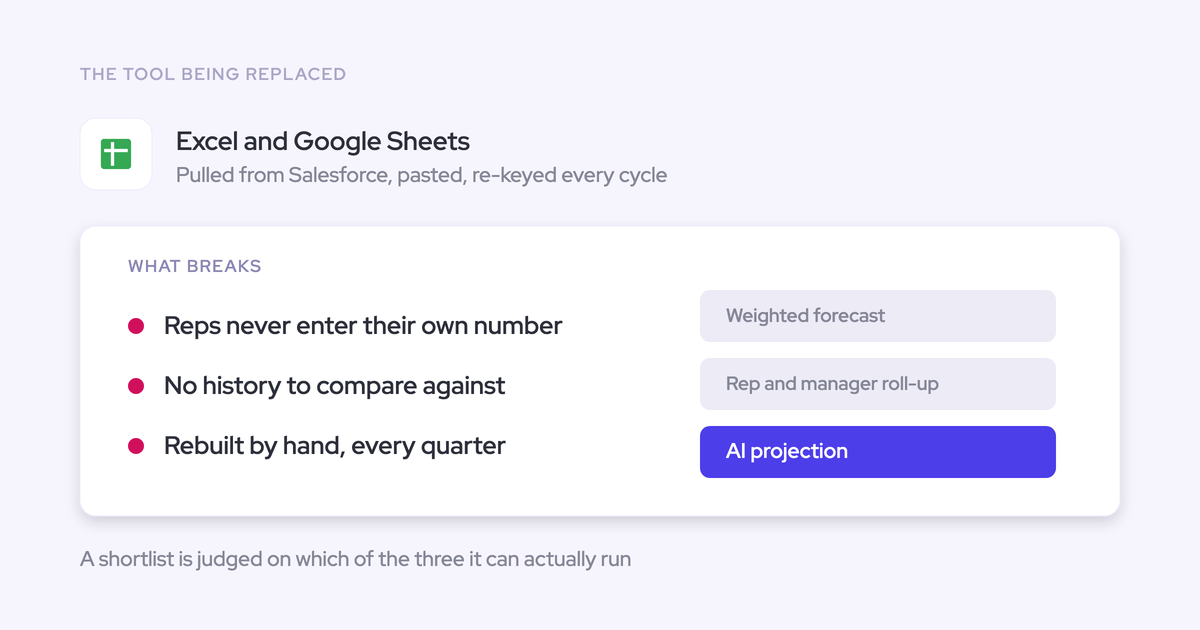
Weflow's Deal Intelligence & Forecasting has moved fast and competes on roll-ups, prediction, and forecast accuracy tracking. But we're not going to tell you to break a working forecast contract to buy ours. If forecasting is the whole job and it's working, keep Clari and read the next section as the thing you're missing.
Where Weflow pulls ahead: the coaching and field-update layer
Everything below sits downstream of the transcript, which is exactly the stretch where Copilot stops. Four capabilities, each one a specific gap you can test in a trial.
AI coaching scorecards grade every call against your methodology
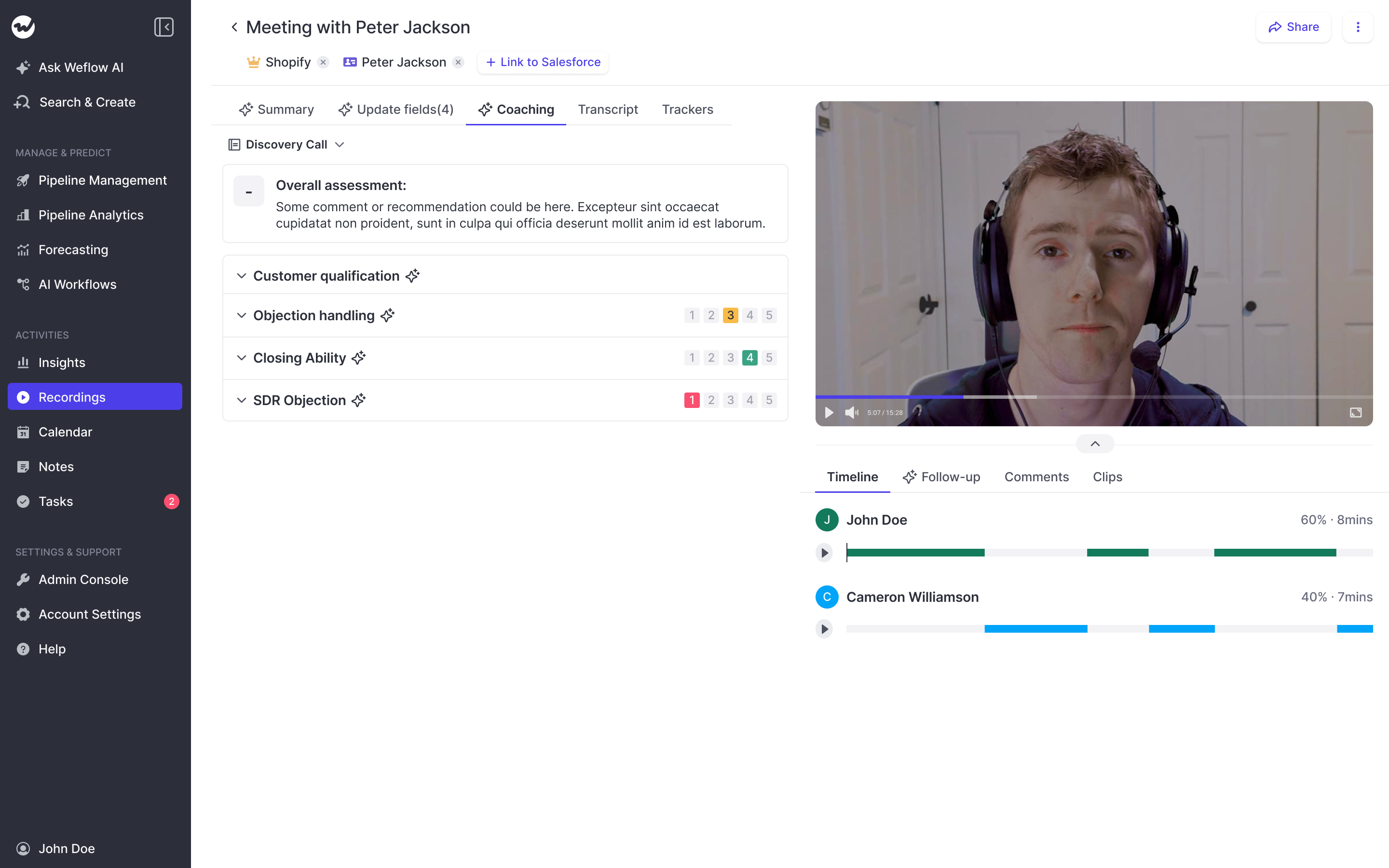
Weflow scores every recorded meeting automatically against the methodology your team has configured, so coaching stops depending on which calls a manager happened to sit in on.
You manage ten reps. You are never going to listen to their calls. One sales manager said the quiet part out loud:
"Going on individual calls is time consuming, you're not going to do that. So that coaching high level piece matters."
What each scored call produces:
- A scorecard for the rep, with ratings across the rubric sections you defined, delivered without a manager in the loop.
- A structured review agenda for the manager, so a one-to-one starts from the two weakest criteria instead of "how's the pipeline looking".
- A trend per rep, so you can watch how one seller's economic buyer identification has moved over months and open the specific calls behind the number.
- A manager override, because the model gets things wrong and the manager's judgment has to win.
Templates are assigned per team, drawn from a catalogue of around thirty methodology frameworks, with your own prompts against your own criteria. Enterprise deals on MEDDIC, transactional on BANT, and CS on something else entirely, all in the same workspace. Rep 360 pulls one rep's conversation and coaching data into a single view.
Two honest caveats. Scoring only covers what gets recorded, and Conversation Intelligence customers typically land at 50 to 70 percent of their meetings, which is high because the notetaker is auto-scheduled from the calendar rather than invited by the rep. And a score nobody inspects has automated the paperwork and left the coaching problem exactly where it was. The scorecard makes the review possible; it doesn't hold the review for you.
AI field updates write methodology fields into Salesforce
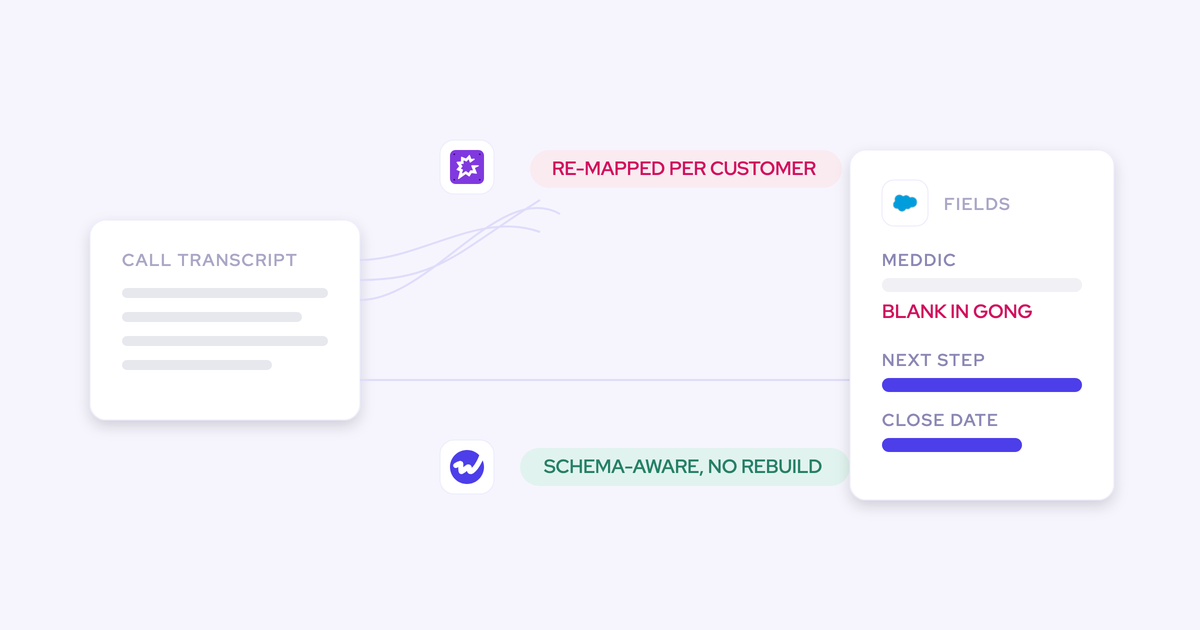
Weflow writes the methodology criteria extracted from a call into your existing Salesforce fields, the ones your deal review already reads, rather than into a score that lives in a vendor portal.
This is the question sophisticated CI buyers now ask first, and they ask it in their own words:
The mechanism is a mapping, not a black box. Each field is tied to its own prompt, and after the call the rep sees the current value beside the suggested value, then accepts, edits, or rejects each one and writes them back in a click. More than 250 pre-built prompts ship with it, covering MEDDIC, MEDDPICC, SPICED, BANT, Challenger, and others.
Within 30 to 60 seconds of the meeting ending, the rep also gets the summary in whatever format your team mandated and a drafted follow-up email. The summary is written onto the Salesforce Event that already exists, with a link to the recording, so it appears on the opportunity timeline.
"It's great if you have those recordings, but, like, the real challenge is to make sure that, you know, the next steps that are discussed in that meeting, sort of, like, the the discussion points that would have an impact on the projected amount, the stage that the opportunity is currently in, the happiness of the account that you're talking to, and so on."
— Philipp Stelzer, CPO & Co-founder of Weflow
The tradeoff: accuracy is a function of prompt quality. A multi-picklist needs its allowed values engineered into the prompt or the write fails, which is why configuration during onboarding is where the real time goes, not the technical connection.

AI playbooks score the whole deal, not one call
Weflow AI Playbooks score an entire opportunity against your methodology by reading every email, meeting, transcript, and CRM field on the deal, then write the result back to the corresponding Salesforce fields with a next-step recommendation.
That's the difference between a coaching score and a forecast signal. A rep can look sharp on last week's call and the deal can still be hollow: the budget signal sat in an email, the champion appeared on a call in March, the compelling event was mentioned once in a meeting nobody wrote up.
Read together, you get something a manager can act on. A deal forecast to close this quarter with no identified economic buyer stops being a coaching anecdote and becomes a named risk on the board. Playbooks refresh on a schedule, they're assigned per team, and a rep can override any field, with the override itself checked for plausibility against the deal.
One data layer: call data that reaches the forecast
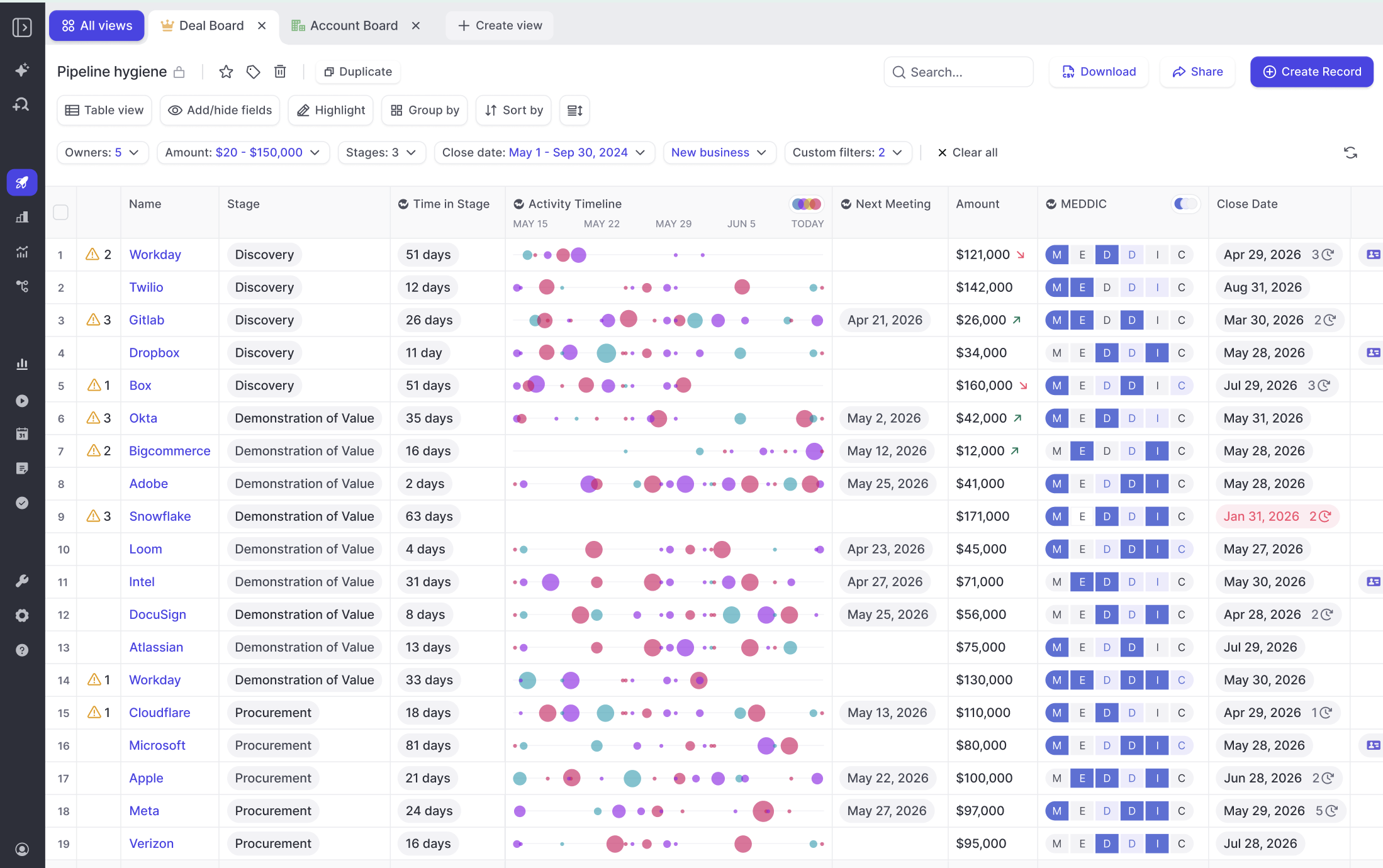
None of the three capabilities above works if capture, conversation, and deal intelligence hold separate data. Weflow's do not: they write to the same native Salesforce objects, which is why the conversation reaches the opportunity by default rather than by integration project.
So here's the test to apply to any suite, including ours. Ask which object each product writes to, and whether one product can filter on a field the other produced. Two vendors can look identical on a feature grid and behave completely differently the week after go-live.
Can you keep Clari forecasting and replace only Copilot?
Yes. Clari reads activities from Salesforce, so Weflow can own capture and conversation intelligence, feed Salesforce, and let Clari keep consuming that data for the roll-up. In practice both sides get better, because Clari's forecast is reading cleaner activity than it was.
The setup order that works:
- Make Weflow Activity & Contact Capture the single capture layer writing emails, meetings, and contacts into Salesforce.
- Turn off the other capture engine. This is the one rule, and skipping it is the failure mode.
- Turn on Weflow Conversation Intelligence: recording, the summary onto the existing Salesforce Event, and the methodology field updates.
- Leave Clari reading Salesforce activity and opportunity fields for the forecast and board reporting.
- At renewal, decide whether Deal Intelligence & Forecasting takes over the roll-up too, as a bundle step rather than a second six-figure contract.
Why step two matters: run two engines that both write meetings and the same customer conversation lands in Salesforce twice, as two separate records. Meetings per rep and meetings per closed opportunity are then inflated, which is precisely the reporting you bought the tools to get.
"if you record a meeting, it's not another meeting. It's the same meeting."
— Janis Zech, CEO & Co-founder of Weflow
A meeting in Weflow is logged as a Salesforce activity whether or not it was recorded. Recording only adds the summary and the field updates on top of that one activity.
Clari vs Weflow pricing: seat costs and services fees
Weflow publishes its pricing. Clari doesn't, so treat the Clari column as reported estimates from evaluations rather than list price.
| Clari | Weflow | |
| Pricing model | Quote-only, no published rate card. Products are not sold standalone, so the CI module comes with the suite. | Published per product and per bundle. Conversation Intelligence can be bought on its own. |
| Per-seat range | Reported at $120 to $180 per user per month, with regular increases reported, and pricing that gets disproportionately expensive at small seat counts. | Conversation Intelligence $39, Activity & Contact Capture $19, Deal Intelligence & Forecasting $39. Bundles: Revenue AI Foundation $49, Revenue AI Business $59, Revenue AI Enterprise $79. |
| Implementation and services | Reported professional services fees of $15k to $50k, and RevOps changes to forecast configuration typically route through professional services. | No platform fee and no implementation fee. Onboarding is run by Weflow and self-service configuration sits in the admin console. |
| Trial | No free trial, no self-serve signup. | 14-day free trial on your own Salesforce, white-glove setup included, 10-user minimum on paid contracts, billed annually. |
Before you compare totals, do one piece of arithmetic. Count the Copilot seats that are actually being used, not the ones you're licensed for, and divide your Clari spend accordingly. That's the real price of the module that disappointed you.
"if someone is trying to sell this to you and they charge you like five thousand dollars as a platform fee and then, you know, one hundred, two hundred dollars per user per month, that's, I think, nowadays not acceptable anymore."
— Philipp Stelzer, CPO & Co-founder of Weflow
Migrating from Clari Copilot before your renewal date
A swap like this doesn't compete against Clari. It competes against your RevOps backlog, which is why it gets approved when it arrives as a managed project with a fixed timeline and a price, and stalls when it arrives as a co-project needing RevOps hours in a busy quarter.
How the move actually runs:
- Trial. 14 days on your own Salesforce with your own meetings, not a demo org. Weflow's implementation team does the setup during the trial, at no cost.
- Technical implementation. A 45 to 60 minute call with your Salesforce admin and your mail admin to connect the systems.
- Configuration. Team structure and hierarchy, the methodology, which custom fields AI should populate, the prompt templates, the scorecards. This is where the time goes and where the output quality is decided.
- Rollout. Split by role, with separate leadership and rep training.
Time to live is typically two to four weeks, or four to six for a large org. Capture and conversation intelligence specifically can go from implementation to rollout in about two weeks, which is what makes a pre-renewal swap realistic.
Weflow runs onboarding itself rather than handing it to a partner, and there's a managed service option where we do the heavy lifting and your RevOps team only answers questions and unlocks access. That option exists because bandwidth, not product fit, is what kills most displacement projects.
"We have got a finite stop. We lose Clari on a day. And I want this live and ready and tested a minimum of two weeks before the 31st of September."
That's a normal ask, and the answer is to work backwards from the date. One more thing that saves weeks: your existing tracker set can be carried across, so keyword reporting on competitors, pricing, and objections doesn't restart from zero.
Choose Weflow if, choose Clari if
Choose Weflow if:
- Your gap is coaching. You need every call scored against your methodology, per rep, as a trend rather than as whichever call you sat in on.
- You need the methodology criteria written into your own Salesforce fields, so the deal review and your reporting read one version of the truth.
- You want call content to reach the opportunity and the number, not sit in a second portal.
- You want published pricing, a trial on your own Salesforce, and no implementation invoice.
- You'd rather consolidate capture, conversation, and deal data onto one layer than maintain integrations between three.
Choose or keep Clari if:
- Roll-up forecasting across a large hierarchy is the job, it's configured, and your leadership trusts it.
- The pipeline flow view is part of how your team runs its quarter. Weflow doesn't have it.
- Your priority this year is board reporting cadence rather than rep coaching or CRM write-back.
And the honest middle: these aren't mutually exclusive. Add the conversation layer now with one capture engine feeding Salesforce, keep the forecast where it is, and make the consolidation decision at renewal when you have leverage and evidence.
See how Weflow captures activity, updates Salesforce fields from calls, and rolls up your forecast. Book a 30-minute demo.
Clari Copilot vs Weflow: frequently asked questions
Does the coaching scorecard use my methodology and my Salesforce fields?
Yours. Weflow ships a catalogue of around thirty methodology templates covering MEDDIC, MEDDPICC, SPICED, BANT, Challenger, and others, and a team can map its own prompt to each element, so a proprietary in-house framework is encoded the same way as a standard one. Templates are assigned per team, and the extracted criteria write into the Salesforce fields you already track against.
What exactly does Weflow write back into Salesforce after a call?
The summary lands on the Salesforce Event that already exists for that meeting, with a link to the recording, plus the AI field updates the rep has approved and any structured fields you've mapped. No duplicate meeting record. Video files are deliberately kept out of Salesforce and exported through the public API to your own cloud storage, because CRM storage is expensive; transcripts and structured outputs stay in Salesforce.
Does Weflow record phone calls as well as meetings?
Weflow is not a dialer and doesn't place or record phone calls itself. Calendar meetings on Zoom, Microsoft Teams, Google Meet, and Webex are auto-recorded, and where a telephony provider handles the call, its recordings can be pulled in through that connection, transcribed, written back to Salesforce, and scored alongside meetings. If your sellers work mostly by phone, solve the telephony layer before you judge coverage.
Will reps experience Weflow call scoring as surveillance?
It depends on what they get first. Weflow supports opt-out, opt-in, and manual consent flows, with a customizable notice in the meeting chat and a link any participant can use to stop the recording, in which case the notetaker leaves and the recording, transcript, and notes are destroyed. On the adoption side, the rep gets the summary, the drafted follow-up, and the fields written for them before anyone talks about scorecards, and the scorecard reaches them as feedback rather than as a manager verdict. Manager-facing insight views can be permissioned separately.
Is Weflow GDPR-compliant, and is call data used to train AI models?
Weflow is GDPR-compliant and SOC 2 Type II certified, with a Data Processing Agreement incorporating EU Standard Contractual Clauses, a public sub-processor list with advance change notification, and a 48-hour breach notification commitment. Zero data retention applies to AI processing and customer data is never used to train models. ISO 27001 is in progress, not certified, and Weflow is not FedRAMP certified.
Can existing trackers and keyword reporting carry over from another recorder?
Yes. Tracker sets are configured over years, so an existing set can be carried across and applied to recordings in Weflow rather than rebuilt, and trackers roll up by rep, team, and region. Clips and playlists are built on the new library, so onboarding collections do start fresh there.