Aviso vs Gong Forecast (2026)
Learn whether Aviso or Gong Forecast fits your roll-up, AI forecast, and CRM setup—plus Weflow.


On a feature grid, Aviso and Gong Forecast come out even. Both roll up commit and best case, put an AI number next to the team's call, score deals, keep pipeline history and record meetings. The grid can't pick your finalist for you.
What separates them is what each forecast is built from and where it lives. Aviso forecasts from its own time-series copy of your CRM, on hierarchies it builds for you. Gong Forecast is an application you buy on top of Gong Foundation. It reads CRM field history and follows your Salesforce hierarchy. Here's the short answer:
- Aviso fits enterprises that run several CRMs or forecast consumption revenue, and that want the vendor's team to build the rollout.
- Gong Forecast fits teams already on Gong Foundation whose managers live in Gong deal boards.
- Weflow is the third finalist worth adding if you're Salesforce-only and forecast bookings. Weflow is the Revenue AI Orchestration platform for sales, customer success, and RevOps teams. Weflow Deal Intelligence & Forecasting builds your forecast on activity captured in your own Salesforce, reads three methods as a corridor, and has a published price of $39 per user per month.
Aviso vs Gong Forecast vs Weflow across ten forecasting capabilities
The three tools are closest on recording. They're furthest apart on where the data lives, how the AI number is built, who does the setup, how you reach the data and what you pay.
| Capability | Weflow | Aviso | Gong (Gong Forecast) |
|---|---|---|---|
| Forecast submissions and roll-ups | Reps submit a baseline and best case on named deals, and managers submit their own call beside it. Overrides are logged with a rationale and every version is kept. Submission is web-only and isn't written to Salesforce fields. | Commit, best case and most likely roll up on Aviso's own hierarchies, with one-click commit moves. Includes a forecast audit trail and commit accuracy per AE. | Reps submit per category with notes, and managers see team totals with target and coverage. Includes a weekly trend chart and a per-person accuracy report. Rolls up the Salesforce hierarchy. |
| AI forecast prediction | Low, middle and high range from 50+ deal signals, beside a weighted forecast and the roll-up. Needs six months of history and doesn't yet adjust for ramping reps. | Aviso AI forecast beside the team's most-likely call, built from deal WinScores, with factors given for each changed deal. | Closed-won plus historically weighted pipeline plus expected deals, with a "See the math" panel. Reliable at 400 created and 150 closed-won opportunities across four quarters. |
| AI deal scoring | 0 to 100 score refreshed nightly, trained on your own closed deals, with the drivers shown. | WinScore: a daily probability that the deal closes this quarter, with its top factors. | Percentile rank against other open deals, from 300+ signals. Needs 50 closed-won and 150 closed-lost deals, and first scores can take up to two weeks. |
| Opportunity snapshots | Every opportunity every few hours, feeding the waterfall, push counts and period-over-period views. Prior history comes from a 12-month Salesforce import. | Time-series copy of the CRM, six to eight quarters back on average, recording every change of state. Held in Aviso. | Trends and Changes reports read CRM field history. Up to five quarters can be backfilled on request through your customer success manager. |
| Recording video meetings | Weflow Conversation Intelligence notetaker on Zoom, Teams, Meet and Webex, auto-scheduled onto external meetings. | Native imports from Zoom, Teams, Webex and RingCentral, plus a Notetaker bot elsewhere, including Meet. | Zoom, Meet, Teams, Webex and seven other providers on any plan. Bot-free recording on Zoom only. |
| Forecasting setup and rollout | Weflow runs onboarding at no charge. Forecasting takes longer than capture because it encodes your cadence, and Salesforce forecast settings don't carry over. | Aviso's implementation team builds the hierarchy, integrations and screens from your CRM access. | Fixed-scope services project of up to 22 hours, on top of Gong Foundation. Multi-motion setup is heavy. |
| Integrations with other tools | Salesforce, Gmail, Google Calendar, Outlook, Zoom, Teams, Meet, Slack and the Outreach dialer. Salesforce is the only CRM. | Claims 200+ connections, including several CRMs. Most are set up by Aviso's team. | About 450 integrations and partner solutions, around thirty dialers and eleven meeting platforms. |
| Access from AI assistants (MCP) | Read-only connector returning forecast calls, live pipeline, the delta between them and per-rep metrics. Per-rep breakdowns are capped at 25 owners. | No MCP server for external assistants. MCP runs only inside Aviso's Agent Studio. | Three record-scoped tools that return insights rather than transcripts. Read-only and draws credits. |
| Raw data access outside the tool | REST API bulk export (JSON or CSV) to BI tools such as Tableau and Looker. No native Snowflake, Databricks or BigQuery connector. | No public API or warehouse feed. Data leaves as spreadsheet and file exports. | API capped at 3 calls per second and 10,000 per day. Warehouse delivery needs Data Cloud, about $5,000 a year. |
| Pricing | Published per seat: $39 standalone, bundles at $49, $59 and $79. AI included in the seat, 10-user minimum, billed annually. | Quote-only, with an offer to buy out your current contract. Agent work at $1 to $1.50 per outcome, by Aviso's own figures. | No published prices. Per-user licence plus a platform fee, on a mandatory Foundation licence. |
Each tool gets its own section below, covering the same capabilities in the same order, followed by a side-by-side look at cost.
Why CROs end up choosing between Aviso and Gong Forecast
Forecasting became the expansion product for both vendors, and that puts both in front of the same CRO.
- Gong sells Gong Forecast as a separate application on a mandatory Gong Foundation licence.
- Aviso sells forecasting as the head of a consolidation platform meant to replace Clari, Gong, Salesloft, Outreach, People.ai, BoostUp and Drift. It backs that with an offer to buy out your existing contract and migrate you for free.
We see three versions of this buyer on our calls:
- You're already on Gong Foundation. Adding Gong Forecast is the default, and Aviso is pitching a buyout.
- You forecast in spreadsheets plus Salesforce reports, with a weighted roll-up and no commit or best case. A PE acquirer, a new leader or a missed quarter is forcing the decision.
- You bought Gong Forecast and fell back to spreadsheets, because configuring it for several motions took too much RevOps time.
In every version, matching features won't settle it. An honest evaluation of a replacement usually lands at about 80% of what a mature setup does. The decision gets made on what one option does that the other can't do at all.
Gong also carries a weight of its own, because it's the safe buy:
"I wasn't going to get fired for buying Gong. It wasn't going to happen, right? So it was a very safe choice."
Chris Nethercote, Head of Sales at Weflow, former Gong enterprise customer
So leaving Gong, or choosing not to extend it, needs a reason you can defend to your CFO and board. A lower sticker price alone won't carry that.
What Aviso and Gong Forecast actually build your forecast from
The three tools differ in the data each forecast reads, the hierarchy it rolls up, and where the numbers end up:
- Aviso forecasts from its own copy of your CRM.
- Gong Forecast reads CRM field history and follows the Salesforce hierarchy, beside Gong's conversation cloud.
- Weflow forecasts on activity written into your own Salesforce and runs three methods side by side.
| Underneath the forecast | Weflow | Aviso | Gong Forecast |
|---|---|---|---|
| What the forecast reads | Salesforce opportunities, plus emails, meetings and call outcomes written into native Salesforce objects | Aviso's own copy of the CRM, synced every two to five minutes | CRM field history, plus Gong's conversation data |
| Which hierarchy it rolls up | Salesforce role hierarchy by default, rearrangeable in Weflow by drag and drop | Aviso's own hierarchies, which can differ from Salesforce and merge several CRMs | The Salesforce hierarchy, with a placeholder structure where reporting lines differ |
| Where pipeline history lives | Weflow snapshots taken every few hours | Aviso's time-series store | Salesforce field history, backfilled into Gong reports |
| What the AI number is built on | 50+ deal signals, including communication cadence, next meeting booked and methodology health | Per-deal WinScores from stage behavior, push-outs and field text | Closed-won plus historically weighted pipeline plus expected deals |
| Where submitted forecast numbers live | In Weflow, readable over MCP, not in Salesforce fields | In Aviso, leaving only as file exports | In Gong Forecast |
The source decides how far you can trust the AI number. A model can only weigh what reached the data. If reps skip logging, the projection reads a pipeline that looks quieter and cleaner than it is.
Gong's real strength here is that it reads what was said on calls, which catches context that never reaches a CRM field. Aviso's copy gives it full control over hierarchy and history, at the cost of running your forecast somewhere other than your CRM.
We learned the data lesson the hard way:
"We actually launched a prediction forecast before we had automated Salesforce data capture, and we found that it was not that accurate, which made us realize you have to solve it end to end."
That's why we spend most of our engineering effort on capture and mapping. Weflow's AI forecast reads activity captured into native Salesforce objects, so the signals behind the number are the same ones your own reports and automations use.
How Weflow Deal Intelligence & Forecasting builds your forecast
Weflow gives you three things:
- A deal-by-deal roll-up with independent manager calls, on a hierarchy you can rearrange.
- A ranged AI projection that sits beside the team's call.
- Forecast data you can reach from outside the tool.
Here's each capability, with its limits stated alongside it.
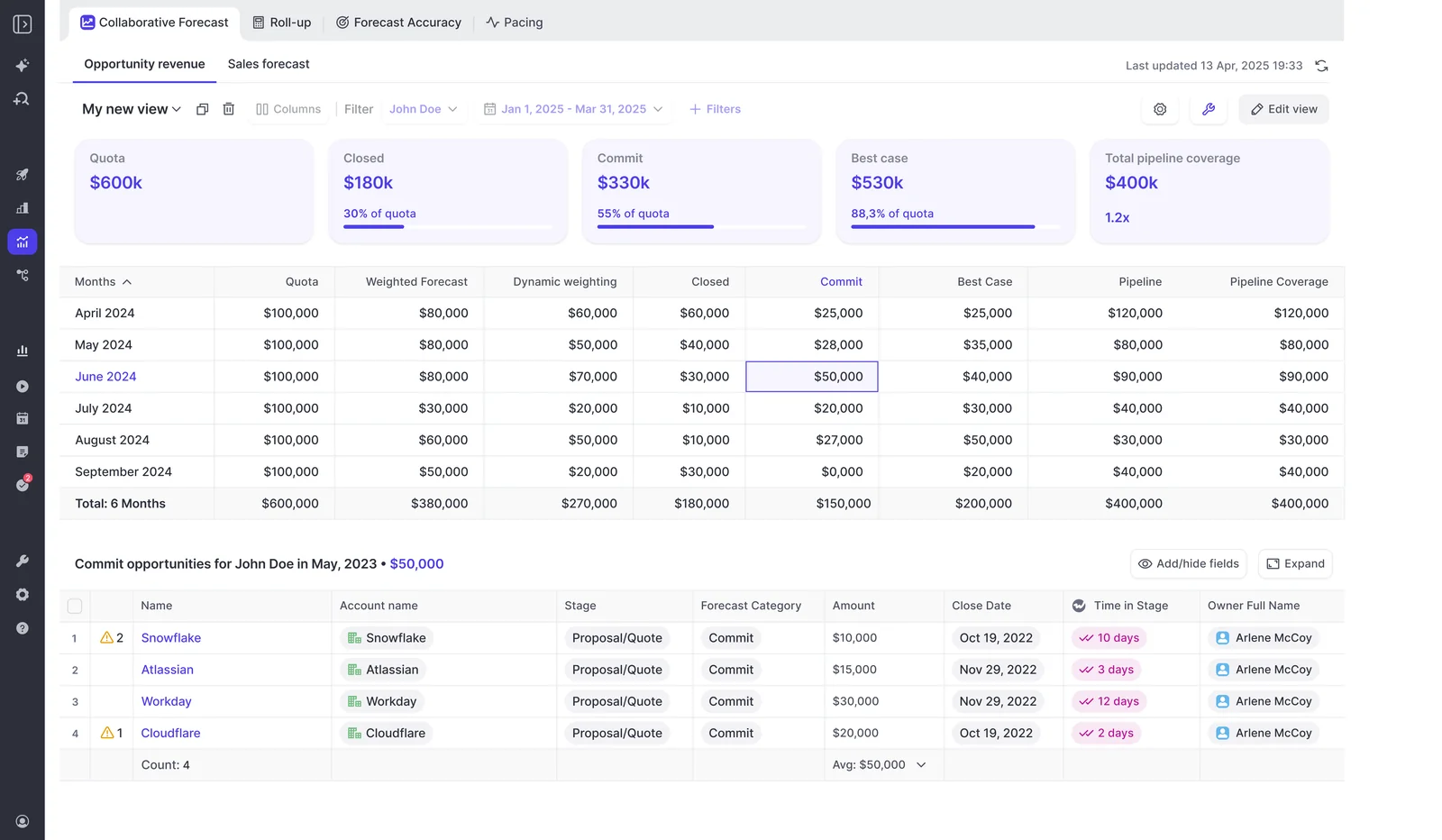
Reps and managers submit separate calls on named deals
In Weflow you see the rep's call, the manager's call and any override side by side, on reporting lines that don't have to match Salesforce. That's the request we hear most from multi-level orgs:
"I need to keep the three numbers: the team's roll-up, the manager's call and the override. I need to be able to see all three."
Here's how a submission works:
- Reps submit a baseline and a best case, either as a total or by selecting the opportunities behind each number, with a comment. A reminder email deep-links them straight into the submission.
- Every submission is versioned. You can see whether a rep's call moved during the quarter or never moved at all.
- Managers submit their own team number beside the rep's, not over it, and can build it from their reps' deals. Changing a rep's call is a separate permission.
- Overrides are timestamped, attributed and retained with their rationale across quarters.
- Deadlines can lock the submission.
The roll-up follows the Salesforce role hierarchy by default. When that doesn't match how you forecast, an admin switches on a custom hierarchy and arranges which team reports into which by drag and drop.
One person can sit in several teams. That covers the CSM who carries both an expansion and a renewal number. For a large org, our team can build the teams from a spreadsheet.
Where Weflow stops:
- It doesn't support Salesforce opportunity splits or overlay forecasting. A split deal counts in full for its owner.
- Submissions happen in the web app, not from a phone or a chat tool.
- Submitted numbers live in Weflow. You can read them over MCP, but no Salesforce field holds them today.
Weflow's AI projection returns a range beside the team's call
The AI projection is your second opinion, and it owes nothing to rep optimism. It returns a low, middle and high value built from more than 50 deal signals and up to two years of history, and it refreshes nightly.
It reads how the deal is behaving:
- seasonality and rep performance;
- conversion rates and communication cadence;
- whether a next meeting is booked;
- whether the deal is healthy against your sales methodology.
So a large deal that's being worked poorly gets projected down.
The projection runs beside two other methods. Each carries something the others miss:
- Dynamic weighted forecast: recalculates each stage's win rate from a rolling 90 or 180 days, instead of the probability typed once onto the Salesforce stage. An admin can pin a stage by hand, for example keeping prospecting at zero. It's accurate across many deals and says little about any single one.
- Rep and manager roll-up: carries the judgment of the people closest to the deals, along with their incentives.
- AI projection: carries the signals nobody has time to read, with no accountability attached.
Read together, the three give you a corridor. Where they converge is your credible range. Where they diverge is the agenda for the forecast call.
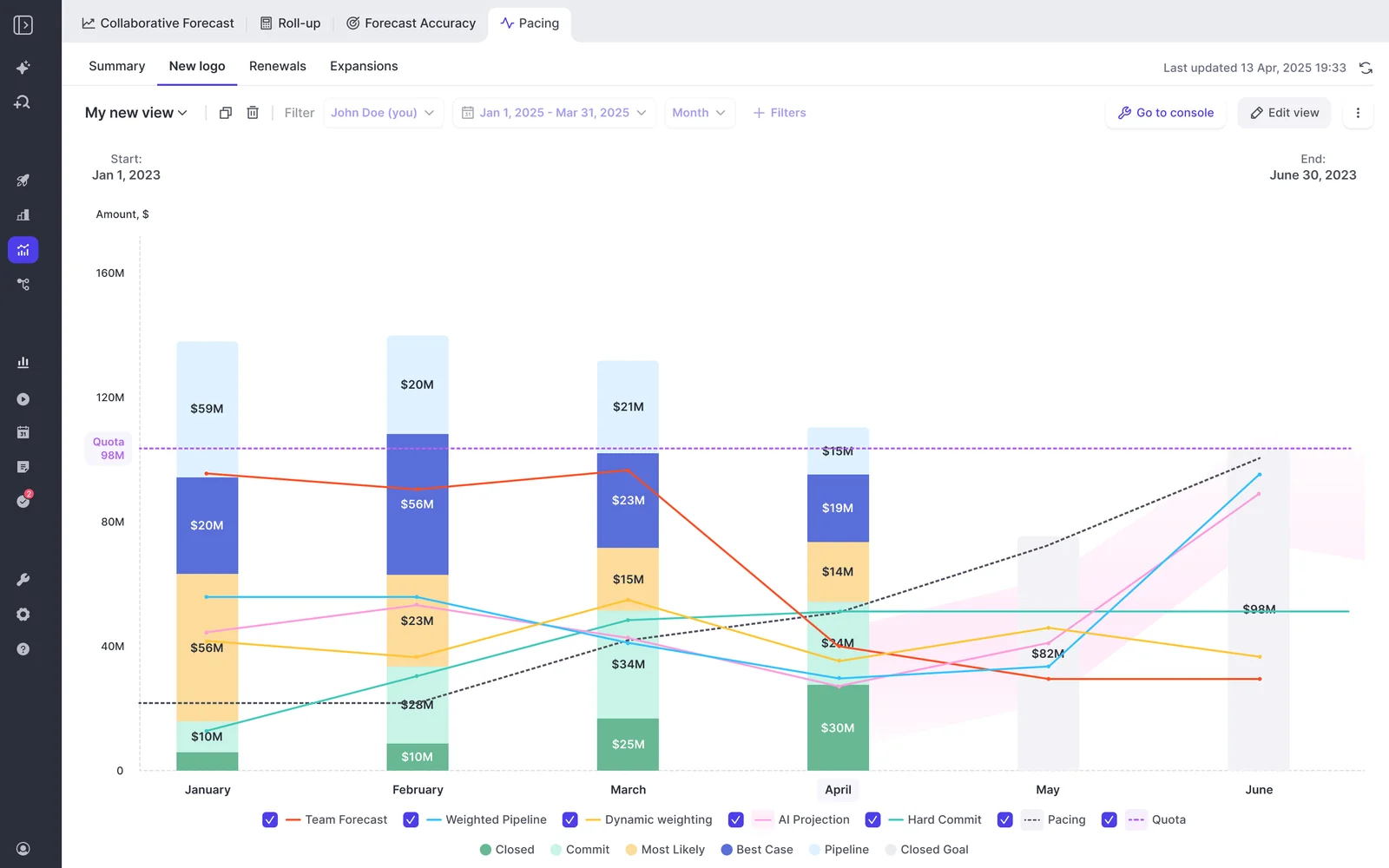
Every opportunity also gets a 0 to 100 score, recalculated nightly. The score is trained on your own closed deals, not a generic model, and each one shows the drivers behind it.
The history comes from your Salesforce opportunity data, imported at install: twelve months by default, more on request where field history allows. Your first projection is ready 48 to 72 hours after import. Each forecast configuration gets its own model, so new logo and renewal are projected from their own history.
Where it stops:
- It needs at least six months of opportunity history.
- When the model isn't confident, it shows no range and says why. The range also widens when your business is changing, for example with new products, motions or territories.
- It doesn't yet adjust for ramping reps, so a new hire's line is projected from very little history of their own.
Weflow snapshots every opportunity every few hours
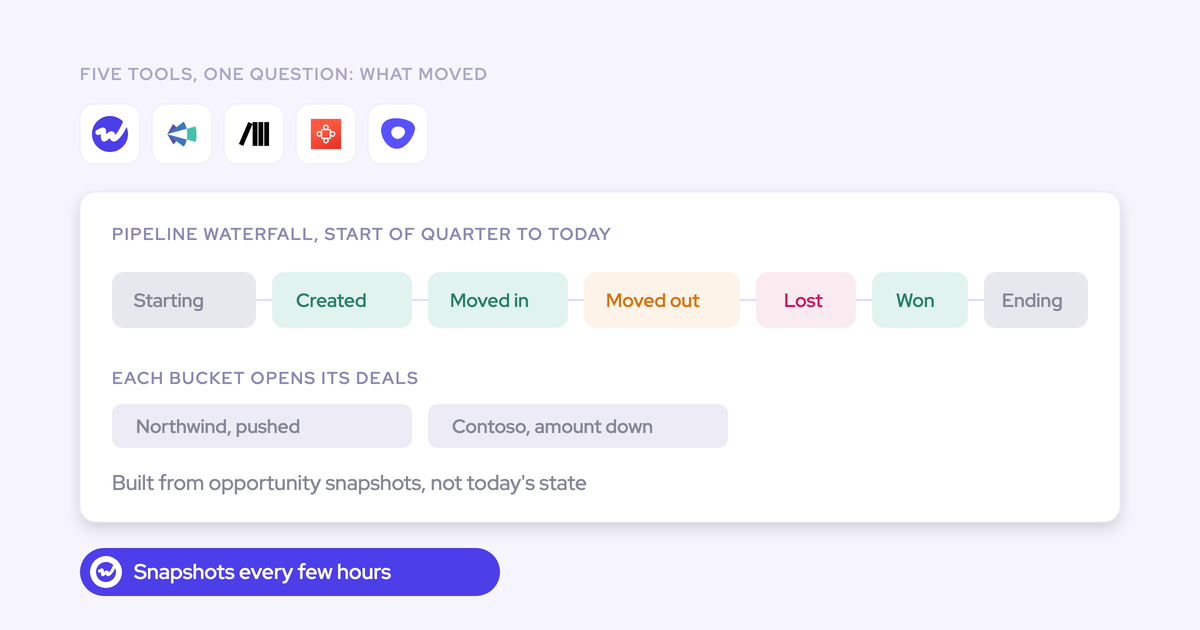
A Salesforce opportunity only holds its current value, so movement between two dates can't be rebuilt from the record. Weflow takes its own snapshots every few hours.
Those snapshots power three views:
- A clickable waterfall: created, increased, pulled in, moved out, lost, decreased and won, each drilling through to the deals behind it.
- Push counts and days in stage on every deal.
- Period-over-period views.
That's how you answer "this was committed last week, where is it now?" deal by deal.
History before rollout comes from the Salesforce import. For custom fields, its accuracy depends on Salesforce field history tracking having been switched on.
Changing a forecast configuration re-runs that import. The views built on it can show partial numbers for up to a day or two while it runs.
Weflow Conversation Intelligence records Zoom, Teams, Meet and Webex calls
Recording lives in Weflow Conversation Intelligence, a separate product from Weflow Deal Intelligence & Forecasting. The notetaker is auto-scheduled from the calendar onto every external meeting, so reps don't have to remember to invite it.
A few platform settings apply at rollout:
- Zoom needs local recording enabled by your Zoom admin, plus host approval.
- On Teams and Meet, the notetaker has to be admitted from the lobby.
- Webex is off by default and gets switched on per workspace.
Transcripts and the structured outputs of each call land in Salesforce. Video files export through the API to your own cloud storage.
Forecasting takes longer to set up than capture, for a reason
We run onboarding ourselves, at no charge, against a mutual action plan with named owners on both sides. Activity capture and conversation intelligence typically go live in about two weeks.
Forecasting takes longer because it encodes your operating cadence. You decide:
- who submits, and how often;
- whether calls happen at deal or manager level;
- which quota they're measured against.
Existing Salesforce forecast settings don't carry over, so you set forecasting up in Weflow. If your RevOps team is stretched, a managed service option has us do the heavy lifting while your team answers questions and unlocks access.
A two-week trial can't prove a forecast, because a roll-up has to run for a cycle before you can judge it. For that, we offer a three-month paid pilot. It's contractually the first three months of a multi-year agreement, with an opt-out at the end.
One limit: forecasting setups that depend on deal data stored on non-standard Salesforce objects aren't always feasible.
You can reach forecast calls from Claude or ChatGPT over MCP
Weflow's official MCP connector is read-only, switched on per workspace by an admin. A separate toggle decides whether assistants can read full transcripts or only AI summaries.
For any close-date period, scoped to you or your team, it returns:
- the most recently submitted forecast call, the live pipeline total and the delta between them (or null when nothing was submitted);
- per-rep weighted and unweighted pipeline, closed-won amount and count, win rate, average deal size, sales cycle length, coverage ratio and gap to forecast, with the opportunity IDs behind them;
- playbooks, call summaries and transcripts.
The forecast layer never reaches Salesforce. That's why the Weflow connector is worth running alongside Salesforce's own.
For BI and warehouses, the REST API bulk-exports transcripts, metadata, scores and signals as JSON or CSV, and feeds tools such as Tableau and Looker.
Where it stops:
- There's no native Snowflake, Databricks or BigQuery connector. Teams move data into the warehouse through the API.
- Per-rep breakdowns over MCP are capped at 25 owners. A large org gets aggregate answers unless the question is narrowed to a team.
How Aviso forecasts from its own copy of your CRM
Aviso is strong on four things:
- merging several CRMs;
- running hierarchies unlike your CRM's;
- a daily win probability per deal;
- a mobile app and a done-for-you build.
The trade-off is that its intelligence lives in Aviso's store, with no API or assistant access.
Aviso rolls up commit, best case and most likely on its own hierarchies
Aviso rolls the forecast up automatically across every rep, category and team, with commit, best case and most likely numbers. Reps and managers enter calls and plans on the forecast screen, and a deal moves in or out of commit in one click.
Because Aviso builds its hierarchies from its own copy, they can differ from Salesforce's. Consolidated forecasting merges several CRM instances into one forecast.
For accuracy, Aviso keeps a forecast audit trail of past weekly, monthly and quarterly calls that you download to compare with actuals. Its dashboard shows commit accuracy per account executive.
WinScore gives every deal a daily probability of closing this quarter
WinScore is a true probability, and that's a real credit to Aviso. It's built from:
- time in each stage and the order of stage moves;
- deal age and close-date push-outs;
- time left in the quarter;
- the text of fields such as Next Step and manager comments.
The Aviso AI forecast sits beside the team's most-likely call and the booked amount, each marked against plan. WinScore explanations give the factors behind every changed deal.
Aviso also runs consumption forecasting for usage-based revenue alongside bookings, and splits forecasts by new business, upsell and renewal.
Aviso keeps six to eight quarters of history in its own copy
Aviso copies your CRM into its own time-series database, on average six to eight quarters back, and tracks every change of state as it happens. That's what lets its dashboard compare deal, forecast and pipeline values with the previous day, week, month and quarter.
The history lives in Aviso, not in Salesforce.
Aviso imports native recordings and sends a bot where it can't
Aviso records mainly by importing native recordings from Zoom, Microsoft Teams, Webex and RingCentral. It sends its Notetaker bot only where an import isn't possible, such as meetings another company hosts, and for Google Meet.
Each conferencing platform needs your admin to register an app and hand the credentials to Aviso's team. In-person meetings record in the mobile app after the rep reads a consent notice aloud.
Aviso's implementation team builds the hierarchy and screens for you
You hand over CRM access and integration credentials, and Aviso's team builds the hierarchy, connects each integration and configures the screens. After setup, your admins add users and manage the hierarchy themselves.
Custom screens, formulas and reports go through the implementation team or your customer success manager. You carry less RevOps load and more vendor dependency.
Aviso data leaves as file exports, with no public API or MCP
Aviso claims more than 200 native connections, across CRMs, conferencing, telephony, engagement tools, Slack, support ticketing and marketing automation. It writes deal field edits back to Salesforce under each rep's own login.
Getting data out is narrower. Deals, reports and the audit trail leave as spreadsheet or file downloads. Aviso has no public API or warehouse feed, and no MCP server for Claude or ChatGPT. It uses MCP only inside its own Agent Studio.
How Gong Forecast works as an application on Gong Foundation
Gong Forecast has strong reporting, with per-person accuracy, Changes and Trends, plus rich conversation signals. Building on Gong Foundation also brings four constraints:
- the roll-up follows the Salesforce hierarchy;
- it needs large data volumes;
- it's heavy to configure for several motions;
- external access is narrow and metered.
Gong Forecast rolls up category calls along the Salesforce hierarchy
Reps submit their own number per forecast category, with notes. Managers see their team total on top and each person below, with target and coverage beside each number, and can move up and down the hierarchy. Here's Gong's forecast roll-up from VP to manager to rep:
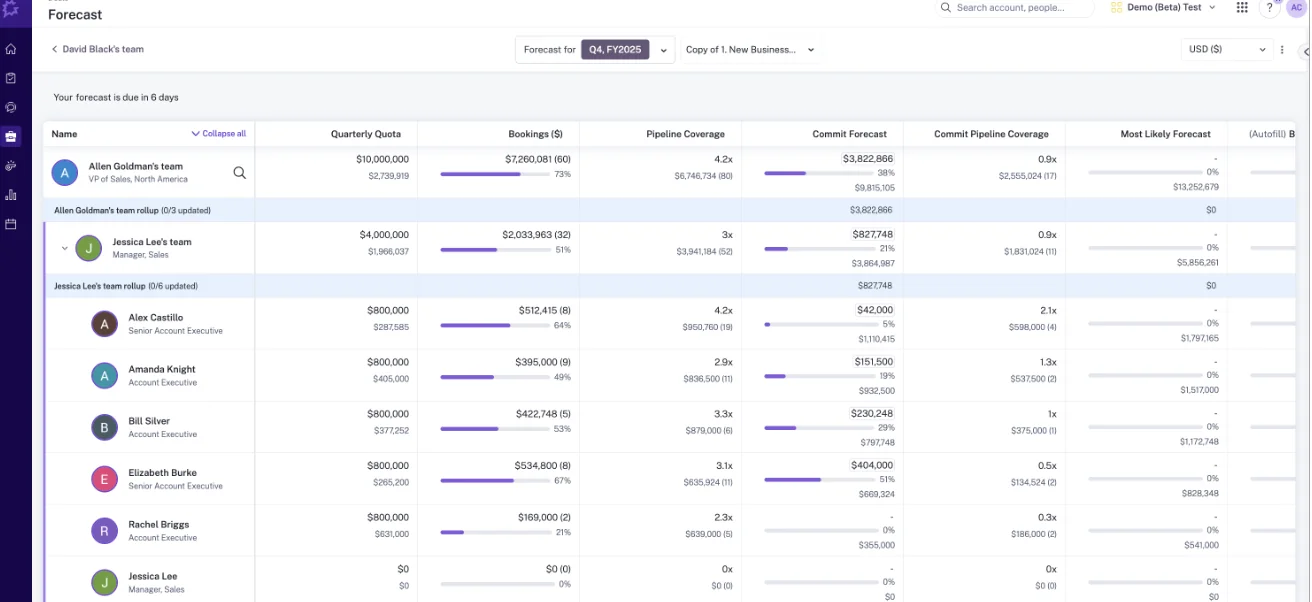
The reporting here is good:
- The trend chart tracks the team's forecast and the manager's forecast week by week against target. When a submission is missing, it carries the last number forward.
- The accuracy report divides each person's submitted forecast by actuals and bands the result: high sits between 85% and 115%.
- You can run separate boards for new business, renewals or retention.
The constraint is the hierarchy. The roll-up follows Salesforce, so reporting lines that differ from the manager field need a placeholder structure. And when the org changes, you change it twice.
Gong's projection and deal score need large deal histories
Gong Forecast projects where a team lands from three components:
- closed-won deals;
- pipeline weighted by historical stage conversion at the same point in the period;
- expected new, pulled-in and pushed-in deals.
A "See the math" panel shows each component. Reliable projections need at least 400 created opportunities, with 150 closed-won, across four quarters.
The deal score draws on more than 300 signals, trained on your own won and lost deals, and lists the positive and negative signals behind it. It's a percentile rank, not a probability: a deal scored 80 beats 80% of your other open deals.
Scoring needs a Gong Forecast seat and at least 50 closed-won and 150 closed-lost deals from the last two years. First scores can take up to two weeks.
Gong Forecast reads pipeline history from CRM field history
Trends and Changes compare each deal's stage, close date and amount between the start and end of a period. Changes groups the movement into sixteen reasons, such as pulled in, pushed out and amount increased. A deal that moves and comes back within the period doesn't appear.
Gong backfills up to five quarters of history on request through your customer success manager, in three to five business days. You need that backfill again after changing a business line's fields or categories.
Gong records meetings on eleven conferencing platforms
Gong has the broadest coverage of the three:
- Zoom, Google Meet, Microsoft Teams, Webex and seven other providers, on any plan;
- call audio imported from about thirty dialers.
Bot-free recording is Zoom-only, through Zoom's native recording. On every other platform the Gong bot joins, and the host admits it from any waiting room.
Gong Forecast rollout runs as a services project of up to 22 hours
Gong sells the Gong Forecast rollout as a fixed-scope professional services project. It runs up to 22 hours, to be used within 60 days, and assumes you already run Gong Foundation with a CRM integration.
The project covers:
- up to six discovery sessions;
- three configuration sessions;
- go-live and post go-live office hours.
Your named Gong administrator owns all configuration.
Multi-motion setups are where it gets heavy:
"Our RevOps team spent too many hours building it out and trying to get it to work super well. So we ended up actually doing most forecasting back in spreadsheets."
Chris Nethercote, Head of Sales at Weflow, former Gong enterprise customer
His team was trying to run enterprise, commercial and post-sale in one module. The spreadsheet that replaced it combined a deal-by-deal roll-up with a weighting from historical conversion.
Gong's MCP server answers one record at a time, on credits
Gong's MCP server connects Claude, ChatGPT and Copilot. Personal access keeps each user inside the permissions they already have in Gong, which is a sound default.
The surface is narrow:
- It has three tools: ask_account, ask_deal and generate_brief. Each works on one named record at a time.
- It returns AI-generated insights, not raw transcripts, and it's read-only.
- A brief pulled through MCP or the API draws credits, while the same brief generated by hand in Gong is free.
Gong's API does return transcripts, trackers and scorecards, capped at 3 calls a second and 10,000 a day. Warehouse delivery to Snowflake, Databricks, BigQuery or Redshift needs Data Cloud, a separate purchase of about $5,000 a year.
What Aviso, Gong Forecast and Weflow cost all-in
Of the three, only Weflow publishes prices. Gong stacks a Foundation licence, the Forecast application, per-application seats and AI credits. Aviso is quote-only, with a buyout offer.
How each vendor prices forecasting, side by side
| Cost element | Weflow | Aviso | Gong Forecast |
|---|---|---|---|
| Pricing model | Per seat, AI included in the seat | Per-user licences in a custom proposal | Per-user licence plus a platform fee that scales with users, assigned per application |
| Published list price | Weflow Deal Intelligence & Forecasting $39. Revenue AI Foundation $49, Revenue AI Business $59, Revenue AI Enterprise $79 (includes forecasting) | None | None, and Gong Foundation is mandatory before any application |
| AI usage | Ask Weflow AI, summaries and AI field updates in the seat. Agent Builder is the only metered product: free 25 actions a month, then $299 for 500 or $999 for 2,500 | Agent work at $1 to $1.50 per outcome, by Aviso's own figures | 2,000 credits a year per paid core seat, pooled company-wide. Top-ups expire at term end |
| Data export | REST API and MCP connector | File and spreadsheet exports only | Data Cloud for warehouses, about $5,000 a year |
| Implementation | Onboarding at no charge, plus an optional three-month paid pilot | White-glove onboarding and free migration in Aviso's offer | Fixed-scope professional services project |
| Minimums and terms | 10-user minimum, 12-month terms, annual billing | Offer to buy out your current vendor contract | Matching seats free when added at renewal, paid per application when added after it |
Aviso says it charges no platform fee and prices licences and onboarding at about half of Gong's. Those are Aviso's claims.
For sizing a business case, here are our own reference points at roughly 62 seats:
- Activity capture plus conversation intelligence: about $36K a year.
- The full platform: about $58K a year.
- Most reps on a lower bundle and a handful of managers on the full platform: about $45K.
What adding Gong Forecast costs when you already run Gong Foundation
Gong assigns seats per application, not per person. A team member who needs Gong Forecast consumes a Foundation seat and a Forecast seat, so each person costs the sum of every application they touch.
Timing changes the price too. In Gong's own example, a company renewing at 20 seats grows to 30:
- Added at renewal, the extra ten arrive with both licences at no cost.
- Added a month later, both licences are paid for.
Then there's AI. The credit pool is shared across the company, so heavy users draw down what everyone else relies on. A Gong Collaborator seat is free but excludes AI and MCP.
Because Gong Forecast sits on its own line, it has to justify itself separately at every renewal. Compare Foundation plus Forecast plus credits against the alternative, not the Forecast line alone.
What switching from Gong to Aviso or Weflow involves
Your call archive doesn't have to keep you on Gong, because both Aviso and Weflow bring recordings across. What decides the rollout is sequencing: capture first, forecasting last.
Aviso and Weflow both bring your Gong recordings across
Aviso pulls calls through Gong's API with your API key. It can run a daily sync alongside Gong, or move recordings over with a historical backfill.
Weflow imports and reprocesses your existing library, at volumes in the thousands of recordings. Because the calls are reprocessed rather than just stored, they stay searchable and scoreable, so your team doesn't lose its memory on switch day.
Teams that switch roll out forecasting after capture
Reps adopt capture and conversation intelligence. Forecasting is a leadership motion, and it only works on data reps already trust. KORE evaluated Gong, chose Weflow, and rolled out in five phases:
- Activity Capture
- Conversation Intelligence
- Coaching
- Deal Intelligence
- Forecasting
Putting forecasting last means reps never submit numbers built on data they know is wrong.
When to choose Aviso, Gong Forecast or Weflow
Each tool wins a distinct profile, and in two of them Weflow isn't the right pick.
Choose Aviso if you run several CRMs or forecast consumption revenue
- You run more than one CRM, or a CRM other than Salesforce. Aviso merges several instances and connects HubSpot, Dynamics, Oracle, SAP and Siebel. Weflow works only with Salesforce.
- You forecast consumption or usage revenue. Aviso runs consumption forecasting alongside bookings, and Weflow is a weak fit there.
- You want the vendor's team to build the hierarchy, integrations and screens for you.
- Your managers need to work the forecast from a phone. Aviso's mobile app covers the forecast, and Weflow's submission is web-only.
- You want a daily win probability on every deal, which WinScore gives you.
Choose Gong Forecast if your managers already live in Gong
- You're on Gong Foundation, and your managers run pipeline reviews from Gong deal boards.
- You want Gong's per-person accuracy report and its sixteen-reason Changes report on top of conversation-derived deal signals.
- You need the broadest recording and dialer coverage of the three.
- Your forecast depends on opportunity splits or overlay credit, forecast numbers stored in Salesforce fields, or a projection that adjusts for ramping reps. Weflow doesn't do those today, so staying with what you run is the safer call.
Choose Weflow if you forecast bookings on Salesforce alone
- You want your forecast built on emails, meetings and call outcomes captured into your own Salesforce.
- You want reps to submit baseline and best case on named deals, with managers submitting their own number beside them.
- You want a weighted forecast, the roll-up and an AI range read together as a corridor.
- Your reporting lines don't match Salesforce, and you want to fit the roll-up without distorting the CRM.
- You want forecast calls, pipeline and the gap between them reachable from Claude or ChatGPT.
- You want a published seat price with AI included.
"With Weflow, we forecast within 7% by week 4 of the quarter."
See how Weflow captures activity, updates Salesforce fields from calls, and rolls up your forecast. Book a 30-minute demo.
Aviso vs Gong Forecast: questions CROs ask before signing
Is Gong's deal score a probability that a deal will close?
No. Gong's deal likelihood score is a percentile rank against your other open deals, so in a weak quarter the top deals still score high.
Aviso's WinScore is a daily probability of closing this quarter. Weflow's 0 to 100 score rates how likely each deal is to close won, trained on your own closed deals.
How much history do Gong Forecast and Weflow need before the AI number is usable?
Gong Forecast needs 400 created opportunities with 150 closed-won across four quarters for a reliable projection. Its deal score needs 50 closed-won and 150 closed-lost deals from the last two years, and can take up to two weeks to first scores.
Weflow needs about six months of opportunity history. The first projection is ready 48 to 72 hours after the Salesforce import.
Can Aviso, Gong Forecast and Weflow forecast new logo, renewal and expansion separately?
Yes, all three can:
- Aviso splits forecasts into new business, upsell and renewal, and adds consumption forecasting.
- Gong Forecast runs separate boards per motion, though configuring several motions at once takes RevOps many hours.
- Weflow gives each Salesforce opportunity record type its own stage path, forecast-category mapping and roll-up, with a separate AI model per forecast. One person can sit in several teams.
Is the number a rep submits weighted, or a raw sum of deals?
In Weflow, the roll-up sums the amount field on the selected deals. It doesn't apply stage weighting unless the foundation field is itself a weighted value. The weighted forecast and the AI projection model likelihood separately, beside it.
In Gong Forecast, each submission column is either entered by hand or submitted automatically from a metric, and formula metrics can compute weighted pipeline.
Can managers submit their forecast from a phone?
Aviso's iOS and Android app covers the forecast, so yes.
Weflow, no. It emails a reminder when a forecast is due and flags missing submissions, but the submission itself happens in the web app.
Where does our forecast data live, and what do we keep if we cancel?
Weflow:
- Emails, meetings and contacts are written into native Salesforce objects and stay there.
- Transcripts and call outputs land in Salesforce.
- Recordings are stored by Weflow and export through the API to your own storage.
- Opportunity snapshots and forecast submissions live in Weflow.
Aviso: history and forecasts live in its own copy and leave as file exports.
Gong: conversations sit in Gong's cloud under a three-year retention policy, while calls saved to the library are kept indefinitely. Data leaves through the API or Data Cloud.
How strong is Gong's security and compliance posture?
Strong. Gong's formal certification set includes:
- SOC 2 Type II, with a third-party attestation covering security, availability, confidentiality, privacy and a HIPAA mapping;
- ISO 27001, 27017, 27018 and 27701;
- listing in the Cloud Security Alliance STAR registry;
- certification under the EU-US Data Privacy Framework, with the UK Extension and the Swiss-US framework;
- PCI DSS compliant handling of data in transit.
Gong states that customer data is never used to train generative models. New customers choose US or EU storage on AWS at onboarding, with US as the default.
What contract terms and pilot options does Weflow offer?
Our standard terms:
- 12-month contract, with no shorter term.
- 10-user minimum per product or bundle, billed annually.
- Discounts for bundle, volume and multi-year commitments.
- No mid-term seat reduction, though you can reassign a seat when someone leaves.
For forecasting evaluations a trial can't cover, the three-month paid pilot is the first three months of a multi-year agreement, with an opt-out at the end.