Best Conversation Intelligence Tools for Sales Teams in Germany and the EU (2026)
Compare conversation intelligence tools for Germany and the EU in 2026 on GDPR, residency and consent.


In Germany and the EU, legal filters conversation intelligence on four questions before any demo gets booked:
- Where is call data processed, not only stored?
- Who in the AI chain can train on it or keep it?
- How does consent work on each meeting platform?
- Do the deletion, consent-log and retention procedures actually exist?
Ranked on those four questions, the six tools in this comparison sort quickly:
- Weflow fits an EU Salesforce team that needs residency, the AI chain and the consent procedure answered in writing. Its gap is ISO 27001, which it doesn't hold yet. The target is December 2026.
- Gong has the broadest certification set in the field, but stores data in the US unless you pick the EU at onboarding.
- Jiminny runs a fully separate EU environment and suits coaching-first or HubSpot teams.
- Attention gives external AI assistants the most open access, but doesn't publish where its EU instance sits.
- Avoma publishes its prices but hosts all customer data in the US.
- Chorus has the strongest GDPR consent page of the six, running on ZoomInfo's US data centers.
Weflow is the Revenue AI Orchestration platform for sales, customer success, and RevOps teams. We're a German company hosted in Frankfurt. Weflow Conversation Intelligence and AI Field Updates turns each call into structured fields in your own Salesforce rather than an archive in a second portal.
We publish this article, so read it knowing that. Where Gong's certifications or Chorus's consent page beat ours, we say so.
We also don't assume you've decided to buy. If legal hasn't cleared recording existing customers, a prospects-only rollout or waiting are both real options, and the shortlist section covers them.
Weflow, Gong, Jiminny, Attention, Avoma and Chorus compared side by side
This table measures each tool on the nine things legal and procurement ask about, in the order they usually ask. On recording and summaries the six are close. Where they differ is where data is processed, who in the AI chain can keep it, and how consent is enforced.
| Capability | Weflow | Gong | Jiminny | Attention | Avoma | Chorus |
|---|---|---|---|---|---|---|
| Data residency | Frankfurt, New York or Sydney; follows your Salesforce region, EU or UK override as a setting | US by default, EU storage chosen at onboarding; processing also in the US and Israel; paid relocation | Separate EU (Ireland) and US (Ohio) environments; no data passes between them | Separate EU instance exists, placement not published; privacy policy says US storage | All data on AWS in the US; EU residency is "discuss options" | ZoomInfo US data centers; Enterprise can keep recordings in its own bucket |
| Recording consent | Opt-in, opt-out or none per team; chat notice with stop link; pre-meeting email; CSV log; no flow on desktop app | Consent profiles per team or region: consent page, audio prompt, pre-call email | Pre-meeting decline email; strict opt-in needs its Outlook add-in (Teams only); scheduled external meetings only | Per-team consent page in five languages; pre-meeting email; desktop chat notice in beta, on request | Invite disclaimer, reminders, bot notice; four enforcement levels in one org-wide policy | Consent page adapts to attendee location; under GDPR, records only if every attendee consents |
| AI data handling | Zero Data Retention and no training; primarily Google Gemini | No training; model providers and retention not disclosed | No training; providers named; ZDR not documented; DPA allows processing for service improvement | No training; ZDR with model providers not documented | No training on meeting data; ZDR not documented | ZoomInfo policy lists LLM training among data uses, Chorus included; OpenAI and Anthropic (US) as sub-processors |
| Transcription and languages | 96 languages, automatic detection | 70+ languages, automatic detection on most calls | 60+ languages, automatic detection per call | 100+ languages; per-user primary language; detection not documented | 60+ languages and dialects; detection not documented | Language set per user in advance, no detection; summaries in English only |
| Security certifications | SOC 2 Type II since 2021; ISO 27001 targeted for December 2026 | SOC 2 Type II; ISO 27001, 27017, 27018, 27701; CSA STAR; DPF | SOC 2 Type II; states GDPR, CCPA and HIPAA compliance | SOC 2 Type II (Security, Confidentiality, Availability); HIPAA with BAA | SOC 2 Type II; ISO/IEC 42001; no ISO 27001 named | ISO 27001, ISO 27701 and SOC 2 Type II through ZoomInfo |
| Integrations | Salesforce only; Google and Microsoft mail and calendar, Zoom, Teams, Meet, Webex, Slack, Outreach dialer | About 450 marketplace listings; about 30 dialers; 11 meeting platforms | Multi-CRM including HubSpot; about 20 dialers; Zapier | 200+ claimed; Slack both ways; workflow steps into CRMs, Notion, Snowflake and more | 26 native integrations including six CRMs; Zapier | 19 conferencing tools, 30+ dialers, three cloud CRMs; Zapier and Slack on Enterprise |
| Access from AI assistants (MCP) | Official read-only connector; admin switch plus a separate transcript switch | Three record-scoped tools; AI insights only, no transcripts; metered credits | Read-only connector on Scale and Grow; per-user OAuth; requests stay in region | 68 tools, read and write; raw transcripts; rate limits, no consumption charge | 11 read and 3 write tools; Organization or Enterprise plan, or API add-on | ZoomInfo MCP answers from Chorus calls since July 2026; metered credits |
| Raw data access | REST API bulk export in JSON or CSV; transcripts in Salesforce; video exportable to your storage | API capped at 3 calls a second and 10,000 a day; warehouse delivery through Data Cloud, bought separately | REST API with an admin-only organization key | Raw transcripts through MCP and API keys; workflows can push to Snowflake or any API | REST API and webhooks, 60 requests a minute, Organization plan and up | API only with the Enterprise package |
| Pricing | Published: Weflow Conversation Intelligence $39 per user per month; bundles $49 to $79 | Not published; per-user license plus platform fee; AI credits | Not published; flat per-seat fee, no credits | Not published | Published: $19 to $39 per seat; add-ons $29 | Not published |
How we judged EU readiness, and the four deal-breakers
A conversation intelligence tool clears EU procurement when the vendor can answer for the whole data chain in writing. Storage, processing, AI sub-processors, consent and procedure are five separate questions, and a vendor that answers one of them isn't answering the others.
On features, this category is close to a commodity. Most buyers we talk to have sat through four or five demos that sounded the same before they reach us. In Europe the filter is binary: either legal gets written answers for the whole chain, or the tool doesn't reach a pilot, whatever it costs.
Here's what to ask each vendor on all nine criteria, and what a weak answer sounds like.
| Criterion | What to ask the vendor | What a weak answer looks like |
|---|---|---|
| Data residency | Where is call data stored, and where is it processed, including by sub-processors? | "We offer EU hosting." |
| Recording consent | Show the flow on Teams, Meet and Zoom, and what happens when one guest opts out. | "Reps announce the recording at the start of the call." |
| AI data handling | Which model providers see transcripts, and do they keep any copy? | "We don't train on your data," with no provider named. |
| Transcription and languages | Is the spoken language detected per call, and which outputs stay in English? | A language count with no word on detection. |
| Security certifications | Which certifications are held today, with audit dates? | Roadmap items listed next to held ones. |
| Integrations | Which of our dialers, meeting platforms and CRM connect natively? | "You can do that through Zapier." |
| Access from AI assistants | What can an external assistant read or change, and under whose permissions? | One organization-wide key with no user scoping. |
| Raw data access | Can we export transcripts in bulk, and does it cost extra? | "That's part of a separate data product." |
| Pricing | What's the list price, and what's metered on top? | "It depends. Let's set up a call." |
Four of these nine end EU deals. The next four sections take them in the order legal tends to raise them.
Ask where data is processed, not only where it's stored
"EU hosting" answers half the question. Storage location is where data sits at rest. Processing location is where it gets read, transcribed and analyzed, and that's what a data protection assessment turns on.
Gong is the documented case. A customer who chooses Gong's EU data center gets EU storage, while Gong processes data in the United States, Israel and Ireland and uses sub-processors in the US, the UK and EMEA. Gong covers those transfers with standard contractual clauses and its Data Privacy Framework certification. That's a legitimate legal answer, but it isn't "the data stays in the EU."
That's why your legal team keeps rejecting "we host in the EU." Each vendor line needs a second question behind it:
| What the vendor says | What legal needs to know |
|---|---|
| "We host in the EU." | Where processing happens, including transfers to other regions |
| "We're GDPR compliant." | The legal basis for each transfer in the DPA, such as SCCs or the DPF |
| "Our sub-processors are listed." | The jurisdiction of each one, and how much notice you get before a change |
| "You can choose your region." | Whether the choice can change later, and at what cost |
Ask who in the AI chain can train on or keep transcripts
Every vendor in this comparison sends transcripts through large language model providers. So the question that now kills deals has moved on from "do you train on our data." It's "does anyone in your chain train on it or keep it, including a sub-processor you didn't mention."
Vendor answers fall into three levels of commitment:
- No training. The vendor says customer data isn't used to train models. Most vendors stop here, without naming providers or saying whether those providers keep copies.
- No training, a named provider and Zero Data Retention. The vendor names the model provider and commits that the provider keeps no data. This is the written answer a works council can file.
- Training permitted. The vendor's policy lists model training among its data uses and makes no commitment to exclude conversation data.
Each tool section below says which level its vendor's documentation reaches.
Check how consent works on Zoom versus Teams and Meet
Consent quality depends on the vendor and the meeting platform together. Zoom has a built-in recording consent prompt. Microsoft Teams and Google Meet don't give a recording bot a dialog to ask through, so each vendor fills that gap its own way: a pre-meeting email, a notice in the meeting chat, or a consent page the invite links to.
| Platform | What the vendor has to supply |
|---|---|
| Zoom | A built-in consent prompt carries part of the notice; the vendor adds opt-out before or during the call |
| Microsoft Teams | No consent dialog for a bot. The vendor supplies a pre-meeting email and a chat notice, and Teams can hide chat history from late joiners |
| Google Meet | Same gap as Teams. Pre-meeting email and chat notice, and the host admits the bot from the lobby |
| Botless desktop recorder | Nothing joins the meeting, so nothing posts a notice. Consent falls to the person recording |
If you're Teams-heavy, which most German organizations are, that third row is where tools differ most.
Visibility also reads differently in Europe than in the US. US buyers often want the recorder invisible. European legal teams tend to treat a visible bot with a consent flow as the safeguard, and an invisible recorder as the exposure. As one buyer told us about their legal team:
"Our legal team liked the Gong and Zoom situation, because legally it asks them whether they want to be recorded or not and usually they say yes and that is fine."
Botless recording is sold as a selling point. To this reader, it's a consent question.
Ask the vendor to show deletion, consent logs and retention
Legal reads the SOC 2 report, the DPA and the trust center as necessary but not sufficient. What they want is the working procedure, shown on screen. One legal reviewer put it this way:
"If I get a request, practically speaking, what do I need to do and how does the system work? How do I address someone's request to remove their data, where do I see the consent logs, where do I see my retention periods?"
Ask for these four things in the demo:
- The deletion-request path. A data subject request arrives by email, so legal needs to see who clicks what, and what else gets deleted with it.
- Where the consent log is read. When a guest later says they never agreed, the log is your evidence, so it has to be exportable.
- Where retention is set. Legal sets limits like 90 days, and the setting has to exist in the product rather than in a policy document.
- How a call is recovered for litigation. If a recording disappears, you need to know who removed it and whether the summary survived.
Retention limits are specific in practice. A prospect with a large French team told us:
"French law has some specific regulations and we have a lot of people in France. So they are kind of concerned about keeping customer data longer than 90 days, or 30 days even."
Weflow: German-built, Frankfurt-hosted, and writing calls into Salesforce
Weflow answers the residency, AI chain and consent procedure questions in writing, and keeps transcripts and structured call outputs inside your own Salesforce. It's built for Salesforce teams and sold as modular products on one platform: Weflow Activity and Contact Capture, Weflow Conversation Intelligence, and Weflow Deal Intelligence and Forecasting, with Ask Weflow AI and Weflow Agent Builder on top.
- CRM: Salesforce only
- Hosting: AWS in Frankfurt, New York or Sydney
- Certifications: SOC 2 Type II; ISO 27001 targeted for December 2026
- Price model: published per seat, with AI included in the seat
| Capability | Weflow's answer |
|---|---|
| Data residency | Your instance follows your Salesforce region, so an EU-hosted org keeps its Weflow data in Europe. We can override it to EU or UK as a configuration, not a migration. Recordings, transcripts and Weflow fields outside Salesforce sit in AWS in Frankfurt, New York or Sydney, isolated per tenant. |
| Recording consent | Opt-in, opt-out or none, set per team. A customizable notice posts in the meeting chat with a stop link, and an optional pre-meeting email lets guests decline in advance. An opt-out removes the bot and deletes everything, and decisions export as a CSV log. |
| AI data handling | Zero Data Retention for AI processing, and customer data is never used to train models. We run primarily on Google Gemini. |
| Transcription and languages | 96 languages with automatic detection. Follow-up emails come out in the meeting's language, and Salesforce summaries in your workspace language. |
| Security certifications | SOC 2 Type II since 2021. GDPR compliant. ISO 27001 is in progress for December 2026 and not held today. |
| Integrations | Salesforce, Gmail, Google Calendar, Outlook, Zoom, Teams, Meet, Webex, Slack and the Outreach dialer. We aren't an integration platform with a connector catalogue, and there's no native Snowflake, Databricks or BigQuery connector. |
| Access from AI assistants (MCP) | An official read-only connector for Claude, ChatGPT and other assistants, covering playbooks, summaries, transcripts and forecast calls. An admin switches it on per workspace, with a separate switch for transcript access. Per-rep breakdowns cap at 25 owners. |
| Raw data access | The REST API bulk-exports transcripts, metadata, scores and signals as JSON or CSV into warehouses and BI tools like Tableau and Looker. Video exports to your own storage. |
| Pricing | Published. Weflow Conversation Intelligence is $39 per user per month billed annually, with a 10-user minimum. |
Where Weflow fits an EU Salesforce team
Weflow suits an EU Salesforce team that needs residency as a setting, a named model provider with Zero Data Retention, consent the product enforces, and calls that become Salesforce fields.
The residency and consent mechanics give legal a written answer for each step:
- Residency is a configuration. Data follows the Salesforce region you've already approved, and an EU or UK override doesn't trigger a paid relocation.
- The AI chain has a name. Google Gemini is the primary model provider, under Zero Data Retention and with no training on your data.
- The procurement documents exist. A DPA with EU Standard Contractual Clauses, a public sub-processor list with advance notice of changes, and a 48-hour breach notification commitment.
- Consent runs in the product, not the rep. You choose opt-in, opt-out or none. The notice posts itself in the meeting chat with a stop link, and its text and language are yours to change.
- An opt-out removes everything. The notetaker leaves and the recording, transcript and notes are deleted on the spot.
- The host can stop recording mid-call. Removing the notetaker keeps everything up to that point, so a call can be recorded for the working half and left unrecorded for a private second half.
- Every decision is logged. Consent outcomes are stored per meeting with the reason (opted out, not admitted, or error) and export as a CSV.
Admins assign consent behavior through recording configurations attached to teams, set up in the Conversation Intelligence admin view:
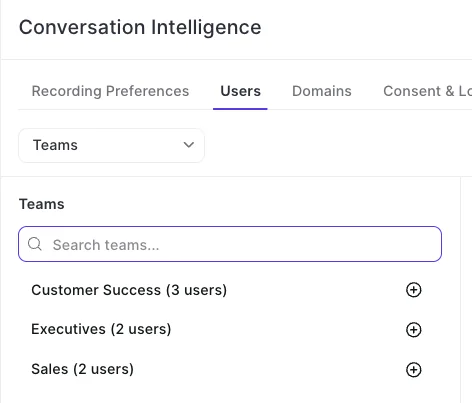
The audit and retention controls answer the procedure test:
- Only admins can delete a recording. Reps can't remove their own calls, so a missing recording traces to a named admin action.
- Retention is a setting. By default we keep recordings for as long as you subscribe, and you can have them deleted on a schedule, such as every 30 days.
- Exclusion goes beyond domains. The notetaker exclusion list blocks named domains. Weflow Activity and Contact Capture can block capture on any Salesforce field, so an account flagged confidential or every account in a billing country stays out.
- Nothing is read before enrollment. No mailbox is touched until a user is enrolled in a capture configuration, so IT can finish the technical setup while legal review is still open.
Access is controlled per recording as well. A manually uploaded call, for example, gets an access permission at upload, down to "only me":
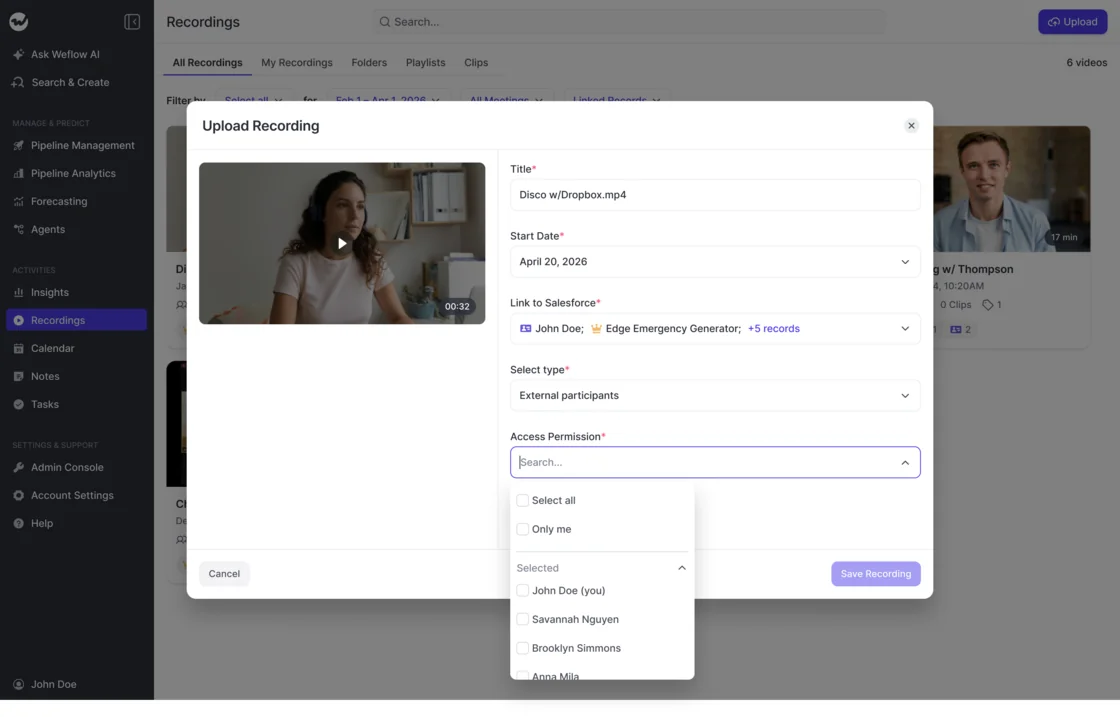
Your works council also has a smaller footprint to document. Weflow writes the summary and full transcript into native Salesforce objects, so the call content is reportable, permissioned by your existing Salesforce sharing, and still yours when the subscription ends. Video stays in Weflow's storage in your chosen region, because Salesforce is a poor place for large files.
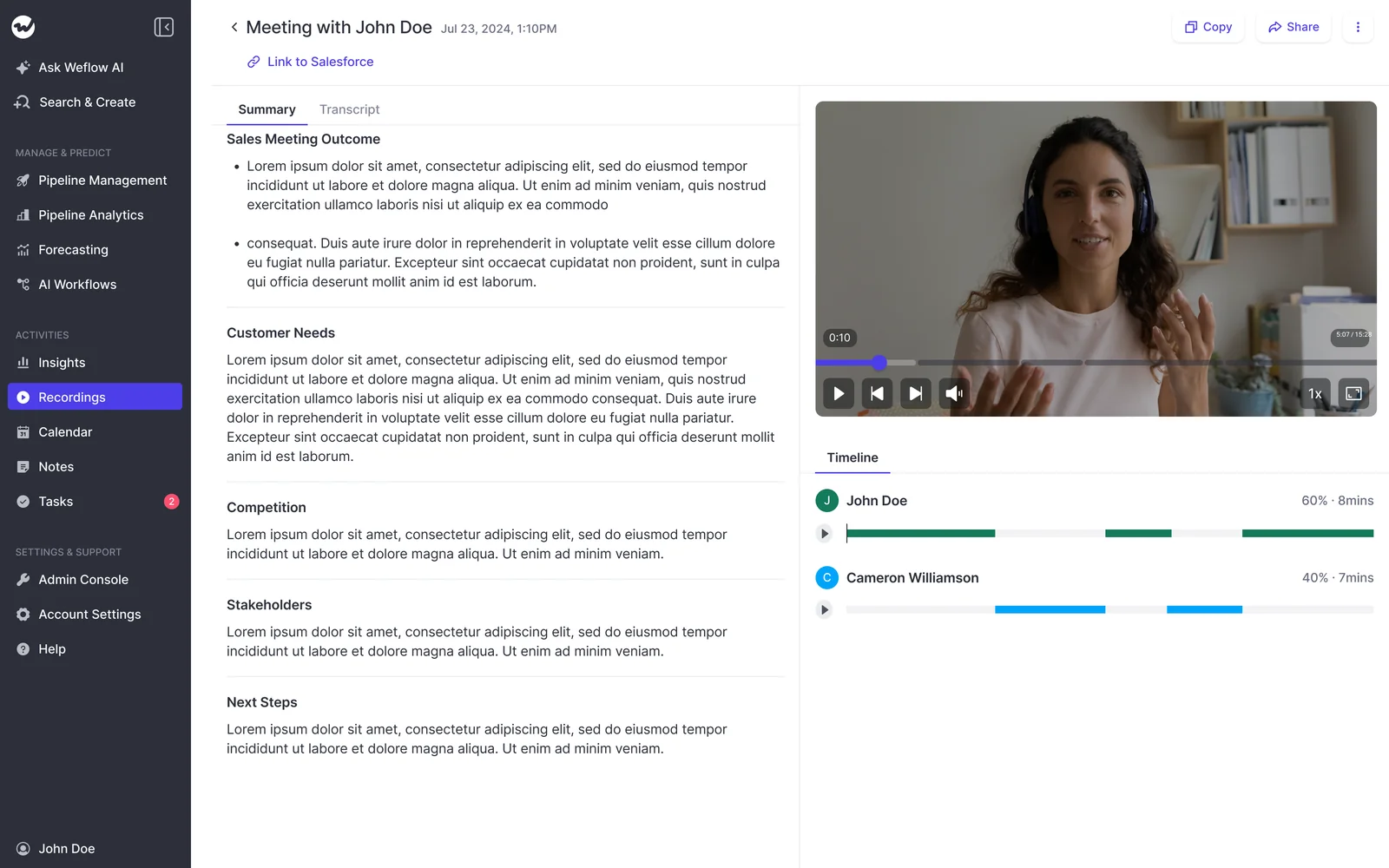
HolidayCheck went through this evaluation and chose Weflow over Gong as an EU-made, GDPR-safe alternative. Their Head of Media Sales Operations had used Gong before.
What Weflow doesn't cover yet, and who should stay put
Weflow has six limits that matter in an EU evaluation:
- No ISO 27001 yet. We're targeting December 2026 and have held SOC 2 Type II since 2021. If your procurement requires an ISO 27001 certificate today, we don't clear that gate.
- Consent is set per team, not per account region. A team selling into Germany and the US gets one consent behavior across both, so separate jurisdictions need separate teams. Gong's consent profiles are more granular here.
- The desktop app has no automated consent flow. When a rep records from the desktop app, nothing joins the meeting to post a notice, so consent is the rep's responsibility.
- Teams late joiners may miss the chat notice. Depending on Teams chat settings, someone who joins after the notetaker may not see the message. The notetaker stays visible in the participant list, and the pre-meeting email covers the gap.
- Salesforce only. There's no HubSpot, Dynamics or Pipedrive support.
- No live in-call assistant. Summaries, field updates, follow-ups and coaching scores all arrive after the call, and there are no real-time battlecards.
Stay where you are if your procurement mandates ISO 27001 today or you run HubSpot. Weflow isn't the answer for you on this article.
Gong: the broadest certifications, with US storage by default
Gong invented the category and records and analyzes sales calls in its own cloud. It sells a mandatory Foundation core license, with coaching, forecasting, engagement and data export applications on top. For an EU deployment, its residency is a choice made once at onboarding.
- CRM: multiple, through a marketplace of about 450 listings
- Hosting: AWS, US by default or EU if chosen at onboarding
- Certifications: SOC 2 Type II, ISO 27001, 27017, 27018 and 27701, CSA STAR, DPF
- Price model: per-user license plus platform fee, with AI credits on top; no published prices
| Capability | Gong's answer |
|---|---|
| Data residency | New customers choose US or EU storage, and the default is the US. EU storage doesn't confine processing, which also happens in the US, Israel and Ireland. Moving regions later costs extra. |
| Recording consent | Consent profiles set rules per team or region, using a consent page, an audio prompt and a pre-call email 10 to 20 minutes before. The page can be enforced, and participants can refuse recording and still join on most platforms. |
| AI data handling | Gong states customer data is never used to train generative models. It doesn't disclose its model providers or whether they retain data. |
| Transcription and languages | 70+ languages, with automatic detection on most calls and reprocessing when a call came out in the wrong language. Four features work on English calls only. |
| Security certifications | SOC 2 Type II, ISO 27001, 27017, 27018 and 27701, CSA STAR, and EU-US Data Privacy Framework certification. |
| Integrations | About 450 integrations and partner solutions, about 30 dialers, and recording on 11 meeting platforms. |
| Access from AI assistants (MCP) | Three record-scoped tools that return AI insights, never raw transcripts. Read-only, and each request draws metered credits. |
| Raw data access | The API returns transcripts, trackers and scorecards, capped at 3 calls a second and 10,000 a day. Warehouse delivery needs Data Cloud, a separate purchase of about $5,000 a year. |
| Pricing | No published prices. Foundation is mandatory, other applications sit on top, and figures come in a custom proposal. |
Gong's working surface is its own call page, where the transcript and analysis live in Gong's cloud:
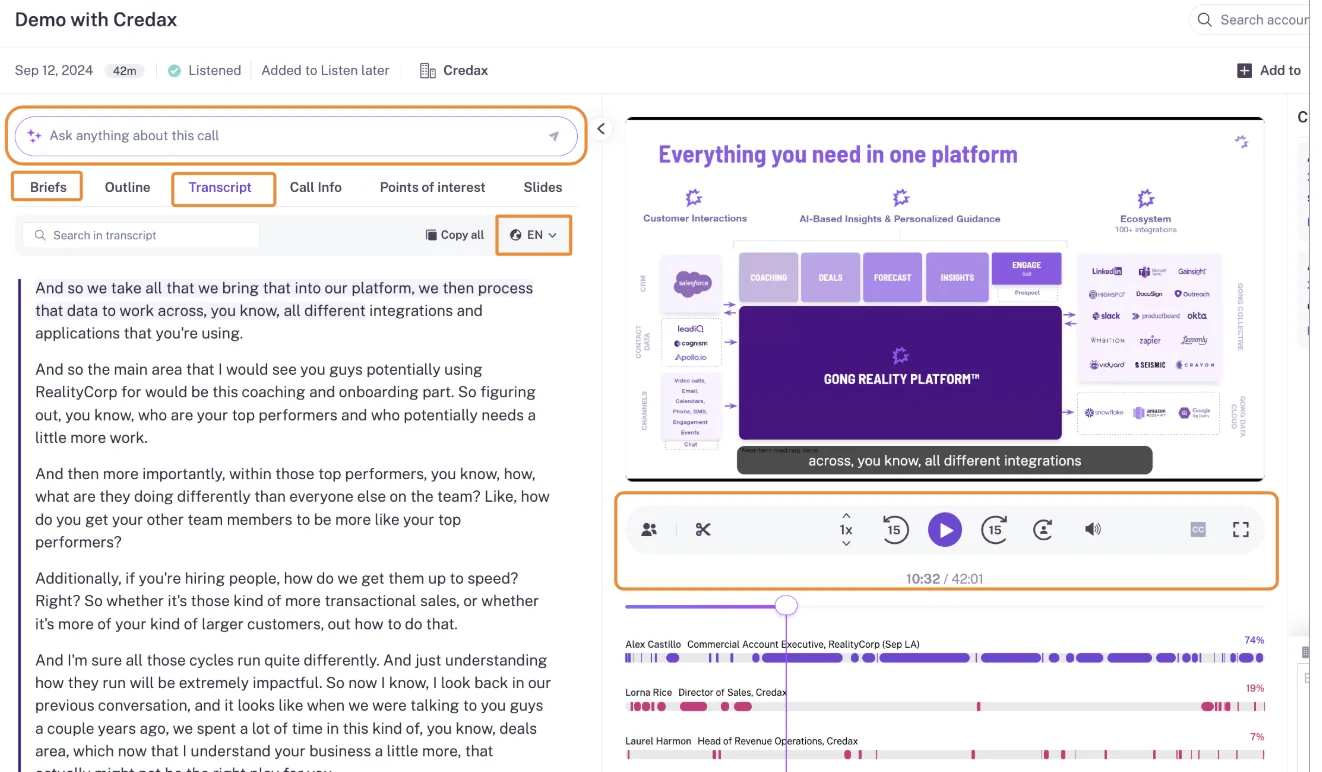
Where Gong is the stronger choice for EU buyers
Gong genuinely leads this field in four areas:
- The certification set is the strongest of the six. SOC 2 Type II, four ISO standards, CSA STAR and DPF are all checkable, and any comparison implying Gong is weak on formal compliance is wrong.
- Consent profiles go further than ours. A company can set different consent rules for different teams and regions in one workspace.
- Language coverage is wide. 70+ transcription languages with automatic detection on most calls.
- Conversation analytics run deepest. Gong gives you the deepest conversation analytics; Weflow gives you the fastest path from conversation to CRM data.
Best for: an enterprise whose procurement requires ISO 27001 today and needs per-region consent rules in one workspace.
Where Gong's EU residency story gets complicated
Your DPO is likely to flag these points in Gong's documentation:
- Storage defaults to the US unless someone selects the EU at onboarding.
- Choosing EU storage doesn't keep processing in the EU, which also runs in the US, Israel and Ireland.
- Moving data between regions after onboarding is a paid relocation.
- Gong doesn't name its model providers or document Zero Data Retention with them.
- Gong keeps calls, transcripts and statistics for up to three years by default, and calls saved in the library are kept indefinitely.
- Ad hoc recordings bypass the exclude lists, so a call with an excluded domain enters Gong the moment someone records it manually.
- A right-to-be-forgotten deletion also removes the Gong data synced into Salesforce, and can take several hours.
- Gong publishes no prices.
Jiminny: a separate EU environment and coaching-first design
Jiminny is coaching-first conversation intelligence for mid-market teams. It records meetings, dialer and in-person calls, scores and coaches reps, and writes call activity and AI-extracted fields into Salesforce, HubSpot and other CRMs. Its fully separate EU environment is a real residency answer, while its DPA and AI terms leave the AI chain question partly open.
- CRM: Salesforce, HubSpot, Dynamics, Pipedrive, Zoho, Copper, Close and Bullhorn
- Hosting: AWS, EU (Ireland) or US (Ohio)
- Certifications: SOC 2 Type II
- Price model: flat per-seat fee per tier; no published prices
| Capability | Jiminny's answer |
|---|---|
| Data residency | Two fully separate environments, EU in Ireland and US in Ohio. You pick one, data never passes between them, and Jiminny can move a customer between regions. |
| Recording consent | An email ten minutes before the meeting lets guests decline. A strict mode records only if every guest opts in through a consent page, which needs meetings created with its Outlook add-in, Teams only. Covers scheduled external meetings. |
| AI data handling | No training on customer data, by Jiminny or its AI providers, which it names. Zero Data Retention isn't documented, and the DPA allows processing to improve and develop the service. |
| Transcription and languages | 60+ languages with automatic detection per call. |
| Security certifications | SOC 2 Type II, with stated GDPR, CCPA and HIPAA compliance. |
| Integrations | About 20 third-party dialers plus its own, Zoom, Meet and Teams, Google and Microsoft 365 mailboxes, and Zapier. |
| Access from AI assistants (MCP) | A read-only connector for Claude and ChatGPT on the Scale and Grow tiers. Each user authorizes their own account and sees only what they can see, and requests stay in the customer's region. |
| Raw data access | A REST API opened with an organization-level key only admins can generate, suggested for feeding a warehouse or BI tool. |
| Pricing | No published prices. Flat per-seat fee with no platform fee or credits; dialer minutes above the allowance cost 2 cents each. |
Where Jiminny fits an EU sales team
- The EU environment is genuinely separate. EU and US data never pass between them, which answers residency more cleanly than an EU storage option on a US platform.
- It works across CRMs. HubSpot teams, and teams on Dynamics or Pipedrive, get a real option here.
- Coaching comes first. Scorecards, live in-call coaching and team insights are the center of the product.
- The commercial model is flat. One per-seat fee with no platform fee, add-on modules or usage credits.
Best for: a coaching-led mid-market team, possibly on HubSpot, that wants a fully separate EU environment.
Where Jiminny's DPA and consent setup fall short
Legal is likely to question these points in Jiminny's terms:
- The DPA lets Jiminny process personal data for the improvement and development of its service.
- Zero Data Retention with its AI providers isn't documented. Its terms let those providers use data as needed to provide the features, comply with the law and enforce their own policies.
- Strict opt-in needs meetings created through its Outlook add-in, which supports Teams only.
- Consent emails go out only for scheduled external meetings hosted by a Jiminny user.
- Default retention runs up to three years, and conversations in playlists or on open opportunities are kept regardless.
- Jiminny publishes no prices.
Attention: the most open AI access, with an unpublished EU location
Attention is an AI-native conversation intelligence tool that uses call data to power scorecards, CRM field updates, and agents and workflows. It's the most agent-accessible conversation store in this field. Its EU instance placement isn't published, and its defaults favor flow over control.
- CRM: Salesforce, HubSpot, Pipedrive, Zoho and others through workflow steps
- Hosting: a separate EU instance exists; the privacy policy says US storage
- Certifications: SOC 2 Type II
- Price model: negotiated contract; no published prices
| Capability | Attention's answer |
|---|---|
| Data residency | A separate EU instance serves EU-hosted organizations through its own API host. How a customer gets placed there isn't published, and the privacy policy says Attention stores customer data in the US. |
| Recording consent | A per-team pre-meeting consent page in five languages, an admin master consent switch, and a pre-meeting email. The desktop chat notice is in beta, and Attention switches it on per organization on request. |
| AI data handling | Attention commits not to train generalized models on user data. Zero Data Retention with its model providers isn't documented. |
| Transcription and languages | 100+ languages with automatic speaker labels. Each user sets a primary language, and automatic language detection isn't documented. |
| Security certifications | SOC 2 Type II covering Security, Confidentiality and Availability, plus stated HIPAA compliance with a BAA. |
| Integrations | Google, Outlook and Zoom calendars, Zoom Phone and Aircall, two-way Slack, and workflow steps into Gmail, Sheets, Salesforce, HubSpot, Notion, Snowflake and more. |
| Access from AI assistants (MCP) | 68 tools across 15 groups, read and write, returning raw transcripts. Calls run under the user's permissions, except org-level API keys, which carry full organization access. Rate-limited, with no consumption charge. |
| Raw data access | Raw transcripts, scorecards and insights through MCP and API keys. Workflows can push data to Snowflake or any API. |
| Pricing | Not published. |
Where Attention fits an EU sales team
- The widest MCP surface in the field. 68 tools that return raw transcripts, with no consumption charge on the traffic.
- Agent workflows run on call data. Workflows branch, loop, run custom code and call OpenAI or Anthropic as steps.
- A per-team consent page shipped in July 2026. Participants review and consent before joining, in five languages.
- Admins set media retention. Retention policies with configurable hold periods shipped in April 2026.
Best for: a fast-moving team that puts agent workflows and open AI access first, and whose legal team is comfortable with an EU instance of unpublished placement.
Where Attention's defaults work against EU governance
Your legal team is likely to push back on these:
- EU instance placement isn't published, and the privacy policy says US storage.
- Zero Data Retention with model providers isn't documented.
- Snippets of recorded customer calls share as public links unless someone restricts them.
- Automatic CRM sync is the recommended setting, so extracted values land on the opportunity without review.
- The desktop chat notice is in beta, and the consent page reaches only participants who join through an Attention meeting link.
- The Salesforce integration needs a connecting user with Modify All Data.
- Attention publishes no prices.
Avoma: published prices, but customer data hosted in the US
Avoma is a meeting-first conversation intelligence tool that records, transcribes and summarizes calls, with CRM sync, coaching and deal features added on top. It's open about price and flexible on consent enforcement. All customer data sits on AWS in the US.
- CRM: Salesforce, HubSpot, Pipedrive, Zoho, Copper and Zendesk Sell
- Hosting: AWS, United States
- Certifications: SOC 2 Type II and ISO/IEC 42001
- Price model: published per recorder seat, plus add-ons
| Capability | Avoma's answer |
|---|---|
| Data residency | All customer data on AWS in the US. Organizations that need EU residency discuss options with its enterprise team. |
| Recording consent | Invite disclaimer, reminder emails, and a spoken and chat notice from the bot, plus an optional accept-or-decline mode. Admins pick one of four enforcement levels for the whole organization. |
| AI data handling | Avoma never trains on meeting data, and admins set retention periods. Zero Data Retention with model providers isn't documented. |
| Transcription and languages | 60+ languages and dialects. Automatic detection isn't documented, and multi-language support is switched on through support. |
| Security certifications | SOC 2 Type II and ISO/IEC 42001, the AI management standard. No ISO 27001 certificate is named. |
| Integrations | 26 native integrations across conferencing, CRMs, dialers, Slack, Teams chat and ClickUp, plus Zapier. |
| Access from AI assistants (MCP) | 11 read tools and 3 write tools for Claude and ChatGPT, on the Organization or Enterprise plan or the API Access add-on. |
| Raw data access | REST API and webhooks, limited to 60 requests a minute, from the Organization plan up. |
| Pricing | Published: Startup $19, Organization $29, Enterprise $39 per seat per month billed annually, with $29 add-ons. |
Where Avoma fits an EU sales team
- Prices are public. You can build the business case before talking to sales.
- It supports six CRMs. Teams outside Salesforce have an option.
- Consent enforcement is selectable. Four levels, from notice up to an explicit accept-or-decline.
- Meeting data isn't used for training, and admins set retention.
- It holds SOC 2 Type II plus ISO/IEC 42001.
Best for: a small, budget-led team whose legal stance accepts US hosting.
Where Avoma falls short on EU residency
- Hosting is US only, and EU residency is a conversation with the enterprise team rather than a published option.
- Mutually signed DPAs, custom data retention and SSO come with the Enterprise plan only.
- Automatic language detection isn't documented.
- Zero Data Retention with model providers isn't documented.
- Consent policy applies org-wide, so it doesn't vary by team or region.
Chorus: a strong GDPR consent page on US data centers
Chorus is ZoomInfo's conversation intelligence tool, sold as one engagement feature inside the ZoomInfo data platform. Its Compliance Mode consent page is the strongest GDPR consent flow in this field. Hosting is US, and ZoomInfo's privacy policy doesn't exclude Chorus data from model training.
- CRM: Salesforce, HubSpot and Microsoft Dynamics, cloud versions only
- Hosting: ZoomInfo's US data centers
- Certifications: ISO 27001, ISO 27701 and SOC 2 Type II through ZoomInfo
- Price model: custom plans quoted through sales
| Capability | Chorus's answer |
|---|---|
| Data residency | ZoomInfo hosts its services in US data centers. Enterprise customers can keep recordings in their own AWS S3 or Google Cloud bucket; transcripts aren't described as moving. |
| Recording consent | Compliance Mode sends attendees to a brandable page that adapts to their location and language. Where GDPR applies, each attendee joins with or without recording, and Chorus records only if all consent. |
| AI data handling | ZoomInfo's privacy policy lists training LLMs among its data uses and applies it to Chorus recordings. OpenAI and Anthropic, both in the US, are generative AI sub-processors. |
| Transcription and languages | Each call is transcribed in the user's preset language, with no automatic detection. Summaries and next steps come out in English only. |
| Security certifications | ZoomInfo's ISO 27001, ISO 27701 and SOC 2 Type II cover Chorus and renew annually. |
| Integrations | 19 conferencing providers, 30+ dialers, three CRMs, Clari and Gainsight. Slack and Zapier need Enterprise. |
| Access from AI assistants (MCP) | Since July 2026, ZoomInfo's MCP server answers account questions from Chorus calls, emails and transcripts, drawing on ZoomInfo's credits. |
| Raw data access | API access comes with the Enterprise package only. |
| Pricing | Not published. |
Where Chorus fits an EU sales team
- Compliance Mode is the strongest GDPR consent flow here. Under GDPR, Chorus records only if every attendee consents, and the page adapts to where each attendee is.
- The certification set comes through ZoomInfo. ISO 27001, ISO 27701 and SOC 2 Type II, renewed annually.
- Recordings can live in your own bucket. Enterprise customers can store recordings in their own AWS S3 or Google Cloud storage.
- It slots into a ZoomInfo contract. An existing ZoomInfo customer adds conversation intelligence without a new vendor.
Best for: an existing ZoomInfo customer whose priority is a strict all-attendee consent flow and an ISO 27001 certificate today.
Where Chorus falls short on the AI chain and languages
- Hosting is in US data centers.
- ZoomInfo's policy lists LLM training among its data uses with no exclusion for Chorus, and its generative AI sub-processors are OpenAI and Anthropic in the US.
- There's no language detection, and summaries come out in English only, which is hard for a German-speaking team.
- Teams consent is weak in practice. On our calls, one Teams-based Chorus customer gave up on Compliance Mode and built an integration to pull Teams recordings in after the call.
- ZoomInfo's AI investment points at its data graph rather than the conversation layer.
- ZoomInfo publishes no Chorus prices.
What each tool costs, and which vendors publish prices
Only Weflow and Avoma publish prices. Gong adds a platform fee, a mandatory Foundation license, metered AI credits and paid region relocation, and the rest quote through sales.
| Tool | Pricing model | Published list prices | What costs extra | Commercial terms we know |
|---|---|---|---|---|
| Weflow | Per seat, with AI included; Weflow Agent Builder is the only consumption-priced product | Weflow Conversation Intelligence $39 per user per month billed annually. Weflow Revenue AI Foundation $49, Weflow Revenue AI Business $59, Weflow Revenue AI Enterprise $79 | Agent Builder beyond the free 25 actions a month: $299 for 500, $999 for 2,500 | 10-user minimum, 12-month term, no mid-term seat reduction (seats reassign when someone leaves), added seats pro rata. Ask Weflow AI Pro and Agent Builder free tier in every plan |
| Gong | Per-user license plus a platform fee; Foundation is mandatory | None | Applications on top of Foundation; AI credits for trackers, MCP and API workflows; Data Cloud at about $5,000 a year; region relocation | Custom proposal; seats added after renewal are paid per application |
| Jiminny | Flat per-seat fee per tier, no credits | None, apart from dialer overage | Dialer minutes above 1,350 per 30 days, at 2 cents each | 14-day trial without a card |
| Attention | Negotiated contract | None | Not published; MCP usage is rate-limited rather than charged | Custom priced for mid-market and enterprise |
| Avoma | Per recorder seat, plus add-ons | Startup $19, Organization $29, Enterprise $39 per seat per month billed annually; Conversation and Revenue Intelligence add-ons $29 each; Lead Router $19 | Optional $1,000 onboarding; bulk import of past recordings may carry a fee | 10-seat minimum; free viewer seats; 14-day trial |
| Chorus | Custom plans through ZoomInfo | None. Our estimate: about $8,000 a year for a base with three seats, plus about $1,200 per extra seat | API, Zapier and Slack need Enterprise; MCP draws ZoomInfo credits | Sold standalone or inside a wider ZoomInfo subscription |
Metered AI is the line your finance team will ask about. A seat price is a known annual number, while a credit pool grows as adoption succeeds. Teams respond by rationing who can use the AI, which is the opposite of what you bought it for.
We price per seat with summaries, field updates and Ask Weflow AI included, and Weflow costs about half of what Gong typically does for the same coverage.
Which tool to shortlist for your team and legal setup
Shortlist on your hardest legal constraint first, then on CRM and budget.
| If your situation is… | Shortlist |
|---|---|
| An EU Salesforce team that needs residency and the AI chain answered in writing | Weflow |
| Procurement mandates ISO 27001 today | Gong, or Chorus if you're a ZoomInfo customer |
| HubSpot or multi-CRM, with an EU environment required | Jiminny |
| Agent workflows and open MCP access come first | Attention, if legal accepts an EU instance of unpublished placement |
| A small, budget-led team where US hosting is acceptable | Avoma |
| An existing ZoomInfo customer | Chorus |
| Legal hasn't cleared recording existing customers | Start prospects-only, with exclusion rules for customers and confidential accounts |
That last row is more common than vendors admit. Buyers tell us existing customers are more sensitive than prospects, and that a narrower rollout limits the seat count. A prospects-only pilot with domain exclusions gives legal a contained scope to approve, and gives you data to make the case for the next phase.
Two gates can override everything in this table:
- Certifications held today. If ISO 27001 is a hard requirement, roadmap dates don't count.
- Vendor size and longevity. For a multi-year rollout, your organization will weigh who's behind the product. The person proposing a smaller vendor carries that risk, which is why the old line about nobody getting fired for buying Gong still circulates.
If Weflow is on your shortlist, you can see the consent settings, the consent log and the exclusion rules before legal asks. Walk through the product yourself, no call required.
What changed in EU conversation intelligence during 2026
- April 2026, Attention: admins can set media retention policies with configurable hold periods, and individual users can choose consent-required bot joining. Retention became a setting rather than a support ticket.
- July 2026, Attention: a per-team pre-meeting consent page in five languages, an admin master consent switch, and an admin setting for desktop chat compliance messages, which Attention still enables per organization on request. Attention now has a real consent page for bot recordings.
- July 2026, ZoomInfo: its MCP server added a tool that answers account questions from Chorus calls, emails and transcripts. Chorus conversation data now reaches external assistants, and ZoomInfo puts the no-training obligation on the customer's own AI account settings.
- Gong: AI trackers, MCP requests and API workflows draw on a pooled credit model, 2,000 credits per paid core seat a year. The AI cost of an EU rollout now moves with usage.
- Weflow: we set a December 2026 target for ISO 27001. Procurement gets a dated commitment, not a certificate yet.
How we researched these six tools
Each verdict comes from vendors' public trust pages, help centers, DPAs, sub-processor lists and pricing pages, plus our own documentation for Weflow. A few points, such as Chorus's Teams consent experience and Gong's relocation fee, come from what buyers told us on calls, and we've flagged those where they appear.
Weflow publishes this article. We applied the same nine criteria to every tool, and where a vendor doesn't document something, we say it isn't documented rather than guess.
- Offers: the vendor documents the capability, and we describe it as documented.
- Partial: the capability exists with a documented limit, such as no training but no Zero Data Retention, or prices with no published figures.
- Not offered: the vendor's documentation shows the capability isn't there, such as no published pricing.
FAQ: GDPR, works councils and conversation intelligence
Is consent to record the same as consent to analyze under GDPR?
Not necessarily, and legal teams raise the difference often. Most vendors' consent flows only address recording. In Weflow the consent notice is fully customizable, text and language included, so you can state in it that the call is recorded, transcribed and analyzed to update CRM records. Whether that covers your legal basis is your counsel's decision, so get both purposes written into your notice and your works council documentation.
Does EU data storage mean call data stays in the EU?
Not necessarily, because storage and processing are separate questions. Gong is the documented example: EU storage, with processing in the US, Israel and Ireland. Weflow's data follows your Salesforce region, so an EU-hosted org keeps its Weflow data in Europe, and temporary processing data follows the same tenant isolation and is deleted after processing.
Where does Weflow store video recordings versus transcripts?
Weflow holds video in its AWS environment in the region you choose: Frankfurt, New York or Sydney. Transcripts and structured outputs go into native objects in your Salesforce. Video can also be exported through the API to your own storage.
Can we exclude existing customers or confidential accounts from recording?
Yes. The notetaker exclusion list blocks named customer domains, and Weflow Activity and Contact Capture can block capture on any Salesforce field, such as a confidential flag or billing country. During a call, the host can remove the notetaker, and a guest opt-out deletes the recording, transcript and notes.
Are internal meetings recorded?
The Weflow notetaker only joins meetings with at least one attendee outside your configured internal domains. Internal-only meetings aren't recorded by the notetaker.
What happens with late joiners on Microsoft Teams?
Depending on your Teams chat settings, someone who joins after the notetaker may not see the chat notice. The notetaker stays visible in the participant list, and the pre-meeting email gives every external guest the notice and a way to decline before the call.
Does a botless desktop recorder make GDPR easier?
Usually not. Legal teams often prefer a visible bot with a consent flow, because the bot is what posts the notice and leaves when someone objects. When a rep records with the Weflow desktop app, there's no automated consent flow, and consent is the rep's responsibility.
When will Weflow hold ISO 27001?
Our target is December 2026. We've held SOC 2 Type II since 2021, and the segregation controls for data outside Salesforce sit inside that audited scope. If your procurement requires ISO 27001 today, treat ours as in progress.
Can we migrate Gong call history into Weflow?
Yes, at no charge. The migration keeps the link between each call and its Salesforce account, so imported calls are searchable and scoreable like native ones. The history lands in the Weflow region you've chosen.
What are Weflow's contract terms?
- 10-user minimum per product or bundle.
- 12-month term.
- No mid-term seat reduction, though you can reassign a seat when someone leaves.
- Seats added mid-term are charged pro rata to the end of the term.