
Clari vs Gong: Forecasting and Conversation Intelligence Compared


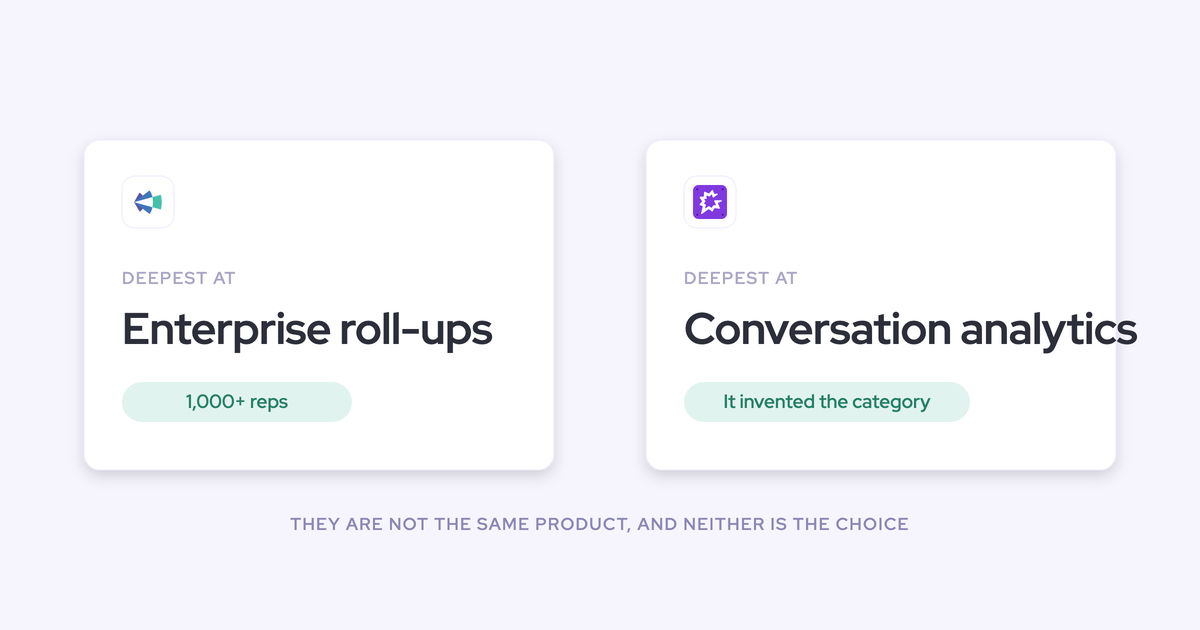
If you're comparing Clari and Gong, you're comparing two tools that barely compete. Clari is a forecasting and leadership tool that acquired its way into conversation intelligence. Gong is a conversation platform that rolled forecasting in later. Each is strong on the job it started with and thin on the other half.
So the honest question isn't which one. It's which gap you can live with, whether you can carry both (and whether they'll talk to each other, which they don't), or whether one platform where conversation intelligence and forecasting run on the same data layer removes the trade-off entirely.
Weflow is the Revenue AI Orchestration platform for sales, customer success, and RevOps teams, and it's the third option in this comparison: Conversation Intelligence + AI Field Updates and forecasting built in-house, landing in the Salesforce you already own. Weflow stays out of the way until the second half of this article, because the comparison has to be fair first. Both incumbents genuinely win somewhere, and we'll say exactly where.
Clari vs Gong at a glance: two tools, two different jobs
On almost every dimension that matters to a RevOps evaluation, one tool is strong precisely where the other is weak.
| Dimension | Clari | Gong |
|---|---|---|
| Origin and core strength | Started in forecasting. Roll-up forecasting and board reporting are still its strongest, most defensible product. | Invented conversation intelligence. Call recording, transcription, and conversation analytics are still the deepest in the market. |
| Forecast roll-ups | Mature and flexible, and the most mature option we've seen at 1,000+ rep scale. | AI prediction and automated roll-ups, thinner on configuration and hierarchy depth. |
| Deal-by-deal forecast submission | Core to the product. Reps and managers submit and the roll-up follows the hierarchy. | None. You get a predicted number, not a submitted one. |
| Deal-level health | Weak. Hard to see which deals are being pushed, and forecast-versus-actual accuracy isn't measured. | Deal boards with AI-detected qualification signals, which buyers genuinely like. |
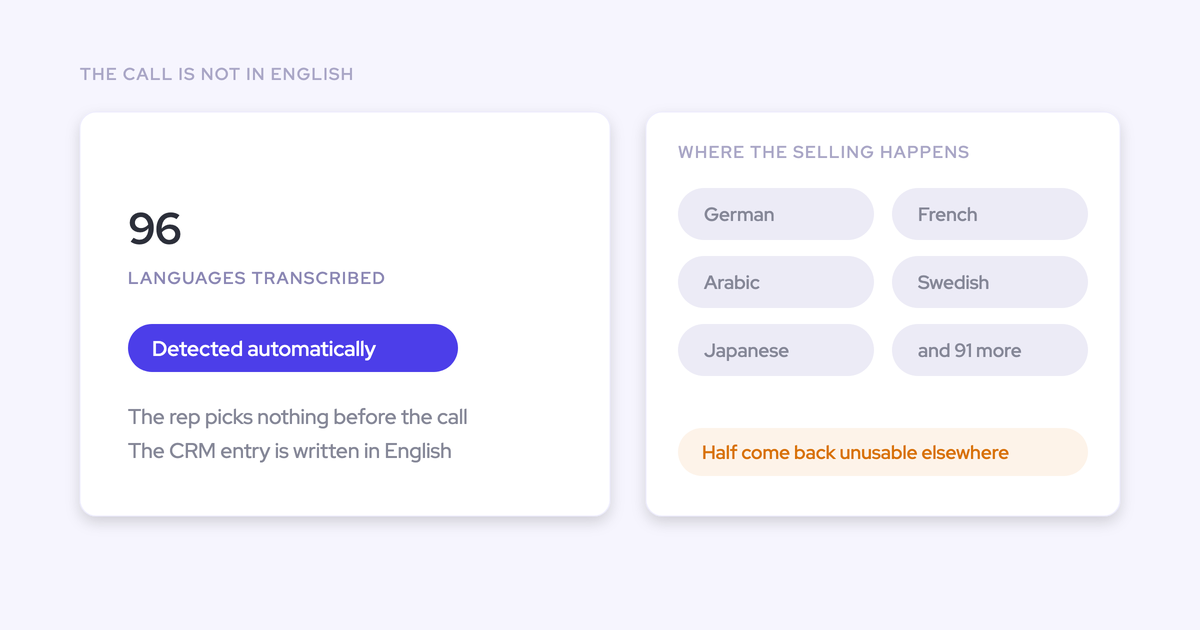
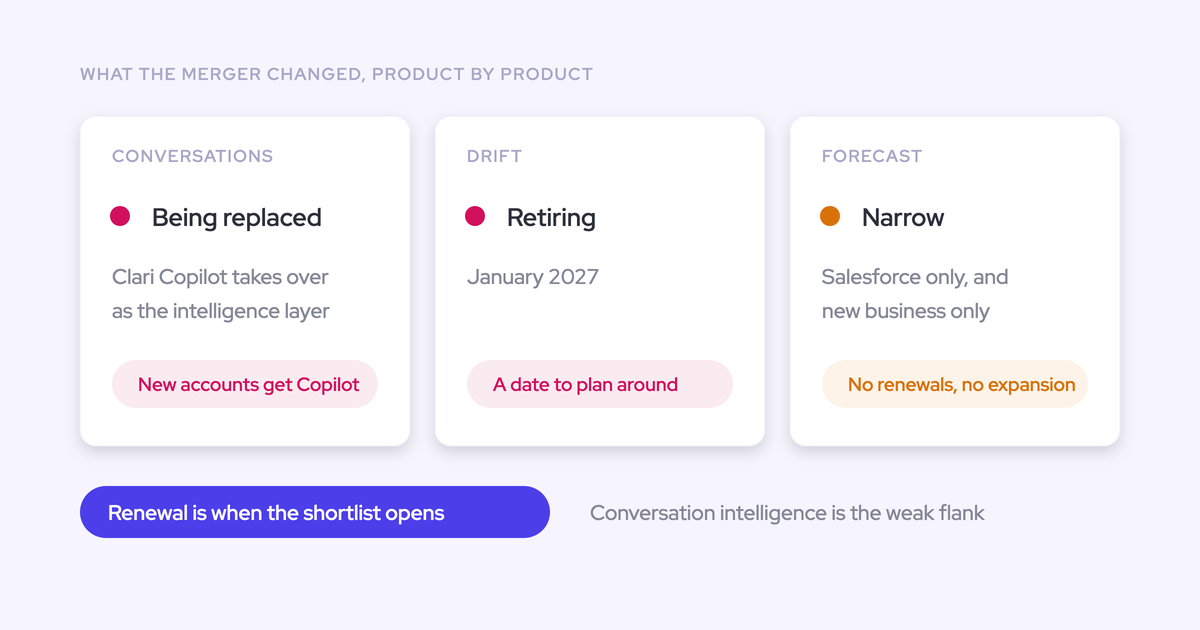
| Conversation intelligence depth | Clari Copilot came in by acquisition. Buyers describe it as transcription with little on top. | Transcription across 96+ languages, trackers, and account-level methodology summaries across every call on a deal. |
| Coaching and methodology scorecards | No AI coaching scorecards for MEDDIC or MEDDPICC, no advanced rep-level coaching insights. | Coaching workflows and scorecards, sold as a paid add-on module. Trackers detect methodology mentions but don't produce a weighted deal score. |
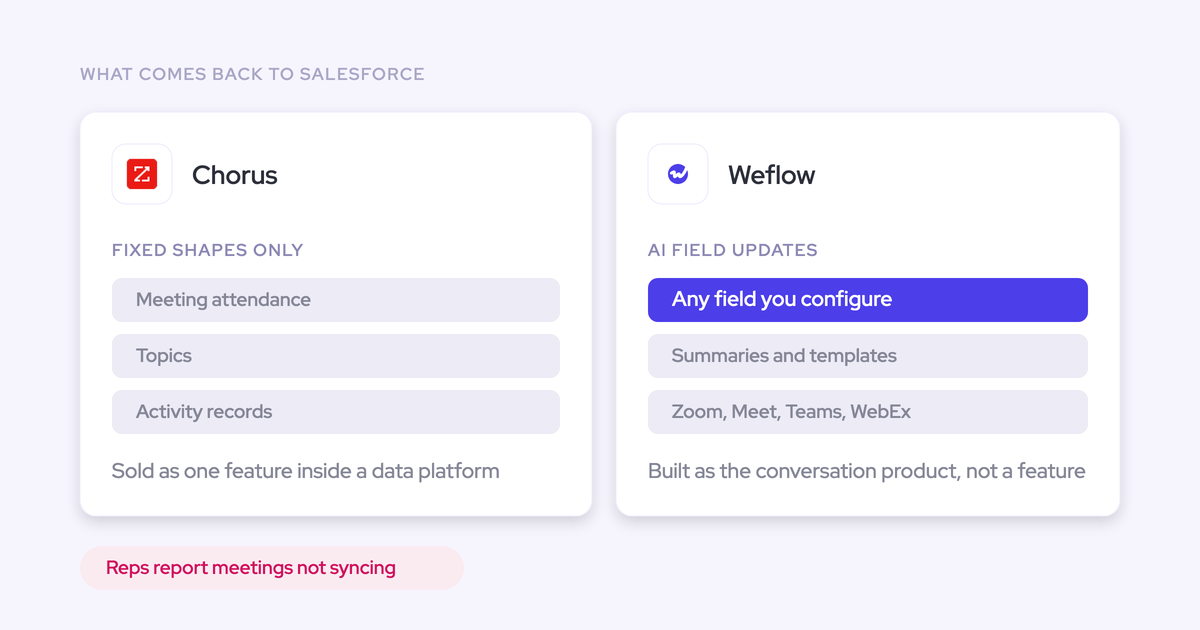
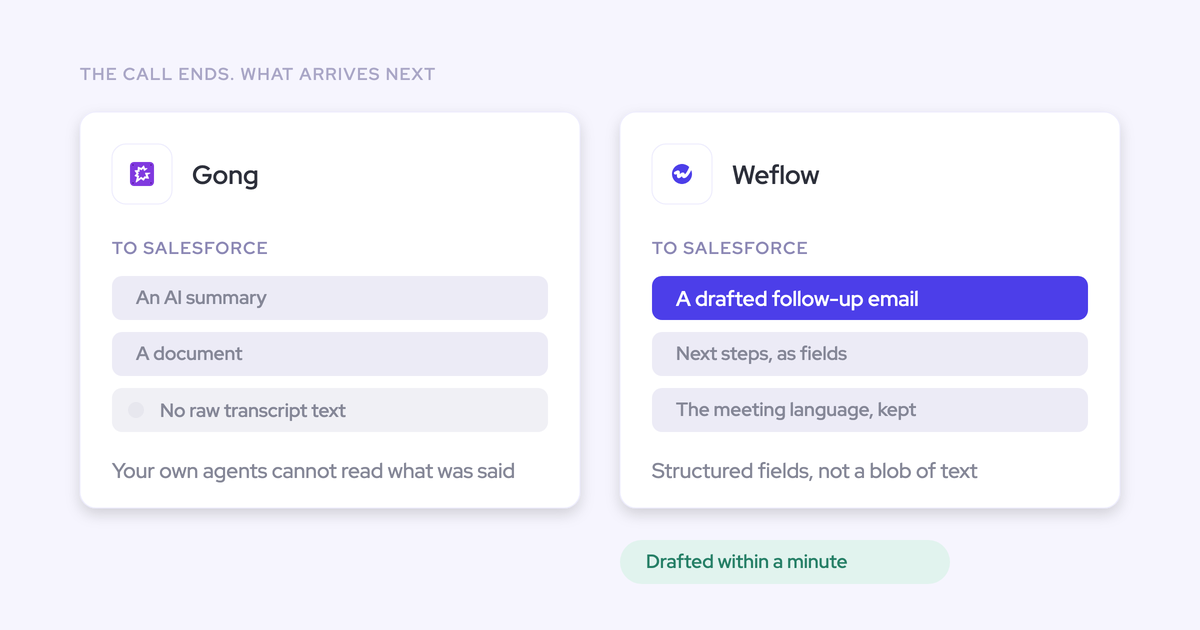
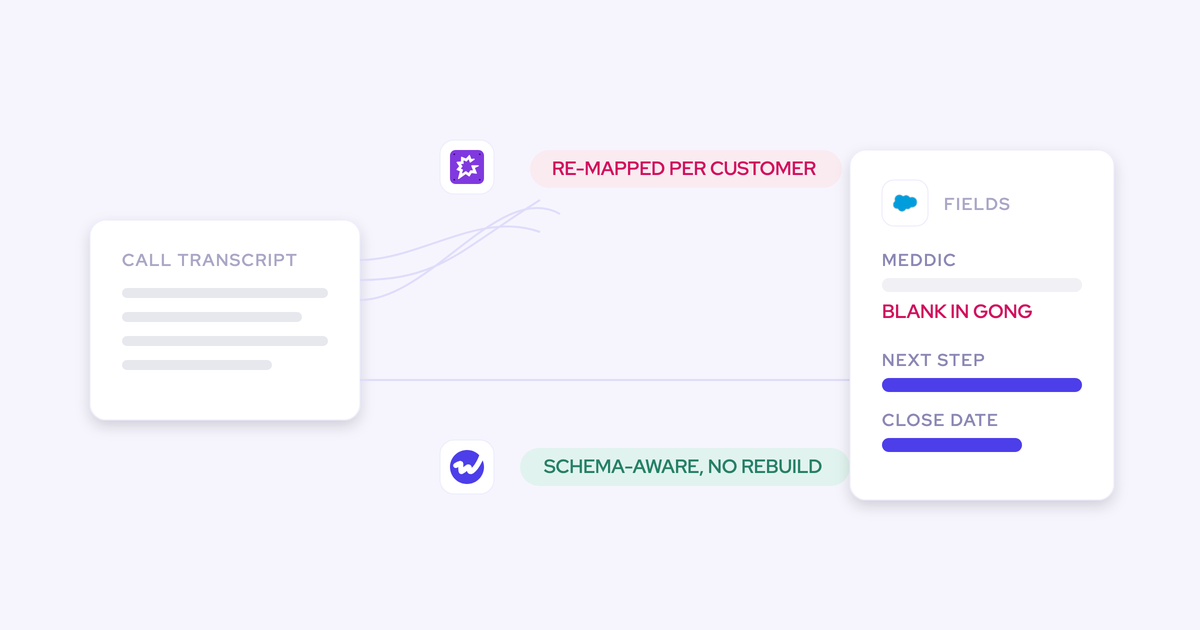
| Writing call outcomes to Salesforce fields | No AI field updates into Salesforce fields or objects from Copilot. | Surfaces insights, but MEDDIC and methodology fields are updated by hand after a rep reviews them. |
| Where captured activity lands | Clari Capture maps server-side by email domain, so activity often sits on the account rather than the right opportunity, and misattributes when an account has several open deals. | Activity is logged to Salesforce, but mapped into Gong's own data structure. Recordings, transcripts, and analytics live in Gong's cloud. |
| Contact creation in Salesforce | Contacts have to already be mapped to the right account, or the emails are missed. | Captures call participants but does not create the missing contact records. |
| Pipeline history and point-in-time views | The waterfall, the pacing view, and the same-day-last-quarter comparison are the three views teams actually use. In practice the bridge runs on close date and gets hard-coded to the current quarter. | Not where Gong plays. Buyers who want to reconstruct pipeline as it stood on a date don't get it here. |
| Who gets value | Sales leadership and ops. Rarely deployed across CS and account management. | Managers and enablement. Per-seat cost usually stops it reaching the whole customer-facing org. |
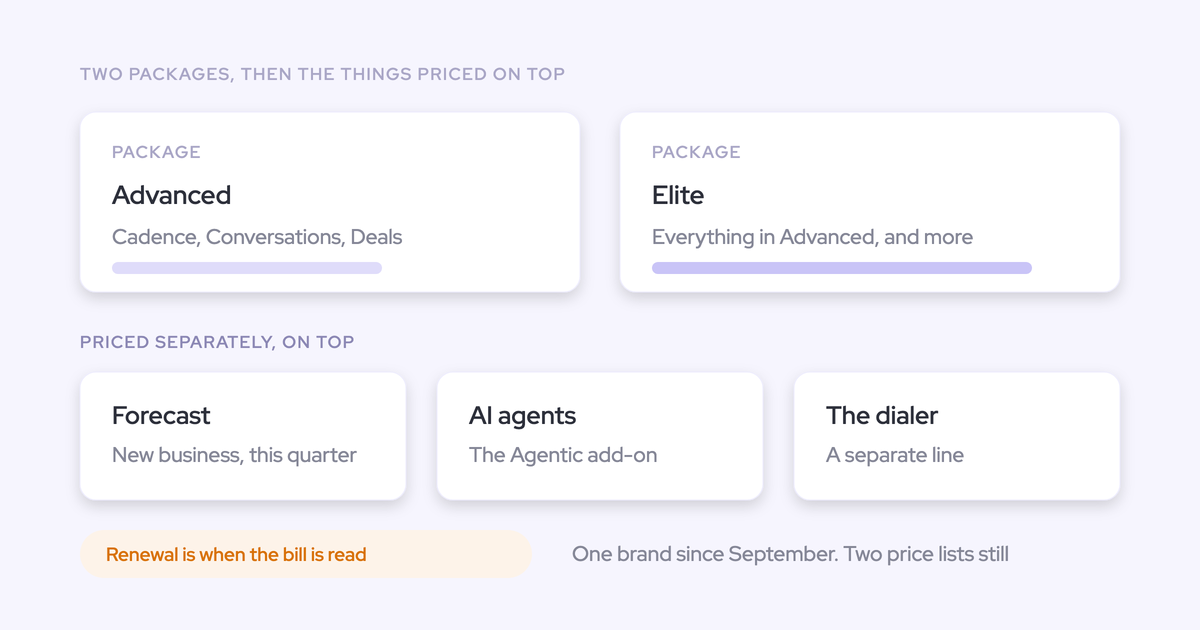
| Pricing model | Not published. Quote-based, and buyers consistently describe it as expensive relative to the usage they get. | Not published either. Platform access fee, then a per-seat Foundation license, then paid add-on modules for coaching and forecasting. |
Read that table as a division of labor, not a scoreboard. Neither column is a losing column. It's just that whichever one you pick, you're buying one half of the job.
Why teams end up comparing Clari and Gong
The two categories converged from opposite directions, and the marketing converged faster than the products did.
Gong started in call intelligence and rolled forecasting in. Clari started in forecasting and bought a recording company. Gong then pushed outward again into sales engagement, while Outreach pushed inward into deal management and forecasting. Everybody now claims everybody's turf.
That's why you landed on this query. A vendor page told you either tool covers the whole job. Neither does, and the tell is always the same: the bolted-on half doesn't share data with the original half.
Clari's strength is forecasting, not conversation intelligence
Clari is a leadership tool. That's its edge and it's also its boundary, and the boundary is where most of the frustration we hear lives.
Where Clari's forecasting genuinely leads
Clari's roll-up forecasting is mature, flexible, and at enterprise scale it's the most defensible product in its suite. If you're running a formal weekly forecast across a large org, it does the mechanics properly.
The parts teams actually use every week:
- Deal-by-deal and rep-by-rep forecast submission, rolling up through the hierarchy.
- The pipeline waterfall, which is still the view most Clari owners open first.
- The pacing view, and the comparison of where the quarter stands against the same day in previous quarters.
- Roll-ups at 1,000-plus reps, where Clari is more mature than anything else we've evaluated against.
Two honest limits sit underneath that strength. Clari is weak at deal-level health, so it struggles to tell you which deals are quietly being pushed. And it doesn't measure forecast-versus-actual variance, which means after several years on it a team still can't say how close its commits have been.
Why Clari's conversation intelligence feels like transcription
Clari Copilot wasn't built in-house. It arrived through the acquisition of a separate recording company and it still behaves like a bolted-on layer.
Concretely, what's missing is the layer above the transcript. Copilot doesn't produce AI field updates that write into Salesforce fields or objects. There are no AI coaching scorecards for MEDDIC or MEDDPICC, and no advanced rep-level coaching insights.
That matters because transcription stopped being a differentiator a while ago. Every tool in this category transcribes well now. The value is in what happens to the conversation afterwards, and Copilot mostly stops at the recording.
There's a second-order cost too. Clari gets deployed on AEs and the managers above them, rarely across account management and customer success, so the teams generating renewal and expansion conversations sit outside the data layer completely.
Gong's strength is conversation intelligence, not forecasting
Gong created this category and still leads it. Forecasting is the part that arrived later, and it shows in a specific, testable way.
Where Gong's conversation analytics lead the category
If conversation depth is your first requirement, Gong is a defensible choice and we say so on calls.
- The deepest conversation analytics in the market, with transcription across 96+ languages.
- Account-level methodology summaries, so a manager reviewing a long cycle can ask for the qualification picture across every call on the account, not call by call.
- Deal boards that flag which qualification criteria the AI has checked off, which buyers name unprompted as their favorite feature.
- Category maturity: an MCP endpoint, in-platform agents, and a decade of pattern data behind the analytics.
- A sales engagement product, which Weflow doesn't have and doesn't plan to build.
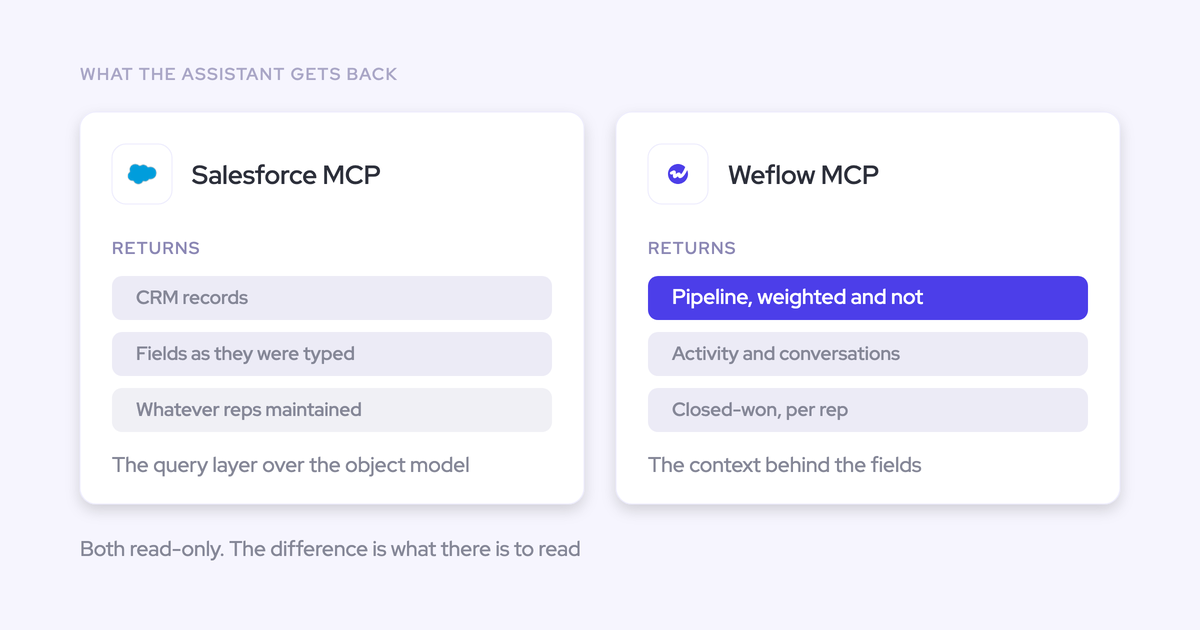
Where it hurts is the CRM boundary. Gong logs activity to Salesforce, so activity logging on its own isn't why teams leave. But the data is mapped into Gong's own structure, contacts aren't created, and methodology fields stay manual after a rep reviews the insight.
The mapping of fields is a nightmare in Gong, and they really haven't overcome that properly.
What breaks when you try to forecast in Gong
Gong has no deal-by-deal forecast submission, which is the specific mechanic a weekly forecast cadence runs on.
Think about what that cadence actually requires. Reps update pipeline by a fixed day. Managers run deal reviews. Reps submit a number against named deals. Managers adjust the roll-up. Then the call happens, and the only useful question in the room is: this was committed last week, where is it now, why did it move.
You can't ask that question without submissions to compare week over week. Gong gives you an AI prediction and an automated roll-up, so you get a number without an owner and without a change history. Configuration depth is limited too, which bites the moment you need separate targets for new business, expansion, and renewal running in parallel.
The other thing that repeatedly fails to land is the dashboards.
Do Clari and Gong work together if you buy both?
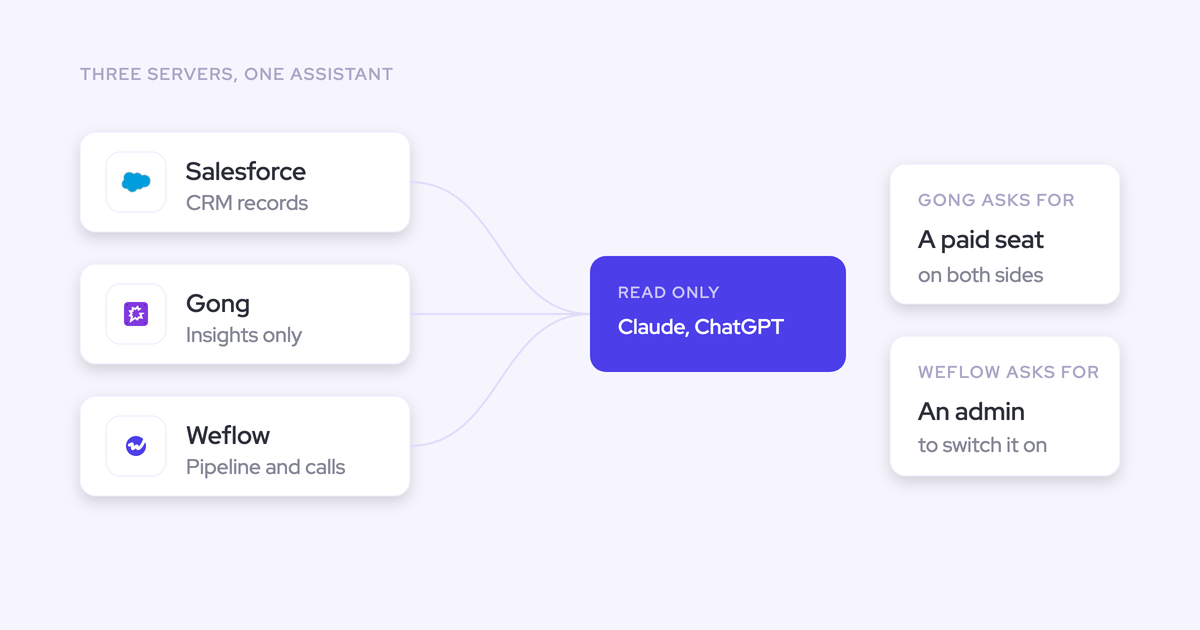
No. Buying both gets you two clouds and no shared data layer, so call insight still never reaches the forecast.
Gong holds the conversation data in its own structure. Clari reads Salesforce activity and rolls up a number. Nothing in that arrangement carries what was said on the call into the deal record the forecast reads.
The sharper version of this problem is that Clari's own two products don't share data either. Clari's forecasting product and Clari Copilot don't talk to each other, so owning both halves from one vendor doesn't fix it. Teams end up piping transcripts into a separate AI workspace to extract structure and then feeding it back to the CRM by hand.
There's also a quieter tax when two tools both write to Salesforce. An activity capture layer writes the meeting, a recorder writes the meeting again, and every report on meetings per rep or per closed opportunity is inflated.
If you record a meeting, it's not another meeting. It's the same meeting.
— Janis Zech, Co-founder and CEO of Weflow
What Clari and Gong actually cost
Neither publishes pricing, which is itself part of the buying experience. One buyer told us it took three calls with Gong before a number appeared.
Gong's list structure is a stack, not a seat price:
| Component | List cost | What it covers |
|---|---|---|
| Platform Access fee | $5,000 per year | Charged before any seat license |
| Gong Foundation seat | $1,600 per seat per year | Interaction capture, mobile app, keyword and smart trackers, Ask Anything, basic analytics |
| Gong Enable Essentials | About $300 per seat per year | Coaching workflows and scorecards |
| Gong Forecast Essentials | About $300 per seat per year | Deal boards, win/loss |
| Gong Engage | About $800 per seat per year | Prospecting and an in-app dialer |
| Gong Forecast | About $800 per seat per year | The fuller forecasting tier |
| Gong Data Cloud | About $5,000 per year | Gong data exposed in Snowflake, Databricks, BigQuery, Redshift |
| Dedicated CSM | Included above $45,000 per year | Below that threshold, pooled support |
Run the list math for 100 seats on Foundation plus the two Essentials modules and you're at $225,000 a year before any discount. The structural problem isn't the total, it's that you can't put most seats on a cheap tier and a few on the expensive one. Everyone pays the Foundation floor first.
That's why Gong so often doesn't reach the whole customer-facing org. Coverage ends where the per-seat budget ends, and customer success is usually what gets cut.
Clari's cost shows up differently. There's no published number, and the complaint we hear isn't the license line, it's what happens after implementation:
- Changes route through professional services. Adding a quarterly target, creating a new forecast call, adjusting the roll-up, even changing columns in a view: a ten-minute change becomes a two-week billed ticket.
- Deployments go stale. Half the license holders log in to look, RevOps quietly rebuilds the forecast dashboard on raw Salesforce data, and the seat count stops matching the people doing the work.
- The forecast leadership debates often isn't Clari's. Teams export the worldwide consolidation into a BI tool to build the deck the CFO and CEO actually see.
One team we spoke to was cutting back to about twenty seats at their June renewal and had given the project an internal name. That's what an expensive tool with partial adoption looks like on the inside.
Weflow: conversation intelligence and forecasting on one Salesforce data layer
Weflow was built as one platform with three modular products: Activity & Contact Capture, Conversation Intelligence, and Deal Intelligence & Forecasting. Nothing was acquired and stitched on, so the connection the two-tool stack can't make is the default behavior here.
Four things carry that claim. Test all of them with your own Salesforce data, because that's how this category should be bought.
Call data feeds the forecast through one shared data layer
The call becomes structured fields on the opportunity, and the forecast reads those fields. That's the whole mechanism.
Within 30 to 60 seconds of a meeting ending, the rep gets the processed recording, an AI summary in whatever format your org mandates, a drafted follow-up email, and the proposed Salesforce field updates. The summary is written back onto the Salesforce Event, so it shows up on the opportunity activity timeline without anyone leaving the CRM.
From there it compounds:
- AI field updates write MEDDIC, MEDDPICC, SPICED, or your own methodology fields straight from the transcript, rather than leaving a rep to retype them.
- Coaching scorecards score every call against the framework you already run, per call type and per team, so coaching stops being a sample of whatever a manager sat in on.
- Deal warnings run as rules against any Salesforce field or Weflow's computed fields (days inactive, single-threading, close date pushed more than twice), and they surface inside the forecast submission screen, at the moment a rep chooses what to commit.
That last detail is the one Clari owners react to. Unhealthy pipeline gets caught before it enters the number, not in a report after the number is already wrong.
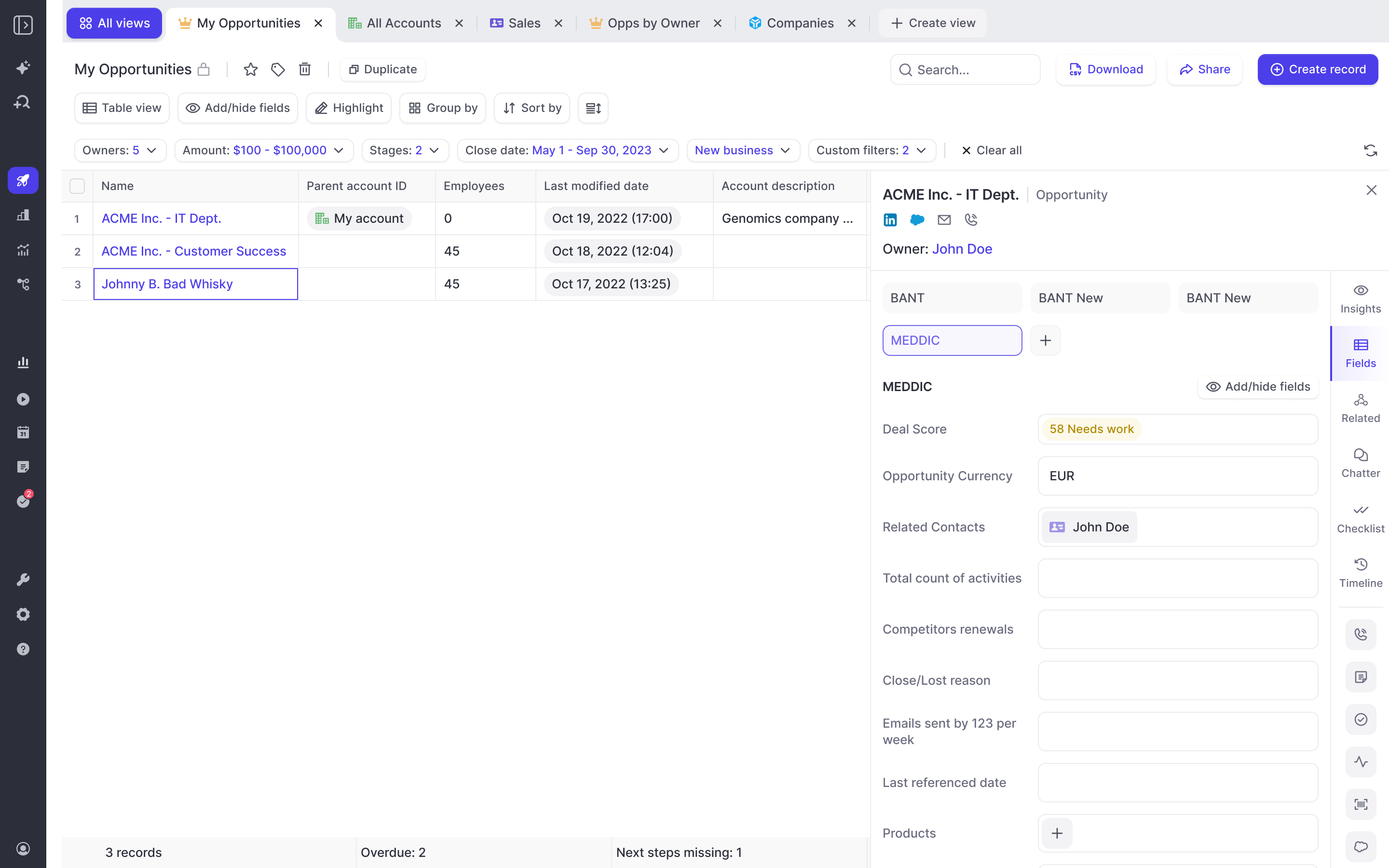
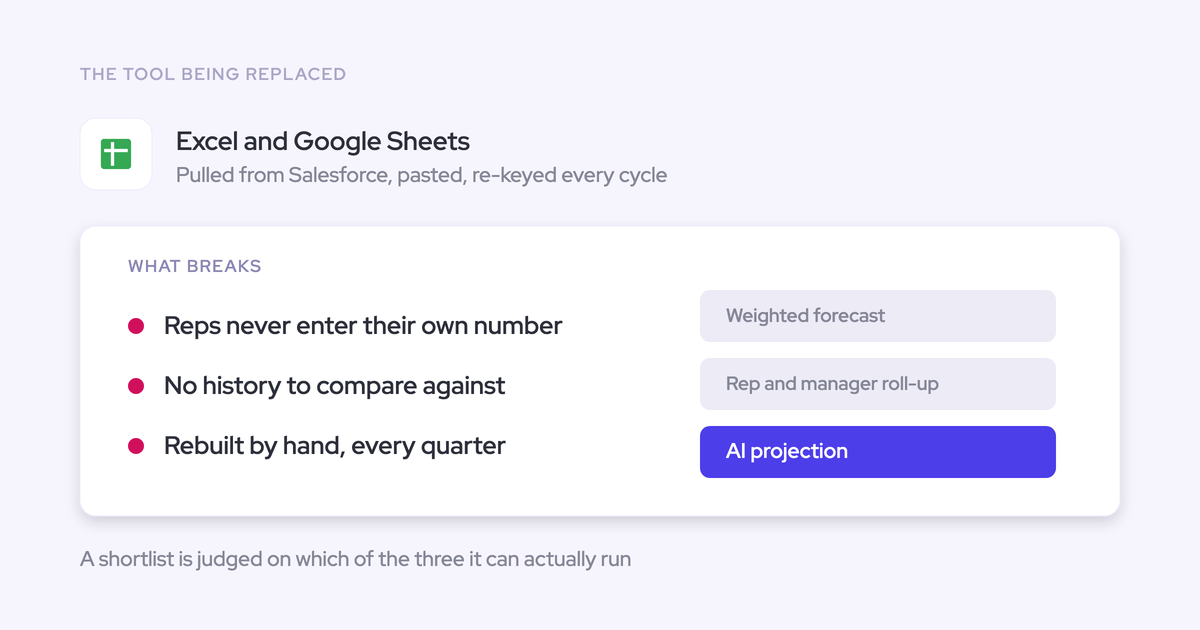
And the forecast itself runs three methods side by side: a weighted forecast from historic stage close rates, the rep and manager roll-up, and an AI projection built on 50-plus deal signals and up to two years of history that returns a landing range. The gap between the three is the agenda for the forecast call. Weflow also tracks forecast accuracy, forecasted versus actual, by rep and by manager.
We have so many customers that come to us and say, oh, we need to improve our forecasting. We need to improve our forecast accuracy. And, you know, then you peel back the onion and you see that data is missing, visibility is missing, understanding of what's going on is missing.
— Janis Zech, Co-founder and CEO of Weflow
Your activity and conversation data lands in Salesforce objects you own
Everything Weflow captures and generates is written into native Salesforce objects, permanently, on your org. Not mirrored from a vendor schema.
The practical differences you can check in a trial:
- Emails and meetings map to the right opportunity, with a browser and Outlook extension so a rep can correct the mapping when an account has two open deals.
- Missing contacts get created automatically, attached to the account and opportunity, with contact roles set. That's what turns multi-threading from an assertion into a reportable fact.
- Validation rules, field dependencies, permissions, and role hierarchy are respected as they already exist in your org.
The consequence lands at renewal. A previous Gong user described the problem in one line on a call with us:
I know they're weak and also you can never leave them because you don't own any of the data. And also they take you away from the Salesforce interface and you have to work within their interface.
That second half is the adoption risk RevOps leaders raise before price. Every extra place a rep has to work is a reason the CRM degrades further.
Look at the Salesforce integration, trial it. That is often something that most CI providers don't start with. They see it as an afterthought.
— Janis Zech, Co-founder and CEO of Weflow
Point-in-time pipeline snapshots and a drillable waterfall
Weflow snapshots opportunity data every few hours and builds the pipeline views from that time series, not from current state.
The waterfall reconciles starting pipeline to ending pipeline through:
- Newly created
- Increased
- Moved into the period
- Moved out of the period
- Decreased
- Won
- Lost
Each bucket clicks through to the actual opportunities, with whatever fields you care about. That's what answers why a quarter that opened strong ends thin, and it exposes chronic slippage and sandbagging that a live pipeline report hides.
Salesforce won't get you there on its own either, because it doesn't history-track calculated or roll-up fields. Without snapshots you'd be building the history tracking yourself.

Seat-based pricing with AI included, published openly
Weflow publishes its prices, and they're per seat with AI usage bundled in.
| Product or bundle | Price per user per month | What's in it |
|---|---|---|
| Activity & Contact Capture | $19 | Email, meeting, and contact capture into Salesforce, activity insights and reports |
| Conversation Intelligence | $39 | Recording, transcription, AI field updates, coaching scorecards, follow-up drafts, Mobile Copilot |
| Deal Intelligence & Forecasting | $39 | Deal health and signals, pipeline analytics, roll-up forecasting, deal-by-deal submission, accuracy tracking |
| Revenue AI Foundation | $49 | Activity & Contact Capture + Conversation Intelligence |
| Revenue AI Business | $59 | Foundation + Deal Intelligence |
| Revenue AI Enterprise | $79 | Business + Forecasting: the full platform |
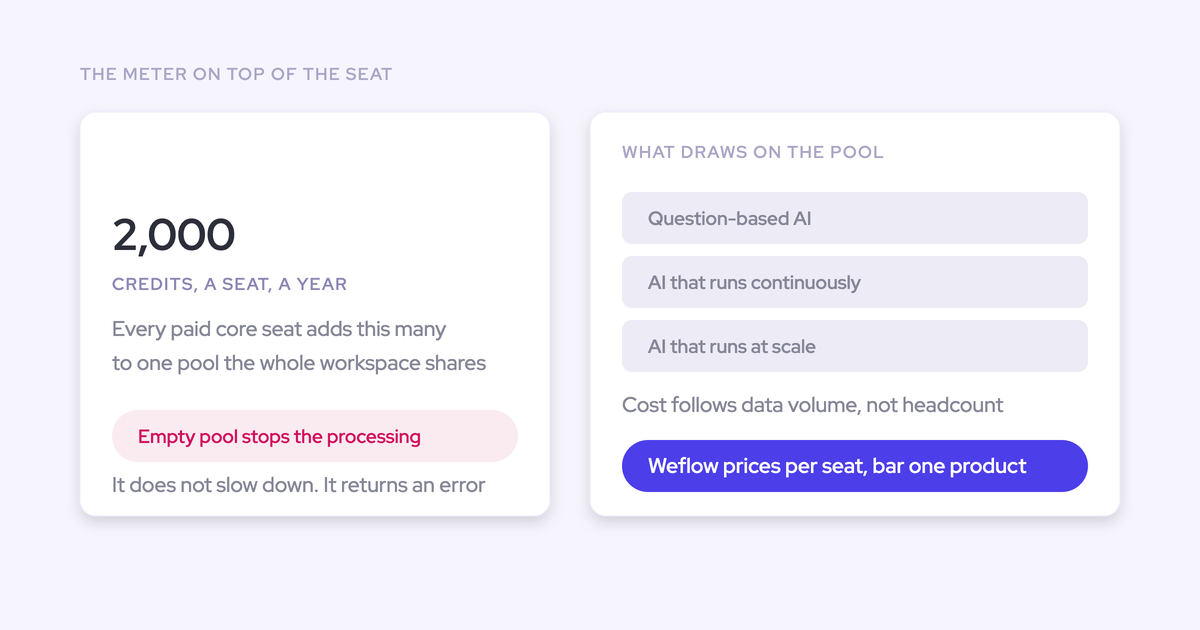
Ask Weflow AI Pro and Agent Builder are included in every plan and bundle. Recordings, transcripts, AI templates, and prompts have no usage caps or metering. No platform fee, no implementation fee, minimum 10 users, billed annually, and unlimited view-only licenses so leadership and product can look without consuming a seat.
100 users on Revenue AI Enterprise is $94,800 a year at list, covering capture, conversation intelligence, deal intelligence, and forecasting.
The obvious question is what's missing at roughly half of Gong's cost. The answer is the cost base, not the product. Gong's pricing was set when transcription was expensive, and it's now held up against roughly $300 million in ARR and a $7 billion valuation with IPO expectations attached. Building the same capability today, after inference costs collapsed, is structurally cheaper. That's the argument, and the only proof that should count is a side-by-side trial on your own data.
Choose Clari, Gong, or Weflow: a decision guide
There's an honest case for each. Here's where we'd point you.
- Choose Clari if your PE sponsor or board has standardized on it across the portfolio, and raising a replacement internally is a non-starter. The better product doesn't win that argument.
- Choose Clari if you're rolling up forecasts across 1,000-plus reps and heavyweight roll-up mechanics at that scale are your single hardest requirement. At that scale, Clari's forecasting is more mature than ours and we'd say so on the call.
- Choose Gong if conversation analytics depth is the requirement that outranks everything else, and you want account-level methodology aggregation and a sales engagement product from the same vendor, with budget for the platform fee, the Foundation seats, and the modules.
- Choose Weflow if you need conversation intelligence and forecasting on one data layer, running on Salesforce, with call outcomes writing into fields your forecast reads, and one budget line that covers both jobs.
- Choose Weflow if you need coverage across account management and customer success, not just AEs and their managers, because per-seat economics decide whether the data layer covers your whole revenue base.
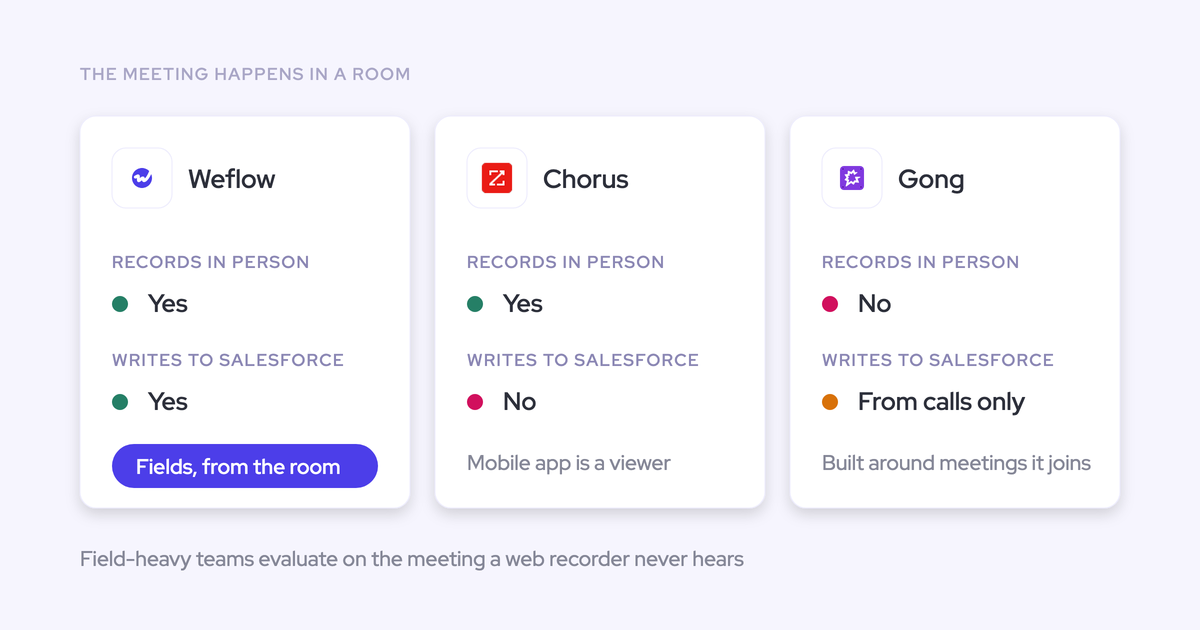
- Don't choose Weflow if you run a non-Salesforce CRM, need phone and VoIP call capture today, need FedRAMP certification, or want sequencing and a dialer in the same tool. Those are real gaps, not roadmap hedges.
How to start without breaking an existing Clari or Gong contract
You don't have to rip anything out, and if you're mid-renewal you can't anyway. A CFO who just signed a forecasting renewal will not approve a second forecasting tool, so the entry point has to be a capability you don't already own.
The sequence that clears internally:
- Land on Activity & Contact Capture and Conversation Intelligence. Revenue AI Foundation at $49 per user per month sits outside the blocked forecasting line item, and it's the layer that asks nothing of your reps: capture runs in the background and summaries and follow-up drafts arrive whether anyone logs in or not.
- Let the incumbent consume the cleaner data. Clari reads activities from Salesforce, so one capture engine feeding Salesforce improves both tools at once. The failure mode is running two capture engines in parallel, which produces duplicate activities. Compatibility mode handles the overlap while a second tool is still live, including Outreach, Salesloft, and Apollo presets and Einstein Activity Capture (set the Einstein event sync to one direction first, or the same meeting lands twice).
- Add pipeline and forecasting at renewal. Foundation to Revenue AI Business is $10 more per user per month; the full platform with forecasting is $79. That's an expansion conversation, not a second procurement cycle against a six-figure contract.
On rollout ownership, the honest read is that a tool swap competes against your RevOps backlog, not against the incumbent vendor. So it has to arrive as a managed service with a fixed timeline, a named benefit, and a price.
Weflow's technical setup is a 30 to 45 minute session with a Salesforce admin and your Google or Microsoft admin. HolidayCheck was live in under an hour and full time to value is typically one to three weeks, with most of the time going into business logic: AI templates, forecast types, cadences, quotas, warning rules, permissions.
Roll it out in data-foundation order, one wave at a time. KORE Wireless ran five phases: activity capture, then conversation intelligence, then coaching, then deal intelligence, then forecasting. Reverse that order and you get the same stalled deployment you're already paying for.
Walk through the product yourself, no call required.
FAQ
Do I need both Clari and Gong?
Only if you need best-in-class depth on both forecasting and conversation analytics and can carry two contracts that won't share data. Buying both gives you Clari's roll-up and Gong's analytics, but call insight still doesn't reach the forecast, because neither tool writes structured conversation data into the deal record the other reads. Most mid-market teams we talk to can't get two six-figure lines approved anyway.
Is Clari or Gong better for forecasting?
Clari, clearly. Clari has deal-by-deal and rep-by-rep forecast submission rolling up through the hierarchy, and its roll-up mechanics are more mature than anything else at large rep counts. Gong offers AI prediction and automated roll-ups but no per-deal submission, which means you can't compare this week's commit to last week's deal by deal. The gap in Clari is underneath the roll-up: weak deal-level health, and no forecast-versus-actual accuracy measurement.
Does Gong write call and activity data back to Salesforce?
Activity, yes. Gong logs emails and meetings to Salesforce, so activity logging alone isn't the reason teams move off it. What it doesn't do is map that data into your own structure, create the missing contact records, or populate methodology fields, so MEDDIC and similar fields stay a manual step after a rep reviews Gong's insights. The recordings, transcripts, and analytics stay in Gong's cloud.
Can Weflow run alongside Clari for forecasting?
Yes, and it's the pattern we recommend when leadership or a PE sponsor is committed to Clari. Run Weflow as the single capture and conversation layer writing into Salesforce, and let Clari consume the cleaner Salesforce activity for its roll-up. The one thing to avoid is turning on two capture engines against the same inbox, which produces duplicate activities and distorts every activity metric built on top.
Do Clari and Gong give reps anything, or only managers?
Both were designed for managers and ops, which is what kills adoption. Rep-side value looks like the follow-up email drafted 30 seconds after the call, the mandated Salesforce note arriving already in your template, and fields that fill themselves, and it has to arrive without a second daily destination outside the CRM.
How does Weflow's pricing compare to Gong's?
Weflow publishes per-seat prices with AI bundled in: $19 for Activity & Contact Capture, $39 each for Conversation Intelligence and Deal Intelligence & Forecasting, or $49 to $79 for the bundles. Gong charges a $5,000 annual platform access fee, then about $1,600 per seat per year for Foundation, then paid add-on modules for coaching and forecasting on top. The structural difference is that Weflow has no platform fee, no implementation fee, and no usage metering on recordings, transcripts, or AI, so you can deploy across CS and account management without the per-seat math forcing partial coverage.