
Best Gong Alternatives for Revenue Teams on Salesforce (2026)


Almost nobody leaves Gong because the product disappointed them. They leave because the invoice stopped matching the part of the product they actually use, and because the conversation data they paid for never became data they own.
That's the pattern on our calls, over and over. A RevOps leader with a team of one to three, a Salesforce org they've spent two years cleaning up, a quote in hand, and a number that doesn't survive the CFO conversation. Then they start googling.
So this is an honest shortlist, organized around what a RevOps buyer actually tests: Salesforce write-back, data ownership, whether methodology fields get populated, and whether the pricing lets you cover the whole team. Weflow is the Revenue AI Orchestration platform for sales, customer success, and RevOps teams, and it leads the list because of Conversation Intelligence + AI Field Updates. Where keeping Gong is the right call, that's in here too.
Why teams leave Gong: the value, not the product
Teams leave Gong on value, not budget. The same buyer who won't sign a Gong renewal will happily pay for a tool that clears the bar, which makes this a value argument rather than a discount argument.
Credit where it's due. Gong invented conversation intelligence and still has the deepest conversation analytics in the category. It's strongest at the aggregate level: patterns across hundreds of calls, account-level methodology summaries that read every conversation on a deal rather than one at a time. That's real, and a team that lives in those views will feel the difference if they move.
What breaks the deal is the mismatch between the price and the slice a mid-market Salesforce team actually uses.
The five reasons that come up on switch calls, in the order we hear them:
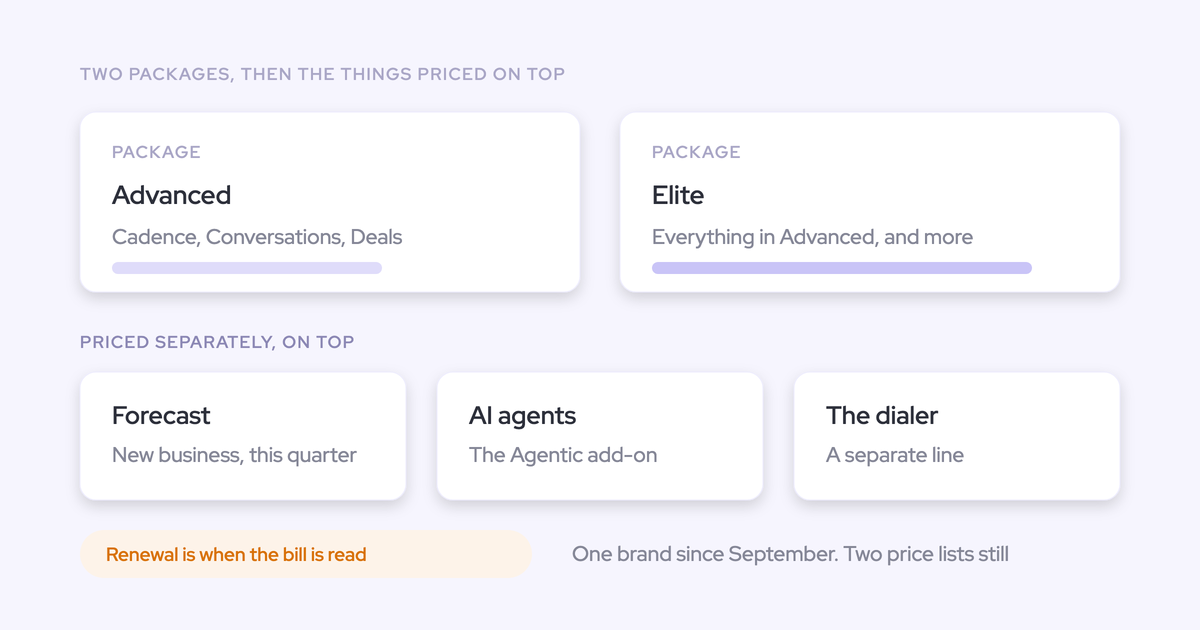
- The fee structure stacks. Gong Foundation starts around $1,600 per seat per year, on top of a $5,000 annual platform access fee, with coaching and forecasting sold as add-ons at roughly $300 to $800 per seat per year each. A dedicated CSM only comes with contracts above $45,000 a year.
- A mid-market team pays for suite depth it doesn't use. Gong expanded outward into sales engagement, so a team that needs conversation intelligence plus clean CRM data gets billed for a platform built much wider than the problem.
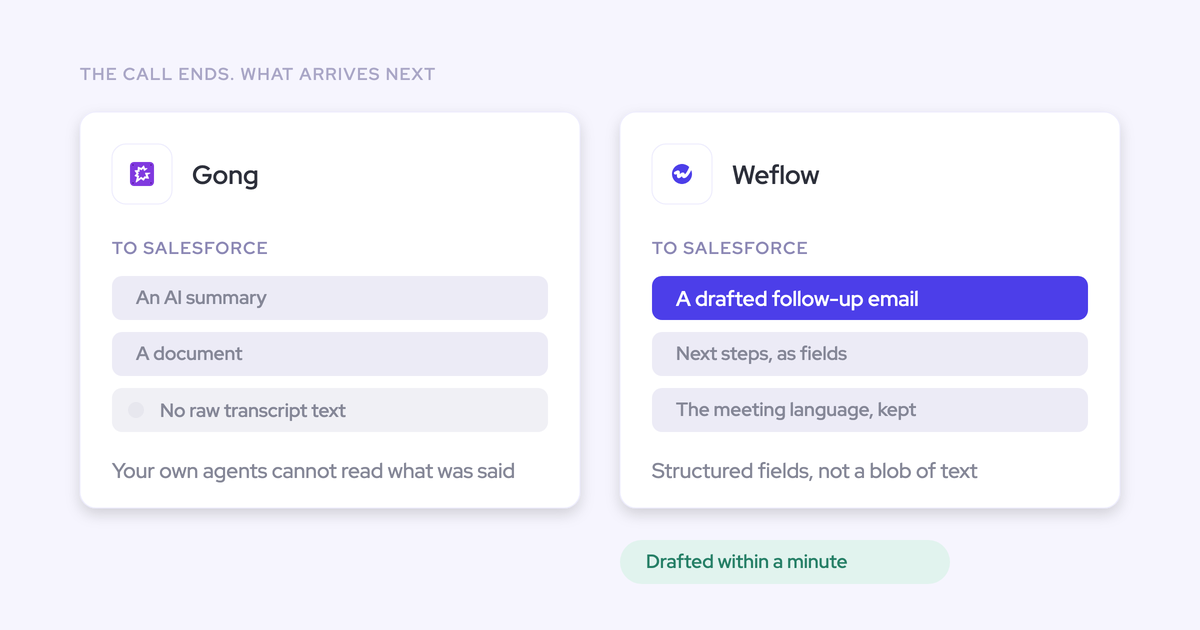
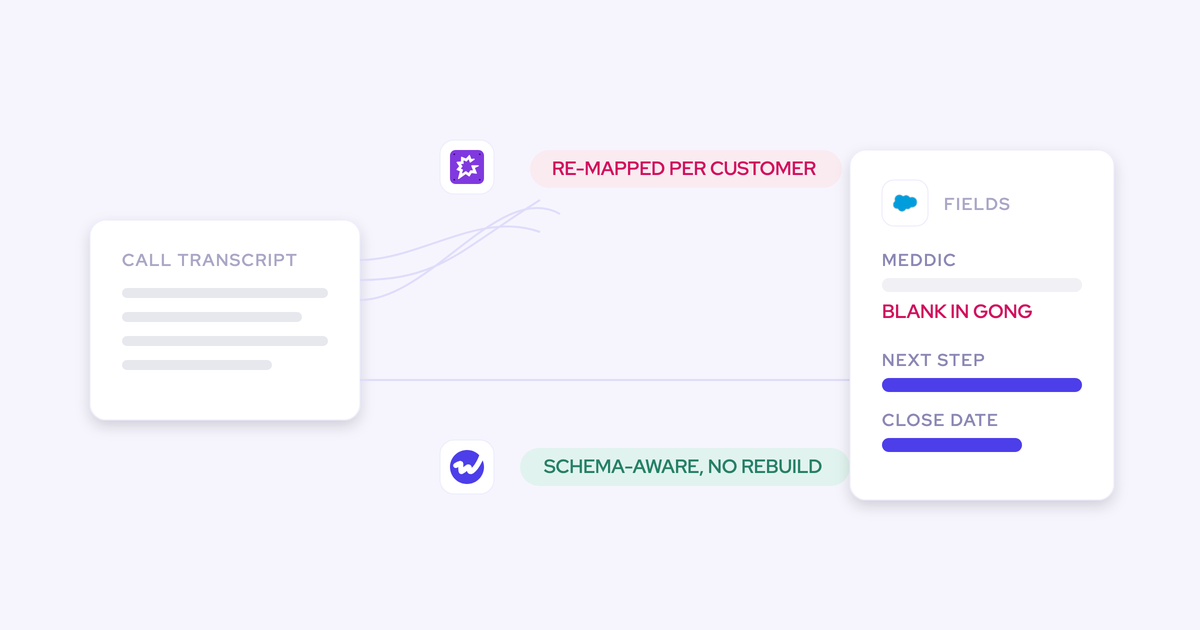
- Salesforce field updates stay manual. Gong surfaces the insight; a rep still has to type the MEDDIC answer into the field. So the methodology fields stay blank and the deal review has nothing to read.
- The captured data lives in Gong's cloud. Gong stores recordings, transcripts, and intelligence in its own Revenue Graph rather than native Salesforce objects. It can display inside Salesforce, but it can't trigger a Flow, and it doesn't stay when the contract ends.
- Per-seat cost forces partial coverage. Because the expensive foundation has to be bought before any module, teams deploy Gong to a subset of AEs and leave customer success without it. The coverage gap is a pricing artifact, not a decision anyone wanted to make.
Two of those aren't Gong's fault so much as Gong's founding conditions. When Gong set its pricing, transcription was expensive. It isn't anymore.
What to look for in a Gong alternative
Every tool in this category transcribes well now, so the transcript is not where the decision gets made. The differences that matter live in the Salesforce integration, and they're all testable in a two-week trial with your own org.
| What to evaluate | How to verify it in the trial |
| Write-back depth | Record a discovery call, then open the opportunity in Salesforce. Did the outcome land in fields you can filter and report on, or as one text blob in a description field? |
| Data ownership | Ask what remains in Salesforce the day after you cancel. Native Task, Event, and EmailMessage records stay in your org. Anything held in a vendor's cloud leaves with the vendor. |
| Methodology field automation | Point the tool at the MEDDIC, MEDDPICC, or SPICED fields you already built. Can you map your own prompt per field, including picklists, or do you get the vendor's scorecard in the vendor's UI? |
| Duplicate control | Count meetings per rep in two views for a week. A recorder writing its own meeting record alongside your existing capture doubles the number and quietly ruins every activity metric built on it. |
| Capture beyond recorded calls | Ask what happens to the email threads between meetings, the field meetings nobody dialed into, and the four contacts who joined the thread but never a call. |
| Deployable pricing | Can you put the whole team on a base product and only leadership on the expensive one? Is the price published, or does it arrive on call three? |
One more that admins raise and buyers forget: does the tool act with your permission model, or around it? Field-level security, validation rules, role hierarchy, custom objects, record types. A tool that imposes its own data model forces a migration nobody signed off on.
The best Gong alternatives compared at a glance
| Tool | Salesforce write-back | Where the data lives | Standout capability | Pricing | Best for |
| Weflow | Writes AI-extracted values into any standard or custom Salesforce field, plus native Task, Event, EmailMessage records | Your Salesforce org; records stay after cancellation | AI Field Updates for MEDDIC, MEDDPICC, SPICED, BANT and custom frameworks | Published: $19 to $79 per user per month, annual, 10-user minimum | Salesforce teams that want conversation content as reportable CRM data, deployed to everyone |
| Clari Copilot | Logs calls and summaries; no AI field updates into Salesforce fields or objects | Clari's cloud | The wider Clari product: pipeline waterfall, pacing, quarter-over-quarter comparison | Quote-based | Orgs already committed to Clari for forecasting |
| Attention | Basic AI field updates | Attention's cloud | Conversation intelligence depth | Quote-based; CI not sold standalone | Teams whose need is the conversation layer itself |
| Einstein Conversation Insights | Native, but opportunity mapping leans on contact roles | Salesforce | One vendor, one contract, no new procurement | Comes through your Salesforce agreement | Small teams with simple orgs and one opportunity per account |
| Revenue.io | Salesforce-native dialer logging call activity | Salesforce plus Revenue.io | Real-time in-call coaching (Moments) and local presence dialing | Quote-based | Phone-heavy inside sales teams, including HIPAA and TCPA-sensitive ones |
| Fireflies | Notetaker-level logging; transcripts accumulate in the tool | Fireflies' cloud | Cheap transcripts across every meeting type | Per-seat, at notetaker prices | Teams that need transcripts and nothing downstream of them |
1. Weflow: better AI at half the price, built for Salesforce
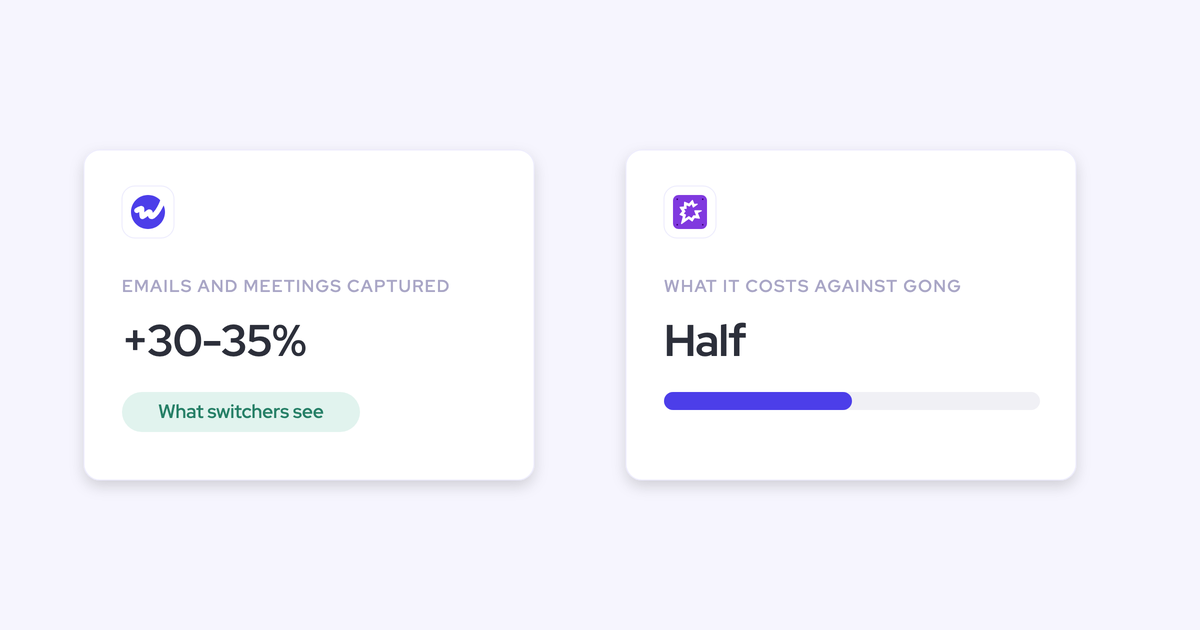
Weflow is conversation intelligence that turns calls into structured Salesforce data, at roughly half what Gong costs a comparable team. The saving is a cost base, not a thinner product: Weflow was built after transcription and inference costs collapsed, so the same capability carries a structurally lower price today.
That's the answer to the obvious question, and it's also the one you should refuse to take on faith. Run both against your own org for two weeks and look at what lands on the opportunity.

How Weflow answers the reasons teams leave Gong
| Why teams leave | What Weflow does instead |
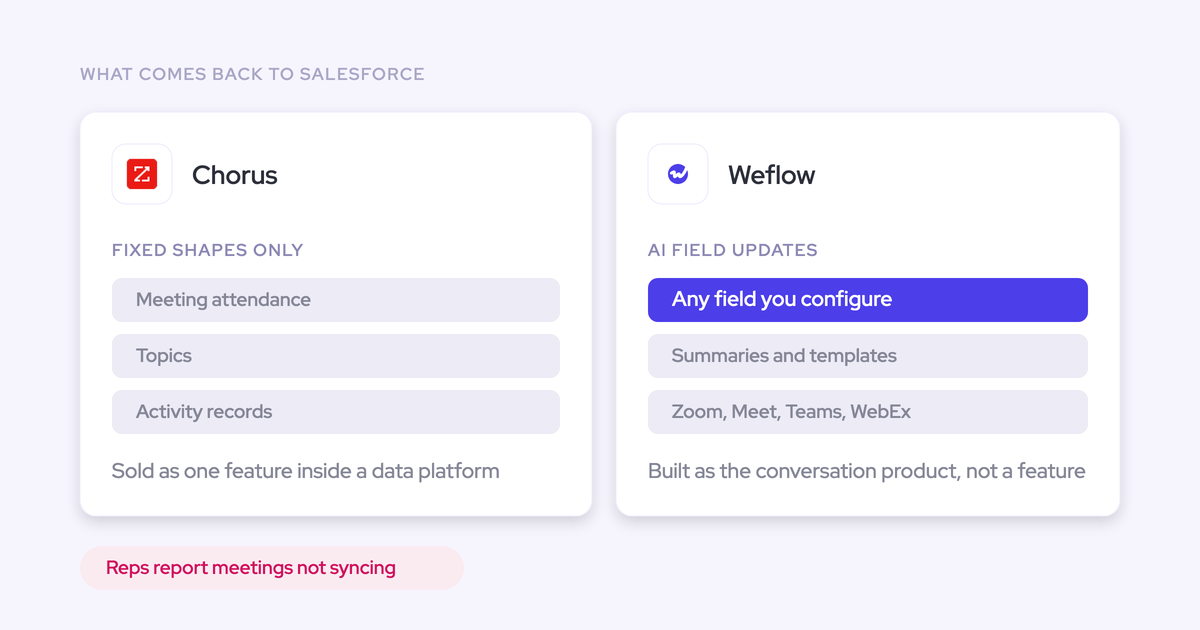
| Field mapping is manual | Weflow's AI Field Updates extract structured values from the transcript and write them into the specific Salesforce fields you already review, with the suggested value shown beside the current one so the rep accepts, edits, or rejects each. Around 30 methodology templates and 250+ pre-built prompts ship out of the box, and you map your own prompt per field for a proprietary framework. |
| Data lives in the vendor's cloud | Weflow writes native Task, Event, and EmailMessage records into your Salesforce, so the activity history is yours, reportable by your own reports, readable by your own Flows and agents, and still there if you cancel. |
| Capture is call-centric | Weflow adds email, meeting, and contact capture on top of the recorded calls, and creates missing contacts against existing accounts with dedupe guards and per-event caps. Switchers typically see 30 to 35% more emails and meetings captured. |
| Reps get pulled into a second UI | Two-way real-time sync means an edit in Weflow is an edit in Salesforce and back. Salesforce stays the record. Sign-in runs only through your Salesforce OAuth and SSO, so there's no second identity to manage. |
| Coverage is partial because seats are expensive | Per-product, per-team packaging plus unlimited view-only licenses. A 260-seat rollout stays affordable when only the leadership group needs forecasting. |
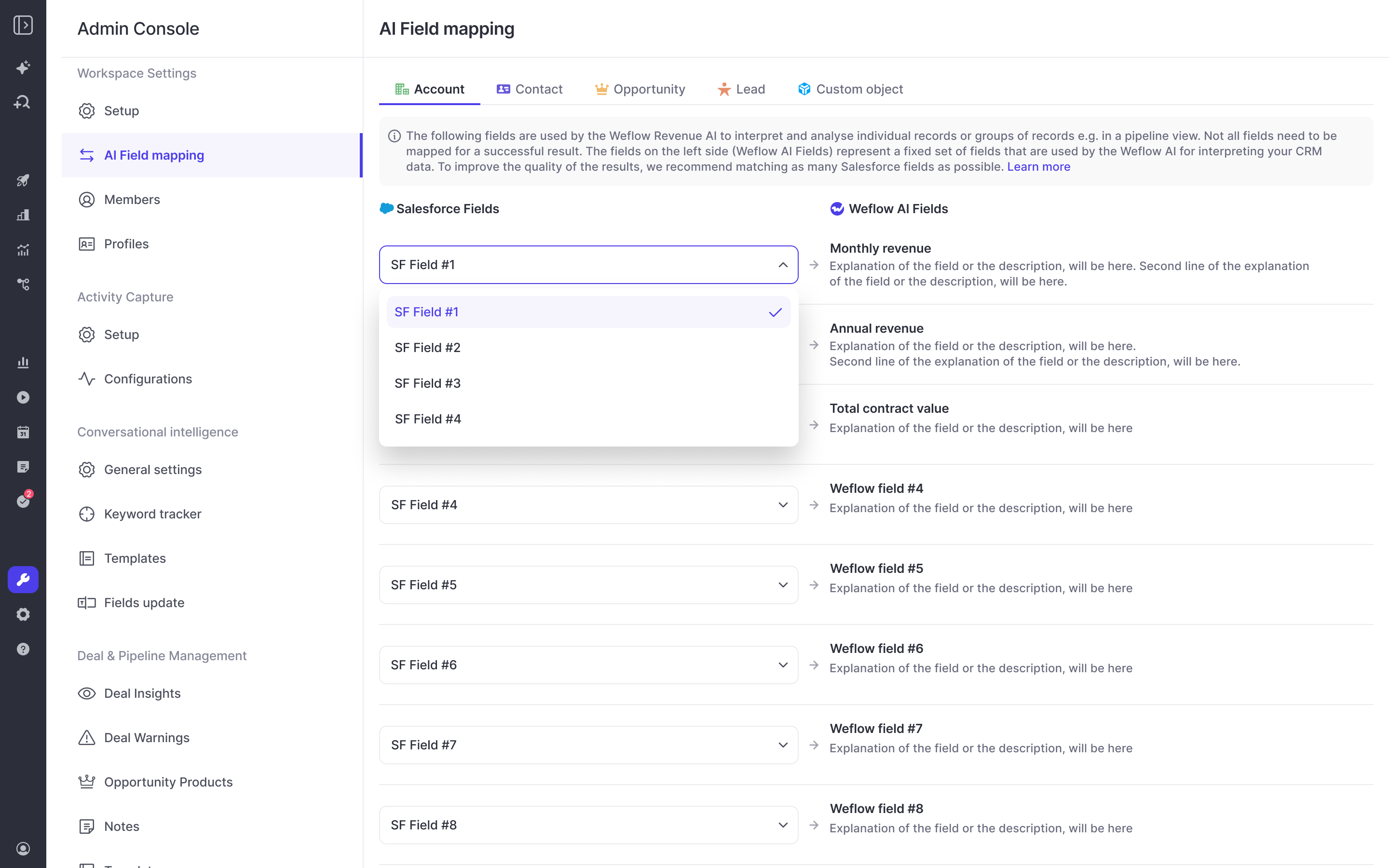
The field-update piece is the one customers underestimate before they see it and rate highest afterward, because it fixes a problem no methodology rollout has ever fixed with training.
The sales methodology fields in Salesforce are almost always empty. Even the data capture doesn't work.
— Janis Zech, Co-founder and CEO, Weflow
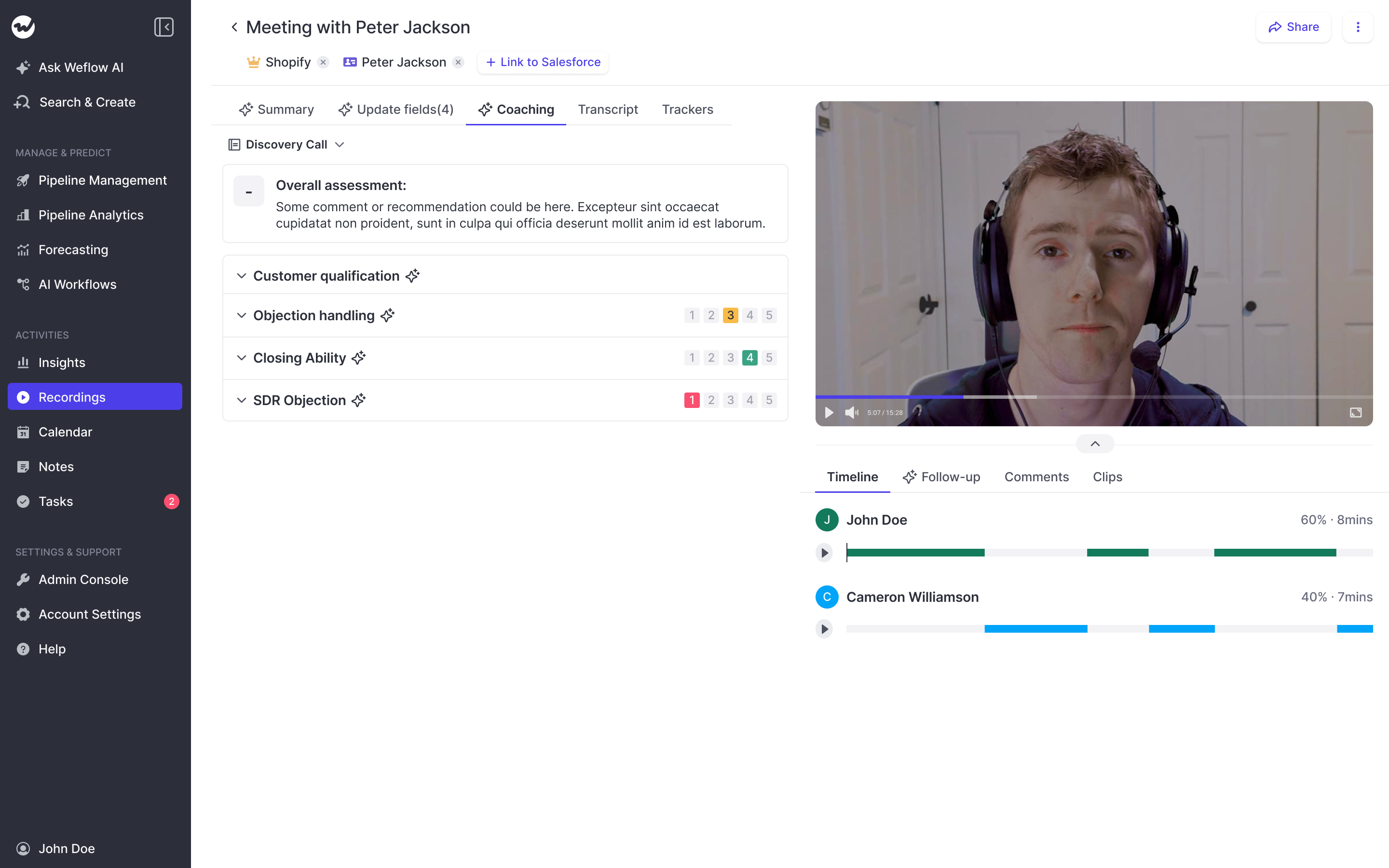
Coaching works the same way: configurable scorecards per call type and per team, scored against your framework, with the score attached to the rep over time rather than to whichever call a manager happened to sit in on.
Where Gong is still the stronger choice
There's a real catch list, and you'd find it in week two of a trial anyway.
- Aggregate conversation analytics. Gong is deeper here, and its account-level analysis across every call on a deal is more mature. Weflow answers those questions through Ask Weflow AI and AI deal summaries rather than a dedicated aggregate analytics surface.
- Sales engagement. Weflow has no sequences, no cadences, no dialer, and doesn't intend to build them. If you want conversation intelligence and an outbound engine on one contract, Gong Engage exists and Weflow doesn't compete with it.
- Phone calls. Weflow records Zoom, Google Meet, Microsoft Teams, and WebEx. VoIP and phone call capture isn't there today. A phone-first motion is not a fit.
- Live in-call coaching. Weflow coaches after the call, not during it.
- Salesforce only. No HubSpot, no Dynamics, no Pipedrive. Off Salesforce, stop reading here.
- Compliance edges. SOC 2 Type II, HIPAA, GDPR, and CCPA are in place. ISO 27001 is in progress, and Weflow is not FedRAMP certified, so US government contractors with a FedRAMP requirement are out.
- One structural exception to the write-back rule. If you later add forecasting, the roll-up submissions and targets live in the Weflow app, not in Salesforce fields. Everything else is written back; that layer sits on top.
Weflow pricing and packaging
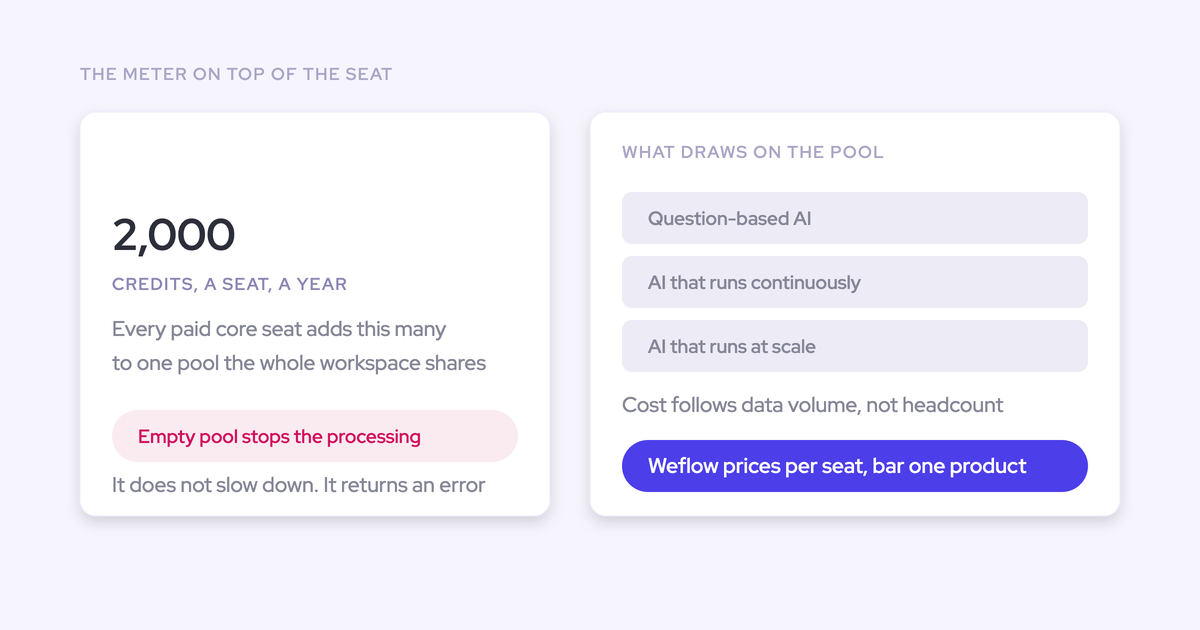
Weflow publishes its pricing, which is half the point. Seat-based, billed annually, AI usage bundled in.
| Product or bundle | Price per user per month | What it covers |
| Weflow Activity & Contact Capture | $19 | Emails, meetings, and contacts auto-synced to the right Salesforce records, with activity insights and reporting |
| Weflow Conversation Intelligence | $39 | Recording, transcription, summaries, AI Field Updates, coaching scorecards, Mobile Copilot |
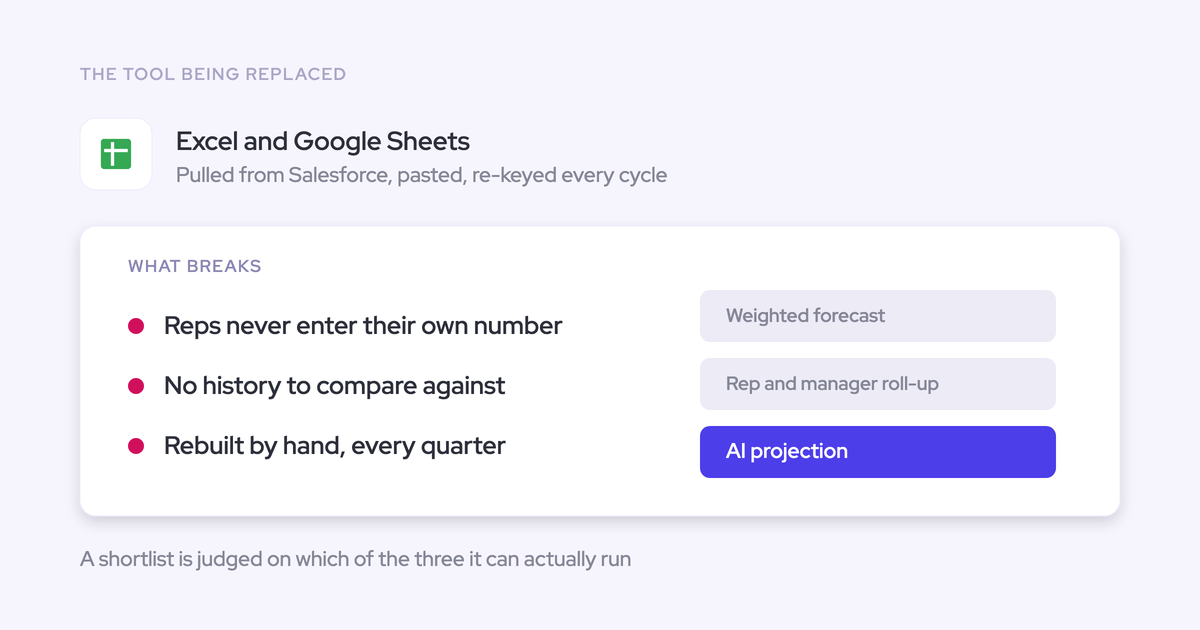
| Weflow Deal Intelligence & Forecasting | $39 | Deal health and signals, pipeline analytics, roll-up forecasting, forecast accuracy tracking |
| Revenue AI Foundation | $49 | Activity & Contact Capture + Conversation Intelligence |
| Revenue AI Business | $59 | Foundation + Deal Intelligence |
| Revenue AI Enterprise | $79 | Business + Forecasting |
Every plan includes Ask Weflow AI Pro and Agent Builder's free tier with 25 agent actions a month, plus unlimited view-only licenses so product, CS, and leadership can read calls without consuming a paid seat. Minimum 10 users. Multi-year discounts are 10% for two years and 20% for three.
No platform fee, no implementation fee, no token or usage metering. Recordings, transcripts, AI templates, and Ask Weflow AI prompts have no caps.
Set that against a Gong quote and the shape of the comparison is clear: a per-seat foundation around $1,600 a year plus $5,000 of platform access plus coaching and forecast add-ons, versus a published $49 to $79 per user per month with the modules you don't need left off.
2. Clari Copilot: if you already run Clari for forecasting
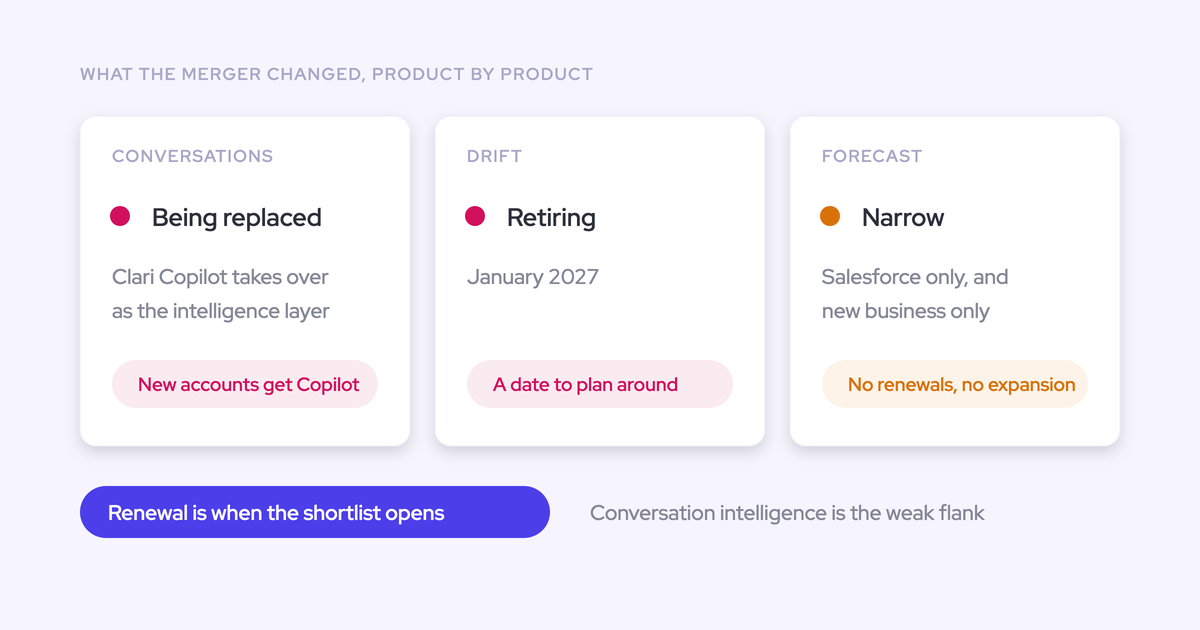
Clari Copilot makes sense as an add-on inside a Clari commitment, and mostly only there. It's a conversation intelligence product that came into Clari by acquisition, and its innovation has stalled.
Where it's genuinely strong is the company it sits in. Clari's pipeline waterfall, pacing view, and same-day-last-quarter comparison are the views revenue teams actually use, and Clari's roll-ups at a thousand reps and up are more mature than anyone else's in this list.
Where it falls short:
- No AI field updates writing to Salesforce fields or objects, and no AI coaching scorecards for MEDDIC or MEDDPICC.
- No advanced rep-level coaching insights.
- Clari's conversation intelligence and its forecasting product don't talk to each other, so call content never informs the forecast. Teams that own both end up piping transcripts into a separate AI workspace and feeding conclusions back by hand.
- Clari Capture maps activity server-side on email domain, so activity gets misattributed once an account carries several open opportunities.
Best for: orgs where leadership or a PE sponsor has committed to Clari for forecasting and you need a conversation layer inside that contract.
3. Attention: deep conversation intelligence, basic CRM writing
Attention's conversation intelligence is its real strength and shouldn't be dismissed. It's a credible CI product built recently, and it shows up in the same searches you ran to get here.
The limits are on either side of the call:
- AI field updates are basic, and coaching insights are limited.
- Conversation intelligence isn't available as a standalone product.
- Deal intelligence is thin: no roll-up or collaborative forecasting, no forecast accuracy measurement, and no pipeline analytics or dashboards. It reports on activity rather than running a forecast process.
Best for: teams whose problem is the conversation layer itself, with forecasting and pipeline analytics already solved somewhere else.
4. Einstein Conversation Insights: the Salesforce-native option
Procurement will raise this one, so have an answer ready: Salesforce's own layer keeps everything in one contract, and it's a reasonable fit for a small team with a simple org.
It stops clearing the bar exactly where a RevOps buyer's requirements are highest. The Einstein capture and insights layer decides which opportunity an activity belongs to using opportunity contact roles, which is one of the least maintained objects in any CRM. So it works when an account has one open opportunity and fails when it has four.
- Einstein Activity Capture runs as background logging with no interface, and the Outlook and Gmail add-in is a separate service, so there's nowhere for a rep to see or correct a wrong mapping.
- It can't log email attachments, can't create contacts automatically, and doesn't let an admin choose whether activity lands on EmailMessage or Task, which decides what's reportable.
- It's weak on mobile, which is where field reps actually work.
Einstein Activity Capture just doesn't have the reporting functionality we needed. We wanted to do more - especially with AI playing a bigger role.
— Erick Mahle, VP of Revenue Operations & Digital Transformation, Lendz Financial
Best for: small teams with one opportunity per account, simple reporting needs, and no appetite for a second vendor.
5. Revenue.io: real-time coaching for calling-heavy teams
Revenue.io is the honest answer for a motion neither Gong nor Weflow serves best. Its wedge is a Salesforce-native dialer with real-time in-call coaching, branded Moments, out of an inside-sales and telephony heritage.
That's a genuine difference in kind. Gong and Weflow both coach after the call; Revenue.io prompts the rep during it. It also supports HIPAA and TCPA compliance and local presence dialing.
Where it falls short: it's built around the phone, so a team whose pipeline runs on video meetings and long email threads is buying a dialer to solve a conversation-data problem.
Best for: high-velocity phone motions, inside sales teams, and regulated calling environments.
6. Fireflies: a lightweight AI notetaker, not a revenue platform
A notetaker solves recording and transcription cheaply, and for some teams that's genuinely the whole requirement. Take it seriously as the budget floor. Just don't call it a Gong replacement.
Three things break when a notetaker becomes the system:
- The history accumulates outside the CRM. Teams running Fireflies alongside Salesforce keep a year or more of recordings and transcripts in the tool. That's the same ownership problem, one price tier down.
- Coverage rots quietly. Capture depends on each rep connecting their own calendar and that token staying alive. When it breaks, nobody finds out, because the failure looks like a rep who had no meetings. Out of a hundred reps, a handful never authenticate and a few more drop off every month.
- There's nothing downstream. No deal layer, no coaching program, no field updates. The summary reads well and the opportunity record stays empty.
One practical note if you already have a notetaker: Weflow reads Salesforce through the API rather than needing to have recorded the call, so it can work on top of existing transcripts as long as they're synced into Salesforce in a structured form.
Best for: teams that need transcripts and are not trying to run revenue intelligence on them.
Which Gong alternative fits your situation
Pick from the primary need, then trial two.
| Your situation | The pick |
| Salesforce-first, want conversation content as reportable CRM fields, and need coverage across AEs and CS | Weflow. AI Field Updates into your existing fields, native records you keep, per-product pricing that covers everyone. |
| Leadership has committed to Clari for forecasting | Clari Copilot, and run one capture engine into Salesforce so Clari reads cleaner activity. |
| You only need the conversation layer, deeply | Attention. |
| Small team, simple org, no new vendor | Einstein Conversation Insights, as long as accounts carry one opportunity each. |
| Phone-first, high-velocity, regulated calling | Revenue.io, for the dialer and in-call coaching. |
| Transcripts only, minimal budget | Fireflies, with your eyes open about what doesn't reach the CRM. |
| You live in aggregate conversation analytics, or you need conversation intelligence plus a full engagement and dialer motion on one contract | Keep Gong. That's the honest answer, and no amount of write-back depth changes it. |
Walk through the product yourself, no call required.
How to evaluate alternatives and migrate off Gong
Switching is a known path, and the risk that scares people (broken activity data during the overlap) is the one thing you can control precisely.
- Decide which engine writes. Two capture tools writing the same meeting into Salesforce produces two meeting records, and every meetings-per-rep number built on top is wrong from that day forward.
If you record a meeting, it's not another meeting. It's the same meeting.
— Janis Zech, Co-founder and CEO, Weflow - Turn on compatibility handling for whatever already logs email. Weflow's compatibility mode names the other tool's sending domain, delays its own sync by around ten seconds, checks the message for that tool's tracking pattern, and skips it if it finds one. Named sequencers ship as presets. If Einstein Activity Capture is live, set its event sync to one direction, from the calendar into Salesforce, or the loop duplicates every event.
- Trial on real deals, not a sandbox account. Record five discovery calls, then read the opportunities. Which fields filled, which stayed empty, and could you build a report on the result.
- Check the permission model and the API bill. Weflow acts inside Salesforce validation rules, field dependencies, permissions, and role hierarchy, and signs in only through your Salesforce OAuth. Watch org-wide API consumption during the trial; every integration draws on the same allowance.
- Roll out in phases. Capture and conversation intelligence first, because they ask nothing of reps and give time back immediately. Coaching, deal intelligence, and forecasting after that has stuck. KORE Wireless ran exactly that five-phase sequence.
- Backfill, then switch the old tool off. Compatibility mode is for the overlap only; one capture engine is the cleaner end state.
Now the uncomfortable part, and you probably already suspect it. Gong keeps recordings, transcripts, and derived intelligence in its own cloud, and it maps captured emails and meetings into its own data structure rather than writing them into your Salesforce. Getting that history back into Salesforce is not a project with a clean ending.
What you can do is start deeper than day one. Weflow's historical sync-back pulls up to 24 months of emails and meetings from Google or Microsoft into Salesforce as an add-on, so your activity history has depth from the first week. And anything that fails to map isn't lost: support corrects the rule and backfills the record, which is what makes phased enablement safe.
FAQ: switching from Gong
What do you actually give up at half of Gong's price?
Aggregate conversation analytics depth, Gong's more mature account-level analysis, and a sales engagement product Weflow deliberately doesn't build. You don't give up the core capability, which is turning conversations into structured Salesforce data. The price gap comes from when the product was built, not from what it does: Gong set its pricing when transcription was expensive.
Can Weflow run alongside Gong during an evaluation?
Yes, with one rule: only one tool writes activity to Salesforce during the overlap. Weflow's compatibility mode detects another tool's tracking pattern on an outbound email and skips logging it, so the same email isn't written twice. If Einstein Activity Capture is also running, set its event sync to one direction first, or you'll see two events per meeting and blame the new tool.
Which meeting platforms and consent flows does Weflow support?
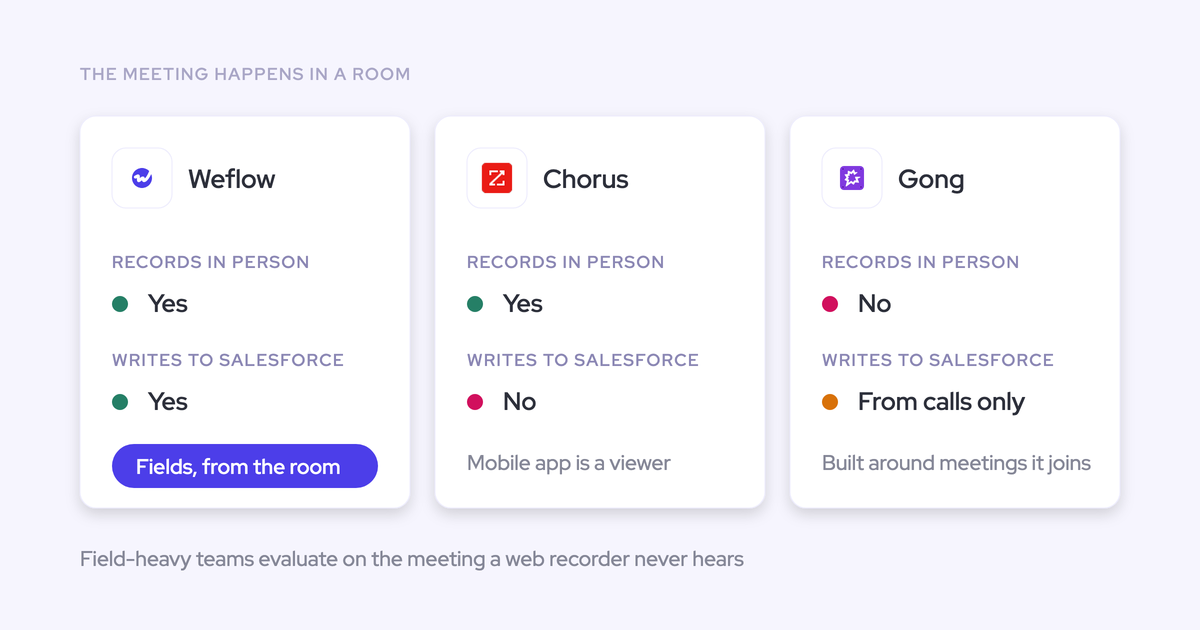
Weflow Conversation Intelligence records Zoom, Google Meet, Microsoft Teams, and WebEx, and Mobile Copilot records in-person meetings. Three consent modes are configurable: opt-out (records by default, notice posted in chat with a link any participant can use to stop it), opt-in (everyone accepts first), and manual. If someone opts out, the notetaker leaves and the recording, transcript, and notes are destroyed. The consent message and its language are customizable, and an optional pre-meeting email lets a guest decline in advance.
Is Weflow's pricing really seat-based with no usage metering?
Yes. Seat-based, billed annually, with AI usage bundled: recordings, transcripts, AI templates, and Ask Weflow AI prompts have no caps or metering. No platform fee and no implementation fee. Minimum 10 users. The one exception is Agent Builder, which is priced per workspace above the free 25 actions a month included in every plan.
Can you get your call history out of Gong?
Not into Salesforce in a form you can report on. Gong's recordings, transcripts, and intelligence live in its own cloud, and its captured activity is mapped into Gong's data structure rather than your Salesforce objects, so the history built up over years leaves with the subscription. Going forward, the model is different: Weflow writes native Task, Event, and EmailMessage records into your org, so the record is yours whether or not Weflow is still in the stack.
Who has switched from Gong to Weflow?
HolidayCheck moved from Gong to Weflow for an EU-based, GDPR-safe option, and cut past-due opportunities by around 75% alongside the data-quality work.
I've worked with Gong before, but Weflow's simplicity and real-time sync are game-changing. Whether I update a deal in Salesforce or Weflow, it's instantly reflected everywhere.
— Bastian Stosic, Head of Media Sales Operations, HolidayCheck
KORE Wireless evaluated Gong and chose Weflow, in their words because the value didn't justify its price compared to Weflow, then rolled out in five phases from activity capture through to forecasting.
It's probably been the most flawless rollout of any product I've ever been involved with.
— Scott Jones, SVP of GTM Revenue Intelligence & Enablement, KORE Wireless