
"How Can Weflow Be Half the Price of Gong?": The Question We Answer on Every Demo


We hear this question on almost every demo call, sometimes word for word: you guys claim to be 50% cheaper than Gong but do the exact same thing, so tell us how. One buyer put a number on it: "Gong costs $93,000 a year for my little team," for a tool that "offers a lot of things we don't need."
The answer is not a discount. It's structural.
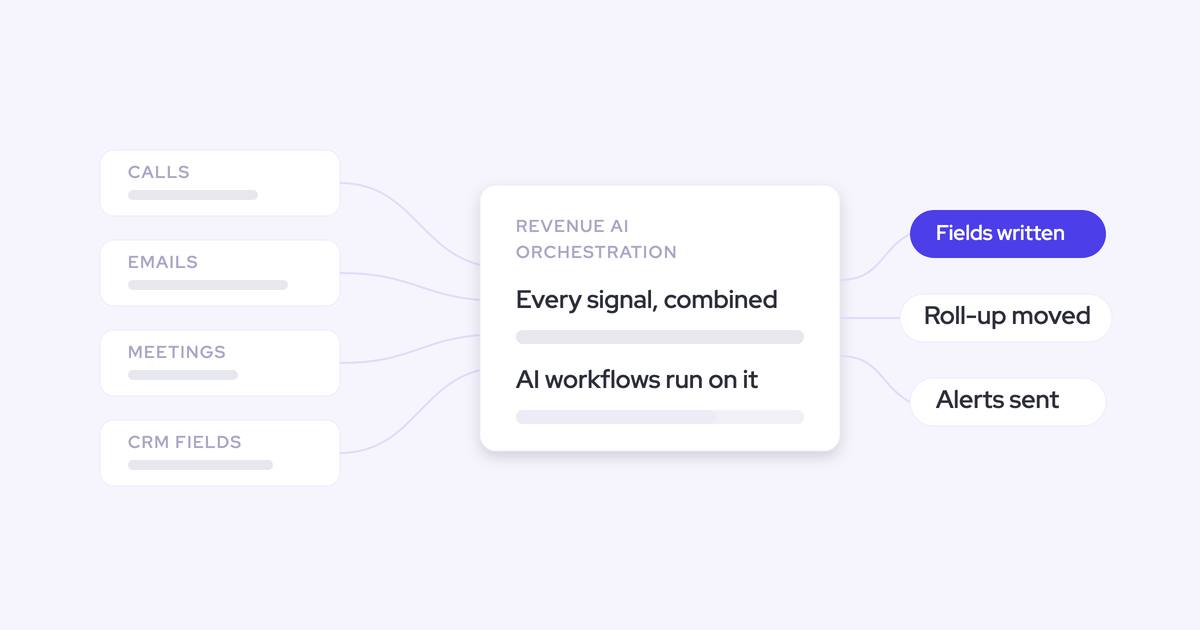
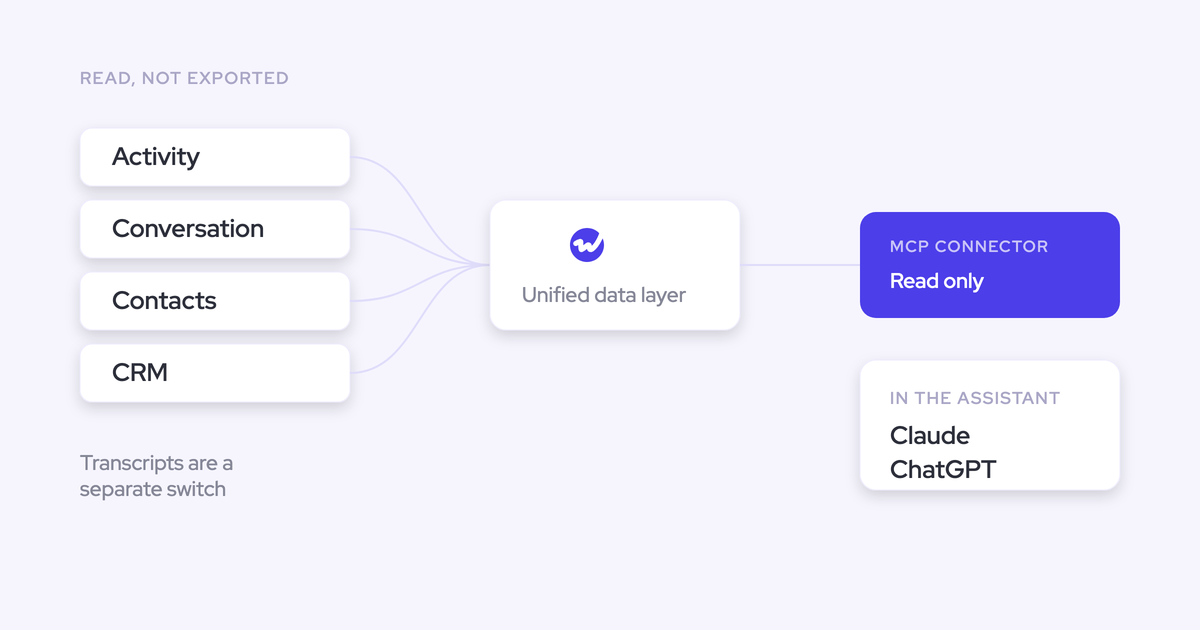
Weflow was built after transcription and inference costs collapsed, and it writes captured conversations and activity into the Salesforce a team already owns instead of running a parallel data cloud they have to pay to duplicate. Weflow is the Revenue AI Orchestration platform for sales, customer success, and RevOps teams, built for Salesforce teams. Weflow's Revenue AI Orchestration platform writes into the Salesforce you already run instead of building a second data cloud you'd have to keep in sync.
TL;DR: Weflow costs roughly half of what buyers report paying for Gong because its cost base is structurally lower, not because the product is thinner.
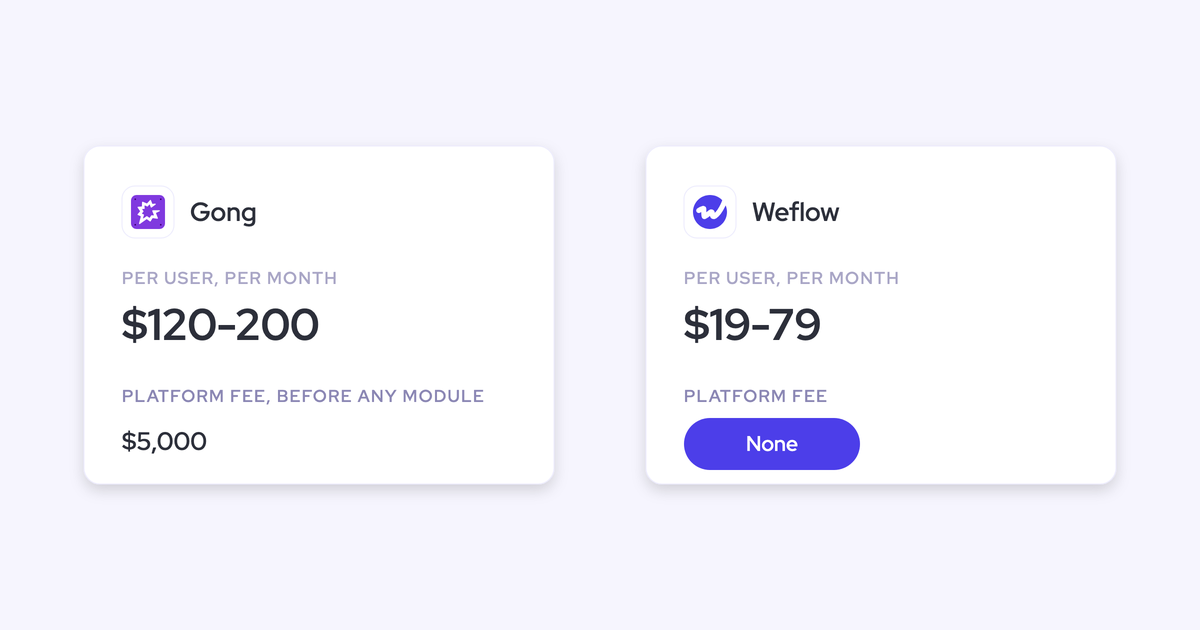
- Weflow costs between $19 to $79 per user per month across standalone products and bundles.
- Migration from Gong runs on an API key and takes about a week, with call history and trackers carried over.
- Implementation is included at no extra charge, typically live in two to four weeks.
- Gong still has the deepest conversation analytics and a decade of enterprise scale Weflow doesn't have.
"$93,000 a year for my little team": the Gong math buyers bring to demos
We hear this on calls constantly. One buyer summed up the sticker shock as "$93,000 a year for my little team." Another told us, "we love Gong but it's way too expensive," and added that "Gong offers a lot of things we don't need... we want what we actually use, cheaper."
That total gets assembled the same way on almost every call, and it breaks down into four line items.
| Cost component | As reported by buyers / estimated by us |
|---|---|
| Platform access fee | About $5,000 a year, charged before any seat or module is added; a dedicated CSM is included only above roughly $45,000 in annual contract value. |
| Foundation seat license | Around $1,600 per seat per year for the base Foundation tier. |
| Add-on modules | Roughly $300 to $800 per seat per year for coaching, forecasting, or engagement add-ons; buyers describe a full stack as landing around $120 to $200 per user per month plus the platform fee. |
| Worked example at 27 seats | A representative quote lands around $64,400 a year with modules included, or about $48,200 a year for Foundation and the platform fee alone. |
Buyers who leave Gong tell us the objection isn't the absolute number, it's whether the output justifies it. That's what makes this a value argument, not a discount argument.
Half the price is a cost-base difference, not a thinner product
Nothing is missing at half the price. The gap is in when each product was built and what each company's price has to fund.
Gong set its pricing when transcription was expensive, and that price is now held up by growth and IPO expectations against a valuation few products can discount their way out of. Weflow can price at half of Gong because the same capability is materially cheaper to build today, not because Weflow cut what the product does.
Gong has grown to roughly $300 million in annual recurring revenue and was last valued at about $7 billion. A company carrying that multiple has to keep growing into it, and that is the mechanism behind the price floor buyers hit before they've added a single module.
The proof we offer isn't a discount argument. It's a side-by-side demo and a trial on a buyer's own Salesforce data, because the cost-base explanation only means something once it's checked against the product itself.
There is no parallel data cloud on your invoice: everything lands in your Salesforce
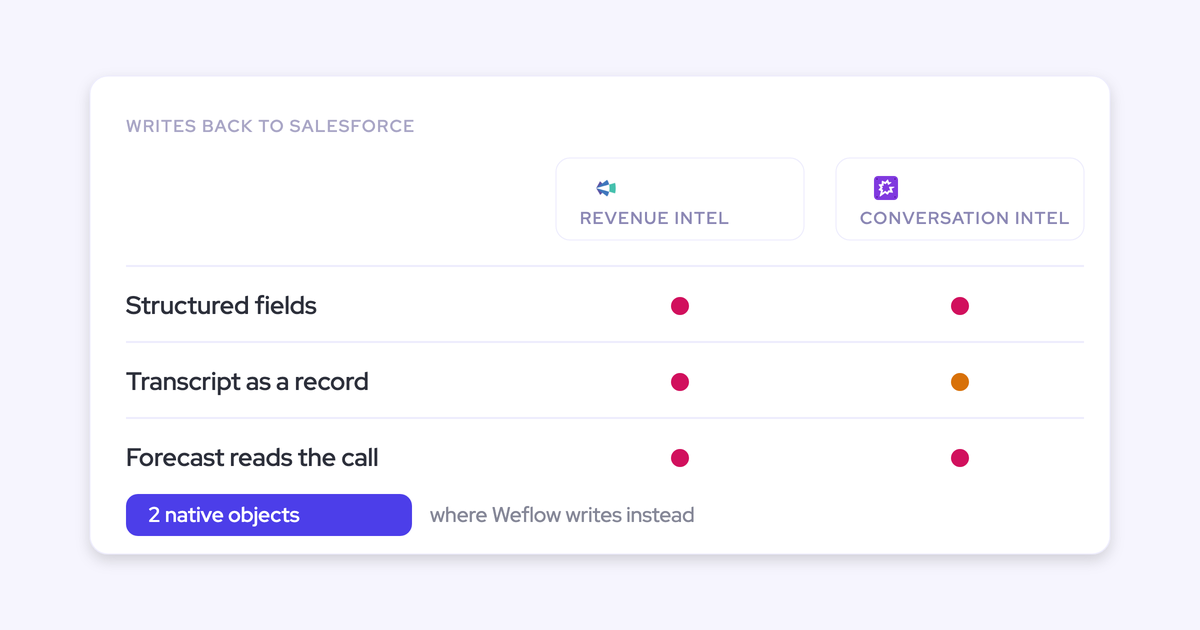
Gong maps captured emails and meetings into its own data structure and does not write that activity back into the customer's Salesforce. Everything downstream, reporting, agents, warehouse models, has to be reconciled back to the CRM instead of living there natively.
Weflow was built the other way. What it captures lands in native Salesforce objects, so the data a rep or a manager needs is already where the rest of the business reports.
Buyers report a Data Cloud add-on priced at roughly $5,000 a year just to expose their own conversation data to their warehouse. That's the sharpest version of a pattern buyers describe more casually on calls, paying to reach data that was already about their own customers.
We hear this from former Gong users directly: they felt they could never leave, because they didn't own the data, and the tool had pulled the team out of Salesforce and into its own interface. That fear is why data ownership has become a first filter on the next tool a team buys.
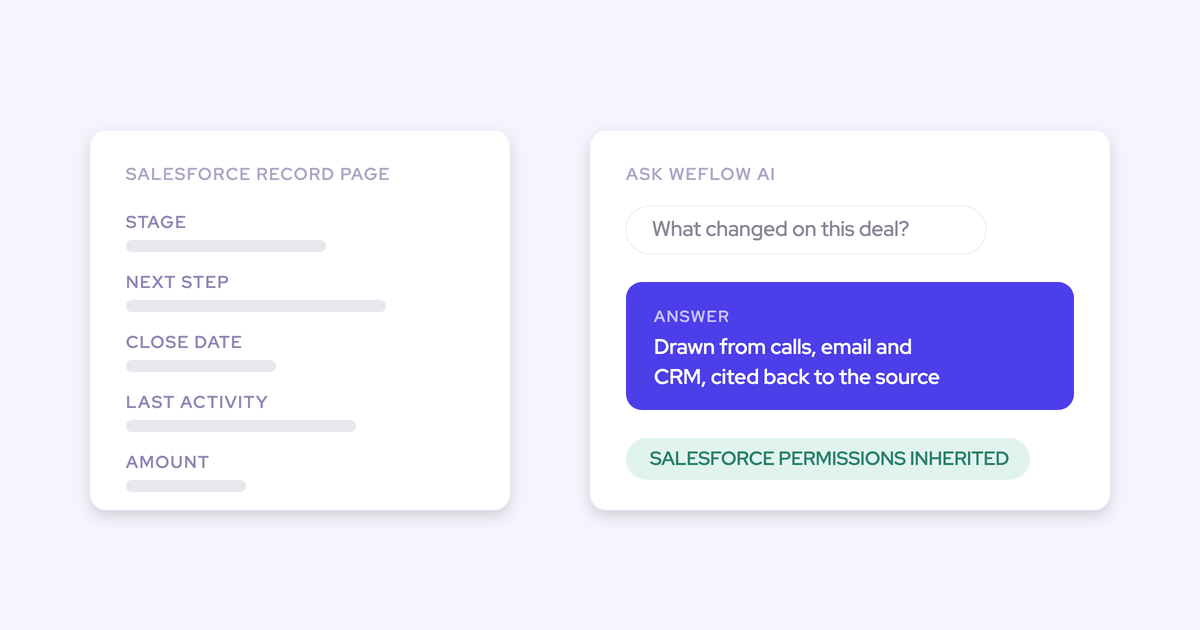
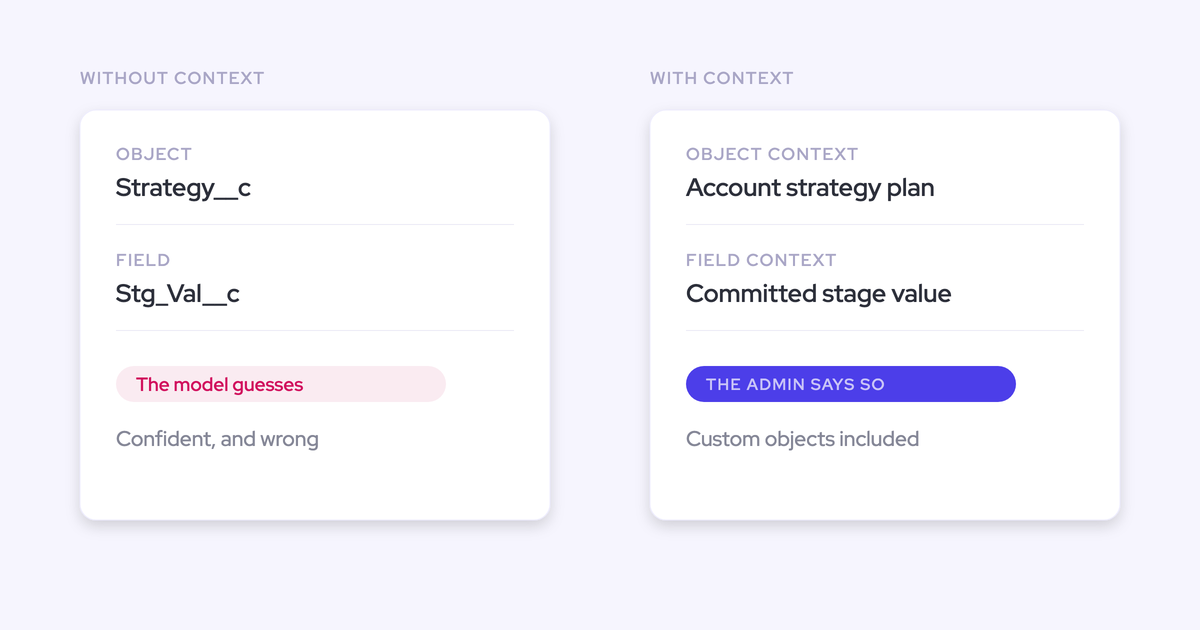
The real line between the two products is CRM depth. Weflow is built only on Salesforce and writes everything back into it, where Gong is a conversation platform holding its own data layer. Going deep on one CRM is a deliberate trade, and it's what lets Weflow respect custom objects, field dependencies, and permission sets instead of forcing a generic data model on top of them.
What Weflow costs: per seat, AI usage included
Our pricing is public, seat-based, and split into three standalone products or three bundles, billed annually with a minimum of 10 users.
| Product or bundle | Weflow's price per user/month | What's included |
|---|---|---|
| Activity & Contact Capture | $19 | Standalone capture product, with the Agent Builder free tier included. |
| Conversation Intelligence | $39 | Standalone conversation product, with the Agent Builder free tier included. |
| Deal Intelligence & Forecasting | $39 | Standalone deal and forecasting product, with the Agent Builder free tier included. |
| Revenue AI Foundation | $49 | Activity & Contact Capture plus Conversation Intelligence, with Ask Weflow AI Pro and the Agent Builder free tier |
| Revenue AI Business | $59 | Foundation plus Deal Intelligence |
| Revenue AI Enterprise | $79 | Business plus the full forecasting layer |
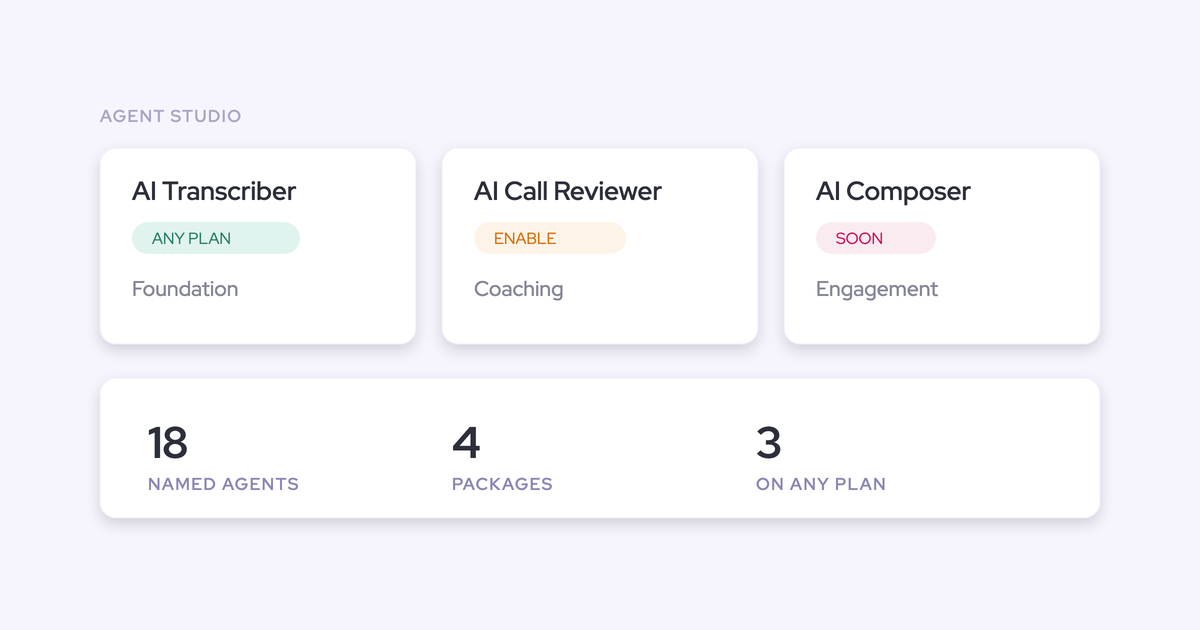
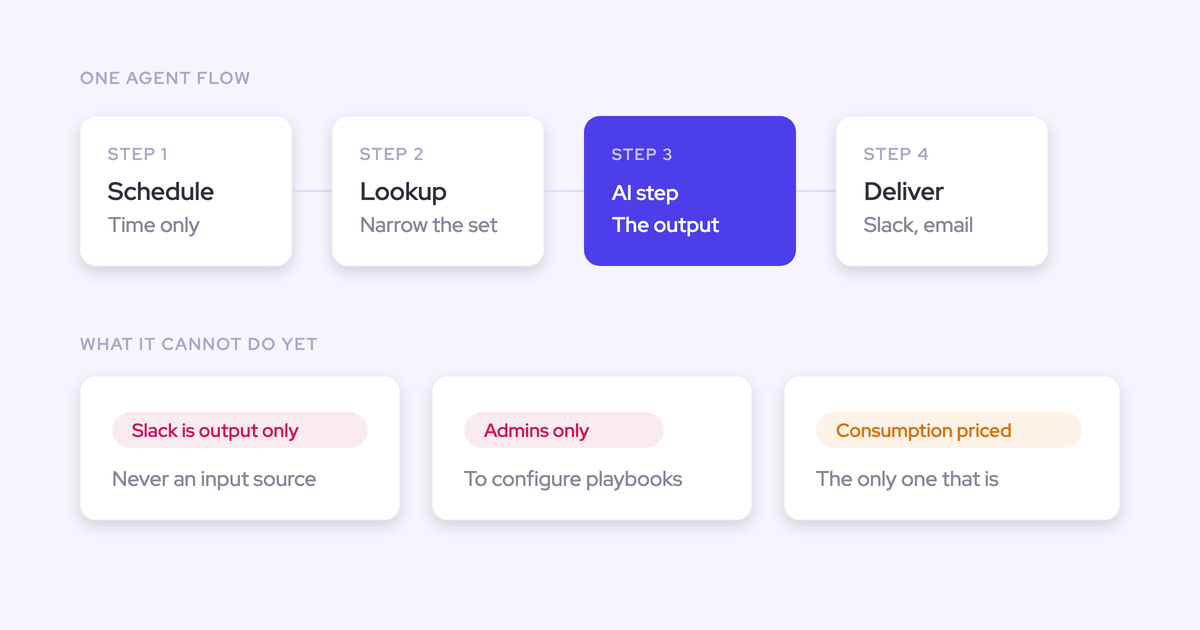
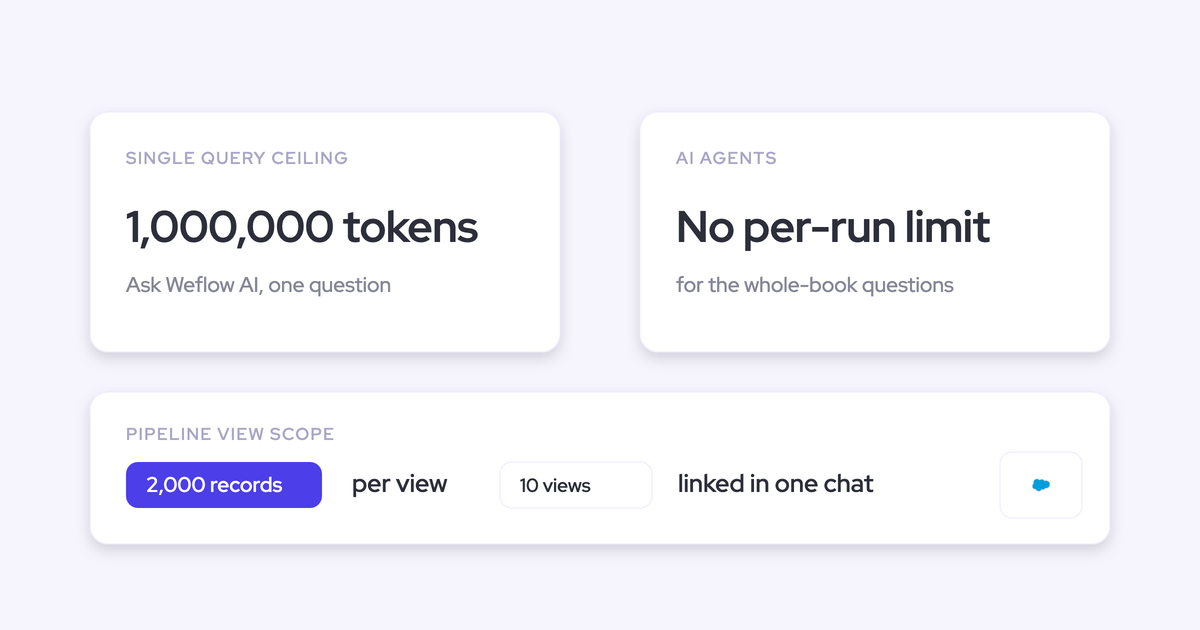
Pricing is seat-based, not usage- or token-based, so recordings, transcripts, AI templates, and Ask Weflow AI prompts are unlimited within a bundle. Agent Builder ships with a free tier in every plan, with paid tiers priced per workspace rather than per user for teams that need more agent actions.
Weflow ticked all the boxes: GDPR-compliant, tightly integrated with Salesforce, simple to use - and without the heavy price tag of U.S. vendors.
Bastian Stosic, Head of Media Sales Operations, HolidayCheck
The 62-seat math: three ways to configure Weflow, and why you can't slice Gong this way
At roughly 62 seats, three Weflow configurations land at three different totals, because Weflow lets a team put most seats on a lighter bundle and reserve the full platform for the roles that need it.
| Configuration | Approximate annual total | Who it fits |
|---|---|---|
| Activity capture plus conversation intelligence, all seats | ~$36,000/year | Teams that want calls and activity captured everywhere before adding deal and forecast intelligence |
| Full platform, all seats | ~$58,000/year | Teams that want deal intelligence and forecasting for every rep, not only managers |
| Mixed by role: most reps on the capture plus deal intelligence bundle, managers on the full platform | ~$45,000/year | Teams applying the buy what your team actually uses principle role by role |
Treat these totals as reference points for sizing a business case before a formal quote.
Gong can't be sliced the same way. Its pricing starts from a high-priced Foundation tier that every seat has to buy before any module gets added, so a buyer can't put most of a team on a cheap capture-only tier and reserve the expensive modules for a handful of managers. Weflow's per-product, per-team bundling is the direct answer.
Rollout owners tell us the seat count on paper is never the real number. A list that starts at 150 turns into 260 by the time the rollout is real, and half of those roles don't need the full product, which leaves the rollout owner walking an unplanned budget increase into a finance conversation nobody scheduled.
Migrating from Gong takes an API key and about a week
The switch away from a conversation intelligence vendor is priced by fear, not by the new license. Every won deal, every objection, every coaching example lives inside the tool a team is trying to leave, and buyers now ask about migration and backfill in the first conversation rather than the last.
The honest answer is that switching doesn't mean losing that history.
- Share an API key for the current provider, Gong, Chorus, Jiminny, or another recorder, with no manual export or file upload required.
- Weflow runs the import on its own side, pulling recordings, transcripts, and metadata directly from the provider's API.
- Weflow re-links every imported recording to the right Salesforce account, opportunity, and contact automatically, running its own lookup match where the provider's API doesn't already carry that association.
- Existing tracker sets carry over, so keyword reporting on competitors, pricing, and objections doesn't restart from zero.
A Gong migration takes about a week: recordings, metadata, and transcripts re-imported via the Gong API, with transcripts reused where possible and retranscribed only where they aren't. Teams weighing a fuller comparison, including Gong vs Chorus, can carry that same migration path with them.
Implementation is in the price, and we run it ourselves
Late in a Gong evaluation, buyers tell us they discover implementation isn't Gong's job at all. It goes to a third-party partner, at another twenty or thirty thousand dollars on top of a price they'd already defended internally, and buyers report that Gong routes smaller and mid-market customers to those third-party partners.
We run onboarding ourselves, in three phases against a mutual action plan with named owners on both sides: a short technical implementation, a configuration phase, and a role-based rollout with training. Time to live is typically two to four weeks, and we don't charge for implementation.
It's probably been the most flawless rollout of any product I've ever been involved with.
Scott Jones, SVP of GTM Revenue Intelligence & Enablement, KORE Wireless
KORE Wireless evaluated Gong before rolling out Weflow across four regions, and that rollout is the one Scott Jones is describing.
Will the price hold as you grow: contracts, discounts, and the small first invoice
Weflow's standard contract is 12 months, and we don't offer a shorter term.
- Three discount layers apply on top: a bundle discount, a volume discount, and a multi-year discount.
- Every product or bundle requires a minimum of 10 users.
- There's no contractual right to reduce seat count mid-term, though seats can be reassigned when someone leaves.
- Expansion into forecasting costs roughly $10 more per user per month on top of an existing bundle, instead of a separate contract at $100 to $200 per user per month elsewhere.
That expansion path is built for a buyer who describes what they want as "crawl, walk, run," not "25 seats tomorrow": start with capture and conversation intelligence, then expand into forecasting once the case is made, without reopening procurement.
The first invoice can effectively be zero. Weflow runs a 14-day free trial with white-glove implementation included, on the buyer's own Salesforce, so the cost risk is minimal before any contract is signed.
What this means in practice: run the 14-day bake-off on your own Salesforce
Don't take our word for the price difference, or Gong's. Buyers in this category already run two or three vendors through the same use case on their own data before deciding, and that instinct is the right one here too.
Price and interface are things you can verify in minutes. The deeper differences, how far the Salesforce integration actually goes, what happens to your data at renewal, only become visible in a demo and a trial, which is why we ask for the trial rather than a feature grid.
Weflow's 14-day trial runs on your own Salesforce, with our team handling setup, and with a sync-back it can show months of real history on day one.
See how Weflow captures activity, updates Salesforce fields from calls, and rolls up your forecast. Book a 30-minute demo.
FAQ: the Weflow vs Gong pricing questions buyers ask
Is Weflow just a cheaper Gong?
No. Weflow is not a discounted Gong. It's the Revenue AI Orchestration platform for sales, customer success, and RevOps teams, and what it captures lands in the customer's own Salesforce rather than a vendor data layer. The line between the two products is CRM depth: Weflow writes everything back into Salesforce, where Gong holds its own data structure that has to be reconciled against the CRM.
Does Gong publish its pricing?
No. Gong does not publish pricing, so every Gong figure in this article is what buyers report or a reasonable estimate, not a stated fact. Buyers describe needing three sales calls before Gong would disclose a number, and reported quotes land around $120 to $200 per user per month plus a roughly $5,000 platform fee.
Can we keep our Gong recordings if we switch to Weflow?
Yes. Weflow imports existing recordings, transcripts, and metadata from Gong using only an API key, and automatically re-links them to the right Salesforce accounts, opportunities, and contacts. Transcripts are reused where possible, and only retranscribed where the original isn't usable.
What would Weflow cost a team of around 60 people?
At roughly 62 seats, activity capture plus conversation intelligence lands around $36,000 a year, the full platform lands around $58,000 a year, and mixing bundles by role brings the same team to roughly $45,000 a year. Treat these as reference points for sizing a business case, not a substitute for a formal quote.
What happens to our Gong trackers and call playlists?
Teams switching off Gong expect the same clips, playlists, and tracker capability on day one, since trackers are often configured over years. An existing tracker set carries over to Weflow, so keyword reporting on competitors, pricing, and objections does not restart from zero. Clipping moments from transcripts and grouping them into shared playlists is supported in Weflow, so coaching libraries can be rebuilt from imported calls.
Is there a minimum commitment?
Yes. Weflow's standard contract is 12 months, with bundle, volume, and multi-year discounts published rather than negotiated case by case. There's no contractual mid-term seat reduction, though an early opt-out after three months has been offered as a negotiated concession for buyers who want to limit downside risk.