Revenue Intelligence vs Conversation Intelligence: What Each One Writes Back to Salesforce
See what revenue intelligence vs conversation intelligence writes back to Salesforce—and what stays reportable.



Both terms have real definitions. Revenue intelligence reasons over CRM and activity data to produce a forecast, a roll-up, and a risk signal. Conversation intelligence records, transcribes, and analyzes what was actually said to a customer. That part isn't complicated.
What's complicated is that every vendor now sells both labels, and the products underneath were never merged. So the category name won't tell you what to buy. The question that decides it is narrower: what does each tool write back into Salesforce as structured, reportable data, and do the conversation half and the revenue half read the same data layer?
That's the argument of this piece. Weflow is the Revenue AI Orchestration platform for sales, customer success, and RevOps teams, built for Salesforce teams, and we sell both halves, so read the rest knowing where we sit. We'll name where Gong and Clari are genuinely better on the way through.
What revenue intelligence and conversation intelligence actually mean
The two categories have different jobs, and both definitions are legitimate. That's exactly why the marketing overlap is so hard to see through.
What is revenue intelligence?
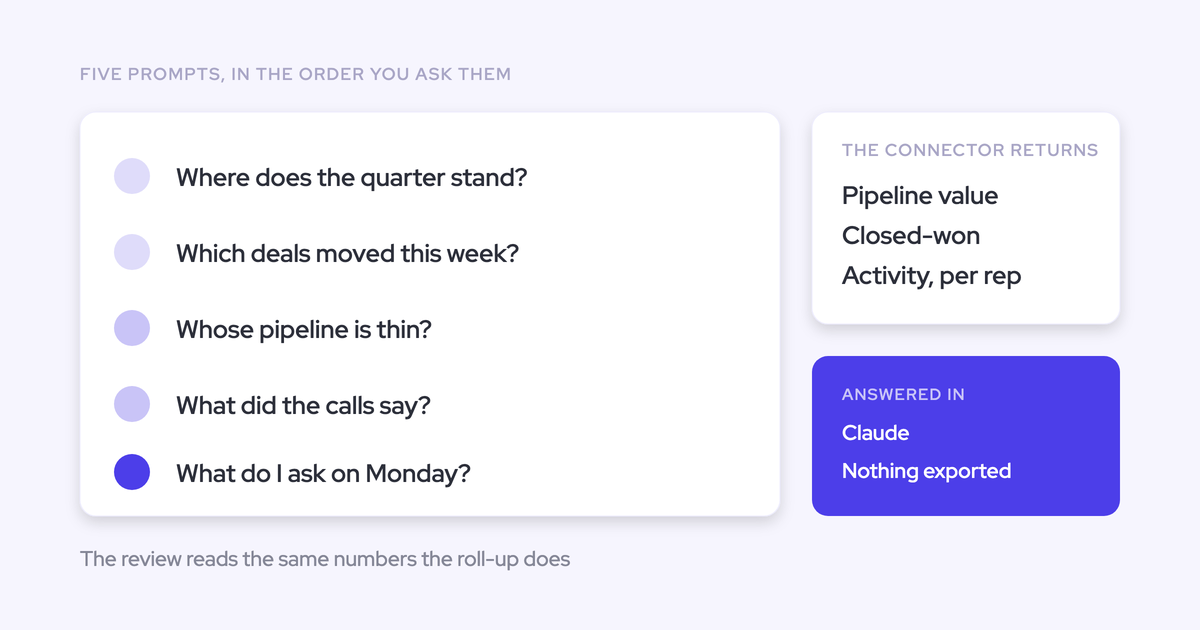
Revenue intelligence is the layer that reasons over deal, pipeline, and activity data to produce a forecast, a roll-up, and a read on which deals are at risk. Clari is the reference point for most buyers.
In practice it's three or four screens: the roll-up, the pipeline waterfall, the pacing view, and deal inspection. Those are the views teams actually open. Everything else in a revenue intelligence tool tends to go unused, which is why renewal conversations for this category so often turn into an audit of what a team still uses twelve months in.
What is conversation intelligence?
Conversation intelligence records, transcribes, and analyzes customer conversations, then turns them into coaching signals, trackers, and summaries. Gong invented the category and still has the deepest analytics in it.
Here's the part vendors don't lead with: recording and transcription are commodity now. Everyone transcribes well, in dozens of languages, for very little money.
So the differences between conversation intelligence tools have moved entirely into what happens after the call. Whether the conversation becomes a field in your CRM, or a transcript in someone else's portal.
Why revenue intelligence and conversation intelligence blurred together
The two categories converged from opposite directions, and the marketing merged before the products did.
Gong started as call intelligence and rolled forecasting in on top, sold as a paid add-on above the seat. Clari came the other way and bought its conversation intelligence: Wingman in 2022, rebranded as Clari Copilot. Then Groove in 2023, then the Salesloft merger completing in December 2025.
Each arrived with its own data model, its own interface, and its own release cycle. None was rewritten onto a shared foundation. That's the whole mechanism behind the confusion you're feeling.
| What the combined label promises | What the assembled product ships |
| One platform covering conversation intelligence and revenue intelligence | Clari Copilot is the rebranded Wingman, acquired rather than built, running beside the forecasting product rather than inside it |
| Call insights that inform the forecast | Clari's forecasting product and its conversation intelligence product don't talk to each other, so call data never reaches the forecast |
| Conversation data in your CRM | Gong sends an AI summary and a document to Salesforce rather than the raw transcript text, and its AI writes only to standard objects |
| Consolidation onto one vendor | Wingman, Groove, and Salesloft still run as separate applications, so the same number of systems remain, now under one invoice |
None of that is a reason to dismiss either vendor. It's a reason to stop treating the category label as information.
The real question: what each tool writes back to Salesforce
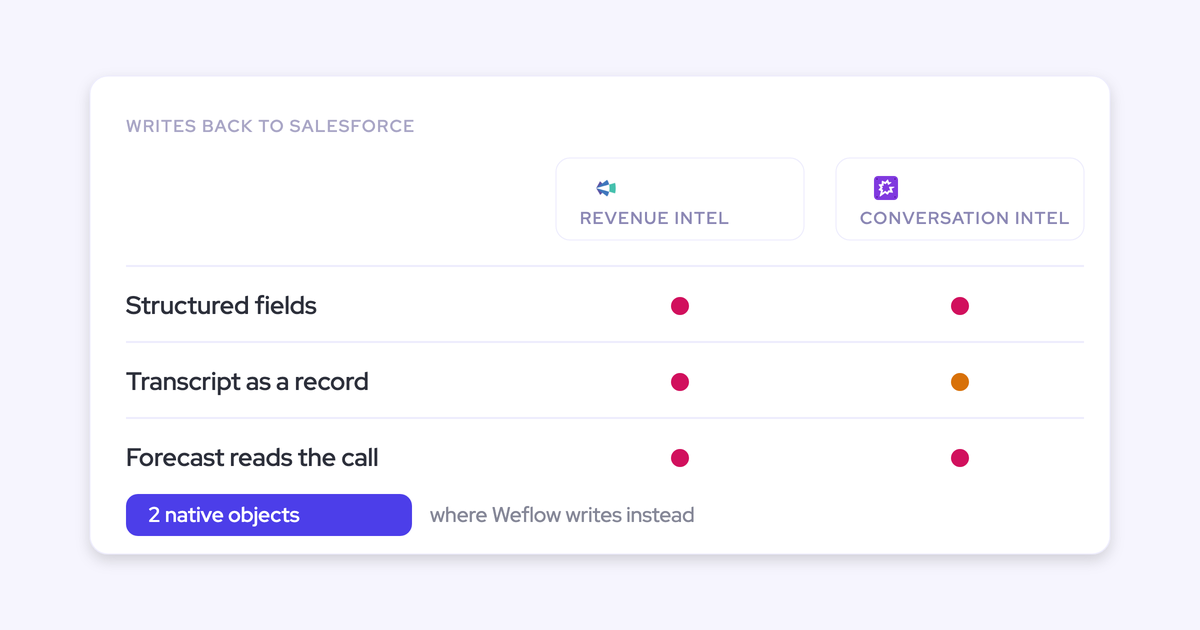
The decision criterion isn't analytical depth. It's what lands in your CRM as structured, reportable, owned data.
Everything downstream reads from the CRM. Your reporting does. Your forecast does. Your flows and validation rules do. And every AI initiative your CEO is asking about does, whether that's an agent, a corporate Claude license, or a warehouse model your data team owns.
A summary dropped in a text box feeds none of them. A link to a vendor cloud feeds none of them either.
Across the Salesforce orgs we connect to, the methodology fields are almost always empty before anything automatic is switched on. The company picked MEDDIC or SPICED, trained on it, built the fields, and then nobody typed into them. The conversation happened, the qualification was discussed, and the CRM has nothing.
This is also where "one connected platform" claims get tested. If the conversation half and the revenue half don't read the same data layer, then call content never informs the forecast, whatever the invoice says.
What Gong and Clari actually write back to Salesforce
Both write something. What matters is the format, the object, and whether anything structured survives the contract.
| Write-back dimension | Gong | Clari (forecasting + Copilot) | Weflow |
| What lands in Salesforce from a call | An AI summary and a document, not the raw transcript text | Copilot writes no Salesforce fields; recordings and reviews stay in Copilot | A recording object holding the summary and full transcript, plus an indexing object, in native Salesforce objects |
| Structured field writes | AI writes to standard Salesforce objects only, not custom objects | None from Copilot; Clari itself can't even calculate a field, so derived metrics have to be built as Salesforce formula fields first | Picklists, number, date, and multi-select fields on standard and custom objects (lookup relationship fields excepted) |
| Methodology fields (MEDDIC, MEDDPICC, SPICED) | Trackers detect whether topics were mentioned; the weighted score on the opportunity has to be built separately with RevOps and IT | No AI field updates and no methodology scorecards | Around thirty methodology templates and 250+ prompts, mapped by an admin into the fields your team already reviews |
| Does conversation data reach the forecast | Forecasting is a separate paid module reading Gong's own data layer | No; the two products don't talk to each other | Yes; the forecast and deal warnings read the same opportunity fields the conversation layer writes |
| Conflict control when a later call contradicts an earlier write | No setting decides whether the field is overwritten, appended to, or left alone | Not applicable, no field writes | Current value shown beside the suggested value for the rep to accept, edit, or reject, or run automatically per admin config |
| Who holds the archive at contract end | Activity and conversation history is mapped into Gong's own structure and leaves with the contract | Nothing structured stays behind in your CRM to keep | Transcripts and summaries sit in Salesforce records you own, so they survive the subscription |
Two things worth crediting, because a fair read helps you more than a hit piece.
Gong does log activity to Salesforce, so activity logging is not why teams leave it. And Gong will summarize a methodology across every call on an account, not just call by call, which is the view a manager reviewing a long cycle actually needs. Anything that only summarizes single calls feels like a downgrade after that.
Clari's waterfall, pacing, and same-day-last-quarter comparison are the real thing, and the quarter-over-quarter comparison is the hardest of the three to reproduce, because it needs pipeline state snapshotted over time. Salesforce reporting can't do that without a warehouse.
How to test whether a vendor's two halves connect
A vendor with integrated products and a vendor with acquired products look identical on a feature grid. The difference only surfaces in production, months after signature, unless you force it out in the evaluation.
The test is short. Run it in the next call:
- Which Salesforce object does each product write to? Name it. A passing answer names the object and the fields. A failing answer is "it syncs to Salesforce."
- Can the revenue side filter on a field the conversation side produced? A passing answer is them building that filter live in front of you. A failing answer involves a BI tool, a middleware step, or "you could export it."
- Show me one report, in my Salesforce, that groups deals by something said on a call. Grouping needs a picklist or a multi-select. If the write is a narrative in a text field, there's no report.
- When was each product built or acquired, and are they on one data model? A vendor with an honest answer here tells you the acquisition dates without flinching. Vagueness is the tell.
- What happens to the conversation archive when the contract ends? The years of calls are what keeps teams on an incumbent. Ask where they live now.
One warning: a demo showing both halves side by side proves nothing. Two windows open on one screen is not a shared data layer. Ask for the field, not the tour.
Do you need revenue intelligence, conversation intelligence, or both?
Framed as two categories, the question forces a false choice. Framed as one data layer, it mostly dissolves: the conversation layer supplies the evidence the revenue layer reasons over, so buying them disconnected buys about half the value of each.
You get a forecast built on stage and amount, and a call archive nobody joins to a deal. Both work. Neither answers whether the deal closing this quarter has an economic buyer.
The honest exceptions, by condition:
- You want conversation coaching depth and have no CRM reporting ambition. Buy the deepest specialist. That's Gong, and we'd say so on a call.
- You want a roll-up and a pacing view for a small leadership group, and your pipeline data is already clean. A forecasting tool alone is fine. Price it honestly against Salesforce reports plus a BI dashboard, because a competent RevOps team can approximate those three views.
- You have an AI mandate and a data foundation problem. Then you need both halves and you need them writing to one place, because an agent can only reason over what reached the CRM.
How Weflow connects conversation intelligence and revenue intelligence
Weflow was built as one platform rather than assembled by acquisition, which is the only reason the two halves share a data layer at all. Here's what that means at the object level, held to the same standard we just applied to the competitors.
Both halves read one unified data layer
Conversation data, activity and contact data, and deal and forecast intelligence all sit in one queryable layer, and everything Weflow captures lands in native Salesforce objects the customer owns.
Run the two-question test on us. Which objects: a recording object holding the summary and full transcript, an indexing object, plus the Salesforce Event the summary is written back onto with a link to the recording. Can one side filter on what the other produced: yes, because AI Field Updates write into the same opportunity fields the forecast, the deal warnings, and your own reports already read.
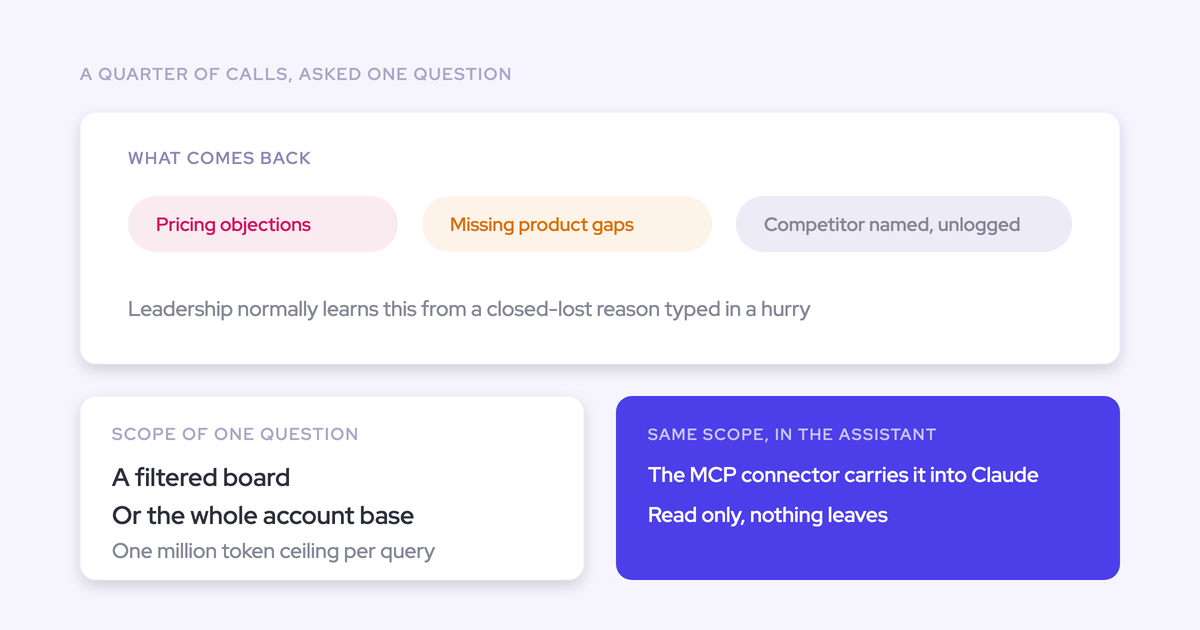
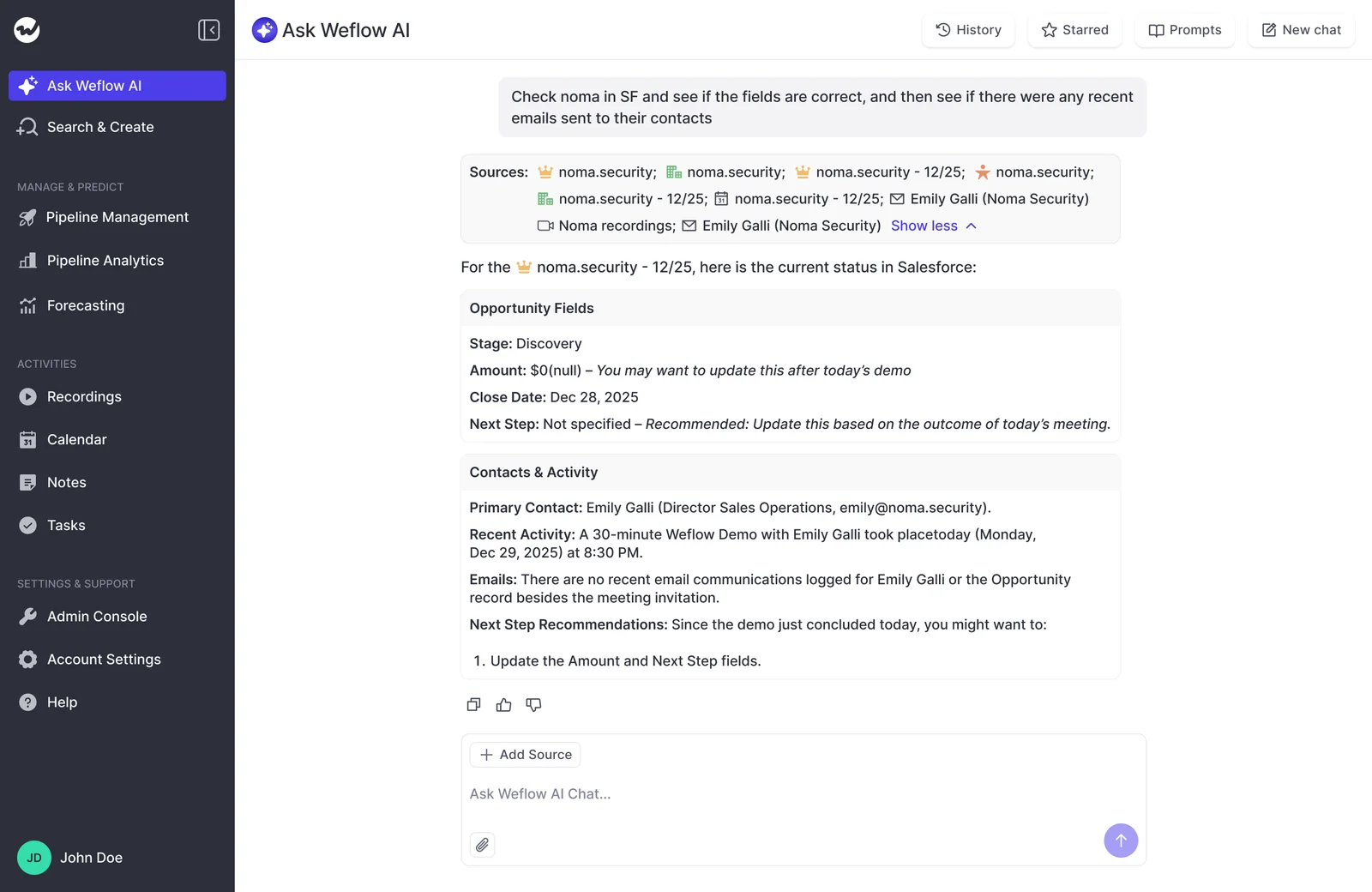
Ask Weflow AI reads across the whole layer, so a question can span a transcript, the opportunity fields, and the email history on one account in a single answer.
We weren't buying conversation intelligence. We were buying a unified data layer that the entire go-to-market motion could run on, and a partner who understood that distinction.
— Scott Jones, SVP of GTM Revenue Intelligence & Enablement, KORE Wireless
AI Field Updates write structured fields, not summaries
Weflow Conversation Intelligence extracts values from the transcript and writes them into real Salesforce fields, which is the thing that makes a call reportable.
What lands where:
- Values into picklists, number fields, date fields, and multi-select fields, on standard and custom objects.
- Methodology answers into the fields your team already reviews, from around thirty templates and 250+ prompts an admin maps and rewrites.
- An AI summary in named sections, written back onto the Salesforce Event with a link to the recording, so it shows on the opportunity activity timeline.
- The full transcript and summary as Salesforce records, reportable and permissioned like anything else in the org.
- The proposed field updates shown to the rep beside the current value, within 30 to 60 seconds of the call ending, to accept, edit, or reject.
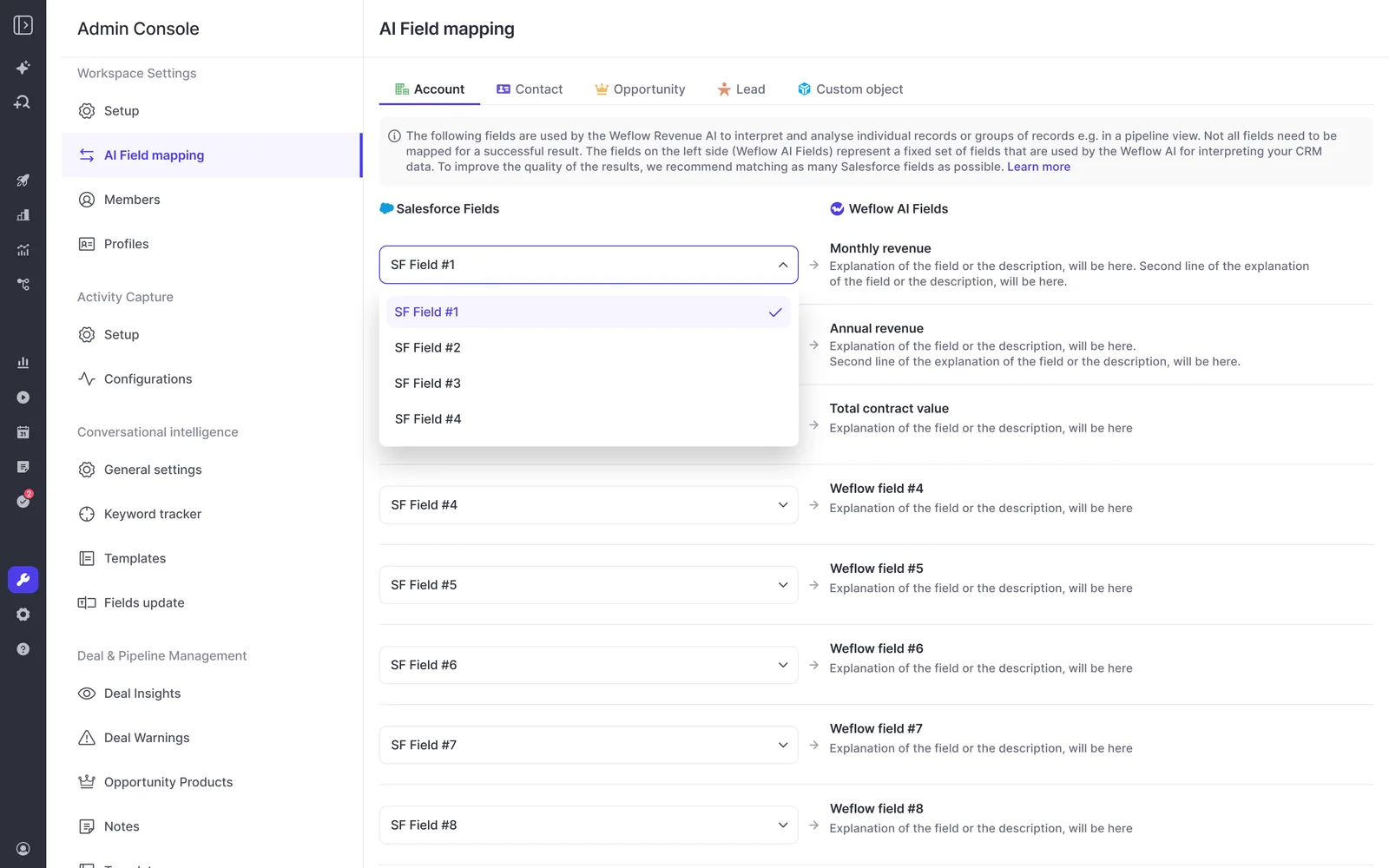
The reason field type matters: a narrative in a text field can't be grouped or charted. A value in a picklist can. Score qualification strength as a 0 to 3 picklist, or track competitors mentioned as a multi-select, and you have a dashboard populated from what was said rather than from what the rep remembered.
Where Gong and Clari are still stronger
Gong invented conversation intelligence and has the deepest analytics in the category. If pure conversation analytics depth is your decision criterion, that's the honest answer, and its account-level methodology summary across every call is a view teams miss when they leave.
Clari's enterprise roll-ups at a thousand-plus reps are more mature than ours, and a forecast configured over several years is ahead of what any replacement delivers on day one.
That's a fair read and we use it internally. The missing 20% is usually the specific things a team built over years: splits, dual-date logic, a particular roll-up. We also don't have Clari's pipeline flow view, and Agent Builder is our newest product, less mature than capture, conversation intelligence, and forecasting.
Walk through the product yourself, no call required.
FAQ: revenue intelligence vs conversation intelligence
Is Gong revenue intelligence or conversation intelligence?
Both by label, conversation intelligence by origin and depth. Gong created the conversation intelligence category and later added forecasting as a separately priced module on top of the Foundation seat. For a RevOps buyer the decisive detail is the write-back: Gong sends an AI summary and a document to Salesforce rather than the raw transcript text, and its AI writes to standard objects only.
Do AI field updates overwrite what reps already typed?
With Weflow, the rep sees the current field value beside the suggested one and accepts, edits, or rejects each update, or an admin runs the writes automatically once the prompts are trusted. This is the question to press hardest on with any vendor: Gong offers no control over what happens when a later call contradicts what an earlier one wrote, so the field holds whichever answer arrived last.
The cost of getting this wrong isn't the lost paragraph. Once a rep watches their own note disappear, they stop maintaining the field at all.
Can conversation data write to custom Salesforce objects and fields?
Weflow writes to standard and custom Salesforce objects, including the methodology fields your team already tracks against, across picklist, number, date, and multi-select types. Lookup relationship fields are the one exception. Gong's AI writes to standard objects only, which is the fastest way to separate the two category claims in an evaluation.
Does my Gong or Clari call history migrate and stay linked?
Weflow migrates an existing Gong call history at no charge and reprocesses libraries running into the thousands of recordings, carrying enough metadata to restore the link between each call and its Salesforce account. That link is the whole point. A migration that arrives as an undifferentiated pile of recordings is close to worthless for win-loss or closed-lost analysis, and the archive is the real reason teams stay on an incumbent they've stopped liking.
Is buying both capabilities one line item or two?
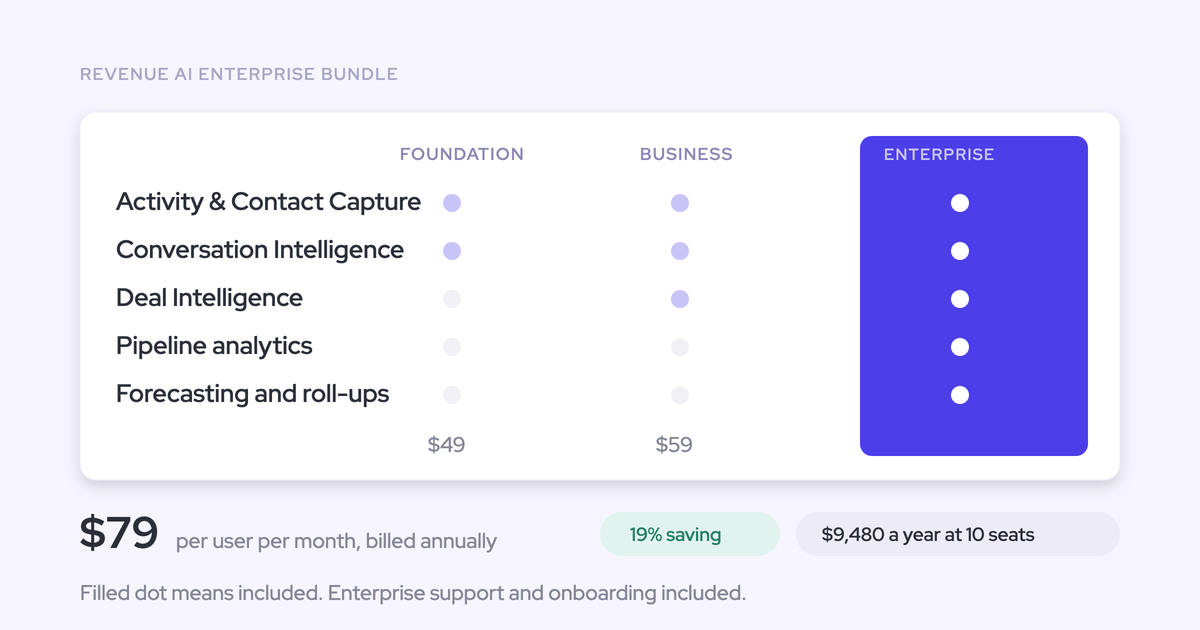
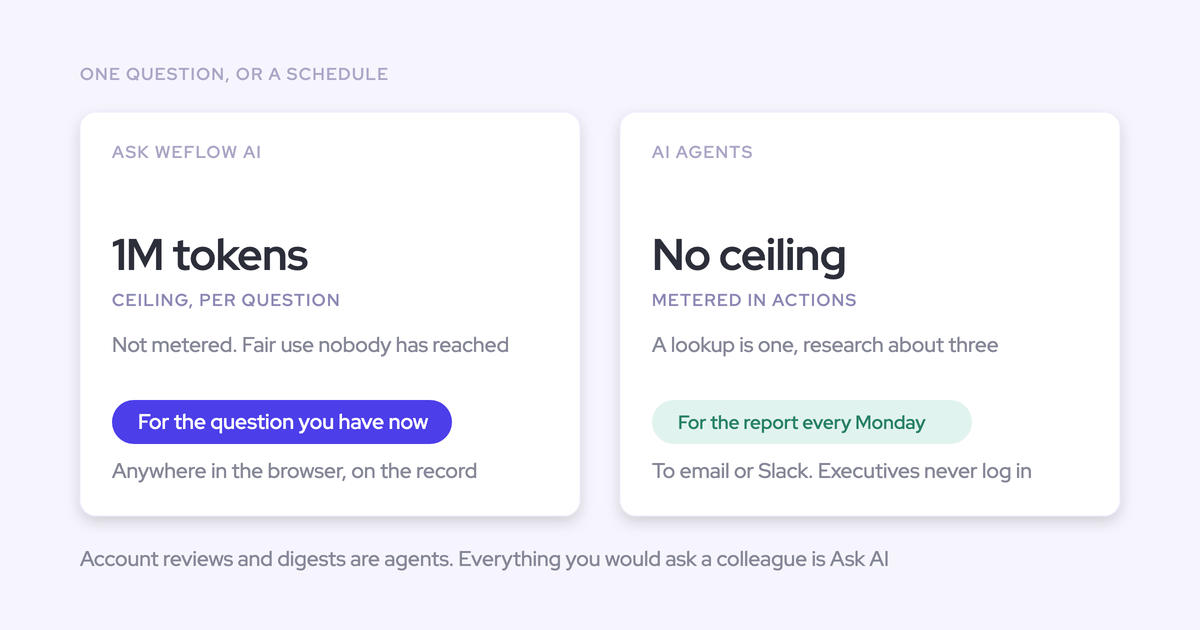
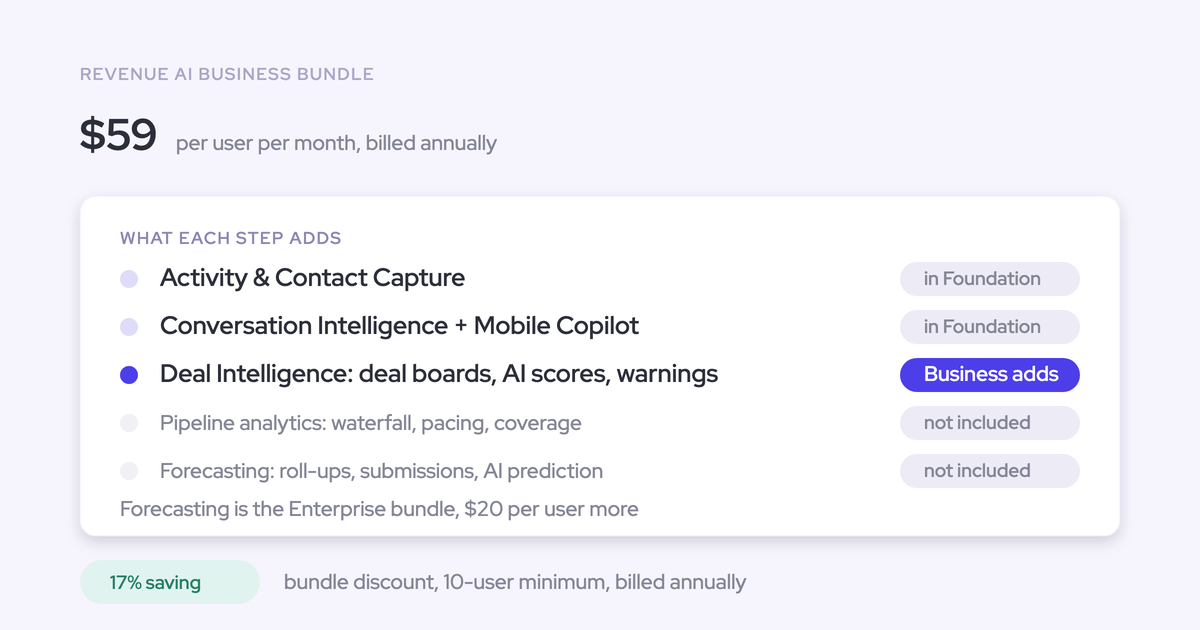
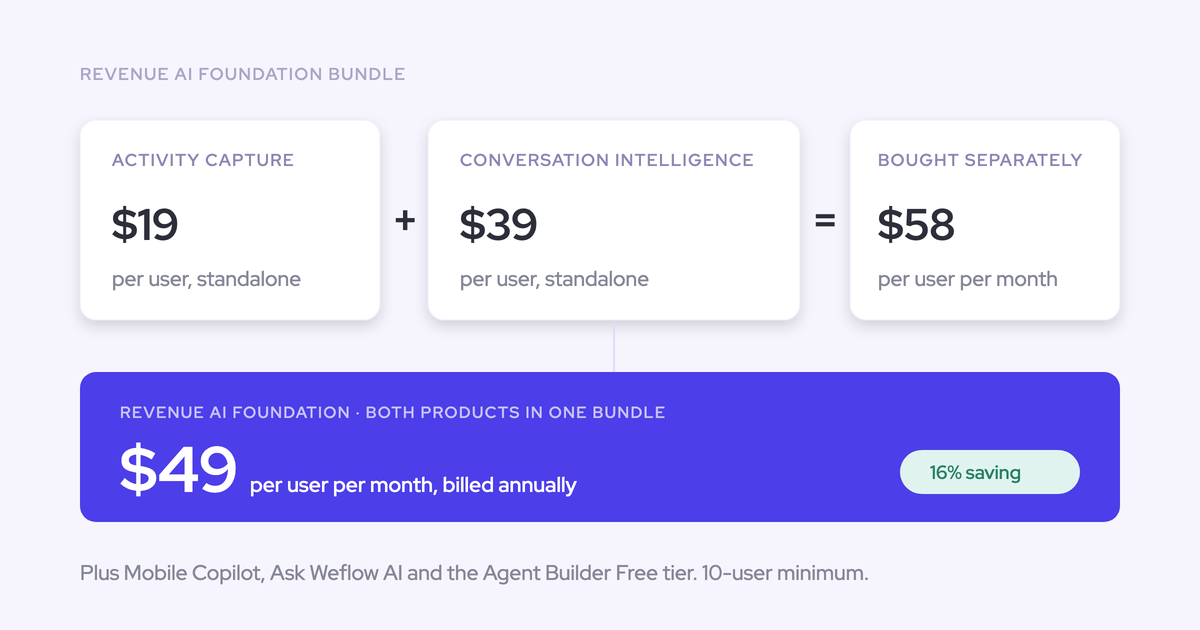
With Weflow it's one platform on per-seat pricing, published openly: Conversation Intelligence at $39 per user per month, Deal Intelligence & Forecasting at $39, Activity & Contact Capture at $19, or the bundles at $49, $59, and $79 for Revenue AI Foundation, Business, and Enterprise. Minimum ten users, billed annually. AI usage is in the seat; Agent Builder is the only consumption-priced piece.
Compare that to what the incumbents itemize. Gong charges a $5,000 per year platform access fee before any seat, from $1,600 per seat per year for Foundation, roughly $300 to $800 per seat per year for coaching and forecasting modules, and has added consumption pricing for AI on top of the seat. Clari and Salesloft are one company as of December 2025 and still run as separate applications.
Take the seat number to your CFO. Take the consumption line to them too, because that's the one that moves after you've rolled out.