
Why Gong gates its pricing until the third call, and what to ask before then


If you're three calls into a Gong evaluation and still can't put a number in front of finance, you're not being handled badly. You're inside a pricing motion that works exactly as designed. This article does the part Gong's process withholds: how the quote actually stacks line by line, what the real all-in per seat comes to at a realistic seat count, the questions that pull the number forward on your next call, and a side-by-side with a vendor that publishes its price. That vendor is us. Weflow is the Revenue AI Orchestration platform for sales, customer success, and RevOps teams, and what a Weflow seat funds is the path from conversation to deal execution with Weflow. But the first half of this piece is about Gong, because that's the number you have to defend this quarter.
Why Gong gates pricing until the third call
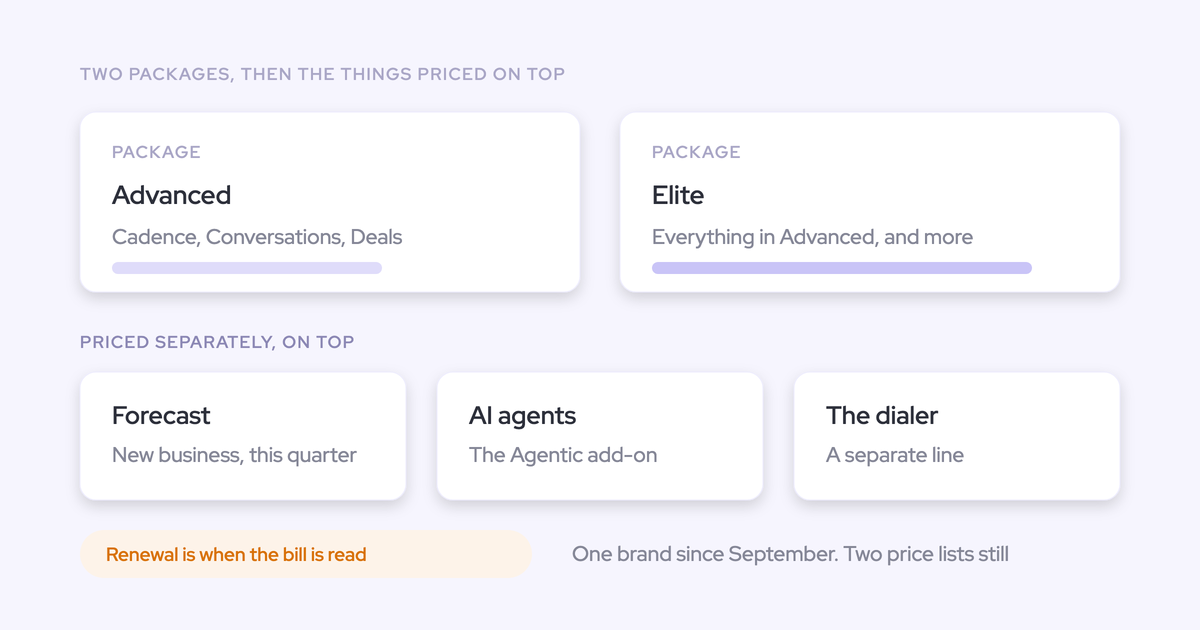
Gong gates pricing because the quote is layered and a single published number would show how the layers stack. There's a base seat you have to buy first, a platform access fee, coaching and forecasting sold as separate per-seat modules, and a data warehouse add-on. Put all of that on a web page and the sticker arrives before any value does.
So the sequence gets inverted on purpose. Discovery, then demo, then the number, once you've spent enough time that walking away feels expensive.
"We had our third call with Gong because they refused to tell us pricing until now."
RevOps leader, from a Weflow sales call
The second reason is structural, and it's the one worth understanding before you negotiate. Gong was founded in 2015, has raised roughly $584 million, reached around $300 million in ARR, and was last valued near $7 billion. A company carrying that multiple has to keep growing into it.
That limits how far any rep can discount. It's why buyers hit the same high floor before a single module gets added, and why "we'll see what we can do on price" rarely moves the base seat much.
Your instinct about gated pricing is fair, and we hear it on almost every switch call: a vendor confident in its value publishes the number. But be precise about what the gate tells you. It says something about Gong's go-to-market and its cost base. It says nothing about whether the product is good, because the product is good.
How Gong pricing stacks: base seat, platform fee, add-ons
Here's the structure buyers report to us on switch calls, line by line. These are the figures we see quoted, in the shape they arrive.
| Line item | What it covers | Approximate cost |
| Gong Foundation seat | Interaction capture, mobile app, keyword and smart trackers, Ask Anything, basic analytics. This is the tier you have to buy before anything else. | $1,600 per seat per year |
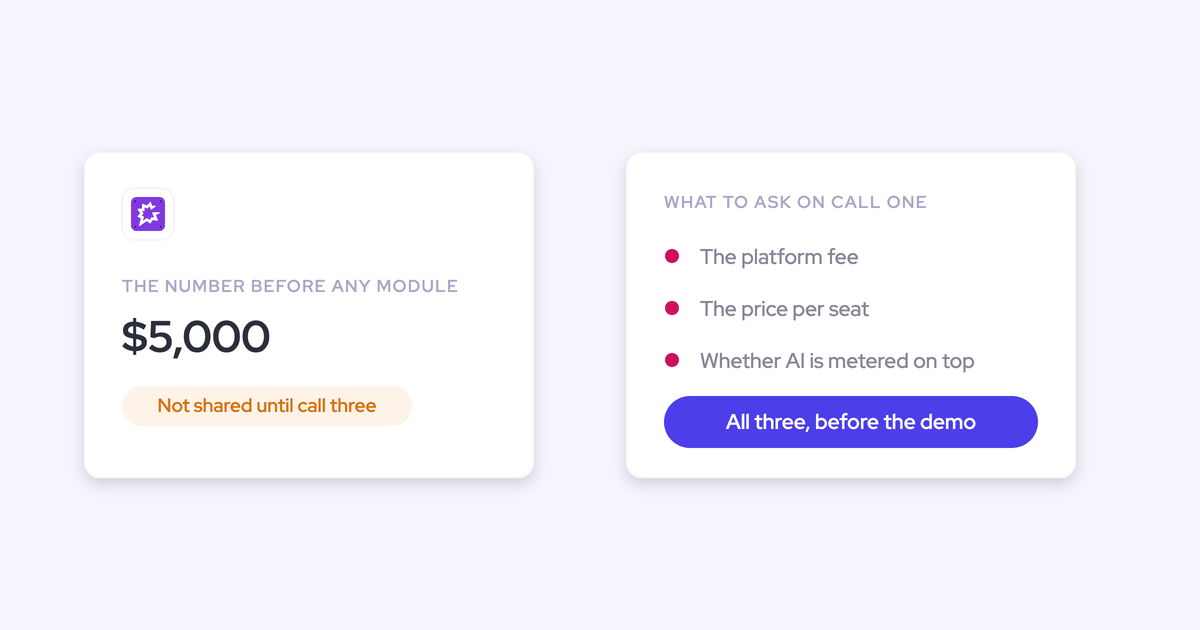
| Platform access fee | A flat access charge that applies before any per-seat cost. | $5,000 per year |
| Gong Enable Essentials | Coaching workflows and scorecards, added per seat on top of Foundation. | ~$300 per seat per year |
| Gong Forecast Essentials | Deal boards and win/loss, added per seat on top of Foundation. | ~$300 per seat per year |
| Gong Engage or the full Gong Forecast tier | The deeper versions: Engage adds prospecting and an in-app dialer, Forecast adds the fuller forecasting product. | ~$800 per seat per year, each |
| Gong Data Cloud | Exposes Gong data across Snowflake, Databricks, BigQuery and Redshift. Separate from the platform fee and the seats. | ~$5,000 per year |
| Support and CSM | A dedicated Customer Success Manager comes with contracts above $45,000 per year. Enterprise support is quoted separately. | ~$5,000 per year |
| Implementation | Smaller and mid-sized customers get routed to a third-party implementation partner, billed on top of the license. | $20,000 to $30,000, per buyer reports |
The Foundation-first rule is the part that decides your total. You can't put 200 seats on a cheap capture tier and 20 on the expensive intelligence tier. Everyone who touches the system pays $1,600 a year before you add the module you actually came for.
The implementation line is the one that ambushes people latest. You defend a number internally, and then find out the vendor doesn't implement its own product.
Beyond the money, it splits accountability. If adoption stalls in month three, the software vendor and the partner can each point at the other while you hold the outcome.
What Gong actually costs all-in per seat
Assembled, the number is materially higher than the seat price implies. Below is a worked example at two seat counts: the 150 you probably assumed, and the 260 that appears once you finish building the actual user list.
Assumptions: coaching for every seat, forecasting for the leadership group only, implementation in year one. Data Cloud and enterprise support are left out to keep it conservative.
| Line item | 150 seats | 260 seats |
| Foundation seats at $1,600/seat/year | $240,000 | $416,000 |
| Platform access fee | $5,000 | $5,000 |
| Enable Essentials, all seats, ~$300/seat/year | $45,000 | $78,000 |
| Forecast Essentials, leadership only, ~$300/seat/year | $9,000 (30 seats) | $12,000 (40 seats) |
| Third-party implementation, year one | ~$25,000 | ~$25,000 |
| Total, year one | ~$324,000 | ~$536,000 |
| All-in per user per month | ~$180 | ~$172 |
| What the seat price alone suggested | $133 | $133 |
The gap between those last two rows is the whole problem. At 150 seats the structure adds about $84,000 to the figure you'd have derived from the seat price. That's a 35% miss on a line item you already socialized internally.
Then the seat count moves. It always moves, because the list you build is never the list people were talking about.
Two things follow. First, at $1,600 a seat before modules, most teams quietly cut scope instead of paying: customer success and account management get left off, and you end up with conversation data for part of your revenue base. Second, get the structure on paper before you get the discount, because a percentage off a number you don't understand isn't a negotiation.
The questions that get Gong's number out sooner
Asking for "pricing" invites a deflection. Asking for the components one at a time doesn't, because each one has a factual answer a rep can't reasonably refuse. Take these into the next call:
- What is the Foundation seat price, and what is specifically excluded from it? This establishes the floor and forces the add-on list into the open in the same breath.
- Is there a platform access fee, and does it apply before per-seat licenses? A flat five-figure charge changes the math most at smaller seat counts, which is exactly where it's least expected.
- What do coaching and forecasting cost per seat as add-ons, at both the Essentials and the full tier? There's a wide spread between the two levels. Ask which one the demo you saw was actually running on.
- Can I put different groups on different tiers, or does every seat need Foundation first? This is the single biggest driver of your total, and the answer determines whether you can cover CS and AM at all.
- Who implements: Gong, or a partner? Is it in the license, and what's the quoted range? Get this before you take a number to finance, not after.
- What contract size do I need for a dedicated CSM, and what does support cost below that? Support thresholds are contractual, so they're easy to confirm and easy to forget to ask about.
- If I want this data in Snowflake or BigQuery, what's the line item? Data Cloud is priced separately from the platform fee and the seats.
- Give me the all-in year-one total at my seat count, in writing, with every line named. One number with no breakdown is not something you can defend in a CFO conversation.
Gong vs Weflow pricing at a glance
Same dimensions you just excavated for Gong, answered for both.
| Dimension | Gong | Weflow |
| Price transparency | Quote only. Buyers report needing three sales calls before a number is disclosed. | Published on the pricing page: $19 to $79 per user per month, before you speak to anyone. |
| Base seat structure | Foundation at $1,600 per seat per year must be bought before any module is added. | Three products sold standalone or in three bundles. Any product can be bought on its own. |
| Platform access fee | ~$5,000 per year, applied before any seat cost. | None. |
| Coaching and forecasting | Paid per-seat add-ons: ~$300 per seat per year at Essentials, ~$800 at the full tiers. | AI coaching scorecards sit inside Conversation Intelligence at $39. Forecasting sits inside Revenue AI Enterprise at $79. |
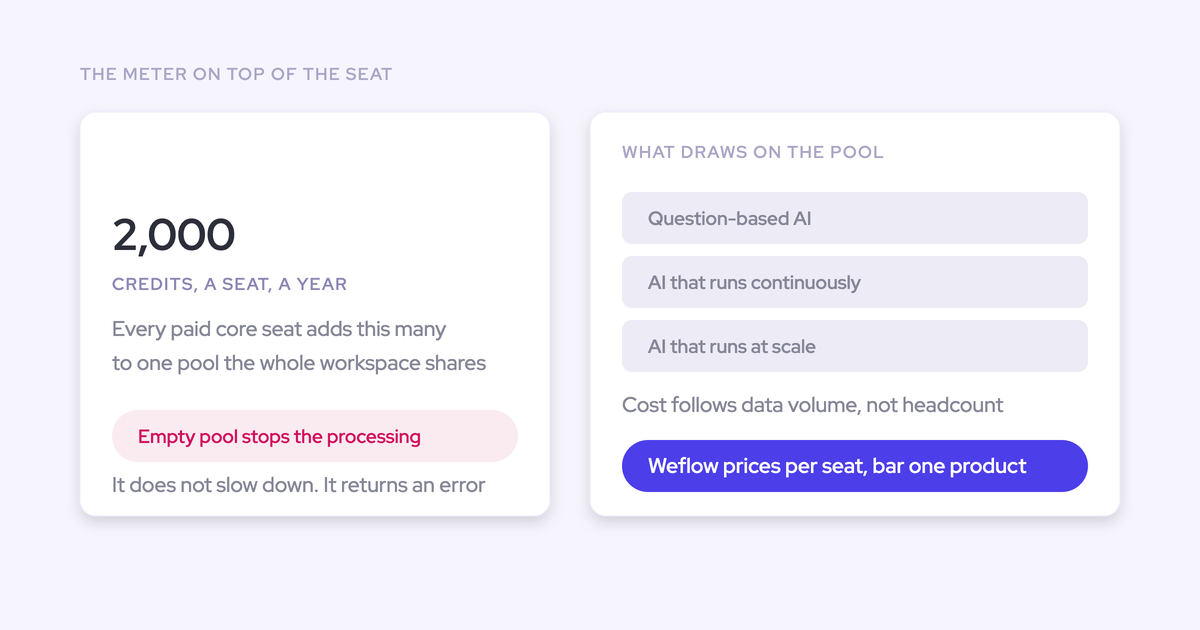
| AI and usage limits | Data Cloud is a separate ~$5,000 per year line for warehouse access. | Unlimited recordings, transcripts and AI processing. Ask Weflow AI Pro and Agent Builder Free (25 agent actions a month) are in every plan and bundle. |
| Implementation | Smaller and mid-sized customers are routed to third-party partners, billed separately. | Run by Weflow end to end at no charge. Typically live in two to four weeks. |
| Support | Dedicated CSM on contracts above $45,000 per year; enterprise support quoted at ~$5,000. | Enterprise support included, with no spend threshold. |
| Minimums and billing | Quote-based, annual. | 10-user minimum, annual billing in USD or EUR, unlimited view-only licenses included. |
What Weflow's published pricing includes
You're going to test this claim, so here is everything at the level of detail you'd want before a procurement call.
Three products and three bundles, priced per user
Weflow publishes six prices. Three standalone products, three bundles, all per user per month, billed annually, 10-user minimum.
| Plan | Price | What it covers |
| Weflow Activity & Contact Capture | $19/user/month | Auto-syncs emails, meetings and contacts from Outlook or Google to the right Salesforce records, with activity insights and reporting. |
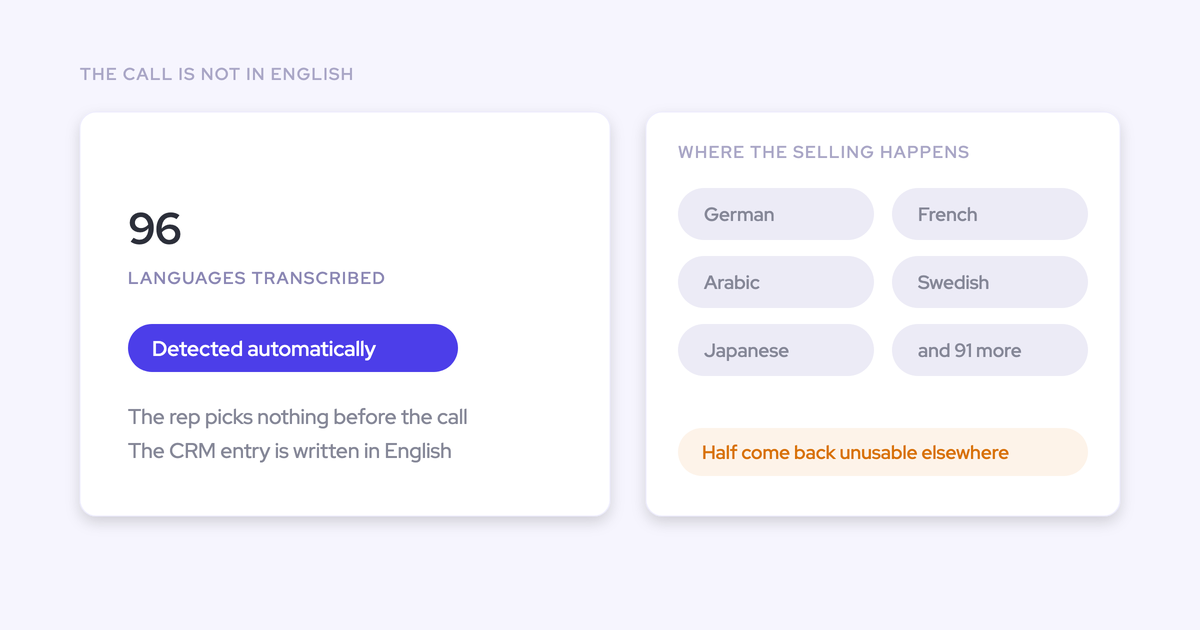
| Weflow Conversation Intelligence | $39/user/month | Records, transcribes (96 languages, auto-detected) and summarizes meetings, writes AI Field Updates into Salesforce fields, runs AI coaching scorecards. |
| Weflow Deal Intelligence & Forecasting | $39/user/month | Deal health and 50+ signals, pipeline analytics, AI forecast prediction, roll-ups, quota management, forecast accuracy tracking. |
| Revenue AI Foundation | $49/user/month | Activity & Contact Capture + Conversation Intelligence + Mobile Copilot. Saves 16% against buying the products separately. |
| Revenue AI Business | $59/user/month | Foundation plus Deal Intelligence. Saves 17%. |
| Revenue AI Enterprise | $79/user/month | All Weflow products, including Forecasting. Saves 19%. |
Ask Weflow AI Pro and Agent Builder Free come with every plan on that list, standalone products included. Multi-year terms take 10% off for two years and 20% off for three, and volume discounts apply at larger seat counts, so the real number at 260 seats lands below list rather than above it.
Per-team bundling: the answer to Gong's Foundation floor
Weflow products are assigned per team, so you don't buy the expensive tier for everyone to give a few people forecasting. This is the direct structural answer to a Foundation-first floor, and it's how a 260-seat rollout stays affordable.
Take the same 260 seats from the worked example above and group them by what each group genuinely uses:
- 180 seats on Revenue AI Foundation ($49): AEs, CS, AM. Capture, recording, transcripts, AI Field Updates, coaching scorecards. About $105,800 a year.
- 40 seats on Revenue AI Business ($59): frontline managers who need deal health, warnings and pipeline analytics. About $28,300 a year.
- 40 seats on Revenue AI Enterprise ($79): the leadership and RevOps group that actually runs the forecast. About $37,900 a year.
That comes to roughly $172,000 a year, about $55 per user per month all in, against roughly $536,000 for the Gong structure at the same seat count. Put every one of those 260 seats on Revenue AI Enterprise instead, forecasting for everybody, and you're at about $246,000. Still under half.
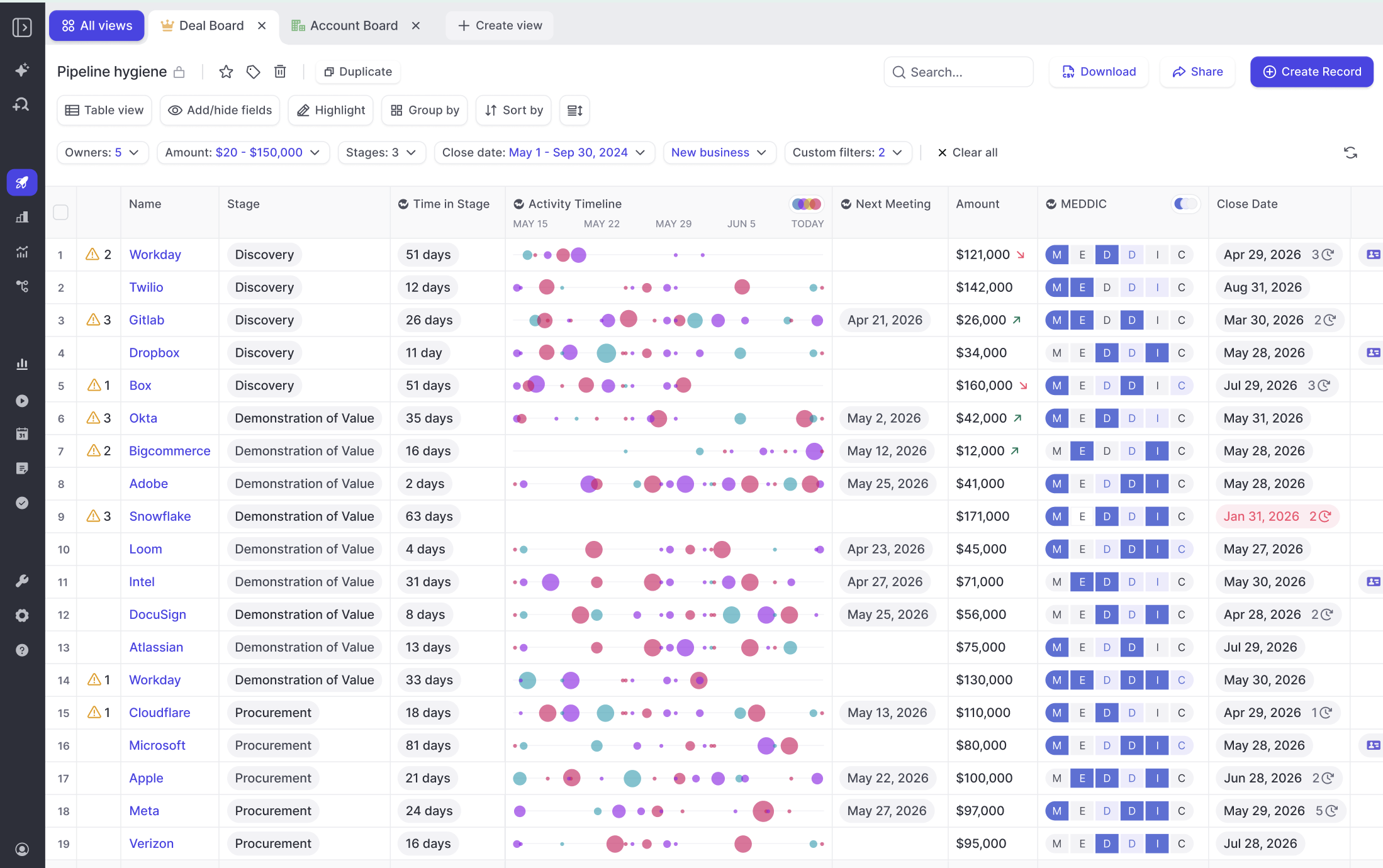
Managers get the deal board and methodology scoring at the Business tier without paying for the forecasting product they'll never open.
One honest constraint on the mixing: call recording lives in Conversation Intelligence, not in Activity & Contact Capture. If a group needs recordings, $19 doesn't cover them. That's why Revenue AI Foundation pairs the two.
Implementation, AI usage, and support included in the seat
The line items you just learned to itemize for Gong, checked off one at a time:
- No platform access fee. Nothing is charged before the first seat.
- No implementation fee. Weflow runs onboarding itself rather than handing you to a partner. Technical setup takes under an hour with a Salesforce admin and a mail admin present, and most teams are live in two to four weeks, four to six for a large org.
- No usage metering. Recordings, transcripts, AI templates and Ask Weflow AI prompts are unlimited. Pricing is per seat, not per token.
- Unlimited view-only licenses. Product, enablement and execs can read recordings, summaries, pipeline views and analytics without consuming a paid seat.
- Enterprise support with no spend threshold. There's no contract size you have to clear to get looked after.
- Historical backfill is the one paid extra worth naming. Weflow can pull up to 24 months of emails and meetings from your mail server into Salesforce, and that backfill is an add-on rather than part of the seat.
On the implementation point, KORE Wireless evaluated Gong and went with Weflow, then ran a five-phase rollout from Activity Capture through to Forecasting with Weflow owning onboarding end to end, including live training with a real-time Portuguese translator for the Brazil team. Smaller rollouts land the same way.
"It took less than an hour to install the managed package and start syncing data. Everything was live immediately."
Bastian Stosic, Head of Media Sales Operations at HolidayCheck
Why half the price doesn't mean half the product
The price gap is a cost-base difference, not a capability difference. When Gong set its pricing, transcription was expensive and inference barely existed as a line item. That cost has collapsed since. A platform built after the collapse carries a structurally lower cost base for the same work, and a $7 billion valuation to grow into keeps the older price level where it is.
That's the causal story, and it's the one to repeat internally, because "they're cheaper" invites the question of what's missing.
What buyers actually conclude when they run the comparison is narrower than a price complaint:
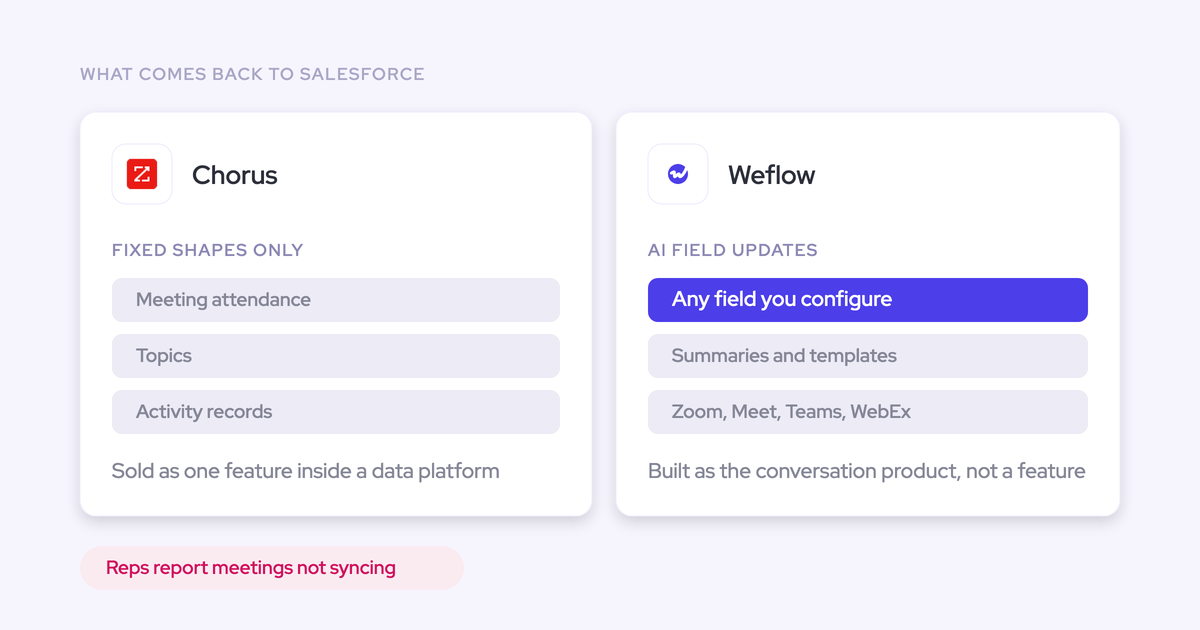
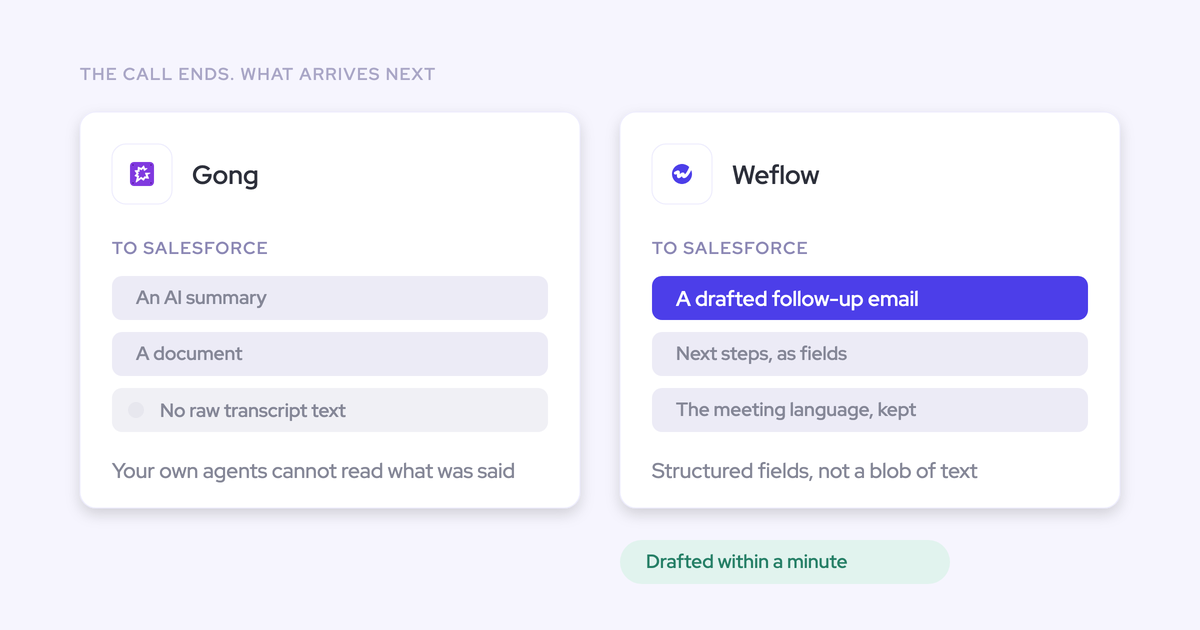
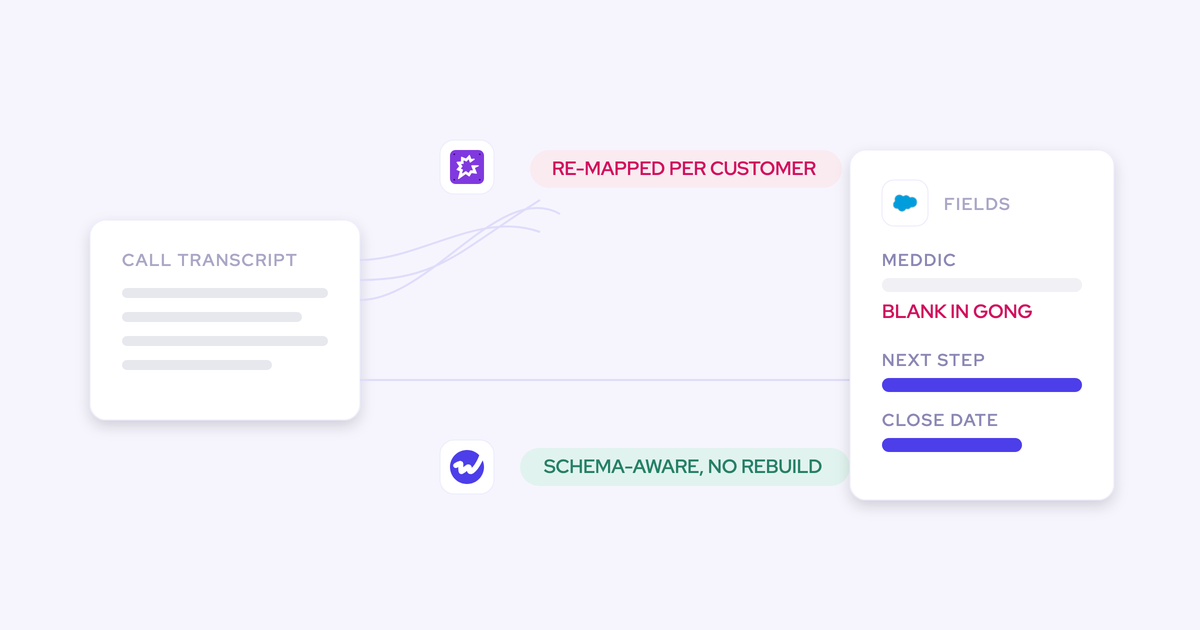
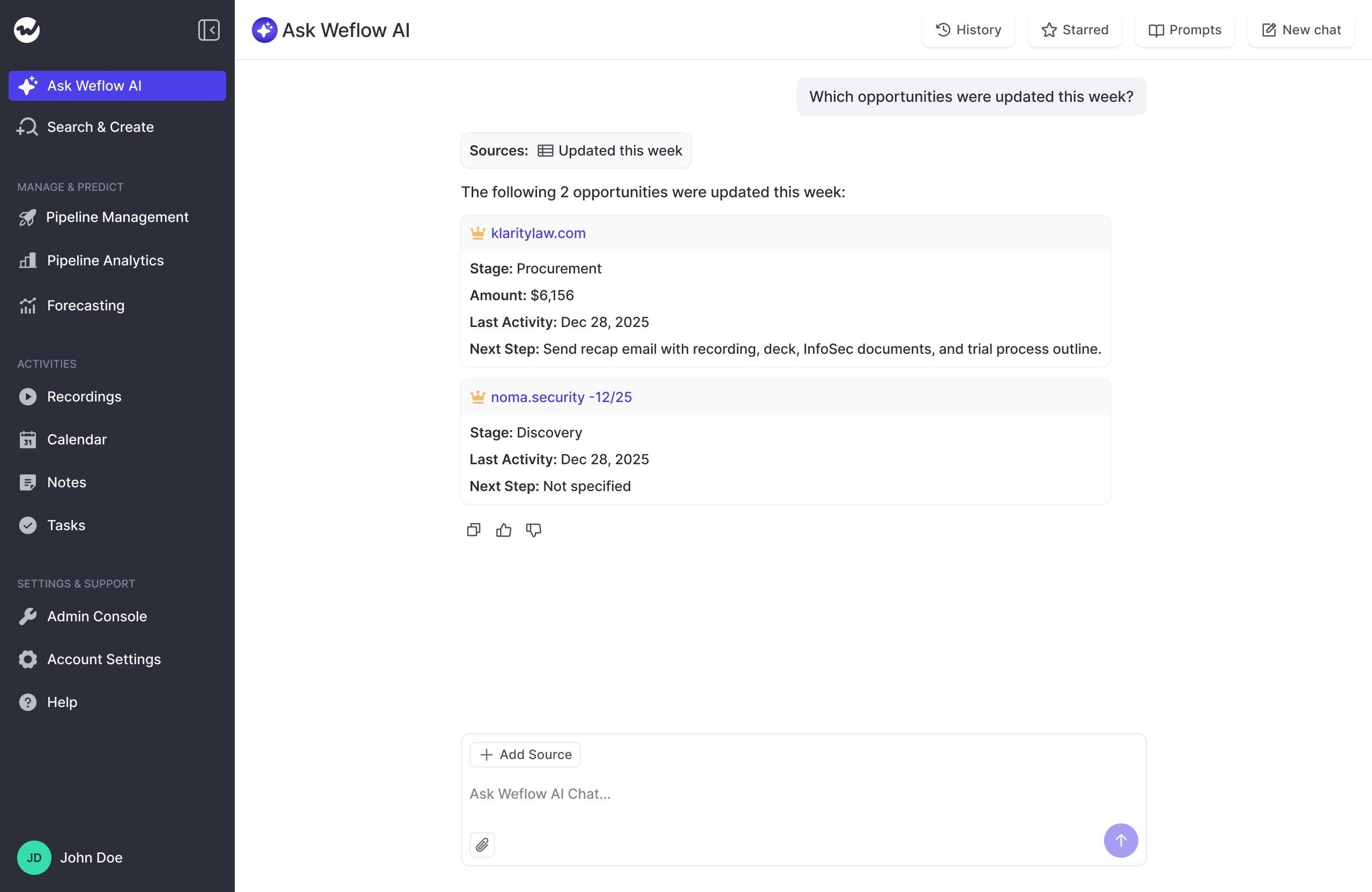
On the capability that decides most of these evaluations, the gap runs the other way. Gong surfaces insights from the call and leaves the CRM update to the rep, so MEDDIC and other methodology fields get filled in by hand after the fact, or not at all. Weflow AI Field Updates extract the values from the transcript and write them into the specific Salesforce fields your deal reviews already read, with the rep seeing the current value beside the suggested one before it lands.
Weflow also creates the missing contacts and sets Opportunity Contact Roles, which is how multi-threading becomes reportable rather than anecdotal.
Don't take that on our word. Run both against your own Salesforce org on the same use case, same team, same two weeks, and compare what ends up in your fields. Weflow's trial is 14 days with guided onboarding. That's the proof, not a discount argument.
Where Gong is still the stronger choice
Gong invented this category and is genuinely ahead in places that matter. If any of these is your deciding factor, stay where you are, and pricing opacity on its own is not a good enough reason to switch.
- Depth of conversation analytics. Gong has the deepest analytics in the category, and for teams whose entire program is built on aggregated conversation analysis, that depth is the product.
- Interface polish. Buyers regularly tell us they prefer Gong's UX, and they're not being polite. It's a real strength that costs us deals.
- Sales engagement. Gong Engage brings prospecting and an in-app dialer. Weflow has no sequencing, no cadence engine and no dialer, and isn't building one.
- Phone-heavy motions. Gong captures calls placed through its dialer. Weflow does not capture VoIP or phone calls today.
- Enterprise footprint and scale. A decade in market, $584 million raised, and a support and partner ecosystem sized to match. If a very large global rollout with a long procurement chain is your risk, that maturity is worth something.
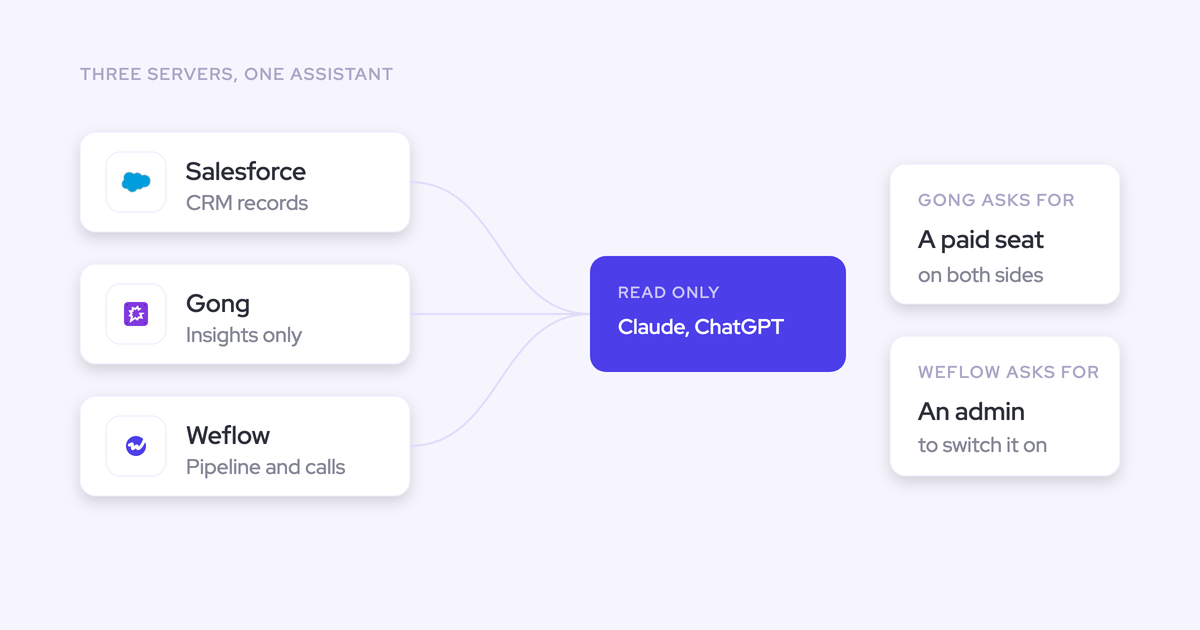
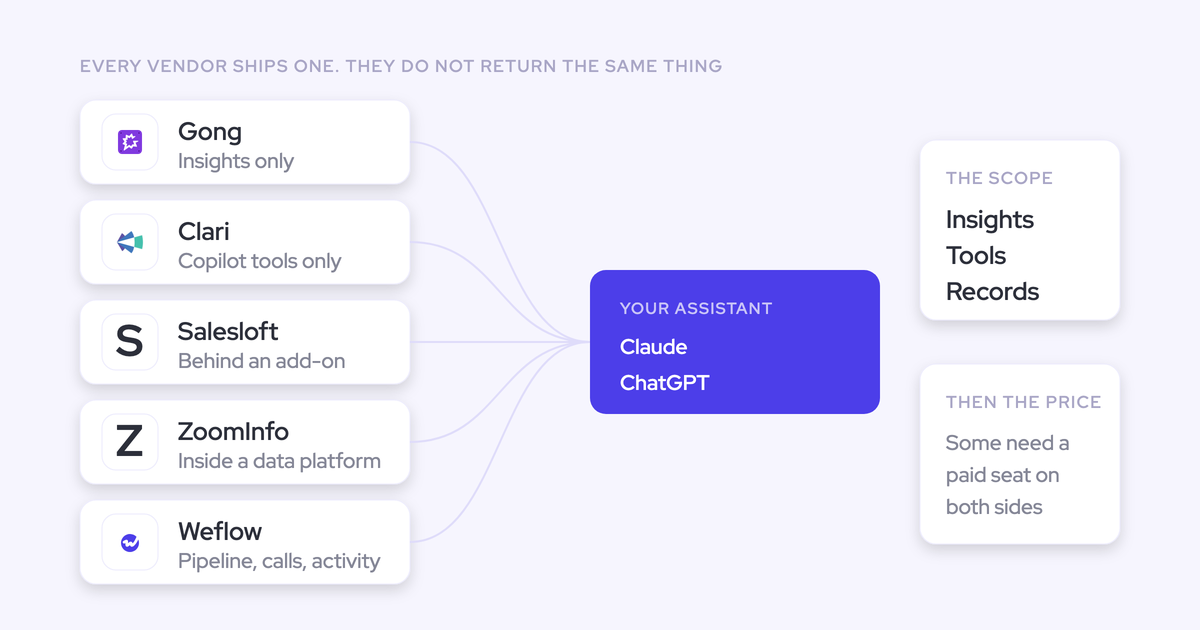
- Existing agent integrations. Gong offers an MCP endpoint for connecting external AI agents, plus in-platform agents.
There's a softer reason teams stay that nobody writes in an evaluation doc: managers are attached to Gong, reps treat it as a perk, and removing a tool everyone knows is disruptive. That's a real cost of switching. Price it honestly alongside the license.
Choose Weflow if, choose Gong if
Choose Weflow if:
- You need a defensible number now, in a single line, without a third call to get it.
- Your seat count grew past what was budgeted and you need most seats on an inexpensive tier with only the leadership group on forecasting.
- Your methodology fields in Salesforce are empty and you want them populated from the conversation rather than by reps at 11pm before the forecast call.
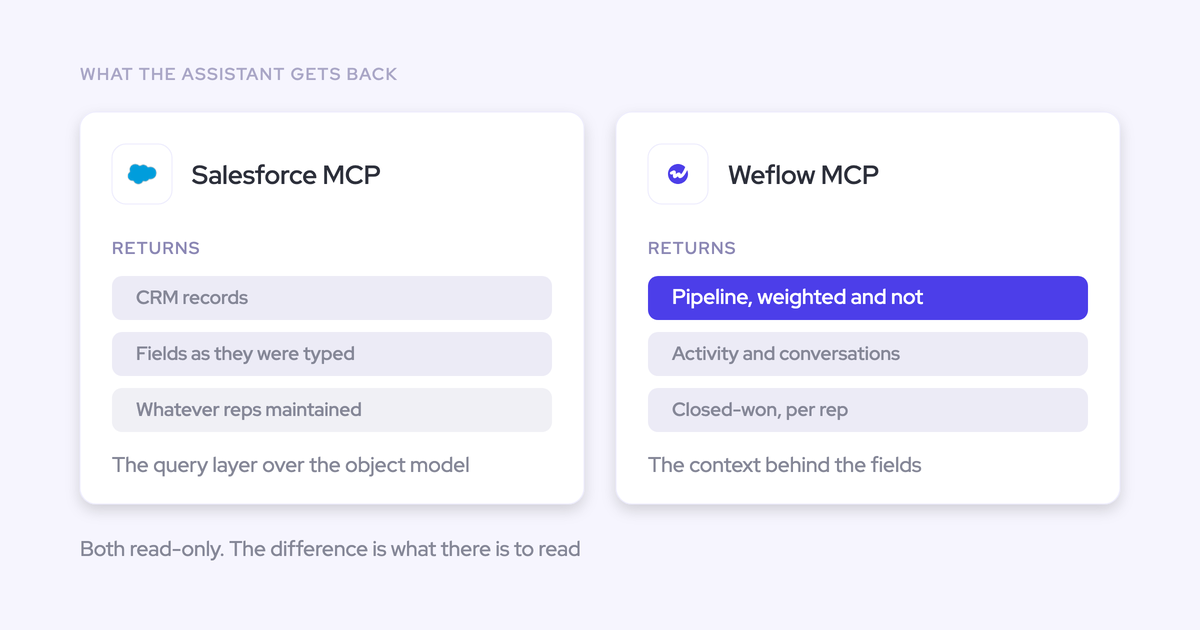
- You want the captured activity, contacts and structured conversation data living in your own Salesforce objects, usable by your reporting, automations and agents.
- Your RevOps team has no bandwidth to run a rollout, and you want the vendor accountable for onboarding end to end.
- You want conversation data across CS and AM too, not just the subset of AEs the budget stretched to cover.
Choose Gong if:
- Aggregated conversation analytics depth is the reason you're buying, and nothing else moves the decision.
- You need sequencing, cadences or a dialer inside the same tool, and Gong Engage covers it.
- A large share of your customer conversations happen on the phone rather than in Zoom, Teams or Meet.
- Interface polish is a genuine adoption risk with your sellers, and you'd rather pay for the one they'll actually open.
- You run on a CRM other than Salesforce. Weflow works exclusively with Salesforce.
- You need FedRAMP. Weflow is SOC 2 Type II, HIPAA, GDPR and CCPA compliant, and is not FedRAMP certified.
FAQ: Gong pricing and evaluating Weflow
Is Weflow's published price the price you sign at contract?
Yes, the published list price is the contract basis. Weflow's bundles are $49, $59 and $79 per user per month, the standalone products are $19 and $39, all billed annually in USD or EUR with a 10-user minimum.
There's no platform access fee, no implementation fee, and no metered AI usage. Final pricing is quote-based only in the sense that it moves down: volume discounts at larger team sizes, 10% off a two-year term, 20% off three years. The one paid extra to know about is historical backfill.
Can we migrate our Gong recordings and history to Weflow?
Partly, and the honest answer is that the hard part sits on Gong's side of the fence.
- Activity history: yes. Weflow backfills up to 24 months of emails and meetings straight from your mail server into Salesforce, because that data lives in your own tenant and was never Gong's to hold. You can switch the old capture off in the morning and have the gap filled without waiting on anyone.
- Keyword reporting: yes. An existing tracker set can be carried over, so competitor and objection tracking doesn't restart from zero.
- Recordings: this is the hard part. Teams tell us getting historic recordings out of Gong means an API export, extra cost, and about a week of someone's time, if it happens at all.
Which is the data-ownership argument in one paragraph. On Weflow, transcripts and the structured outputs of a call land in Salesforce, and video files export through the public API to your own cloud storage rather than sitting in the CRM, where storage is expensive.
What are Weflow's minimums, billing terms, and contract basics?
Ten-user minimum, billed annually, priced per user in USD or EUR. You buy either a standalone product ($19 or $39) or a bundle ($49, $59 or $79), and different teams can sit on different products in the same contract.
Unlimited view-only licenses are included at no cost, so stakeholders who only read never consume a paid seat. Multi-year discounts are 10% for two years and 20% for three.
How long does Weflow implementation take, and who runs it?
Weflow runs it, and doesn't charge for it. There's no third-party partner in the middle.
It's a project in three phases against a mutual action plan with named owners on both sides: a technical implementation of under an hour with your Salesforce admin and mail admin, then configuration, then a role-based rollout with separate leadership and rep training.
Time to live is typically two to four weeks, or four to six for a large org. Capture and conversation intelligence move fastest. Forecasting takes longer, because you're encoding an operating cadence rather than switching on a feature: who submits, how often, against which quota. If RevOps bandwidth is the real blocker, there's a managed service option where Weflow does the heavy lifting and your team just unlocks access and answers questions.
"The implementation was very uneventful - in the best way. Setup was smooth, communication was prompt, and we were off to the races."
Erick Mahle, Vice President of Revenue Operations & Digital Transformation at Lendz Financial
Does Weflow cover phone calls and sales engagement like Gong?
No. Two real gaps, and they're worth naming before you get to contract rather than after.
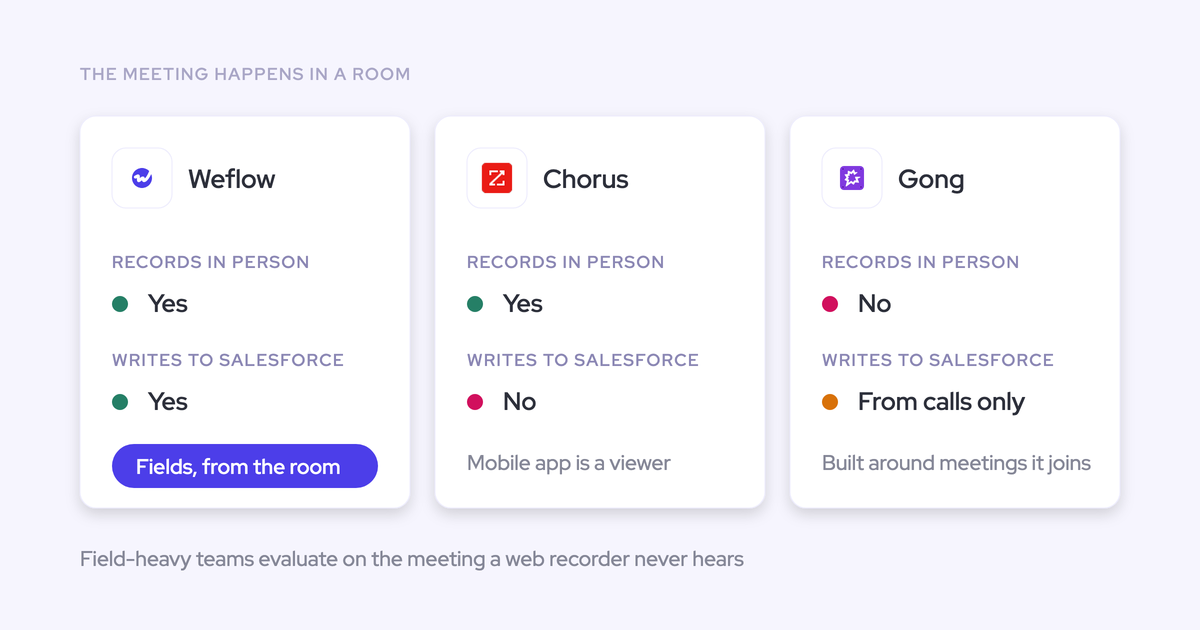
- VoIP and phone call capture. Weflow captures meetings on Zoom, Microsoft Teams and Google Meet, and Mobile Copilot records in-person conversations. Phone calls are not captured today. Zoom Phone is on the roadmap.
- Sales engagement. No sequencing, no cadence engine, no dialer, and no plan to build one. Weflow starts once there's an opportunity to manage.
Teams running Outreach, Salesloft or Apollo keep them and run Weflow alongside in compatibility mode, so the two capture engines don't fight over the same inbox and create duplicates. If a dialer inside the conversation tool is a hard requirement, that's a legitimate reason to pick Gong.