Weflow vs Gong for AI Forecast Prediction: How Each Projects the Quarter (2026)
Compare Weflow vs Gong for AI forecast prediction: team, weighted, and AI forecasts to improve accuracy.


If you're trying to close the gap between what reps say, what the weighted pipeline says and what your gut says, you need a number you can explain to the board. Gong Forecast and Weflow both put an AI number next to your team's call, but they build it from different evidence.
Gong extrapolates the quarter from your historical stage conversion and shows you every part of the math.
Weflow Deal Intelligence & Forecasting scores each open deal on captured behavior and returns a low, middle and high range, which sits next to your team roll-up and a dynamically weighted forecast.
Which one fits comes down to your data. Gong's math holds up if you close enough volume (about 400 created and 150 closed-won opportunities across four quarters) and your stage history is clean.
If reps skip stages, history is thin, or a few large deals swing the quarter, a deal-scored range is easier to defend.
Weflow vs Gong on forecast prediction, data access and pricing
Here's where the two tools differ most: what the projection reads and returns, what your AI assistants and warehouse can reach, and how forecasting is priced..
| Capability | Weflow | Gong |
|---|---|---|
| AI forecast prediction | A low, middle and high range built from more than fifty deal signals and up to two years of history, refreshed nightly. Every deal also gets a 0 to 100 close score. When the model isn't confident, it shows no range and says why. It doesn't yet adjust for ramping reps. | A projection built from closed-won deals, pipeline weighted by historical stage conversion, and expected new, pulled-in and pushed-in deals. A "See the math" panel shows each part. It needs about 400 created and 150 closed-won opportunities over four quarters. |
| Forecast submissions and roll-ups | Reps submit a baseline and a best case tied to named deals. Every version is kept, and manager overrides are logged with a rationale. Submissions live in the Weflow app, not in Salesforce fields. | Reps submit a number per forecast category, with notes. Managers see team totals with target and coverage. The roll-up follows the Salesforce hierarchy, and a missed week carries the last number forward. |
| Forecast accuracy tracking | Tracked per period for each rep, manager and team, against a field the admin picks, with no setup. It averages every submission in the period, so it can't grade a week-four call. | Divides the forecast submitted in a chosen week by actual sales, per person. Results are banded high, medium or low. |
| Integrations with other tools | Native integrations with Salesforce (the only CRM), Gmail, Google Calendar, Outlook, Zoom, Teams, Meet, Slack and the Outreach dialer. BI tools and AI assistants connect through the API and MCP. There's no catalogue marketplace. | About 450 marketplace listings, about 30 dialers, eleven meeting platforms and three native CRMs. |
| Access from AI assistants (MCP) | A read-only connector returns forecast calls, per-rep pipeline metrics with opportunity IDs, transcripts, summaries and playbooks. Admins control it with two toggles. Per-rep breakdowns are capped at 25 owners, and there's no credit meter. | A read-only server with three record-scoped tools that return AI insights only, never transcripts. Every use draws metered credits, and you need a paid seat on both sides. |
| Raw data access outside the tool | The REST API bulk-exports data as JSON or CSV to warehouses and BI tools, and recordings export to your own storage. There's no native Snowflake, Databricks or BigQuery connector. | The API returns transcripts and call data, capped at 3 calls a second and 10,000 a day. Warehouse delivery needs Data Cloud, at about $5,000 a year. |
| Pricing | Published. Deal Intelligence & Forecasting is $39 per user per month standalone, and bundles are $49, $59 and $79. Billing is annual with a 10-user minimum, and AI is included in the seat. | No published prices. Foundation is mandatory, Forecast is a separate application, and there's a platform fee plus metered AI credits. |
Why CROs weigh Gong Forecast against Weflow for the quarter
This comparison usually comes up at one of two moments:
- Your Gong renewal is coming up, and someone has asked whether one platform could replace several.
- You're about to add Gong Forecast on top of the Foundation license you already pay for.
In both cases, Gong feels like the safe choice. Nobody gets blamed for picking it, and the push often comes from your own team. As one sales leader told us:
"We're relatively far down the road with Gong. Gong was probably recommended more internally because there's people that had experience."
Budget matters here, too. Gong prices Forecast as a separate application, so it has to justify its own line item, usually at a renewal where finance is already scrutinizing the core seats.
But underneath both moments is the same problem: your numbers won't line up.
"Maybe they say they're going to close 300. My weighted forecast is saying 700. My deal forecast is saying 400. I want to get them to converge."
Adding a fourth number won't fix that. What helps is a projection that doesn't depend on the rep's call and is built on evidence you can show your CFO.
How Weflow Deal Intelligence & Forecasting projects the quarter
Weflow is the Revenue AI Orchestration platform for sales, customer success and RevOps teams on Salesforce. Deal Intelligence & Forecasting runs the AI projection as one of three methods on a single pacing chart, and you can reach its data outside the app.
How the Weflow AI projection scores deals and returns a range
Weflow's AI projection looks at how each deal is being worked, not just which stage it's in. It scores every opportunity first, then projects the quarter from those scores.
| Question | Weflow AI projection |
|---|---|
| Reads | More than fifty deal-level signals, including seasonality, rep performance, conversion rates, communication cadence, whether a next meeting is booked, and deal health against your sales methodology. It draws on up to two years of opportunity history. |
| Returns | A low, middle and high value, refreshed nightly. The range widens when the business is changing, for example with new products, motions or territories. Each opportunity also gets a 0 to 100 close score, trained on your own closed deals, with an explanation of what drives it. |
| Needs | Six months of opportunity history. We import twelve months at install by default, and the first projection is ready within 48 to 72 hours. Each forecast configuration gets its own model. |
| Where it breaks | It doesn't yet adjust for ramping reps. A new hire's deals lean on their own conversion history, which barely exists yet, so their line can read too high or too low until that history builds. |
For example, a large late-stage opportunity with no next meeting booked and a slowing email cadence gets projected down, whatever its stage probability says.
And when the model isn't confident, it shows no range and tells you why. The ramp gap evens out at the team level, so just take a new rep's individual line with a grain of salt.
How Weflow roll-up and weighted forecasts sit beside the projection
Weflow's pacing chart shows the AI projection, the team forecast and the weighted forecast side by side, against pipeline, commit and closed. Each method catches something the others miss:
- Team roll-up: Each rep submits a baseline and a best case tied to named opportunities. Managers can override with a logged rationale, and every version is kept. It reflects the judgment of the people closest to the deals, incentives and all.
- Dynamic weighted forecast: Stage win rates are recalculated from a rolling 90- or 180-day window instead of the fixed probability on the Salesforce stage. You can pin a stage by hand, for example keeping prospecting at zero. It reflects history but says little about any single deal.
- AI projection: It scores deals on behavior and picks up signals nobody has time to read, but nobody is accountable for it.
The gaps between the three become your forecast-call agenda. If a rep's submission sits far above both the weighted number and the projection, you know who to talk to, and you have the evidence to back up that conversation.
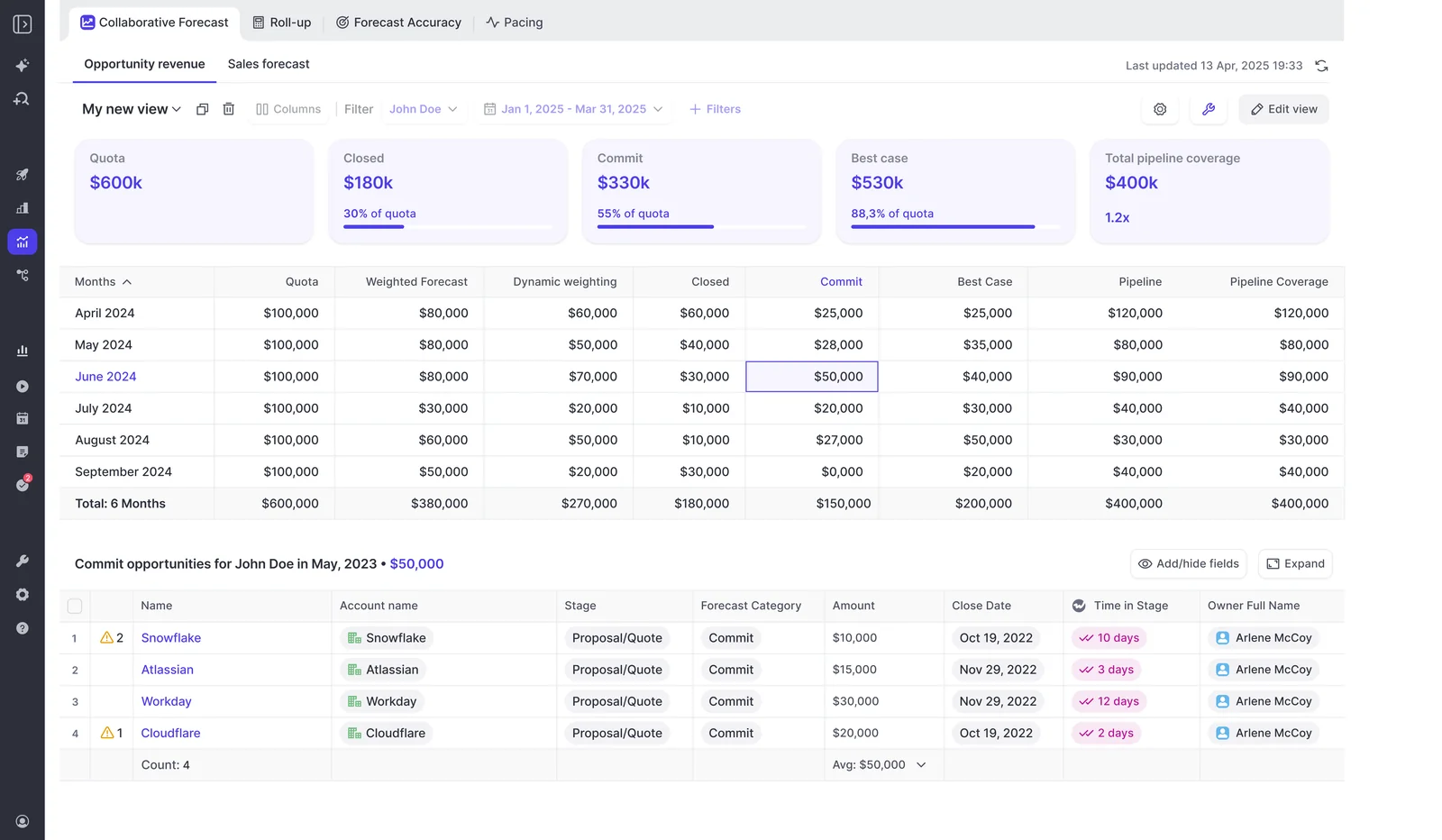
Note that forecast submissions live in the Weflow app and aren't written to Salesforce fields.
How Weflow measures forecast accuracy by rep and team
Weflow tracks forecast accuracy per period for every rep, manager and team, against an outcome field the admin chooses, such as Closed Won. It's on by default for every Forecasting customer, with no setup needed.
Manager and team averages get their own rows, so you can compare a manager's call with the team's. The view also flags both extremes, so sandbaggers and over-callers stand out.
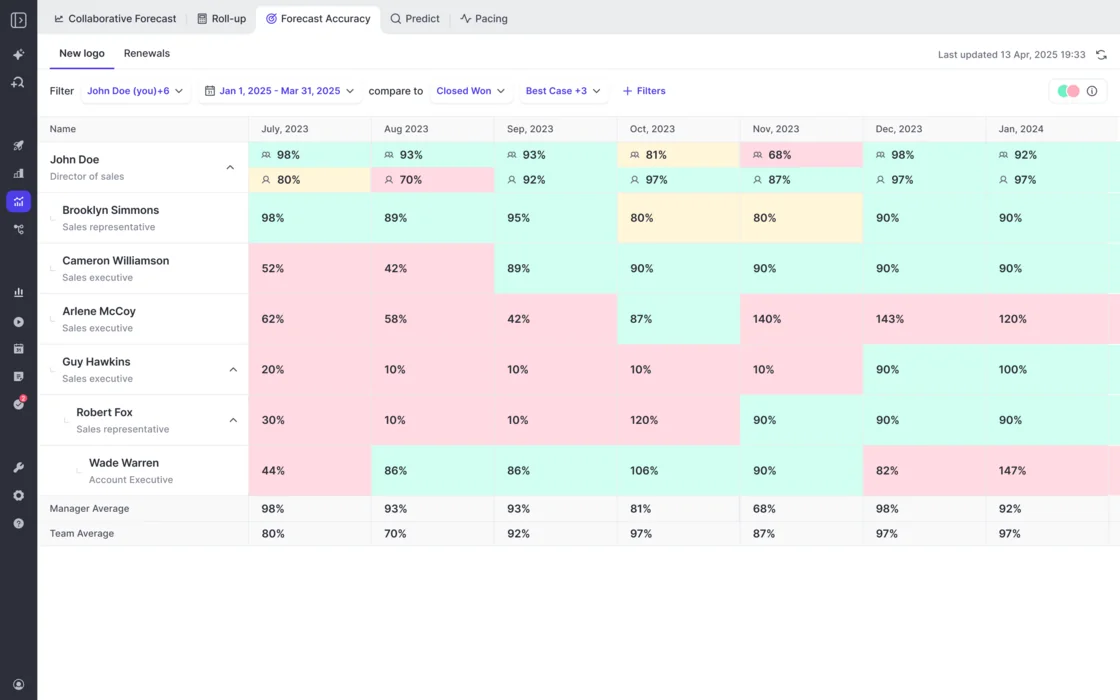
The catch is that accuracy averages every submission across the period, including every call type. A rep who starts the quarter way off and corrects later gets scored on the blend, and you can't grade their week-four call on its own.
Which revenue tools Weflow connects to around the forecast
Weflow connects natively to the tools that feed the forecast:
- CRM: Salesforce only.
- Email and calendar: Gmail, Google Calendar and Outlook.
- Meetings: Zoom, Microsoft Teams and Google Meet.
- Collaboration and dialing: Slack and the Outreach dialer.
- BI and AI assistants: Tableau, Looker, Claude, ChatGPT and other MCP clients, through the API and the MCP connector.
Weflow isn't an integration platform with a catalog of connectors, and it has no native warehouse connector.
What Claude or ChatGPT can read from Weflow over MCP
Weflow's read-only MCP connector lets Claude, ChatGPT or any other MCP client query about the forecast directly. For a chosen close-date period, scoped to you or your team, it returns:
- Forecast calls.
- Per-rep weighted and unweighted pipeline, coverage ratio, gap to forecast, win rate, average deal size and sales cycle length.
- The opportunity IDs behind those numbers.
- Transcripts, summaries, tracker hits, coaching scores and playbook results.
An admin turns the connector on per workspace, and a separate toggle controls whether assistants see full transcripts or just summaries. Since AI usage is included in the seat, your team's questions aren't metered.
This matters because forecast calls never reach Salesforce, so a Salesforce connector alone can't see them.
There are three limits to keep in mind:
- Per-rep breakdowns are capped at 25 owners.
- Saved views aren't exposed.
- Captured email content and Salesforce field values come through Salesforce's own connector, not Weflow's.
How Weflow exports forecast and conversation data through its API
Weflow's REST API bulk-exports transcripts, metadata, scores and signals as JSON or CSV, on a schedule or on demand, into a warehouse or BI tool. Recordings export to your own cloud storage.
There's no native Snowflake, Databricks or BigQuery connector today, so teams use the API for those. To get submitted forecast calls out of the app, use the MCP connector.
How Gong Forecast projects the quarter from stage history
Gong Forecast runs transparent math on your stage history, and it comes with strong accuracy grading and a large integration marketplace. Its AI assistant access, though, is narrow and credit-metered.
How Gong Forecast builds its projection from stage conversion
It's honest math, and Gong shows its work.
| Question | Gong Forecast projection |
|---|---|
| Reads | Closed-won deals, pipeline weighted by historical stage conversion at the same point in the period, and expected new, pulled-in and pushed-in deals. You pick the historical period it's based on. |
| Returns | A projected landing point for the period, with a "See the math" panel that breaks out each component. It also plots as a line on the trend chart, against the team forecast, the manager forecast and the target. |
| Needs | About 400 created opportunities and 150 closed-won across four quarters, plus up to four quarters of history. |
| Where it breaks | Gong itself notes that the state of your CRM data, and changes to stages or board definitions, affect accuracy. The projection inherits the quality of your stages. |
"See the math" is a real strength: when your CFO asks where the number came from, you can walk them through every piece.
One thing to watch: Gong's deal likelihood score isn't a close probability. It's a percentile rank, so a deal scored 80 has a better chance of closing than 80 percent of your other open deals, not an 80 percent chance of closing.
How Gong Forecast boards handle submissions and roll-ups
In Gong Forecast, reps submit their own number per forecast category, with notes. Managers see team totals with target and coverage, and can move up and down the hierarchy.
You can also set up separate boards for new business, renewals or any other motion, each with its own filters, columns, metrics and targets.
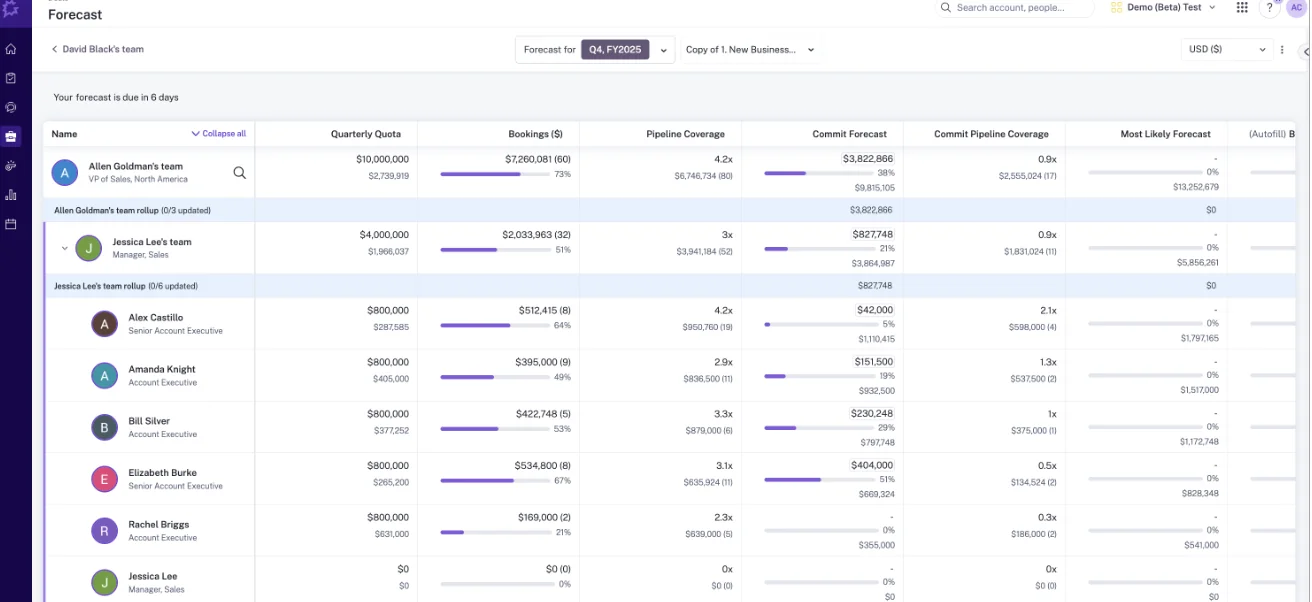
The roll-up follows the Salesforce hierarchy, so if your reporting lines don't match the manager field, you'll need placeholder structures to make it work.
And when a weekly submission is missing, Gong carries the last number forward.
How Gong Forecast scores accuracy on a chosen submission week
Gong Forecast's accuracy report divides the forecast submitted in a week you choose by actual sales at period end, for each person, then bands the result:
- High: 85 to 115 percent.
- Medium: 70 to 84 percent, or 116 to 130 percent.
- Low: Anything outside those ranges.
You can filter by team, line of business, forecast category and forecast week.
This lines up with the week-four discipline many practitioners recommend: lock the call early, while it's still a judgment, and score it at quarter end. Here, Gong has the edge over Weflow's period average.
Keep in mind the report is part of Gong Forecast, so you only get it if you add that application on top of Foundation.
Which revenue tools Gong connects to through its marketplace
Gong connects deeply to the rest of the stack, and that depth is part of why teams stay:
- About 450 integrations and partner solutions in the Gong Collective.
- About 30 dialers connected by API, including Aircall, Dialpad, Outreach and Salesloft.
- Eleven meeting platforms, including Zoom, Google Meet, Teams and Webex.
- Three native CRMs: Salesforce, HubSpot and Microsoft Dynamics 365.
Some customers even switch meeting platforms to fit Gong. The limit is the CRM: a Gong workspace connects to one CRM at a time, and any CRM outside the three native ones can only import data.
What Claude or ChatGPT can read from Gong over MCP
Gong's MCP server connects Claude, ChatGPT and Copilot, but it answers questions about one record at a time.
- Returns: Answers from ask_account and ask_deal, plus a structured brief from generate_brief.
- Doesn't return: Raw transcripts, message bodies, activity lists or private calls.
- Can't do: Write anything to Gong or the CRM.
Every MCP and API request also draws credits from a shared company pool, so the same brief that's free in the Gong interface costs credits through MCP. To connect, you need a paid Gong seat and a paid tier of the AI tool, and collaborator accounts can't connect at all.
To work around this, some teams route transcripts through Salesforce so Claude can read them there, while others copy transcripts into Claude by hand.
How Gong delivers data to a warehouse or BI tool
Gong's public API returns transcripts, participants, trackers and scorecards. It's capped at 3 calls a second and 10,000 a day, and the daily cap is the one you'll hit on bulk exports.
To deliver Gong data to Snowflake, Databricks, BigQuery or Redshift, you'll need Data Cloud, a separate application that costs about $5,000 a year.
How each projection holds up under thin data and slipping deals
In a messy quarter, the two methods break in different places. Here's how each one holds up in the situations that usually make CROs lose trust in the forecast.
What happens to each projection when stage history is thin
Weflow holds up better when stages get skipped, because stage is only one of the signals it reads.
| Situation | Weflow | Gong |
|---|---|---|
| Minimum history | Six months of opportunity history, using up to two years. | About 400 created and 150 closed-won opportunities across four quarters. |
| Reps skip stages | The deal score still reads activity, cadence, next meetings and methodology health. Time in stage is one input among many. | Stage conversion is the backbone of the weighting, so skipped stages thin the rates it projects from. |
| Migration without stage history | Historical import depends on Salesforce field history tracking. Without it, the six-month clock starts at go-live. | Gong backfills CRM field history through your CSM. If the history was never migrated, there's nothing to backfill, and the four-quarter threshold starts over. |
| Lower deal volume | Each deal is scored on its own, and the range widens when the model is less certain. | Below the volume threshold, Gong doesn't consider the projection reliable. |
What happens when one large deal slips out of the quarter
Weflow lowers a poorly worked large deal before it slips. Gong counts it at its stage rate until it moves.
"If that large deal moves then the whole probability goes out of the window. That's the challenge I have."
In Weflow, a big deal that's going quiet gets projected down early, and the low-to-high range reflects the uncertainty, so you see the risk while there's still time to work the deal.
Gong does model expected pushed-in and pulled-in deals, but only across the pipeline as a whole, not based on whether this particular deal is being worked.
How you find the deals behind a commit drop in each tool
Both tools let you trace a week-over-week drop to specific deals without clicking through the pipeline one deal at a time.
"One week we have 100k in commit, the next week it's 80k at the global level, and they want to know why. Then I have to click and go deal by deal. Or does it already tell you the difference is because of these three deals?"
In Weflow, opportunity snapshots track pipeline changes week over week, and the Waterfall and Deal Flow views show which deals moved in or out of commit. Click the Commit bucket to see every deal inside it.
Each deal can carry deal health columns next to its Salesforce fields:
- Close date pushed
- Inactivity
- Next meeting
- Multi-threading
That way, you see why a deal moved, not just that it moved.
Gong's trend chart shows each forecast category week by week, and clicking a bar opens the deals behind it, which answers the same question well.
How each tool handles new reps, new segments and renewals
| Situation | Weflow | Gong |
|---|---|---|
| New logo vs renewal | Each forecast configuration gets its own model, trained on its own history. | Separate boards per motion, each with its own filters, columns, metrics and targets. |
| New products, motions or territories | The range widens to reflect the change. | Gong notes that changes to stages or board definitions affect projection accuracy. |
| Reporting lines that differ from Salesforce | An admin builds a custom hierarchy by drag and drop, and one person can sit in several teams. | The roll-up follows the Salesforce hierarchy, so you build placeholder structures. |
| What history each model learns from | Up to two years per configuration, with deal scores trained on your own closed deals. | The history period you pick, up to four quarters. |
The one gap on Weflow's side is new reps: their lines stay noisy until they've built a few months of their own history.
What the first quarter looks like after go-live on each
Weflow gets you a projection within days, while Gong runs a services-led rollout. Either way, you'll need a closed quarter before rep-level accuracy means much.
| Milestone | Weflow | Gong |
|---|---|---|
| History at install | Twelve months of Salesforce history imported by default. | Historical CRM data imported by the professional services onboarding consultant. Later backfills of up to five quarters go through the CSM and take 3 to 5 business days. |
| First projection | Within 48 to 72 hours. | Once history is loaded, and reliable at the volume threshold. |
| Rollout effort | A 30 to 45 minute technical setup, then one to three weeks to full time to value. | A fixed-scope Forecast package of up to 22 hours within 60 days. It assumes Foundation is in place and asks you to name an admin, a project manager and sponsors. |
| Rep-level accuracy | Needs about a quarter of locked submissions. | Needs a closed period to compare the chosen week against. |
Where Gong Forecast is the stronger choice
Gong Forecast is the better fit when:
- You need to show every component of the number: "See the math" breaks the projection into closed-won, weighted pipeline and expected deals, and a board can follow that line by line.
- You grade reps on their early call: Gong scores the forecast from a chosen submission week. Weflow averages the period.
- You have high volume and clean stage history: Above about 400 created and 150 closed-won opportunities across four quarters, with stages that mean what they say, stage math is accurate and easy to explain.
- Your stack runs through Gong's integrations: With about 450 marketplace listings and about 30 dialers, Gong is often wired into tools that have nothing to do with forecasting.
- You're deep in Gong for conversation intelligence: Gong invented the category and has the deepest conversation analytics, including a rep-level coaching overview we're still building toward.
And if your quarter hinges on about ten big deals, you might not need either tool. Native Salesforce forecasting and a solid deal-by-deal review can handle that.
Why we feed the Weflow projection captured calls and emails
A projection is only as good as the deal data behind it, and reps don't reliably log that data. That's why Weflow's projection reads captured activity and conversations, not whatever someone remembered to log on Friday.
Weflow Activity & Contact Capture writes emails, meetings and contacts into Salesforce automatically, and Weflow Conversation Intelligence turns calls into structured Salesforce fields.
From that data, Weflow calculates the deal health signals the projection reads:
- Communication cadence
- Whether a next meeting is booked
- Reply rate
- Multi-threading
- Methodology health
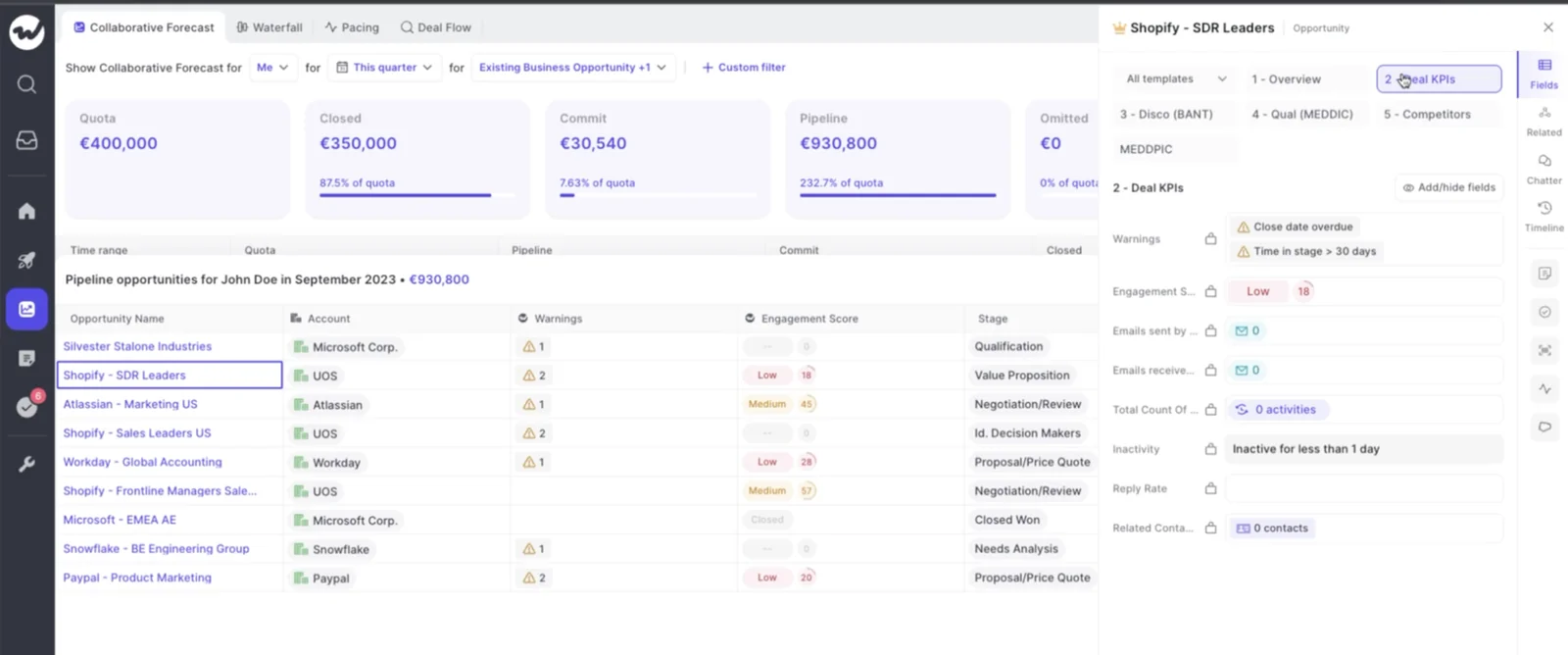
This is the core difference from Gong. Gong captures rich conversations, but much of that data stays in Gong's own layer, while Gong Forecast's projection reads stage conversion from your CRM.
Weflow puts the behavioral evidence and the projection on the same record in your Salesforce. It's a lesson we learned the hard way:
"We actually launched a prediction forecast before we had automated Salesforce data capture, and we found that it was not that accurate, which made us realize you have to solve it end to end."
The flip side is that Weflow forecasting is weaker on its own. If you keep Gong for calls and only buy our forecasting, you get the projection but not the evidence that makes it worth trusting.
With both layers in place, here's what one customer's CRO reports:
"With Weflow, we forecast within 7% by week 4 of the quarter."
KORE Wireless also evaluated Gong and decided it wasn't worth the price compared to Weflow. They rolled out in five phases: activity capture, conversation intelligence, coaching, deal intelligence, and forecasting last.
And that's the reason you can defend to your CEO: the forecast stands on captured evidence, not on a better formula.
What forecasting costs on Weflow and on Gong
We publish our prices, and AI usage is included in the seat. Gong doesn't publish prices, and forecasting comes as a separate application on top of a mandatory core license.
| Cost item | Weflow | Gong |
|---|---|---|
| Pricing model | Per seat, per product or bundle. Different teams can sit on different products. | Per user, per application, plus a platform fee that scales with users. |
| Published list price | Weflow Deal Intelligence & Forecasting is $39 per user per month standalone. Weflow Revenue AI Foundation is $49, Weflow Revenue AI Business is $59, and Weflow Revenue AI Enterprise is $79, which adds forecasting to capture, conversation intelligence and deal intelligence. | None. Every figure comes through a custom proposal. |
| Mandatory core license | None. Each product can be bought on its own, and there's no platform fee. | Gong Foundation, which you buy before any application. |
| Forecasting line | Included in Deal Intelligence & Forecasting and in Revenue AI Enterprise. | Gong Forecast is a separate application, and seats are counted per application. |
| AI usage | Included in the seat. Weflow Agent Builder is the only consumption-priced item: a free tier of 25 actions a month comes with every plan, then $299 for 500 actions or $999 for 2,500. | Metered credits on question-based trackers, MCP and API AI workflows. Each core seat adds 2,000 credits a year to a shared company pool. |
| Warehouse and data export | REST API included. | Data Cloud, bought separately at about $5,000 a year. |
| Contract basics | Annual billing, a 10-user minimum and a 12-month term. Seats added mid-term are charged pro rata, and multi-year discounts apply. | Seats added after the renewal are paid for across every application they need. |
The one real Gong data point we have is a renewal proposal: 45 licenses at about $80,000 a year, about $10,000 of which was forecasting.
That works out to roughly $1,800 per license per year, compared with $948 per user per year for Revenue AI Enterprise, forecasting included.
It also shows where the money goes. With Gong, most of the cost sits in the core seats, not in Forecast, so compare the whole stack, not just the forecasting line. As one buyer put it on a call:
"... Gong is great but I don't think it's 2x value"
How to run Weflow forecasting beside Gong, then switch
You can run Weflow's forecast privately while Gong keeps running. Since forecasting is a leadership motion, very little changes for reps. Here's the usual sequence:
- Turn on Weflow Activity & Contact Capture and Weflow Conversation Intelligence centrally, so captured evidence starts building in Salesforce without reps installing anything.
- Let RevOps configure the forecast in private: hierarchy, forecast types, weighting windows and targets. Reps already on capture see nothing until forecasting is assigned.
- Import twelve months of history and get your first projection within 48 to 72 hours.
- Run a full quarter with the Weflow range, the weighted forecast and Gong's projection side by side, then compare all three with what actually closed.
- Assign forecasting to managers and reps. Reps submit their call in the Weflow app, and nothing else in their week changes.
- Import and reprocess your Gong recording library, so years of calls stay searchable and scoreable after the contract ends.
Try to time this against your renewal. If you start early enough to close a full quarter on Weflow before your Gong contract is up, you'll have an accuracy comparison on your own data when it's time to decide.
Gong keeps recordings and their transcripts for up to three years by default, so plan the archive import before you sign off.
When to pick Weflow and when to stay on Gong
It comes down to two questions: can your stage data and deal volume support stage math, and do you want a deal-scored range or a transparent aggregate?
| Pick Weflow if | Stay on Gong if |
|---|---|
| You run a booking-based, mid-market business on Salesforce. | You close more than about 400 created and 150 closed-won opportunities across four quarters, on clean stage history. |
| Your stages get skipped or your history is thin, and you want each deal scored on behavior. | Your board values seeing every component of the number in "See the math". |
| You want a low, middle and high range beside the team roll-up and the weighted forecast. | You grade reps on their week-four call and want that report built in. |
| You want capture, conversation intelligence and forecasting in one platform with published per-seat prices. | Your stack depends on Gong's integration depth across dialers and meeting platforms. |
| Your team works in AI assistants and needs forecast calls and pipeline metrics without a credit meter. | You're deep in Gong for conversation intelligence and coaching, and the team relies on it every day. |
See how Weflow captures activity, updates Salesforce fields from calls, and rolls up your forecast. Book a 30-minute demo.
FAQ: Weflow vs Gong forecasting
How much history do Weflow and Gong need before the projection is reliable?
The Weflow AI projection needs six months of opportunity history and uses up to two years. We import twelve months at install by default.
Gong says reliable Gong Forecast projections need about 400 created opportunities and 150 closed-won across four quarters.
How do I explain a low, middle and high forecast range to my board?
Present the range as the honest shape of the quarter, then point out where the team call and the weighted forecast fall inside it. A range you can defend beats a single number that implies precision you don't have.
When the three methods line up, you have a credible number, and when they don't, you can name the deals behind the gap.
Does Weflow forecasting work for consumption-based revenue?
It's a weaker fit. Weflow forecasting is built for booking-based revenue, where contracted deals map cleanly onto opportunities, while consumption revenue depends on usage that doesn't sit on the opportunity.
What happens to our Gong call recordings if we consolidate on Weflow?
Weflow imports and reprocesses your existing recording library, even if it runs into the thousands, so the archive stays searchable and scoreable.
Can we trial the Weflow projection on our own Salesforce data first?
Yes. We offer a side-by-side demo and a 14-day trial with guided onboarding.
Can we exit a Weflow contract early if forecasting doesn't land?
Contracts run on a standard 12-month term. You can negotiate an early opt-out after three months, but it isn't a default term.