Why Revenue Teams Look Beyond Gong: Reasons Buyers Give on Sales Calls
Learn why teams look beyond Gong at renewal and decide whether to renegotiate, trim, or switch.


The revenue leaders who bring up Gong on our sales calls mostly like it. They start looking beyond it at renewal. By then the invoice has outgrown what the team actually uses, and Finance has started asking what the spend produced.
Price opens that conversation, but price on its own rarely holds up in front of a board. The reason that does hold up is about where the data lives. Gong keeps the call intelligence inside Gong. The methodology answers, the transcripts and the deal context never fully reach the Salesforce records your managers use for deal reviews built on Salesforce data.
This page doesn't assume you'll switch. It gives you:
- The reasons buyers give for looking beyond Gong, grouped and in their own words.
- The mechanism behind each reason.
- A check you can run on your own Gong account before the renewal.
- The reasons teams stay, given the same weight.
- A way to sort your situation into renegotiate, trim or evaluate.
Plenty of readers will finish this page and decide to renegotiate. That's a good outcome too.
The buyers we talk to like Gong and question its value
Revenue leaders look beyond Gong at renewal because of value, not product quality. Gong does what it promised. The seat count grew with hiring while depth of use didn't, and each new capability costs more on top of the base license.
Underneath all of that sits the reason a CRO can defend. Gong keeps call data in Gong instead of in Salesforce.
| What buyers say | What's behind it | The check before renewal | Why teams stay anyway |
|---|---|---|---|
| The renewal price outgrew what we use | Pricing set when transcription was expensive, plus seats that grew with hiring | Compare licensed seats against people who recorded or reviewed a call last month | Managers who use Gong weekly make the price a working habit, not waste |
| Every next step costs more | A mandatory Gong Foundation license, separately bought applications, and credits that meter AI at scale | List every application on the contract and every tracker that draws credits | Interactive use, including agents run by hand, stays inside the seat |
| Reps don't use it | Gong is built for managers and ops, and opt-in recording means reps skip it | Compare recorded customer meetings against the calendar | Managers are attached to it, and reps treat it as a perk |
| Gong Forecast didn't hold up | One module stretched across several teams, priced on its own line | Find where your weekly forecast call actually runs | Many teams run the forecast call from the deal board without buying Gong Forecast |
| Our call data lives in Gong, not Salesforce | Export covers tasks and events only, and transcripts never leave Gong | Open a live opportunity and look for methodology fields filled from calls | Teams that work happily inside Gong's interface don't feel the gap |
How we built this from approved buyer quotes on our calls
These findings come from approved buyer quotes about Gong taken from Weflow's own sales conversations.
Weflow is the Revenue AI Orchestration platform for sales, customer success, and RevOps teams. So the people quoted here were already talking to an alternative. Read the findings with that in mind.
- Source: conversations between Weflow's sales team and revenue leaders, RevOps owners and sales operations leads who run Gong today or ran it before.
- What counts as a quote: a buyer's own words about Gong, reviewed and approved by a person on our team before it entered our knowledge base.
- How we grouped reasons: by the mechanism underneath the complaint, not by how often it came up. We don't rank the reasons, and we don't give counts or percentages per reason.
- Anonymity: buyer quotes appear without names or companies.
- Named voices: Chris Nethercote speaks as Weflow's Head of Sales and a former Gong customer. Kyle Norton speaks as CRO of Owner.com. KORE Wireless and HolidayCheck appear through their published customer stories.
- Selection bias: buyers who are happy with Gong rarely book a call with us. This is a picture of why teams look, not how many do.
The Gong renewal price outgrew what the team actually uses
The Gong price problem is a mismatch between the price and how much of Gong a team uses. The seat count grew with every hire. The depth of use stayed where it was, and what the team mostly uses is call recording, a capability that got cheap after Gong set its price.
In buyers' words
"we love Gong but it's way too expensive… $93k a year for my little team… Gong offers a lot of things we don't need."
"I'm not being told to go find a replacement for it. There's no pressure on me to replace it in our tech stack, but it's expensive."
"we were a Gong shop, but I was like, I can't pay that much for just call recording. And then we moved over to Clari. So we're using Clari now for forecasting and call recording."
What's behind it
Gong set its price when transcription was expensive. Transcription and inference costs have since collapsed, so a conversation intelligence product built today carries a much lower cost base for the same capability.
Gong's own numbers keep the price high. At roughly $300M in ARR against a last valuation of about $7B, Gong carries growth expectations its pricing has to justify. That's why buyers meet a high floor before any module is added.
The structure adds to it. Gong prices licenses per user, adds a platform fee that scales with the number of users, publishes no prices, and quotes every buyer through a custom proposal. One buyer told us they were on a third call with Gong before they saw a number.
We also see teams paying for both Gong and Clari where Gong is barely opened. They pull recordings through the API and rarely log in. That's the clearest sign the seat price has stopped matching use.
The check before renewal
- Compare licensed seats against the people who recorded or reviewed a call in the last month.
- List which parts of Gong your team opens every week. Recording and playback alone is a different contract from coaching, deal inspection and forecasting.
- Count the seats added through hiring since you last signed, and who actually uses them.
- Ask Gong for usage by application before the proposal arrives, not after.
Why teams stay anyway
If your frontline managers run coaching and deal reviews in Gong every week, the price buys a habit that works. Those teams aren't overpaying for recording. They're paying for a management rhythm, and that's worth protecting.
Each new Gong capability costs more on top of Foundation
Gong sells a mandatory core license, Gong Foundation, plus applications bought on top of it. No application can be bought without Foundation. That's why every conversation about the next capability ends in a bigger number.
In buyers' words
"Gong is incredibly expensive… we're semi happy with Gong but at the same time it's super expensive… I don't want to go from one tool to another tool that's equally potentially expensive."
What's behind it
The entry price isn't the price of the capability you came for. It's the price of Foundation plus that capability. Credits now sit on top of that and meter AI that runs continuously or at scale.
| What you want next | What Gong requires |
|---|---|
| Coaching agents such as AI Call Reviewer and AI Trainer | Gong Foundation plus Enable Essentials or Enable |
| Forecasting and AI Deal Reviewer | Gong Foundation plus Forecast Essentials or Gong Forecast |
| Engagement agents such as AI Composer and AI Tasker | A Gong Engage license |
| The full Agent Studio set of eighteen agents | Foundation plus three applications, with seat prices that add up per person |
| Call outcomes written into Salesforce fields, plus smart trackers | More spend on top of the existing license, as long-standing customers describe it |
| Question-based AI Trackers running across the company | Credits |
| An external AI assistant reaching Gong through the MCP server | Credits |
| API-based AI workflows | Credits |
| Seats added after the renewal is signed | Paid separately, for every application that seat needs |
That last row matters more than it looks. At renewal, Gong grandfathers existing functionality and provides matching seats at no extra cost, including headcount added as part of the renewal. Hire the same people a month later and every one of them is a new purchase.
The check before renewal
- List every application on your contract and the people who actually use each one.
- Find your credit allowance. Gong sent allocation details by email in late May 2026.
- List every published AI Tracker and its scope. Tracker configuration has the largest effect on credit consumption.
- Line up your hiring plan against the renewal date.
Why teams stay anyway
Credits leave a lot inside the seat. Calls and call analysis, conversation insights, deal intelligence, forecasting, coaching, deal predictions and Agent Studio agents run by an individual user draw no credits.
If your team uses Gong interactively rather than through automation, credits may never touch your invoice.
Reps stop using Gong when recording depends on them
Gong only pays off when first-line managers live in it. Reps get little direct benefit, and when they have to opt in to record, they don't. The recordings thin out, and the seats go idle.
In buyers' words
"We did buy Gong, but it's not really widely adopted through variety of reasons"
"The insights we're getting is great compared to like Gong, which just people weren't really using because we had it set up where they had to actually select to bring it into calls, which just meant that people didn't use it."
"Gong is very strong on the aggregated level… for all the sales managers, going on individual calls it's time consuming… you're not going to do that"
What's behind it
Gong was designed for managers and ops. That's a fair design choice, but it means the rep has no reason of their own to switch it on.
Any step that depends on the rep, such as adding the recorder, installing something or connecting an account, gets skipped. A buyer described chasing reps into that kind of setup as herding cats.
Once recordings get patchy, the coaching and deal views built on them get patchy too. Managers stop trusting them, which pushes usage down further.
The check before renewal
- Compare recorded external meetings last quarter against the meetings on your reps' calendars.
- Find out whether recording is automatic or opt-in, and for which teams.
- List which frontline managers open Gong every week, and which haven't opened it this quarter.
Why teams stay anyway
Where managers are attached to Gong, adoption isn't the problem. Reps at those companies often treat Gong as a status perk. Taking it away costs goodwill you'll have to earn back.
Gong Forecast struggles once several teams share one forecast
Gong Forecast gets hard to run when one module has to forecast enterprise, commercial and post-sale teams at once. RevOps spends many hours configuring it and still falls back to spreadsheets.
Gong prices the module on its own line, so it's the first thing on the cutting block when a renewal gets scrutinized.
In buyers' words
Chris Nethercote ran Gong as an enterprise customer before he joined us. His team bought the forecasting module and ran into exactly this.
"We upgraded to the forecasting module. But it's a little bit clunky… So we were trying to run forecasting for enterprise, commercial and customer success or post sale, like in one forecasting module, and it was very, very clunky. There's a lot of customization, but our RevOps team spent too many hours building it out and trying to get it to work super well. So we ended up actually doing most forecasting back in spreadsheets."
Chris Nethercote, Weflow's Head of Sales and a former Gong customer
What's behind it
Leadership usually wants a deal-by-deal roll-up with a statistical overlay on top, such as weighting by historical conversion. One team found that combination too hard to build in Gong Forecast. It ended up running it in a spreadsheet next to the module it was paying for.
A forecasting module also takes months of use to pay off. A line item that hasn't paid off yet is an easy cut at renewal.
The check before renewal
- Find where your weekly forecast call actually runs: Gong Forecast, the deal board, Salesforce or a spreadsheet.
- List who submits a forecast in Gong Forecast each week.
- Find out which number goes to the board, and which tool produced it.
Why teams stay anyway
Many teams never buy Gong Forecast. They run the forecast call straight from the deal board, which already shows which deals are moving. For a single-motion team, that works.
Your call data lives in Gong, not in Salesforce
Gong keeps the intelligence from your calls in its own system. Salesforce gets tasks and events for activity that matches an existing contact or lead. The transcripts never leave Gong.
Your reps end up working in two places, and the archive turns into the reason you can't leave. This is the reason that turns "it's expensive" into something you can defend.
In buyers' words
"Gong is getting all the data into Gong. If you ever stop using Gong, getting it back into Salesforce is not so easy."
"…you can never leave them because you don't own any of the data. And also they take you away from the Salesforce interface and you have to work within their interface anyway."
"My team will end up spending a lot of time in Gong and a lot of time in Salesforce. And so like from like an operational efficiency perspective, for reps, it's not great."
Chris Nethercote, Weflow's Head of Sales and a former Gong customer
What's behind it
Gong maps captured emails and meetings into its own data structure. A tech admin can turn on export to Salesforce on any Gong plan, but the export has firm limits.
| Gong data | Where it ends up |
|---|---|
| Meetings, calls and emails with a participant matching a Salesforce contact or lead | Salesforce, as tasks or events, once export is turned on |
| Activity with no matching contact or lead | Gong only |
| Emails from before email export was enabled | Gong only |
| Call transcripts | Gong only |
| Call outcomes in Salesforce fields | Salesforce, with field updates that work best on the full Gong platform and cost more on top of the license |
| Conversation views on the opportunity | An embedded Gong tab inside Salesforce, not native fields |
| Prebuilt dashboards on conversation and scorecard data | Salesforce, in a Gong Dashboards folder |
The consequence goes beyond reporting. Any agent, prompt or warehouse model you build on Salesforce is missing the call transcripts. Gong does offer an MCP server, but credits meter it.
Kyle Norton put the frustration in terms most CROs recognize.
"I really felt like Gong was a walled garden, and they wanted to have you do everything that you wanted to do inside that platform. And I didn't want to do that. I wanted to write my own prompts, build my own workflows."
There's also a time limit on the archive you're protecting. By default, Gong keeps recorded calls and their transcripts and statistics for up to three years.
The check before renewal
- Open a live opportunity. Look for MEDDIC, MEDDPICC or SPICED fields filled from calls, not typed by the rep.
- Look for a transcript on that opportunity in Salesforce itself.
- Check how your export is configured: whether it's on, which activity types it covers, and the date it started.
- Find meetings whose participants aren't Salesforce contacts or leads. Those never reached the CRM.
- Check your retention setting and the date your oldest calls age out.
Why teams stay anyway
If your managers and reps are happy working inside Gong's interface, the two-places problem is mostly invisible. Gong's dashboards in Salesforce and its MCP endpoint cover part of the gap. For some teams, that part is enough.
Why plenty of teams renew Gong, and are right to
Gong earns a lot of its renewals. If you're weighing a switch, give these strengths their full weight:
- Gong has the deepest conversation analytics in the category, and it invented the category.
- Gong can summarize a methodology across every call on an account, which is what a manager on a long sales cycle needs.
- Gong's deal board is the feature managers get attached to, and many teams run their forecast call from it.
- Gong's integrations with meeting platforms and enablement systems are strong enough that teams reshape their stack to fit them.
- Gong holds SOC 2 Type II, ISO 27001, ISO 27017, ISO 27018 and ISO 27701, and sits in the Cloud Security Alliance STAR registry.
- Gong is the safe purchase. Nobody expects to be blamed for choosing it.
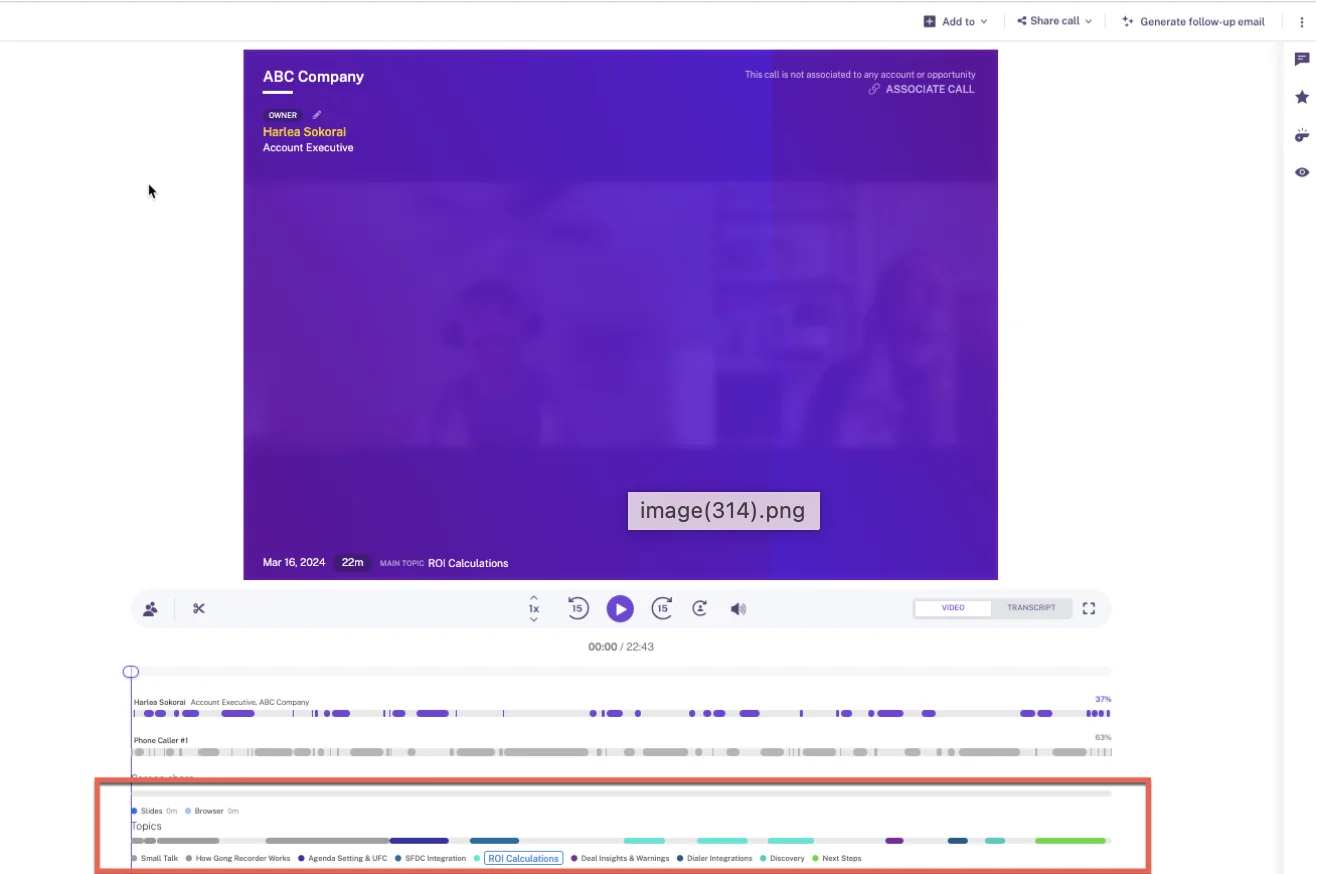
Gong's call page shows that analytics depth. Every recording breaks down into named topics along the timeline, next to a per-speaker talk track.
The safe-buy point is real, and the people who've made the purchase say it plainly.
"I bought Gong twice at two different companies. I signed a multi-year agreement at two different companies. And I'm sure you guys have heard this before, but like, I wasn't going to get fired for buying Gong. It wasn't going to happen, right? So it was a very safe choice."
Chris Nethercote, Weflow's Head of Sales and a former Gong customer
Change management is the bigger barrier. Unhappy teams still renew because removing a tool everyone knows costs more than living with it. The internal pushback sounds like this:
"Fight the fight against the group that are saying, hey, Gong is well known in the industry and the whatever 15k, whatever 13k, is not worth the disruption here."
If you can't give your reps and the board a reason better than price, staying is the rational call.
Which reasons apply depends on how your team uses Gong
The same complaint points to different answers depending on how your team runs Gong. Find the row that looks like your setup.
| How you use Gong | Reasons that bite hardest | What keeps you on Gong | Likely path |
|---|---|---|---|
| Recording and call review only | Price against use, data in Gong | Familiarity and the archive | Evaluate |
| Gong Foundation plus Gong Forecast, or Clari alongside | Stacked packaging, Gong Forecast across several teams | The deal board and the managers who rely on it | Trim the forecasting line, or evaluate if you want one platform |
| Gong Foundation plus Gong Engage and a dialer | Stacked packaging | One contract covering three jobs | Renegotiate, or separate engagement and conversation intelligence over time |
| Managers running weekly reviews from the deal board | Price at renewal | A working management habit | Renegotiate |
| EU teams with residency requirements | Data in Gong, plus where it's processed | Certification breadth | Evaluate |
The EU row needs a word of explanation. New Gong customers choose US or EU storage, and the default is the US. Choosing EU storage doesn't confine processing to the EU. Gong processes data in the United States, Israel and Ireland and covers those transfers through standard contractual clauses.
Renegotiate, trim, or evaluate: picking your Gong renewal path
Each path fits a situation you can check on your own account. Evaluating an alternative is one of three honest answers, not the default.
Renegotiate Gong when frontline managers use it every week
Renegotiate if your managers run coaching and deal reviews in Gong weekly and the value is visible to the team. You keep the habit and push on the terms.
These levers come straight from Gong's packaging and seat rules:
- Bring your hiring plan into the renewal. Headcount added as part of the renewal gets matching seats at no extra cost, while seats added a month later are a new purchase.
- Drop applications nobody opens, and resize seats per application to the people who use them.
- Agree your credit allowance up front, and narrow AI Trackers by team, user, account type or deal stage so they draw fewer credits.
- Ask who runs implementation of anything new. Buyers tell us Gong recommends third-party partners, which adds cost after you've already defended the budget.
- Use a published price from another vendor as your reference point. A proposal is easier to negotiate when you know what the capability costs elsewhere.
Trim Gong seats and modules when usage sits in pockets
Trim if one team lives in Gong and the rest barely open it. You keep Gong where it works and cut cost without a migration.
Teams typically cut:
- Idle seats, especially ones added through hiring that never recorded a call.
- Gong Forecast, when the forecast call already runs from the deal board or a spreadsheet.
- Published AI Trackers that run across the whole company and draw credits nobody reviews.
Evaluate an alternative when Salesforce needs to hold your call data
Evaluate when you need what your calls produce to live in Salesforce. That's a reason you can repeat to the board and to your reps, because it's about what the company owns, not about saving money.
The conditions we see most often:
- Methodology fields on your opportunities are empty even though the calls are recorded.
- Your team wants its own prompts, agents and workflows to read call transcripts from Salesforce.
- Reps don't record because recording depends on them.
- Frontline managers don't live in Gong, so you pay for a habit nobody has.
- Procurement needs EU residency for processing, not only for storage.
If two or more of those describe you, here's what evaluating Weflow looks like.
What evaluating Weflow looks like before your Gong renewal
Weflow writes structured Salesforce fields from the recording alone. It removes the archive and the rep opt-in as reasons to stay, and it does this at published seat pricing.
We position it as better AI at half the price, and we'll show you where we're still behind.
How Weflow Conversation Intelligence writes call data into Salesforce fields
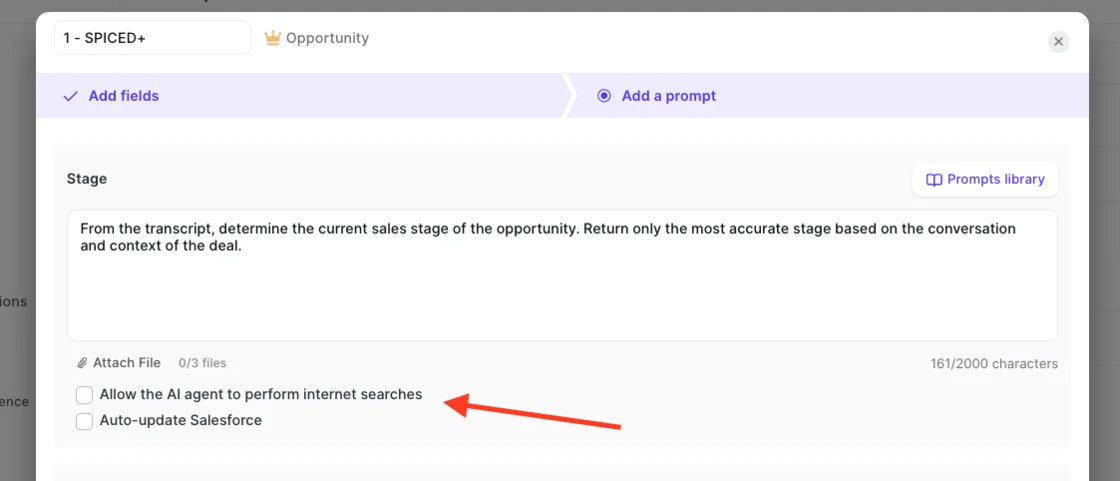
Weflow Conversation Intelligence turns each call into structured Salesforce field writes through AI Field Updates. The output is the field your forecast and deal reviews read, not a transcript in a second tool.
Here's how it works:
- AI Field Updates write MEDDIC, MEDDPICC, SPICED, BANT and custom methodology fields from the recording.
- You start from more than 250 pre-built prompts and adjust them in AI templates your admins own.
- Field updates write to any standard or custom Salesforce field except lookup relationships.
- Reps can review each suggested value against the current one, or you can switch fields to automatic once the output has earned it.
We recommend starting with a human in the loop. Fields with an unambiguous answer, such as a billing address, can go automatic right away. Interpretive fields like Metrics should earn it first.
The integration underneath is what makes the fields trustworthy. Our CEO explains the difference from field mapping.
"Everything we do has a bi-directional Salesforce integration that is real time and API based, that respects all your validation, field dependencies, permission sets. And that is actually quite different to for example Gong or Attention, that typically have to do field mapping."
How your Gong call history and trackers move into Weflow
Weflow migrates your Gong call history at no charge, through the Gong API, in about a week. The history arrives connected to your Salesforce accounts, so it stays useful for win-loss and closed-lost analysis.
- You share a Gong API key. We run the import on our side, with no manual export or file upload.
- Weflow imports recordings, metadata and transcripts. We reuse transcripts where possible and retranscribe the rest.
- Weflow links each call to its Salesforce account, contact or opportunity. When Gong's API doesn't carry the association, we run our own lookup to match it.
- Weflow reprocesses the library so it's searchable and scoreable on the same terms as new calls. We've done this with libraries in the thousands of recordings.
- Your existing tracker set carries over, so keyword reporting doesn't restart from zero.
Calls that only exist as video files, for example ones recorded natively in Zoom, come in through a CSV bulk import. Weflow processes about 180 of those calls in roughly a day.
How the Weflow desktop app gets reps recording without opting in
The Weflow desktop app records a meeting without a notetaker joining the call. It's included in every Weflow Conversation Intelligence seat at no extra charge.
The app captures system audio, the microphone and video on Zoom, Google Meet and Microsoft Teams. It runs on Windows, Mac with Apple Silicon and Mac with Intel.
There's no bot to admit and no lobby to wait in, so the rep has nothing to skip. The recording goes through the same pipeline as a notetaker recording: field updates, summaries, follow-up emails and scorecards.
One honest note. Some legal teams prefer a visible recorder that asks participants for consent. One buyer's counsel ruled out background recorders entirely ahead of FedRAMP. For those teams, Weflow's notetaker joins the call and supports configurable consent flows instead.
Where Weflow is still catching up to Gong
Buyers ask us where we're behind, so here's the list before you have to ask:
- Gong's conversation analytics go deeper than ours, and Gong has years more of them.
- Gong's deal board is a habit your managers built over years. Weflow has a deal board, but moving people off a view they're attached to is real work.
- Gong's integration ecosystem is broader, and teams have shaped their stack around it.
- Weflow holds SOC 2 Type II. ISO 27001 is in progress, not certified, and Weflow isn't FedRAMP certified.
- Weflow isn't a sales engagement platform and has no dialer. If you run Gong Engage and a dialer, you'd replace one tool with two. Weflow works alongside Outreach and Salesloft through compatibility mode.
- Weflow's deal inspection and forecasting run on opportunities. There's no account-level board for CSMs to see a customer as a whole.
Why KORE Wireless and HolidayCheck chose Weflow over Gong
KORE Wireless evaluated Gong and chose Weflow. In its published story, KORE says "the value didn't justify its price compared to Weflow."
"We weren't buying conversation intelligence. We were buying a unified data layer that the entire go-to-market motion could run on, and a partner who understood that distinction."
Scott Jones, SVP of GTM Revenue Intelligence & Enablement, KORE Wireless
KORE's rollout answers the change-management question. The team went live in five phases:
- Activity capture
- Conversation intelligence
- Coaching
- Deal intelligence
- Forecasting
Weflow ran onboarding end to end, including live training with a real-time Portuguese translator for the Brazil team.
HolidayCheck's Head of Media Sales Operations, Bastian Stosic, had used Gong before. He chose Weflow as an EU-made, GDPR-compliant alternative.
"Weflow ticked all the boxes: GDPR-compliant, tightly integrated with Salesforce, simple to use - and without the heavy price tag of U.S. vendors."
Bastian Stosic, Head of Media Sales Operations, HolidayCheck
What Weflow Conversation Intelligence costs per seat, and what's included
Weflow Conversation Intelligence is $39 per user per month, billed annually. We publish that price, and Gong quotes every buyer through a custom proposal.
We can price this way because we built Weflow after the cost of transcription and inference collapsed, not because the product is thinner. You can test that yourself with a side-by-side trial on your own Salesforce data.
| Item | In the $39 seat? |
|---|---|
| Unlimited recordings and transcripts | Included |
| AI Field Updates to Salesforce | Included |
| AI coaching scorecards, topics and trackers, clips and playlists | Included |
| Ask Weflow AI Pro | Included |
| Agent Builder | Free tier included, with 25 agent actions per month |
| Mobile Copilot and the desktop app | Included |
| View-only licenses for other teams | Unlimited, included |
| Platform fee and implementation fee | None |
| Gong history migration | No charge |
| Weflow Deal Intelligence & Forecasting | Separate: $39 standalone, or inside Revenue AI Business at $59 and Revenue AI Enterprise at $79 |
All plans have a 10-user minimum. Multi-year terms are discounted 10% for two years and 20% for three.
Walk through the product yourself, no call required.
How to cite this Weflow research on Gong renewals
Suggested citation: Weflow, "Why Revenue Teams Look Beyond Gong: Reasons Buyers Give on Sales Calls," published on the Weflow blog.
The unit of evidence is approved buyer quotes about Gong from Weflow's sales conversations. It isn't a count of calls or of reasons, and the reasons appear grouped, not ranked.
FAQ: switching from Gong at renewal
How long does migrating years of Gong recordings to Weflow take?
A Gong migration to Weflow takes about a week. Weflow imports recordings, metadata and transcripts through the Gong API at no charge and relinks each call to its Salesforce records.
Weflow then reprocesses the library so it's searchable and scoreable. Recordings that only exist as video files come in by CSV, at roughly 180 calls a day.
How do we time a Gong switch without paying for two tools?
Work back from your Gong end date. Plan for your decision, a 30 to 45 minute technical setup, the migration of about a week, and one to three weeks to full time-to-value as you configure templates and roll out.
Buyers who need a decision by October usually run the evaluation and a trial in the months before. Weflow's 14-day free trial runs on your own Salesforce data, so the comparison happens before you sign anything.
Can we pilot Weflow with a subset of reps before the Gong renewal?
Yes. Weflow's minimum is 10 users, and admins can add whole teams to Conversation Intelligence recording at once. Many buyers protect their most important quarter and pilot with a subset in a quieter one.
"We can't make any changes to the sales guys process in Q3 because our Q3 is by far the most important quarter of the year. So I sort of have to leave the sales guys alone. But in Q4 I would like to test out a solution with a subset of users."
How do managers inspect deals without Gong's deal board?
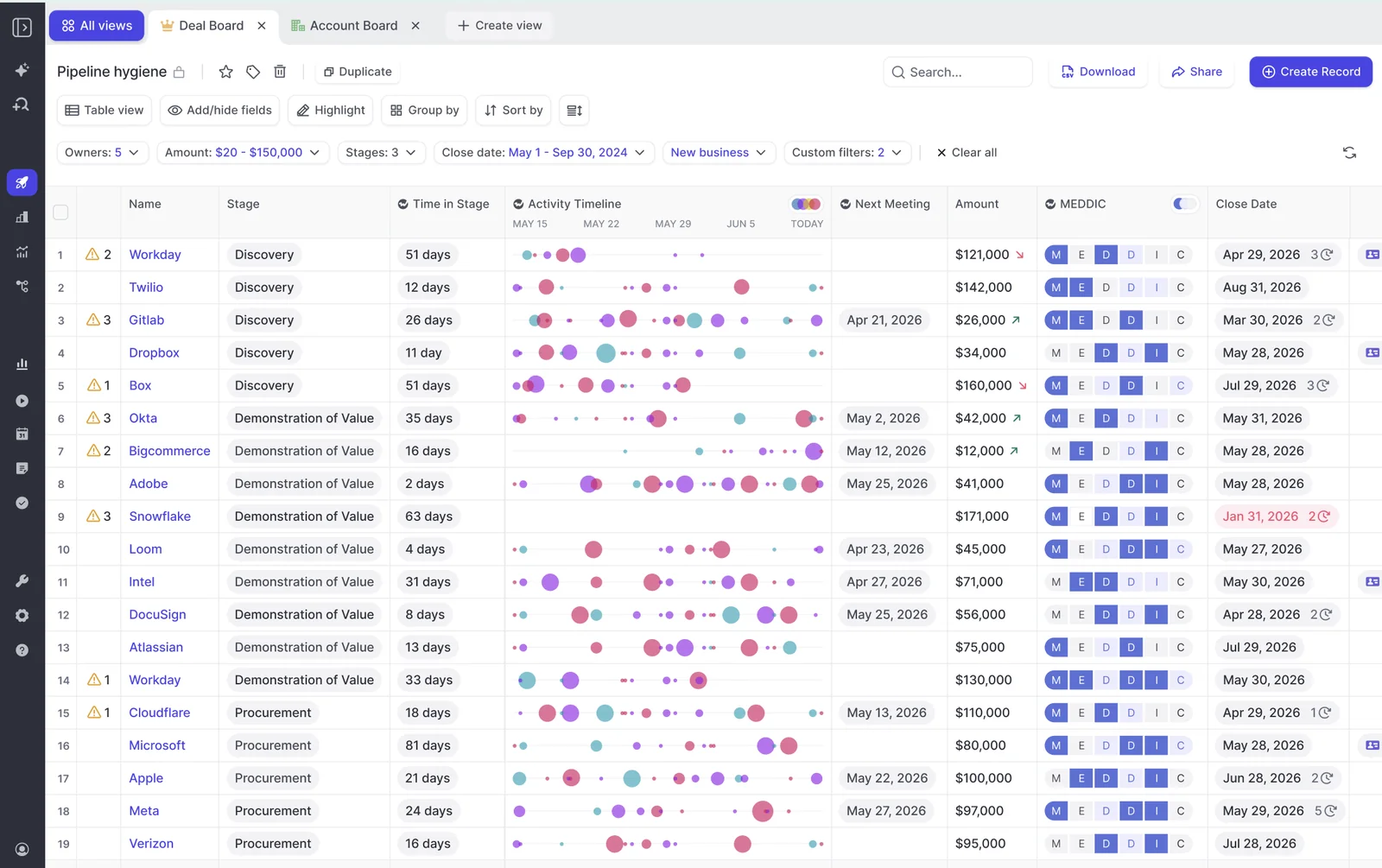
Gong's deal board is a real strength, and your managers will notice it's gone. Weflow's deal inspection runs on opportunities in Weflow Deal Intelligence & Forecasting. The deal board shows an activity timeline per deal next to MEDDIC scores filled from calls.
We use Gong Engage and a dialer too. What happens to those?
Weflow doesn't replace Gong Engage or a dialer, because it isn't a sales engagement platform. Replacing all three means one tool out and two in, which reads badly to most executives.
Teams in this position usually separate the decisions over time. Weflow runs alongside Outreach and Salesloft through compatibility mode.
Do marketing and customer success keep access to call transcripts after switching?
Yes. Every Weflow plan includes unlimited view-only licenses, so marketing, customer success and product can read recordings, summaries and transcripts without a paid seat.
Teams that pull transcripts into their own systems use the Weflow API. The call outcomes your methodology depends on land in Salesforce fields.
Who runs a Weflow implementation, Weflow or a third-party partner?
Weflow runs its own implementations, with no implementation fee. Your Salesforce admin and your Google Workspace or Microsoft admin join a 30 to 45 minute technical setup.
Our team then handles AI templates, rollout and training. At KORE Wireless, that included live sessions with a translator.
Where does Weflow store call recordings, and can data stay in the EU?
Weflow stores call recordings and transcripts in its own AWS environment, not in Salesforce file storage. You choose the region: Frankfurt, New York or Sydney. Weflow is a German company, and your instance can be kept in the EU or UK whatever region your Salesforce runs in.
Weflow keeps recordings for as long as you subscribe, or deletes them on a schedule you set. Weflow is SOC 2 Type II certified and GDPR compliant, uses Zero Data Retention for AI processing, and never uses customer data to train AI models.