Salesforce Agentforce Pricing for Sales Teams: Flex Credits, Per-User Licences and Add-Ons (2026)
See what Salesforce Agentforce costs a sales team: add-on vs Flex Credits, plus Weflow's seat price


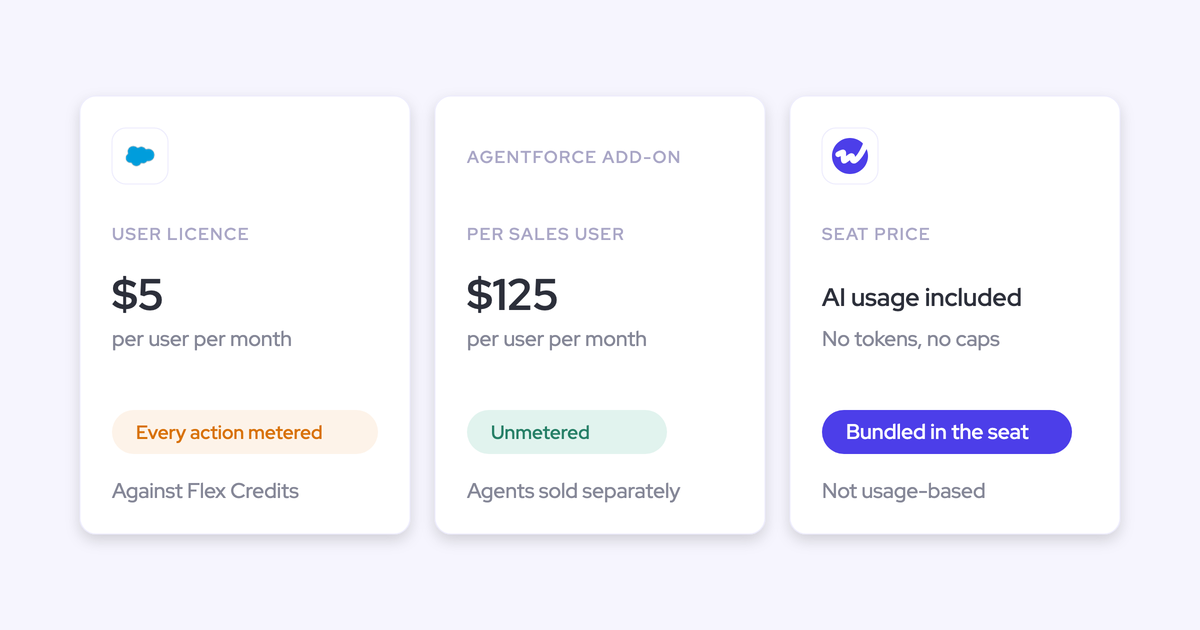

Salesforce Agentforce costs a sales team one of 3 ways:
- The Agentforce add-on at $125 per seller per month, on top of the Salesforce edition.
- The Agentforce User License at $5 per seller per month, plus Flex Credits at about $0.10 an action.
- The Max edition at $550 per seller per month, with the add-on included.
The $5 route is cheaper for a seller whose agents take fewer than about 1,200 actions a month. Above that, the add-on wins, because its price stops moving while the credits keep counting.
You also pay for things the rate card leaves out. Agentforce does not run without Data 360, which consumes its own Data 360 credits. Buyers also report being quoted hundreds of thousands of dollars for Salesforce or partner services to deploy it.
We price the same team on Weflow as the reference point, so you have a written like-for-like for the business case. Weflow is the Revenue AI Orchestration platform for sales, customer success, and RevOps teams. Built for Salesforce teams, it prices per seat with AI Field Updates, AI summaries and Ask Weflow AI included, and Agent Builder is the only Weflow product that meters usage.
Salesforce Agentforce and Weflow side by side for a sales team
Salesforce Agentforce is the deeper agent platform, and Weflow is the one that captures the data and prices AI into the seat.
| Capability | Weflow | Salesforce Agentforce |
|---|---|---|
| Prebuilt AI agents | Starting templates (pipeline snapshot, meeting recap, deal risk PDF) with basic prompts to rewrite | Sales agents for SDR work, pipeline updates, account research, coaching practice and quoting |
| Building your own AI agents | Agent Builder: scheduled multi-step agents delivering to Slack, email or PDF; admins only, no field writes | Agentforce Builder: natural language and Agent Script, wired to Flows, Apex and MuleSoft, with test runs |
| Deal intelligence setup and rollout | Free implementation, live in 2 to 3 weeks, configured centrally by an admin | Needs Data 360 and an admin build per agent; buyers report services quotes in the hundreds of thousands |
| Integrations with other tools | Native with Salesforce, Gmail, Outlook, Zoom, Teams, Meet, Slack and the Outreach dialer; no native warehouse connector | MuleSoft APIs, plus external MCP servers whose tools become agent actions |
| Access from AI assistants (MCP) | Read-only MCP connector for summaries, transcripts, forecast calls and pipeline metrics | Hosted MCP Server queries org data; agents surface in ChatGPT, Claude and Gemini |
| Raw data access outside the tool | REST API bulk export in JSON or CSV; recordings to your own storage | Output lands in Salesforce records, reached through Salesforce's APIs and Hosted MCP Server |
| Pricing | Public: $19 to $79 per seat; Agent Builder free to $999 per workspace a month, or a custom package | Public: $125 add-on, $5 license plus Flex Credits, Max at $550 |
| Best for | Salesforce teams of 50 to 1,200 sellers wanting capture, AI and forecasting at one seat price | Orgs with admin capacity and Data 360 that want agents acting inside Salesforce |
Salesforce Agentforce wins on depth. Its prebuilt sales agents run from prospecting to quoting, and Agentforce Builder wires custom agents into Flows, Apex and MuleSoft APIs. You pay for that depth in setup, because Agentforce needs Data 360 and an admin build for each agent.
Weflow wins on what the seat includes: capture, conversation intelligence and everyday AI from $49 to $79 per seller per month. You go live in 2 to 3 weeks, with free implementation. Weflow's Agent Builder is newer and runs scheduled briefings rather than field-writing agents. It is the only part of Weflow that meters, per workspace, starting with 25 free actions a month.
Why Salesforce teams price Agentforce first, and what finance asks of it
Salesforce teams price Agentforce first because procurement makes them. It is Salesforce's own product, so you have to price and assess it on paper before anyone may propose another tool.
In our deals, the buyer has often already settled on Salesforce as the database, with the intelligence in a layer above it. For that buyer, the Agentforce step is a formality to clear.
Inside your buying team, though, the pull is real. People who know Salesforce want everything in one place, while whoever runs the evaluation finds the pricing convoluted. Both sides end up asking the same question: what does our Salesforce license already cover that we've never switched on, and which gap is left that nothing we already pay for can close?
You need to answer that question in writing, like for like, because a demo never reaches the approval chain. Finance reads AI pricing for the second number, the consumption charge on top of the seat, since that's the line that makes an invoice unpredictable. Finance asks 3 questions of it:
- What the seat includes: which AI features a seller gets for the per-user price, with no meter attached.
- What meters: which features draw on consumption, in what unit, and at what rate.
- Where the ceiling is: what stops a popular feature from doubling the contract before anyone has forecast the second invoice.
Predictable pricing is very hard to achieve in the age of AI. - Philipp Stelzer, Co-founder and Chief Product Officer, Weflow
How Salesforce charges a sales team for Agentforce
Salesforce sells Agentforce to a sales team as an add-on to the CRM edition, paid either per user or from a pool of Flex Credits.
The 3 ways to license a seller for Agentforce
Salesforce licenses a seller for Agentforce through a $125 add-on, a $5 license or the Max edition, and only the $5 license meters every action. The routes differ in who carries the usage risk. The add-on caps your cost per seat, while the license leaves the usage bill open.
- The Agentforce add-on costs $125 per user per month ($150 on the Industries clouds) on top of the seller's edition, and gives that user unmetered agent use. Salesforce doesn't sell the add-ons on the PayGo or Pre-Commit models.
- The Agentforce User License costs $5 per user per month and gives limited CRM access. Every action that user's agents take draws on Flex Credits, so you can spread agents across the company while the usage bill stays open.
- The Max edition costs $550 per user per month and includes the Agentforce add-on plus 2.75 million Flex Credits per org per year. It is Agentforce 1 Edition under a new name at an unchanged price.
How Flex Credits meter every agent action
Flex Credits are Agentforce's usage currency. $500 buys 100,000 credits, and a standard action uses 20 credits, about $0.10, so $500 covers 5,000 standard actions. An Agentforce Voice action uses 30.
An action is one thing an agent does, such as updating a record, summarizing a case, answering a question or running a prompt or flow. Every action draws on one shared pool, which also pays for prompts and translations.
Salesforce deserves credit for how the meter behaves: it is bounded by what you buy and visible while it runs, so you can forecast it. Plan your budget around these rules:
- Flex Credits are bought upfront (Pre-Purchase), against a committed baseline billed monthly (Pre-Commit), or with no commitment (PayGo).
- Flex Credit usage beyond the entitlement is billed monthly at the contracted rate, with no penalty.
- Salesforce's Digital Wallet shows consumption in near real time.
- Unused Flex Credits expire at the end of the subscription term instead of rolling over.
- An org runs either Flex Credits or per-conversation pricing at $2 a conversation, never both. Conversation pricing is built for customer-facing agents, and employee agents run on Flex Credits or per-user licenses.
When the $5 license stops being cheaper than the $125 add-on
The $5 Agentforce User License stays cheaper than the $125 add-on until a seller's agents take about 1,200 actions a month. The arithmetic: the add-on costs $120 more per month than the license, and $120 buys about 1,200 actions at $0.10 each.
You can apply that rule to each group of sellers. Below 1,200 actions a month, the license plus credits costs less, and every 100 actions adds $10. Above it, the add-on costs less and stops moving.
If the work runs through Agentforce Voice at 30 credits an action, the break-even drops to about 800 actions. Count prompts and flow runs toward the total too, because they draw on the same pool.
What your Salesforce edition already includes
Every new Salesforce sales edition includes a Flex Credit allocation and Agentforce skills such as Account Research. Below Max, the sales agents themselves are sold separately.
Salesforce Foundations, a free tier, adds Agentforce Builder, Prompt Builder, Agent Script, Agentforce Coworker and Agentforce Vibes at no charge. Building agents costs you nothing; running them is what you pay for.
| Edition | Core | Advanced | Max |
|---|---|---|---|
| Price per user per month | $195 | $395 | $550 |
| Flex Credits a year | 500,000 | 1 million | 2.75 million |
| Actions a year | 25,000 | 50,000 | 137,500 |
| Sales agents included | No: Agentforce for Sales is an add-on from $125, and the Pipeline Management, Prospecting and other sales agents are sold separately | No: Agentforce for Sales is an add-on from $125, and the Pipeline Management, Prospecting and other sales agents are sold separately | Yes: Agentforce for Sales is in the license |
We converted credits to actions at 20 credits each; that conversion is our arithmetic, not a Salesforce figure. Prompts and translations draw on the same allocation, so the actions you actually get are fewer. Salesforce itself describes Core's 500,000 credits as capacity to experiment rather than to run at scale.
The new editions apply to new purchases from 3 September 2026, replacing Enterprise, Unlimited and Agentforce 1 Edition. Existing customers keep their legacy edition's pricing, and Agentforce 1 customers move to Max at no extra cost.
The Agentforce costs that never appear on the rate card
Agentforce carries 5 costs that sit off the rate card. Put each one in your business case, because finance reopens a case that leaves them out:
- Data 360 is a prerequisite: it must be provisioned and enabled before any Agentforce use, and the Einstein Trust Layer and Agentforce Data Library don't work without it. A working agent workforce goes further, into a project that connects data, maps it to data models, cleans it, runs identity resolution and sets up retrieval-augmented generation.
- Data 360 credits are a separate meter from Flex Credits, consumed by those Data 360 features, so they need their own line in the business case.
- The Einstein Agent license is needed for the dedicated agent user that agents such as Agentforce Sales Coach and Agentforce SDR run as.
- Professional services are where buyers report the biggest number: deploying Agentforce through Salesforce or a third-party partner is quoted in the hundreds of thousands of dollars.
- Admin time is the cost nobody invoices: every agent change queues behind an internal Salesforce admin team that is already the bottleneck, so you can pay for Agentforce and have nothing running on it.
What Salesforce Agentforce does well, and where it stops for a sales team
Salesforce Agentforce is strongest at agents that act inside Salesforce across the whole sales cycle, and it stops at capture, Data 360 and the admin queue.
Prebuilt sales agents and Agentforce Builder cover the whole sales cycle
Salesforce Agentforce's prebuilt sales agents cover the cycle from first touch to quote, and they act inside Salesforce:
- Agentforce SDR qualifies leads and books meetings.
- The Pipeline Management agent updates opportunity fields such as Stage and Next Steps from calls, meetings, emails and seller notes, either autonomously or as suggestions a rep approves, and shows the source behind each update.
- The Account Management agent researches an account across Salesforce, the web, third-party data and conversations, fills in account plans, and sends meeting briefs to reps.
- Agentforce Sales Coach runs role-plays against an AI buyer tailored to the opportunity and its stage, with feedback grounded in the deal's data.
- Agentforce Sales also covers quoting, billing, partner success and renewals.
For anything the prebuilt agents miss, your admins build a custom agent in Agentforce Builder. They describe it in natural language and Agent Script, connect it to Flows, Apex, MuleSoft APIs, prompt templates and knowledge, and test it in a simulator and batch tests before it goes live.
Agentforce reaches sellers in Slack, AI assistants and the Hosted MCP Server
Salesforce builds Agentforce to be headless: you build an agent once and it surfaces wherever the seller works, including Slack, Microsoft Teams, Outlook, ChatGPT, Claude and Gemini. In Slack, a rep asks Slackbot in plain language and it routes the request to the right agent.
Salesforce's Hosted MCP Server lets an outside assistant query the org directly, reading objects and pulling filtered lists. Agentforce can also register external MCP servers, so their tools become agent actions.
Underneath sits the Einstein Trust Layer. It masks sensitive data before a prompt reaches a model, keeps the user's permissions on grounding data and holds third-party model providers to zero data retention. Agentforce also falls under Salesforce's ISO 42001 certification for AI management.
Agentforce captures nothing itself and needs Data 360 and an admin build
Salesforce Agentforce captures no activity or conversations of its own. It acts on what Momentum, Einstein Activity Capture and Einstein Conversation Insights put into Salesforce. Agentforce SDR makes the dependency explicit, because every rep must be connected to Einstein Activity Capture for the agent's emails to show on the prospect's Activity Timeline.
Each agent is also an admin build. Agentforce Sales Coach takes 5 parts: enabling its features and Data 360, creating an agent user on the Einstein Agent license, assigning permission sets, adding the component to the Opportunity page, then configuring it in Agentforce Builder. One buyer told us: "It feels like we're getting stuck at the administrator all the time."
If you want to stay native, we recommend building on Foundations and running pilots on your edition's credits before you buy seats, because neither costs anything extra.
What Weflow does for the same sales team, and where it stops
Weflow covers the capture, conversation intelligence and everyday AI that a sales team's agents depend on, in one per-seat price, and it stops at agents that write to Salesforce fields.
Weflow captures every conversation and writes it into Salesforce
Weflow's seat includes the capture Agentforce assumes someone else has done. Weflow Activity & Contact Capture runs at the mail-tenant level and logs every email and meeting it can match to a Salesforce record onto the Task or Email Message object and the Event. It also creates contacts for new people on threads and invites.
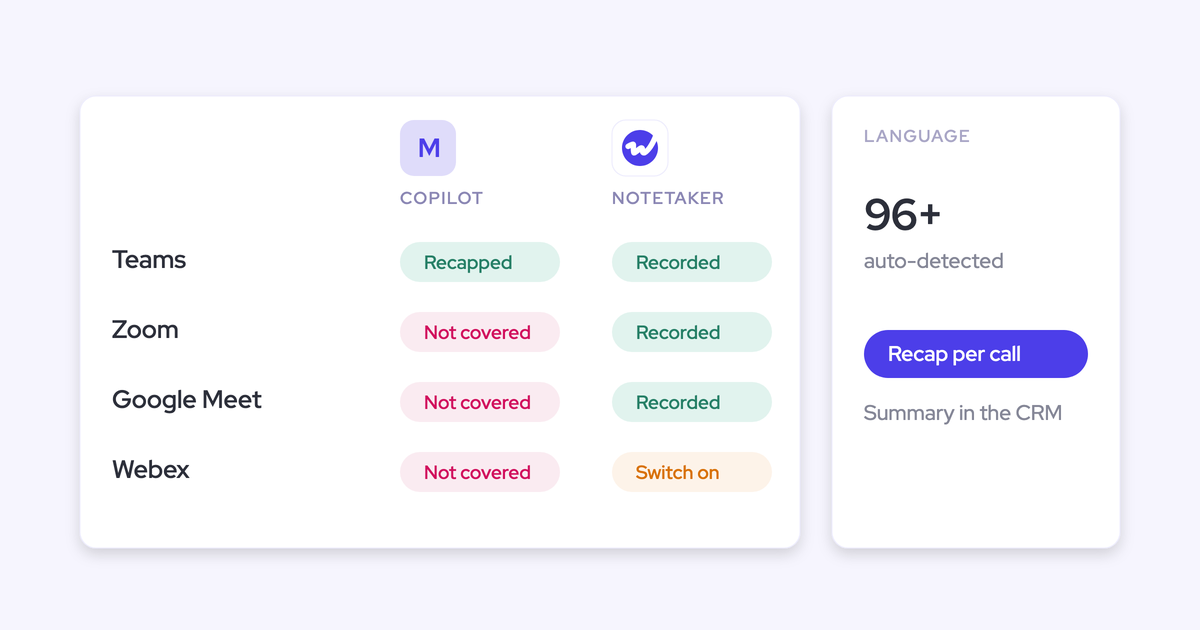
Weflow Conversation Intelligence records Zoom, Teams, Google Meet and WebEx calls. Within 30 to 60 seconds of a meeting ending, the rep has the summary, a drafted follow-up and proposed field updates.
The everyday AI comes in the seat, unmetered:
- AI Field Updates write call-derived values into Salesforce fields, automatically or as suggestions, and you choose which per field.
- AI summaries land on the Salesforce Event.
- Ask Weflow AI answers across records, emails and transcripts under a fair use policy no customer has yet reached.
Viewer seats are free, and teams typically go live in 2 to 3 weeks.
Weflow Agent Builder runs scheduled agents on a per-workspace meter
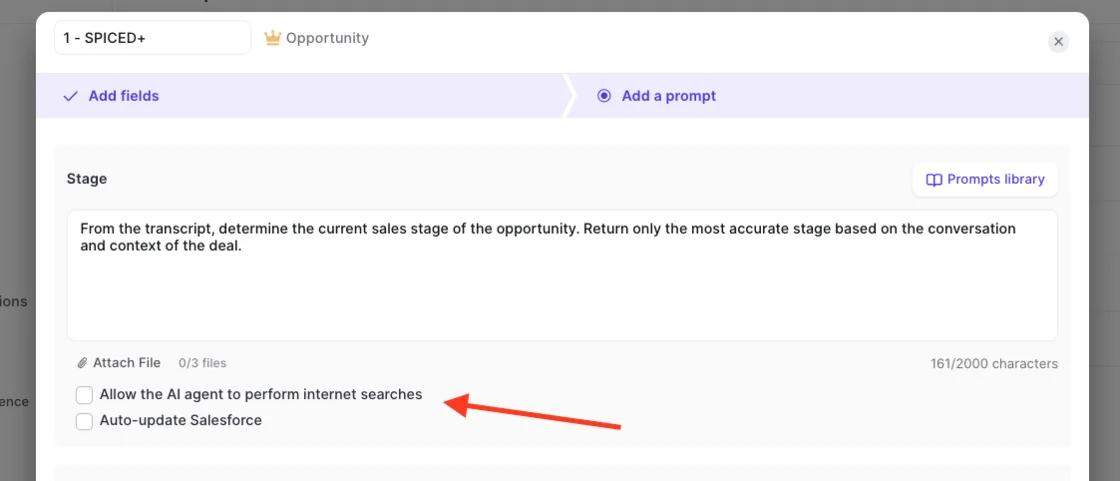
Weflow Agent Builder is the only Weflow product that meters, and it meters per workspace in fixed monthly tiers. You build each agent from 4 parts, which run in order:
- A schedule with day, time and timezone.
- A lookup that reads Salesforce accounts, contacts, leads or opportunities, with field filters.
- An AI step with a free-text prompt over those records' emails, calls and transcripts.
- Delivery to Slack, email or a PDF.
Agent Builder meters actions rather than runs, so a heavier agent uses more of the allowance each time it runs. A simple lookup counts as 1 action, a research agent about 3, and an agent reasoning across transcripts and activity about 5.
Meeting prep, summaries, field updates and coaching scorecards never draw on the allowance. Agents you build on Weflow's public API or MCP connector cost nothing extra. Agent Builder's tiers are priced per workspace per month:
- The Free tier includes 25 actions a month with every Weflow plan.
- The Growth tier costs $299 for 500 actions a month.
- The Scale tier costs $999 for 2,500 actions a month.
- The Enterprise tier is a custom package.
Where Weflow is the wrong fit for a sales team
Weflow isn't the right fit for every sales team. These are its limits:
- Weflow Agent Builder is the newest Weflow product and less mature than the rest of the platform. Its 3 starting templates carry basic prompts you are meant to rewrite.
- Weflow agents can't write their conclusions into Salesforce fields, so an agent's insight needs a person to enter it. If your agents must update Salesforce on their own, Agentforce is the better fit. AI Field Updates and AI Playbooks are the parts of Weflow that set fields directly.
- Only admins configure Weflow agents in the current release, so reps can't build their own.
- Weflow does no sales engagement: no sequencing, cadences or dialer, no email sent to prospects on a rep's behalf, and no role-play coaching. If you need those, Weflow isn't the tool for them.
- Weflow works only with Salesforce, so it isn't a fit for a team on another CRM.
- Weflow isn't a general-purpose agent platform. Its agents reason over customer-facing data mapped to Salesforce, and its API and MCP connector feed that data into agents built elsewhere.
What 62 sellers pay for AI on Agentforce and on Weflow
For a team of 62 sellers, the Agentforce add-on costs $93,000 a year before Data 360 and services. Weflow costs about $36,000 to $58,000 a year, with capture included.
Both sit on top of the Salesforce edition you already pay for. We leave Max out because it is a CRM edition, not an AI layer.
| Cost line | Salesforce Agentforce | Weflow |
|---|---|---|
| Price per seller per month | $125 add-on, or $5 license plus Flex Credits | $49 for Revenue AI Foundation or $79 for Revenue AI Enterprise |
| AI in the seat | Add-on: unmetered agent use; $5 license: none, every action meters | AI Field Updates, AI summaries and Ask Weflow AI, unmetered |
| What meters, and its unit | Flex Credits, 20 per action; Data 360 credits separately | Agent Builder only, in actions per workspace |
| Allowance and expiry | Edition allocation of 500,000 to 2.75 million credits a year; unused credits expire at term end | 25 free actions a month; paid tiers add 500 or 2,500 a month |
| Prerequisites | Data 360 enabled; agent users on the Einstein Agent license | Salesforce, plus a Salesforce admin and a mail admin for one setup session |
| Implementation | Admin build per agent; buyers report services quotes in the hundreds of thousands | Free, live in 2 to 3 weeks |
| Minimums and term | Editions billed annually; add-ons not sold on PayGo or Pre-Commit | 10 users per product or bundle; 12-month contract billed annually; viewer seats free |
| Yearly total for 62 sellers | $93,000 on the add-on; on the $5 route, $3,720 in licenses plus about $7,440 for every 100 actions per seller per month | About $36,000 on Revenue AI Foundation or $58,000 on Revenue AI Enterprise, plus $0, $3,588 or $11,988 for Agent Builder |
If you price the $5 route instead, estimate actions per seller first. For 62 sellers, every 100 actions per seller per month adds about $7,440 a year on top of the licenses.
Agentforce bills agent use by consumption unless you pay $125 a seat to turn the meter off. That $93,000 buys agents that act on data other Salesforce products must capture first. Weflow prices by seat: $58,000 on Revenue AI Enterprise buys capture, conversation intelligence, forecasting and unmetered AI, with Agent Builder as the one bounded meter on top.
How to run Weflow alongside Agentforce, or instead of it
Weflow and Agentforce can share one Salesforce org. We recommend splitting the jobs between them before you buy more of either, so each tool gets the jobs it is built for.
Agentforce sees Weflow's data wherever it lands in Salesforce records. Forecast calls and tracker hits stay in Weflow.
- Sort your agent jobs into field-writing and briefing. Jobs where an agent must change Salesforce records on its own, such as working leads or building quotes, belong to Agentforce. Recurring briefings, such as a weekly deal-risk review or a closed-lost analysis, fit Weflow Agent Builder.
- Keep building on Salesforce Foundations. Agentforce Builder and Prompt Builder cost nothing there, so your Salesforce agent work continues while you test.
- Run a 14-day Weflow trial with one team of 5 to 10 sellers, and agree pricing and success criteria before it starts. Weflow's team does the setup on your own Salesforce, so the trial runs on your real activity.
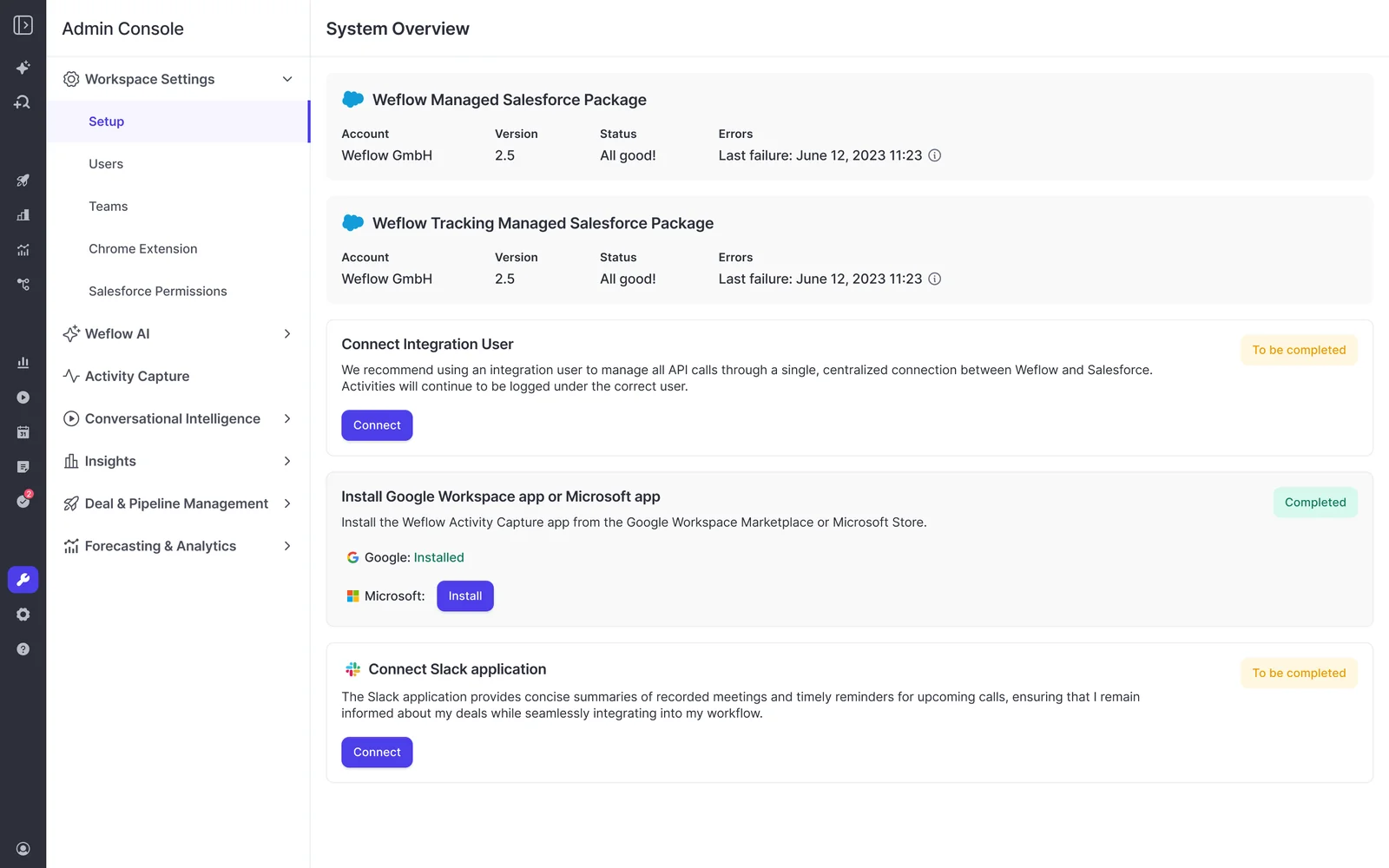
- Hold the setup session with a Salesforce admin and a mail admin in the room. The technical integration takes 30 to 45 minutes and workspace configuration about an hour. On Microsoft 365, the Microsoft admin has to start the install from Weflow's admin console.
- Connect Weflow's MCP connector beside Salesforce's Hosted MCP Server. Salesforce's connector answers questions about the record, and Weflow's answers questions about the forecast and the conversation, which never fully reach Salesforce.
- Roll out by role, with separate leadership and rep training, starting with capture and conversation intelligence before forecasting. Reps use capture and conversation intelligence while forecasting is a leadership motion, and the forecast is only as good as the capture and conversation data underneath it.
- Size the next Flex Credit purchase on observed usage before the term ends. Digital Wallet shows what your agents actually consumed, and unused credits expire at term end, so buy for what ran rather than what was planned.
Choose Salesforce Agentforce or Weflow: who each one fits
Choose by where your agents need to act and how your finance team needs the bill to behave.
Choose Salesforce Agentforce if:
- Your agents must act inside Salesforce on their own, updating fields, working leads or building quotes, which Weflow agents can't do.
- Your org already has admin capacity and Data 360 in place, so each agent build doesn't wait in a backlog.
- Your team is already on the Max edition, where the add-on and 2.75 million Flex Credits come in the seat.
Choose Weflow if:
- You want one per-seat price that includes capture, conversation intelligence and everyday AI, with nothing to ration.
- You want the only meter to be Agent Builder's, bounded per workspace in fixed tiers, so finance can see the ceiling before signing.
- You need a team live in 2 to 3 weeks, with free implementation and no data-platform project first.
Stay with your Salesforce edition if your agent usage fits the Flex Credits your edition already includes and Foundations covers what you build, because then you pay nothing beyond the seats you already have.
Walk through the product yourself, no call required.
Questions RevOps teams ask about Agentforce pricing
Is the $125 Agentforce add-on on top of the Salesforce edition price?
Yes. On Core and Advanced, Agentforce for Sales is an add-on from $125 per user per month on top of the edition, so a Core seller with the add-on lists at $320 a month. Only Max at $550 includes it in the license.
What does Data 360 add to the cost of Agentforce?
Data 360 adds a prerequisite and a second meter. It must be provisioned and enabled before any Agentforce use, and its features consume Data 360 credits, separate from the Flex Credits that agent actions use. Implementing it properly, with data mapping, identity resolution and retrieval-augmented generation, is a project of its own.
Do we need professional services to deploy Agentforce?
Buyers who deploy Agentforce through Salesforce professional services or a third-party partner report quotes in the hundreds of thousands of dollars. The alternative is your own admin team building each agent. Every change then queues behind whatever else the business needs from that team.
Does Weflow meter anything, and where is the ceiling?
Weflow meters only Agent Builder, per workspace, in fixed monthly tiers starting with 25 free actions on every plan. Ask Weflow AI, AI summaries and AI Field Updates come in the seat, and agents you build on Weflow's API or MCP connector cost nothing extra.
Can Weflow and Agentforce run side by side?
Yes. Weflow writes captured activity, summaries and field values into Salesforce records, where Agentforce agents can act on them. Weflow's MCP connector sits beside Salesforce's Hosted MCP Server for the forecast and conversation data that stays in Weflow.
How long until Weflow is live, and who has to be in the room?
Weflow is typically live in 2 to 3 weeks, and implementation is free. The technical setup is one session with a Salesforce admin and a mail admin. What stretches the timeline is internal alignment on methodology and fields, not the product.
What are Weflow's minimums and contract terms?
Weflow requires 10 users per product or bundle on a 12-month contract, billed annually, with no shorter term. Seats can't be reduced mid-term but can be reassigned when someone leaves, and bundle, volume and multi-year discounts apply.