Weflow vs Gong for AI Deal Scoring: How Each Scores an Open Opportunity (2026)
Weflow vs Gong for AI deal scoring: likelihood score vs pipeline rank, warnings, setup and pricing.


Gong's AI Deal Predictor ranks each open deal against your other open deals. Weflow is the Revenue AI Orchestration platform for sales, customer success, and RevOps teams. Weflow Deal Intelligence & Forecasting scores each opportunity from 0 to 100 on its likelihood to close won, trained on your own closed deals.
So a Gong 80 tells you where a deal sits in this quarter's pipeline. A Weflow 80 is a read on that deal's own chance, learned from what separated your won deals from your lost ones.
The two tools also ask for different things before they score. Gong needs a Gong Forecast seat and at least 50 won and 150 lost deals from the last 2 years, while Weflow needs about 6 months of closed history.
If you're below Gong's deal floor or don't want a Forecast seat, Weflow scores your pipeline on Salesforce. If you need call content inside the score, or you run HubSpot, Gong fits better. Beyond the score, we compare deal risk warnings, rollout, integrations, access from AI assistants, raw data access and pricing.
Weflow vs Gong at a glance for AI deal scoring
The biggest difference between Weflow and Gong is what the score means. Weflow scores a deal's likelihood to close won, while Gong ranks it against your other open deals, and that changes how you read every number in your pipeline review.
| Dimension | Weflow | Gong |
|---|---|---|
| AI deal scoring | 0 to 100 likelihood to close won, recalculated nightly, drivers shown; needs about 6 months of closed history | Percentile rank against other open deals from 300+ signals including calls; needs a Forecast seat plus 50 won and 150 lost deals |
| Deal risk warnings | 50+ signals; your own AND/OR rules on non-text and computed fields; not reportable in Salesforce or BI | 8 Gong-defined warnings; on/off and timing controls only; some read what's said on calls |
| Setup and rollout | Run by Weflow's customer success team at no extra cost; typically 2 to 3 weeks | Paid services projects of up to 12 or 22 hours, after Foundation and the CRM integration are live |
| Integrations with other tools | Salesforce, Gmail, Outlook, Google Calendar, Zoom, Teams, Meet, Slack and the Outreach dialer | About 450 marketplace entries, about 30 dialers, Salesforce, HubSpot and Dynamics 365 |
| Access from AI assistants (MCP) | Read-only connector returning transcripts, playbooks and forecast calls; admin toggles; 25-owner cap | 3 record-scoped tools returning AI insights only; read-only; metered credits; paid seat needed |
| Raw data access outside the tool | REST bulk export of transcripts, scores and signals; no native warehouse connector | API capped at 3 calls a second and 10,000 a day; Data Cloud for warehouses as a separate purchase |
| Pricing | $39 per user per month, billed annually, AI included, 10-user minimum | No public prices, custom quote |
| Best for | Salesforce teams that want a likelihood score, their own warnings and a known price | Teams deep in Gong with the deal volume for Forecast, or on HubSpot or Dynamics |
Why sales managers compare Weflow and Gong for deal scoring
Sales managers compare Weflow and Gong because both promise a neutral read on which deals will close, one that doesn't rest on the rep's word.
Managers describe this routine on our calls. Before a deal review, you rebuild the picture by hand: one report for stage duration, another for last activity, the rep's story for everything else. That takes about an hour per team per week.
The review still ends on the rep's word, because the engagement data that would contradict them isn't in front of you. Meanwhile the single-threaded deal and the deal stuck in one stage for 2 months look exactly like healthy ones until the last week of the quarter.
What you want is a second opinion built from what happened in the deals, rather than from whoever told the best story on Monday. Many managers assume that's a Gong capability, and Gong earned it: its buyers valued that it judges deals from what's said in conversations, not from how Salesforce fields change.
We recommend holding any replacement, Weflow included, to that bar. A model built on field changes sees only what reps typed into the CRM, so it misses context that never reaches a field.
How Gong and Weflow each score an open opportunity
Gong ranks each open deal against the rest of your open pipeline, while Weflow scores each opportunity's own likelihood to close won. Both models train on your own closed deals.
Gong ranks each open deal against the rest of your pipeline
Gong's AI Deal Predictor scores each open deal from more than 300 signals, using a model trained on your own won and lost deals. The signals come from CRM data, calls and meetings, emails, and conversation intelligence signals such as warnings and trackers.
Gong lists the positive and negative signals behind each score. Scores refresh once a day and show on the Forecast page, deal boards, deal pages and pipeline views.
The Gong number is a percentile rank, and Gong spells out the distinction itself. A deal scored 80 has a better chance of closing than 80 percent of your other open deals, which isn't an 80 percent chance of closing.
Read a Gong score as a position in the pipeline. In a uniformly weak quarter the top-ranked deals still score high, so the score tells you nothing about whether you'll make the number.
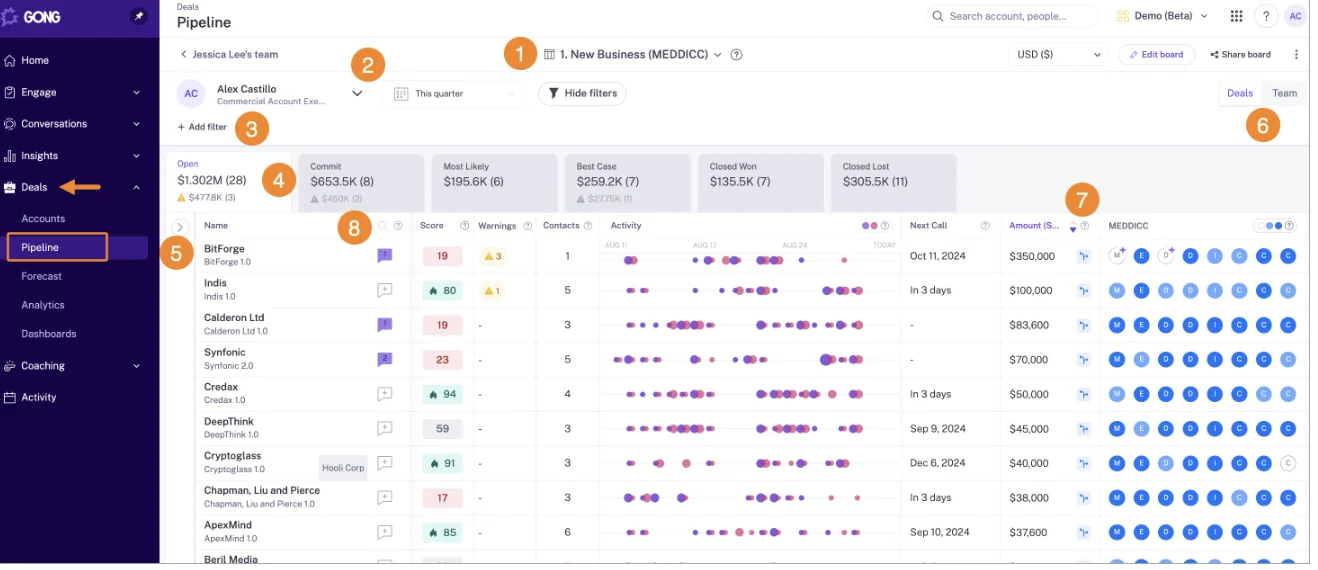
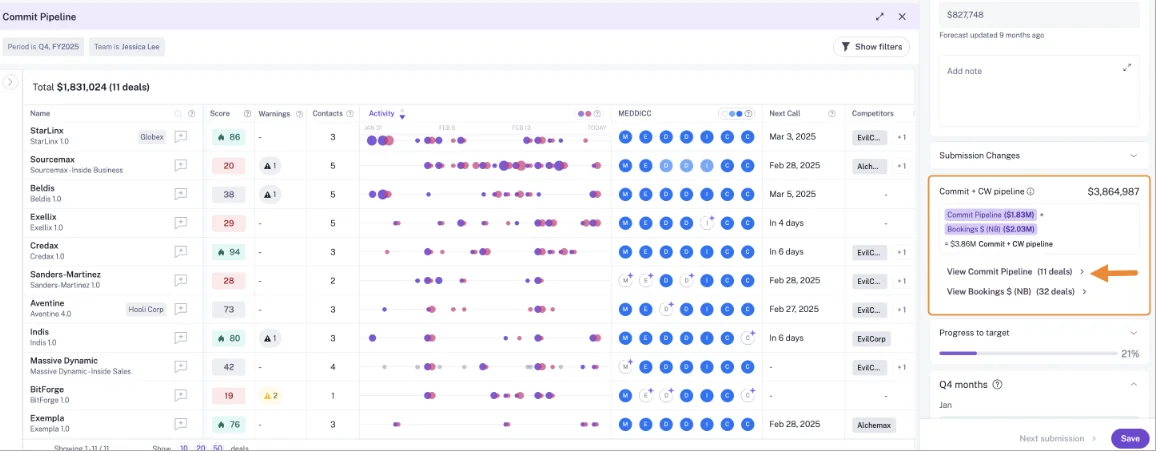
On Gong's own pipeline board, each deal row carries its score, such as 19, 80 or 94, beside a warnings count, contacts, an activity timeline and MEDDICC chips.
Weflow Deal Intelligence & Forecasting scores each deal's likelihood to close
Weflow Deal Intelligence & Forecasting scores every opportunity from 0 to 100 on how likely it is to close won. Weflow recalculates the score nightly and trains it on your own closed deals rather than a generic model.
The model reads your opportunity history as far back as your instance allows, usually 2 years. From that history it learns what separated won from lost in your business: time in each stage, number of activities, communication cadence.
Each score comes with an explanation of what drives it, so you and the rep discuss the drivers instead of arguing over the number. Reps also argue less with a score weighted from your own wins and losses, because it reflects why your company loses deals.
Read a Weflow 80 as a strong signal about that deal, not as a calibrated 80 percent probability. Because the score isn't a rank against your other open deals, it describes the deal itself rather than its place in this quarter's pipeline.
Weflow's score learns from stage timing, activity and cadence, while Gong's signals also include call content. What's said on calls reaches Weflow in two other places:
- AI Playbooks, which read the whole record with its activities, meetings and recordings and refresh every few hours.
- A deal-level AI summary, which reasons across every meeting on the opportunity.
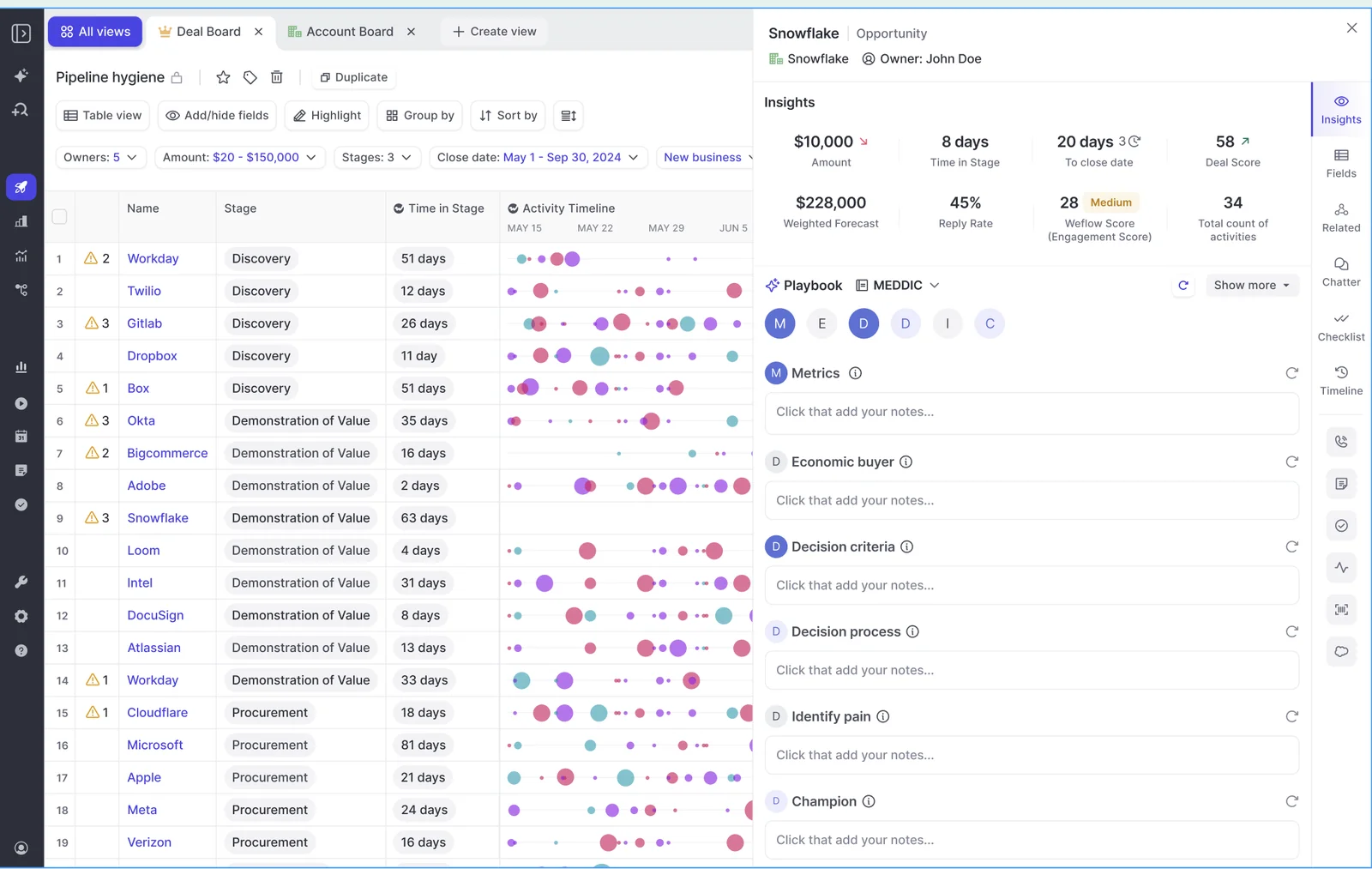
In Weflow's deal board, the opportunity panel shows a Deal Score of 58 next to an Engagement Score of 28. The Engagement Score is a separate measure Weflow calculates per account. Below both sits a MEDDIC playbook with a field for each letter.
What each tool needs before the first score appears
Gong needs a Gong Forecast seat and at least 50 closed-won and 150 closed-lost deals from the last 2 years before it scores a deal; Weflow needs about 6 months of closed history.
| Requirement | Gong | Weflow |
|---|---|---|
| Data needed | 50 closed-won and 150 closed-lost deals from the last 2 years, with change tracking on close date, amount and stage | About 6 months of closed history in Salesforce |
| Seat needed | A Gong Forecast seat on top of Gong Foundation | A Weflow Deal Intelligence & Forecasting seat |
| Time to first score | Up to 2 weeks to process first scores | Trains within a few days once the history exists |
Count your closed-lost opportunities from the last 2 years in Salesforce before you take a Gong Forecast quote, because Gong won't score below that floor. If your team loses 5 deals a month, you have 120, which is short of Gong's floor, while 6 months of closed history is enough for Weflow to train.
If you clear 150 lost deals and already pay for Gong Forecast, the score is already within reach in Gong.
How Gong and Weflow warn you a deal is slipping
Gong warns you with 8 warnings it defines and you tune, while Weflow warns you with rules your team writes on your own fields and on fields Weflow computes.
Gong's AI Deal Monitor runs 8 warnings that Gong defines
Gong's AI Deal Monitor offers exactly 8 deal warnings, all defined by Gong:
- No activity
- Ghosted
- Overdue
- Not enough contacts
- No power
- Pricing not mentioned
- Red flag
- Stalled in stage
You can switch each Gong warning on or off and change how long before it triggers, but you can't define a new one. A risk specific to your motion, such as a required stakeholder or a partner sign-off, has no way to become a warning.
Gong also decides what evidence prompts each warning, for example which references to pricing count as pricing being mentioned. Because Gong reads the calls, a warning like pricing not mentioned catches what was said in conversation, which a rule on a Salesforce field can't see.
Gong's commit pipeline puts each deal's score and warnings beside the submission you're about to save.
Weflow runs the warnings your team writes on your own fields
Weflow ships 50+ deal signals and lets your team build warnings with AND/OR rules. A rule can use any opportunity-related field except text fields, or a field Weflow computes, such as days inactive, days in stage and close-date push count.
Weflow tracks days in stage and push count on every opportunity automatically. Your team writes the warnings because a warning only works when it encodes your own slippage patterns and sales cycle length. Rules teams build look like these:
- Warn when the close date has been pushed more than twice.
- Warn when only one contact is on the deal.
- Warn when a methodology field is still empty.
- Warn after 14 days with no emails or meetings, for a team with a 60-day sales cycle.
Weflow counts inactivity from emails and meetings only, so editing a field or a note doesn't make a neglected deal look alive. You set thresholds per team, and a signal takes effect only once it's assigned to a team.
Warnings also show in the forecast submission screen, at the moment a rep picks which deals to commit. Reps see the flag before you have to chase them, and an unhealthy deal gets caught before it enters the forecast.
The visibility alone changed behavior. Reps come into meetings already aware of what's overdue or inactive. They're more proactive now, because they can actually see what needs attention. - Bastian Stosic, Head of Media Sales Operations, HolidayCheck
Weflow deal warnings are Weflow fields, not Salesforce fields, so you can't report on them in Salesforce or pull them into a BI tool. If you report from Salesforce dashboards, plan for the workaround: an agent that writes the assessment into a Salesforce field you create, which works but has to be built.
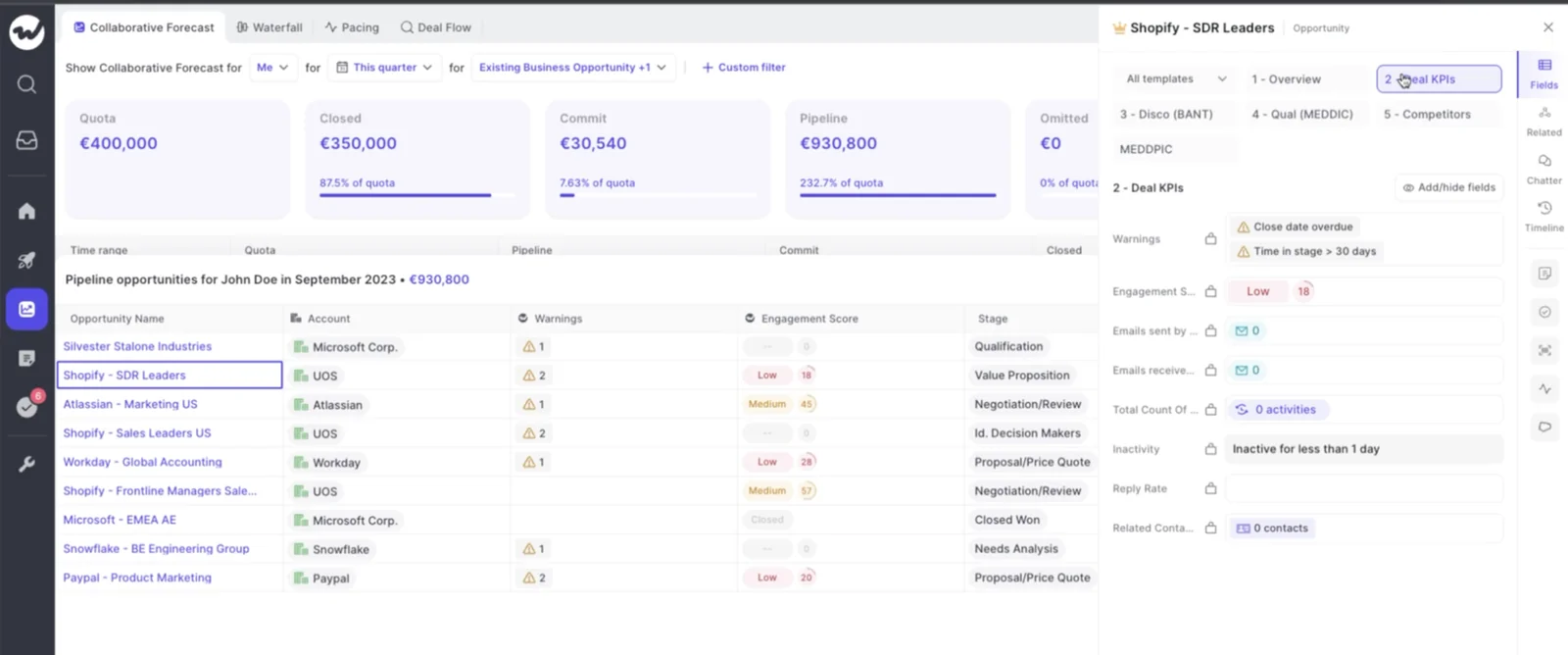
In Weflow's collaborative forecast, the opportunity sidebar lists a deal's warnings, such as an overdue close date and more than 30 days in stage, above its Engagement Score and activity fields.
What it takes to get deal scoring and warnings live
Gong sells the rollout of deal boards and forecasting as professional services projects that start once Gong Foundation is live. Weflow's customer success team runs the rollout at no extra cost, typically in 2 to 3 weeks.
Gong sells the rollout as a professional services project
Gong sells the rollout of Forecast Essentials, the package with deal boards and AI Deal Reviewer, as a fixed-scope project of up to 12 hours used within 45 days. Gong Forecast, which the deal score needs, comes as a project of up to 22 hours used within 60 days.
Both projects assume you already run Gong Foundation with a Salesforce, HubSpot or Dynamics integration in place. Unused hours expire, so you want your own people ready before the project starts.
Gong's projects also require you to staff these roles:
- A Gong administrator who owns all configuration.
- A project manager.
- Sales process leaders.
- Executive sponsors.
- System administrators.
Gong routes some smaller and mid-sized customers to third-party implementation partners instead, with a separate implementation fee on top of the licence.
Weflow's customer success team runs the rollout at no extra cost
Weflow runs onboarding itself, against a mutual action plan with named owners on both sides. Time to live is typically 2 to 3 weeks with implementation included, and the work runs in 3 phases:
- A technical setup of 30 to 45 minutes with a Salesforce admin and a mail admin.
- A configuration phase. Configuring the workspace takes about an hour, covering team structure, methodology, playbooks and deal warnings.
- A role-based rollout with training.
Internal alignment is what usually stretches a Weflow rollout. You need two admins from different teams in one call, and you need to decide which methodology to score against and which fields to write.
Forecasting takes longer than capture because you're encoding an operating cadence: who submits, how often, and against which quota. The deal score waits on your history: with about 6 months of closed deals, it trains within a few days.
How deal data gets from each tool into the rest of your stack
Gong reaches far more tools, while Weflow hands AI assistants and your warehouse more of the underlying data. Weflow's MCP connector returns transcripts and forecast calls, and its API exports scores.
Which tools Gong and Weflow connect to
Gong connects to far more tools than Weflow. Its marketplace, the Gong Collective, lists about 450 integrations and partner solutions across CRM, dialers, web conferencing, email and calendar, BI and data, enrichment, workflow automation and MCP servers.
Gong imports calls from about 30 dialers, records on 11 meeting platforms and integrates natively with Salesforce, HubSpot and Microsoft Dynamics 365. Its integrations are strong enough that some customers change their own infrastructure to fit Gong.
Weflow integrates natively with the tools your reps work in every day:
- Salesforce, the only CRM it works with
- Gmail, Google Calendar and Google Meet
- Outlook and Microsoft Teams
- Zoom and Slack
Weflow also pulls calls from the Outreach dialer and supports BI connectors such as Tableau and Looker. It works on customer-facing data mapped to Salesforce, so connecting systems such as finance or ERP is outside what it's built for.
What Claude and ChatGPT can read through each MCP connector
Weflow's MCP connector gives Claude and ChatGPT the conversations and forecast calls themselves, while Gong's MCP server gives them Gong's AI insights about one record at a time.
Gong's MCP server exposes 3 tools: ask_account, ask_deal and generate_brief, each working on one named record. The server is read-only and returns AI-generated insights only, never raw transcripts or message bodies.
Each call to Gong's MCP server draws metered credits, and connecting needs a paid Gong seat plus a paid tier of the AI tool.
Weflow's official MCP connector is read-only and returns playbooks, call summaries, transcripts and forecast calls, plus per-rep pipeline metrics capped at 25 owners. An admin switches it on per workspace, with a separate toggle for full transcripts.
The Weflow connector doesn't return captured email content or Salesforce field values. We recommend connecting it alongside Salesforce's own MCP server, so your assistant can read the fields too.
How you get raw scores, transcripts and signals out of each tool
Both tools have an API for raw data. The difference is warehouse delivery: Gong sells it as Data Cloud, while Weflow exports through its REST API with no native warehouse connector.
Gong's public API returns transcripts, participants, trackers and scorecards. The API is capped at 3 calls a second and 10,000 a day, so you have to schedule bulk syncs around those limits.
Gong's Data Cloud delivers Gong data to Snowflake, Databricks, BigQuery and Redshift as a separate purchase of about $5,000 a year.
Weflow's REST API bulk-exports transcripts, metadata, scores and signals as JSON or CSV, on a schedule or on demand. Recordings export to your own cloud storage.
Weflow has no native Snowflake, Databricks or BigQuery connector, so you move the data into your warehouse through the API. The data arrives already mapped to Salesforce accounts and opportunities.
What AI deal scoring really costs on Gong and on Weflow
Gong prices deal scoring as a Gong Forecast seat on top of a mandatory Foundation licence, quoted through a custom proposal. Weflow prices it as one Deal Intelligence & Forecasting seat with AI included.
Gong prices scoring as a Forecast seat on top of Foundation
Gong sells Gong Foundation as a mandatory core licence and sells applications such as Gong Forecast on top. Gong assigns seats per application rather than per person, so everyone who needs deal scores carries a Foundation seat and a Forecast seat.
Gong has no public prices, and every buyer gets a custom proposal. When you ask for a quote for scoring, check that it covers these line items:
- A Gong Foundation seat for each user.
- A Gong Forecast seat for each user who needs deal scores.
- A platform fee that scales with the number of users.
- A professional services project for the rollout.
- Data Cloud, if you want Gong data in your warehouse.
- Credits: each paid core seat adds 2,000 a year to a shared pool that the MCP server, API-based AI workflows and question-based AI Trackers draw on. Deal predictions consume none.
Weflow charges one per-seat price with AI included
Weflow Deal Intelligence & Forecasting costs $39 per user per month, billed annually. It's a standalone product with no core licence underneath.
AI comes in the seat: Ask Weflow AI Pro is included. Agent Builder, the only consumption-priced product, includes a free tier of 25 agent actions a month.
Weflow requires at least 10 users on a standard 12-month contract, and implementation is included. Across the platform, Weflow sits at about half the price of Gong.
How to move deal scoring from Gong to Weflow
Moving deal scoring from Gong to Weflow doesn't depend on Gong's data, because the Weflow score trains on the closed-deal history already in your Salesforce. Weflow also migrates your Gong call history at no charge.
The habit to plan for is Gong's deal board. Managers read it every day, and many teams run their forecast from it.
The reason why I stuck with Gong was like the bubbles. You sort of get like addicted to the bubbles. - Chris Nethercote, Head of Sales, Weflow
Move in this order:
- Check your Salesforce history first. With about 6 months of closed opportunities, the Weflow score trains within a few days, with no Gong data involved.
- Migrate your Gong call history at no charge. Weflow imports recordings through the Gong API or CSV, reprocesses them through Weflow AI, and restores each call's link to its Salesforce account.
- Adopt in data order: Weflow Activity & Contact Capture first, Weflow Conversation Intelligence second, Weflow Deal Intelligence & Forecasting third. Bad data in means a bad forecast out, because the forecast depends on the data the first two collect.
- Replace the board habit with Weflow's deal board. It shows last email, last meeting, next meeting and the full activity timeline on each deal, with AI prompting reps to follow up.
- Evaluate on your own data with a 14-day free trial with implementation included, an opt-out pilot, or a 3-month paid pilot. The paid pilot forms the first 3 months of a multi-year agreement with an opt-out at the end. It suits forecasting, which takes longer than 2 weeks to prove.
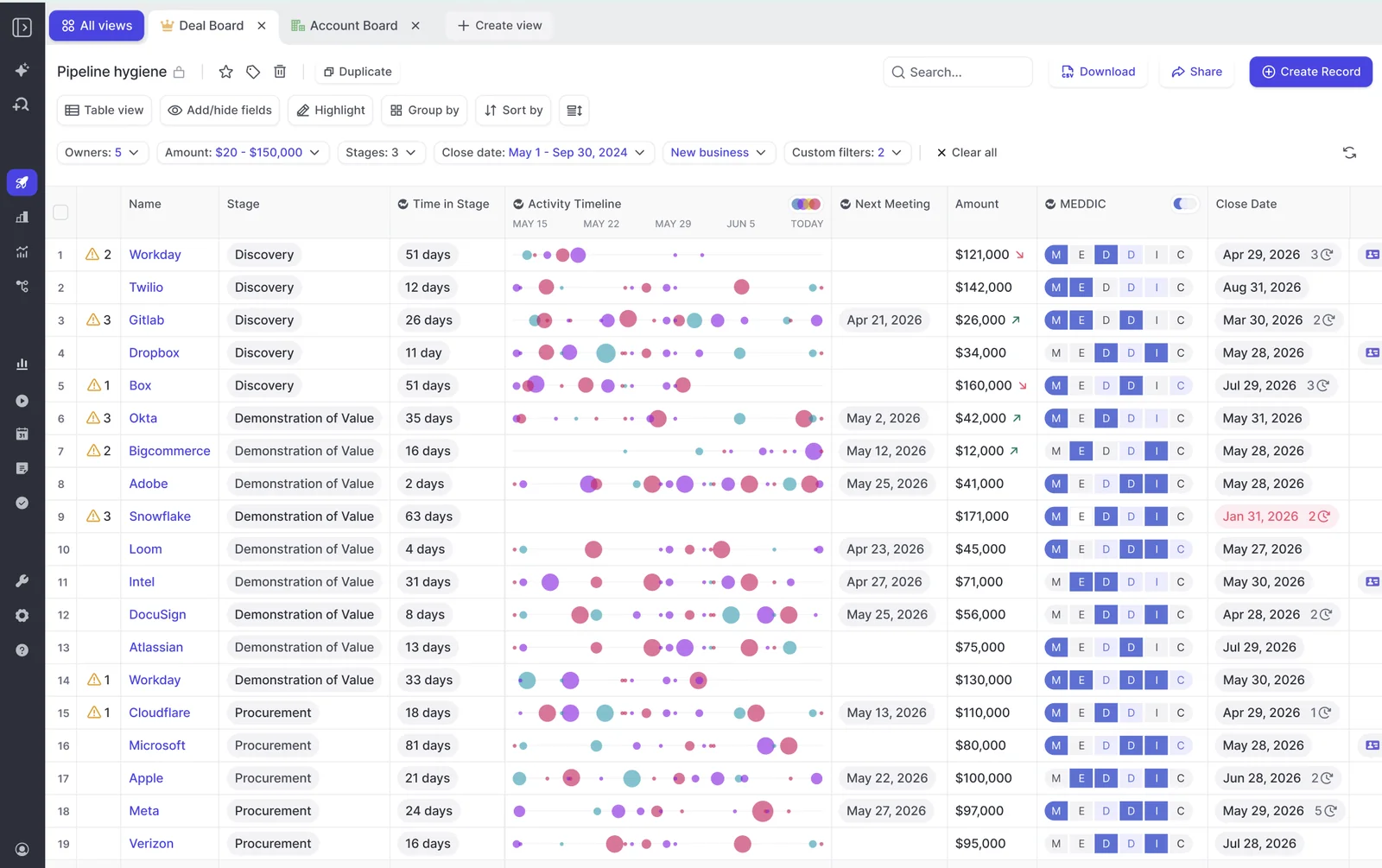
Weflow's deal board shows each deal's activity timeline bubbles beside its stage, time in stage, next meeting, amount, MEDDIC letter scores and close date, with overdue close dates flagged in red.
Which tool to choose for scoring your open deals
Choose Gong if you need call content inside the score, run a CRM other than Salesforce, or already feed Gong Forecast enough deals. Choose Weflow if you run Salesforce and want a likelihood score, your own warnings and a price you know up front.
Choose Gong if you need conversation signals in the score or a CRM other than Salesforce
Gong is the better fit if one of these describes your team:
- You run HubSpot or Microsoft Dynamics 365. Weflow works only with Salesforce, so it can't serve your team.
- You want conversation signals inside the score itself. Gong's 300+ signals draw on calls, meetings and emails.
- You already run Gong Forecast with at least 50 won and 150 lost deals from the last 2 years. Your Gong score is live, and predictions consume no credits.
- Your stack spans many dialers and tools. Gong has about 450 marketplace entries to connect them.
Choose Weflow if you run Salesforce and want a likelihood score with your own warnings
Weflow is the better fit if you run Salesforce and one of these describes your team:
- You want each opportunity scored 0 to 100 on its likelihood to close won, with the drivers shown.
- You're below Gong's 150-lost-deal floor or don't have a Gong Forecast seat, and you have about 6 months of closed history.
- Your deals slip in ways a fixed list doesn't name. Weflow warnings are rules you write on your own and computed fields.
- You want a price up front: $39 per user per month, billed annually, AI included, from 10 users.
- You want transcripts and forecast calls in Claude or ChatGPT, and scores in your warehouse through the API.
Walk through the product yourself, no call required.
Weflow vs Gong for AI deal scoring: frequently asked questions
Does Weflow's deal score read call content?
No. Weflow's deal score is built from your deal history: time in each stage, number of activities and communication cadence. Call content reaches Weflow through AI Playbooks, which read the whole record including recordings, and through the deal-level AI summary. If you want call content inside the score itself, that's Gong's AI Deal Predictor.
What if we have under 6 months of history or fewer than 150 lost deals?
Under about 6 months of closed history, Weflow has no score yet. Under 150 closed-lost deals in 2 years, Gong has none. Weflow's warnings, days in stage and push count work from day one, so you can run deal reviews on them while the history builds.
Can reps see the score and the warnings?
Reps see Weflow's warnings and computed fields on the Salesforce views and deal boards they already work in, and in the forecast submission screen where they choose what to commit. Gong shows its scores on the Forecast page, deal boards, deal pages and pipeline views.
Can Weflow warnings go into a Salesforce dashboard?
Not directly. Weflow deal warnings and AI Playbook scores are Weflow fields, so you can't report on them in Salesforce or pull them into a BI tool. The workaround is an agent that writes the assessment into a Salesforce field you create. Weflow marks its own fields with a W, so you can tell at a glance what will and won't reach a report.
Can we keep Gong for recording?
Weflow's deal score doesn't need your recordings: Weflow Deal Intelligence & Forecasting is sold as a standalone product, and its score trains on your Salesforce opportunity history. AI Playbooks and the deal summary read the meetings and recordings Weflow holds. If you later move recording over, Weflow migrates the Gong call history at no charge.
Does Weflow work with HubSpot?
No. Weflow works only with Salesforce. Gong integrates natively with Salesforce, HubSpot and Microsoft Dynamics 365.