
How the Weflow Engagement Score Is Built, and Why "Trained on Your Data" Isn't the Point
Learn how Weflow builds its Engagement Score—and why Clari/Gong-style training on your data falls short.


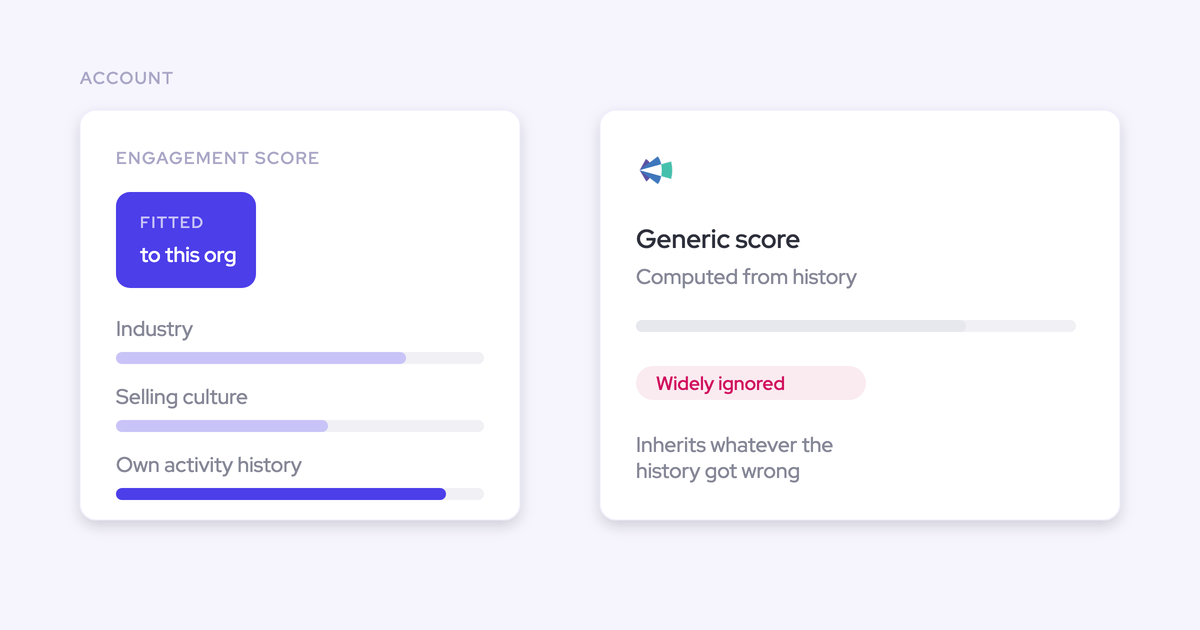

Your deal score was confidently wrong once, in front of your team, and you've quietly ignored it ever since. That's the normal life cycle of a deal score. It shows up on the board, it disagrees with something you know for a fact, and from that Tuesday on nobody in the room looks at the number again.
The math isn't the problem. The problem is what the model learned from: your own CRM history, which is missing most of the activity, carries stages that moved for reporting reasons, and has methodology fields somebody filled in to clear a validation rule. Train on that and you get a confident number built on gaps.
So this piece is about what a score has to be built from to survive a deal review: captured activity instead of typed fields, fitted to how your company actually sells, and sitting next to evidence you can click into.
Weflow is the Revenue AI Orchestration platform for sales, customer success, and RevOps teams, and the Weflow Engagement Score is one output of Deal Intelligence & Forecasting. Here's how it's derived, and where it stops.
Why the deal score in your pipeline gets ignored
The sequence is always the same. The number says a deal is healthy that you know went dark in August. Or it flags a deal at risk that closed two weeks later. Somebody says out loud that the score doesn't know anything, and the room agrees, and after that it's a column nobody sorts by.
The triggers are boring and consistent:
- A dead deal and a live deal carry the same number, so the score can't gate anything in the review.
- There's no way to open the number and see what drove it, so nobody can argue with it or correct it.
- Reps can move the inputs. Change the stage, fill the field, and the score follows.
What replaces it is the thing you were already doing. You rebuild the deal picture by hand before the review: one report for time in stage, another for last activity, and the rep's account of everything else. It takes about an hour a week per team, and it still ends with you taking their word for it.
The spend is made, the score renders on screen, and the behavior never changed. Which is worse than having no score, because it occupies the space where a usable signal would sit.
Why "trained on your own data" doesn't fix the score
Clari and Gong both genuinely train on your own history. That's the trap, not the fix.
Gong calculates its deal likelihood score from more than 300 signals with a machine-learning model trained on your closed deal outcomes, reading CRM data, calls, meetings, emails, and its own conversation signals.
Clari's opportunity score is computed from historical performance the same way. Neither is a generic industry model, and neither vendor is bluffing about it.
Credit where it belongs: Gong invented conversation intelligence and still has the deepest conversation analytics in the category. Clari's roll-up mechanics at real enterprise scale are more mature than most of what's on the market.
The issue sits underneath the model. A score trained on your history inherits whatever is wrong with that history, and in most Salesforce orgs a lot is wrong with it.
| What the model reads as history | What was actually true on the deal |
| Stage 4, advanced last Tuesday | Advanced so it would show up in the quarter's roll-up |
| Two contacts on the opportunity | One of them replied to an email once, in August |
| MEDDIC fields complete | The metrics field says the customer has 50,000 staff |
| Close date inside the quarter | Pushed three times, with no record of why |
| Eleven activities logged | Most of the emails and meetings never reached Salesforce |
That last row is the one that decides everything. Teams switching to Weflow capture 30 to 35% more emails and meetings than they were capturing before.
So the model isn't lying. It's answering accurately from a record that describes a different deal than the one you ran.
This is the argument we end up having in most evaluations, and it's why feature grids don't settle them. Feature parity is not data-quality parity. Two products can ship the same-looking score and produce different numbers, because one is reading a fuller record than the other.
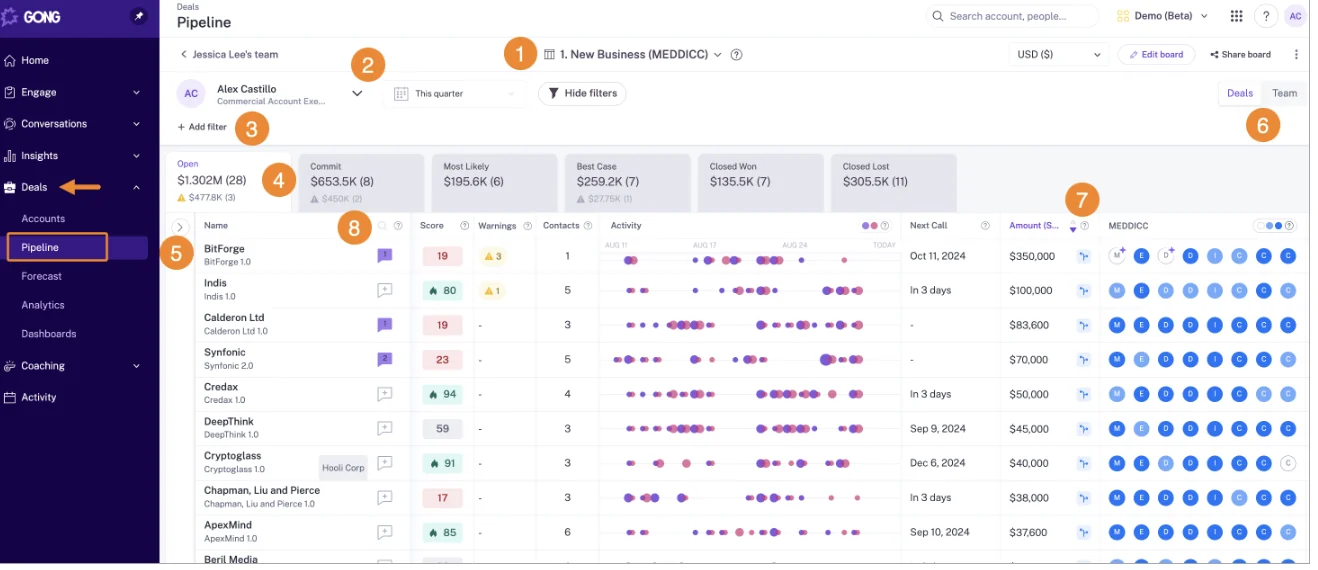
Gong's pipeline board: each deal row carries a numeric score, a warnings count, and MEDDICC chips shaded by completeness.
What the Weflow Engagement Score is built from
The Weflow Engagement Score is a 0 to 100 score calculated per account by a model fitted to your industry and selling culture, and it reads the captured record of the deal rather than the fields a rep filled in. Higher score, higher closed/won likelihood. Same meaning in every view you sort by.
Two properties do the work, and both of them are about inputs rather than math.
Captured activity and conversations, not what the rep typed
The score reads what happened on the deal. Emails sent and received, meetings held, who's replying and how quickly, how the buying committee is behaving, and how the deal is moving through your stages.
Concretely, the inputs it sits on include:
- Emails sent and received on the opportunity, plus reply rate and time to reply
- Meetings held, last meeting, next meeting booked or not
- Days inactive, and a rolling four-week activity timeline
- Per-contact engagement, so multi-threading is measured from who actually engages rather than how many contact roles exist
- Time in stage and total close-date push count, both tracked automatically without anyone building custom fields
None of that is typed. A rep can't lift the score by updating a picklist, because the picklist isn't an input. They can lift it by getting a reply from a second stakeholder, which is the behavior you wanted anyway.
"The fundamental question people have to ask is, when you look at a deal, can you tell whether it actually is healthy or it's derailed?"
Janis Zech, CEO and Co-founder of Weflow
Fitted per account to your industry and selling culture
The score is calculated per account by a model customized to how your company sells, not by a benchmark borrowed from someone else's sales cycle. A 14-day silence means something different in a 60-day cycle than in a 12-month one, and the fitting is what stops the score from flagging your whole pipeline.
Here's the honest part. Fitting to your business is table stakes now. Everyone does it, and on its own it doesn't produce a score you'd trust.
We learned that the expensive way. Weflow shipped a prediction forecast before we had automated the Salesforce data capture underneath it, and the predictions weren't accurate enough to be worth reading. The model was fine. The record it read wasn't complete.
That's why capture came first and the scoring layer came after, and it's the reason we're skeptical when a vendor's answer to "why is your score better" is a bigger signal count.
How you click from the score into the evidence
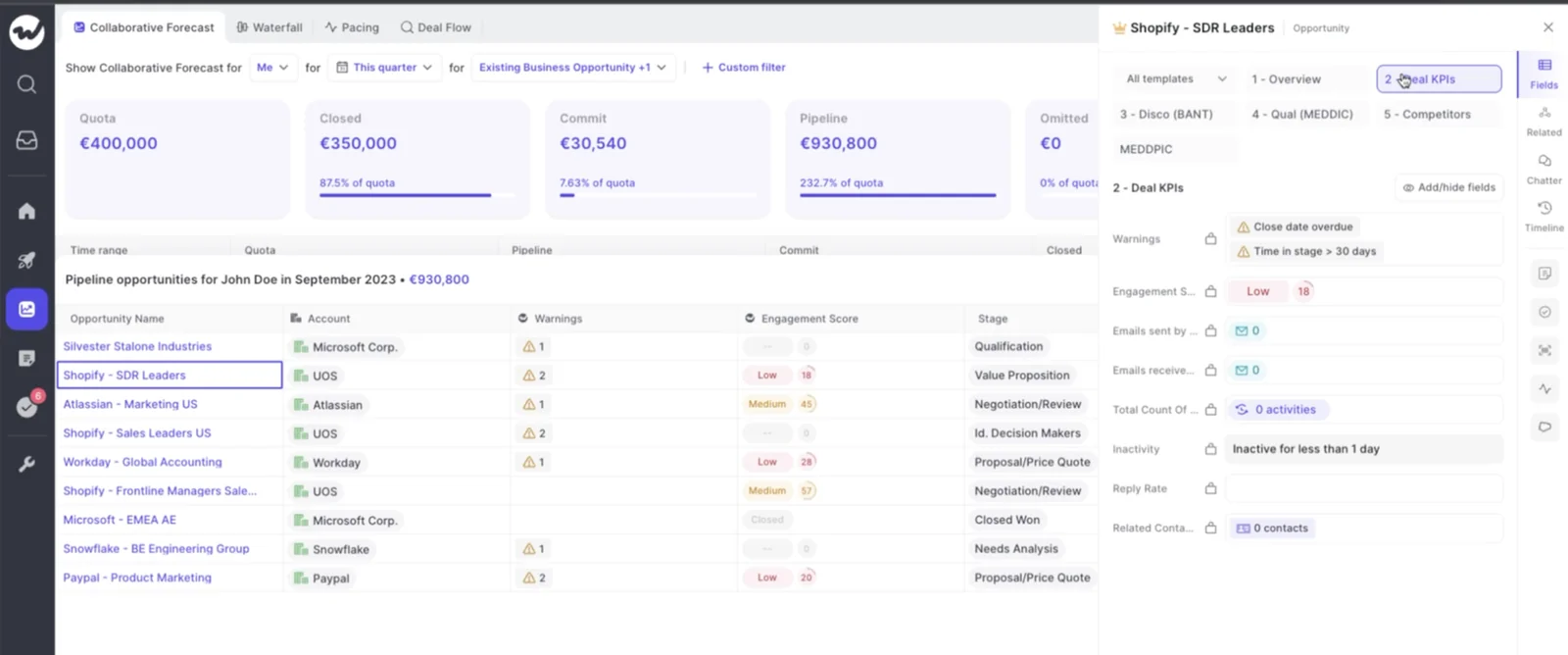
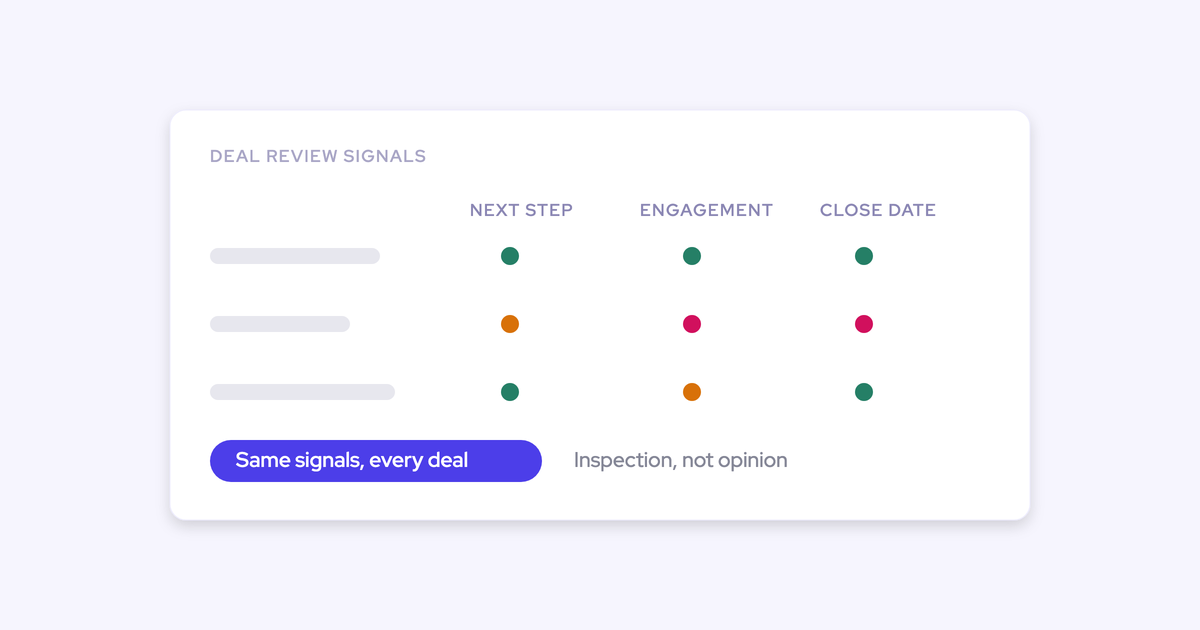
The Weflow Engagement Score is one of 50+ deal signals, and it sits next to the evidence that produced it, so a disagreement becomes an investigation instead of a funeral.
When the number says 18 and you think the deal is fine, you open the panel and read what's next to it:
- The rolling activity timeline: sent mail, received mail, meetings and tasks against the opportunity, week by week
- Days inactive, last meeting and next meeting
- Time in stage, and how many times the close date has been pushed
- Every person involved in the deal, with the depth and recency of contact with each of them
- A deal-level AI summary that reasons across every meeting on the opportunity, not just the last call
And the timeline is clickable through to the messages themselves. You can go from the score to the actual email thread that stopped in August, in the same screen, while the rep is still on the call.
That's the split worth understanding. A per-call summary is genuinely useful and it only ever sees one conversation, so a deal can look qualified on the last call and be hollow overall. The score has to be read against the whole opportunity.
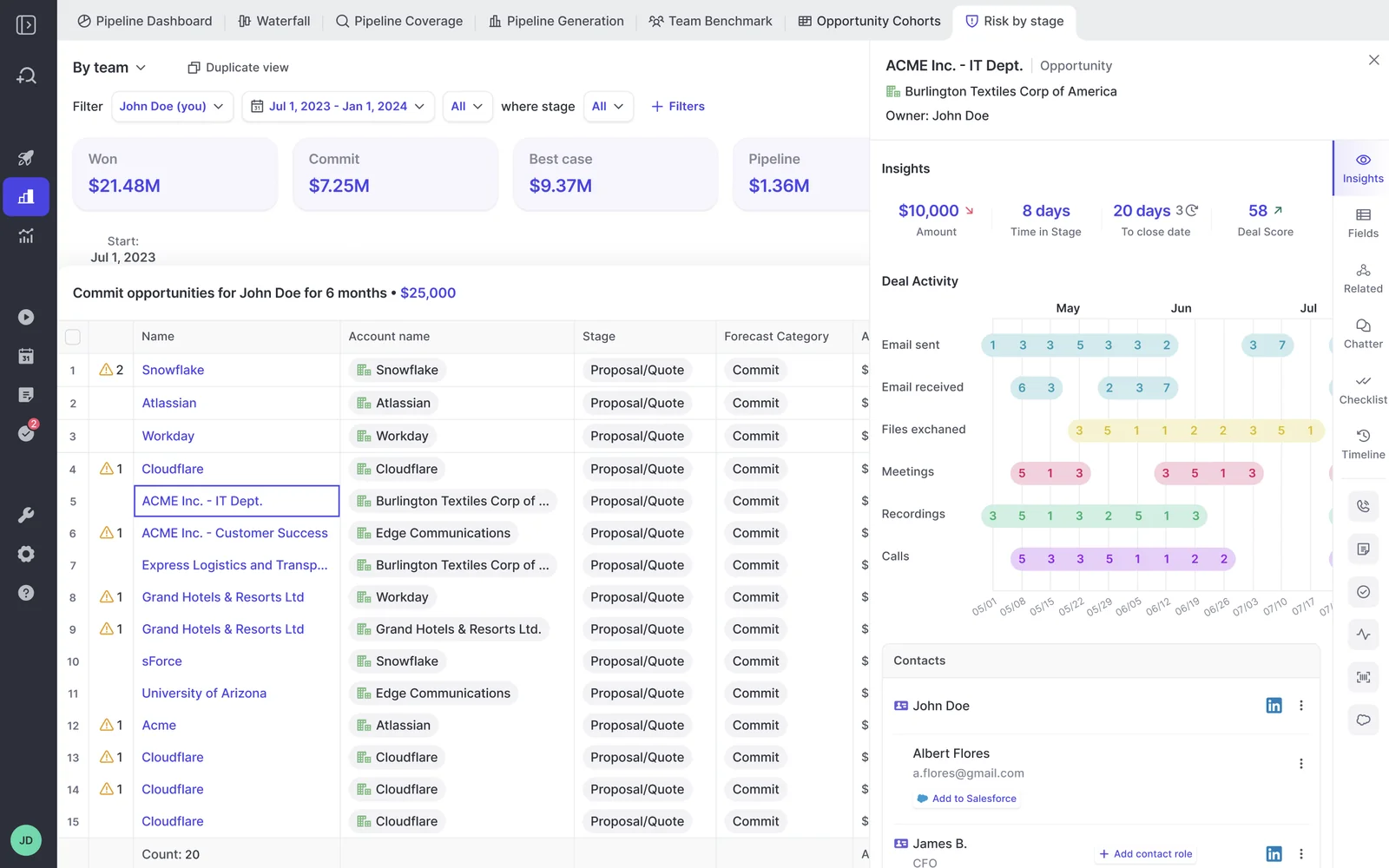
Running the deal review sorted by engagement score
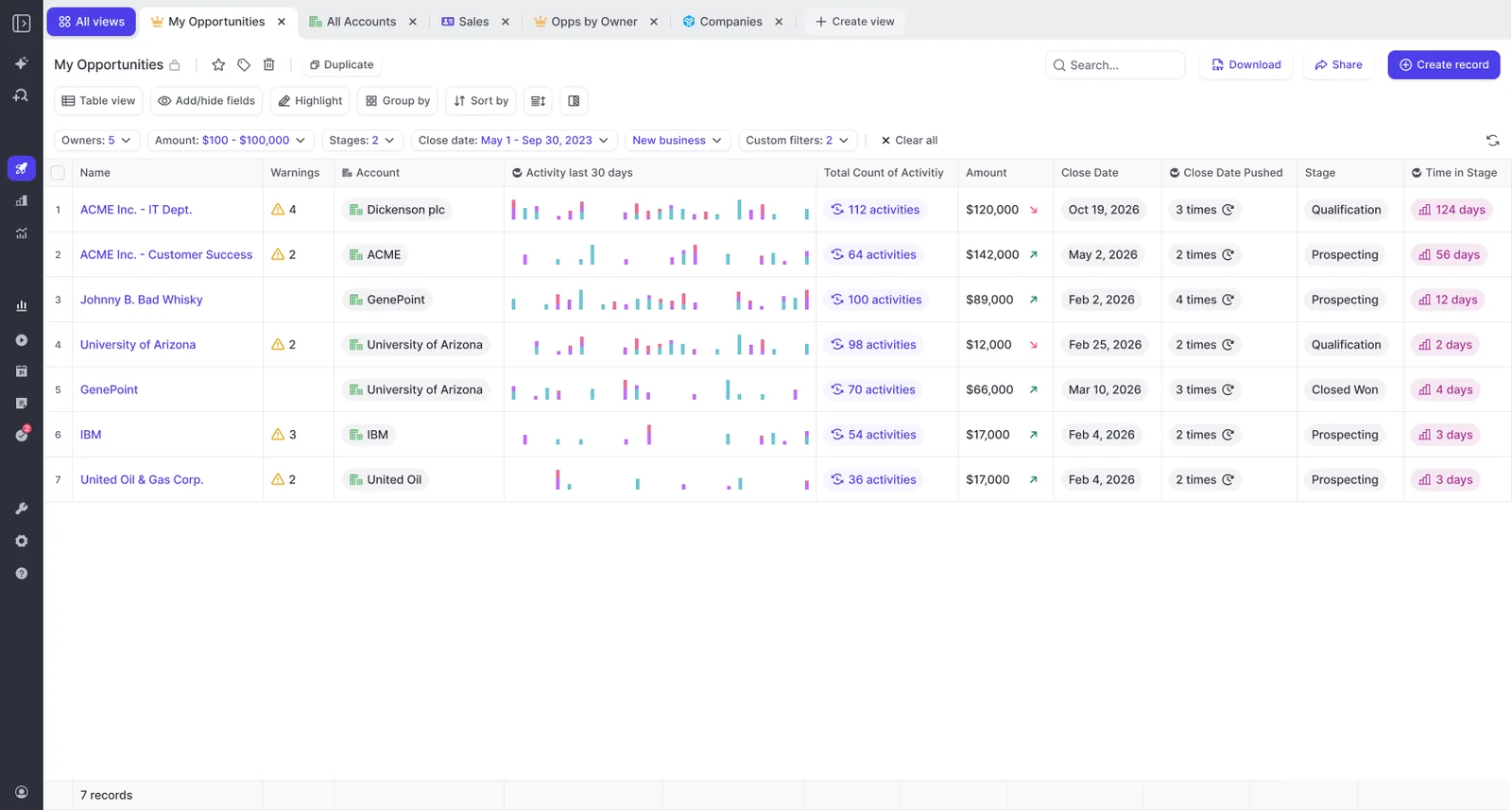
The score drops onto any Kanban or table view, which means you can sort a rep's entire pipeline by it and start the review at the bottom.
What that looks like on a Tuesday morning:
- Open the rep's pipeline as a table and sort by engagement score, ascending.
- Take the five lowest-scoring deals that are still in the current quarter.
- Open the panel on each one and read days inactive, reply rate, who's actually replying, time in stage and push count.
- Click into the last thread. See what was said, and when it stopped.
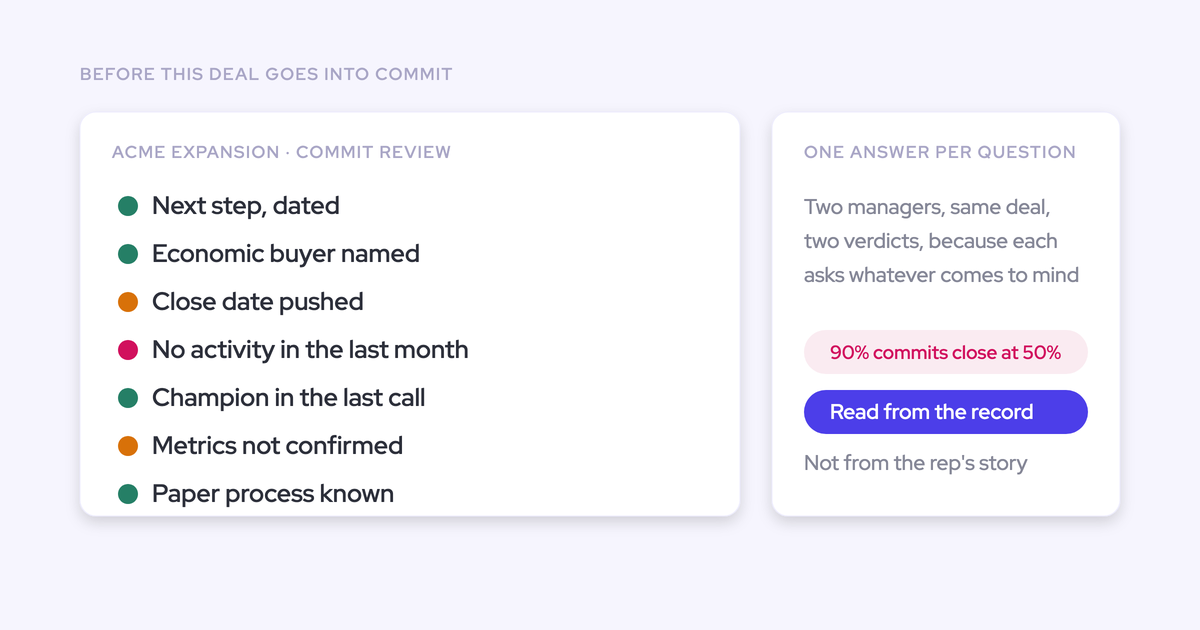
- Ask the question the evidence raises, not "what's the status." Why is this in commit when nobody has replied since January?
- Decide in the room: work it, multi-thread it, or close it lost and take it out of the number.
The change is in the first ten minutes of the meeting. You stop spending them reconciling whether the deals on the screen are real, because the record wasn't assembled by the person you're reviewing.
That's also what makes it coachable rather than adversarial. The score and the timeline are a third party in the conversation, so naming a weak deal stops being a confession.
What the Weflow Engagement Score won't tell you
Two limits, and both of them are the kind you'd rather hear now than find in a trial.
A busy contact is not a proven champion
Engagement data proves somebody is responding. It does not prove somebody is fighting for you internally, and those are different deals.
Weflow shows the engagement facts and doesn't pretend to score the relationship. Who's replying, how often, how recently, who has gone quiet, whether anyone with budget authority has ever been in the room.
The champion question stays yours to ask out loud in the review: will this person take your call, and will they get you to the economic buyer? The score tells you which deals to ask it about.
Getting the score into Salesforce dashboards needs a build step
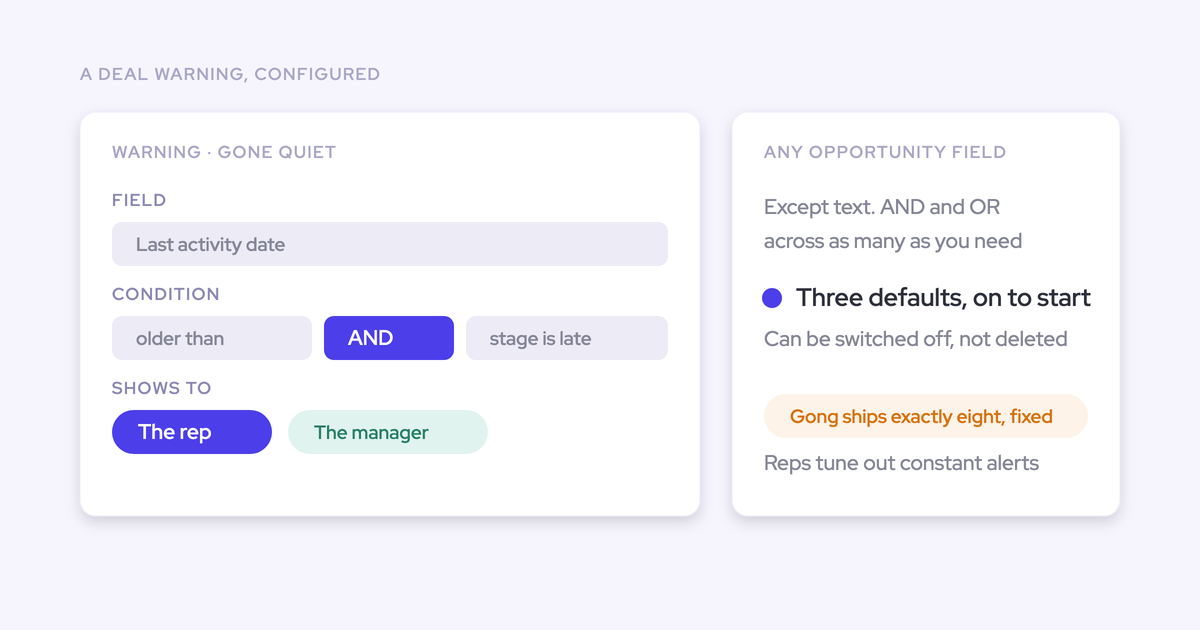
The engagement score and deal warnings live in Weflow fields, marked with a W in the interface, so they don't land in a Salesforce report or a Power BI board deck on their own.
The way around it works: an agent writes the assessment into a Salesforce field you create, and from there it reports like any other field. But that's a build step, not something you get on day one. If your executive reporting runs out of Salesforce dashboards, plan for it in the rollout rather than discovering it the week before a board meeting.
What changed for HolidayCheck once signals came from captured data
HolidayCheck chose Weflow over Gong and runs automatic activity capture, conversation intelligence, pipeline visibility and automated Salesforce field updates together. So the signals on their board are computed from the captured record rather than from what reps remembered to log.
"The visibility alone changed behavior. Reps come into meetings already aware of what's overdue or inactive. They're more proactive now, because they can actually see what needs attention."
Bastian Stosic, Head of Media Sales Operations at HolidayCheck
What followed showed up in the pipeline itself:
- Past-due opportunities down roughly 75%
- Inactive opportunities down more than 60%
Read that against the failure this article opened with. A signal nobody trusts gets ignored and nothing moves. A signal backed by evidence people can open gets read, and reps start clearing the deals before anyone asks.
FAQ: score accuracy, data requirements, and switching from Clari or Gong
Can a rep inflate the Weflow Engagement Score?
Not by editing Salesforce. The Weflow Engagement Score is computed from captured activity and conversation data rather than from typed fields, so changing a stage, a close date, or a methodology field doesn't move it.
What a rep can influence is the real behavior underneath: sending more emails, booking the next meeting, bringing a second stakeholder into the thread. Some of that is genuine progress and some of it is noise, which is why the score also reads what the buyer does. Received mail, reply rate and time to reply are on the buyer's side of the conversation, and no rep controls those.
What should I do when the score disagrees with what I know?
Open it before you dismiss it. The score sits next to the activity timeline, days inactive, push count and time in stage, and the timeline clicks through to the actual emails and meetings.
You'll land in one of two places. Either the evidence shows something you didn't know, usually silence or single-threading, or you're holding context the record can't see, like a conversation that happened at a conference. Both are the review agenda. Neither is a reason to stop reading the number.
How much history does the score need before it's useful?
The fitted score improves as resolved deals accumulate, because it's calibrated per account to your industry and selling culture. That's a real dependency and we won't pretend otherwise.
The raw signals don't wait for it. Days inactive, reply rate, push count, time in stage and multi-threading are readable from the first week of capture, and they're what a deal review actually runs on. Weflow also backfills up to 24 months of activity history as standard, and up to three years as a custom import, so the record doesn't start empty on day one.
Where does the engagement score show up during pipeline reviews?
On any Kanban or table view, as a column you can sort and filter by, and in the opportunity sidebar next to the other deal signals. It's in the screen the review already runs in, alongside warnings, engagement fields and the activity timeline, rather than in a separate analytics tab someone has to remember to open.
Which Weflow plan includes the engagement score, and what does it cost?
Deal Intelligence & Forecasting is $39 per user per month, billed annually, and includes the deal signals, scoring, configurable warnings, pipeline analytics and the forecasting layer.
One packaging note worth knowing before you buy: Revenue AI Business ($59 per user per month) includes Deal Intelligence without pipeline analytics and forecasting, so you get the table and Kanban views, AI deal and account scoring, warnings and buying committee intelligence. Revenue AI Enterprise ($79 per user per month) adds the full forecasting and analytics layer. Pricing is billed annually with a 10-user minimum, and there are no usage-based charges on top.
Can we switch from Clari or Gong and keep our history?
Yes, and the inputs to the score are the reason it matters. Weflow imports existing recordings from Gong, Chorus, Jiminny and others using an API key from your current provider, then re-links them to the right Salesforce account, opportunity or contact. Where the provider's API doesn't carry the Salesforce association, we run our own lookup matching.
A Gong migration typically takes about a week for recordings, metadata and transcripts, with transcripts reused where possible and retranscribed where not. Combined with the activity backfill, the score isn't starting from an empty record on the day you switch.
The one thing worth checking against your own stack: Weflow matches Clari on pacing and waterfall pipeline analytics but doesn't have a pipeline flow view. If your team lives in that view, factor it in.
If you've read this far, you're not going to take a vendor's word for any of it, and you shouldn't. Walk through the product yourself, and see whether the score really does click through to the evidence behind it.



.webp)