Best Revenue Intelligence Platforms (2026)
Compare the best revenue intelligence platforms in 2026: Weflow, Gong, Clari, People.ai, Aviso, Avoma.


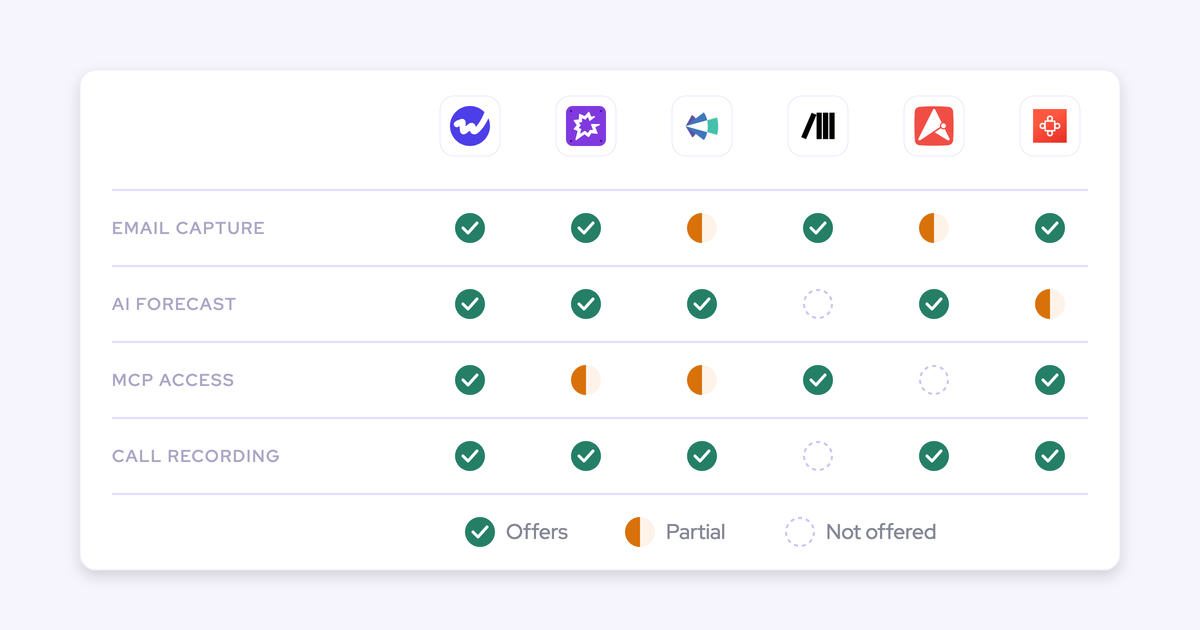

When you compare revenue intelligence platforms, start with five jobs: automatic email capture, meeting recording, deal risk warnings, an AI forecast number, and forecast submissions with roll-ups.
After that, look at whether you can get your data out and whether the price is public.
Weflow is the only tool in our grid that fully covers all five jobs. Every other tool is partial or missing on at least one, but each of them leads in its own area:
- Gong on conversation analytics and coaching depth.
- Clari (with Salesloft) on mature roll-ups at 1,000+ reps.
- Backstory (People.ai) on automatic capture and MCP answers, without recording calls.
- Aviso on AI-forecast-led consolidation across several CRMs.
- Avoma on low published prices for small, meeting-first teams.
Because these tools now use the same feature names, every cell in this roundup also explains how the tool gets its data.
That matters: a capture feature that waits for each rep to connect their mailbox behaves very differently from one an admin switches on once for the whole company.
A quick disclosure: we're Weflow, a Revenue AI Orchestration platform built for Salesforce teams, and we publish this roundup. We've named our own gaps in Weflow's entry the same way we name everyone else's.
How Weflow, Gong, Clari, Backstory, Aviso and Avoma compare
Here's how all six tools stack up on the nine capabilities that matter most in a revenue intelligence purchase.
| Capability | Weflow | Gong | Clari (with Salesloft) | Backstory (People.ai) | Aviso | Avoma |
|---|---|---|---|---|---|---|
| Automatic email capture | Offers. Server-side app in Google Workspace or Microsoft 365; no rep action; logs mail that matches a Salesforce record | Offers. Server-side import keeps only CRM-matched mail; Salesforce export runs forward from the day it's enabled | Partial. Logs emails reps send as Lofted; mailbox capture needs per-user opt-in | Offers. Server-side from Workspace or Microsoft 365, granted once by an admin | Partial. Bcc'd or routed shared mailbox; only cleanly mapped mail is written back | Offers. Background sync for Revenue Intelligence seats, org-wide Google connection or each member's inbox |
| Recording video meetings | Offers. Notetaker auto-scheduled on every external Zoom, Teams, Meet and Webex call; desktop app records without a bot | Offers. Bot on Zoom, Meet, Teams, Webex and seven more; Outlook and Teams need a per-invite step | Offers. Zoom, Teams, Meet, Webex; skips calls under two minutes; Copilot's Zoom bot records only while the organizer is present | Not offered. Pulls transcripts that Zoom, Teams, Meet, Webex and Gong already hold | Offers. Imports native Zoom, Teams and Webex recordings; Notetaker bot covers Meet | Offers. Bot on Zoom, Meet, Teams and four more; bot-free cloud imports on Teams, Meet and Zoom |
| Deal risk warnings | Offers. Customer-defined rules on opportunity fields and computed fields such as close-date pushes and inactivity | Partial. Eight fixed Gong-defined warnings; you toggle them and set timing | Offers. Deal Gaps admins build on any deal field | Partial. AI summaries, Forecast Headlines and out-of-the-box Signals; not yet configurable | Offers. Nudges on stalled stages, falling WinScore, single-threaded deals; teams add their own | Offers. AI risk score per deal with written factors, plus keyword alerts |
| AI forecast prediction | Offers. Low, middle and high range from up to two years of imported history; first range in 48 to 72 hours | Offers. Projection from won deals and stage-weighted pipeline; needs 400 opportunities with 150 won | Offers. Current-quarter new business only, switched on per team; teams report 12 to 18 months before it's useful | Not offered. Forecast values come straight from Salesforce opportunities | Offers. Own AI forecast beside the team's call, built from explained WinScores | Partial. Described as AI-driven, but no model-predicted number; weighted amounts "coming soon" |
| Forecast submissions and roll-ups | Offers. Calls tied to selected deals, every version kept; submissions live in Weflow, not Salesforce fields | Offers. Number per category with notes; no deal-by-deal submission | Offers. Mature roll-up with inline editing; bound to the Salesforce hierarchy; a call is a number with notes | Offers. Forecast types side by side, manager adjustments on team roll-ups; launched October 2025 | Offers. Commit, best case and most likely on its own hierarchies, across several CRMs | Offers. Amount plus included deals per pipeline and period; one forecast configuration per organization |
| Integrations with other tools | Partial. Salesforce, Google, Microsoft, Zoom, Slack, Outreach dialer; no native warehouse connector | Offers. About 450 marketplace integrations, about thirty dialers | Offers. Salesloft data layer syncs Salesforce, Dynamics, Snowflake, Databricks and more | Offers. Email, calendar, five meeting platforms, Slack, Sales Navigator, Transcript API | Offers. Claims more than 200 connections | Offers. 26 native integrations plus Zapier |
| Access from AI assistants (MCP) | Offers. Read-only connector returns transcripts, playbooks and forecast calls; included in the seat | Partial. Three record-scoped tools; insights only, no transcripts; credit-metered | Partial. Three narrow servers; Forecast server has no deal-level data | Offers. MCP server for Claude, ChatGPT, Copilot, Gemini and n8n | Not offered. MCP runs only inside its own Agent Studio | Offers. Connector reads meetings and transcripts; needs Organization plan or an add-on |
| Raw data access outside the tool | Offers. REST API on every plan; bulk export of transcripts, scores and signals | Offers. API returns transcripts; warehouse delivery is a separate Data Cloud purchase | Offers. Forecast history CSV export; data layer sync to Snowflake and Databricks | Offers. API delivers data and analytics; export and delete activity | Partial. No public API; spreadsheet and file exports only | Partial. REST API and webhooks from the Organization plan up |
| Pricing | Offers. Published per seat, AI included in the seat | Partial. Model published, no prices; mandatory Foundation licence | Partial. No published seat prices; Talk to Sales page | Partial. Model published, no figures | Partial. Quote-only licences; agents priced per outcome | Offers. Published per recorder seat; add-ons priced separately |
Across the first five rows, Weflow's is the only column with no partial or missing cell. It isn't a clean sweep, though.
We're marked partial on integrations because we have no native Snowflake, Databricks or BigQuery connector and route warehouses through the API instead, so every other tool here scores higher than we do on that row.
Why every revenue intelligence tool looks alike on a feature grid
Every tool on this list started with one core job and grew outward until the feature names matched, partly through acquisitions like the Clari and Salesloft merger in December 2025. What didn't converge is where each tool keeps the intelligence it produces.
"all these tools converging on the same feature set"
— A RevOps buyer on a call with us
So in a demo, the most useful questions are about origin: what was this tool built to do first, and where does its data live today?
| Tool | What it started as | Where its intelligence lives | What that means underneath |
|---|---|---|---|
| Weflow | A better interface for entering Salesforce data, rebuilt to capture automatically once reps still didn't log | Activity, transcripts, summaries and AI field updates land in your Salesforce; forecast submissions and warnings stay in Weflow | Your reports, flows and AI read the same records Weflow writes |
| Gong | Call recording and analysis | Gong's own structure; export to Salesforce is CRM-matched, forward-only, and leaves out transcripts | Salesforce and Gong can hold two versions of the deal |
| Clari (with Salesloft) | The forecast roll-up | Forecast reads Salesforce; Copilot call data sits in a separate product | Call data doesn't feed the forecast |
| Backstory (People.ai) | Activity capture | Activity written to Salesforce; answers delivered in its app and over MCP | Strong on who's engaged, no recordings of its own |
| Aviso | AI forecasting | A copy of the CRM in Aviso; mapped activity partly written back | BI tools and Salesforce reports see only what Aviso writes back |
| Avoma | The meeting: record, transcribe, summarize | Avoma, with notes and events written to the CRM | CRM depth was added after the call layer |
Keep in mind that buying two products from one vendor doesn't mean they share data. When a vendor built its suite through acquisitions, the forecast and the conversation tool often don't connect, and you end up stitching them together in a BI tool.
To test this, ask which object each product writes to, and whether one can filter on a field the other produced.
Pricing follows the same pattern. Much of the category set its prices back when transcription was expensive. That cost has since collapsed, yet AI usage is increasingly metered on top of the seat.
The nine capabilities we scored, and what to ask vendors
For each capability below, we've added the one question that shows how a tool actually does the job. Feel free to copy the table into your evaluation doc.
| Capability | What it means in plain language | The question that exposes the mechanism |
|---|---|---|
| Automatic email capture | Sent and received email reaches Salesforce without the rep doing anything | Does anything depend on a rep installing or connecting something? |
| Recording video meetings | Zoom, Teams and Meet calls get recorded | Who schedules the recorder: the calendar, or the rep on every invite? |
| Deal risk warnings | Flags for slipping dates, silence, single-threading, stalls | Can I define my own warning, or only toggle yours? |
| AI forecast prediction | A model's number beside the team's call | How much history does the AI number need, and when is it usable? |
| Forecast submissions and roll-ups | Reps and managers submit calls that roll up the hierarchy | Can I open a submitted call and see the deals behind it? |
| Integrations with other tools | Dialers, sequencers, calendars, BI and meeting platforms | Does the integration write to one activity, or create a second meeting record? |
| Access from AI assistants (MCP) | Claude or ChatGPT can query the tool's data | Does your MCP return transcripts or only your summaries, and is it metered? |
| Raw data access outside the tool | API, export or warehouse delivery | Is API access on my plan, or a separate purchase? |
| Pricing | Whether prices are public | What does it cost at my seat count, and is AI in the seat? |
How each revenue intelligence platform gets its data, tool by tool
Every entry follows the same order: what the tool is, quick specs, how it handles each capability, where it's strong, where it stops, and who it suits.
Weflow: Capture, conversation intelligence and forecasting in your own Salesforce
What it is: One platform of modular products that captures activity, records conversations, and runs deal intelligence and forecasting, with the results written into your Salesforce.
Quick specs: Works only with Salesforce. Capture installs once as a central app in Microsoft Entra or Google Workspace, and technical setup takes 30 to 45 minutes with your Salesforce and Google or Microsoft admins.
| Capability | How Weflow does it |
|---|---|
| Automatic email capture | Weflow Activity & Contact Capture runs server-side at the mail tenant, so it logs email and meetings from any device with no rep action. It logs only activity it can match to a Salesforce record. Personal accounts and mail from a separate deliverability subdomain aren't captured. |
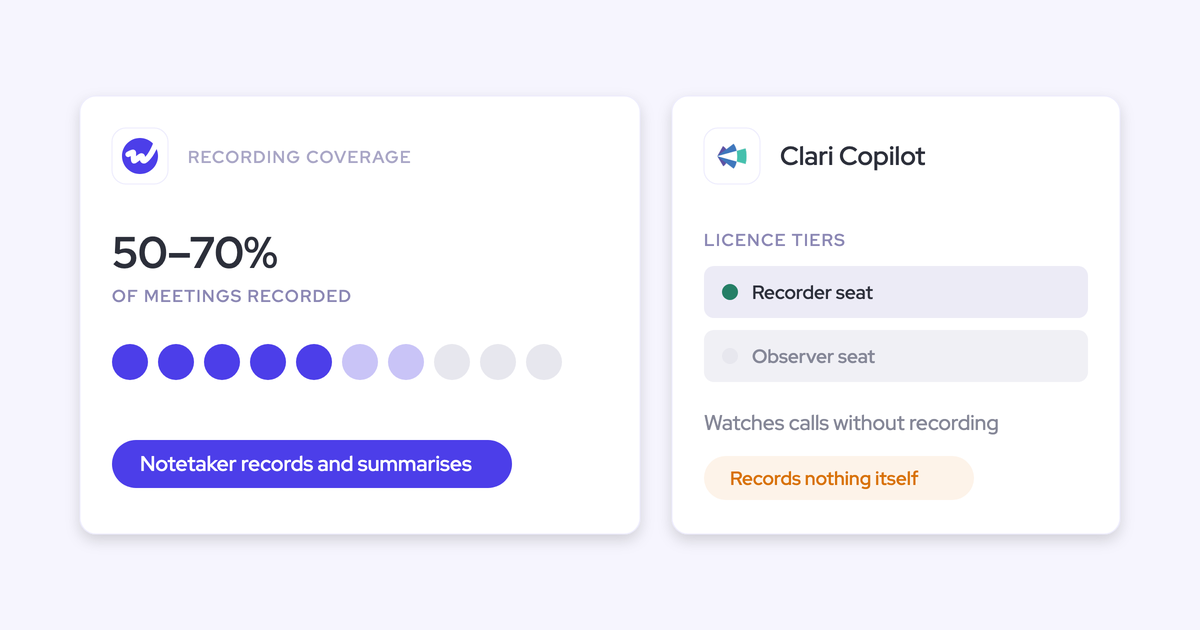
| Recording video meetings | Weflow Conversation Intelligence schedules its notetaker onto every external meeting from the calendar, on Zoom, Microsoft Teams, Google Meet and Webex. The bot gets admitted from the lobby, and Zoom needs local recording enabled. The desktop app records without a bot in the meeting. |
| Deal risk warnings | You build warnings with AND/OR rules on any opportunity field except long and rich text, or on computed fields such as days in stage, close-date pushes and inactivity. Warnings are Weflow fields, so they don't appear in Salesforce reports. |
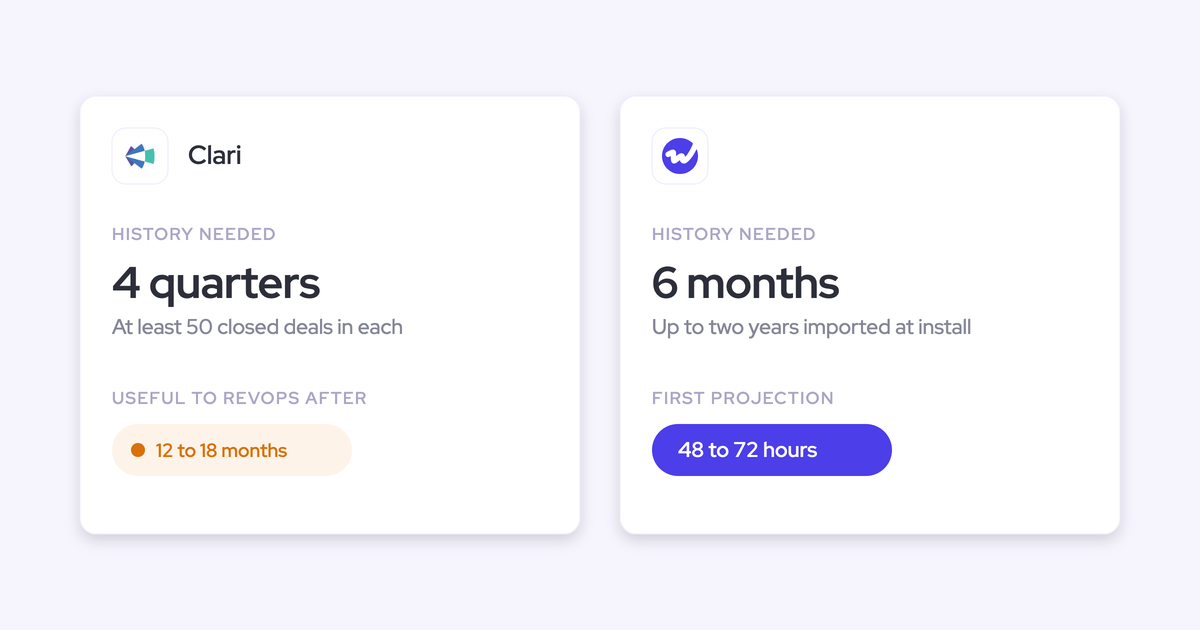
| AI forecast prediction | Weflow Deal Intelligence & Forecasting imports up to two years of opportunity history and returns a low, middle and high range within 48 to 72 hours. It needs at least six months of history, and shows no range when it isn't confident. The range sits beside the weighted forecast and the roll-up. |
| Forecast submissions and roll-ups | Reps submit calls such as a base call and best case by selecting the deals behind them. Every version is kept, managers override with a logged rationale, and you can run a custom hierarchy without placeholder users. Submissions live in the Weflow web app, not in Salesforce fields. |
| Integrations with other tools | Salesforce, Gmail, Google Calendar, Outlook, Zoom, Teams, Meet, Slack and the Outreach dialer. BI tools such as Tableau and Looker read the API. No native warehouse connector, so warehouses load through the API. |
| Access from AI assistants (MCP) | A read-only MCP connector gives Claude, ChatGPT and other clients transcripts, summaries, playbook results and forecast calls. An admin switches it on per workspace, with a separate toggle for transcript access. It's included in the seat. |
| Raw data access outside the tool | The REST API is on every plan and bulk-exports transcripts, metadata, scores and signals as JSON or CSV. Recordings export to your own cloud storage. |
| Pricing | Published per seat: $19 for Weflow Activity & Contact Capture, $39 each for Weflow Conversation Intelligence and Weflow Deal Intelligence & Forecasting. Bundles are $49, $59 and $79, billed annually, 10-user minimum, AI included in the seat. |
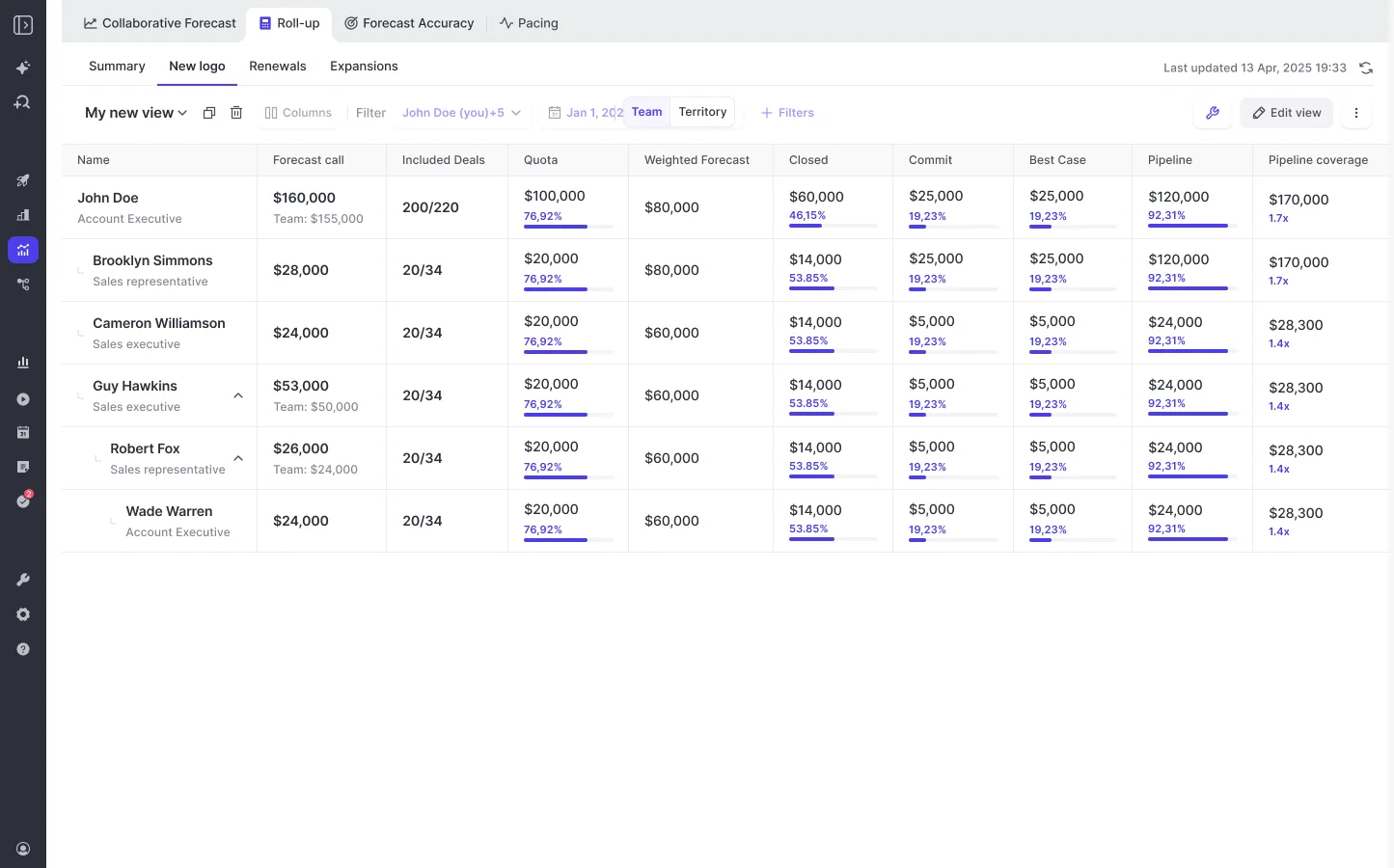
The forecast roll-up shows each manager and rep with their call, how many of their deals sit behind it, and attainment against quota.
What it does well:
- Capture doesn't depend on rep adoption, because it runs at the mail tenant rather than in a per-rep plugin.
- AI Field Updates write structured call outcomes, including MEDDIC, MEDDPICC and SPICED answers, into the Salesforce fields your forecast reads.
- Because each forecast call is tied to named deals, your review runs deal by deal instead of turning into a debate about the total.
- The AI range is usable in days, because it learns from imported history rather than waiting for history to build up.
- Days in stage and close-date push count are tracked on every opportunity without custom fields, so warnings work from day one.
- Your data stays reachable, with the API on every plan and an MCP connector that returns transcripts and forecast calls without metering.
- Prices are public, and Agent Builder is the only product priced by consumption.
Where it falls short:
- Weflow works only with Salesforce.
- Forecast submissions and deal warnings stay in Weflow, so you can't report on them in Salesforce or pull them into BI.
- Our dashboards are thinner than Clari's, with no funnel report, no flow view and no single central pipeline dashboard.
- Forecasting and deal inspection run on opportunities, so there's no account-level view for customer success.
- Gong is further along on rep-level coaching. We don't have a single manager page that brings one rep's calls, scores and metrics together over time.
Who should use it: Mid-market to enterprise Salesforce teams who want capture, conversation intelligence and forecasting on one record they own, at a published price.
Gong: The deepest call analytics, with the data kept in Gong
What it is: Gong pioneered conversation intelligence. It records and analyzes sales calls in its own cloud and is sold as a Foundation core licence, with coaching, forecasting, engagement and data export applications on top.
Quick specs: Works with Salesforce, HubSpot and Microsoft Dynamics. New customers choose US or EU storage, with the US as default. Holds SOC 2 Type II and ISO 27001, 27017, 27018 and 27701.
| Capability | How Gong does it |
|---|---|
| Automatic email capture | Imports email server-side from each mailbox, company-wide or user by user. It keeps only email where a participant matches a CRM record. Export to Salesforce as tasks or events runs forward from the day it's enabled, and transcripts aren't exported. |
| Recording video meetings | Records Zoom, Meet, Teams, Webex and seven other providers on any plan. Bot-free recording exists only on Zoom. The recorder picks meetings up from a calendar sync, so it can join late or miss buyer-scheduled calls, and on Outlook and Teams the rep adds the Gong assistant to each invite. |
| Deal risk warnings | Exactly eight Gong-defined warnings, such as ghosted, no power and stalled in stage. You can switch each on or off and adjust timing, but you can't define a new one. |
| AI forecast prediction | Gong Forecast projects the landing from closed-won deals, stage-weighted pipeline and expected new or moved deals, with a See the math panel. Reliable projections need 400 created opportunities with 150 won across four quarters. |
| Forecast submissions and roll-ups | Reps submit a number per forecast category with notes. Managers move up and down the hierarchy, and a forecast accuracy report scores each person. There's no deal-by-deal submission. |
| Integrations with other tools | About 450 integrations and partner solutions in the Gong Collective, with calls imported from about thirty dialers. |
| Access from AI assistants (MCP) | Three tools, each scoped to one account, deal or contact. It returns AI insights, never raw transcripts, and it's read-only. Calls through MCP draw credits, and free collaborator accounts can't connect. |
| Raw data access outside the tool | The API returns transcripts, trackers and scorecards, capped at 3 calls a second and 10,000 a day. Warehouse delivery needs Data Cloud, a separate purchase of about $5,000 a year. |
| Pricing | No published prices. A per-user licence plus a platform fee that scales with users, with Foundation required before any application. AI credits are pooled on top of the seats. |
What it does well:
- Gong has the deepest conversation analytics and coaching in this grid.
- It records on the widest set of meeting platforms here.
- Its integration marketplace is the largest in the field, and customers build infrastructure around it.
- Its certification set is strong and complete.
- Deal boards are a genuine favorite with reps and managers.
"The reason why I stuck with Gong was like the bubbles. You sort of get like addicted to the bubbles."
— Chris Nethercote, Head of Sales at Weflow, former Gong enterprise customer
Where it falls short:
- Email capture keeps only CRM-matched activity and exports forward from the day export is turned on.
- Recording coverage on Outlook and Teams depends on a step the rep takes on every invite.
- Deal warnings are a fixed eight, so a risk pattern specific to your motion can't become one.
- MCP returns insights only, one record at a time, and it's metered.
- Warehouse delivery is a separate purchase, and there are no public prices.
Who should use it: Teams whose core need is coaching depth, and leaders who want a safe, established brand.
"I wasn't going to get fired for buying Gong. It wasn't going to happen, right? So it was a very safe choice."
— Chris Nethercote, Head of Sales at Weflow, former Gong enterprise customer
Clari with Salesloft: A mature roll-up bound to your Salesforce hierarchy
What it is: Since the December 2025 merger, Clari and Salesloft are one platform. Clari supplies roll-up forecasting, Inspect and Clari Copilot. Salesloft supplies activity logging, engagement and deal management.
Quick specs: The data layer syncs with Salesforce and Microsoft Dynamics. New Copilot implementations need unified Okta single sign-on and an Advanced or higher Salesloft tier.
| Capability | How Clari (with Salesloft) does it |
|---|---|
| Automatic email capture | Salesloft logs the emails and invites a rep sends as Lofted. Mailbox capture needs each user to opt in, so coverage stops where users decline. |
| Recording video meetings | Covers Zoom, Teams, Meet and Webex. Salesloft Conversations skips recordings under two minutes and all-public-domain meetings by default. Copilot's Zoom bot records only while the organizer is present. |
| Deal risk warnings | Deal Gaps are rules a team admin builds on any deal field, such as days in stage, a past close date, an empty next step or days since last activity. |
| AI forecast prediction | Salesloft's AI Forecast predicts current-quarter new business and is switched on per team after an engineering check. Teams need four quarters with at least 50 closed deals each. RevOps teams tell us the projection takes 12 to 18 months to become useful, and Copilot call data doesn't feed it. |
| Forecast submissions and roll-ups | Submissions roll up a hierarchy up to eight levels deep, with inline editing in shared views. The roll-up is bound to the Salesforce hierarchy: a sub-total needs an inactive placeholder user, and a rep who changes team can lose their history. A forecast call is a number with notes. |
| Integrations with other tools | The Salesloft data layer syncs with Salesforce, Dynamics, Snowflake, Databricks, Gmail, DocuSign, ZoomInfo and LinkedIn. |
| Access from AI assistants (MCP) | Three separate servers. Forecast gives numbers and snapshots without deal-level data. Copilot reaches call data only. Salesloft's is read-only, needs the paid Agentic add-on, and returns summaries, not transcripts. |
| Raw data access outside the tool | Admins export two years of forecast history as CSV, and the data layer syncs to Snowflake and Databricks. |
| Pricing | No published seat prices. Both pricing pages lead to a Talk to Sales booking. Salesloft publishes its package structure, Advanced and Elite, with paid add-ons. |
What it does well:
- Clari is the more mature choice for roll-ups at 1,000+ reps.
- Inline forecast editing and the top-down view let a CRO see every direct report's commit and drill down fast.
- Deal Gaps are genuinely configurable on any deal field.
- The AI prediction tends to land close to the quarter's actual result once it's running.
- Pipeline reporting goes deep, including a flow chart and dashboard widgets.
Where it falls short:
- Email capture depends on each user opting in.
- The roll-up is tied to the Salesforce hierarchy, so reorganizations mean placeholder users and maintenance.
- The AI projection takes a year or more before teams trust it.
- Copilot call data doesn't inform the forecast.
- There are three narrow MCP servers instead of one, and no public prices.
"We mostly use Clari for roll-ups, simple pipeline analytics, and to inspect and the price point for that is crazy high."
— A RevOps leader on a call with us
Who should use it: Sales leadership running a mature, large-scale roll-up.
Backstory (People.ai): Automatic capture and MCP answers, but no call recording
What it is: People.ai rebranded as Backstory in 2026. It's an enterprise revenue intelligence platform built on automatic activity capture, with AI deal summaries, forecasting and an MCP server on top.
Quick specs: Works with Salesforce through a managed package, and with Microsoft Dynamics 365 and Oracle through API connections, but not with HubSpot. Forecasting is Salesforce-only. Most teams go live in two to four weeks.
| Capability | How Backstory does it |
|---|---|
| Automatic email capture | Server-side from Google Workspace or Microsoft 365, granted once by an admin, with no rep action. Most activity appears within two hours. Attachments aren't captured. |
| Recording video meetings | Not offered. Backstory pulls transcripts that Zoom, Teams, Meet, Webex and Gong already hold, from the day the integration is switched on. |
| Deal risk warnings | Flags risk through AI summaries, Forecast Headlines and out-of-the-box Signals. Customer-configured signals are planned for a later release. |
| AI forecast prediction | Not offered. Forecast values come from Salesforce opportunities, and its AI is the Backstory Assistant, which answers deal questions. |
| Forecast submissions and roll-ups | Reps and managers submit forecasts that roll up, with forecast types side by side and weekly snapshots. Managers adjust team roll-ups only. The hierarchy loads from a CSV and doesn't sync from Salesforce. Forecasting launched in October 2025. |
| Integrations with other tools | Workspace, Microsoft 365, Exchange on-premises, five meeting platforms, Gong, Slack and Sales Navigator, plus any dialer that logs calls to Salesforce and a Transcript API. |
| Access from AI assistants (MCP) | Its own MCP server for Claude, ChatGPT, Copilot, Gemini and n8n, with your Backstory permissions. Tools cover account and deal status, recent activity, engaged people and similar past deals. |
| Raw data access outside the tool | An API with up to five keys delivers its data and analytics, and lets you export and delete activity data. |
| Pricing | A published model, with a platform fee per connected customer-facing person plus pre-packaged AI answers, but no figures. Viewers use it free. |
What it does well:
- Org-wide server-side capture that keeps working when reps change passwords or leave.
- Relationship mapping and account planning are among its strongest capabilities.
- A broad MCP server across the major assistants.
- Multi-CRM reach for enterprises running Dynamics or Oracle beside Salesforce.
Where it falls short:
- It doesn't record calls.
- It shows no AI forecast number.
- You can't configure your own warnings yet.
- Its forecasting product is still new compared with established vendors.
- There are no published price figures.
Who should use it: Large multi-CRM enterprises prioritizing capture and relationship intelligence.
Aviso: An AI forecast first, with no API or MCP access
What it is: An enterprise revenue platform led by AI forecasting. It copies the CRM into its own store and adds deal scoring, conversation intelligence, the MIKI assistant and prebuilt agents.
Quick specs: Runs on Salesforce, HubSpot, Dynamics, Oracle, SAP and Siebel. Your IT admin sets up integrations and hands credentials to Aviso's implementation team.
| Capability | How Aviso does it |
|---|---|
| Automatic email capture | A shared tracking mailbox, filled by an Exchange rule that Bcc's the sales team's email or by Gmail routing. Only interactions cleanly mapped to an account or opportunity are written back to the CRM. |
| Recording video meetings | Imports native Zoom, Teams, Webex and RingCentral recordings, and sends its Notetaker bot where that isn't possible, including Google Meet. Consent profiles can require every participant to agree. |
| Deal risk warnings | Nudges on stages not updated, a falling WinScore, commits at risk, single-threaded deals and quiet accounts. Teams create their own. |
| AI forecast prediction | Shows its own AI forecast beside the team's most-likely call, built from daily WinScores whose contributing factors it explains. |
| Forecast submissions and roll-ups | Rolls up commit, best case and most likely on hierarchies that can differ from Salesforce, merges several CRM instances, and exports an audit trail of past calls. |
| Integrations with other tools | Claims more than 200 connections across conferencing, telephony, engagement, support, learning and marketing tools. |
| Access from AI assistants (MCP) | Not offered for outside assistants. MCP runs only inside its own Agent Studio. |
| Raw data access outside the tool | No public API or warehouse feed. Data leaves as spreadsheet and file downloads. |
| Pricing | Quote-only licences per user, no platform fee, and agent work billed at $1 to $1.50 per outcome. |
What it does well:
- The AI forecast sits beside the team's call, with an explanation for every deal that moved.
- Nudges are configurable.
- One forecast across several CRMs, including consumption forecasting for usage-based revenue.
Where it falls short:
- Email capture runs through a Bcc'd or routed shared mailbox and is only partly written back.
- No API or MCP, so your own AI can't reach the data.
- Licences are quote-only, and agents are billed per outcome.
Who should use it: Enterprise CROs wanting AI-forecast-led consolidation across several CRMs, including consumption revenue.
Avoma: Meeting-first with published prices, built for small teams
What it is: A meeting-first conversation intelligence tool, sold mainly to small businesses. It records, transcribes and summarizes calls, with CRM sync, coaching and deal features added on top.
Quick specs: Works with Salesforce, HubSpot, Pipedrive, Zoho, Copper and Zendesk Sell. Holds SOC 2 Type II and ISO/IEC 42001.
| Capability | How Avoma does it |
|---|---|
| Automatic email capture | Syncs Gmail and Outlook in the background for members with the Revenue Intelligence add-on, through an org-wide Google connection or each member's own inbox. |
| Recording video meetings | A bot records Zoom, Meet, Teams, BlueJeans, GoToMeeting, Lifesize and UberConference. Bot-free routes cover Teams and Meet cloud recordings, and Webex records through Webex cloud recording. |
| Deal risk warnings | Each opportunity gets an AI risk score with written factors, plus keyword alerts and a risk-detection agent template. |
| AI forecast prediction | Partial. Avoma describes its forecasts as AI-driven but shows no model-predicted number beside the call, and weighted amounts are marked "coming soon". |
| Forecast submissions and roll-ups | Reps submit an amount and included deals per pipeline and period, managers approve and roll up, and every change is kept. One forecast configuration per organization. |
| Integrations with other tools | 26 native integrations across conferencing, CRMs and dialers, plus Zapier. |
| Access from AI assistants (MCP) | A connector for Claude and ChatGPT reads meetings, transcripts, notes and scorecards. It needs the Organization or Enterprise plan, or the API Access add-on. |
| Raw data access outside the tool | A REST API and webhooks, limited to 60 requests a minute, from the Organization plan up. |
| Pricing | Published per recorder seat: Startup $19, Organization $29, Enterprise $39 a month billed annually. Revenue Intelligence and Conversation Intelligence add-ons are $29 a seat each. |
What it does well:
- Published per-seat pricing, free viewer seats and a 14-day trial.
- Broad meeting-platform and dialer coverage.
- Its own MCP connector, with read and write tools.
- Multi-CRM support for teams not on Salesforce.
Where it falls short:
- No model-predicted forecast number.
- One forecast configuration per organization, so new logo and renewals can't run separately.
- Revenue intelligence is a per-seat add-on.
- API and MCP come only with the Organization plan or an add-on.
Who should use it: Small, meeting-first teams wanting low published pricing and multi-CRM support.
What each platform costs, and which vendors publish their prices
Only two vendors in this grid publish per-seat prices: Weflow and Avoma. The rest share a pricing model at most, and several charge extra for AI or data access on top of the seat.
| Tool | Pricing model | Published list prices | What costs extra or is metered | How you get a number |
|---|---|---|---|---|
| Weflow | Per seat, AI included | $19, $39, $39 per product; bundles $49, $59, $79 per user per month, billed annually | Agent Builder beyond the free 25 actions a month ($299 for 500, $999 for 2,500) | Pricing page; volume and multi-year discounts in the quote |
| Gong | Per-user licence plus platform fee | No published price | Mandatory Foundation licence, per-application seats, AI credits, Data Cloud | Custom proposal after sales calls |
| Clari (with Salesloft) | Packages plus add-ons | No published price | Forecasting, agents and dialer as add-ons; Agentic add-on for MCP; Copilot AI Themes quota | Talk to Sales booking |
| Backstory (People.ai) | Platform fee per connected person plus AI answers | No published price | Allotment of AI answers, resized at renewal | Quote |
| Aviso | Per-user licences, custom proposal | No published licence price | Agent work at $1 to $1.50 per outcome | Custom proposal |
| Avoma | Per recorder seat plus add-ons | $19, $29, $39 per seat a month billed annually | Revenue Intelligence and Conversation Intelligence add-ons at $29 a seat each | Pricing page |
Here are a few reference points to help you size a business case before you get a quote:
- At about 62 seats, Weflow Revenue AI Foundation lands around $36K a year, and the full platform around $58K.
- One Gong renewal proposal we saw came to about $80,000 a year for 45 licences, with forecasting only about $10,000 of it.
- On Avoma, an Organization recorder seat with the Revenue Intelligence add-on lists at $58 a month billed annually.
Metering is where budgets tend to drift. Clari Copilot, for example, meters AI Themes as a monthly quota of analyses, as shown here in Clari's own interface.
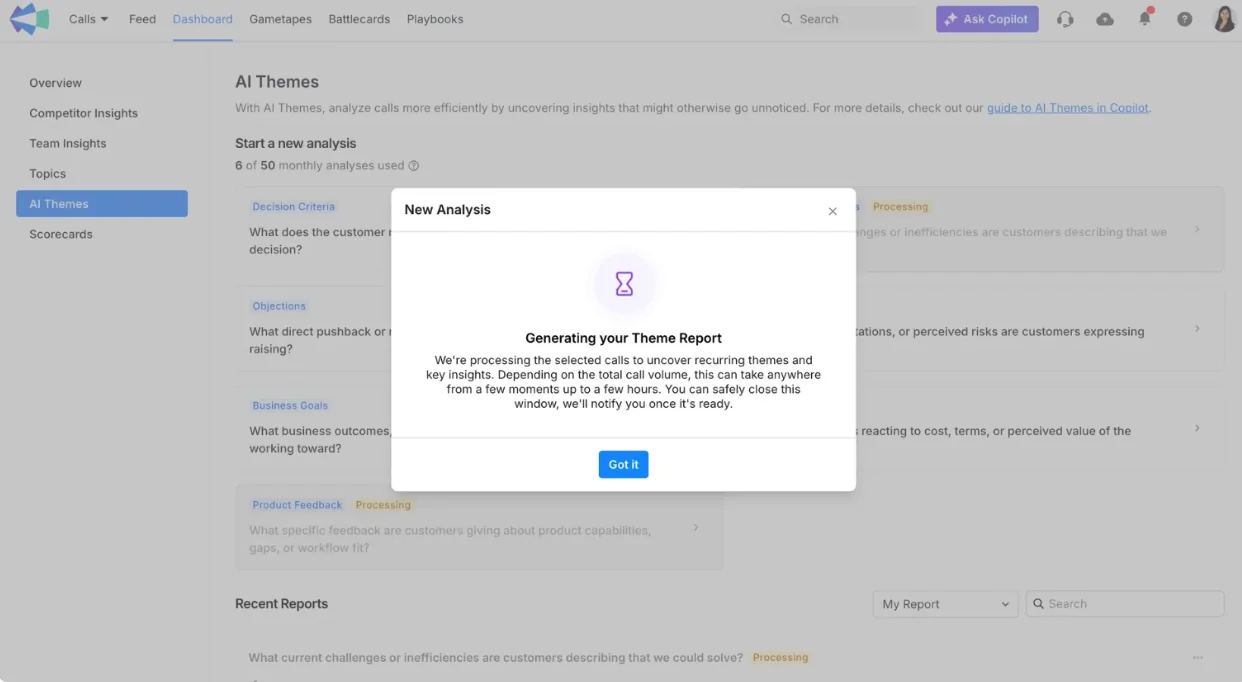
A published price with AI included in the seat is something a CFO approves once. Metered AI, on the other hand, grows with adoption, so teams end up rationing the very features that justified the purchase.
Which revenue intelligence platform fits your team
Your shortlist comes down to three things: your main need, your team profile and your current contracts. And sticking with what you have or building your own are both valid options too.
Match the platform to the job you need done most
| If your main need is… | Shortlist, and why |
|---|---|
| Rep coaching depth | Gong. It's further along on conversation analytics and coaching than anyone else here. |
| A mature roll-up at 1,000+ reps | Clari (with Salesloft). Inline editing and the top-down view are proven at that scale. |
| Capture and relationship intelligence, without recording | Backstory (People.ai). Org-wide capture, relationship maps and MCP answers across several CRMs. |
| An AI forecast across several CRMs | Aviso. Its forecast leads, with explained WinScores and multi-CRM consolidation. |
| Low-cost meeting intelligence | Avoma. Published per-seat prices and broad meeting coverage. |
| Capture, conversation intelligence and forecasting on one record you own | Weflow. All five jobs covered, data in your Salesforce, a published price. |
Match the platform to your team size, CRM and budget
| Team profile | Best fit | Watch-out |
|---|---|---|
| Mid-market or enterprise on Salesforce only | Weflow | Forecast submissions and warnings don't reach Salesforce reports |
| Enterprise across Salesforce plus Dynamics, Oracle or SAP | Aviso or Backstory (People.ai) | Aviso has no API or MCP; Backstory has no recording or AI number |
| 1,000+ reps with a working roll-up | Clari (with Salesloft) | Roll-up maintenance through every reorganization |
| Small team, possibly on HubSpot or Pipedrive | Avoma | One forecast configuration, no model-predicted number |
| Finance needs a published, seat-only bill | Weflow or Avoma | Weflow has a 10-user minimum; Avoma's Revenue Intelligence is an add-on |
Keep your current tool if one of these is true
- Your need is deep rep coaching, and Gong is working for your managers.
- Your 1,000+ rep forecast already runs well in Clari, and leadership trusts it.
- A contract or an executive sponsor locks the tool in. In that case, start with a capability your team doesn't have yet, like capture or conversation intelligence, which sidesteps the CFO's "two forecasting tools" objection.
"There's a trend towards consolidation, but then you're in a renewal cycle with your forecasting solution. And the CFO just blocks you because you can't have two forecasting solutions."
— A RevOps leader on a call with us
Building it yourself with Claude covers forecasting, not capture
Plenty of RevOps leaders now build a forecasting prototype with an AI coding tool before taking a vendor call, and that part works. Forecast views sit on data that's already in Salesforce, so rebuilding them is mostly a presentation job.
Capture is a different story. You have to read every mailbox and calendar at volume, then decide which contact, account and opportunity each activity belongs to, even when an account has several open deals and no contact roles.
And when something doesn't log, you're the one troubleshooting it.
The real cost, though, is maintenance. Snapshots, permissions, the hierarchy and integrations all have to keep working while you're also running the business.
That's why teams who build most of their stack still buy the capture layer and build extensions on top of it.
Run every finalist against your own Salesforce data first
Trial two or three finalists side by side on your own Salesforce org, in the order below. What you see with your own data is what really counts, and if a vendor resists a side-by-side or hides the price, that tells you something too.
- Turn capture on centrally: Pass: Email and meetings for the whole pilot group reach Salesforce with no rep installing or connecting anything.
- Record a real customer meeting: Pass: It writes to the one meeting activity that already exists and links to the right contact, account and opportunity, with no duplicate meeting.
- Ask for the AI forecast: Pass: The vendor tells you how much history it needs, and a first number appears inside your evaluation window.
- Submit a forecast: Pass: A manager can open the number and see the deals behind it.
- Build a warning on your own slippage pattern: Pass: You define the rule, for example two close-date pushes with no meeting booked, rather than picking from a fixed list.
- Connect Claude: Pass: Transcripts come back, not only summaries, and you know whether each query is metered.
- Price it at your seat count: Pass: A total you can put in front of finance, with AI and API access stated.
If you're trialing Weflow, a champion can connect Gmail user by user without a Google Workspace admin, then switch to the central app at rollout. And if you'd like to see the product before shortlisting it, walk through the product yourself, no call required.
What changed in revenue intelligence since late 2025
In just over a year, the field has consolidated, rebranded and made AI access part of every evaluation:
- October 2025: People.ai launched its forecasting product.
- December 2025: Clari and Salesloft merged and now ship one monthly release across Clari, Clari Copilot, Salesloft and Groove.
- 2026: People.ai rebranded as Backstory, keeping the same product and data infrastructure.
- June 2026: Clari Copilot began replacing Salesloft Conversations as the conversation layer inside Salesloft.
- August 2026: Salesloft removed transcript retrieval from its MCP server, so assistants now receive call summaries only. The Clari Copilot MCP server became available for ChatGPT and Claude. Backstory MCP moved to Backstory credentials, opening it to customers on other CRMs.
- September 2026: Clari released its Forecast MCP server, with forecast numbers but no deal-level data.
- Across the period: Gong added AI credits on top of seat pricing, and MCP access in the category split into transcripts versus summaries, included versus metered.
The common thread? Buyers now want their data in their own CRM, reachable by their own assistant, and acted on by agents they control.
"Everything is moving from revenue intelligence to revenue orchestration."
— Janis Zech, Co-founder and Chief Executive Officer of Weflow
How we scored these revenue intelligence platforms
We built each cell from vendors' public documentation and help centers, Weflow's own product documentation, and what buyers tell us in evaluations. Competitor claims trace back to public sources where they exist, and we checked them in late 2026.
Every cell uses the same three-step scale:
- Offers: The tool does the job as defined, and the cell says how.
- Partial: The tool does part of the job, or only under a stated condition such as a fixed list, a per-user opt-in or a paid add-on.
- Not offered: The tool doesn't do the job, and the cell says what it does instead.
FAQs RevOps leaders ask about revenue intelligence platforms
How much do revenue intelligence platforms cost per seat?
Weflow publishes $19 to $39 per product and $49 to $79 per user per month for bundles, billed annually with a 10-user minimum and a 12-month term.
Avoma publishes $19 to $39 per recorder seat, plus $29 add-ons. Gong, Clari (with Salesloft), Backstory (People.ai) and Aviso are quote-only.
Can we start beside an existing Clari or Gong contract?
Yes. You can start with a capability your team doesn't have yet, usually Weflow Activity & Contact Capture and Weflow Conversation Intelligence, and add forecasting later for roughly $10 more per user per month. Different teams can sit on different products.
Meanwhile, RevOps can set up and compare the Weflow forecast privately while reps are already on capture, so finance never sees two forecasting tools at once.
How long does it take to migrate call history from Gong or Clari?
It depends on volume, because Weflow migrates calls through the source vendor's API one call at a time. About 7,000 calls take around a week, and 20,000 take two weeks or more.
Weflow migrates up to two years of Gong history at no charge and keeps each call linked to its Salesforce account. Your old contract and API access stay active until the import ends.
How much history does an AI forecast need before it is useful?
Weflow needs at least six months of opportunity history, imports up to two years, and returns a first range in 48 to 72 hours. Gong Forecast needs 400 created opportunities with 150 won across four quarters.
Salesloft's AI Forecast needs four quarters with at least 50 closed deals each, and RevOps teams tell us Clari's projection takes 12 to 18 months to become useful. Backstory (People.ai) and Avoma don't show a model-predicted number at all.
Does any of these tools depend on reps installing or connecting something?
Not with Weflow or Backstory (People.ai): both capture email through an app an admin installs once, and Weflow's notetaker starts joining a user's meetings after their first sign-in.
Gong connects company-wide or user by user, and on Outlook and Teams reps add the Gong assistant to each invite.
Clari (with Salesloft) mailbox capture needs per-user opt-in, Aviso's setup runs through your IT admin, and Avoma uses an org-wide Google connection or each member's inbox.
Where does our data live, and what do we keep if we leave?
Weflow writes captured activity, transcripts, summaries and AI field updates into your Salesforce, so they stay when you leave.
Forecast submissions and warnings stay in Weflow, while video recordings are held by Weflow and can be exported to your own storage. Weflow stores data in the region of your Salesforce instance.
By contrast, Gong keeps data in its own structure and doesn't export transcripts, and Aviso works from its own copy of the CRM.
Is API or MCP access metered, and which plans include it?
Weflow includes the API on every plan and the read-only MCP connector in the seat, with no metering on transcripts or Ask Weflow AI.
Gong's MCP draws credits and needs a paid seat. Salesloft's MCP needs the Agentic add-on, and Avoma's needs the Organization plan or the API Access add-on. Aviso has no API or MCP for outside assistants.
Can renewals and expansion run as their own forecast?
Yes. Weflow runs new logo, renewal and expansion as separate forecast types, each with its own AI model. Forecasting runs on renewal opportunities, though there's no account-level view for customer success teams.
Gong, Backstory (People.ai) and Aviso support separate forecast motions, and Salesloft adds account-based forecasting for consumption revenue. Avoma allows one forecast configuration per organization.
What would we lose moving from Clari's dashboards to Weflow?
The roll-up, pacing and waterfall match. are on par. What you'd lose is the funnel report, the flow view, some dashboard widgets and a single central pipeline dashboard, so leaders open several Weflow reports where one Clari dashboard used to do the job.
Any calculated columns you built in Clari can be rebuilt with Weflow formula fields.
How do these platforms handle security review, data residency and AI training?
Weflow stores data in the region of your Salesforce instance, runs on third-party models (primarily Google Gemini), and never uses customer data to train them.
An annual third-party penetration test covers its AI endpoints, and Weflow inherits Salesforce permission sets, field-level security and role hierarchy.
Gong holds SOC 2 Type II and four ISO certifications, defaults to US storage, and processes data in the US, Israel and Ireland. Avoma holds SOC 2 Type II and ISO/IEC 42001.
Who runs the rollout, and how many RevOps hours does it take?
Weflow runs onboarding end to end as a managed project, so your team doesn't have to. Technical setup takes 30 to 45 minutes, and full time to value takes one to three weeks, most of it spent on your business logic, like templates, forecast types and warning rules.
What is the difference between revenue intelligence and Revenue AI Orchestration?
Revenue intelligence tools analyze your revenue data and show it back to you, usually inside their own interface.
Revenue AI Orchestration goes a step further: it runs go-to-market as one system, with people, AI agents and unified data working the same pipeline, and the data living in the CRM you own.
Weflow sits in the second category: capture, conversation intelligence, forecasting and agents on one record in your Salesforce.