Weflow vs Clari for EU Data Residency and AI Data Handling (2026)
Decide between Weflow vs Clari for EU data residency, AI data handling, and vendor due diligence.


If you're counting on Salesloft's Frankfurt data center to cover Clari Forecast or Clari Copilot, it doesn't. Customer data for Clari services is hosted in US-east only, and the Clari Copilot Slack app runs on AWS in the United States.
A quick note on naming: when we say "Clari", we mean those Clari products, sold under the Salesloft brand since September 2026.
Anything that belongs to Salesloft itself, like its EU hosting and certifications, is labelled as Salesloft, since it doesn't carry over to Clari services.
Weflow, the Revenue AI Orchestration platform for sales, customer success, and RevOps teams, gives you one answer instead of several:
- Your data sits in the region that matches your Salesforce org (Frankfurt, New York or Sydney), with an override to keep it in the EU or UK.
- Captured activity, transcripts and summaries land in your own Salesforce.
- Our AI runs on a named provider, primarily Google Gemini, under Zero Data Retention, and we don't train models on your data.
To be upfront about one gap: Weflow doesn't hold ISO 27001 yet. It's in progress with a December 2026 target, while Salesloft already holds it.
Weflow vs Clari at a glance: Residency, AI and security
| Capability | Weflow | Clari (sold under Salesloft) |
|---|---|---|
| Data residency | Frankfurt, New York or Sydney, matched to your Salesforce org's region by default, with an EU or UK override. Activity, transcripts and summaries land in your own Salesforce. | Clari Forecast and Clari Copilot: US-east only. Clari Copilot Slack app: AWS US. Salesloft: US or EU by configuration, with Frankfurt for new EU customers since December 2021. |
| AI data handling | Third-party models, primarily Google Gemini. Zero Data Retention. Customer data never used to train models. | Clari Copilot: OpenAI and Azure, with no training by Clari or the providers. Provider retention not stated as zero. Copilot Slack app: Azure OpenAI with 30-day retention. Salesloft: providers don't train without customer permission. |
| Security certifications | SOC 2 Type II since 2021. ISO 27001 in progress with a December 2026 target, not held today. | Salesloft: SOC 2 Type 2, ISO 27001 and ISO 27701. Coverage of Clari Forecast and Clari Copilot not stated. |
| Integrations with other tools | Salesforce, Outlook, Gmail, Google Calendar, Zoom, Teams, Meet, Webex, Slack, dialers, plus BI tools and AI assistants via API and MCP. Limits: Salesforce only, no native warehouse connector, and not an integration platform. | Salesloft data layer syncs Salesforce, Dynamics, Snowflake, Databricks, Gmail, DocuSign, ZoomInfo and LinkedIn. Recording connects to Zoom, Teams, Meet and Webex. |
| Access from AI assistants (MCP) | One read-only connector, switched on per workspace by an admin, with a separate transcript toggle and a list of connected users. | Three servers. Clari Forecast: forecast numbers and snapshots, no deal-level data. Clari Copilot: calls only. Salesloft: read-only, paid add-on, no transcripts or cadences. |
| Raw data access outside the tool | REST API bulk export of transcripts, metadata, scores and signals as JSON or CSV. Recordings export to your own storage. Warehouses through the API. | Salesloft syncs to Snowflake and Databricks. Salesloft Forecast exports forecast history as CSV. Export routes for Clari Forecast and Clari Copilot not stated. |
| Pricing | Published per seat: $19 to $79 per user per month, billed annually, 10-user minimum. | No published prices. Both pricing pages route to a Salesloft Talk to Sales booking. |
Why Weflow vs Clari gets decided at security review
By the time you're comparing these two, you've probably settled the product question. What decides the deal now is how each vendor answers three questions in writing: where the data sits, who processes it, and whether any model trains on it.
On our calls, the review usually kicks off for one of these reasons:
- A Clari renewal window opens.
- An acquisition moves procurement and the GDPR questionnaire to a parent group.
- Account management changed after the Clari and Salesloft merger, and nobody on the other side is reaching out proactively.
- Legal reads the new Salesloft paper and asks which entity hosts what.
How one Salesloft brand ended up with several hosting answers
The reason Salesloft can't give you a single hosting answer is that Clari was never one product. It grew through acquisitions, each product kept its own data model and infrastructure, and hosting followed the product rather than the brand.
- December 2021: Salesloft opens its Frankfurt data center for new EU customers.
- 2022: Wingman becomes Clari Copilot.
- 2023: Groove becomes Groove by Clari.
- December 2025: Clari and Salesloft merge.
- 2026: Clari Copilot starts replacing Salesloft Conversations as the conversation intelligence layer inside Salesloft, for new customers first.
- 1 September 2026: Everything sells as Salesloft, and Clari Forecast continues as the platform's forecasting product line.
So one brand now carries at least three hosting answers. It's natural to assume one brand means one residency posture, but here it doesn't.
What legal asks about storage, processing and model training
Where the data is stored is only one part of what your reviewers will ask, so a vendor that answers just that has covered a fraction of the review. Expect questions like these:
- Where does each type of data physically sit, product by product, and sometimes country by country?
- Who processes it, including every sub-processor and the jurisdiction each one sits in?
- Does any model in the chain train on it, and does the model provider retain it?
- What's the working procedure for retention, deletion, consent logs and retrieval for litigation?
If you're in Germany or Austria, the works council sets its own bar: it wants documentation of what's captured, where it's processed and who can hear it, plus a consent notice on every recorded session.
How Weflow answers residency, AI and security questions
Here's how we answer each of these, including where we fall short.
Where Weflow stores your data: your Salesforce org and your region
By default, Weflow stores your data in the same region as your Salesforce org. If your org is hosted in Europe, your Weflow data stays in Europe.
| Data type | Where it lives |
|---|---|
| Emails and meetings from Weflow Activity & Contact Capture | Your Salesforce org, as native activity records. Weflow keeps no copy, only a 30-day log of each matching decision. |
| Contacts and Weflow fields synced to Salesforce | Your Salesforce org. |
| Call transcripts and AI summaries | Your Salesforce org, on the Weflow recording object. |
| Video recordings | Weflow's AWS environment in your region (Frankfurt, New York or Sydney), streamed back to you, and exportable to your own storage. |
| Transcripts and Weflow-native fields held outside Salesforce | The same AWS region, scoped to your tenant ID, encrypted with AES-256 at rest and TLS 1.2+ in transit. |
| Temporary processing data | The same tenant isolation, deleted after processing. |
Because we follow your Salesforce region, legal gets an answer it has already approved, and residency becomes a setting rather than a migration project. If your policy says EU or UK and your org sits elsewhere, we override the default.
We're also a German company, headquartered in Berlin and hosted in Frankfurt, and our tenant segregation controls sit inside our SOC 2 Type II audited scope.
Email capture is usually what security pushes back on hardest, so here's exactly how it works:
- Weflow checks each email's sender and recipients against your Salesforce org on metadata alone.
- It pulls the body only when the email matches a Salesforce record, writes it to Salesforce, then deletes it from temporary storage.
- Our support team sees how Weflow decided to log or skip each email, never what the email says.
How Weflow handles AI: Google Gemini, Zero Data Retention, no training
Weflow runs on third-party foundation models, primarily Google Gemini, under Zero Data Retention, and customer data is never used to train them.
We deliberately don't compete at the model layer, since the models themselves are commodities. What makes the answers better is the context we bring to each question: your activity record, your conversation data and your Salesforce structure.
This also makes your review easier, because "who sees our data" gets answered with a vendor name and a contractual position, not a claim about proprietary technology.
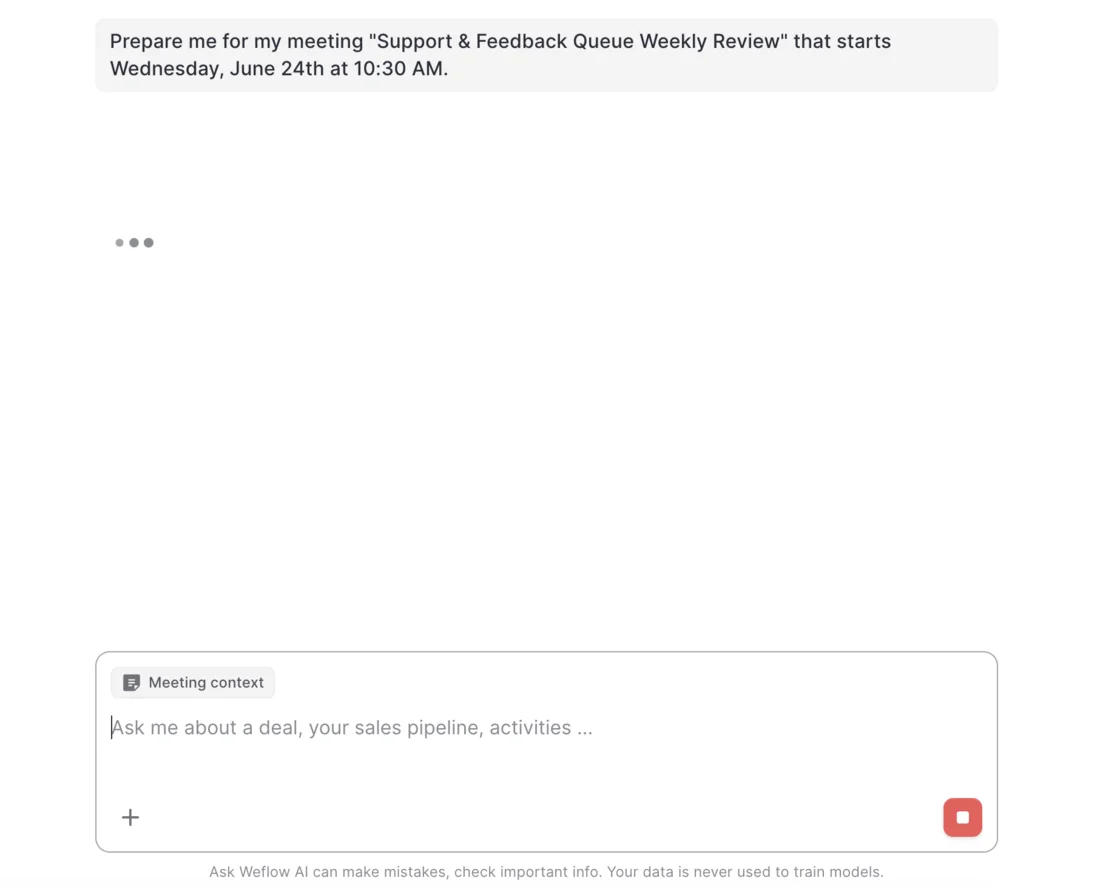
On top of that, Ask Weflow AI applies its own guardrails. It treats Salesforce permissions as a floor, so it can withhold information a user could still reach directly in Salesforce.
Which certifications Weflow holds: SOC 2 Type II now, ISO 27001 in progress
Weflow holds SOC 2 Type II today.
- SOC 2 Type II: Held since 2021, with the tenant segregation controls inside the audited scope.
- GDPR compliance: A DPA with EU Standard Contractual Clauses.
- Zero Data Retention for AI processing.
- No training: Customer data is never used to train AI models.
- Supporting evidence: Third-party penetration testing and a trust center with certificates and controls.
- ISO 27001: Not held. In progress, target December 2026.
So if your policy requires ISO 27001 today, we don't clear that bar yet, while Salesloft does (at the Salesloft level). If SOC 2 Type II plus a dated ISO commitment works for your reviewers, you can move forward on that basis.
Access control also runs through Salesforce: users sign in with your Salesforce authentication and whatever SSO your org enforces, and deactivating someone in Salesforce removes their Weflow access immediately.
Which tools Weflow connects to, and where it stops
Weflow integrates natively with Salesforce, your mail and calendar, your meeting platforms, Slack and dialers, and sends data to BI tools and AI assistants through its API and MCP connector.
Here's what Weflow connects to:
- Salesforce, as the system everything lands in.
- Outlook, Gmail and Google Calendar for activity capture.
- Zoom, Microsoft Teams, Google Meet and Webex for recording.
- Slack.
- The Outreach dialer, connected by your admin, plus Aircall, CloudTalk and Dialpad, activated by our team.
- Salesloft and Clay, as native integrations on request, and compatibility mode for Outreach, Salesloft, Apollo and Clay.
- Tableau and Looker through the API, and Claude, ChatGPT or any remote MCP client through the connector.
And here's where it stops:
- Weflow works with Salesforce only.
- There's no native Snowflake, Databricks or BigQuery connector, so warehouse delivery goes through the API.
- Weflow isn't an integration platform. Its agents work on the customer-facing revenue record, not your ERP or finance system.
- Weflow doesn't do sequencing, cadences or outbound dialing.
How admins govern AI assistant access to Weflow through MCP
Weflow gives AI assistants one read-only MCP connector, and an admin decides per workspace whether it's on and how deep it reaches.
Your admin sets it up in this order:
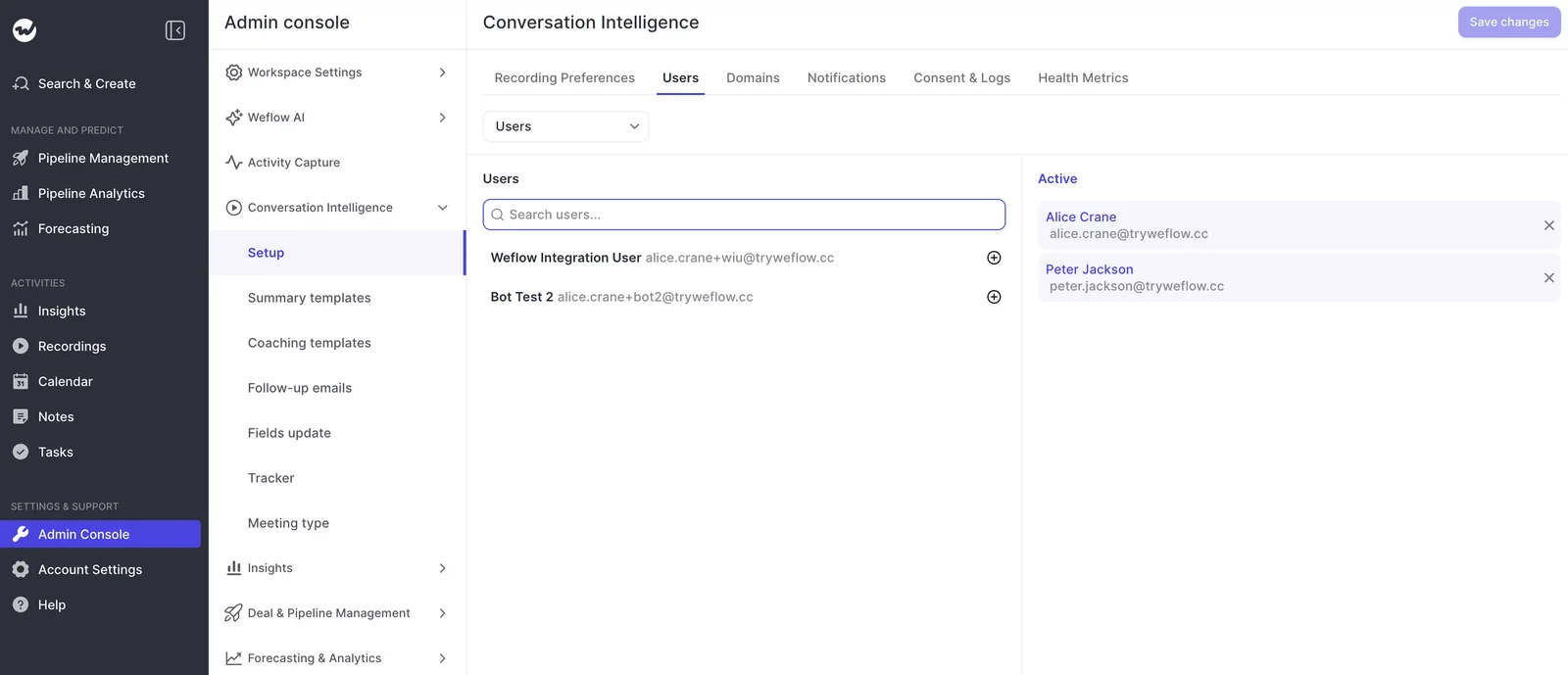
- Enable MCP Connector: An admin switches the endpoint on for the workspace in the admin console.
- Allow transcript access: A separate toggle. With it off, assistants see AI summaries and never the verbatim transcript.
- Connection: A user pastes one URL as a custom connector. The same URL works for Claude, ChatGPT and any client that supports remote MCP servers.
- Connected users: The console lists everyone who has attached an assistant, with their email and the date they connected.
Once connected, assistants can pull playbook results, call summaries, transcripts where allowed, tracker hits, coaching scores, forecast calls and pipeline metrics, with per-rep breakdowns for up to 25 owners.
Team scope follows your reporting hierarchy, and if you haven't configured one, it covers every active user.
What it doesn't return is the content of captured emails or values stored on Salesforce records, which stay behind your Salesforce permissions. It also can't write anything back into Weflow.
How you export raw Weflow data through the API
Weflow's REST API bulk-exports transcripts, metadata, scores and signals as JSON or CSV, on a schedule or on demand.
- Recordings export to your own cloud storage.
- Tableau and Looker read from the API, and teams move data into Snowflake, Databricks or BigQuery the same way.
- An exportable audit log records field write-backs and configuration changes for compliance review.
For litigation retrieval, though, what matters more is where the transcripts already sit: they're Salesforce records in your org, reportable and permissioned like everything else in your CRM, and they stay there if you ever stop using Weflow.
How Clari answers residency and AI questions, product by product
Same six questions, same order. Clari here means Clari Forecast and Clari Copilot, sold under Salesloft, and every Salesloft-level fact is labelled as Salesloft.
Where Clari Forecast, Clari Copilot and Salesloft store your data
Customer data for Clari services is hosted in US-east only. That means even with an EU Salesloft tenant, your Clari Forecast and Clari Copilot data doesn't move to Frankfurt.
| Product or component | Hosting region |
|---|---|
| Clari Forecast | US-east only, as a Clari service. |
| Clari Copilot | US-east only, as a Clari service. |
| Clari Copilot Slack app | AWS, United States. |
| Salesloft, EU customers | AWS eu-central-1 and GCP europe-west3, with Frankfurt for new EU customers since December 2021. |
| Salesloft, US customers | AWS us-east-1 and GCP us-central1. |
Salesloft places data in the US or the EU based on service configuration and customer selection. At rest it uses AES-256-GCM, and in transit TLS 1.2 or higher.
The open question is Clari Copilot inside an EU Salesloft tenant. Salesloft's Copilot rollout notes cover the Advanced licence tier and unified Okta single sign-on, but they don't say where Copilot data sits once it becomes the conversation layer for an EU tenant.
How Clari Copilot and Salesloft handle AI models and training
Clari states that neither it nor its model providers, OpenAI and Azure, train on Clari Copilot call data, but it doesn't say retention at those providers is zero.
| Component | Model provider | Provider retention | Training |
|---|---|---|---|
| Clari Copilot Smart Summaries | OpenAI's GPT-4o mini (Clari names OpenAI and Azure as providers) | Not stated | No training by Clari, OpenAI or Azure |
| Clari Copilot Slack app | Azure OpenAI | 30 days | Not stated separately |
| Salesloft generative AI (transcription, summaries, action items, scorecards) | Third-party providers, which can change within the authorised sub-processor list | Not stated | No training without customer permission |
| Salesloft MCP server | Not applicable (routes through the Salesloft API) | No data cached outside Salesloft | Not used for model training |
| Salesloft Deal Engagement Score | Salesloft's own model | Not stated | Falls back to a global model trained on anonymised, aggregated data across Salesloft customers |
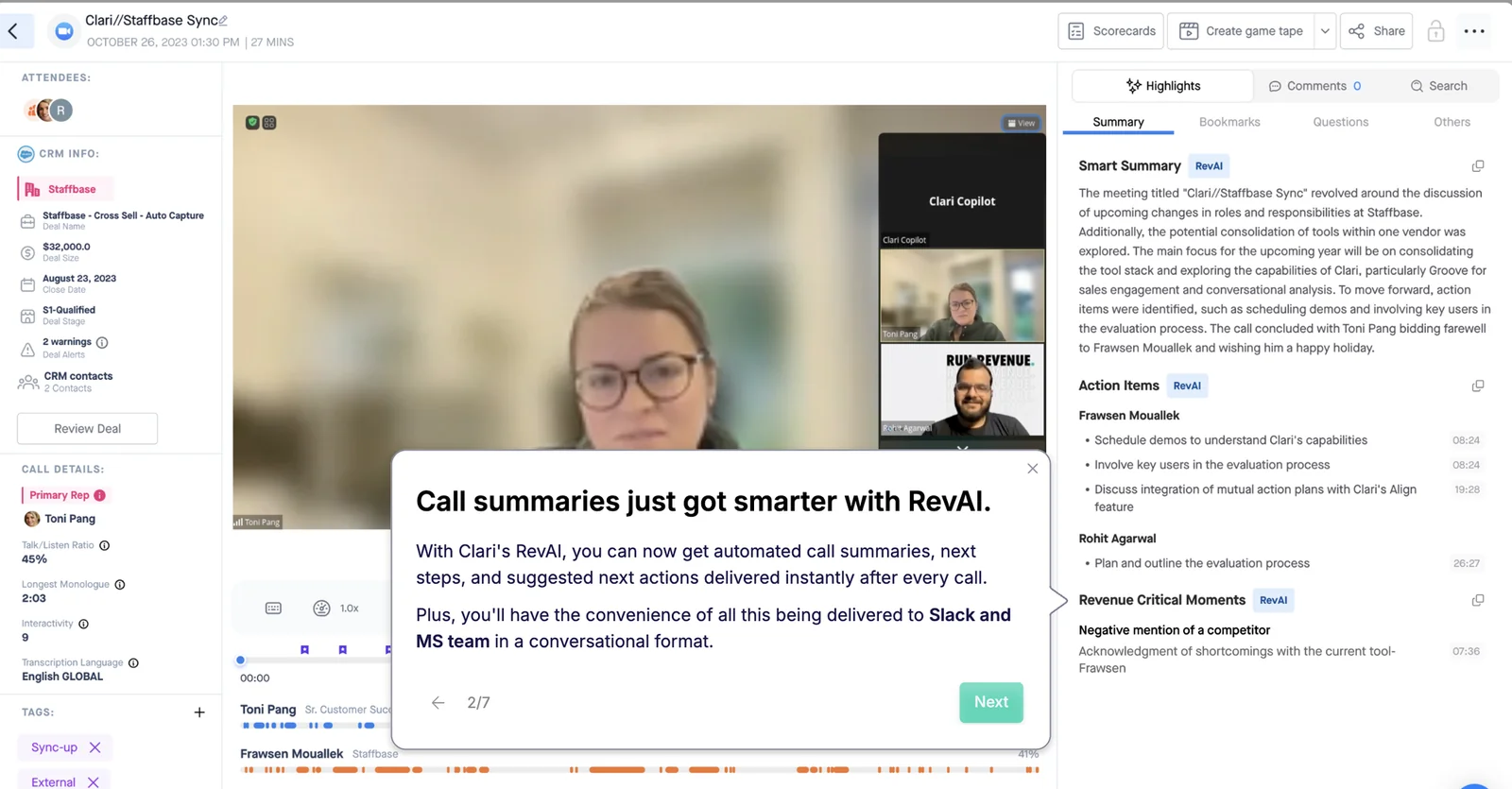
Clari Copilot stores those summaries, encrypted, in MongoDB alongside the rest of the call data. Here's the Clari Copilot call page where they show up:
On the Salesloft side, admins can switch off every generative AI capability in settings.
Salesloft also notifies customers before a new sub-processor handles personal data, though the provider behind a specific feature can change without notice as long as it's on the authorised list.
Which certifications Salesloft holds, and what's unconfirmed for Clari
Salesloft holds SOC 2 Type 2, ISO 27001 and ISO 27701, but it hasn't confirmed whether those cover Clari Forecast and Clari Copilot. Here's what's on record.
- SOC 2 Type 2 and ISO 27001, both audited annually.
- Reports and certificates in the Salesloft Trust Portal.
- A data processing addendum with Standard Contractual Clauses for GDPR.
- Clari Copilot Smart Summaries launched after Clari's SOC 2 audit, so they weren't directly in that audit's scope, although the storage they use was tested.
That's a real strength at the Salesloft level. To rely on it for Clari products, though, you'll need Salesloft to confirm the scope in writing (it's on the question list further down).
Which tools Clari and Salesloft connect to
Salesloft's integrations go further than ours in two places: it supports Microsoft Dynamics as well as Salesforce, and it syncs natively to data warehouses.
- Salesloft's Unified Revenue Data Layer syncs Salesforce, Microsoft Dynamics, Snowflake, Databricks, Gmail, DocuSign, ZoomInfo and LinkedIn.
- Salesloft Conversations captures through Zoom, Microsoft Teams, Google Meet and Webex integrations, a Teams bot, manual upload and the Salesloft dialer.
- Clari Copilot records Zoom either through Zoom's native cloud recording, with no bot, or through a Copilot bot that joins and leaves with the organiser.
- Clari Copilot pushes its call summary and metadata to the Salesforce Task by default.
How Clari's three MCP servers split AI assistant access
Clari runs a separate MCP server for each product, and each one reaches a narrow slice of your data.
| Clari Forecast MCP | Clari Copilot MCP | Salesloft MCP | |
|---|---|---|---|
| What it reaches | Submitted forecast numbers, grid values, hierarchy, periods and historical snapshots | Copilot conversation data | Accounts, people, users, opportunities, call summaries, extracted fields and key moments |
| What it excludes | Deal-level opportunity data | The forecasting and pipeline layer | Raw transcripts (the tool was removed), cadences and cadence performance |
| Who switches it on | A Clari admin, in Clari Studio | A Copilot admin, under Copilot Settings, AI Features | A Salesloft admin, under Settings, Artificial Intelligence |
| Requirements | Claude or ChatGPT Business or Enterprise | ChatGPT Business or Enterprise, or a Claude subscription | The paid Salesloft agent add-on; ChatGPT Business or Enterprise, or Claude |
| Permissions | Scoped to each user's Clari permissions | Copilot tools only | Read-only, follows the user's record permissions, currently in beta |
So connecting Claude to the whole Clari stack means setting up and maintaining three connectors, and even then, an assistant can see what each rep forecast but not the deals behind the number.
What raw data you can get out of Clari and Salesloft
Through Salesloft, data syncs natively to Snowflake and Databricks. Salesloft Forecast exports its full forecast history as a CSV.
Salesloft hasn't published export routes for Clari Forecast and Clari Copilot, so we've added that to the question list below.
And through MCP, the Salesloft server no longer returns transcripts, which leaves you with the summary rather than what was actually said on the call.
What to hand your legal team and works council
In the end, legal signs off on procedures, not certification packs. Here's how each one works in Weflow, and what's still open with Salesloft.
How recording retention and deletion work in Weflow
By default, Weflow keeps recordings for as long as you subscribe, and you can set them to delete on a schedule that mirrors your own rule.
| Retention setting | What happens |
|---|---|
| Default | Recordings stay for the length of the subscription, with no storage cap under fair use. |
| Delete recordings after a set period, keep transcripts | Audio and video go on schedule. Transcripts stay, so summaries, field updates and Ask Weflow AI keep working from the text. |
| Delete recordings and transcripts after a set period | Both the media and the transcript text go on schedule. |
| Delete transcripts, keep AI summaries | The verbatim text goes and the AI summaries remain. |
So if your legal team's rule is "everything removed after 30 days" (or 60), you set that period and Weflow applies it.
During the meeting itself, any participant can use the removal option in the in-call chat message to permanently delete all recording data for that meeting straight away.
How recording consent works on Zoom, Microsoft Teams and Google Meet
Zoom has a built-in recording consent prompt. Microsoft Teams and Google Meet don't, so consent on those platforms runs through a pre-meeting email and an in-meeting chat message.
| Meeting platform | How consent is collected |
|---|---|
| Zoom | Zoom's own consent prompt inside the meeting. |
| Microsoft Teams | Weflow emails attendees beforehand with an opt-in or opt-out link, and posts a chat message in the meeting with an option to remove the recording. |
| Google Meet | An email to attendees beforehand and a message in the meeting chat. |
Keep in mind that consent to be recorded isn't the same as consent to have the recording processed and analysed. Under GDPR, your DPA review has to cover both.
What Weflow's DPA, sub-processor list and breach terms cover
Here's everything you can send your reviewers in one go:
- A Data Processing Agreement with EU Standard Contractual Clauses.
- A public sub-processor list with advance notice of changes, so you can object before a new sub-processor takes effect.
- Breach notification within 48 hours.
- A trust center with certificates and controls, including SOC 2 Type II.
- The ISO 27001 target date: December 2026.
- A 99.5%-plus uptime SLA with a public status page.
How to run legal review while Weflow setup continues
Installing Weflow captures nothing until a user is enrolled, so your technical setup and legal review can run at the same time.
That matters, because most pilots stall on the sheer volume of review, even when nothing in the answers is contentious. As one buyer put it on a call with us:
"The issue is not the number of red flags. The issue is the extent of the information the approval board is looking for."
— A buyer on a call with Weflow
- Install the managed packages in Salesforce: Nothing is captured.
- Connect the integration user: Nothing is captured.
- Add the workspace application in Google Workspace or Microsoft Entra ID. Nothing is captured.
- Enroll users in an activity capture configuration: Capture starts here, and not before.
The technical setup takes 30 to 45 minutes with your Salesforce admin and your Google Workspace or Microsoft admin.
Recording follows the same logic: the notetaker only records meetings for the users or teams an admin adds in the Weflow Conversation Intelligence setup.
What to ask Salesloft about Clari Forecast and Clari Copilot
Salesloft hasn't published several answers your review will need for Clari services, so we'd add these to your questionnaire:
- Is there any EU hosting option for Clari Forecast and Clari Copilot, or are Clari services US-east only for every customer?
- What's the retention period at OpenAI and Azure for Clari Copilot summaries?
- Where does Clari Copilot data sit when Copilot serves as the conversation layer inside an EU Salesloft tenant?
- Do Salesloft's ISO 27001 and ISO 27701 certifications cover Clari Forecast and Clari Copilot?
- Who are the sub-processors for the Clari Copilot Slack app, and in which jurisdictions?
- Which export routes exist for Clari Forecast and Clari Copilot data?
Where Clari and Salesloft are the stronger choice
To be fair, Clari is stronger in several places, and if one of them is your deciding requirement, staying put is the right call.
- Enterprise roll-ups: Clari's roll-ups at 1,000-plus reps are more mature, and a leader can see and edit the whole forecast inline.
- Dashboards: Clari has a central configurable pipeline dashboard, a funnel view and a flow view. Weflow's pipeline reports are separate views.
- Account-level view: Clari's account module shows a customer as a whole. Weflow's forecasting and deal inspection are built on opportunities.
- ISO 27001 and ISO 27701 today, at the Salesloft level.
- Native warehouse sync to Snowflake and Databricks through Salesloft.
- Engagement-only EU scope: If your EU requirement only touches Salesloft engagement data on an EU tenant, Salesloft's Frankfurt hosting answers it.
For this decision, though, the real differences between the two products are residency, the AI chain and where your data lands.
What Weflow and Clari cost: Published seats vs Talk to Sales
Weflow publishes its per-seat prices, while Clari and Salesloft don't: both pricing pages route you to a Talk to Sales booking.
| Weflow | Clari (sold under Salesloft) | |
|---|---|---|
| Pricing model | Per seat, with AI usage included. Weflow Agent Builder is the only consumption-priced item. | Quote-only: Salesloft packages plus paid add-ons. |
| Standalone products (per user per month, billed annually) | Weflow Activity & Contact Capture $19, Weflow Conversation Intelligence $39, Weflow Deal Intelligence & Forecasting $39. | Clari products aren't sold standalone. |
| Bundles (per user per month, billed annually) | Weflow Revenue AI Foundation $49, Weflow Revenue AI Business $59, Weflow Revenue AI Enterprise $79. | Salesloft Advanced and Elite packages. |
| Minimums and term | 10 users, annual billing, 12-month term. | Not published. |
| What costs extra | Weflow Agent Builder beyond the free tier of 25 actions a month, priced per workspace: Growth $299 for 500 actions, Scale $999 for 2,500 actions, Enterprise custom. | Forecasting, Account Agent, Coaching Agent and Dialer add-ons. The MCP server comes with the agent add-ons. |
| Per-seat range | $19 to $79, published. | Our estimate: $120 to $180 per user per month. This is our estimate, not a Clari price. |
| Implementation fees | None. | Our estimate: $15k to $50k in professional services. |
| Free trial | 14-day free trial with guided onboarding. | No free trial or self-serve signup. |
To give you a sense of scale, 62 seats comes to roughly $36K a year for capture plus conversation intelligence, and around $58K a year for the full platform.
If you're still mid-contract with Clari, start with Weflow Revenue AI Foundation. It covers capture plus conversation intelligence, so it doesn't overlap with Clari Forecast, and you can add forecasting later for roughly $10 more per user per month.
How to move from Clari, or run Weflow beside it
You don't have to wait for the Clari renewal to start. Most teams begin with capture and conversation intelligence and leave the forecast where it is.
How to keep Clari Forecast while Weflow captures activity and calls
Clari reads activity from Salesforce, so Weflow can own capture and conversation intelligence while Clari Forecast keeps reading cleaner Salesforce data.
Running both doesn't mean paying for a second forecasting tool. The one thing to avoid is running two capture engines.
| Do | Don't |
|---|---|
| Run Weflow Activity & Contact Capture as the single capture layer writing to Salesforce. | Run Weflow and another activity capture engine in parallel. That creates duplicate activities. |
| Let Clari Forecast keep reading Salesforce until your renewal. | Add Weflow forecasting mid-contract. Weflow Revenue AI Foundation contains no forecasting. |
| Rebuild Clari calculated columns with Weflow formula fields when you move forecasting over. | Carry over formula fields stacked on deprecated Salesforce fields. |
How Weflow imports Clari Copilot recordings, including leavers' calls
We can import your Clari call recordings onto your Weflow users, and calls owned by people who've left get reassigned to a colleague you nominate. Here's how it works.
- Your team's users are set up in Weflow, because each recording lands on its owner.
- You list the people who've left and name a manager or colleague for each one.
- Your team signs in to Weflow during the training session.
- Our migration team runs the import and reassigns leavers' calls, so they stay reachable.
How compatibility mode stops Salesloft emails logging twice
Weflow detects Salesloft's tracking pattern and skips those emails, so only one tool writes each email to Salesforce.
All you do is name Salesloft's sending domain (it ships as a preset). Weflow then delays its own sync by about ten seconds, checks each message for the tracking pattern, and steps back if it finds one.
Since Weflow doesn't do sequencing, Salesloft keeps running your sequences. If you want a direct connection on top of compatibility mode, we offer a native Salesloft integration on request.
When to choose Weflow and when to stay on Clari
| Choose Weflow if | Stay on Clari if |
|---|---|
| Legal needs a named region for every data type, matched to your Salesforce org. | Your policy requires ISO 27001 today. |
| Your works council or DPA review needs a named AI provider with Zero Data Retention and no training. | Your EU requirement only touches Salesloft engagement data on an EU tenant. |
| You want one governed MCP connector with a transcript toggle and a list of connected users. | Your forecast runs 1,000-plus rep hierarchies whose roll-ups live in Clari. |
| You run on Salesforce and want transcripts and activity stored in your own org. | You depend on Clari's central dashboards and account-level view. |
| You need to size the deal from published per-seat prices before the next procurement round. | US hosting of Clari services is acceptable to your reviewers, or you need Microsoft Dynamics support. |
If Weflow looks like the right fit, bring your reviewers along to the call, and we'll walk them through your region setup and security pack directly.
Weflow vs Clari data residency and AI handling: FAQ
Does Salesloft's Frankfurt data center cover Clari Forecast and Clari Copilot?
No. It only holds Salesloft data for new EU customers. Data for Clari Forecast and Clari Copilot is hosted in US-east only.
Is Clari Copilot call data used to train AI models?
Not according to Clari. It states that neither Clari nor its providers, OpenAI and Azure, train on Clari Copilot call data. But retention at those providers isn't stated as zero, and the Clari Copilot Slack app uses Azure OpenAI with 30-day retention.
Where are Weflow's AI model calls processed?
With third-party foundation models, primarily Google Gemini, under Zero Data Retention. We never use customer data to train them.
If Clari Copilot replaces Salesloft Conversations, where does our call data live?
Salesloft hasn't said. Customer data for Clari services is hosted in US-east only, so get this answer in writing before the switch.
When will Weflow have ISO 27001, and what can we review today?
We're targeting December 2026. Until then, your reviewers can work from our SOC 2 Type II report, the trust center and our DPA with EU Standard Contractual Clauses.
Can admins limit what Claude or ChatGPT sees through Weflow?
Yes. An admin turns the MCP connector on per workspace and uses a separate toggle to decide whether assistants see full transcripts or only AI summaries. Captured email content and Salesforce field values are never returned.
Can we start Weflow while our Clari contract is still running?
Yes. Start with Weflow Revenue AI Foundation for capture and conversation intelligence, and let Clari Forecast keep reading your Salesforce data. Just run one capture engine, not two, and move forecasting over at renewal.
What contract term and exit options does Weflow offer?
The standard term is 12 months, which is also the shortest we offer, with discounts for bundles, volume and multi-year deals.
Seats can be reassigned when someone leaves, and the seat count stays fixed for the term. We can also negotiate an early opt-out after three months.