
You're good at your job. You know Salesforce, the stack, the reports and every fire drill. And yet you still get invited after the strategy is set, and people ask you for a dashboard rather than a recommendation.
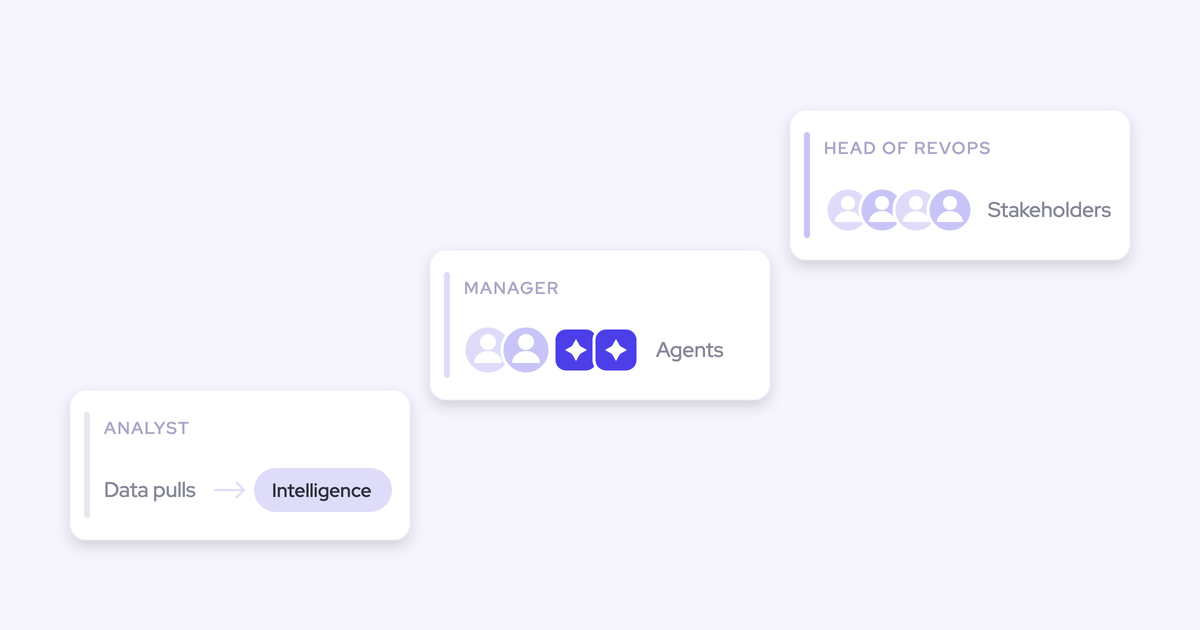
The ladder from analyst to Head of RevOps still exists, but what moves you up it has changed.
These days, seniority comes from two things: owning the systems the business runs on, and having a point of view, grounded in what customers actually say, that stakeholders act on.
What holds good operators back is getting filed as the order-taking reporting function. The way out starts with bringing your findings into the rooms where decisions already happen, like the weekly deal review.
It's the same idea behind AI-powered deal reviews in Weflow.
This article maps the rungs, the role types, the routes in from marketing ops and sales ops, the reporting-line question, and what comes after Head. You won't find salary or time-in-role benchmarks here, since we don't have reliable data on either.
What is the RevOps career path?
The RevOps career path runs from analyst, through specialist or operator and RevOps manager, to Head or VP of RevOps.
On every rung, seniority depends more and more on the systems you own and the decisions you shape, and less on how many people report to you.
That shift is turning the ladder into something closer to a portfolio. Most companies still hire against the ladder, though, so let's start there.
The RevOps rungs from analyst to Head of RevOps
Each rung is defined by what you own and whose decisions you shape, not by how long you've been around.
| Rung | What the work is | What shows you're ready for the next rung |
|---|---|---|
| Analyst | Reports, data pulls and ad hoc analysis for whoever asks | You answer the question behind the request and build with AI tooling, not only in spreadsheets |
| Specialist or operator | Owns an area such as marketing automation, system administration or cross-functional projects | You've shipped workflows other teams depend on, and you govern them after launch |
| RevOps manager | Runs specialists across marketing ops, sales ops and CS ops, plus intake and prioritization | Stakeholders act on your recommendations, and you prioritize for leaders instead of surfacing everything |
| Head or VP of RevOps | Spends most of the week with stakeholders, aligning initiatives to company objectives, and owns the most consequential systems | You're in the planning and headcount trade-offs, and your function's reach extends beyond go-to-market |
The analyst rung is under the most pressure, and some hiring leaders have stopped opening plain analyst roles altogether:
"I generally won't go higher just to straight up analyst anymore. Like there's, you know, I want somebody who's more technical. You can't just be good at Excel, you've got to be good at a lot of other things now."
— A RevOps leader on a call with Weflow
The three RevOps role types you'll find at scale
As teams grow, RevOps tends to split into three role types that sit across the rungs. Tessa Whittaker laid them out on RevOps Lab, and the split works a lot like the one between product management and engineering in a product org.
| Role type | What it owns |
|---|---|
| Business partner | Faces the executives, and owns forecasting, pipeline and the business narrative |
| Business process or product owner | Owns the end-to-end process and turns it into requirements |
| Revenue technology | Owns and builds the stack |
| Head of RevOps | Combines the executive-facing work with ownership of the most consequential systems |
If you're aiming for the Head seat, lean toward business partner work while keeping a hand on the systems. Owning the stack without owning the narrative tends to keep you in the back room.
Smaller teams draw a similar line, between front of house and back of house:
- Front of house covers reporting, analytics, forecasting and planning.
- Back of house covers the go-to-market stack, integrations, IT administration and change management.
In a small company, one person often covers all three role types. Every fire drill competes with every configuration change, so prioritizing gets brutal. If that's you, it's not a personal failing; it's the structure.
Coming into RevOps from marketing ops or sales ops
You don't need both backgrounds to get started, but you'll need both to lead.
RevOps covers the whole bow tie (marketing, sales and customer success), and since marketing ops and sales ops are very different jobs, the best RevOps leaders have usually worked in more than one.
Marketing ops gives you depth in campaigns, lead management and systems, while sales ops teaches you the deal and quota side.
A Salesforce admin background gives you the system itself, which is why so many early-stage companies make that their first sales ops hire.
| You came from | What to add |
|---|---|
| Marketing ops | Financial modeling, deal desk, compensation and forecasting |
| Sales ops | Marketing-side depth: lead management, campaigns, how pipeline gets sourced |
| Salesforce admin | The commercial model behind the system: how growth is generated and what each stage means for revenue |
Whichever side you came from, here's how to close the gap:
- Learn the assumptions inside the finance model: Finance leaders will usually walk you through them if you ask, and once you know them, your system choices start to match how the plan was built.
- Get a structured grounding in revenue architecture: Lindsay Rothlisberger, Head of RevOps at Zapier, points to Winning by Design's revenue architecture course as a recognized way to close the marketing-ops-to-RevOps gap.
- Volunteer for the work you've never touched: Such as standing up a deal desk or modeling a comp change.
- Treat the other side's metrics as your own: For example, if you came from marketing ops, try owning a sales conversion number for a quarter.
Why the RevOps ladder is turning into a portfolio
If most of the career advice you've read feels out of date, that's because the function changed underneath it. RevOps has gone through three stages:
- Help desk: Triaging requests, doing manual work and reacting.
- Change agent: Leaning on process and workflow automation as more tooling arrived.
- Builder and governor: Designing automated and AI workflows, then owning them in production.
The big shift was access to information. Insight that used to take most of the team's week to pull together now comes out much faster, so the spreadsheet-all-day work is disappearing and the job calls for higher-level skills.
"I think it's going to actually start to look more like a portfolio. Right? So it's gonna be less of like this, like, laddered career path. And it's gonna be more of like the person who's, like, overseeing the most, like, consequential systems and, like, business operation components are gonna be those, like, senior people."
Team shape follows suit.
Business-as-usual work that once took three analysts can now be covered by one person running a fleet of agents, and vertical teams for marketing ops, sales ops and CS ops are giving way to horizontal layers for architecture, engineering and governance.
| What changes | The old ladder | The new portfolio |
|---|---|---|
| What makes you senior | Headcount reporting to you | The consequential systems you own |
| How the team is shaped | Vertical ops teams per function | Horizontal layers across the customer journey |
| The entry point | The spreadsheet analyst | A more technical operator who builds |
| What the leader does | Manages people | Manages people and agents |
Org design hasn't caught up yet, and leaders are still deciding whether builders should sit inside business units or stay horizontal.
That's why the ladder is unclear even to the people hiring for it, and why it's worth acting on the shift now rather than waiting for a clear job description.
Why good RevOps operators get stuck as the reporting function
The reporting-function trap is self-reinforcing, and the honest answer to "is it me or the org?" is both. The org fills your week with requests, and the skills you neglect keep you from breaking out.
| Symptom you see | What's actually causing it |
|---|---|
| Your week disappears into report requests and CRM admin | An inherited stack and an intake process with no priority order |
| You have nothing new to say in strategy meetings | You never get close to what customers actually say |
| You're invited after the decision is made | Leadership has filed RevOps as the tooling and reporting function |
| Your recommendations stall even when they're right | You've invested in tools and data, not in influence |
There's data behind that last row. When Haris Odobasic surveyed 180 RevOps professionals across 28 countries, more than 67% spent fewer than ten hours a year improving their soft skills, even though many wanted a path into management.
"So I think this is also a limiting piece why sometimes RevOps is not strategic enough or perceived as a system admin."
And there's more at stake than a stalled promotion. Taking a request and executing it is work standard tooling already does, so an order-taking RevOps function can be replaced by plain automation before AI even enters the picture.
"Do you wanna AI-proof your role? You really have to have a POV. Otherwise, you're kind of just a cog in this workflow."
— Nicole Bradshaw, leads the centralized RevOps function at PandaDoc
Why a seat at the table isn't the finish line
Being called a strategic partner doesn't, on its own, make your company perform better.
When Insight Partners asked about 200 portfolio CROs how they see their RevOps leader, roughly 40% said "right-hand strategic partner," and the answer barely differed between top and average performers.
Jeremey Donovan, Managing Director at Insight Partners, points out that company size likely skews the result, since the first sales ops hire at a very early-stage company is usually a Salesforce admin.
Still, the lesson holds: the seat is worth having, but what really matters is what happens after you sit down, meaning recommendations stakeholders act on. Two levers get you there.
First lever: Own the systems that run the business
The first lever is building. As an operations leader, you need to productize what you ship, put it in the field, and own and govern it once it's there.
"And I think, like, anyone who's in even just, like, the operations leadership roles, like, you're gonna need to know how to build."
How much building does a RevOps leader actually need to do?
You need to build enough to design, ship and govern the workflows and agents the business runs on.
That doesn't mean becoming a software engineer or vibe coding something once and walking away. It means understanding what goes into the field and owning it after launch.
How you deliver matters as much as the analysis itself. Executives rarely log into yet another system to check how the business is doing, so your insight has to land where they already are:
"Most CEOs or CROs don't want to look into the system so much, but would prefer to just have a PDF in their inbox Monday morning."
— A revenue leader on a call with Weflow
In practice, building at operator level looks like this:
- A Monday morning pass over the pipeline that names the deals needing action and pre-writes the follow-up.
- A weekly risk scan that reaches the forecast call before the forecast call starts.
- A monthly closed-lost read that surfaces which competitors showed up and which objections recurred.
- Shared templates with fixed data sources, context and prompt structure, so the result is repeatable across the team instead of living in one person's habit.
- A recurring check that the configuration still matches how teams work, because usage drops quietly when it drifts.
Is GTM engineer your next step or a separate hire?
For most operators, GTM engineer is a partner role to lead, not the next rung. Practitioners disagree on the details, but they agree it's a genuine engineering profile.
Mollie Bodensteiner describes the craft as data modeling, prompt engineering, integrations and the logic of the infrastructure behind the motion. The strongest GTM engineers sit with reps, learn their workflows and build something closer to a product.
"I think most people in go to market operations, myself included, are not technical enough to do the, like, deep integrations and implementations that you need to actually make these agents as productive as you possibly can make them. And so the idea of, like, go to market engineering, like, I want an actual engineer to be the go to market engineer within RevOps."
That said, the engineer can't do the job without you. Lindsay Rothlisberger argues that RevOps holds the funnel context the GTM engineer depends on:
"And the GTM engineer needs to have that context too. They can't operate in a silo. They have to know how these deals progress down funnel and what the impact is of what they're doing in sourcing pipeline."
Our take: if you were an engineer before RevOps, the GTM engineer seat is a real option. If you weren't, there's no need to rebrand. Build enough to own the workflows, and position yourself as the person who decides what the engineer builds and governs it once it ships.
Second lever: A point of view backed by customer reality
The second lever is influence.
Rhys Williams, Founder and Managing Partner at Domestique, argues that leading through influence is the strongest predictor of whether RevOps gets results, since most RevOps work is change management without formal authority.
And influence doesn't come from better dashboards. It comes from a point of view grounded in what customers actually say, delivered the way a good seller would.
Sell your recommendations to stakeholders like a deal
You coach sales on methodology every day, so why not apply it to your own recommendations?
"You can be so good at your job, but if you can't get your stakeholders to heed your recommendations, you're not going to have a business impact."
— Nicole Bradshaw, leads the centralized RevOps function at PandaDoc
Here's what that looks like day to day:
- Work out the stakeholder's priorities before you build the case.
- Anticipate the objections and answer them in the material.
- Multi-thread before the meeting. Brief finance, the data team, marketing, sales, post-sale, product marketing or product in their own terms, so the recommendation arrives with support behind it.
- Time the ask around a compelling event, such as planning or a missed quarter.
- Hold strong opinions loosely. State the view the data supports, invite challenge and change it when the evidence does.
- Prioritize for the leader. Bradshaw learned this from the other side of the table when she ran sales for six months:
"I need my RevOps partner to actually prioritize for me and to tell me what to care about."
— Nicole Bradshaw, leads the centralized RevOps function at PandaDoc
Mine the call recordings your CRO will never read
The fastest way out of the reporting box is producing findings from raw customer conversations. Your CRO won't sit through every recorded call and turn it into a brief, but you can.
"There's probably no CRO that goes in, takes all your call recordings and then creates strategic insights, briefs or reports out of it. But most people in RevOps can do it. So you can go basically and say, look, I found out this is the reality and we should do something about it. And this will elevate you into a more strategic conversation."
This changes what you bring into the room. A dashboard gets skimmed and set aside, while a finding like "here's what buyers said about pricing in 40 lost deals, and here's what we should change" gets acted on.
The benefits compound, too. Routing, campaigns and plays all depend on knowing the buyer's pains and who you're up against, so the same customer insight makes your operational work better.
What shapes your ceiling: Reporting line and team size
Two structural factors shape your ceiling: who you report to and whether you're a team of one. There's no single winning model for either, and you can work within both.
Does reporting to the CMO, CRO or COO cap RevOps?
Your reporting line shapes what the role becomes. One prospect put the risk bluntly:
"if RevOps reports to the head of marketing, you're just marketing ops"
— A prospect on a call with Weflow
| Reports to | What the role tends to become | Career implication |
|---|---|---|
| CMO | Marketing ops under a bigger title | You'll have to fight to cover sales and CS |
| CRO | The revenue leader's right hand across the go-to-market team | Close to the motion, but a company-wide remit sits awkwardly here |
| COO or CFO | A neutral function serving the CRO, CMO and CS leader as peers | The best fit for a move into company-wide AI operations |
| Each functional leader directly | Separate sales ops, marketing ops and CS ops, each embedded with its leader | Deep proximity, but no single owner of the bow tie |
Jeremey Donovan lays out both sides of the trade-off. Centralizing under a neutral executive means RevOps can serve peer leaders without bias, while sitting next to the leader you support helps you understand the motion and act on its priorities.
He also notes that systems and data administration can sit somewhere different from strategy and analytics.
No model has won out yet. If your reporting line points somewhere you don't want to go, change the scope of your work first, since the reporting line usually follows.
How do you progress as a solo RevOps person?
If you're a team of one, you're far from alone: 22% of the 180 people in Haris Odobasic's survey worked as a solo RevOps person.
In a portfolio model, solo isn't a dead end, because seniority comes from the systems you own rather than the team you manage. The hard part is not having a peer.
There's rarely a colleague who's solved your problem before, but someone at another company almost always has.
A few moves that work well when you're solo:
- Pick the two or three systems the business can't run without and own them end to end, including governance.
- Find peers outside the company. RevOps Co-op and Wizops run Slack groups and in-person meetups, and RevOps Chat, the Slack community we run, has over 1,300 practitioners.
- Protect learning time for influence, not only tools. The 67% figure above is the habit to break.
- Use your breadth as your argument. You see marketing, sales and CS at once, which makes you the one person who can connect them.
How a new Head of RevOps spends the first 60 days
As a new Head of RevOps, audit before you write a roadmap. Joe Ort, Founder of RevOps Inflection, suggests roughly 30 to 60 days of audit and stakeholder conversations, or longer for more complex businesses.
Anything you recommend before then rests on guesswork.
The audit covers four areas:
- Data: What exists, how accurate it is, and whether you can track a lead from the top of the funnel through to bookings.
- Tech stack: What you own, how it's integrated, and whether sellers actually use it.
- Processes and handoffs: Whether sales stages map to the buyer's journey, and whether the marketing-to-sales and sales-to-CS handoffs are documented.
- Skills: Whether RevOps has the skills and headcount for the work ahead, and whether stakeholder teams have gaps that need training rather than a system fix.
Expect to inherit a stack nobody can fully explain. New leaders bring it up on our calls all the time:
"A lot of things from what I can see have been inherited basically on the premise that someone suggested it and they have just gone away."
— A RevOps leader on a call with Weflow
From there, work through it in this order:
- Audit the four areas.
- Baseline the metrics you plan to move, before you change anything.
- Prioritize the gaps by business impact.
- Write the roadmap and take it to stakeholders.
"One of the steps that I always skipped early on in my career that I wish I could go back and fix was not baselining things."
Skip the baseline, and you lose the one thing that makes the case for your next promotion: proof that something moved because of you.
What comes after Head of RevOps: COO or AI operations
Two routes open up after Head of RevOps:
- The operating executive path to COO: It asks you to run company operations beyond go-to-market, with the same system-and-cadence mindset.
- Company-wide AI operations: It asks you to take the AI workflows you built for sales, marketing and CS, show the return, and extend them to finance, product and engineering.
Avtar Varma argues that the AI operations route fits a RevOps team reporting to the COO better than one under the CRO, because the function touches every department.
He cites Kyle Wakefield as a RevOps leader who took on AI operations this way, broadening ops from go-to-market to the whole organization.
This opening comes from how companies adopt AI. Varma describes three phases, and RevOps is a natural fit for the third:
| Phase | What happens |
|---|---|
| 1. Open access | Everyone gets the tools and experiments alone. Lots of ideas, little repeatable value |
| 2. Centralization inside each function | One person or team per function turns what worked into shared templates, skills and agents, and coaches the team |
| 3. Company-wide AI operations | A central team joins the functions up, so everyone works from the same context and data and the company sees one combined return |
If you're already running phase two for go-to-market, you're building the case for phase three.
Where Weflow fits as RevOps becomes the orchestration layer
Weflow is the Revenue AI Orchestration platform for sales, customer success, and RevOps teams.
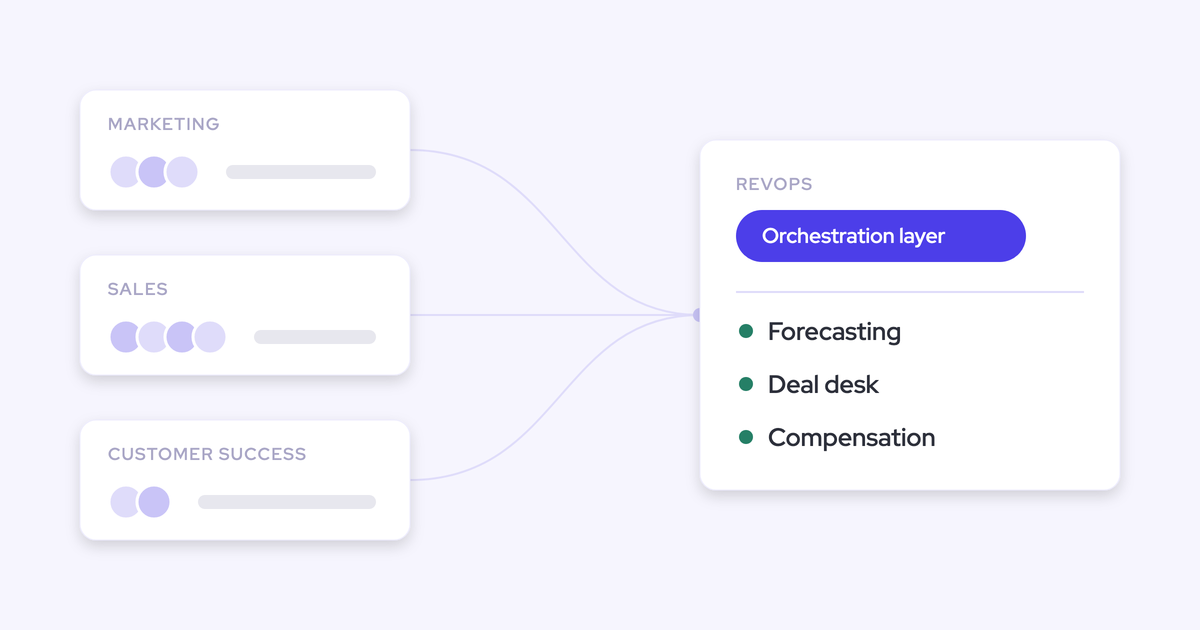
We built it around the same idea this article makes the case for: RevOps is becoming the orchestration layer that designs and governs the workflows humans and AI agents run on.
"The orchestration layer will continue to be RevOps and the interaction layer will be chat, whether that's in Slack, in a tool, or in email."
Two capabilities map to the two levers.
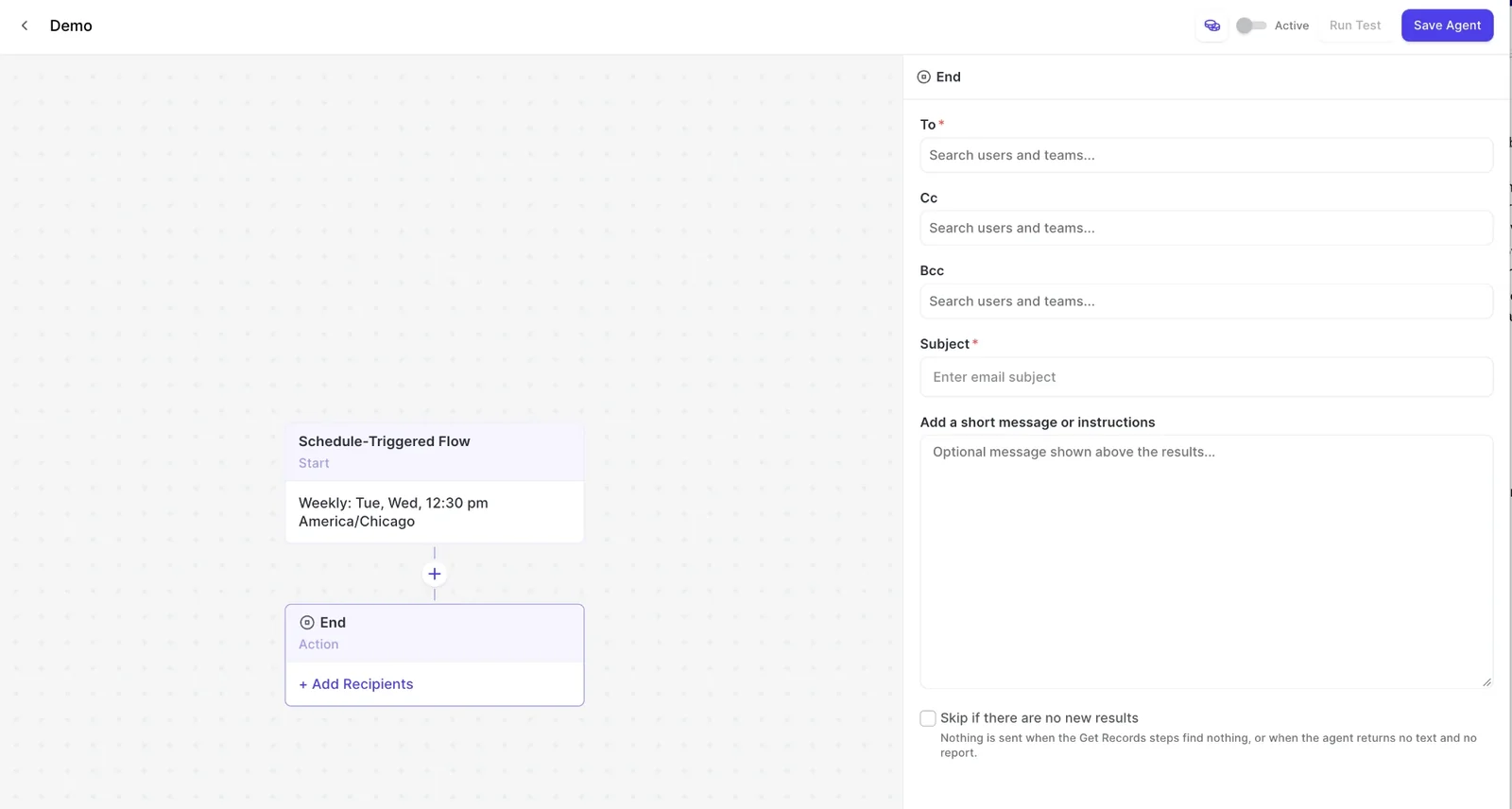
For building and governing, Weflow Agent Builder lets you set up a scheduled flow without an engineering team. A schedule triggers a live Salesforce lookup with field-level filters.
An AI step then reads the activities, emails, calls and transcripts on those records, and the end step emails the result, with a PDF report attached if you want one.
That's the Monday morning PDF executives ask for, and you own the prompt, the schedule and the recipient list.
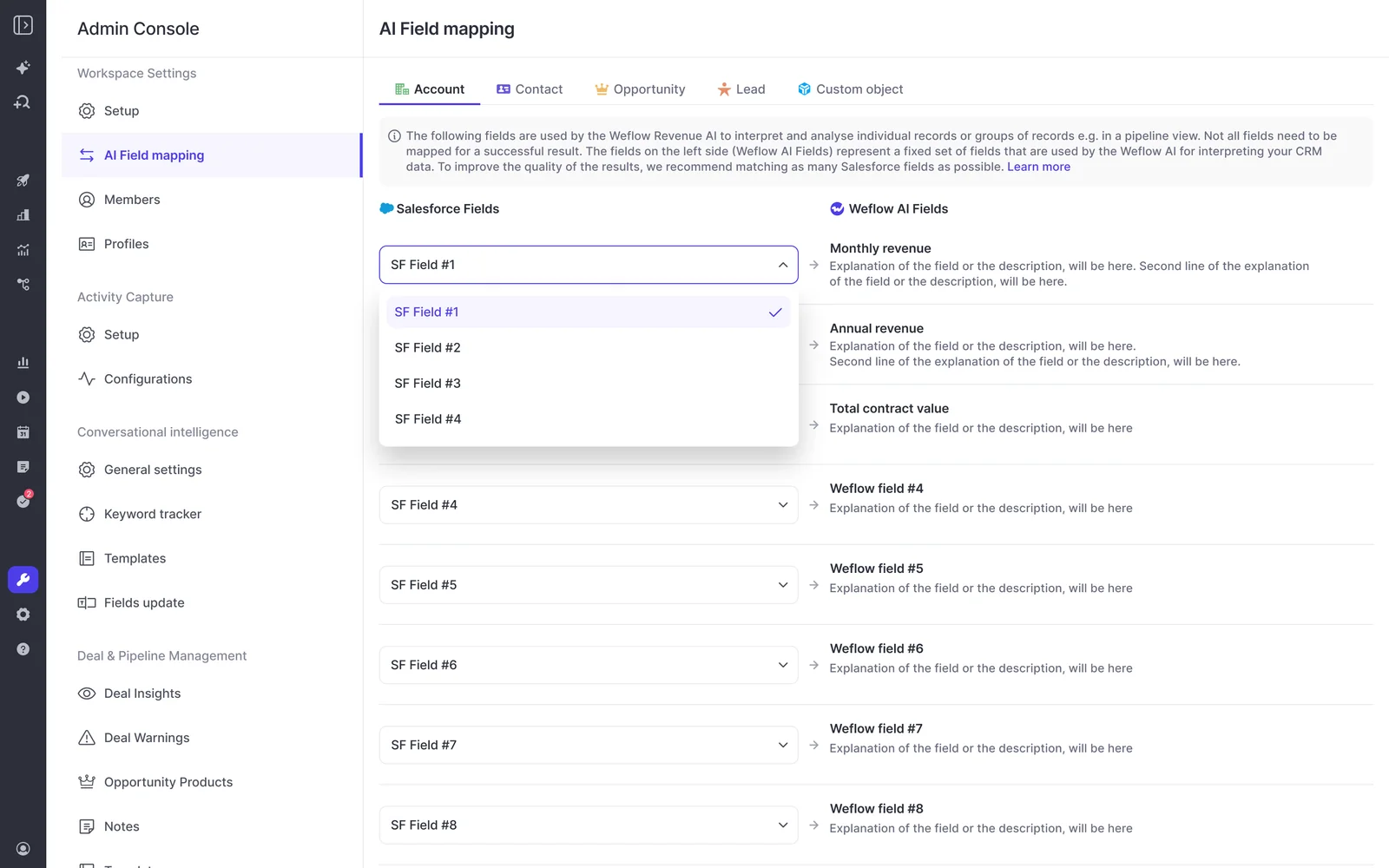
For customer reality, Weflow Conversation Intelligence records and transcribes your calls and writes what was said into Salesforce fields you map.
That puts call content in Salesforce, where your reports, automations and agents can reach it, so mining recordings becomes something you can do across hundreds of deals rather than a listening project.
That said, there are honest limits here::
- No tool builds a career. Influence, a point of view and stakeholder management are the hard part, and no platform does them for you.
- For the deep integrations behind serious agent work, you still want an actual engineer, as Avtar Varma argues above.
- Weflow works exclusively with Salesforce, so these examples won't map to your stack if you run another CRM.
Most of the evidence in this article comes from our podcast. Janis and Philipp talk RevOps, forecasting, and AI with operators who run it daily.
FAQs RevOps people ask about their career path
Will AI replace RevOps jobs?
AI will replace order-taking RevOps work, and plain automation already handles much of it. If you form a point of view, get stakeholders to act on it, and build and govern the systems the business runs on, you're much harder to replace.
How are RevOps candidates interviewed now that AI writes take-home cases?
Take-home cases don't test much anymore, since candidates use AI to write them.
Many hiring leaders now run live whiteboard sessions on a one-sentence business problem instead, to see how you handle ambiguity: the questions you ask, where you push back and how you work with the team when there's no right answer.
What is the difference between RevOps and sales ops?
RevOps covers the whole bow tie of marketing, sales and customer success, while sales ops serves the sales team. A RevOps function that only serves sales is really just sales ops under a new name.
What is the fastest way to ramp into a new RevOps role?
Run a deep research pass on the topic with an LLM, then test your own thinking against it. Alexander Müller, Founder at Revenue Enablement, recommends this over reading another book, since RevOps practice moves faster than publishing.
Pair it with early conversations with the stakeholders you'll be serving.