A RevOps manager owns the outcomes your go-to-market runs on: the shared definitions every team uses, the planning and capacity model, the operating rhythm, the stack, and which problems leadership hears first.
More and more, that also includes governing the AI agents doing go-to-market work, whether you're a team of one or the VP running the function.
Most job descriptions list tasks instead, like Salesforce admin, reports and tools. Write the role that way, and every request from every function starts to look in scope. Before long, the team becomes the ticket desk.
Take the weekly deal review. Whether your leaders run it in a spreadsheet or in Weflow deal reviews, it's either a cadence you designed and own, or a report somebody asked you to pull. That difference is the job.
Below, we break down what the role owns, how that changes as the team grows, and the skills that make it stick, drawing on what RevOps leaders at Aircall, ZoomInfo, PandaDoc, Zapier and Forrester shared with us on RevOps Lab, our podcast.
What does a RevOps manager actually own?
RevOps owns six things, and each one is an outcome. Here's how they compare to the task-list version of the job.
The sixth, governance of AI agents, is the newest, so we cover it in the AI section further down.
| The task-list version | What RevOps actually owns |
|---|---|
| Build the reports each team asks for | The single source of definitions: one meaning for pipeline, stages, ICP and every metric across marketing, sales and CS |
| Pull headcount numbers for the planning deck | The capacity model, and the neutral seat in headcount and budget decisions |
| Prepare the forecast spreadsheet | The operating rhythm: pipeline management, forecasting, business reviews and QBRs |
| Administer Salesforce and the other tools | The go-to-market stack, run as a product with employees as its customers |
| Surface every risk on the dashboard | The ranking of which two problems leadership hears first, each with the decision it implies |
| Set up the AI tools somebody bought | The governance of AI agents and the workflows they run |
RevOps owns the single source of definitions across go-to-market
RevOps exists to bring alignment across go-to-market, and a single source of definitions is how you enforce it.
Someone has to:
- Hold what "qualified pipeline" means
- Keep funnel stages consistent across teams
- Push for a regular revisit of the ICP
Other functions deprioritize this work because it's nobody else's top objective.
"The number one priority of a RevOps org is to bring alignment across the go to market team. That is why the function exists at all."
Owning the definitions also gets you out of refereeing. When marketing and sales bring different numbers and each wants you to back theirs, picking a side costs you the trust that made you useful.
The only neutral position in a number fight belongs to whoever holds the agreed definitions.
We regularly talk to teams running three versions of the pipeline waterfall (one in RevOps, one in finance, one somewhere else), each built on different objects. Their leadership meetings open with reconciling the numbers, and the decisions wait.
RevOps owns the capacity model and referees headcount
Owning the capacity model is what earns RevOps a seat in headcount and budget decisions.
Revenue leaders want more people, and the CFO wants margin.
Four parties usually sit at the headcount table:
- CFO and FP&A: Budget, top line and EBITDA.
- CHRO and talent acquisition: Whether people can be recruited and onboarded on time.
- CRO and regional GMs: The resourcing their goals need.
- RevOps: The capacity model and the data underneath it.
"RevOps sees the capacity model. We see, like, all the data. So we bring all the insights to that conversation, and we can be a neutral referee between the CRO and GMs always wanting more headcount versus the CFO who says, let's not hire."
Planning ownership covers timing, too. Laura Cross, VP and Principal Analyst at Forrester, describes RevOps as the function that tells downstream teams when the plan is solid enough to start preparing, even if it's not yet time to sign contracts.
Of course, that seat depends on executives who value RevOps. Without them, the trade-offs get made without you.
RevOps runs the operating rhythm: Pipeline, forecast, business reviews
The operating rhythm is the set of recurring cadences that run the business week to week.
Together with planning, it's one of the two pillars everything else in ops hangs off, and it usually breaks into a few sub-rhythms:
- Pipeline management: Inspection and hygiene, so pipeline stays sufficient and keeps moving.
- Forecasting: Who submits, how often, at deal or manager level, and against which quota.
- Deal reviews: The weekly inspection of the deals carrying the quarter.
- Business reviews and QBRs: Where functional and regional leaders account for the number.
Two things decide whether a rhythm holds.
The first is the data underneath it. You can't hold anyone to a KPI review when everyone knows the activity data behind it is incomplete, so the cadence gets built and then quietly ignored.
The second is timing. Scheduled AI analysis now delivers conclusions while reps are still mid-cycle, but most teams have no way to act on insights that land between meetings. Deciding who acts on them, and when, is now part of rhythm work, too.
RevOps runs the go-to-market stack as a product
Think of the go-to-market stack as a product, with employees as its customers. That's exactly how Dan Jiao runs Aircall's RevOps team.
"I told the team that we're like a product management organization now. Right? Our product is the global go to market operating system that includes all the features of a product like annual planning, capacity modeling, territory segmentation, sales process, onboarding, and renewal and expansion process, all of those things."
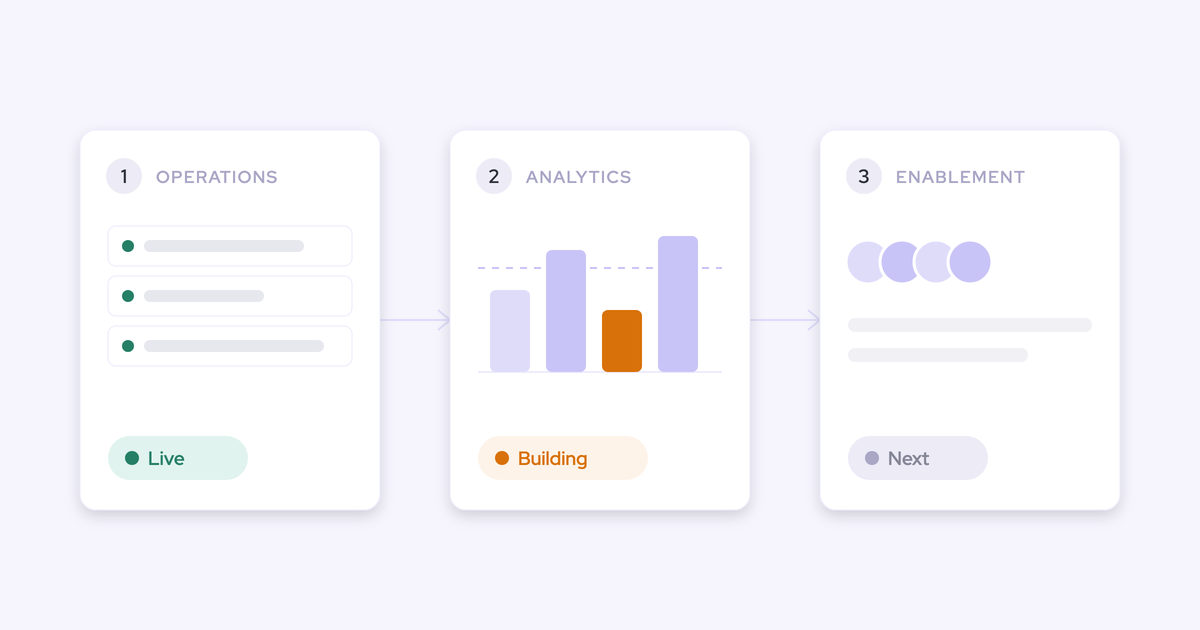
Owning the stack starts with getting the order right. Rhys Williams, Founder & Managing Partner at Domestique, sequences RevOps work like this, putting data fourth on purpose:
- Strategy
- Process
- Tools
- Data
- Enablement
That order explains the inherited stack you might be looking at right now. New RevOps leaders often tell us tools were bought because someone suggested them, and the people who chose them have since left, so nobody can say what each one was for.
That stack is now yours to fix. Before you decide what stays, re-justify each tool against a strategy and a process.
RevOps decides which two problems leadership hears first
RevOps decides which problems leadership hears, and the right number is usually two.
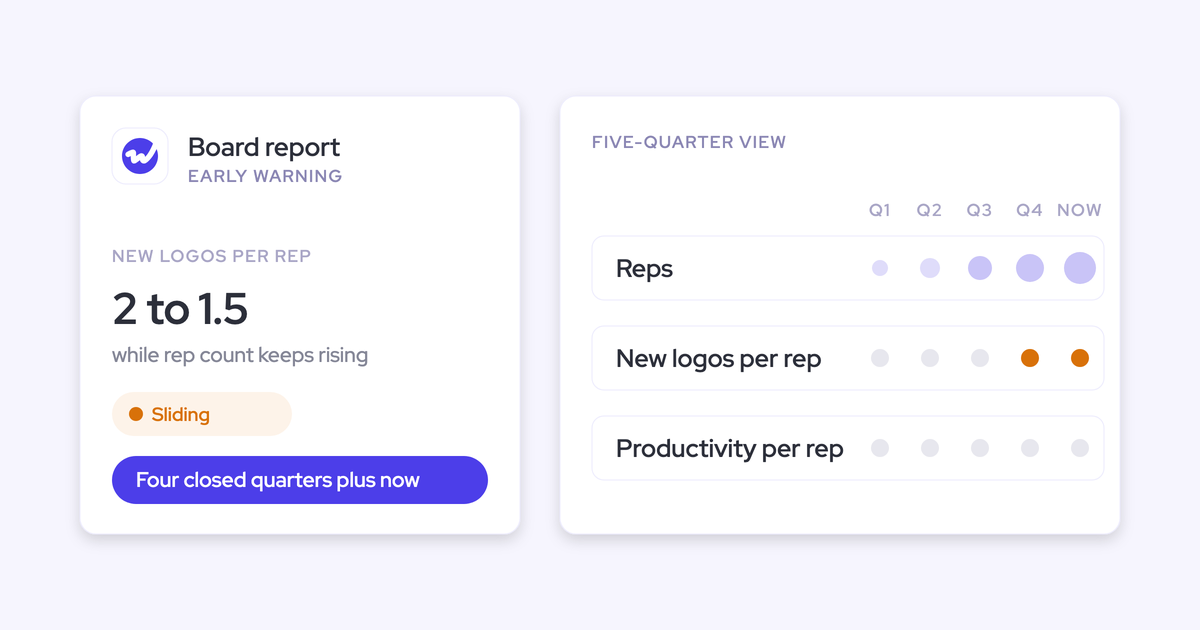
Spotting risks early is a RevOps strength, but surfacing all of them just hands the prioritization work back to an executive who already has too much on their plate.
Nicole Bradshaw, who leads the centralized RevOps function at PandaDoc, learned this firsthand when she spent six months as global sales leader.
"I need my RevOps partner to actually prioritize for me and to tell me what to care about."
— Nicole Bradshaw, leads the centralized RevOps function at PandaDoc
So rank the problems, bring the ones that move the business, and attach the decision each one implies.
A CRO looking at fifty metrics won't act on any of them, but a CRO with two problems and two recommendations can act this week.
How RevOps differs from sales ops and marketing ops
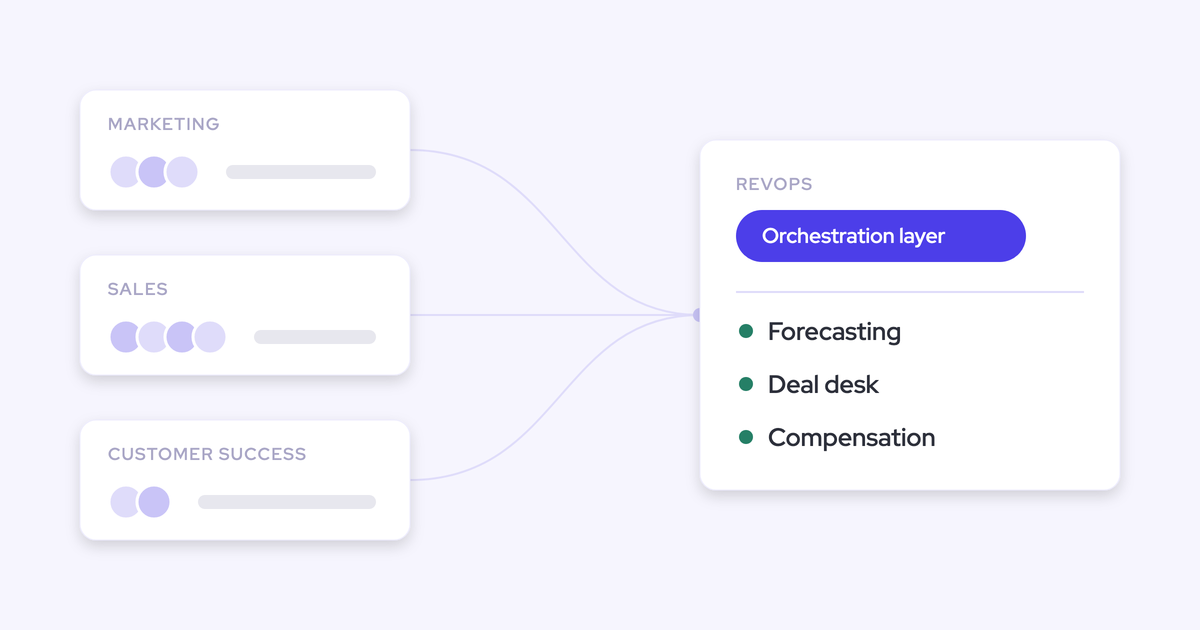
RevOps spans the whole bow tie, covering marketing, sales and customer success, and often reaching well past closed-won. A RevOps team that only serves sales is really sales ops under a new name.
| Sales ops | Marketing ops | RevOps | |
|---|---|---|---|
| Who it serves | The sales org and its leaders | The marketing team | Marketing, sales and customer success together |
| Where scope ends | Closed-won | The handoff from marketing to sales | Past closed-won into renewal and expansion; in a consumption business, most of the work sits after the signature |
| Core ownership | Planning (budget, capacity, quota) and the sales operating rhythm | Campaigns, lead management, attribution and the marketing systems | Shared definitions, the capacity model, the full operating rhythm, the stack and AI agent governance |
| Typical skills | Pipeline and forecast rigor, quota and capacity math | Campaign operations, automation, ROI and attribution | Financial modeling, deal desk, compensation, and influence across executives |
| Usually reports to | The sales leader | The marketing leader | No standard yet: CRO, COO, CFO or the functional leaders |
The best RevOps leaders have worked in more than one of these disciplines, because marketing ops and sales ops are different jobs.
At an early-stage company, there's a quick scope test: if marketing and sales both drive pipeline, marketing ops deserves as much RevOps attention as sales does.
Why RevOps teams get stuck as a reporting function
The reporting label is structural, and it reinforces itself. The way out is defining the role by what it owns.
How a RevOps team gets labelled tooling and reporting
Most RevOps teams get labelled "tooling and reporting" through the same five steps, each one leading to the next:
- The function is born tactical: At early-stage companies, the first RevOps hire is usually a Salesforce admin.
- Efficient growth keeps it small: RevOps carries no quota, so it gets no headcount, even when an AI mandate lands on top of the existing workload.
- Intake swallows the week: Questions, report requests and admin on tools nobody documented fill the days, and the roadmap you're measured on doesn't move.
- Influence and customer time disappear: There's no time left for stakeholder work or for getting close to what customers actually say.
- The label gets confirmed: You're invited after the strategy is set and asked for the dashboard, not the recommendation.
And it's a loop: a team kept away from customer reality has nothing to say about strategy, and that silence proves the label right.
Why "be more strategic" won't get RevOps unstuck
Telling RevOps to "be more strategic" doesn't break the loop. If you've always suspected that, the data backs you up.
Jeremey Donovan, Managing Director at Insight Partners, shared a finding on RevOps Lab: when they asked about 200 portfolio CROs how they see their RevOps leader, roughly 40% said a right-hand strategic partner.
That answer barely differed between top-performing and average companies.
What actually separated the top companies was operational discipline on the basics, done every week.
So don't apologize for operational work. Automating the data entry reps hate, speeding them up, and giving leaders better visibility often creates more value than a project that only sounds strategic.
Besides, outside very large companies, a dedicated strategy job barely exists.
The label changes when you own outcomes and communicate them in each audience's terms, not when you call the same work "strategic."
How RevOps ownership scales from a team of one
The ownership areas stay the same at every team size. What changes is how you divide them, and what you personally hold.
What a RevOps team of one owns alone
As a team of one, you own the entire function and wear every hat at once. You're also far from alone: in a survey of 180 RevOps professionals by Haris Odobasic, Co-Founder of Revenue Visions, 22% worked solo.
Here's how one solo operator described it to us:
"we handle pretty much all the tool stack and strategy and admin of pretty much everything. So we're a bit underwater at the moment."
You can't do it all, so don't try. Tessa Whittaker shared a method on RevOps Lab that works well here:
- List every task you do.
- Quantify the hours each one consumes.
- Rank automation candidates by time saved, not by how easy they look to automate.
Then push the highest-hour work to automation and AI tools first.
The solo setup works best at small, engineering-heavy startups, where the operator often reports straight to the COO. But wherever you sit, hold on to these four:
- The definitions: Nobody else will keep them, and no tool can.
- Planning and the pipeline and forecast rhythm: Everything else in ops hangs off them.
- The stack decisions: What gets bought, what stays and what goes.
- The top two problems leadership hears: Ranking them is the part automation can't do for you.
How larger RevOps teams split ownership: Four working models
Once you have a team, you'll need to decide how to split the work. Practitioners on RevOps Lab run four models, each protecting something different.
| Model (and who runs it) | How it splits the work | What it protects |
|---|---|---|
| Business partner / business process / revenue technology (Tessa Whittaker) | Business partners face executives and own forecasting, pipeline and the business narrative. A process team turns the full process into requirements. A revenue technology team owns and builds the stack. | Keeps always-on work separate from project work, so picklist requests don't eat the roadmap. Mirrors how product orgs split product management from engineering. |
| Front of house / back of house (Navin Persaud) | Front of house covers reporting, analytics, forecasting and planning. Back of house covers the tech stack, integrations, IT administration and change management. | Separates decision support from systems work while staying a one-stop shop. Makes it obvious that internal build projects compete with core work, because both halves already run at capacity. |
| Funnel-stage owners (Lindsay Rothlisberger, Zapier) | One owner per funnel, such as inbound and outbound. Each owner works in a pod with marketing counterparts on experiments for that funnel. | Accountability. One person owns an outcome, instead of everyone holding a partial view through one tool or process each. |
| Center of excellence plus embedded business partners (Dan Jiao, Aircall) | A global center designs and governs planning, analytics, cadence and ops standards. A business partner embeds with each regional GM, reporting to RevOps with a dotted line to the GM. | The global standard, plus regional differences the numbers alone can't explain. Fits companies run by regional GMs. |
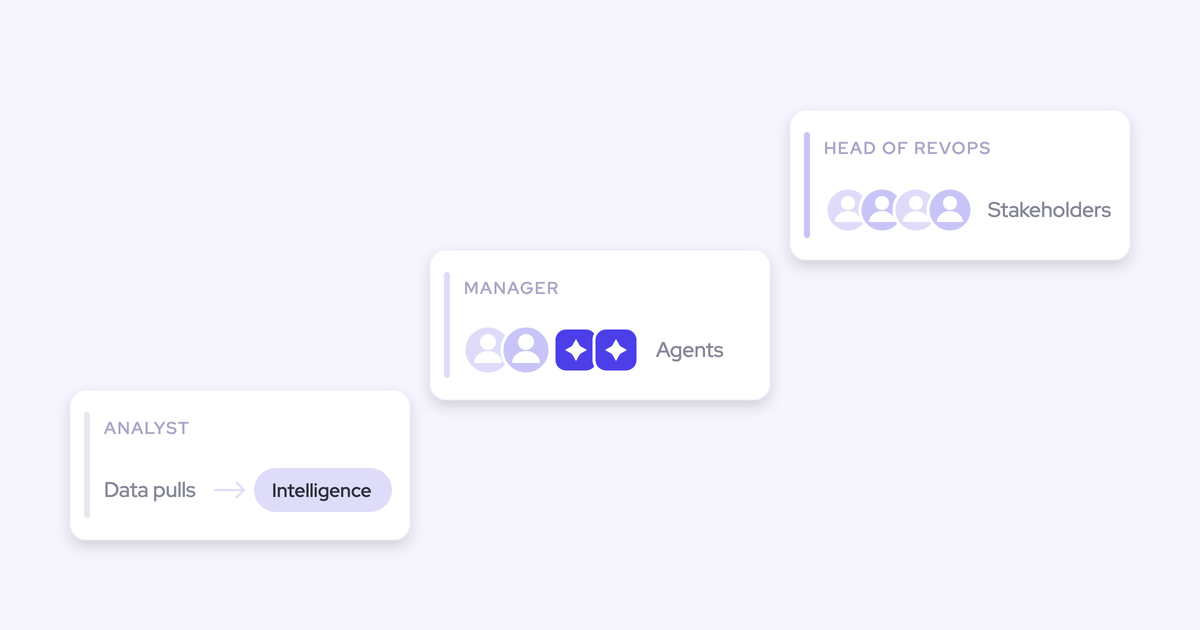
As the team grows, your own job shifts, too. A Head or VP of RevOps spends most of the week with stakeholders, aligning initiatives to company objectives, while the team handles the operational work.
AI is also pulling teams away from separate marketing, sales and CS ops units. Mollie Bodensteiner, VP of RevOps at ZoomInfo, describes the move toward horizontal layers for architecture, engineering and governance.
Who should RevOps report to: CRO, COO, or CFO?
There's no winning reporting model yet. Each line changes what RevOps can own, so the more useful question is what you give up with yours.
| Reports to | The case for it | The tradeoff |
|---|---|---|
| CRO | Closest to the revenue motion. Jeremey Donovan sees a large advantage in a leader having their ops person as their right hand. | RevOps drifts toward serving only sales, and company-wide work such as AI operations sits awkwardly under a CRO. |
| COO | Neutral across the CRO, CMO and chief customer officer. The best fit for growing into company-wide AI operations, and common for solo operators at engineering-heavy startups. | Further from the day-to-day motion of any single revenue team. |
| CFO | A neutral executive with planning and margin built in, serving revenue peers without bias. | The same proximity cost: an ops leader away from the functional leader understands that motion less. |
| Functional leaders | Strategy, analytics and planning work best as each leader's right hand, acting on that motion's priorities. | The bow tie fragments. If RevOps reports to the head of marketing, it's marketing ops. |
Systems and data administration can also follow a different reporting logic from strategy and analytics. Either way, pick the line that protects the ownership areas your company needs most, and know which ones it puts at risk.
RevOps manager skills: Building, finance, influence, point of view
Tool and data skills are table stakes. What decides whether RevOps gets heard (and promoted) are four others: building, finance and sales process, influence, and a point of view.
Building: RevOps leaders now need to build, not just request
The pure spreadsheet analyst profile is fading. RevOps leaders tell us they no longer hire Excel-only analysts and want someone more technical instead, and that goes for the leaders themselves, too:
"And I think, like, anyone who's in even just, like, the operations leadership roles, like, you're gonna need to know how to build. Right? And, like, and not just, you know, I can go in and, like, vibe code something, like, really understand, like, how to productize, like, what you're building and what's going into the field and, like, own and manage that too."
Seniority shifts with it. In AI-era RevOps, the most senior people are the ones who own the most consequential systems, whatever the size of their team. Organizations flatten, and managers end up running both people and agents.
Financial modeling and deal desk: The gap ops specialists hit
When you move from marketing ops or sales ops into full RevOps, the first gaps to show up are usually financial modeling and sales process. Lindsay Rothlisberger, Head of RevOps at Zapier, points to knowing how to stand up a deal desk as one of them.
The full RevOps charter also adds:
- Compensation
- Deal desk
- Forecasting
- The revenue architecture that connects them
If you want to close the gap, Winning by Design's revenue architecture course is a well-known option. It reframes operational work as a model of how growth gets generated, which makes the broader charter easier to take on.
Influence: The RevOps skill most teams underinvest in
Rhys Williams names influence without authority as the strongest predictor of how well a RevOps leader performs.
In Haris Odobasic's survey across 28 countries, more than 67% of RevOps professionals spent fewer than ten hours a year on soft skills, even though many of them wanted a path into management.
Most RevOps work is change management, and you rarely have authority over the people who need to change. The good news is that you already know how good selling works, so apply it to your own stakeholders:
- Work out the stakeholder's priorities before you pitch the recommendation.
- Anticipate the objections and answer them in the stakeholder's terms.
- Multi-thread. Brief finance, the data team, marketing or product ahead of time, so the recommendation arrives with support behind it.
- Time the ask around a compelling event.
- Hold executives to the agreed source of truth when a competing report shows up, and take the discrepancy offline.
"So if you think about RevOps again, like you can be so good at your job, but if you can't get your stakeholders to heed your recommendations, you're not going to have a business impact."
— Nicole Bradshaw, leads the centralized RevOps function at PandaDoc
A point of view grounded in customer reality
RevOps sees how data, processes and systems connect across the company, so when you stay quiet, leadership decides with a blind spot.
"So, I kind of explain it to my teams as like, if you think about a conspiracy theorist wall, we are that wall. And so if we aren't the ones showing those connections, there's gonna be a miss in the execution of what's being talked about in the room."
— Nicole Bradshaw, leads the centralized RevOps function at PandaDoc
Staying close to customer reality is what gets you into strategy conversations before they're settled.
No CRO has time to read every call recording and turn it into briefs, but a RevOps leader can. And leaders act on what customers actually say in a way they rarely act on dashboards.
Hold your view the way a strong seller does: strong opinions, held loosely. State what the data supports, invite challenge, and change your view when the evidence does.
How AI is changing the RevOps job description
As Mollie Bodensteiner at ZoomInfo puts it, the team that used to report on the business is becoming the team that builds and governs the systems running it.
Agent orchestration is now a line in RevOps job descriptions
Orchestrating AI agents now shows up in RevOps job descriptions, including at frontier AI companies like xAI.
"What I find really, really interesting is that suddenly we see responsibility for orchestrating agents as part of the job description of revenue operations."
It lands on RevOps because no other go-to-market function already owns the data, tools and processes agents depend on.
In practice, that means:
- Setting up the agents
- Deciding which AI tools enter the stack
- Treating agents as a channel in their own right
Reps can't each manage five to ten agents, so someone has to design and run the shared workflows. Whether a separate go-to-market engineer role ends up running them day to day is still an open question.
Will AI replace RevOps? Only the order-taking part
No. AI replaces the order-taking part of RevOps, which standard automation was already chipping away at before AI showed up.
Taking a request and executing it is easy to automate. Forming a recommendation, deciding what matters, and getting stakeholders to act on it is much harder.
"AI can absolutely take orders and execute. ... Do you wanna AI-proof your role? You really have to have a POV. Otherwise, you're kind of just a cog in this workflow."
— Nicole Bradshaw, leads the centralized RevOps function at PandaDoc
RevOps designs the workflows; Chat becomes the interaction layer
In an AI-run revenue org, RevOps becomes the orchestration layer that designs agents and automated workflows, while chat becomes the interaction layer for everyone else.
| Orchestration layer (RevOps owns) | Interaction layer (users) | |
|---|---|---|
| Who works here | RevOps | Reps, managers, VPs and CROs |
| What happens here | Designing agents and automated workflows, and governing them | Asking questions and getting answers in Slack, a tool, or email |
| Examples | Scheduled executive reports, deal review and forecast workflows, pre-written follow-ups | Asking which deals are at risk in chat, instead of filing a report request |
| What fades | Building one-off Salesforce reports beyond auditing and field updates | Logging into another system to see how the business is doing |
"The orchestration layer will continue to be RevOps and the interaction layer will be chat, whether that's in Slack, in a tool, or in email."
The role has moved through three stages to get here:
- Help desk: Triaging requests, doing manual work, reacting.
- Change agent: Leaning on process and workflow automation as more tooling arrived.
- Builder and governor: Building automated and AI workflows, and governing them once they're live.
How Weflow takes ticket-desk work off a RevOps team
Weflow is the Revenue AI Orchestration platform for sales, customer success, and RevOps teams. We built it for Salesforce teams to take ticket-desk work off RevOps' plate, so your time goes into the ownership areas above.
Think of it as one worked example of the RevOps Orchestration Layer in practice. Here's what it takes off your plate, and where it doesn't fit.
What Weflow automates: Provisioning, role dashboards, executive reports
Weflow automates four kinds of work that tend to eat up a RevOps week:
| The ticket-desk task | What Weflow does instead |
|---|---|
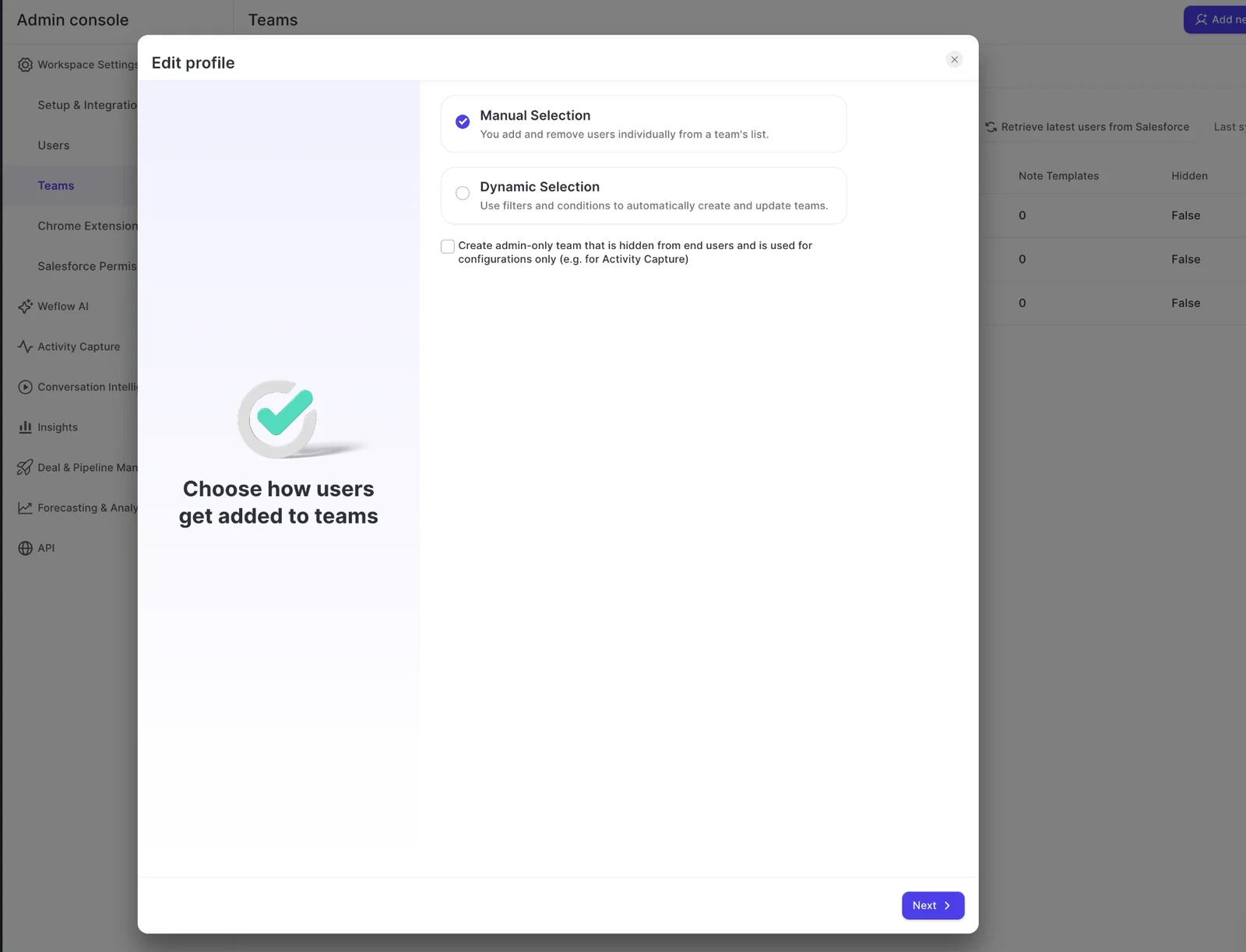
| Adding and removing users in a separate tool every time someone joins, leaves or changes team | Weflow builds teams dynamically from Salesforce by manager, role or field condition. A rep who moves team in Salesforce moves in Weflow automatically. Users who are only on Weflow Activity & Contact Capture need no Weflow seat and don't have to do anything. |
| Rebuilding a dashboard for every rep or manager who wants their own view | You design an Insights dashboard once and assign it to teams from the Weflow Admin Console. Each role opens the board built for it, and you revise it centrally. |
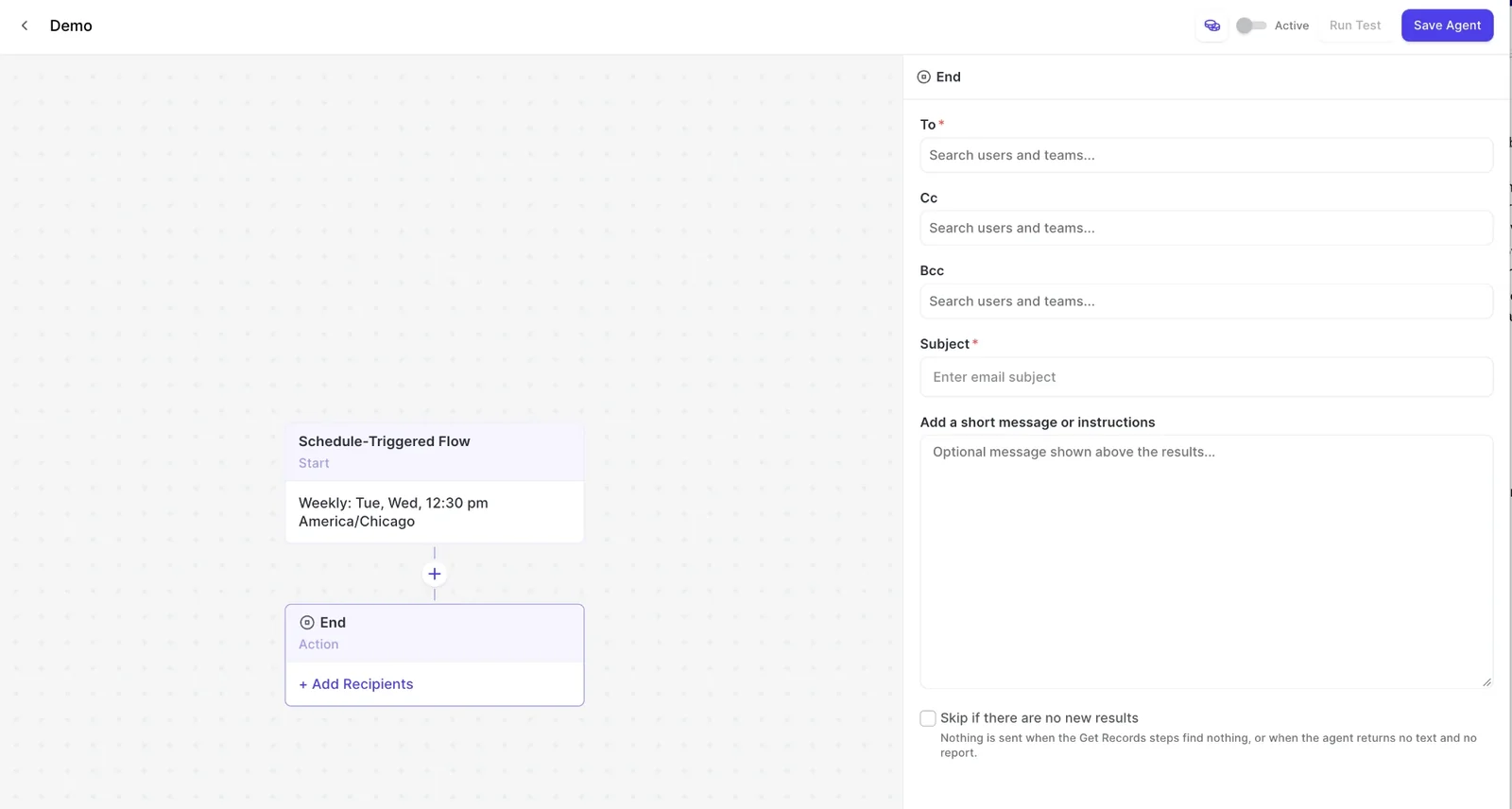
| Pulling the Monday pipeline update for executives who won't log into another system | Weflow Agent Builder runs a scheduled flow that reads Salesforce live, analyzes the records with an AI Agent step, and emails a pipeline snapshot or deal-risk PDF to the executive's inbox. |
| Running an implementation project your team has no time for | Implementation is free and typically live in two to three weeks. With the managed-service option, Weflow does the heavy lifting while your RevOps team answers questions and unlocks access. |
Dynamic selection is a setting on each team in the Weflow Admin Console.
The same agent pattern can run other recurring plays:
- A weekly risk scan before the forecast call.
- A monthly closed-lost analysis that reads every lost opportunity for recurring competitors and objections.
The report itself goes out from the End step of the flow, to the users and teams you choose.
Where Weflow isn't the right fit for a RevOps team
A few situations fall outside what Weflow is built for:
- Influence and the seat at the table: A tool can't give RevOps influence, shared definitions or a seat in strategy conversations. Since strategy and process come before tools and data, Weflow helps once that groundwork exists.
- Other CRMs: Weflow works exclusively with Salesforce. Teams on HubSpot, Dynamics or another CRM fall outside the fit.
- Very small teams: Weflow's bundles start at $49 per user per month, billed annually, with a 10-user minimum. A solo operator at a very small company sits below that line.
- No owner for configuration: Weflow Conversation Intelligence runs on per-team prompts, scorecards and field mappings, so it needs a named internal owner. Without one, templates go stale and the output degrades. Activity capture largely runs itself.
If influence and a point of view are the skills you're building next, learn them from people doing the job. On RevOps Lab, Janis and Philipp talk RevOps, forecasting, and AI with operators who run it every day.
RevOps manager role: FAQ
Is a RevOps manager just a Salesforce admin?
No, though the role often starts there, since the first RevOps hire at an early-stage company is usually a Salesforce admin.
A RevOps manager owns the shared definitions, capacity model, operating rhythm, stack and problem prioritization, all of which reach well beyond the CRM.
How do I say no to requests outside RevOps' scope?
Turn every request into a trade-off. Keep one list of everything in flight, estimate the effort per item, run a capacity model, and use an above-the-line versus below-the-line rule so a new request visibly displaces something.
When executives compete for the same capacity, agree on one stack rank in a single session with the CRO and their direct reports, then execute against it.
What should a new RevOps leader do in the first 90 days?
Start with an audit before you change anything. A RevOps audit should cover four areas: the data, the tech stack, the processes and handoffs, and the skills of both your team and the teams you serve.
Then analyze why the numbers look the way they do and align executives on priorities before you build. That's the order the 5A framework from Joe Ort, Founder of RevOps Inflection, follows.
How do I prove the impact of RevOps work?
Baseline every process metric before the project starts. Bookings get recorded anyway, but you'll only know how long a quote or workflow takes if someone measured it beforehand.
Joe Ort calls skipping the baseline the step he most wishes he could go back and fix.
Can a RevOps career path lead to COO?
Yes, and the path often runs through AI operations. A RevOps leader builds AI workflows for sales, marketing and CS, shows the return, then extends them to the rest of the company.
That move is easier when RevOps reports to the COO rather than the CRO, since AI operations touches finance, product and engineering.
How is RevOps different from a GTM engineer?
A GTM engineer builds the integrations and workflows, while RevOps holds the funnel context that says what's worth building.
Lindsay Rothlisberger at Zapier argues the GTM engineer can't operate in a silo, because sourcing more meetings only matters if those meetings progress down the funnel.
Avtar Varma makes the case that the role works best as an actual engineer inside RevOps, since deep agent integrations need real engineering skills.