


101 Agents for RevOps (Free)
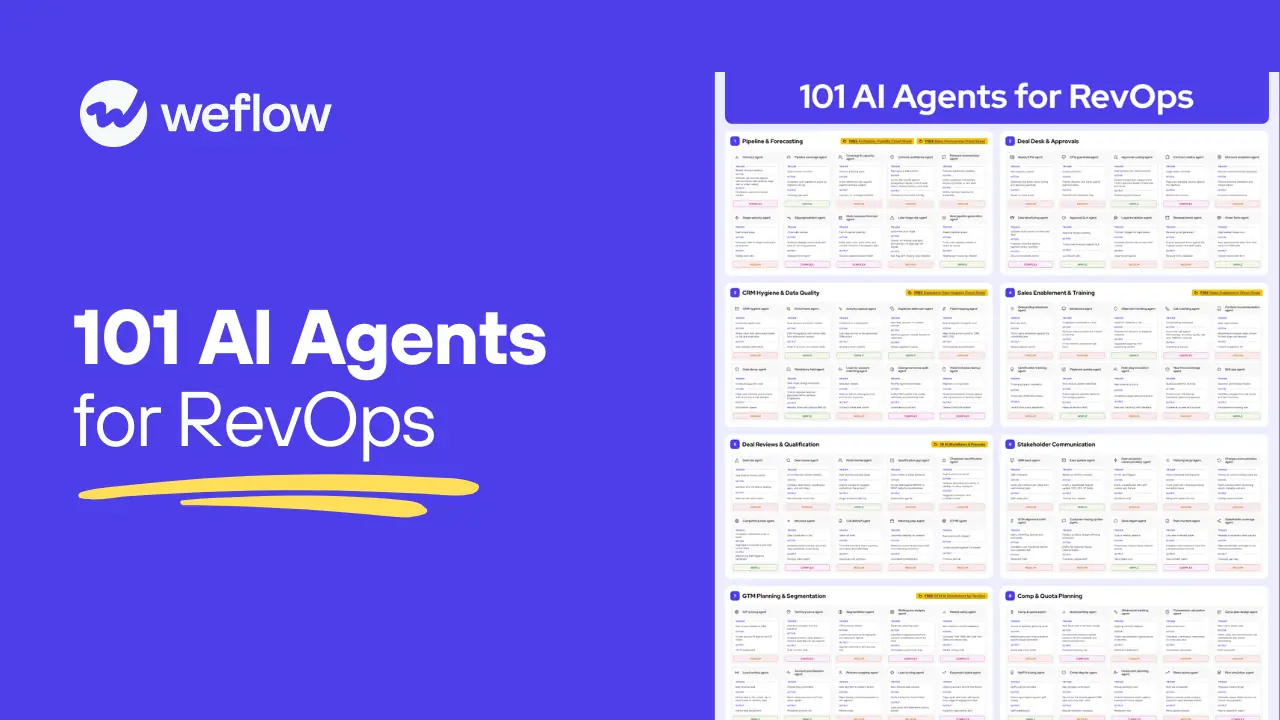
Everyone's asking RevOps to run AI agents. But nobody tells you which ones you can actually run. So we mapped 101 agents for RevOps across 10 areas:
- RevOps Ops
- Reporting & metrics
- Pipeline & forecasting
- Deal Desk & approvals
- Comp & quota planning
- and more!

"With Weflow, we’re now capturing all relevant activities and have full transparency into the performance of each sales rep. It’s a game changer."



"Weflow gives us better visibility and predictability of our business."




"Weflow eliminated the need for our VP to ask, ‘Did you follow up with that deal?’. It tracks customer interactions automatically, creating a framework that drives accountability across the team."



"None of the other tools gave us a solution like Weflow. From the beginning, we had a really smooth process."


"I had a first introductory call with Weflow. I think I was sold after 15 minutes. There’s no question that the people at Weflow understood the problems that we were trying to solve."


"I’ve worked with Gong before, but Weflow’s simplicity and real-time sync are game-changing."



"We use Weflow to auto-capture activity data, run deal reviews, and analyze our pipeline to inform our forecast. Being able to spot deal risks early has improved win rates and pipeline health."



What's Inside
Pipeline risk and forecast agents
- Agents mapped to weekly commits, coverage checks, slippage patterns, and end-of-quarter scenario modeling across best-case, worst-case, and commit
- Commit confidence scoring based on multi-threading, activity recency, and next steps, plus stalled-stage and late-stage missing-step alerts
- RevOps outputs including confidence-adjusted forecast numbers, coverage gap alerts, capacity heatmaps, and written forecast commentary for leadership
Revenue process and CRM automation
- Deal desk workflows spanning quote generation, discount guardrails, approval routing, legal escalation packets, renewal validation, and order form creation
- CRM control points from nightly hygiene writes and enrichment on record creation to duplicate detection, lead-to-account matching, and governance scorecards
- Planning and comp mechanics covering territory carving, segmentation, whitespace analysis, quota setting, commission calculation, ramp quotas, and payout simulation
Rep execution and deal support
- In-flight qualification agents scoring MEDDIC or BANT gaps, identifying champions from activity data, and generating pre-read deal review docs
- Frontline enablement with competitor-triggered battlecards, objection matching, stage-based content recommendations, call coaching scorecards, and buyer persona role-plays
- Communication layer covering QBR decks, stakeholder-specific exec updates, escalation briefs, GTM alignment briefs, meeting recaps, and post-mortem reports

Weflow
Weflow is a modular Revenue AI platform for RevOps leaders and revenue teams, powering pipeline, forecasting, and deal inspection for 200+ B2B companies. The team behind Weflow also hosts the RevOps Lab podcast and runs RevOps Chat, the Slack community for 1,000+ RevOps practitioners.


Go Deeper
16 AI Workflows for RevOps: Deal Scoring, Forecasting & CRM Hygiene
#114 Running RevOps on AI Workflows & Agents
Free AI Agent Ops Cheatsheet for RevOps
Frequently asked questions
What exactly is an AI agent in this context, and how is it different from a regular CRM automation or workflow rule?
A workflow rule fires a static action when a condition is met — move a stage, send an email, update a field. An AI agent reasons over inputs, applies judgment, and produces a structured output like a confidence score, a narrative, or a risk flag. The commit confidence agent, for example, doesn't just check if a deal is marked commit — it weighs engagement signals like multi-thread status and activity recency before issuing a score.
Do I need a specific AI platform or tech stack to actually run any of these agents?
The cheat sheet is platform-agnostic — it gives you the trigger, action, and output for each agent, not a vendor prescription. You could build many of these on top of tools like Clay, Salesforce Flow with an LLM layer, HubSpot with AI integrations, or purpose-built platforms like Pocus or Gong. The value here is knowing what to build, not which button to click.
Which of these 101 agents should stay human-led rather than automated?
Anything that touches a rep relationship or a high-stakes judgment call deserves a human in the loop — the comp dispute agent, the deal escalation communication agent, and the champion identification agent are good examples. Use the agent to compile the inputs and draft the output, but have a human review before it goes anywhere that matters. Automating the prep is fine; automating the decision on a $200K deal is not.
What data do I need to have clean and in place before most of these agents will actually work?
The agents in the Pipeline, Deal Reviews, and Comp sections all depend on reliable CRM data — accurate stage dates, populated qualification fields like MEDDIC, logged activity, and correct close dates. If your reps aren't logging calls or your stage progression is inconsistent, agents like the stage velocity agent or the slippage pattern agent will surface noise, not signal. Start with the CRM hygiene agents in section three before layering on anything analytical.
How do I know if the forecast commentary or deal review outputs these agents produce are actually good enough to use?
Run the agent output alongside your existing human-produced version for two or three cycles and compare them directly — look for gaps in reasoning, missing context, or factual errors against what you know about the deal. For the forecast commentary agent specifically, check whether the narrative correctly explains the week-over-week swing before you let it go to leadership. Treat the first month as calibration, not deployment.
How often should I revisit which agents I'm running as my GTM motion changes?
Quarterly is a reasonable default — tie it to your territory planning or comp cycle review. If you add a new segment, change your qualification methodology, or restructure territories, agents like the ICP scoring agent, the quota setting agent, and the lead routing agent will need their logic updated to reflect the new model. An agent built on last quarter's ICP criteria is just automating the wrong thing faster.