
Revenue operations (RevOps) is the function that decides how a company goes to market.
It sets the definitions, processes, systems, and cadence that marketing, sales, and customer success all run on, so it's judged by what it decides, not by how many reports it ships.
That definition comes from operators we've interviewed on RevOps Lab, our podcast, including RevOps leaders at Aircall, ZoomInfo, PandaDoc and Zapier, analysts at Forrester and an investor at Insight Partners.
None of them describe the job as a ticket queue, though most of them have worked in one.
If your mandate was never written down, you've probably seen how that happens: the function absorbs whatever the last request was.
In this guide, we'll walk you through the scope you can write into your mandate, the order to build and run the function in, where these operators openly disagree and where the role is heading
What is revenue operations (RevOps)?
Revenue operations is the function that designs and runs a company's go-to-market operating system across marketing, sales and customer success: the shared definitions, process, systems, data and cadence the revenue teams work from.
The key word here is "designs." A report tells the CRO what happened last quarter, while RevOps decides:
- What counts as a qualified opportunity.
- How a deal moves from sales to onboarding.
- Which forecast the board sees.
- When each team reviews its numbers.
Those decisions are the real work, and the dashboards come out of them.
The scope is the whole bow tie, from first touch through renewal and expansion. As Janis Zech, our CEO, put it on RevOps Lab, when RevOps only serves the sales team, it's just sales ops under a new name.
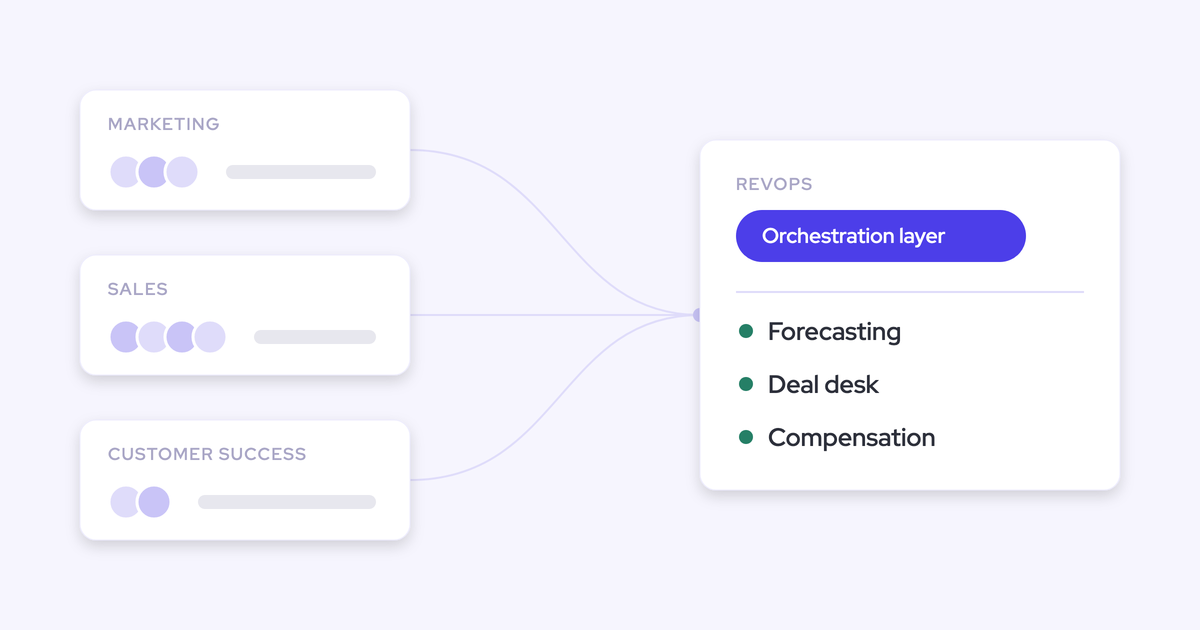
Looking ahead, RevOps also designs the AI agents and workflows those teams use, a stage we call the RevOps Orchestration Layer.
Why companies brought sales, marketing and CS ops under RevOps
Companies brought sales ops, marketing ops and CS ops under one function because each grew up serving a single leader, so the customer journey broke at every border between them.
Each ops team had its own tools, its own definitions and its own numbers, so marketing counted pipeline one way, sales another and finance a third.
Handovers carried the contract but lost the reasoning, so customer success ended up re-asking questions the buyer had answered months earlier.
Nobody owned the shared definitions, because keeping them shared was nobody's top objective. That's the gap RevOps exists to fill.
"The number one priority of a RevOps org is to bring alignment across the go to market team. That is why the function exists at all."
According to Hardey, alignment comes from three things:
- One source of definitions
- A forced, regular revisit of the ICP
- Reporting that supports segmentation analysis
That work only gets done when someone owns it full time.
| Area | Siloed ops | RevOps |
|---|---|---|
| Definitions | Each team defines a lead, an opportunity and churn its own way | One source of definitions every team works from |
| Pipeline numbers | Competing waterfalls built on different objects | One version of the facts leadership acts on |
| Handovers | The contract crosses over, the context stays behind | A designed handover from sale to onboarding to renewal |
| ICP | Set once, rarely revisited | Revisited on a regular schedule |
| Tools | Each team buys its own | One tech stack, decided against one process |
What RevOps owns across marketing, sales and customer success
RevOps owns a defined system, and writing it down is how you protect your time: anything outside it becomes a request you can prioritize, not an obligation.
The go-to-market operating system RevOps designs and runs
Dan Jiao, VP RevOps at Aircall, gives his team a useful framing.
"We're like a product management organization now. Our product is the global go to market operating system."
Thinking of it this way gives you a feature list you can drop straight into a mandate.
| Component | What RevOps decides | Example from a named operator |
|---|---|---|
| Planning | Annual plan, capacity model, quota and when downstream teams can start planning | Laura Cross (Forrester): RevOps tells downstream teams they have enough to plan before finance signs off final budgets |
| Operating rhythm | The recurring cadences, starting with pipeline management and forecasting | Jeff Ignacio: planning and the operating rhythm are the two pillars everything else hangs off |
| Territory and segmentation | How the market is cut and assigned | Dan Jiao (Aircall): RevOps centralizes segmentation and co-designs territories with first-line leaders |
| Process | Sales stages, onboarding, renewal and expansion | Dan Jiao (Aircall): all listed as features of the operating system |
| Definitions and ICP | The single source of definitions and the ICP review schedule | Spencer Hardey (HG Insights): the work nobody else prioritizes |
| Systems | What goes into the tech stack and how it's built | Tessa Whittaker: a revenue technology team owns and builds the stack |
| Deal desk and compensation | Included where the model needs one function coordinating lead to signed deal | Lindsay Rothlisberger (Zapier): part of a broad charter in a product-led plus sales-led business |
One component most teams miss is hiring. Jeremey Donovan of Insight Partners describes a RevOps-led study of about 2,000 SDR profiles that the team used to build the hiring profile for the role.
"HR very rarely has the analytical capability to do stuff like that, you know, but RevOps people often do."
What RevOps informs but leaves to other leaders
RevOps brings the model and the data to decisions other leaders own, and drawing those lines makes your mandate defensible instead of infinite.
- Marketing strategy stays with the CMO: Marketing ops can sit inside RevOps, but positioning, language and where the market is heading need their own leader (Haris Odobasic, RevOps Lab).
- The CFO and CRO decide headcount versus margin: RevOps owns the capacity model and acts as the neutral referee between leaders who want more people and a CFO who wants EBITDA (Dan Jiao, Aircall).
- First-line leaders co-design territories: RevOps centralizes the design, but the managers who live with it shape the final cut, so the rollout has buy-in (Dan Jiao, Aircall).
- Executives own what and why: Once they agree the outcomes and KPIs, how to build it is RevOps' call (Joe Ort, RevOps Inflection).
- The executive team settles contested numbers: RevOps holds the facts, but it can't settle a marketing-versus-sales fight on its own authority.
That last line matters most, because without it, you'll end up in the middle of every argument.
How RevOps differs from sales ops, marketing ops and GTM engineering
The difference comes down to scope and context. Sales ops, marketing ops and CS ops each serve one function, while RevOps owns how those functions connect.
GTM engineers need that same context, too, to know whether the pipeline they source is worth sourcing.
| Role | Primary scope | What it decides | Where it falls short alone |
|---|---|---|---|
| Sales ops | One sales org: annual plan, budget, capacity, quota and the operating rhythm | How sales plans and inspects pipeline and runs the forecast | Sees deals, not the marketing that sourced them or what happens after signature |
| Marketing ops | Campaigns, lead management and marketing systems | How leads are captured, routed and handed to sales | Often lacks the financial modeling and deal desk depth a full revenue charter needs |
| CS ops | Post-sale processes and systems for the CS team | How onboarding, adoption and renewal run | Inherits a handover that carries the contract and loses what was promised in the sale |
| GTM engineering | Signal, enrichment and outbound workflows that source pipeline | Which signals trigger which plays | Can't tell good pipeline from volume without seeing how deals progress |
| RevOps | The whole bow tie: marketing, sales and customer success | Shared definitions, process, systems and cadence across all three | Serving only sales turns it back into sales ops |
"They can't operate in a silo. They have to know how these deals progress down funnel and what the impact is of what they're doing in sourcing pipeline."
In what order should you build a RevOps function?
Start with strategy and process, and leave tools, data and enablement for later.
Strategy, process, tools, data, enablement: Why data comes fourth
Rhys Williams, founder of Domestique, runs RevOps across the customer journey in a fixed order:
- Strategy: How you go to market, written down.
- Process: How that strategy turns into stages, handovers and rules.
- Tools: The tech stack, built to encode the process.
- Data: What the stack records about the process.
- Enablement: Teaching people to run it.
Data sits fourth on purpose.
"Data is intentionally fourth: strategy, process, tools, data, enablement."
So if your executives don't trust the numbers, cleaning the data first won't fix it, because you're measuring something the business never agreed on.
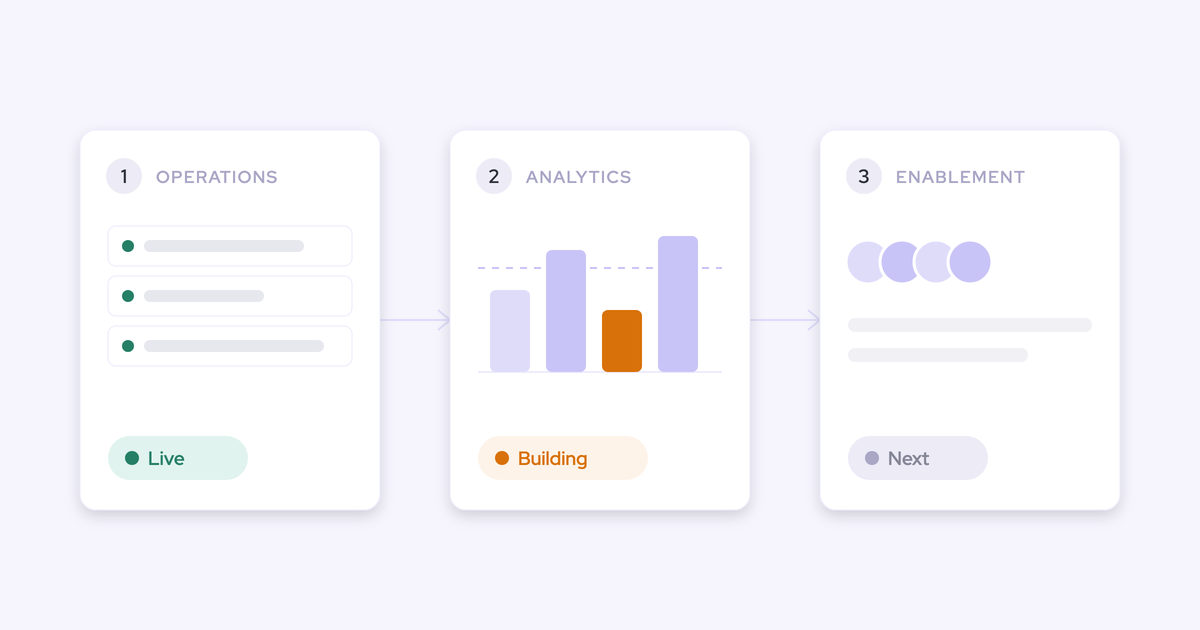
Operations, analytics, enablement: Alexander Müller's Formula One sequence
Alexander Müller, founder at Revenue Enablement, builds the function in three steps:
- Operations: Build the systems.
- Analytics: Find where the system loses speed.
- Enablement: Coach the customer-facing teams on what to change.
"Operations is kind of you built the systems, you built the Formula One car, and now you have a very fast car, hopefully. Then you need the analytics people to tell you, hey, in this corner, you're losing a little bit of speed. And then the enablement people there eventually telling your sales teams, your go to market teams, whoever is customer facing, hey, hit the gas here a little bit earlier so that we save a few seconds on the overall lap time."
The order matters: analytics on broken operations measures noise, and enablement without analytics coaches on opinion.
Joe Ort's 5A cycle for a new RevOps mandate
Joe Ort, founder of RevOps Inflection, uses a cycle that works especially well when you're new in the seat:
- Audit: List the data, tools, processes and skills that exist today.
- Analyze: Work out why the numbers look the way they do and what fixing them is worth.
- Align: Agree priorities, goals and KPIs with the executives.
- Architect: Redesign workflows, standardize data and build the measurement, automations and documentation.
- Accelerate: Roll it out, manage the change and track performance into the next round.
The same cycle works at the start of a fiscal year, after an acquisition, or for a single project like a CPQ rollout.
The step new leaders tend to skip is Align. As Janis pointed out on the episode with Ort:
"Often the executives, they actually don't care how you do it. They just wanna align on what you do and why you do it and what it drives in terms of measurable outcome."
So run the audit and get alignment first. Otherwise, you'll end up picking a tool for a process that doesn't exist yet.
How RevOps runs the operating rhythm week to week
The operating rhythm is the function's engine: planning sets the year, recurring cadences run the weeks, and intake discipline stops requests from eating the roadmap.
The meetings RevOps runs: Weekly, biweekly and quarterly
Kristina Kardell maps every revenue meeting on two axes:
- Who's in it: Cross-functional or within one team.
- What level it works at: Strategic (quarterly), tactical (every two weeks) or operational (weekly).
Placing a meeting on both axes tells you which topics belong in it.
| Cadence | Level | Who's in it | RevOps' role |
|---|---|---|---|
| Weekly deal and forecast meetings | Operational | One team, such as sales or CS | Supplies pipeline and forecast data and keeps the inspection standard consistent |
| Biweekly progress meetings | Tactical | Functional or cross-functional leads | Tracks progress, blockers and the decisions they need |
| Functional leadership meetings | Tactical | A VP and their leaders | The VP owns it; RevOps takes notes and tracks follow-ups |
| Monthly and quarterly results reviews | Strategic | Go-to-market leaders across functions | Moderates, prepares the numbers, writes commentary and asks each function to explain gaps |
| Quarterly planning | Strategic | Go-to-market leadership | Brings the results and risks it saw across the quarter as discussion items |
Moderating the results review gives you the aggregated view: which numbers missed furthest, which initiatives slipped and which risks deserve a closer look. That's how RevOps ends up shaping the plan instead of just receiving it.
Intake rules that stop RevOps becoming the help desk
Tessa Whittaker sets a short baseline of mechanics for any RevOps delivery team:
- Keep one list of everything in flight, so anyone can see what you're working on.
- Agree the priority order with your stakeholders, not by yourself.
- Estimate effort or complexity for every item.
- Run a capacity model in story points by seniority, so you know how much you can take.
- Work to a sprint schedule and publish release notes.
- Apply an above-the-line, below-the-line rule, so a new request visibly displaces something else.
With these in place, prioritization becomes arithmetic instead of argument.
The other half of intake is what you bring to leadership. Nicole Bradshaw, who leads the centralized RevOps function at PandaDoc, learned this from the other side of the table after six months leading sales.
"I need my RevOps partner to actually prioritize for me and to tell me what to care about."
— Nicole Bradshaw, Leads the centralized RevOps function at PandaDoc
So bring the top two problems, not twenty. A leader with a full plate stops listening after the second.
If you're designing your cadence now, our free Revenue Operating Cadence Guide gives you a reference to work from as you set up each meeting.
How RevOps teams are structured, from solo operator to global
Structure follows scale and go-to-market model. Most teams start with one person wearing every hat and move toward specialized roles as the business grows.
Solo RevOps operator vs RevOps team: Who carries what
In the RevOps Lab survey of 180 RevOps professionals, 22% worked solo and 78% worked in a RevOps team, and the two setups feel very different day to day.
| Dimension | Solo operator | RevOps team |
|---|---|---|
| Share of survey respondents | 22% | 78% |
| How the work splits | One person covers marketing automation, system administration and cross-functional projects | Split by role across marketing automation, system administration and cross-functional projects |
| Where the leader's time goes | Everywhere at once | With stakeholders, aligning initiatives to company objectives |
| How the leader is seen | Easily cast as the firefighter | Rarely seen as a firefighter, because the team carries both strategic and operational work |
According to Eric Portugal Welsh, the solo model works best in small, engineering-heavy startups, often with RevOps reporting to the COO, where the operator uses AI tools to cover the capacity of several people.
Business partners, process owners and revenue technology at scale
At scale, Tessa Whittaker splits RevOps into three role types:
| Role type | What it owns |
|---|---|
| Business partners | The executive relationship, forecasting, pipeline and the business narrative |
| Business process or product management | The full process and turning it into requirements |
| Revenue technology | Owning and building the tech stack |
In a small company, the same people do all three, so every fire drill competes with every configuration change.
Splitting the roles separates always-on work from the roadmap of bigger changes, so picklist requests stop eating into it. It's the same way a product org splits product management from engineering.
A global center of excellence with embedded partners for regional GMs
When a company moves to regional general managers who each own a P&L, RevOps becomes more important, not less.
At Aircall, Dan Jiao runs it as a hybrid: a global center of excellence designs the standards, and a RevOps business partner embedded with each GM drives adoption.
The center of excellence holds:
- Planning and insights: annual planning, capacity modeling, operating cadence, analytics, PMO and commissions.
- Acquisition ops for sales and partners.
- Marketing ops for campaign optimization, ROI and attribution.
- Customer ops for CS and technical post-sales teams.
The embedded business partner holds:
- The GM's operating rhythm, from pipeline inspection to the weekly forecast, business reviews and QBRs.
- Diagnosis of why the region has a gap and how to close it.
- Adoption of the global deal inspection and forecast methodology.
Partners report to RevOps with a dotted line to the GM, which keeps them reinforcing the standard instead of drifting into local exceptions.
The embed exists because numbers alone can't tell you whether a region outperforms because of the market or because of how it runs.
Where the RevOps operators we've interviewed still disagree
Operators still don't agree on two things: where RevOps should report and what "strategic" really means. Here's how each side makes its case.
Should RevOps report to the CRO, COO or CFO?
Jeremey Donovan of Insight Partners argues that ops work for strategy, analytics and planning belongs with the leader it supports, while the opposing case is a neutral, centralized RevOps serving peer executives.
"There's just such a huge advantage to having your ops person as your right hand in whatever you do."
| Position | Argument | Who argues or runs it |
|---|---|---|
| Ops reports to the functional leader | Proximity: the leader's right hand understands the motion and acts on its priorities | Jeremey Donovan, Insight Partners |
| Centralized RevOps under a neutral executive | The CRO, CMO and chief customer officer are peers, and someone should serve them without bias | The centralized model, as run at PandaDoc |
| RevOps under the COO | Fits once RevOps grows into AI operations, which touches finance, product and engineering | Avtar Varma |
| Split systems from strategy | Systems and data administration can follow different logic from strategy and analytics | Jeremey Donovan, Insight Partners |
If you're asked to pick, place strategy work with whoever needs a right-hand partner most, then treat systems administration as a separate question.
Does a strategic RevOps partner make a company outperform?
Not on its own. When Insight Partners asked about 200 portfolio CROs how they see their RevOps leader, roughly 40% said a right-hand strategic partner, and that share barely differed between top and average performers.
Company size likely skews this, since at a very early stage the first sales ops hire is usually a Salesforce admin, which pulls the tactical share up.
What does separate top performers, according to Donovan's portfolio work, is weekly operational discipline on the basics. So earning the "strategic" label matters less than making sure the basics run.
Does everything RevOps does need to be strategic?
Janis argues no, and he's openly annoyed by the debate.
"I don't think that everything always needs to be strategic."
As he sees it, removing the data entry reps hate, making them more efficient or giving leaders better visibility often creates more value than a project that only sounds strategic. And outside very large companies, a dedicated strategy job barely exists.
The real skill is explaining operational work in terms of the company's goals, not relabeling it.
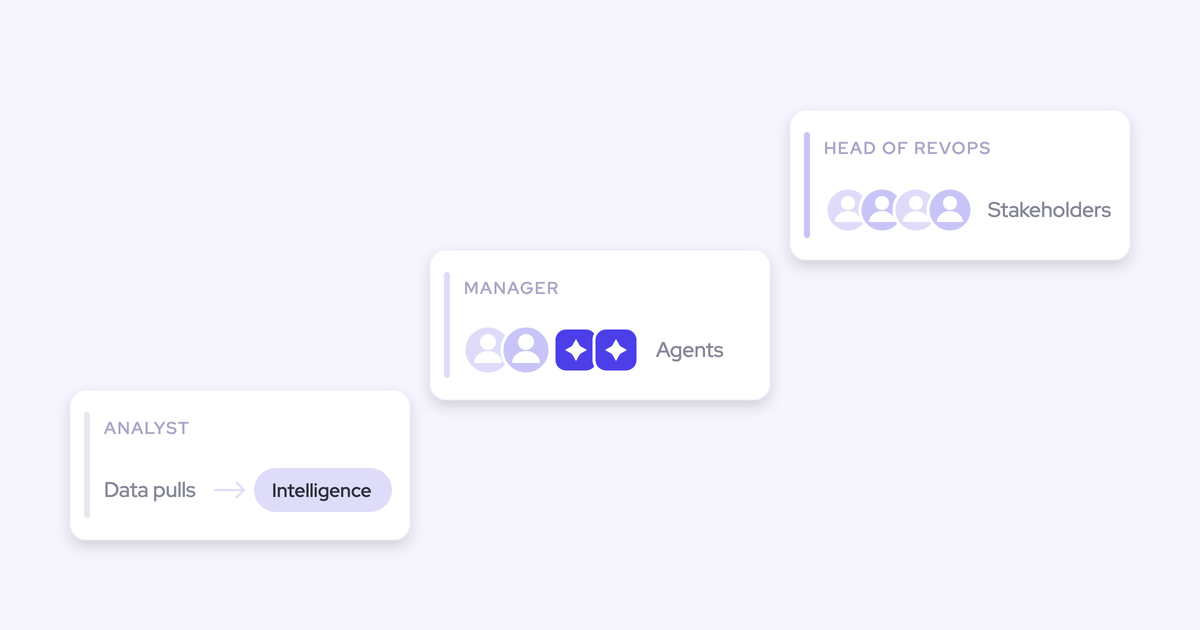
Where RevOps is heading: The RevOps Orchestration Layer
RevOps is moving from reporting on the business to building and governing the systems that run it, for people and for AI agents, and that shift is also what makes the function defensible.
Help desk, change agent, builder: The three stages of RevOps
Mollie Bodensteiner, VP of RevOps at ZoomInfo, has watched the function move through three stages.
"So I think, like, RevOps, you know, used to be the team that, like, reported on the business. Now it's, like, becoming the team that's starting to build and govern the systems that are really running the business."
- Help desk: Triaging requests, doing manual work and reacting.
- Change agent: Using process and workflow automation as more tooling arrived.
- Builder: Building automated and AI workflows, and governing them.
What moved the function forward was access to information: insight that once took most of the team's week to assemble now arrives quickly. As spreadsheet work disappears, the skills the team needs move up.
Why order-taking RevOps work gets automated first
Taking requests and executing them is the part of RevOps that automation already handles, and as Nicole Bradshaw points out, that was true even before AI entered the picture.
"Do you wanna AI-proof your role? You really have to have a POV. Otherwise, you're kind of just a cog in this workflow."
— Nicole Bradshaw, Leads the centralized RevOps function at PandaDoc
Three things are hard to automate:
- Forming a recommendation
- Deciding which two problems matter
- Getting stakeholders to act
RevOps sees how data, process and systems connect better than any other function, so when it stays quiet, leadership decides with a blind spot.
The defensible version of the function shows up the way a strong seller does: with a view, open to being wrong, adjusting to the evidence.
RevOps as the orchestration layer, chat as the interaction layer
In an AI-driven revenue org, RevOps designs the agents and workflows, and reps, managers and the CRO use them through chat.
"The orchestration layer will continue to be RevOps and the interaction layer will be chat, whether that's in Slack, in a tool, or in email."
You can already see this in the job market: Alexander Müller now sees "orchestrating agents" written into RevOps job descriptions.
In Insight Partners' follow-up interviews about AI use cases CROs rated as high value, the CRO brought their head of RevOps on more than half of the calls. RevOps was the team that had built them.
| What RevOps designs | What end users interact with |
|---|---|
| Scheduled executive reports | A report in the CRO's inbox or Slack, with room to ask a follow-up |
| Rep workflows for deal reviews and forecasts | A chat in Slack, a tool or email |
| Pre-written follow-ups | A draft the rep reviews and sends |
| Meeting prep, meeting follow-up and CRM admin | Nothing: these run fully automated |
There's a catch, though: insight now arrives faster than the old weekly cadence can act on it.
Producing the analysis is no longer the hard part. Deciding who's allowed to act on it mid-cycle is, and that's what RevOps has to redesign.
How Weflow helps RevOps run the go-to-market operating system
Weflow is the Revenue AI Orchestration platform for sales, customer success, and RevOps teams. We built it for Salesforce teams, so what it captures and generates lands in the Salesforce org you already own.
In Weflow, RevOps builds the orchestration-layer version of its work: you design a workflow, a team structure or a dashboard once, and every team uses it without anyone rebuilding it.
A worked example: Scheduled Weflow Agent Builder flows for forecast week
Here's what forecast week looks like when RevOps designs it in Weflow Agent Builder:
- Monday morning: A pipeline pass names the deals that need action and pre-writes the follow-up.
- Before the forecast call: A weekly risk scan flags deals at risk and why.
- Once a month: A closed-lost analysis reads every lost opportunity and surfaces which competitors appeared and which objections recurred.
Each flow follows the same four steps:
- A scheduled trigger with day, time and timezone.
- A lookup that reads Salesforce accounts, contacts, leads, opportunities, tasks, events or contracts with field-level filters.
- An AI Agent step that runs your prompt over the activities, emails, calls and transcripts on those records.
- An End step that emails the result to users or teams, with a PDF report attached if you want one.
The lookup reads Salesforce live, so a change made a minute ago shows up in the run.
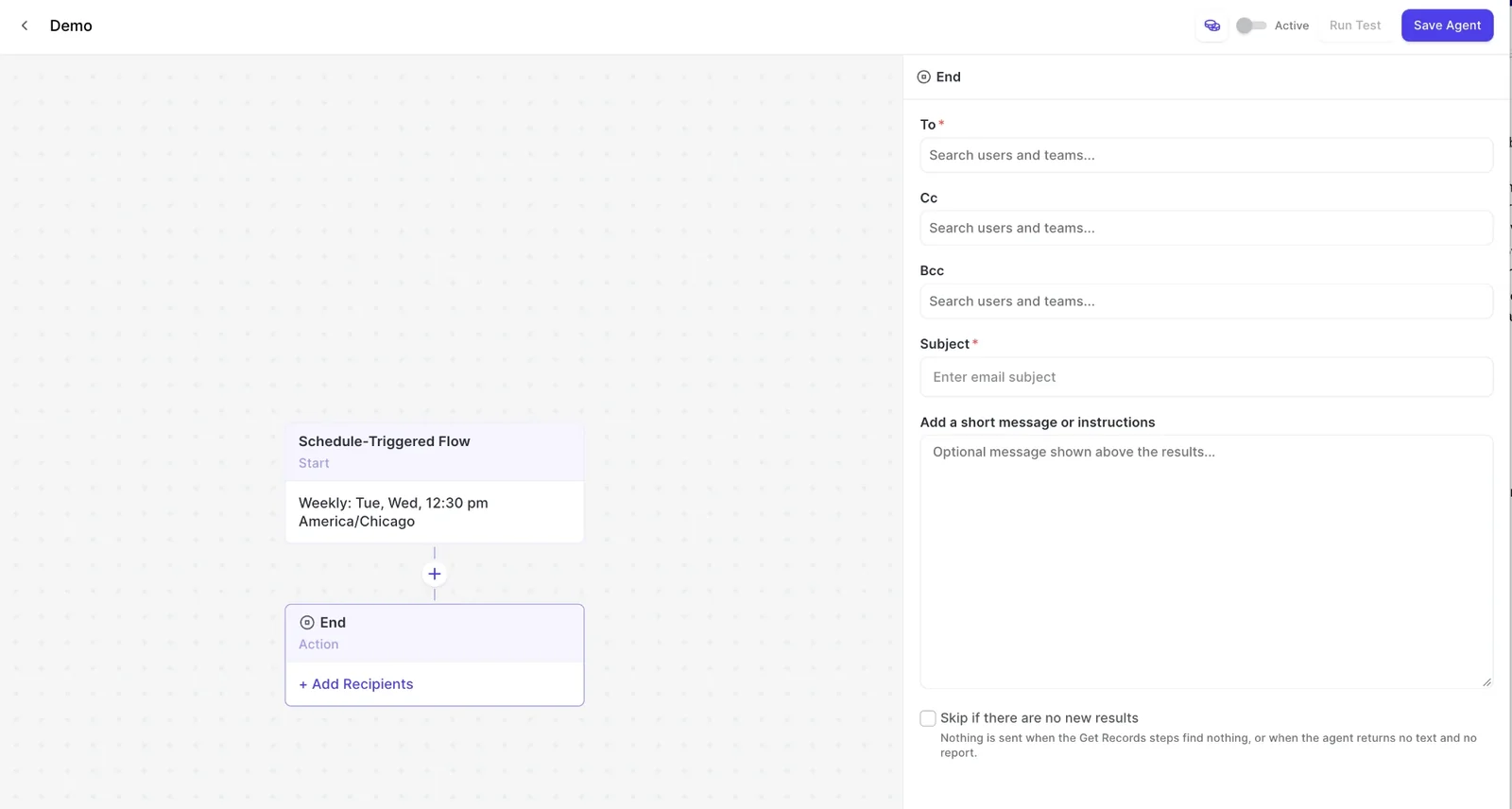
Weflow ships three starting templates (a pipeline snapshot, a meeting recap bundle and a deal risk PDF) with deliberately basic prompts you're meant to rewrite around your process.
Two more pieces take recurring admin off your plate:
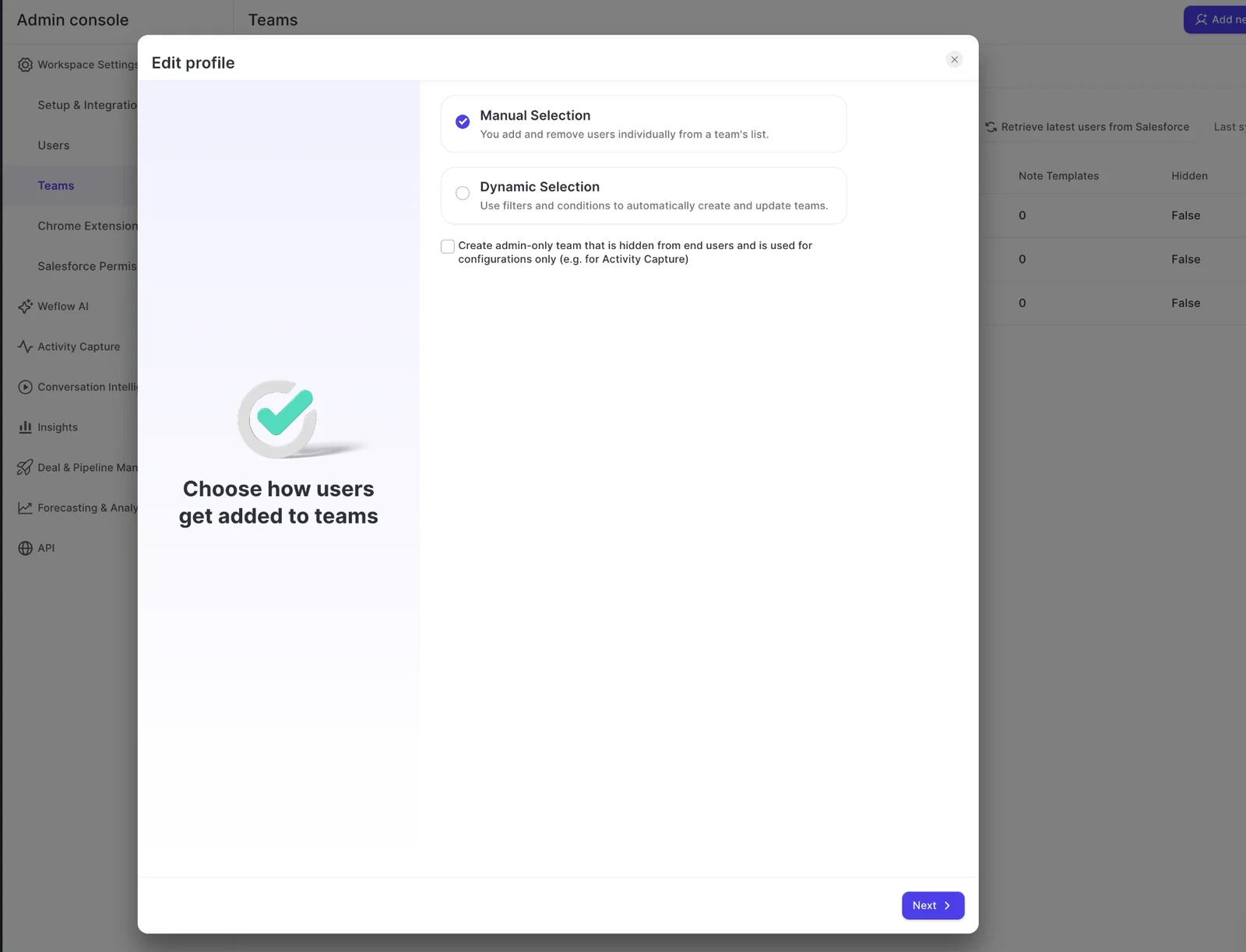
- Dynamic teams: Weflow builds teams from Salesforce by manager, role or a field condition. A rep who moves team in Salesforce moves in Weflow automatically, so you stop hand-managing joiners and leavers.
- Dashboards by role: You assign Insights dashboards to teams from the Admin Console. Each rep opens the board built for their role, and you can revise it centrally afterwards.
What Weflow doesn't decide for you, and what it requires
- Weflow doesn't define your process: Strategy and process come before tools. Activity capture and conversation intelligence typically go live in about two weeks. Forecasting takes longer, because it encodes a cadence you decide first: who submits, how often, at deal or manager level and against which quota.
- Configurable products need a named internal owner: Without one, prompts, scorecards and field mappings go stale.
- Weflow works exclusively with Salesforce and needs API access: That means Enterprise Edition or above, or Professional Edition with Salesforce's API add-on. Starter Edition has no API access.
So write the mandate before you buy anything. A leader two weeks into an undefined process will get more from the 5A audit than from any platform evaluation.
FAQs RevOps leaders ask about the function
What should a company's first RevOps hire do first?
Audit before building, then follow the build order: strategy and process before tools and data.
And below roughly $10M in revenue, if marketing and sales both drive pipeline, give marketing ops as much attention as sales.
How do you measure and prove RevOps impact?
Baseline every process metric before a project starts, because without the "before" number, you can't prove the improvement afterwards.
"One of the steps that I always skipped early on in my career that I wish I could go back and fix was not baselining things."
Then report changes in outcomes, not activity. As Bodensteiner puts it, nobody knows what "fifty-two Jira tickets" means, but everyone understands demos per rep going up.
When should RevOps buy new tools for the tech stack?
After strategy and process. A new leader usually inherits tools whose original owners have left, so start by working out why each one exists and whether it's working.
A new leader's first ninety days is often when a whole category gets re-decided, and overlapping tools tend to get replaced together or not at all.
Will AI replace RevOps jobs?
AI replaces order-taking work, not the function. Bodensteiner sees one person managing a fleet of agents covering work that used to take three analysts, while the ratio of RevOps to the business holds.
The structure is shifting from separate marketing, sales and CS ops teams toward horizontal layers for architecture, engineering and governance across the full customer journey.
How does RevOps work in a product-led growth company?
It carries an unusually broad charter. At Zapier, Lindsay Rothlisberger's team spans marketing, sales, customer success, enablement, tooling and AI, lead and deal management, analytics, compensation and deal desk.
The product-led base feeds the sales-led motion, so routing, qualification and the downstream sales process have to sit in one function.
How does RevOps change in a consumption-based business?
The function extends past closed won, because the signed contract is only an estimate of revenue, and most of the control work comes after signature.
"In a typical seat based or SaaS world, kind of the RevOps machine stops at closed won typically."
Under consumption pricing, RevOps owns evidence before close and tracks whether usage ramps after it.
What skills does a marketing ops or sales ops person need to move into RevOps?
Financial modeling, deal desk and revenue architecture are the common gaps, especially for people coming from marketing ops, because a RevOps charter adds compensation, deal desk and forecasting on top of campaigns and systems.
Rothlisberger recommends Winning by Design's revenue architecture course as a recognized way to close the gap.
What is forward deployed RevOps?
Forward deployed RevOps is an embedded team that goes into a company and fixes the data and process so a new system can be implemented. Philipp Stelzer, our CPO, describes it as the forward deployed engineer model applied to revenue operations.
It exists because many companies buying AI tooling lack the internal capacity to prepare for it, and that gap is what stalls implementations.