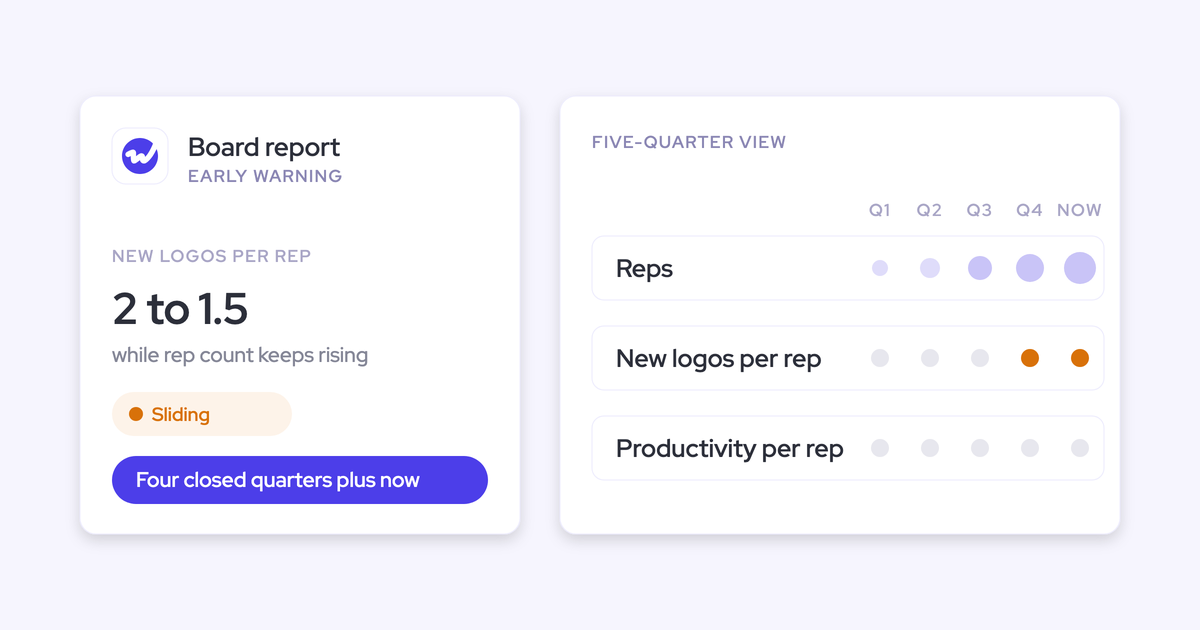
If your board keeps asking about the same five deals quarter after quarter, and the only honest answers live in your reps' heads, you've probably started wondering whether it's time for RevOps.
The short answer: hire when your stack and your forecast outgrow a side job, not when you hit a certain headcount. Start with a generalist operator, add a tool-savvy builder soon after, and have them tackle three things in this order:
- An audit, before any tool purchase.
- A data foundation reps don't have to type into.
- The forecast cadence, plus the capacity model behind your sales hiring.
That said, hiring isn't your only option. You can keep RevOps a side job, rent it from a fractional or forward-deployed team, or buy tooling that shrinks the job, such as AI-powered deal execution workflows.
Below, we'll walk through all four options and where each one falls short.
How do you know it's time to hire RevOps?
It's time when the work behind your forecast no longer fits into someone's spare hours, not when you reach a certain headcount.
In fact, RevOps team size doesn't really track company size. As Alexander Müller points out, a 50-person company and a 500-person company can run RevOps teams of almost the same size.
That's because smaller companies plug in tools early (they're cheap to add), and every tool needs someone to orchestrate it. So if you wait for a headcount milestone, you'll likely hire too late.
Here are a few signs to check against your own week:
| The signal you're seeing | What it's costing you |
|---|---|
| The board asks about slipping deals, and you can't answer without going back to the reps. | Every review costs a round trip and some of your credibility in the room. |
| Reps get pushed to hand-update Salesforce so the forecast has something to run on. | Selling time lost to the admin work you hired them not to do. |
| Your team and finance bring different versions of the pipeline to the same meeting. | Leadership meetings start by reconciling numbers instead of acting on them. |
| Tools were added because someone suggested them, and nobody can say who owns them or whether they're used. | You pay for software that nearly does the job, and changing any of it is a project nobody has time for. |
| Ramp, attrition and manager capacity live in a spreadsheet you update by hand, or nowhere. | Your headcount asks to the CFO rest on guesswork. |
| An AI mandate landed, and nobody owns it. | AI licenses sit unused because the revenue data underneath isn't ready. |
If several of these sound familiar, the side-job approach has probably already run its course.
Four ways to cover RevOps: Side job, hire, fractional, tooling
Each of these four paths fits a company somewhere, and each breaks at a predictable point.
Keep RevOps a side job or hire a Salesforce admin
This is the default for most early-stage companies. According to Jeremey Donovan's research at Insight Partners, the first sales ops hire at very early-stage companies is usually a Salesforce admin.
Or there's no hire at all, and a couple of people tinker in Salesforce between their real jobs.
To be fair, an admin keeps Salesforce running, and for a small team with a short sales cycle and a board that isn't probing the forecast yet, that's enough.
Where it falls short is ownership. An admin keeps the system up, but nobody owns the forecast or decides which tools stay.
So when the board starts asking hard questions, the admin builds you a report, and you still walk into the meeting with an opinion rather than an answer.
Hire a full-time RevOps generalist now
A full-time RevOps generalist gives you one named owner for systems, data and cadence. That person decides what the CRM tracks, which tools earn their place, and how the forecast gets made each week.
The trade-off is time and internal politics. Since RevOps carries no quota, it's one of the roles that has to fight hardest for headcount when growth needs to be efficient.
Finding someone who understands both your CRM and your sales motion can take a quarter, and they'll then spend their first couple of months learning before they change anything.
Bridge the gap with fractional or forward-deployed RevOps
Fractional RevOps, RevOps-as-a-service and forward-deployed RevOps all let you rent capacity instead of hiring it.
With forward-deployed RevOps, for example, an embedded team comes in, fixes the data and process so a new system can actually go live, and then leaves.
This works well for a defined project like a cleanup, an implementation or a migration, but not for anything recurring. A fractional team won't run your Monday forecast call, and it won't be around to notice when a configuration drifts six months later.
If you go this route, scope the engagement as an audit plus one implementation, and make written documentation of what was built (and why) part of the deliverables.
Shrink the job with tooling instead of headcount
The right tools can take entire categories of RevOps work off your plate:
- Automatic capture ends the fight to get reps logging activity.
- Provisioning that follows your Salesforce users and roles handles joiners and leavers without manual work.
- Scheduled AI analysis replaces the reports someone would otherwise rebuild every week.
What tooling can't remove is ownership. Someone still has to configure it, define the process, and notice when the output drifts from how the team actually sells.
In other words, tooling shrinks the job your first hire walks into, but it rarely removes the need for the hire.
Which RevOps path fits your forecast, stack and budget
To pick the right path, weigh these five criteria. For most sales leaders, the first one matters most.
- Board exposure: If the board already asks about slipping deals, you need someone who owns the forecast, not someone who maintains the system.
- Stack size: Count the tools that touch revenue data and name the owner of each one, because every tool without an owner is drifting.
- Appetite for non-quota headcount: Be honest about whether your CFO will fund a role that carries no number this year.
- Continuity: Ask what happens to your setup if the one person who understands it leaves next quarter.
- Time to value: Decide how long you can wait before the forecast has to be defensible.
| Side job or admin | Full-time generalist | Fractional or forward-deployed | Tooling | |
|---|---|---|---|---|
| Fits when | The team is small, the cycle is short, the stack is light, and the board isn't probing the forecast yet. | Board exposure is real, the stack has outgrown spare hours, and you can fund a non-quota role. | You have a defined project (cleanup, implementation, migration) and nobody free to do it. | Most of the work is logging, provisioning and recurring reports, and someone can own the configuration. |
| Breaks when | Someone has to own an outcome rather than keep the system running. | You hire the wrong profile, or the hire buys tools before the process exists. | The work recurs, and the team leaves when the project ends. | Nobody owns the configuration, so it goes stale and reads as an adoption problem. |
| Who owns the forecast cadence | You do, by hand, with the admin pulling reports. | The RevOps hire designs it, and you run the call. | Nobody after the engagement ends, unless you hand it to someone inside. | The tool runs the mechanics, and a person still designs the cadence it encodes. |
| Continuity if a person leaves | Low: the setup lives in one or two people's heads. | Low, unless you require documentation and a recurring configuration review. | Only as good as what was documented at handover. | Better when provisioning follows Salesforce users and roles, though configuration choices still need a written record. |
| Time to value | Immediate, because nothing changes. | A hiring cycle, then roughly 30 to 60 days of audit before a roadmap. | Fast on the scoped project. | Weeks for capture, longer for anything that encodes a process, such as forecasting. |
| First move | Write down who owns which tool today. | Put the ownership order below into the job description. | Scope an audit plus one implementation, with documentation as a deliverable. | Name the internal owner before you sign. |
If you read across the forecast cadence row, you'll notice that every column comes back to a person. That's why we recommend hiring.
Hire a generalist first, then add a tool-savvy builder
If your board exposure is real and your stack has outgrown spare hours, it's time to hire. Start with a generalist operator, and open a second req for a tool-savvy builder early on, not years later.
The generalist covers board exposure and continuity by owning the forecast, the data and the cadence end to end. The builder covers stack size by deploying and wiring up tools quickly. Neither profile can do both on their own.
"In the past, I always said, hey, there's two types of RevOps in general, more the tool guys and more the generalists. And in the beginning, I said, hey, would first get rather generalists. Now I would actually say, try to pair them, get two people quite early on, get a generalist, get somebody who's tool savvy, who likes to play around. And then actually, I think together, they can be a real dream team. Because you don't want to have a new tool every week. You actually want to deploy it well so that everyone can actually use it."
So you still hire one person first, the generalist. You just don't make them wait long for a partner.
Why a Salesforce admin or analyst is the wrong first hire
Your first RevOps hire needs to own outcomes and give you recommendations, which rules out the two profiles most sales leaders reach for first.
| Profile | What they do well | Where they fail as the only RevOps person |
|---|---|---|
| Salesforce admin | Keeps Salesforce configured: fields, users, layouts and reports. | Maintains the system but doesn't own the forecast or decide which tools stay. |
| Analyst | Builds reports and models in spreadsheets. | Hands you data without a recommendation. RevOps leaders we talk to have stopped hiring the straight analyst, because the work now means building with AI tooling. |
| Generalist operator | Owns systems, data and cadence across the funnel, and works with every stakeholder. | Keeps the process clean but doesn't get the most out of the stack. |
| Tool-savvy builder | Deploys tools, builds workflows and agents, and likes to experiment. | Ships a new tool every week, and nothing gets adopted. |
Nicole Bradshaw, who leads the centralized RevOps function at PandaDoc, spent six months on the other side of the table running sales. Here's what that taught her about what sales leaders actually need from RevOps:
"I prided myself on seeing around the corners and anticipating problems before they materialize. And I surfaced all those problems. And as the global sales leader, when my own team did that to me, I was like, oh no, no, no, I don't care about all of those things. I actually only care about the first two things you mentioned. Everything else, I don't have the mental capacity for it. There are so many other things in flight. There's so much else on my plate that I need my RevOps partner to actually prioritize for me and to tell me what to care about."
— Nicole Bradshaw, Leads the centralized RevOps function at PandaDoc
That's exactly what you should interview for. Ask candidates to walk you through a recommendation they made and what changed because of it, rather than a dashboard they built.
When to add the tool-savvy builder or GTM engineer
Open the second req once the generalist's audit has settled the process the tools will encode. Otherwise, your builder ends up automating a process nobody has agreed on.
Agent orchestration makes this profile more urgent:
"What I find really, really interesting is that suddenly we see responsibility for orchestrating agents as part of the job description of revenue operations. Now I've seen that. I've read that now. As I said with xAI, I've seen it with other companies as well. And I think that will be a very interesting trend because what does it mean? It means that the role of RevOps will change, will become not only more important in terms of who actually is responsible for the different AI tools that we bring in, but it also could mean how do we make them a channel."
Someone has to build those agents, decide where they fit in the process, and keep an eye on them as they drift. That's builder work, done under the generalist's direction.
It also helps to keep the two working closely together, since a builder without funnel context tends to automate the wrong things:
"I think the value of it being so closely tied in with RevOps, whether it reports into it or not, is that RevOps has so much context on the funnel. Like, we see all the bottlenecks. We understand what's happening across marketing and how that impacts pipeline and sales. And if RevOps can harness that context for the larger org, it's just super duper valuable. And the GTM engineer needs to have that context too. They can't operate in a silo. They have to know how these deals progress down funnel and what the impact is of what they're doing in sourcing pipeline."
What your first RevOps hire should own, in order
Hold your first RevOps hire to three deliverables, in this order: an audit, a data foundation, then the cadence. The order matters because each one depends on the one before it.
Tools bought before the audit encode a guess, and a cadence built on data nobody trusts gets quietly ignored.
First, a 30- to 60-day audit before buying tools
Joe Ort recommends giving the audit roughly 30 to 60 days of analysis and stakeholder conversations before landing on a roadmap, and longer if the business is complex. Recommendations made any earlier rest on guesses.
The audit should cover:
- What each existing tool is for, who chose it, and whether anyone uses it.
- Where the forecast's numbers come from today, and which fields reps actually fill in.
- How many versions of the pipeline exist, and who depends on each one.
- Which capabilities are simply missing.
- What sales, marketing, customer success and finance each need from RevOps over the next two quarters.
By the end, you should have a short written view of what to keep, what to cut, what's missing, and the order to fix it in.
Second, a Salesforce data foundation reps don't type into
Next comes a Salesforce data foundation that fills itself from the work reps already do, with emails, meetings, calls and contacts captured automatically and written to the right records.
It comes after the audit because the audit tells you which data matters, and before the cadence because you can't enforce a cadence on numbers nobody trusts.
If it depends on reps logging by hand, your new hire will spend months enforcing it and still end up with gaps. Reps update inconsistently and late, and stages drift away from where the deal really is.
Captured data is also what your AI mandate depends on. Buyers tell us they've bought AI licenses that sit unused because their revenue data isn't structured well enough to connect them to anything.
Third, the forecast cadence and the sales capacity model
Once the data is trusted, RevOps can design the operating cadence: who submits the forecast, how often, at deal or manager level, against which quota, and which metrics go to the board every time.
Keep those board metrics stable. The narrative can change from meeting to meeting, but the metrics shouldn't.
The same person should also own the capacity model behind your sales hiring. John McMahon started every week with it:
"That's what would be good for your RevOps people. Anytime I opened a meeting as a CRO, every Monday morning, nine o'clock, it was headcount first. How many people do we have that we hired? How many have hired and are on board? How many ramping reps? How many ramped reps and what's the attrition? I have to know that. If I don't know that, even though I'm constantly trying to increase productivity, if I don't have the heads, I can continue to increase productivity, I'm still gonna miss the number."
The capacity model tracks:
- Reps hired, and reps hired and onboarded.
- Ramping reps versus ramped reps.
- Attrition. One churned rep costs close to two years of productivity in that territory once you add the time to rehire and ramp.
- Manager absorption: how many new reps a first-line manager can take on without churning one.
Owning that model also gives RevOps a seat at the table in headcount discussions, and it makes your asks to the CFO harder to dismiss:
"RevOps sees the capacity model. We see, like, all the data. So we bring all the insights to that conversation, and we can be a neutral referee between the CRO and GMs always wanting more headcount versus the CFO who says, let's not hire. Let's, you know, have a higher EBITDA and gross margin."
If you want a starting point for that rhythm, our free Revenue Operating Cadence Guide is something you can hand a new hire, or use yourself while you're still deciding.
Two ways a first RevOps hire goes wrong early
Both of these tend to show up in the first few months, and both are easy to catch if you know what to look for.
Your new RevOps hire buys tools before process exists
A new hire arrives with a mandate and a blank sheet, and the quickest way to show progress is often to buy something.
But if the methodology, stages and qualification criteria are still up in the air, whatever gets bought encodes a guess. That's how a stack full of half-used tools ends up with one more.
To avoid this, tie every tool decision to the audit. And when a purchase can't wait, pick a tool your own team can reconfigure once the process settles, without needing a services engagement.
The RevOps setup leaves when your first hire leaves
When your first hire leaves, whoever inherits the setup often can't tell what was configured or why. One team that took over an activity capture setup told us they discovered gaps in rep activity just as leadership started relying on the reporting.
A quieter version of this happens even when nobody leaves. Configuration set at rollout goes stale as the business changes, with summaries shaped around last year's use cases and field updates pointing at fields nobody fills anymore.
Usage drops, and it looks like an adoption problem when it's really a maintenance problem.
Build these safeguards in from the first month:
- Require a written record of what each tool is configured to do, and why.
- Put a recurring configuration review on the calendar, so someone checks that templates and field mappings still match how the team sells.
- Prefer setups where users, teams and access follow your existing Salesforce roles and managers, so provisioning doesn't live in one person's head.
- Make sure a second person, even part-time, can log into and explain every system.
Where Weflow shrinks the job for a small RevOps team
Weflow is the Revenue AI Orchestration platform for sales, customer success and RevOps teams on Salesforce.
It takes specific jobs off a small RevOps team's plate, so your first hire can spend their time on the audit, the cadence and orchestrating the work instead of chasing reps.
Weflow Activity & Contact Capture takes reps out of logging
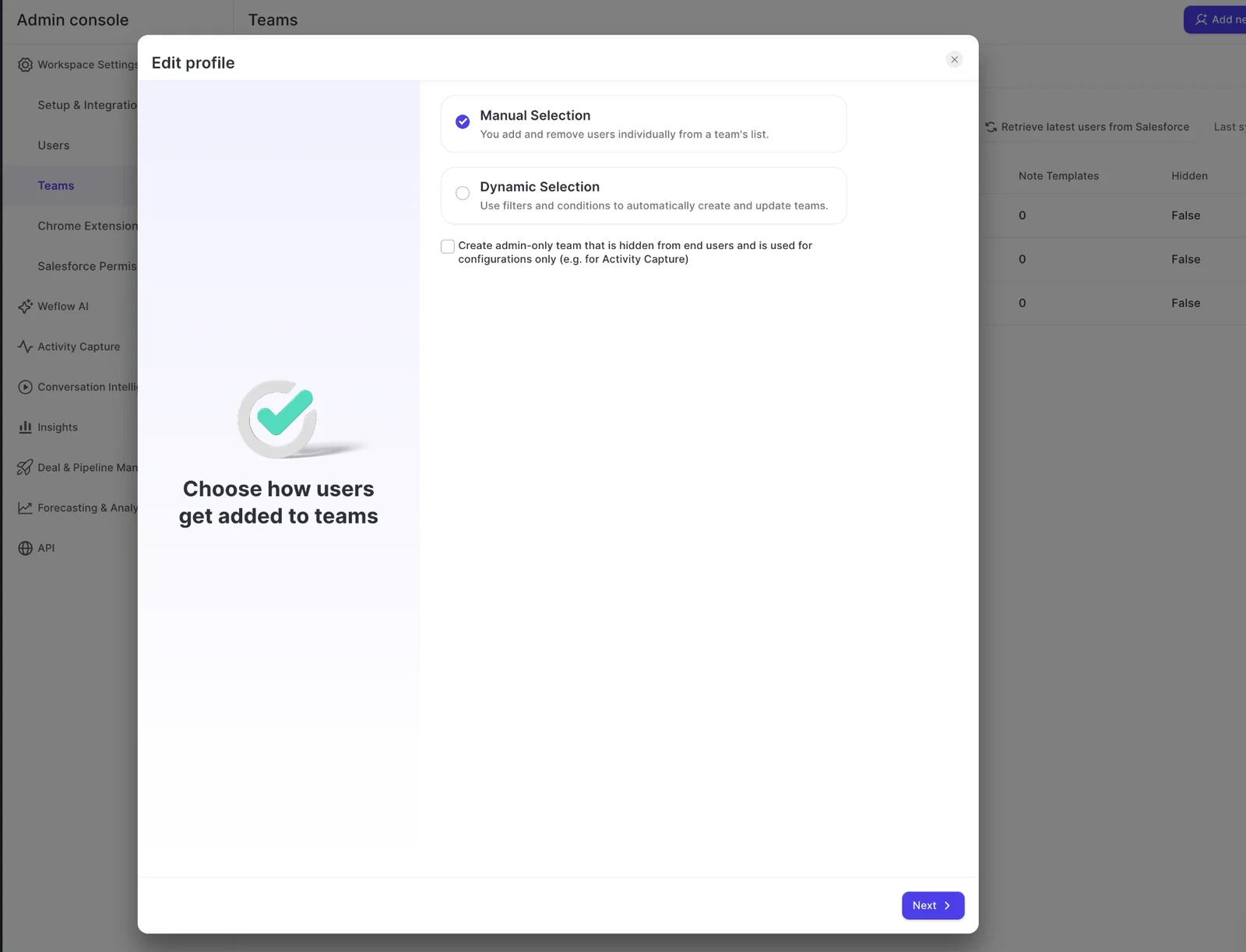
Weflow Activity & Contact Capture removes the rep-logging fight at its root. As soon as an admin adds a user to a capture configuration, their emails, meetings and contacts start getting captured, with no sign-in or action needed on their end.
Teams are built dynamically from Salesforce, pulling users by manager, role or field condition, so a rep who moves teams in Salesforce moves in Weflow automatically.
Joiners and leavers follow the same user logic your HR systems already feed, so nobody has to add and remove users by hand every week.
Everything Weflow captures lands in native Salesforce objects in your own org. That becomes the foundation your forecast reads from, and the same data any AI you connect later will use.
How Weflow onboarding works when you have no RevOps team
You don't need a RevOps hire to implement Weflow. Implementation is free, and you're typically live in two to three weeks. Onboarding runs as a project with a mutual action plan and named owners on both sides, in three phases:
- Technical implementation: One call with your Salesforce admin and your mail admin present, which connects the systems.
- Configuration: Team structure and hierarchy, your sales methodology, which custom fields AI should populate, playbooks, deal warnings and prompt templates. This is where most of the time goes.
- Role-based rollout: Separate training for leadership and for reps.
Capture and Conversation Intelligence can go from implementation to rollout in about two weeks. Forecasting takes longer, because it encodes your operating cadence.
And if you don't have the bandwidth, our managed service option lets Weflow do the heavy lifting while your team just answers questions and grants access.
Weflow Agent Builder schedules the pipeline and risk reviews
Weflow Agent Builder replaces the recurring reports your first hire would otherwise rebuild every week.
Each scheduled flow runs on the day, time and timezone you set, reads Salesforce live, and emails you the result (with the option to attach it as a PDF). Here are three recurring plays you can set up:
- A Monday morning pipeline pass that names the deals needing action and pre-writes the follow-up.
- A weekly risk scan that lands before the forecast call.
- A monthly closed-lost analysis that reads every lost opportunity and surfaces which competitors appeared and which objections recurred.
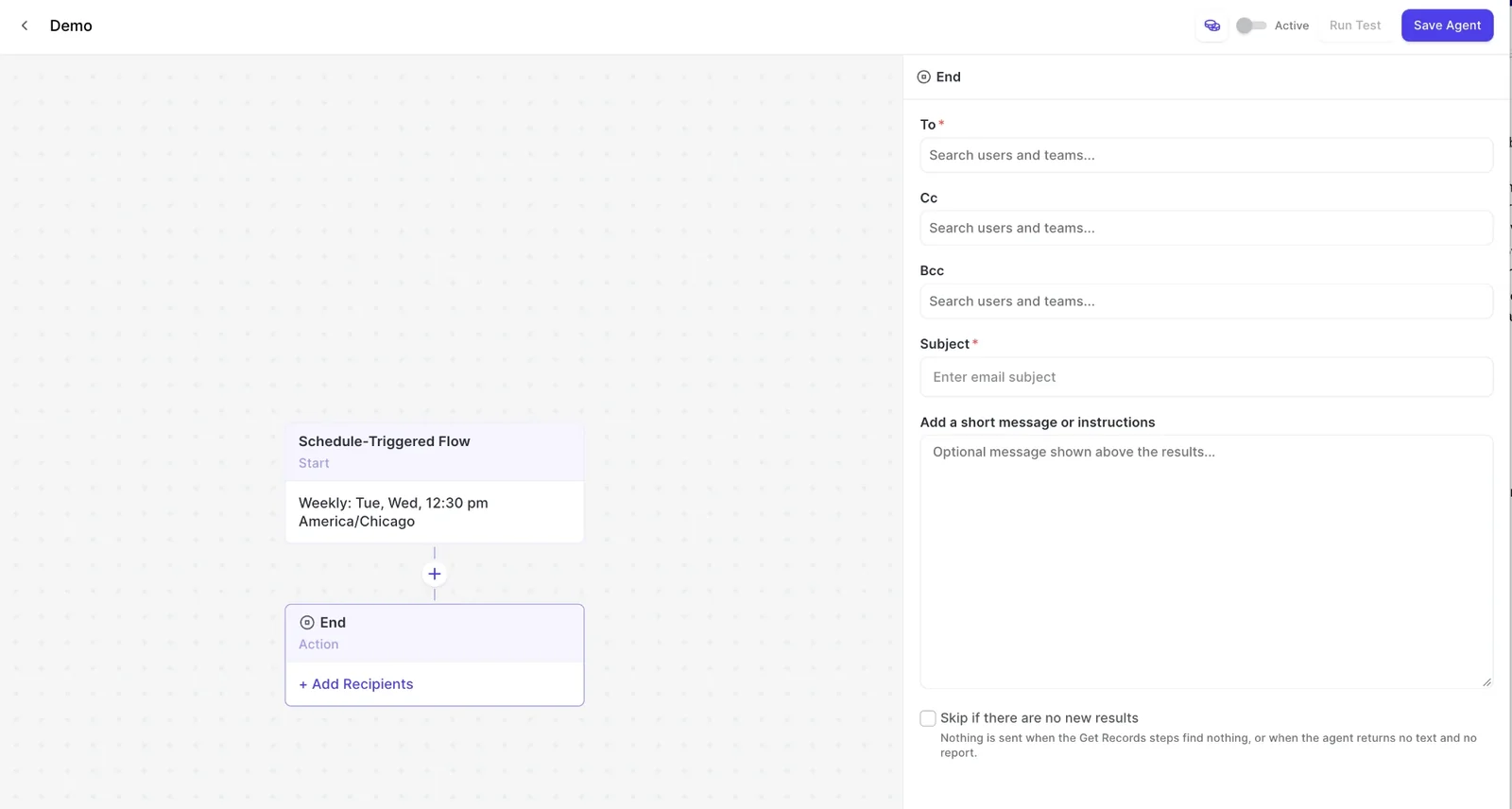
Email delivery matters more than it sounds, since most CEOs and CROs won't log into yet another system to see how the business is doing. They'd rather read the PDF in their inbox on Monday morning.
That said, someone still needs to own these flows, since the starting templates ship with basic prompts meant to be rewritten.
One admin we work with ran a new report on themselves for a full cycle before adding their CEO, because a weak first impression is hard to undo.
Designing, testing and governing those flows is the orchestration job RevOps takes on from the first hire:
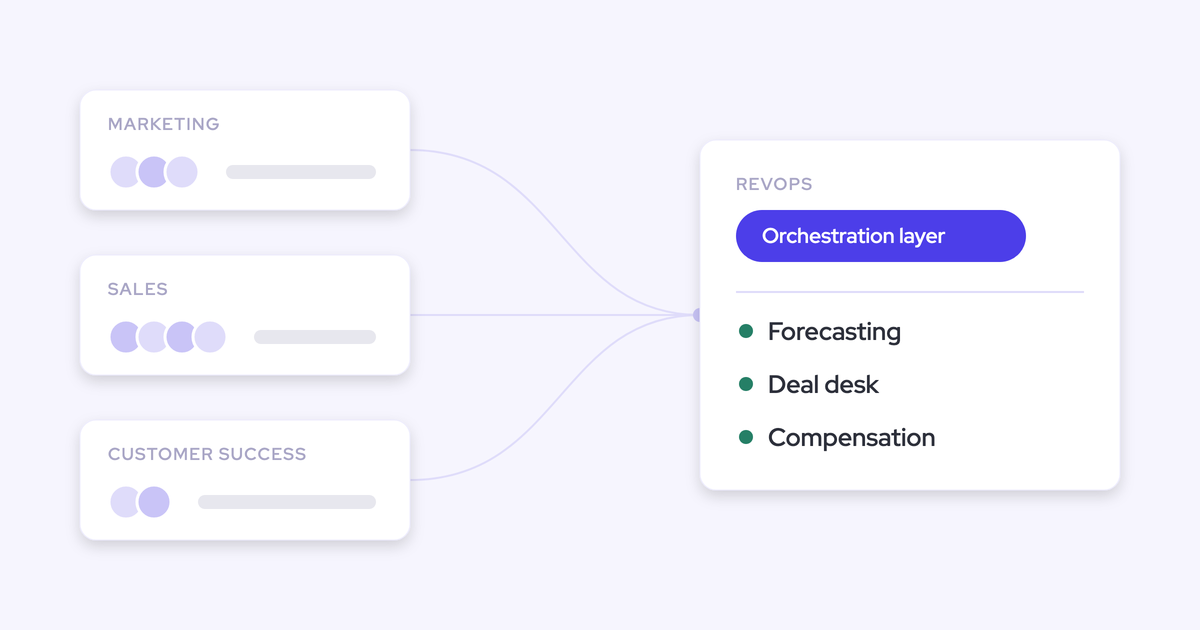
"The orchestration layer will continue to be RevOps and the interaction layer will be chat, whether that's in Slack, in a tool, or in email. You want a set system plus the ability for reps, managers, VPs, and CROs to have flexibility around what else they get out. And many workflows will be just fully automated that should also be automated, like meeting prep, meeting follow-up, and CRM admin."
What Weflow can't do for you without a RevOps owner
Weflow doesn't replace the hire. Capture largely runs itself once it's configured, but Weflow Conversation Intelligence templates, scorecards and field mappings need a named internal owner, or they go stale and people stop trusting the output.
Similarly, Weflow Deal Intelligence & Forecasting encodes a cadence someone has to design and keep current. If nobody on your side owns the configuration, the tooling path won't hold up.
A few fit limits to keep in mind:
- Weflow works exclusively with Salesforce, so teams on another CRM fall outside the fit.
- Weflow needs Salesforce API access: Enterprise Edition and above, or Professional Edition with Salesforce's API add-on. Starter Edition doesn't qualify.
- Bundles start at 10 users, so very small teams fall outside the fit.
FAQ: Hiring your first RevOps person
Should the first RevOps hire be a VP or a manager?
Match seniority to your sales motion and the scope of the role, not to a title. An experienced leader brings a playbook, which only helps if it comes from a motion like yours (enterprise for enterprise, high-velocity for high-velocity).
Who should the first RevOps hire report to: CRO, CFO or COO?
No reporting model for RevOps has won yet, and there are two real arguments. Proximity says RevOps works best as the right hand of the leader it supports, usually the CRO.
Neutrality says centralize under the CFO or COO, so sales, marketing and customer success get served without bias.
Should the first RevOps hire cover marketing and customer success too?
Below about $10M in revenue, focus on sales and marketing, since winning new customers is the bigger risk. By around $50M, roughly 80% of a year's revenue comes from existing customers, so retention deserves at least an equal share of RevOps attention.
Can one RevOps person run the whole function with AI?
Yes, and it's fairly common. In a survey of 180 RevOps professionals, 22% worked solo. It works best at small, engineering-heavy companies that lean on AI tools to cover the work of several people.
The catch is that one person wears every hat and becomes a single point of failure.
Can RevOps help with sales hiring beyond the capacity model?
Yes. RevOps can build a data-driven hiring profile for each sales role based on the backgrounds of people who've succeeded in it.
Jeremey Donovan describes one team that coded about 2,000 SDR LinkedIn profiles, defined success as staying two years or getting promoted to AE, and hired SDRs against the resulting profile.
What does a first RevOps hire cost compared with not hiring?
Compare it with what not hiring is already costing you: the selling hours reps spend updating Salesforce, the board credibility you lose every time a called deal slips without explanation, and the licenses you pay for but nobody uses.
One RevOps leader we spoke with found usage of a paid forecasting tool at just 8%.