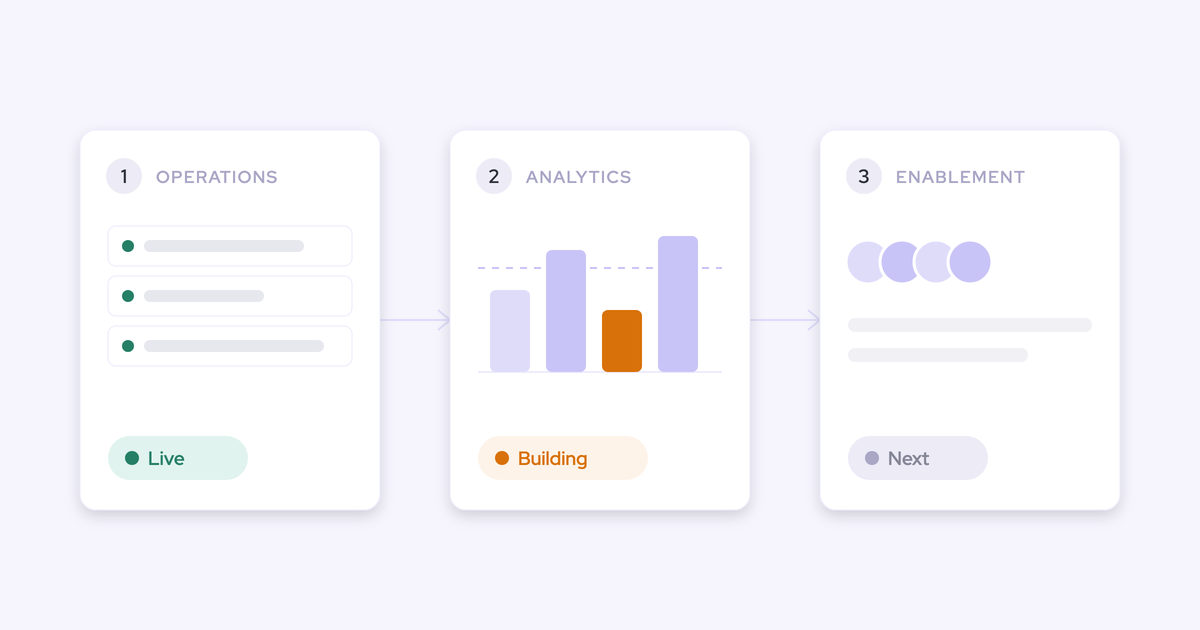

The short version: build it in order and resist doing everything at once. Spend 30 to 60 days auditing before you propose a roadmap, then build operations, analytics and enablement, in that order.
Staff the function with a generalist and a tool-savvy operator, hired together.
That said, "from scratch" usually means the function, not the tech stack. You'll probably inherit a CRM full of half-finished work and tools whose buyers have already left, along with someone else's decisions and no record of why they made them.
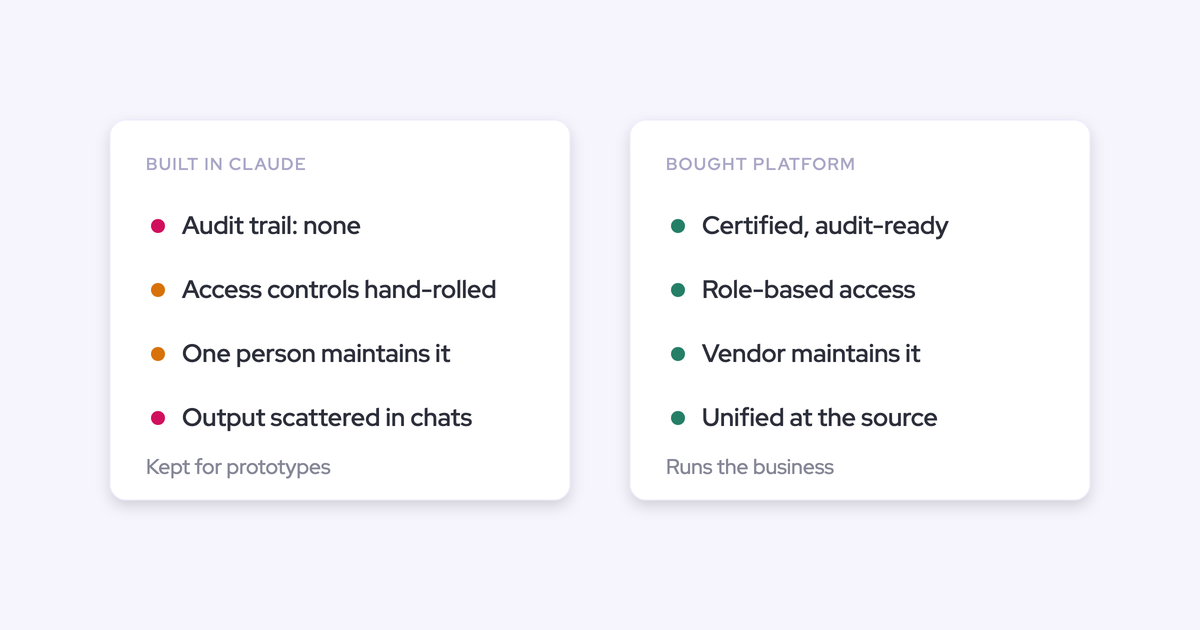
Our advice is simple to state but hard to stick to under pressure: don't buy tools for a process you haven't defined. The one exception is automatic activity capture, since every step that follows depends on complete data that reps will never log by hand.
The goal is a function that designs and governs the workflows that run deals, rather than one that reports on them after the fact.
This guide is for you if you're still choosing your path: who to hire, what to build first, where to report, what to buy, or whether to bring in outside help.
What to have in place before you start building RevOps
Before step one, agree with your executive sponsor on what the function is for and what outcome it drives.
"I think that often the executives, they actually don't care how you do it. They just wanna align on what you do and why you do it and what it drives in terms of measurable outcome. But then how you do it is actually up to you."
Here's what to have lined up before you touch anything:
- One measurable outcome, agreed with your sponsor and written down, so the function has a target beyond "make the dashboards better."
- A purpose framed as go-to-market alignment: shared definitions, a revisited ICP and one version of the facts across marketing, sales and CS.
- Admin-level access to Salesforce, because you can't audit what you can't see.
- A named list of stakeholders to interview across marketing, sales, CS and finance.
- Protected time for the audit, agreed with your sponsor, so the first month doesn't disappear into ticket requests.
Don't underestimate that purpose line. If RevOps gets defined as reporting on day one, that's the job you'll still have in year two.
"...at the end of the day, the number one priority for a RevOps org is to bring alignment across the go to market team and I would extend that to the product team for the product road map."
Step 1: Audit your data, tech stack, processes and skills
Give yourself roughly 30 to 60 days to audit four areas before proposing a roadmap, longer if the business is complex. Joe Ort, founder of RevOps Inflection, puts the audit first in his 5A framework because any recommendation made before it is a guess.
Here's what to look at in each area:
| Area | What to check | The question it answers |
|---|---|---|
| Data | What exists, how accurate it is, and whether a lead can be tracked from the top of the funnel through to bookings | Can we report the metrics the business cares about? |
| Tech stack | What you own, how it's integrated, and whether sellers use it | Which tools are earning their place? |
| Processes and handoffs | Whether sales stages map to the buyer's journey, plus the marketing-to-sales and sales-to-CS handoffs | Where does work and context get lost? |
| Skills | RevOps headcount and skills, and capability gaps in the teams you serve, such as weak discovery | Is this a system problem or a training problem? |
Expect most of your surprises in the handoffs row. Companies between $10M and $100M in revenue often haven't documented the sales-to-implementation handoff at all.
The audit doesn't have to be complete, either. Discovering that a capability is simply missing is a valid finding, and it earns that gap a spot in your later priorities.
It also buys you some political cover. When a leader asks for your plan in week three, "I'll have it after the audit" beats a roadmap you'll have to walk back in month four.
Step 2: Baseline every process metric before you change anything
Before any project starts, capture a baseline for every operational metric you plan to improve. Lagging outcomes like bookings get recorded anyway, but operational metrics only exist if someone measures them first.
"One of the steps that I always skipped early on in my career that I wish I could go back and fix was not baselining things. So we would go do all this work. We would do this big project. We'd roll things out, but we didn't have what that initial baseline was."
Skip it, and you'll deliver the project only to arrive at your annual review with nothing to show for it. RevOps teams rarely promote their own work, so this is the step that quietly disappears unless you make a point of it.
Here's how to tell what needs measuring now:
| Metric | Compare later or baseline now? |
|---|---|
| Bookings | Compare later. It's recorded whether you measure it or not. |
| Net new ARR and GRR | Compare later. They're board metrics, so they exist on every report. |
| Time to get a quote out | Baseline now. Nobody records it unless you start the clock. |
| Time to complete a workflow, such as a handoff | Baseline now. Once you've fixed the process, the old number is gone. |
Step 3: Decide what to do with your inherited tech stack
Treat the inherited stack as audit evidence rather than a month-one decision. You'll usually find several overlapping, half-adopted tools that nearly do the job, and not one you can fully rely on.
Since removing any one of them means a change management exercise, they tend to get replaced all at once or not at all, often in your first 90 days. That's real leverage, which is exactly why you shouldn't spend it before you know what your process is.
Don't buy tools for a process you haven't defined
If you buy before stages, methodology and qualification are settled, you'll codify the mess you were hired to fix. The tool gets configured around today's chaos, and six months later you're either paying to reconfigure it or explaining why nobody uses it.
If you have to evaluate early, judge tools on configurability rather than features. The question isn't whether a tool fits today's process, but how much you can reshape it once the process is settled.
Turn on automatic activity capture as the one exception
Automatic capture is different because it doesn't depend on any process decision or ask anything of reps. It logs every email, meeting and contact against your CRM records, whether or not your stages are settled.
That complete activity record then feeds:
- The audit, because you can see real engagement instead of what reps chose to log.
- The baselines from Step 2, because activity data starts accumulating before you change anything.
- Your forecast later on, which can't run on out-of-date records.
Weflow Activity & Contact Capture is one example, and we cover how it works further down.
Step 4: Build operations, then analytics, then enablement
Build the three layers in this order, since each one depends on the layer before it. Analytics on top of broken operations just measures noise, and enablement without analytics coaches on opinion.
Alexander Müller, founder of Revenue Enablement, explains it with a Formula One car:
"Operations is kind of you built the systems, you built the Formula One car, and now you have a very fast car, hopefully. Then you need the analytics people to tell you, hey, in this corner, you're losing a little bit of speed. And then the enablement people there eventually telling your sales teams, your go to market teams, whoever is customer facing, hey, hit the gas here a little bit earlier so that we save a few seconds on the overall lap time."
AI changes what each layer costs to run, but not the sequence.
Operations: Agree the definitions and codify them in Salesforce
Operations is the alignment work that no other function prioritizes, because it's nobody else's top objective. Agree on definitions with the people who use them, then build them into the tech stack so they hold even when you're not in the room.
You'll know operations is done when you have:
- One written definition for each core term (lead, opportunity, pipeline, churn) that marketing, sales and CS all sign off on.
- An ICP the business has revisited and agreed, with a date for the next review.
- Sales stages that map to the buyer's journey, each with exit criteria.
- Documented handoffs from marketing to sales and from sales to implementation and CS.
- All of the above codified in Salesforce as stages, required fields and validation, not just in a slide deck.
Analytics: Report only once the process produces trustworthy data
Executives tend to distrust data when the strategy and process beneath it were never codified. Rhys Williams, Founder and Managing Partner at Domestique, runs RevOps in a fixed order (strategy, process, tools, data, enablement), with data fourth on purpose.
"And if you think about it, data in what I just laid out is intentionally fourth. And the reason why a lot of executives don't trust the data is because they haven't spent the time flushing out their go to market strategy, updating their processes, building that into their tech stack, and understanding what the data is."
It's also why forecasting belongs after operations. A forecast encodes your operating cadence: who submits, how often, at deal or manager level and against which quota. Until those decisions are made, a forecasting tool just gives you a faster way to argue.
Enablement: Coach the field on what analytics shows you
Enablement turns those findings into behavior change in your customer-facing teams, and it's where you solve the audit gaps that don't have a system fix.
Here's how the three layers connect in practice. Say analytics shows deals stalling after the first meeting. You read the calls and find that reps skip half the discovery questions.
No new field or automation will fix that, but a discovery training built on your own team's real calls will
Step 5: Hire a generalist and a tool-savvy operator together
Hire the pair early rather than one at a time. Even Alexander Müller changed his own advice on this:
"Now I would actually say, try to pair them, get two people quite early on, get a generalist, get somebody who's tool savvy, who likes to play around. And then actually, I think together, they can be a real dream team. Because you don't want to have a new tool every week. You actually want to deploy it well so that everyone can actually use it."
| Generalist | Tool-savvy operator | |
|---|---|---|
| What they own | Process, definitions and stakeholder alignment | Deployment, configuration and experimentation with the stack |
| How they fail alone | Keeps the process clean but can't get much out of the stack | Ships a new tool every week that nobody adopts |
| What they get from the other | Someone who can build what the process needs | Someone who makes each deployment stick |
| Role in an agent-heavy stack | Decides where agents belong in the process | Builds and maintains the agents |
You'll notice the straight analyst is missing. RevOps leaders tell us they've stopped hiring for spreadsheet skills, since the work now means building with AI tooling.
The pairing matters even more as agents arrive. Someone has to build them and someone has to govern where they belong in the process, and one person rarely does both well.
Step 6: Choose where RevOps reports and how it's organized
There's no single winning model here. Decide based on what the function has to own, and give extra weight to AI operations if that's coming your way.
Should RevOps report to the CRO, COO or CFO?
If RevOps is likely to grow into company-wide AI operations, report to the COO, since that work touches finance, product and engineering. And avoid a marketing reporting line unless you want the function to turn into marketing ops.
| Reporting line | What it optimizes for | When it fits |
|---|---|---|
| CRO | Proximity to the revenue motion and its priorities | RevOps serves sales and CS, and AI work stays inside go-to-market |
| COO | Reach across every department | RevOps is set to take on AI operations for the whole company |
| CFO | Neutrality across the CRO, CMO and chief customer officer as peers | The function's main job is holding one version of the numbers between leaders who disagree |
| Head of marketing | Funnel and campaign operations | Rarely, since the function narrows into marketing ops |
Avtar Varma describes the AI operations path as one that starts inside go-to-market: you build AI workflows for sales, marketing and CS, show the return, then extend them to the rest of the company.
That's where a CRO reporting line gets awkward, since the function ends up serving every department.
Should RevOps be centralized or embedded in each team?
Centralize when neutrality matters most, and embed when proximity to the motion does.
Jeremey Donovan, Managing Director at Insight Partners, makes the case for proximity: an ops leader who works as the functional leader's right hand understands the motion and acts on its priorities.
| Question | Centralized | Embedded |
|---|---|---|
| Main strength | Serves peer executives without bias | Knows the motion and its priorities closely |
| Main risk | Drifts away from what the field needs | Takes a side when leaders disagree |
| Best fit | Leaders who often dispute each other's numbers | Strategy and analytics for one function's leader |
| Systems and data admin | Can sit here even if strategy is embedded | Usually better kept out of here |
This doesn't have to be a single decision, either. Where systems and data admin sit can follow a different logic from where strategy and analytics sit.
When to split RevOps into business partners, process and tech
It's time to split roles when always-on requests start eating into your transformational roadmap. In a small team, the same people handle every fire drill and every configuration change, which makes prioritization brutal.
Tessa Whittaker describes three role types at scale:
- Business partners face the executives and own forecasting, pipeline and the business narrative.
- A business process team, run like product management, owns each end-to-end process and turns it into requirements.
- A revenue technology team owns and builds the stack.
There are two other ways to cut it:
- Front of house covers reporting, analytics, forecasting and planning, while back of house supports the tech stack, integrations, IT admin and change management, as Navin Persaud describes it.
- Assigning people to funnel stages instead of processes gives each person ownership of an outcome. Lindsay Rothlisberger at Zapier, for example, splits ownership between an inbound and an outbound funnel owner.
The funnel-stage cut also fixes a problem that tool-based splits create: when one person owns Salesforce and another owns marketing automation, nobody owns the drop in trial-to-opportunity conversion.
Step 7: Design your RevOps team to orchestrate AI agents too
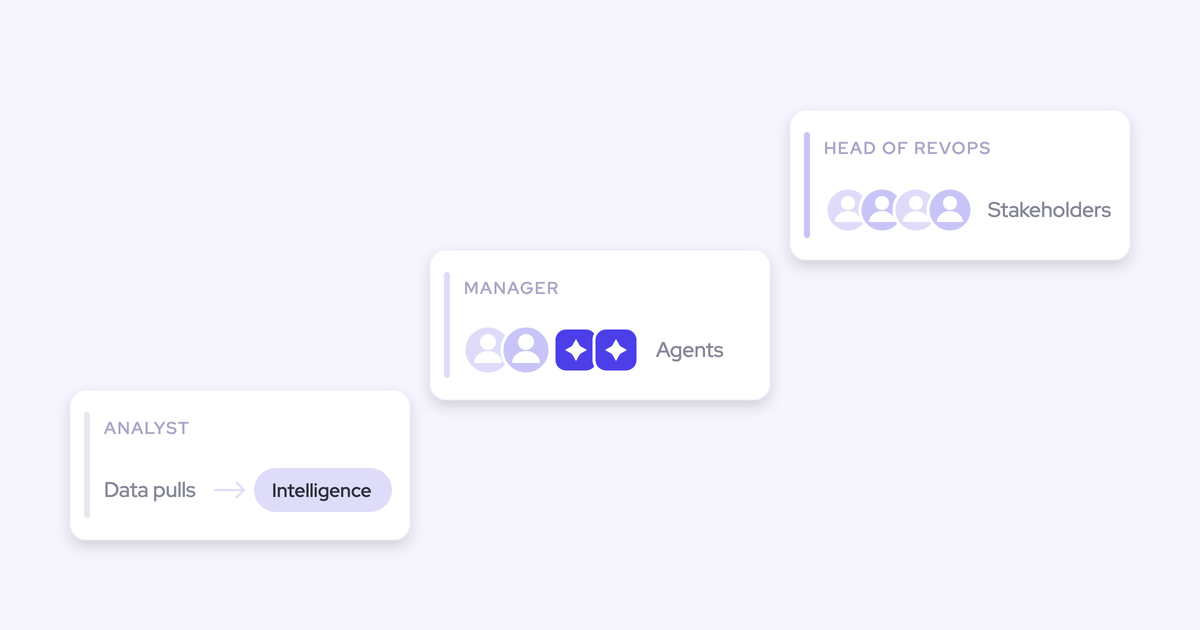
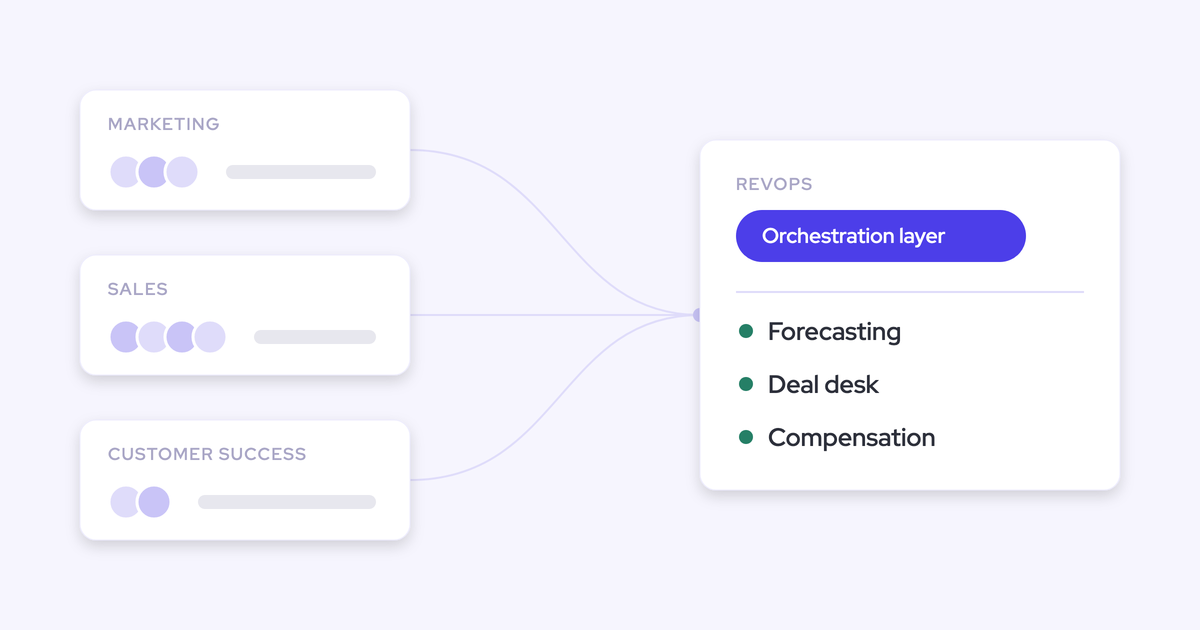
Treat agent operations as a skill you build into your existing operators rather than a new hire. RevOps becomes the orchestration layer that designs and governs agent workflows, while everyone else uses them through chat.
"So I think, like, RevOps, you know, used to be the team that, like, reported on the business. Now it's, like, becoming the team that's starting to build and govern the systems that are really running the business."
After all, reps can't each manage five or ten agents. Someone has to design the shared workflows, and that someone is RevOps.
"The orchestration layer will continue to be RevOps and the interaction layer will be chat, whether that's in Slack, in a tool, or in email."
Mollie Bodensteiner compares agent operations to the way DevOps keeps software up and running:
- Monitoring agents for drift, so output doesn't quietly degrade.
- Running QA on what agents produce before the field relies on it.
- Adjusting prompts and skills as the process changes.
- Managing consumption against a budget, the way you'd manage any software spend.
- Deciding which work is human-first and which is agent-first.
The sales ops person who defined your methodology also owns the agent that runs part of it, and stays accountable for it just as they would for a human-led process.
If you want to start without extra headcount, look to your most AI-forward reps, CSMs and frontline managers.
Collect the use cases that already save them time, rank them and rebuild the best ones as supported versions packaged by role, such as a customer success package with five or six skills and a separate one for sales.
Mistakes that turn a new RevOps function into a reporting shop
A new function usually loses its strategic seat through habits, not bad tools. The good news is that each of these is fixable once you spot it:
- Taking orders without a point of view makes you easy to replace with automation. Bring a recommendation with every request, hold it loosely, and change it when the evidence does.
- Becoming the lookup desk for "how do I do this" and "where do I find that" stalls your roadmap. Make the answers searchable, and treat curating that knowledge, not repeating it, as your job.
- Refereeing marketing and sales numbers week after week costs you trust whichever side you land on. Push the definitions up to the executive level so the argument has somewhere to get settled.
- Answering every question with another metric leaves the CRO with fifty numbers and an understanding of none. Attach each number to a decision, and send the analysis with the chart.
- Surfacing every problem you spot hands the prioritization work back to a leader with no room for it. Bring the top two and hold the rest.
- Building a setup only you can diagnose recreates your predecessor's mess. Document every configuration and tie user setup to systems that update themselves.
Nicole Bradshaw learned that prioritization lesson from the other side, during six months leading sales:
"There's so much else on my plate that I need my RevOps partner to actually prioritize for me and to tell me what to care about."
— Nicole Bradshaw, Leads the centralized RevOps function at PandaDoc
How Weflow fits a RevOps function you're still building
Weflow is the Revenue AI Orchestration platform for sales, customer success and RevOps teams on Salesforce.
For a function that's still under construction, it helps in three places: capturing activity before the process is settled, keeping your data when people leave and running scheduled agent workflows.
Weflow Activity & Contact Capture runs before your process is settled
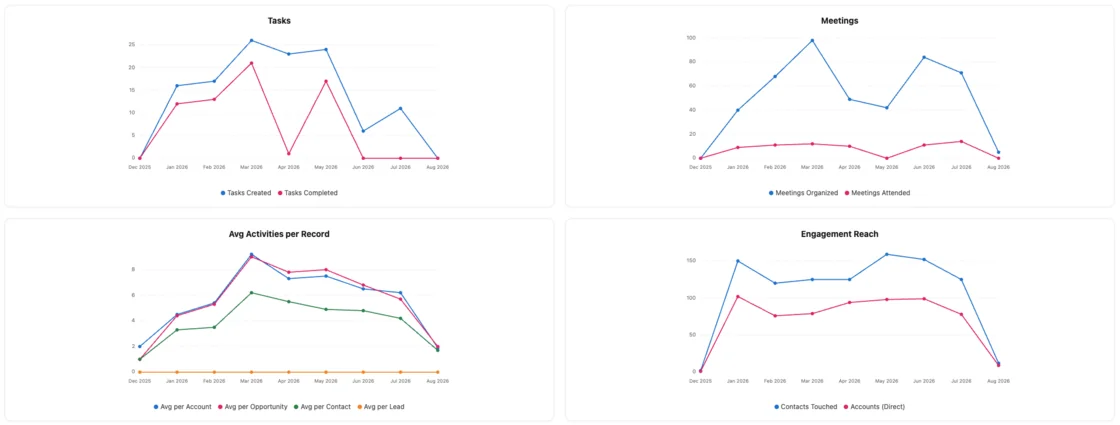
Weflow Activity & Contact Capture starts as soon as your admin adds a user to a capture configuration. The user never has to sign in, since signing in is only needed to see insights. That means capture-only users don't need a Weflow seat and aren't asked to do anything.
That's why it fits Step 3: you can switch it on while stages and methodology are still open questions, and it starts building the activity record your audit and baselines need.
Your captured data stays in your Salesforce when people leave
Weflow writes captured activity into your own Salesforce, where your reporting and automations can use it. If you or your admin leave, the data stays where the company can see it.
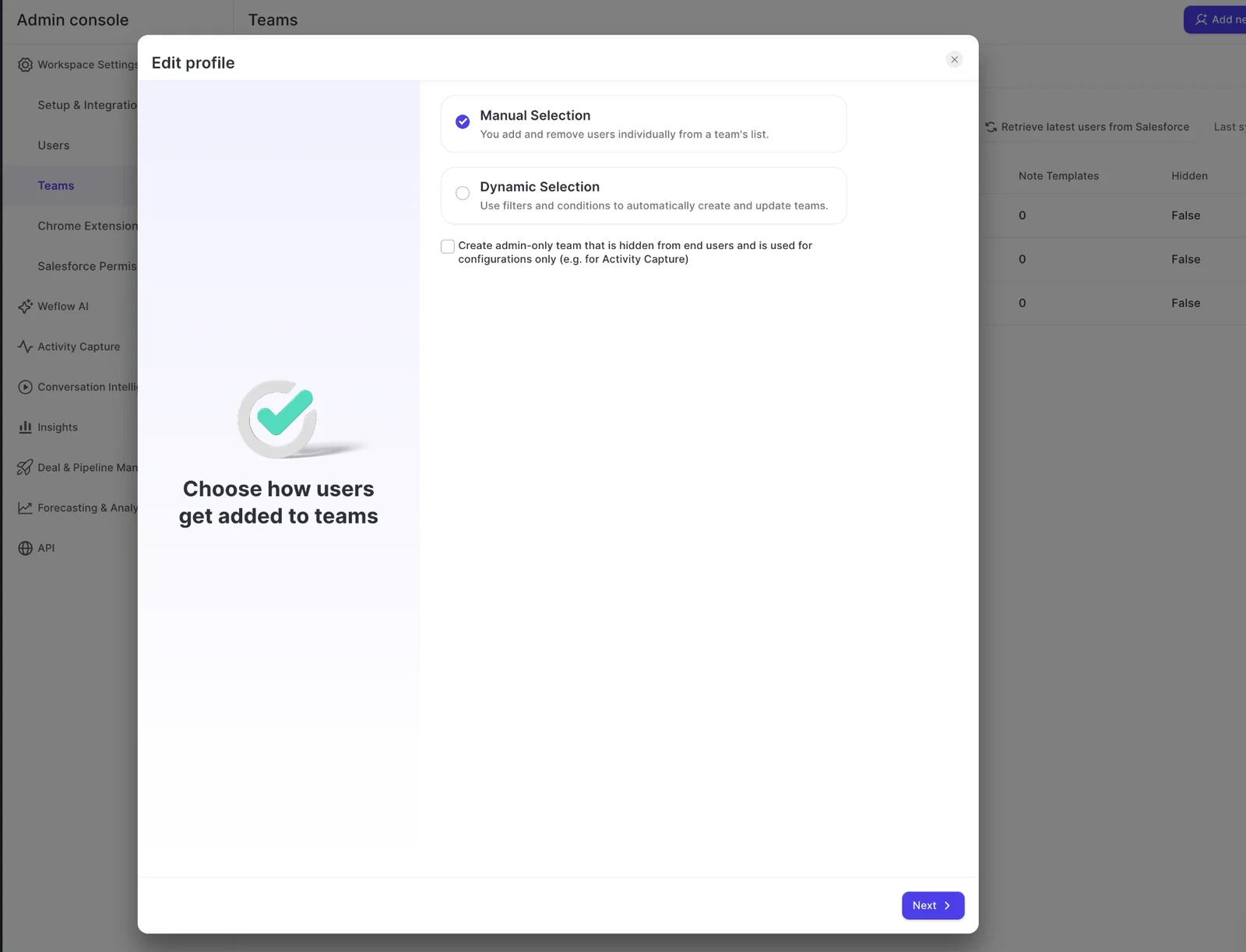
Weflow also builds teams dynamically from Salesforce, by manager, role or field condition. Those teams drive product enrollment, so a rep who moves team in Salesforce moves in Weflow automatically.
Joiners and leavers come through the user logic your HR and identity systems already feed, so nobody has to add users by hand every week.
Weflow Agent Builder sends scheduled insight instead of another dashboard
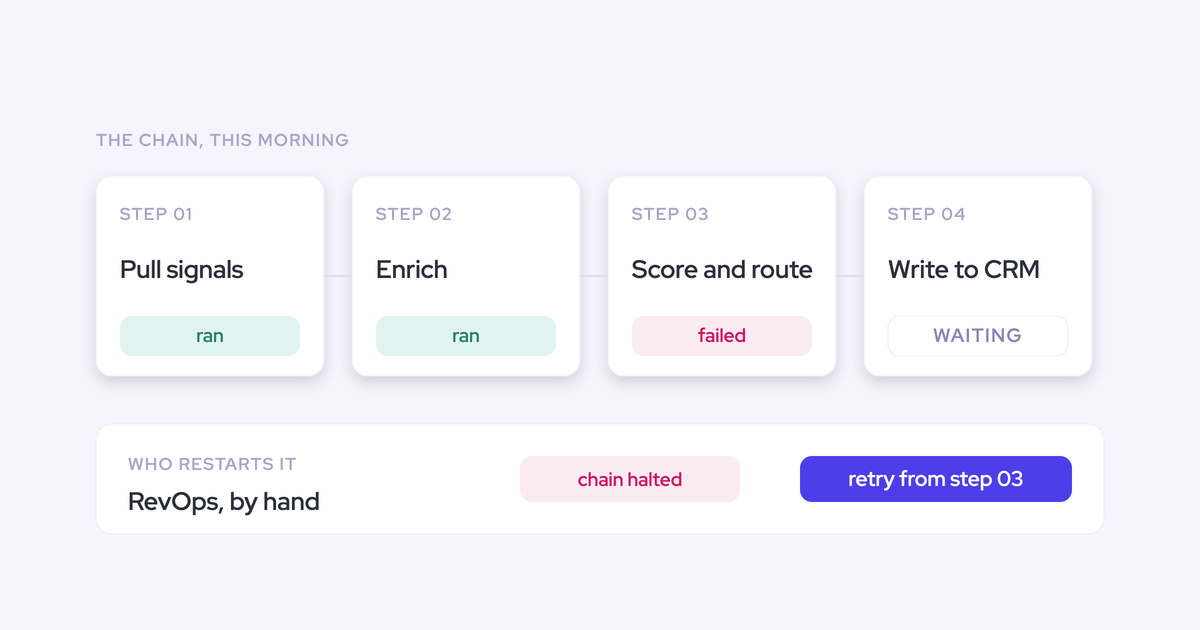
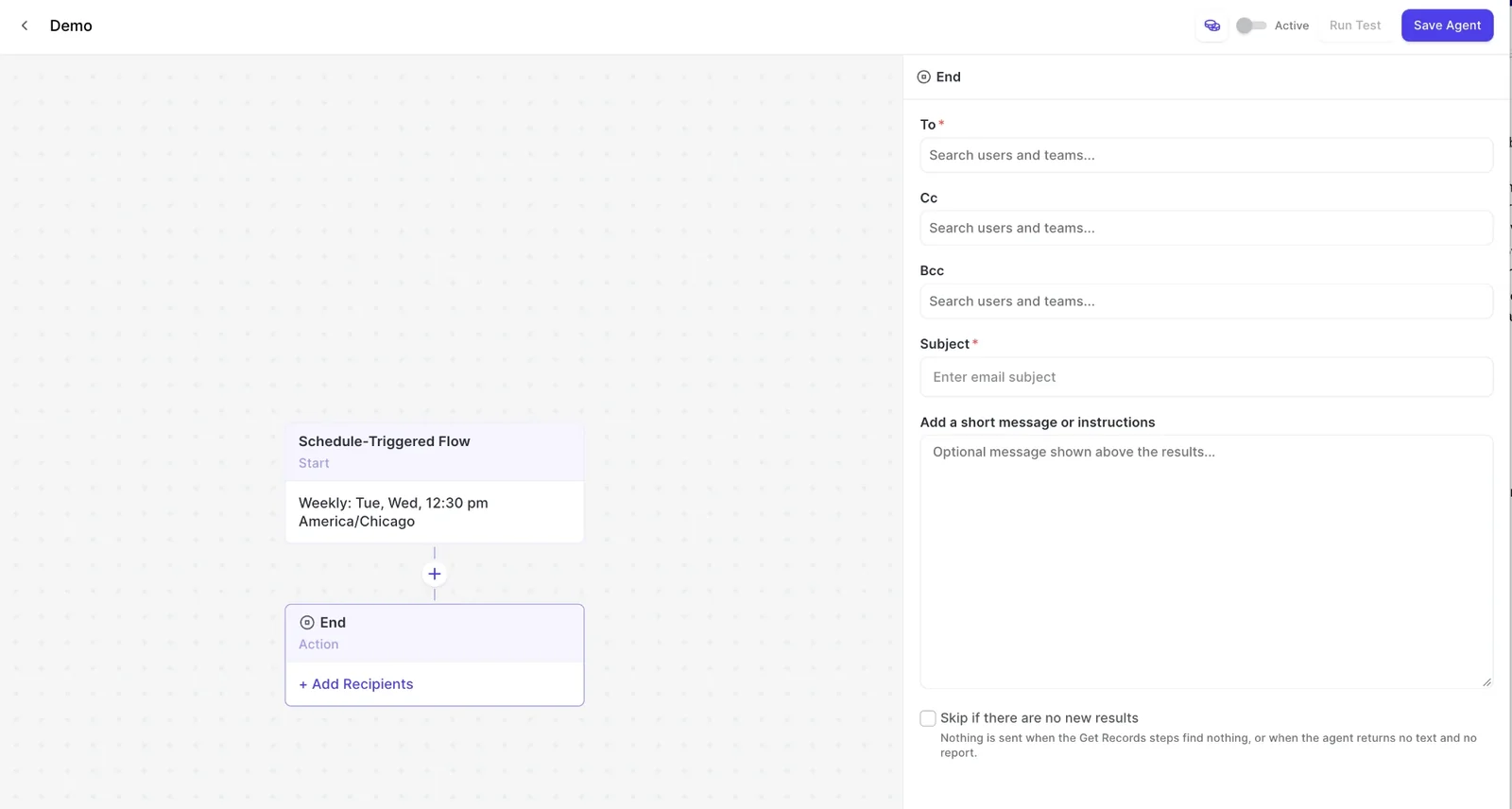
Weflow Agent Builder runs scheduled workflows over live Salesforce data and emails the result, optionally as a PDF. It's the orchestration work from Step 7 in practice: you design the workflow once, and it delivers insight where executives already are.
Each flow has four parts: a schedule (day, time and timezone), a lookup on Salesforce records with field filters, an AI step with your prompt and an email step.
Because the lookup reads Salesforce live, a change made a minute ago is included in the run, and the AI step reads the emails, calls and transcripts attached to those records.
Here are a few recurring plays our customers run:
- A Monday morning pass over the pipeline that names the deals needing action and pre-writes the follow-up.
- A weekly deal-risk scan sent before the forecast call.
- A monthly closed-lost analysis that reads every lost opportunity to surface which competitors appeared and which objections recurred.
You can start from three templates: a pipeline snapshot, a meeting recap bundle and a deal risk PDF. Their prompts are deliberately basic, since they work best once you rewrite them for your process.
How much of your team's time a Weflow rollout takes
Implementation is free, and you'll typically be live in two to three weeks. We run onboarding ourselves as a project with named owners on both sides, in three phases:
- Technical implementation: A 45 to 60 minute call with your Salesforce admin and mail admin to connect the systems.
- Configuration: Team structure, sales methodology, which custom fields AI should fill, playbooks, deal warnings and prompt templates. This is where most of the time goes.
- Role-based rollout: Separate training for leadership and reps.
If your team can't spare the time, there's also a managed service option where Weflow does the heavy lifting and your team just answers questions and unlocks access.
"I made a deliberate choice to let Weflow own end-to-end onboarding rather than pull my team off revenue-generating work. That's exactly the kind of partnership leverage I was looking for."
— Scott Jones, SVP of GTM Revenue Intelligence & Enablement at KORE Wireless
Capture and Weflow Conversation Intelligence can go from implementation to rollout in about two weeks. Forecasting takes longer because, as we covered in Step 4, it encodes your operating cadence.
If you haven't built operations yet, you're not ready for forecasting, and we'll tell you so.
When Weflow isn't the right fit for your team yet
Weflow isn't the right answer for every function under construction. Here are the limits to be aware of:
- Weflow works only with Salesforce, on Enterprise Edition and above, or on Professional Edition with Salesforce's API add-on. Starter Edition has no API access, so teams on Starter need to upgrade first.
- Bundles start at 10 users, so very early teams aren't a fit yet.
- Weflow Conversation Intelligence needs a named internal owner, or its prompts and field mappings go stale. Activity capture, by contrast, largely runs itself once it's configured.
- Weflow isn't a sequencing tool, so it doesn't replace Apollo-type engagement platforms.
- Weflow won't define your strategy or process for you. That's Steps 1 through 4, and it's your job.
Want to hear more from the operators in this guide? On RevOps Lab, Janis and Philipp talk RevOps, forecasting and AI with the people who run it day to day.
FAQ: Building a RevOps function
When does a RevOps team of one stop working?
It works in small, engineering-heavy companies where the operator leans hard on AI tools. It breaks when one person carries enablement, reporting and the KPI cadence for the whole revenue team at once.
At that point, automation is no longer an efficiency project but the only way to keep the role survivable.
How should RevOps capacity split between sales and customer success?
It should follow where revenue comes from, which changes as the company grows. Below about $10M in revenue, a sales and marketing focus makes sense.
Haris Odobasic estimates that by around $50M, about 80% of a year's revenue comes from existing customers, so retention needs at least an equal share of RevOps attention.
Should you bring in a consultancy or forward deployed RevOps instead?
Forward deployed RevOps is an embedded team, from a consultancy or a RevOps-as-a-service provider, that fixes data and process alongside a tool implementation.
It's useful when you lack the capacity to prepare your data for a rollout. It complements building the function but doesn't replace owning the definitions, cadence and roadmap yourself.
How is building the function different from a 30/60/90-day plan?
A 30/60/90-day plan covers your own first quarter as a RevOps leader: who you meet, what you learn and what you deliver early.
This guide covers the build order for the function itself. Your first 90 days usually take you through the audit and the start of operations.