Forecasting a Consumption-Based Business: Rep-Owned Bookings vs Finance-Owned ARR Models
Learn when rep-owned bookings vs finance-owned ARR models improve forecast accuracy and incentives.


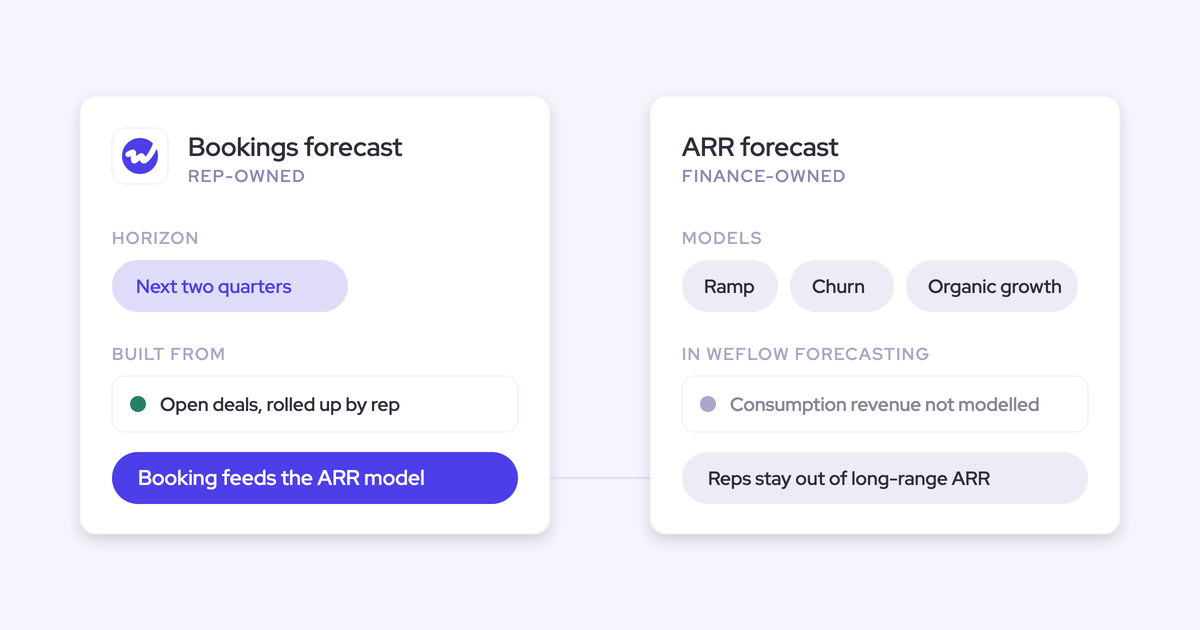

If you run RevOps at a usage-priced company, you don't have to pick between a bookings forecast and an ARR forecast. Instead, you split ownership at the point where signature ends and consumption begins:
- Reps own what they control: A gated, substantiated bookings forecast for the current and next quarter.
- Finance owns what usage decides: ARR modeled with ramp curves, plus run rate for the long tail.
- Pay follows ramped or realized ARR, so neither number gets gamed.
What most teams are missing isn't a formula. It's an agreement on who owns which number and how pay follows it.
We built this model with two operators who run it every day: Markus Jaensch, Head of RevOps at Aiven, a $100M+ ARR consumption business, and Colin Gerber, VP RevOps & Strategy at Socure.
The rep-owned number only earns finance's attention once it holds up in a deal review, with every commit backed by evidence and every submission locked and graded. That's the half where Weflow deal reviews help, and we'll be upfront about where it stops.
Why an opportunity roll-up can't forecast consumption revenue
In a consumption business, a closed-won opportunity records a promise, but the revenue lives in usage data the opportunity never sees. So your roll-up answers "what will we book," while the board is asking "what will we recognize."
| Question | Seat-based SaaS | Consumption |
|---|---|---|
| When does revenue start? | At signature, on a 12, 24 or 36 month term | Whenever the customer decides to start consuming |
| What does closed-won guarantee? | The contracted revenue for the term | Nothing, unless there's a commit contract |
| What does the opportunity amount mean? | The revenue | An estimate of future usage |
| Where does RevOps work end? | At closed-won | Most of it starts after signature |
Aiven learned this the hard way:
"We had a customer saying, yep, we commit, we start next week, and then a major incident happened at the customer and their team was blocked for four months. They could not onboard at all, but we had it already in the books. Winning an opportunity does not mean there is revenue."
Yet most forecasting tools, Salesforce included, model revenue as a sum of opportunity amounts. Buyers on our calls already know it.
Why bookings still matter when usage decides revenue
That doesn't mean you should drop your bookings forecast. In a consumption business, bookings are your leading indicator, and they set the goal line your revenue target is built on.
The real problem is usually that the bookings view is badly defined, not that it's pointless.
Gerber calls the opposite view a common mistake:
"I think it's a common misconception in consumption based models that bookings are sort of irrelevant or it just comes down to revenue because you're kinda booking a made up number, but that's not really the case, because that does inform essentially your forecast and understanding how much revenue do we expect and how do we track towards this. So that's the goal line."
Jaensch adds that bookings also tell you whether your growth is coming from new business or from somewhere you can't explain.
"A bookings target in the end is a sanity metric. What counts is ARR that gets in, so we want to ensure that the ARR actually gets through. But the booking is the big indicator, because if you do not have any bookings but your ARR is growing, then it is also a question of where this is coming from."
Drop bookings, and you lose next quarter's warning light, since ARR only shows you this month's usage.
Four ways to own a consumption revenue forecast
There are four realistic ownership models, and each comes with a real cost.
Bookings-only: Reps forecast what they sign, nothing more
This is the SaaS habit carried over: reps forecast signed deals, the roll-up goes to leadership, and nobody touches consumption.
It does get two things right: it's simple, and it keeps reps focused on pipeline instead of modeling.
The catch is that it answers a question the board isn't asking. Finance still needs a revenue number, so it exports the pipeline and builds its own.
Before long, you have two forecasts (sometimes three versions of the waterfall), and the sales number gets ignored. One RevOps leader described the frustration to us:
"I really want to be able to say this is our bookings forecast and it is worth something and it is valuable to look at. But right now people are wrapped around the axle on the revenue and are we hitting the revenue number for the total year, versus what does it take to get there from a bookings perspective."
Fits when: Commit contracts make up most of your revenue, so a booking is close to bookable ARR anyway.
Rep-owned ARR: Reps forecast consumption on named accounts
Here, reps forecast consumption account by account instead of deal by deal. Aiven ran this model, and it was accurate.
But it took too much company time to sustain. Every rep turns into a part-time revenue analyst, modeling ramp timing they can't control. There's also a structural gap: you can't forecast a long tail of small accounts one by one.
Fits when: Your revenue sits in a small number of large named accounts and reps have the capacity to model each one.
Finance-owned ARR: FP&A builds the only number that counts
In this model, finance builds ARR from usage and history, and the sales forecast either disappears or becomes a formality.
The finance number can even be the more accurate one, precisely because it ignores what reps typed.
The downside is that sales loses authority over its own business, and nobody owns the bookings input every ARR model depends on. Comp then drifts to whatever is easiest to measure (usually bookings), which inflates the very input finance is modeling from.
Fits when: Your motion is mostly self-serve, with little sales-led new business to forecast.
The split model: Reps own bookings, finance owns ARR
In the split model, each side owns what it controls:
- Reps own a gated, substantiated bookings forecast for the near term.
- Finance turns those bookings into ARR with ramp curves and covers the long tail on run rate.
- The two meet in a defined monthly handoff.
The cost here is discipline. You need a monthly reconciliation that actually happens, booking rules both sides accept, and a realization measure that shows whether bookings turn into revenue.
Fits when: You have a mixed base at scale, with sales-led named accounts plus a long tail of smaller customers.
How to choose between the four forecast ownership models
Five criteria decide which model holds up in your business:
- Board trust: Whose number does the board and CFO act on when the two disagree?
- Rep time: How many selling hours does the model take from reps every month?
- Gaming risk: Does the number reps are paid on also feed the forecast, so inflating it pays?
- Leading indicator: Can you still see next quarter's revenue coming before it shows up in usage?
- Long-tail coverage: Does the model cover thousands of small accounts without account-by-account work?
| Criterion | Bookings-only | Rep-owned ARR | Finance-owned ARR | Split model |
|---|---|---|---|---|
| Board trust | Low: answers bookings when the board asks about run rate | High while it lasts | High, but sales has no voice in it | High: each number is owned by the side that controls it |
| Rep time | Low | High: Aiven found it unsustainable | None | Low: reps forecast two quarters of bookings only |
| Gaming risk | High if pay follows bookings | Medium: reps forecast the number they're paid on | High: unowned bookings drift upward | Low when pay follows ramped or realized ARR |
| Leading indicator | Visible, but disconnected from revenue | Weak: the focus moves to current usage | Lost: nobody owns bookings | Visible and measured through realization |
| Long-tail coverage | None | None: can't be forecast account by account | Covered on run rate | Covered on run rate |
| Fits when | Commit contracts dominate | Few large named accounts | Mostly self-serve | Mixed sales-led and long-tail base at scale |
Why we split forecast ownership where consumption begins
We recommend the split model because it's the only one that holds up on all five criteria. It keeps the leading indicator, protects rep time, covers the long tail, and lets you design pay so inflating either number doesn't pay off.
The line sits at roughly two quarters. Reps forecast bookings for the current and next quarter, and beyond that, finance takes over and models ARR. Anything further out depends on ramp, churn and organic growth, and none of those are in a rep's control.
| Area | Reps own | Finance owns |
|---|---|---|
| Number | Bookings | ARR |
| Horizon | Current and next quarter | Beyond two quarters, monthly |
| Method | Gated, substantiated deal-level calls | Ramp curves, known churn, organic growth |
| Accounts | Sales-led new logo and expansion | Long tail on run rate, combined with named accounts |
| Proof of quality | Locked submissions graded for accuracy | Booking cohort realization by month 12 |
How Aiven and Socure each run the split model
Aiven and Socure run the same split with different mechanics: Aiven standardizes, while Socure substantiates deal by deal. The right variant for you depends on how well your buyers know their own volume.
| Element | Aiven | Socure |
|---|---|---|
| Closed-won or booking rule | RevOps approval, valid payment method, three consecutive days of consumption | The volume-substantiated figure gets booked at signature |
| What gets booked | Rep bookings, sized early with T-shirt sizing; commit contracts count as ARR | Annualized full-ramp value for established buyers, contractual commitment for prelaunch |
| Ramp curve source | Standard assumptions set with finance | A curve per deal from go-live month and seasonality |
| Long-tail method | Run rate, combined with named accounts into one ARR number | Not discussed in our conversation |
| ARR definition | 30-day average of 24 daily snapshots | Not discussed in our conversation |
| AE pay basis | New-ARR commission once the deal ramps to a set size per segment | Paid out over eight quarters from go-live |
| Realization target | Not stated | About 90% of each booking cohort by month 12 |
Aiven: Standard ramp curves and a consumption-gated closed-won
Aiven's model has five moving parts:
- A two-quarter bookings forecast owned by reps and first-line managers.
- Standard ramp assumptions agreed with finance, so reps never model ramp timing.
- T-shirt sizing (S, M, L, XL) by solution architects once they join a qualified opportunity, adjusted as the deal develops.
- Run rate for the long tail, merged with the named-account forecast into one ARR number.
- A closed-won gate that only RevOps can approve.
The T-shirt size reflects the workload the customer plans to run within six months. If a fast-ramping customer hits 150% of that size, it's a sign a second expansion opportunity should have been opened.
The gate is what keeps dormant wins out of the books:
"We have two mandatory rules to close an opportunity. One is a valid payment method that is added, and two is that we have three consecutive days of consumption. We see that when you have three consecutive days of consumption, more than ninety percent of the customers actually start consuming and stay."
Socure: Volume-substantiated bookings and a ramp curve per deal
Socure, an identity verification vendor priced on API calls, treats every booking as a volume forecast. Before booking anything, it substantiates the number bottom-up from the customer's own workflows.
For each use case, the team maps the workflows involved, the modules in each, the decisions each workflow makes per month, and the share of decisions that reach each module. From there, volume is simple arithmetic:
"that's how we're actually pressure testing essentially like what we're booking because it is a forecast. But it's like, okay, like we can substantiate, you know, the, hundred thousand calls here because we know that this workflow is gonna make, you know, fifty thousand decisions. There's two modules. Each module is hit every time. So fifty thousand a piece that equals a hundred thousand in volume."
Once booked, each deal gets its own ramp curve instead of a standard assumption, because the same annual number realizes very differently depending on when the customer goes live and when its business peaks:
- Buy now pay later lenders freeze code in September and October, then spike in November and December.
- Online gaming peaks in September and October with the American football season, then again in the January and February playoffs.
Socure tracks each deal against that curve as booked ARR realization (BAR). It also runs prospects in its live production environment before signature, instead of in an offline proof of concept.
That takes Socure's own implementation delay out of the gap between closed-won and consumption, so any remaining lag comes from the customer's launch date or engineering roadmap.
Both models came out of RevOps Lab conversations. Janis and Philipp talk RevOps, forecasting, and AI with operators who run it daily.
How to set up the rep-owned bookings forecast
For finance to trust your bookings forecast, it needs to be gated, substantiated and honest about what's contractual.
Gate closed-won on a payment method and three days' consumption
Start by taking closed-won out of the rep's hands. At Aiven, RevOps approves a win only once there's a valid payment method on file and three consecutive days of consumption.
The consumption rule does most of the work. A win that hasn't consumed is still a deal in progress, and the gate keeps your CEO from announcing a customer who never shows up in usage.
In Salesforce, you build this through process and validation design, with a RevOps approval step on the stage change. Just make sure reporting still shows deals waiting at the gate, not only the ones that passed.
Book only the volume a customer can substantiate
How much you book depends on how well the customer already knows its own volume.
| Rule | Established volume | Prelaunch or very early |
|---|---|---|
| Example buyer | A government tax agency, or a mature buy now pay later lender | A startup projecting fast growth |
| What you book | Annualized value at full ramp, seasonality included | Only the contractual commitment |
| Why | They know how many filings or sign-ups they get | Their growth projection is a guess |
| If growth arrives | Already in the booking | Open a follow-on deal |
Gerber's warning on getting this wrong:
"If it's like a prelaunch startup and they think they're gonna have crazy growth or crazy users, probably be like, that's great, we'll maybe book a follow on deal when that happens, but only book about what they're actually contractually obligated to. Otherwise, you're gonna have a huge hole in your forecast, and you're gonna be answering to everyone for the next twenty four months on that one and why that hasn't realized."
Socure enforces this with a solution readiness document. Late in the deal, usually alongside contracting, solution consultants fill in a custom Salesforce object with one record per use case.
Each record holds monthly decision volume, the modules grouped into sequential steps, and the share of decisions reaching each step.
Expected revenue is then monthly decisions × the share reaching each billable step × each module's contracted price. The rep still calls their own number, but if it's far from what the model produces, the gap gets resolved before the deal is booked.
Treat commit contracts as bookable ARR
A commit contract, where the customer agrees to spend a set amount of credits over a defined period, turns uncertain usage into ARR you can count, so book it as ARR.
Just don't expect commits to solve your forecasting problem. At Aiven, only a small share of customers sign them, so most revenue still comes from pure consumption, which still needs the split model.
How to set up the finance-owned ARR forecast
This is the half you can hand straight to your FP&A partner.
Hand the bookings forecast to FP&A every month
Aiven meets with FP&A every month to extrapolate the rep bookings forecast into a monthly ARR forecast, using four inputs:
- The rep-owned bookings forecast for the current and next quarter.
- Historical ramp patterns.
- Known future churn.
- Organic growth in the existing base.
This is the handoff the other three models are missing, and it's where the two numbers get reconciled instead of argued about in the board meeting.
Pick standard or per-deal ramp curves
You have two ways to turn a booking into a monthly revenue curve.
| Element | Standard assumptions (Aiven) | Per-deal curves (Socure) |
|---|---|---|
| New customers | Linear ramp over 4 to 6 months to expected size | Curve built from the go-live month |
| Existing customers | Ramp in 4 to 8 weeks | Curve built per booked deal |
| After ramp | Flat growth of roughly 5%, depending on region, through month 12 | The customer's own seasonality |
| Setup effort | Low: one agreed set of assumptions | High: a curve for every opportunity |
| Best when | Customers ramp in similar patterns | Customers have strong, known seasonal peaks |
If your customers look alike, start with standard assumptions. Once the same annual booking keeps realizing on wildly different schedules, move to per-deal curves.
Forecast the long tail on run rate, not account by account
For your base of small accounts, extrapolate current consumption forward instead of forecasting each one.
Aiven, for example, runs a dedicated ARR forecast for large named accounts handled by field teams, covers the long tail on run rate, and combines the two into one ARR number.
This keeps forecasting effort proportional to account size, which is exactly the problem that sank rep-owned ARR.
Define ARR on a thirty-day average to absorb daily swings
Define ARR on a rolling average rather than real-time consumption. Here's why Aiven made the switch:
"Back a couple of years ago ARR was on real-time consumption, and if that fluctuation happens on the last day of the fiscal year, you do not want a two million drop that is just for twelve hours. So we changed the ARR metric to an average out of the past thirty days from twenty four screenshots a day, so it is still consumption based but way more stable."
At scale, that definition stops being a technicality:
"Little things like the fact that you cannot just rely on the daily ARR that is calculated, but you need to take a thirty-day average, those things matter if you have a hundred million scale setup and you want to do an IPO. The details matter, and this hits the finance teams, the investor reporting, everything."
How to measure whether bookings turn into ARR
Track each quarterly booking cohort by how much of it realizes by month 12. Socure aims for roughly 90%:
"We wanna be ninety percent accurate. We don't wanna be realizing sixty percent on a rolling twenty four month basis because that would mean our bookings number is either wildly inflated or we need to wildly inflate it in order to get to a hundred percent."
Realization tells you whether your bookings forecast deserves trust, and your comp plan depends on it. You can build the view in four steps:
- Group booked customers into cohorts by booking quarter.
- Set expected realization at month 12 by customer type and size, from historical data.
- Track each cohort's average ramp against that expectation.
- Report cohort realization to the board alongside ARR.
How to pay reps so neither forecast gets gamed
In short: pay on ramped or realized ARR, keep a bookings target as a sanity metric, and balance new-logo and existing-customer incentives. Aiven and Socure handle the AE side differently.
Pay AEs when a deal ramps to its target size
Aiven pays new-ARR commission only after a deal ramps to a predefined ARR size, set separately for enterprise and commercial reps. The rep closes the deal, the customer reaches that size, and only then does commission pay out.
That ties the AE to consumption without asking them to forecast it.
Pay AEs over eight quarters from go-live
Socure starts the clock at go-live, which it sets at a low usage threshold, so even a small number of calls in a month counts. From there, the AE is paid on that opportunity for eight quarters, which gives them every reason to get the customer ramped fast.
Over time, long-tenured reps build a stacked annuity, collecting from deals booked across up to three plan years at once. That rewards reps who stay and grow revenue, which is exactly the behavior a consumption business needs.
Tie CSMs and solution consultants to revenue, not bookings
Outside the AE team, Socure ties 70% of variable comp to revenue, measured at pod, segment or company level. That's because consumption revenue compounds: most of a year's revenue comes from customers signed in earlier years who are still ramping.
CSMs and solution consultants do much of the work across those 24 months, so they carry shared KPI targets instead of individual deals. It's a lower-risk, lower-reward profile than the AE's.
Keep a bookings target so new logos don't dry up
Lean too far either way and your forecast breaks:
| Pay weighted mainly on | What happens |
|---|---|
| Bookings | Reps inflate bookings, realization falls, and RevOps explains the gap for 24 months |
| ARR growth | NRR improves and new-logo acquisition dries up, as Aiven saw in a prior year |
| Ramped ARR, with a bookings target | Reps chase new logos that actually consume |
"In order to avoid a perverse incentive, you really want bookings to be important and drive some compensation, some performance management, but you do not want that to be the main focal point for your teams and how they're compensated, because that will end up with the same problem as well, which is overinflated bookings."
What Weflow adds to the rep-owned bookings forecast
In a consumption business, Weflow Deal Intelligence & Forecasting covers the rep-owned bookings half of the split and makes it credible in front of finance.
KORE Wireless describes the problem we see most often on this side:
"We felt like our forecasting and our bookings pipeline knowledge was flawed. Sellers were over-inflating the value of deals. We felt like we needed validation around that to be able to inform our business more intelligently."
— Scott Jones, SVP of GTM Revenue Intelligence & Enablement at KORE Wireless
Forecast committed volume per motion instead of the Amount field
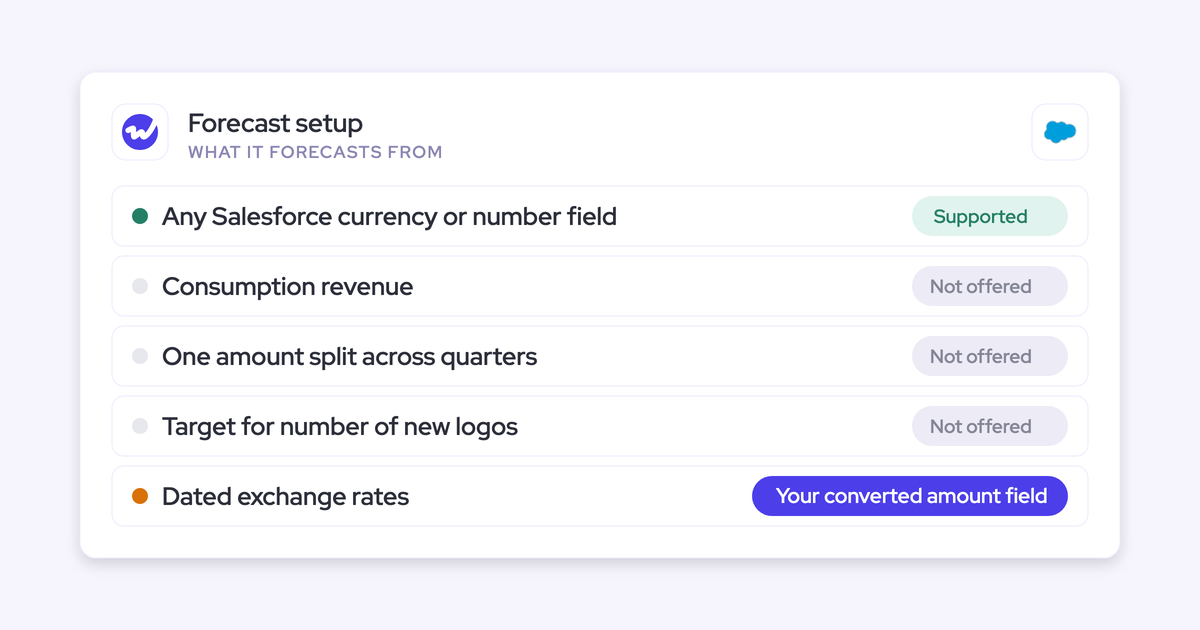
Each Weflow forecast setup runs on any Salesforce currency or number field, so you can forecast committed volume or a substantiated booking field instead of Amount.
If your solution consultants write the substantiated figure into its own field, that field becomes your forecast.
Each setup maps three fields:
- The revenue field: Amount, a custom currency field, or a number field such as Quantity.
- The forecasting field that sorts deals into columns: Stage, Forecast Category or a custom picklist.
- The date field that places a deal in a period.

You can run several setups in parallel, each with its own stages, cadence, targets and forecast calls. We'd recommend keeping new logo and expansion apart, since a blended forecast hides the motion that's failing.
Lock bookings submissions and grade each rep's accuracy
Weflow lets you configure the whole cadence: submission deadlines, how often reps resubmit, who submits, who overrides, how long an override stays open, and when the forecast locks. Locking is what makes accuracy measurable.
Weflow grades accuracy per rep, manager and team against an outcome field you choose. Each rep is graded on their newest submission for the period, and a manager's own call is measured separately from the team's.
It flags both ends, so the rep who sandbags shows up right next to the rep who over-calls..
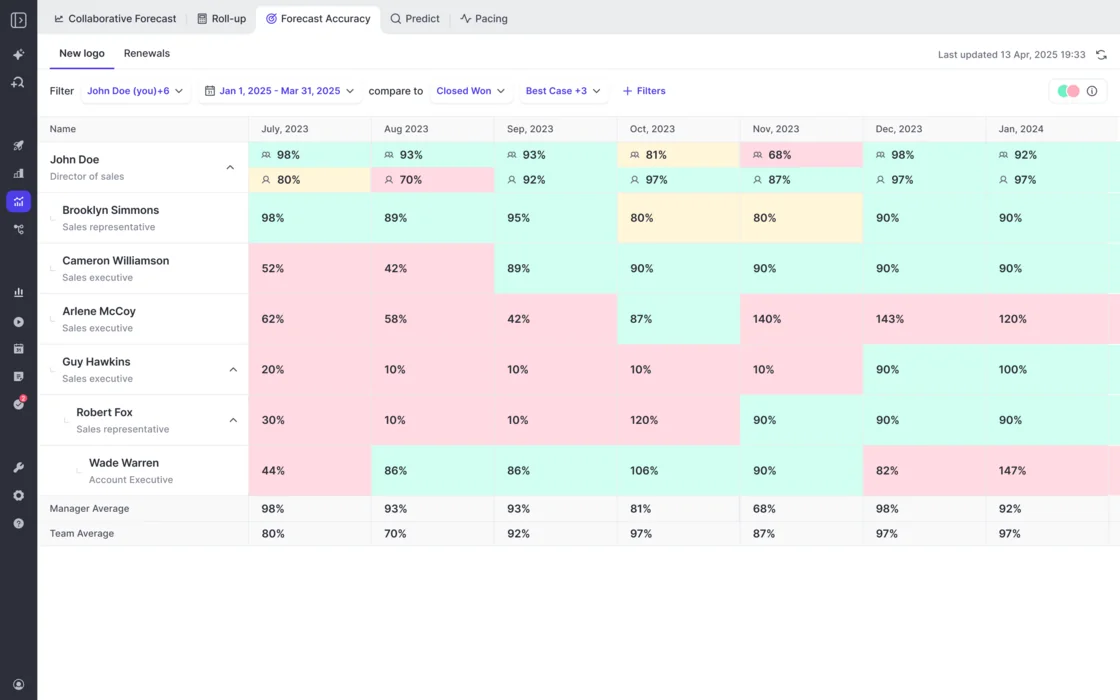
Give it a full quarter of locked submissions before reading too much into rep-level accuracy. Until a period closes, there are calls but no outcomes to score.
Check MEDDPICC evidence with AI Playbooks before commit
Weflow AI Playbooks score the whole opportunity against MEDDPICC, reading every email, meeting, transcript and CRM field on the deal.
They write the result to Salesforce fields and recommend a next step, so a commit with no identified economic buyer gets flagged before it reaches your forecast call.
"It's no longer third-party hearsay from reps or sales leaders. It's now proof in front of us – AI summaries that tell us we're not talking to the economic buyer, that we're single-threaded, whatever it might be."
— Scott Jones, SVP of GTM Revenue Intelligence & Enablement at KORE Wireless
This supports the kind of substantiation Socure runs: it checks that the deal behind a booking is qualified, but it doesn't replace your volume model or the solution readiness math.
One caveat: Playbooks only read transcripts from meetings Weflow records. If your team uses another recording tool, results come from the CRM record, emails and meeting metadata.
Spot a slipping two-quarter pipeline with hourly snapshots
A Salesforce opportunity only holds its current state, so Weflow snapshots every opportunity hourly. That history shows you whether your two-quarter bookings pipeline is real or sliding.
The snapshots power three views:
- A waterfall that reconciles starting to ending pipeline through deals created, increased, moved in, moved out, lost, decreased and won, with drill-through to each opportunity.
- Close-date push counts on every deal.
- Days in stage, plus time spent in each earlier stage.
If next quarter's bookings keep slipping into the quarter after, you'll spot it in the waterfall weeks before finance sees it in usage.
Read rep, weighted and AI forecasts as one corridor
Weflow runs three forecast methods side by side on the bookings forecast:
- A rep and manager roll-up.
- A dynamically weighted forecast that recalculates stage win rates from a rolling window of recent history, per rep and team.
- An AI projection built on more than fifty deal-level signals and up to two years of history, returning a landing range and refreshing every 24 hours.
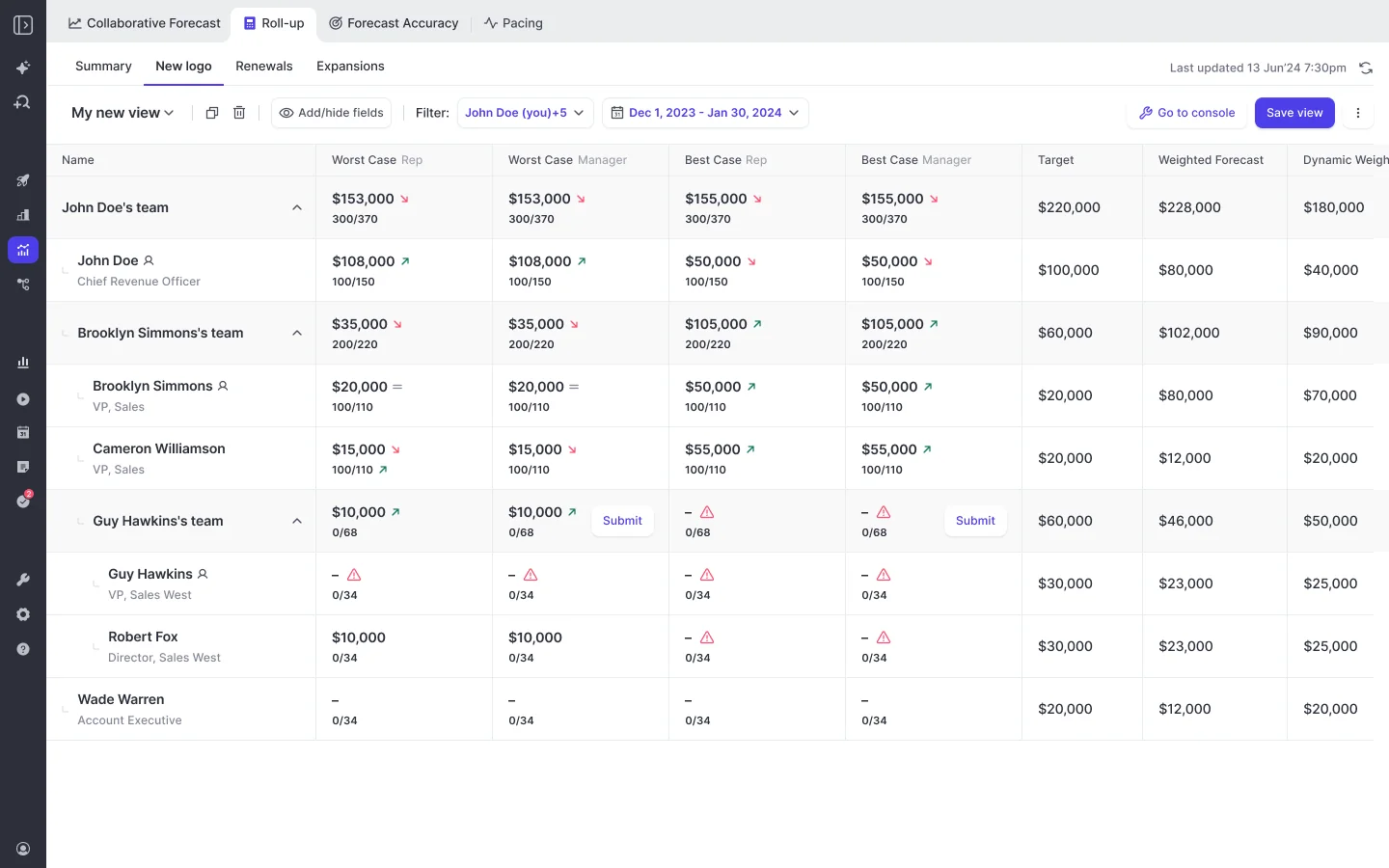
The gap between what the team says, what the pipeline supports and what history predicts becomes the agenda for the forecast call.
"What I am a big fan of is combining three main metrics to keep it simple: a dynamically weighted forecast that looks at your last six and twelve months of stage conversion rates, a bottom up roll up forecast, and an AI prediction based on the data foundation. The AI prediction is not one number, it is actually a mid, high, and base case, so you have a corridor, because the reality is it is a corridor and a lot of things can happen."
Where Weflow stops: The finance-owned ARR forecast
Weflow forecasts deal-based bookings, not consumption or ARR. Usage data doesn't sit on the opportunity, so the revenue half of a consumption business isn't a strong fit for our forecasting.
| Piece of the split | Where it lives |
|---|---|
| Bookings forecast on a committed-volume field | Weflow |
| Locked submissions and per-rep accuracy | Weflow |
| MEDDPICC evidence and pipeline history | Weflow |
| Closed-won gate on payment method and consumption | Your Salesforce process and validation design |
| Ramp curves and realization tracking | Finance's model or a revenue forecasting tool |
| Long-tail run rate and the ARR definition | Finance's model or a revenue forecasting tool |
| Revenue recognition | Finance systems |
If you need a tool for the revenue side, a few vendors do model it well:
- Aviso runs consumption forecasting that turns account usage into ARR or MRR, alongside traditional revenue forecasting.
- Kluster forecasts recognized revenue as well as bookings, including variable and usage-based contracts, and connects CRM data with warehouses and financial systems.
- Salesloft offers account-based forecasting designed for consumption revenue, where each account carries a machine-predicted Pace number sellers can override with a comment.
Weflow Deal Intelligence & Forecasting pricing and rollout
What Weflow Deal Intelligence & Forecasting costs
- Weflow Deal Intelligence & Forecasting is $39 per user per month, billed annually.
- It includes Ask Weflow AI Pro and Agent Builder on the free tier, with 25 agent actions per month.
- Revenue AI Enterprise, at $79 per user per month, bundles Weflow Activity & Contact Capture, Weflow Conversation Intelligence and Weflow Deal Intelligence & Forecasting.
- Plans start at 10 users and include unlimited view-only licenses.
- Implementation is free.
- Weflow works only with Salesforce.
How long a Weflow forecasting rollout takes
Onboarding typically takes two to three weeks. Forecasting takes a bit longer than capture, since you're encoding an operating cadence rather than switching on a tool.
- Technical implementation: A 45 to 60 minute call with your Salesforce admin and mail admin to connect the systems.
- Configuration: Team structure and hierarchy, methodology, playbooks and warnings. For forecasting, you decide who submits, how often, at deal or manager level, against which quota and on which field.
- Role-based rollout: Separate training for leadership and reps.
Since forecast quality depends on the capture layer underneath, Weflow Activity & Contact Capture and Weflow Conversation Intelligence are the foundation the bookings forecast reads from.
FAQ: Forecasting a consumption business
Can Weflow forecast consumption or ARR revenue?
No. Weflow forecasts the rep-owned bookings half: deal-based bookings with locked submissions, accuracy tracking and deal evidence.
For consumption and ARR, you'll need finance's model or a revenue-side tool like Aviso, Kluster or Salesloft's account-based forecasting.
Should commit contracts count as bookings or ARR?
Count committed credits as bookable ARR, since the customer has contracted to spend a set amount over a defined period. Pure consumption without a commit still needs a forecast.
What do you forecast for a new customer with no consumption history?
Use T-shirt sizing and standard ramp assumptions. At Aiven, solution architects size a new opportunity as S, M, L or XL, and finance applies a 4 to 6 month linear ramp to reach that size.
How do you enforce a consumption-based closed-won gate in Salesforce?
Make closed-won a RevOps approval, not a rep action, and require a valid payment method plus three consecutive days of consumption. You build it through Salesforce process and validation design.
What is booked ARR realization, and what's a good target?
It's how much of each quarterly booking cohort turns into revenue by month 12. Socure targets roughly 90%, while around 60% on a rolling 24-month basis is a sign bookings are inflated.
Does Weflow work if finance's ARR model lives in a warehouse or ERP?
Yes. Weflow forecasts from Salesforce only, so finance's ARR model stays where it lives, and Weflow gives it a bookings input it can trust. If you'd rather have one tool that connects CRM, warehouse and ERP data into a revenue forecast, Kluster is built for that.