Bookings Forecast vs Revenue Forecast: How Recurring-Revenue Companies Run Both
Decide when to use bookings forecast vs revenue forecast and how recurring-revenue teams run both


You don't have to choose between a bookings forecast and a revenue forecast. The recurring-revenue companies that forecast well run both, and they split who owns what..
Sales commits a bookings number for each motion: new logo, expansion, renewals by the date they're due, and churn as a negative. Finance then turns that commit into the revenue forecast the board grades.
You already know the revenue number wins the room, and that your team has no number of its own to stand behind.
The answer is a sales-owned commit that rolls up through forecast submissions and roll-ups, one motion at a time, plus an FP&A model that turns it into recognized revenue.
And because bookings is the goal line the revenue forecast is built on, it supports finance's number instead of competing with it.
Bookings forecast vs revenue forecast: What each one measures
A bookings forecast predicts the contract value sales will sign in a period, counted at the point each deal closes. A revenue forecast predicts what the company will actually recognize over time, once ramp, delivery schedules, churn and provisions have shaped it.
| Bookings forecast | Revenue forecast | |
|---|---|---|
| What it counts | Contract value signed: new logo, expansion, renewals, minus churn | Revenue recognized in each period, including run rate |
| When the number lands | At a point in time, the period the deal closes or renews | Over time, as the contract ramps and delivers |
| What shapes it | Deal judgement, stage, historical close rates per motion | Ramp patterns, recognition timing, churn, provisions |
| Which question it answers | Are we signing what the plan needs this quarter? | Will we hit the revenue number for the year? |
Why bookings is the goal line your revenue forecast builds on
Your revenue target is built on bookings, so bookings is the line revenue gets tracked against. That doesn't make it more important than revenue. It's simply where revenue comes from.
The strongest case for this comes from a business where bookings look shakiest. Socure sells identity verification priced on API calls, so a signed contract is only an estimate of usage.
Even so, its RevOps lead pushes back on the idea that bookings are a made-up number:
"I think it's a common misconception in consumption based models that bookings are sort of irrelevant or it just comes down to revenue because you're kinda booking a made up number, but that's not really the case, because that does inform essentially your forecast and understanding how much revenue do we expect and how do we track towards this. So that's the goal line."
If you sell subscriptions, the case is even stronger: once a seat-based deal is booked, you know its recurring value far more firmly than any usage estimate.
So you don't need to argue that bookings outrank revenue. You just show the board the number the revenue forecast is made of.
What a single revenue number hides from your sales team
When there's only one finance-shaped number, sales has nothing of its own to commit to, and you can't see which motion is failing. Here's how that usually shows up.
| Symptom | Cause |
|---|---|
| The quarter misses and nobody can say which motion missed | New, expansion and renewal share one pipeline and one combined quota |
| Sales books a deal in one quarter, finance recognizes it across two | The forecast parks full deal value in one period while revenue follows delivery |
| Renewals look healthy until three weeks before they're due, and churn has no home | Renewals are tracked by close date, and the forecast only adds up positive deal values |
| Leadership meetings open by reconciling pipeline views | RevOps and finance run their own views on different definitions |
| The weighted number undercounts renewals | Stage weightings were set for new business |
Four ways recurring-revenue companies handle bookings and revenue
The real decision is which number sales commits to, and who owns everything else. There are four workable answers, and each comes with a cost.
Keep one revenue forecast owned by finance
This is the status quo, and it's the right call when the debate in your leadership meeting really is about recognized revenue.
If finance already has the model (or a finance-side tool like Kluster that turns CRM and ERP data into recognized revenue), you already have the number the CFO needs.
The catch is that sales pays the price. Your team has nothing to commit to, a miss can't be traced to a motion, and renewals and churn usually end up modeled by hand outside the forecast.
- Fits when: New business is a small share of the year and recognized revenue is the only open question.
- Breaks when: You need to know whether new logo, expansion or renewals caused the miss.
Have reps forecast ARR directly on their accounts
On paper, this makes sense: if the board grades revenue, why not let sales forecast it? Aiven, a consumption-based business, did exactly this on its named accounts. It was accurate, but it took too much company time to sustain.
The problem is that reps get pulled into ramp curves and recognition timing, which they can't do well at scale, and it takes them away from selling.
- Fits when: you have a handful of large named accounts and spare capacity in sales and RevOps.
- Breaks when: the account base grows and forecasting starts eating the week.
Roll every motion into one bookings forecast
This at least gives sales a commit, which is a real step up. The trouble is that new logo, expansion and renewal convert at very different rates, with win rates ranging from about 20% to 75% across motions.
So a single coverage ratio and weighting will mislead you in both directions.
And when the blended number misses, you can't tell whether renewals beat plan while new logos collapsed, or the other way around.
- Fits when: your business essentially runs one motion.
- Breaks when: renewals and expansion are a meaningful share of the number.
Split ownership: Sales commits bookings, finance converts to revenue
Here, sales commits a bookings forecast per motion over a near horizon, and FP&A converts it into the revenue forecast each month, layering in ramp, recognition timing and churn.
That way, each team forecasts what it can actually see: reps judge which deals sign and when, and finance models how those signatures turn into revenue.
- Fits when: You run several motions and finance already models revenue.
- Breaks when: Nobody owns the definitions both sides use, so the two numbers drift apart.
How to pick the right bookings and revenue model
The right model depends on four things: your motion mix, how revenue gets recognized, how much company time forecasting can consume, and how much comp risk you can carry.
| Criterion | Revenue only, owned by finance | Reps forecast ARR | One blended bookings forecast | Split ownership per motion |
|---|---|---|---|---|
| Shows which motion missed | No, one number covers everything | Partly, account by account | No, motions net against each other | Yes, each motion has its own commit |
| Handles ramp and recognition timing | Yes, in finance's model | Yes, reps model it per account | No, full deal value lands in one period | Yes, FP&A layers it on monthly |
| Company time to sustain | Low for sales, high for finance modeling renewals and churn by hand | High, the reason Aiven moved off it | Low | Moderate: weekly sales and renewal calls, a monthly FP&A conversion |
| Gives sales a committed number | None | ARR, which reps struggle to forecast at scale | One blended number | One bookings number per motion |
| Risk of inflated bookings | Low, sales isn't committing | Low on bookings, high on rep time | High if comp pays on the blended number | Contained when pay follows realized revenue and accuracy |
| Fits best when | Recognized revenue is the only open question | A few large named accounts | One dominant motion | A meaningful renewal and expansion base |
Before you pick, it helps to answer these questions about your own business:
- What share of next year's number comes from renewals and expansion?
- Does revenue land when a deal closes, or spread over ramp and delivery?
- How many hours a week can reps, managers, RevOps and finance give to forecasting?
- Does your comp plan pay on bookings today?
- Does finance already have a model that converts bookings into revenue?
Why we recommend splitting bookings and revenue ownership
We recommend split ownership because it's the only option that gives sales a number it can forecast and finance a number it can model, without blending motions asking reps to model revenue.
Looking back at the table, every other option has a structural weak spot: finance-only on visibility, reps forecasting ARR on company time, and the blended forecast on both visibility and comp risk. The split's only real cost is the cadence you have to run.
Aiven is the clearest example we know. It's a consumption business, so its revenue is harder to forecast than a subscription company's. Here's how its setup works:
- Reps own a bookings forecast covering roughly the next two quarters.
- FP&A takes those numbers into monthly meetings and extrapolates them.
- Finance layers in historical ramp patterns, known future churn and organic growth to produce a monthly ARR forecast.
Aiven moved to this setup after forecasting ARR directly proved accurate but too costly. And if a consumption business can make the split work, a subscription business with firmer contract values should find it easier.
Who owns which number across sales, RevOps and FP&A
In this model , each number gets one owner, one horizon and one cadence, while RevOps owns the process and the definitions both sides use.
| Number | Owner | Horizon | Cadence | Rolls into |
|---|---|---|---|---|
| New logo bookings | AEs and sales managers | Current and next quarter | Weekly sales forecast | Net new ARR, then FP&A's revenue forecast |
| Expansion bookings | Whoever carries the expansion number, AEs or account managers | Current and next quarter | Weekly sales forecast | Net new ARR |
| Renewal bookings | Renewal team or CSMs | Renewals due this quarter | Weekly renewals forecast | Retention measures and FP&A's revenue forecast |
| Churn and contraction | Renewal team or CSMs | Renewals due this quarter | Weekly renewals forecast | Net new ARR, as a negative line |
| Pipeline generation | Sales leadership | Pipeline for coming quarters | Monthly | Coverage for future bookings forecasts |
| Revenue and ARR forecast | FP&A | Monthly, through the fiscal year | Monthly conversion meeting | The board's revenue number |
You'll notice the renewals forecast runs separately from the sales forecast. That's because different deals and different people are involved, and if you fold them into one meeting, neither gets a focused discussion.
RevOps's job is to make sure these numbers share the same definitions. We often see companies running several versions of the pipeline waterfall at once, in RevOps and in finance, built on different objects.
Agreeing on what counts as a booking, a renewal and churn keeps the split from turning into two competing truths.
Where the bookings horizon ends and finance's model takes over
Sales commits bookings for the near term, and finance carries everything beyond it. Aiven draws that line at roughly two quarters. Beyond that point, and for ramp, churn and organic growth within it, finance's model holds the number.
In larger revenue orgs, we've also seen this split work well: first-line managers forecast retention for the current quarter and growth for the current and next quarter, while customer success owns retention for the quarters after.
One thing sits outside both horizons: early churn risk on multi-year contracts.
Customers on those contracts can signal their intent to leave one to two years before the renewal, long before the deal shows up in any forecast. Treat that as an account health question, not a forecast.
How bookings and revenue reconcile in front of the board
The board sees revenue, with bookings presented as the goal line behind it. Since reconciliation happens in FP&A's monthly conversion, nobody has to reconcile numbers live in the meeting.
It also helps to keep the same metrics from one meeting to the next and let the story change:
"The metrics should largely be the same and consistently reported every meeting."
In practice, a board pack built on the split includes these every time:
- Bookings against plan, per motion
- Pipeline coverage and forecast accuracy, for the quarters ahead
- Gross and net revenue retention
- The revenue forecast against target, from FP&A
How to set up a bookings forecast for each revenue motion
Each motion gets its own forecast, with its own number, date, target and weighting. Together they add up to net new ARR, which means "which motion missed?" becomes a question you can answer on Monday morning.
Forecast new logo bookings on their own number and quota
Give new logo its own target and roll-up, so a new-logo miss can't hide behind renewals hitting plan. Many teams start with new and expansion sharing one quota.
You can still keep that combined quota: separate targets per motion add up to it, so leadership keeps the total while each team owns its part.
Keep contraction out of the expansion forecast
The expansion forecast should only count the incremental value it adds. If downsells sit in the same number, they quietly cancel out growth, and your expansion team looks flat when it's actually growing and losing at the same time.
Instead, contraction belongs with churn, on the renewal side of the forecast.
Forecast renewals on what's due this quarter, not close date
With renewals, the question is what's due this period and how you're tracking against it. That's why the renewal forecast should key off the renewal date, not the close date.
"When I'm doing the renewal forecast, I don't care what my close date is. What I want to track is renewals that are due in this quarter and how we are doing against those."
— Revenue leader, on a call with Weflow
It also helps to frame renewals as dollars at risk against the prior contract. For example, a renewal that was $2M on the last contract and is forecast at $1M shows $1M at risk, which is a number a CRO can act on.
Renewals are also the motion teams most often leave out. We regularly talk to teams whose new business runs in a forecasting tool while renewals still live in plain CRM reports, because setting them up was always next on the list.
Carry churn as a negative number in net new ARR
Churn and contraction belong in the forecast as a negative line: new logo plus expansion, minus churn, gives you net new ARR, with gross and net revenue retention alongside it.
If the forecast only adds up positive deal values, churn ends up built somewhere else. RevOps teams hand-model it as best, middle and worst cases outside the forecast, and the number in front of the board gets stitched together from two places.
Weight each motion on its own historical close rates
Renewals sit in early stages yet close at around 95%. So if your stage weightings were set for new business, your weighted forecast underweights every renewal on the books.
Instead, weight each motion on its own history. A weighted forecast is an average across many deals, so it only works when those deals behave alike.
How to pay on bookings without inflating them
Bookings should drive some comp and performance management, but not most of it:
"In order to avoid a perverse incentive, you really want bookings to be important and drive some compensation, some performance management, but you do not want that to be the main focal point for your teams and how they're compensated, because that will end up with the same problem as well, which is overinflated bookings."
Aiven's version: reps carry a bookings target as a sanity check and get paid on ARR that actually lands.
Since that's a consumption business, don't copy it wholesale into a seat-based plan, but the principle still applies: bookings confirm reps are building pipeline, and pay follows what realizes.
To keep the bookings forecast honest, grade reps on three things:
- Attainment against goal, the number they signed.
- Forecast accuracy, scored both ways so sandbagging costs as much as a missed call.
- Pipeline generation, the activity that feeds the next period.
Just keep in mind that accuracy only works if each forecast is recorded at a point in time. A "keep your pipeline updated by Friday" routine doesn't record anything, so there's no call to grade.
If you're ready to stand up a sales-owned, bottom-up commit with your RevOps leader, start here: Free Guide: Getting started with Bottom-up Forecasting.
Do you need a forecasting tool to run bookings per motion?
Not always. In fact, spreadsheets are still the most common forecasting setup we come across in evaluations, ahead of any named vendor.
Stay in a spreadsheet or Salesforce if:
- Your quarter rests on about ten material deals, since a deal-by-deal call is something native Salesforce forecasting and pipeline inspection can handle.
- Your go-to-market structure is still changing, because automating a process nobody can describe yet hardens the wrong one.
- The real question is recognized revenue from CRM and ERP data, in which case a finance-side tool such as Kluster is a better fit.
Consider a forecasting tool if:
- The number of deals, managers and roll-up layers makes submission, overrides and history tracking a weekly grind.
- You run several motions in parallel, each needing its own commit and weighting.
- You forecast on ARR or another custom revenue number, which native Salesforce forecasting handles poorly.
- You need pipeline history, because native Salesforce shows only the pipeline as it stands now.
Several tools run separate forecasts per motion, including Gong, Salesloft, Backstory.ai and Kluster. When you compare them, focus on how each one handles renewals and churn.
Whatever you choose, remember that forecasting is a muscle. It takes more change management than any other revenue process, and no tool can build that discipline for you.
How Weflow runs a separate bookings forecast for each motion
Weflow is the Revenue AI Orchestration platform for sales, customer success, and RevOps teams.
It's built for Salesforce teams, and in the split model it runs the sales-owned side (parallel bookings forecasts per motion and a recorded commit), while finance keeps the revenue model.
Run new logo, expansion and renewal forecasts side by side in Weflow
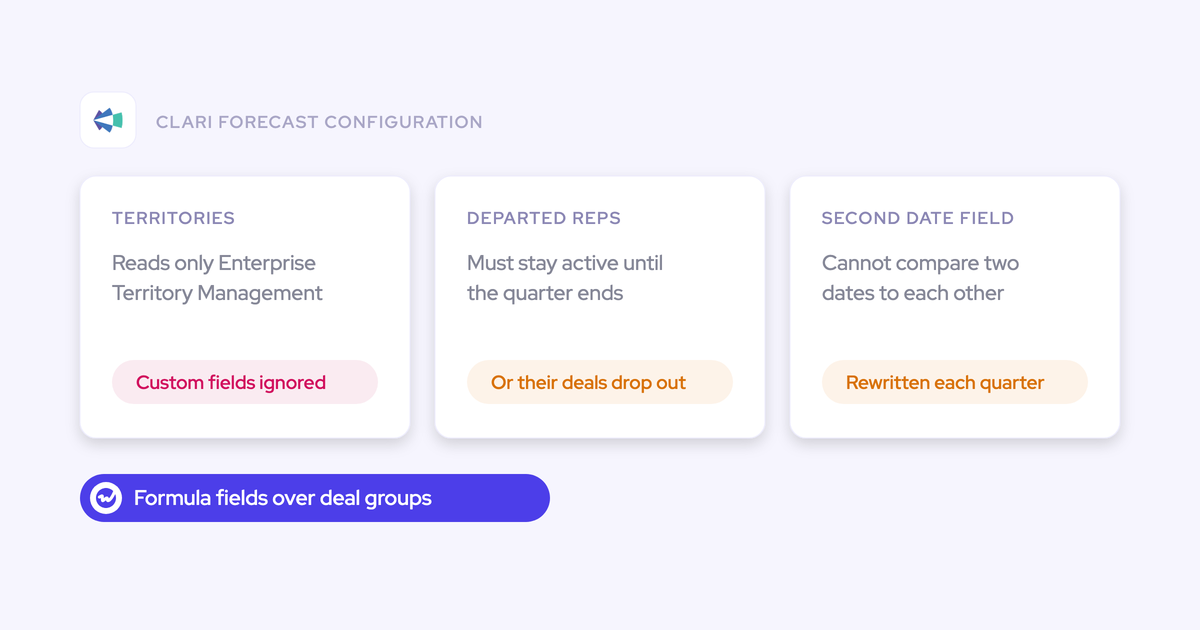
Weflow runs a separate forecast for each motion, each with its own revenue number, date basis, stages, cadence, targets and forecast calls. The number can be ARR or any other revenue figure your team manages by, not just the standard deal amount.
That means you can set up everything covered above:
- Renewals forecast on the contract or renewal date, so the forecast shows what's due.
- Contraction stays out of the expansion number through filters the admin sets once.
- Churn and contraction combine into one calculated figure with its own target, and retention measures like net and gross dollar retention sit alongside.
- A CSM who carries both an expansion and a renewal number sits in both teams.
Our configuration guides cover the setup detail for RevOps.
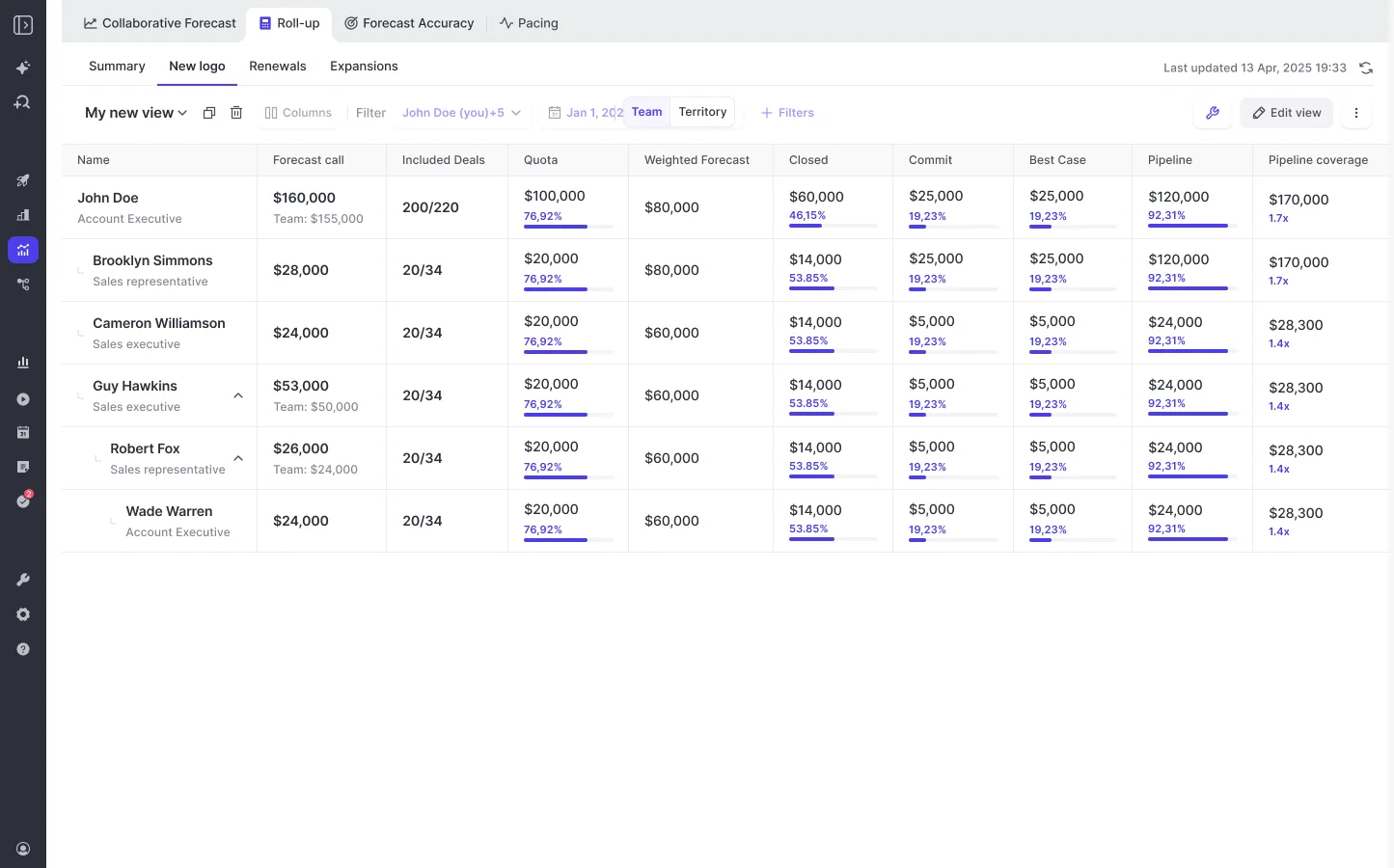
Give each motion its own weighting and AI projection in Weflow
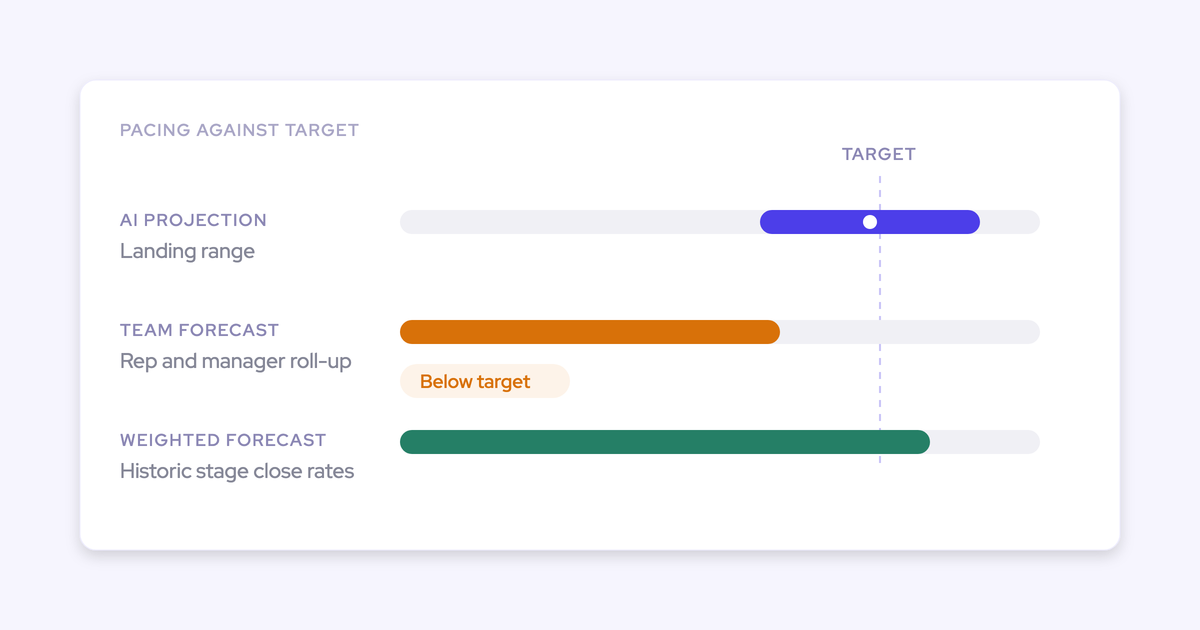
Weflow calculates the weighted forecast from each motion's own historical close rates, recalculated daily over a rolling window. So renewals get weighted on how renewals actually close, not on new-business probabilities.
Each motion also gets its own AI projection:
- It's built from up to two years of deal history imported at install, and needs at least six months of it.
- It returns a low, middle and high value, a range rather than a single point.
- The first projection is ready within 48 to 72 hours.
- The range widens when the business changes, for example with new products, motions or territories.
Turn the sales commit into a recorded number you can measure
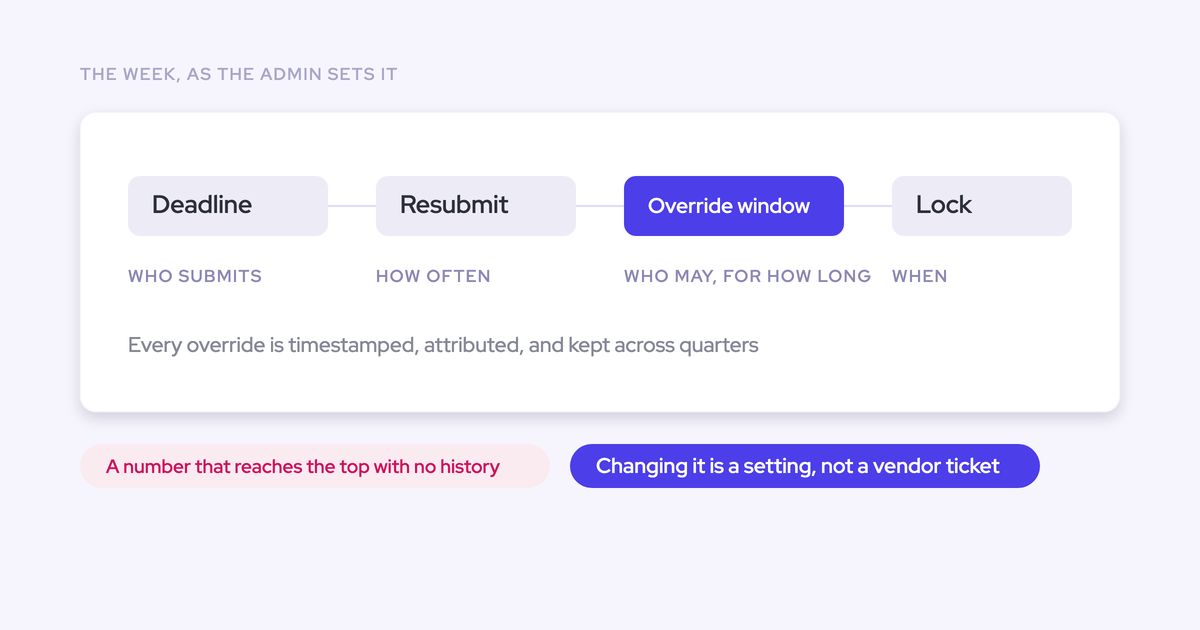
In Weflow, reps submit calls tied to named deals. Every submission is versioned, managers can override, and calls roll up the hierarchy. That record is what lets you prove to your CFO that your bookings forecast is worth something.
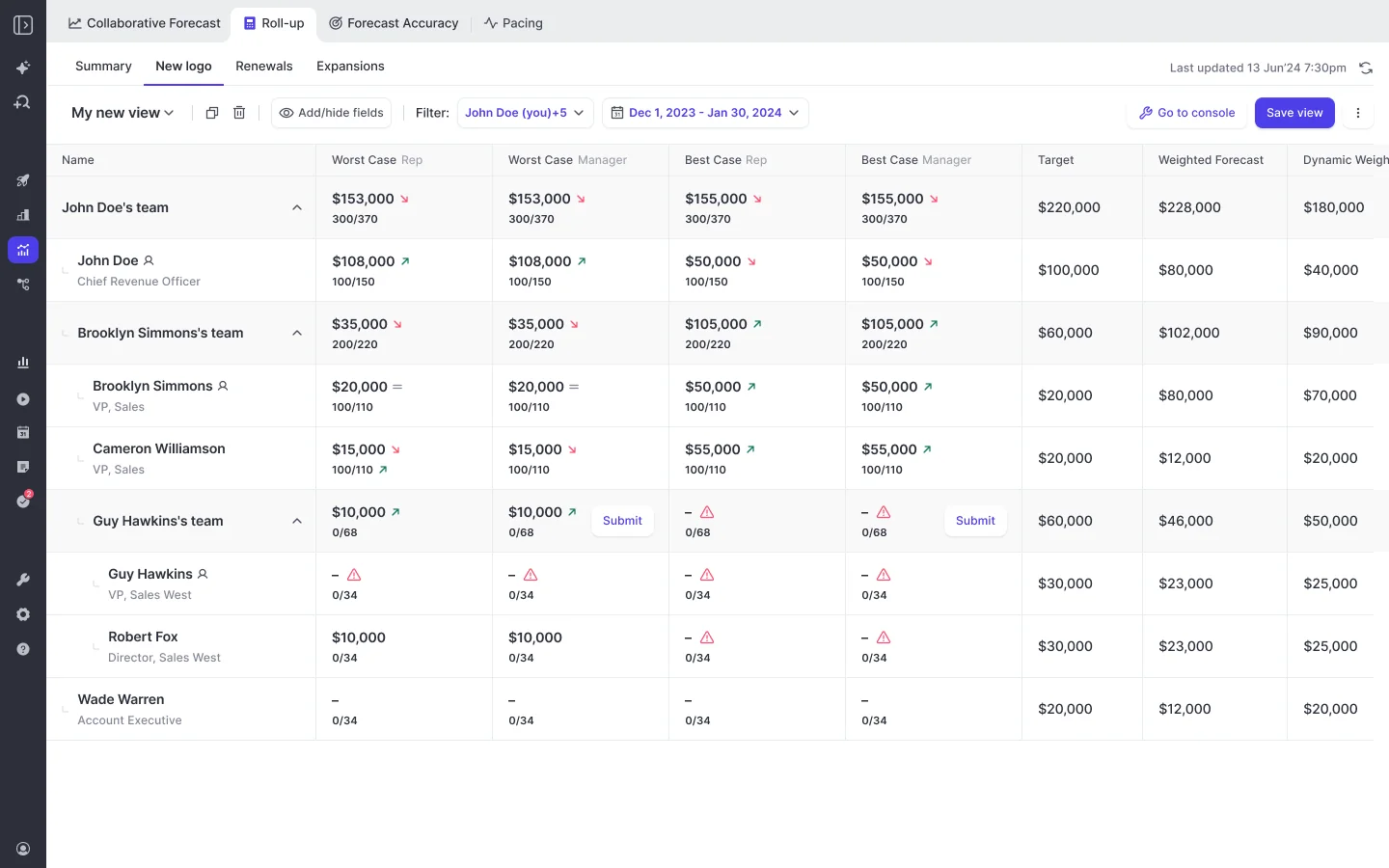
Forecast accuracy tracking is built into the forecasting module, with nothing to switch on. You pick the field to measure accuracy against, and Weflow reports it per period for each rep, manager and team.
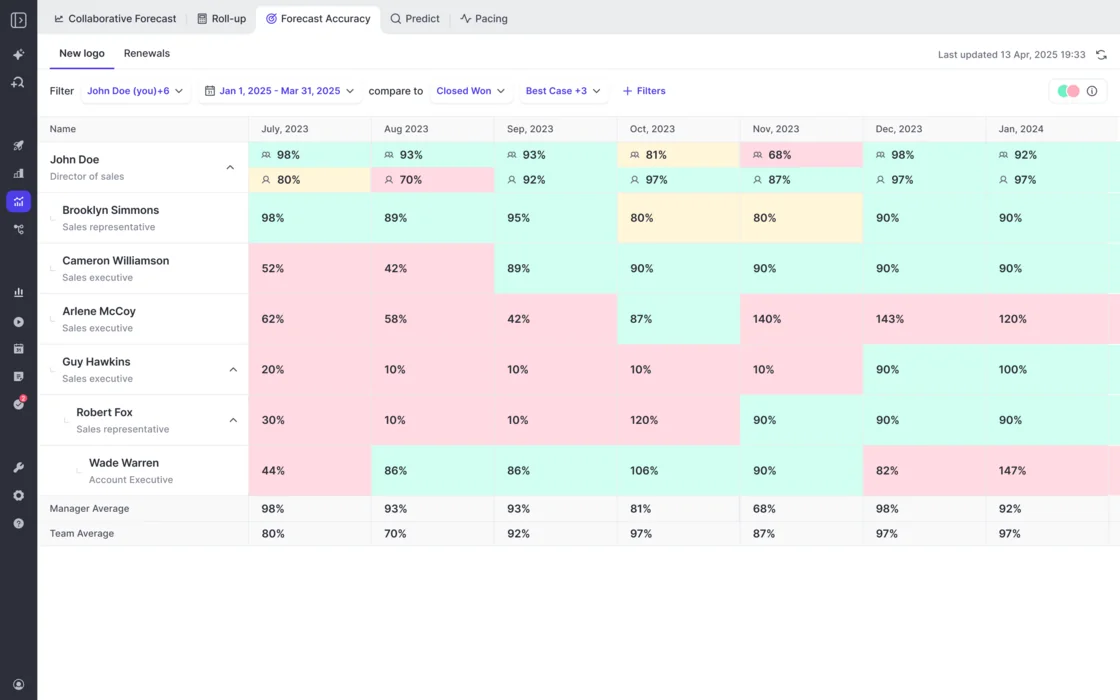
"With Weflow, we forecast within 7% by week 4 of the quarter."
What Weflow doesn't cover on the revenue side
Weflow handles the sales-owned bookings side, not finance's revenue model.:
- Weflow places a deal's full value in one period and can't split one deal across quarters.
- Weflow doesn't forecast consumption or usage-based revenue.
- Every forecast in a workspace uses the same period type, so annual renewals and quarterly new business share one shape.
- Weflow has no account-level view that rolls renewal work up by customer.
- Submitted forecast calls stay in Weflow and aren't written back to Salesforce.
What Weflow Deal Intelligence & Forecasting costs, and how to pilot it
Weflow Deal Intelligence & Forecasting is $39 per user per month, billed annually. Viewer seats are free, so finance and leadership can see the forecast without a paid seat.
Since you can't prove a forecast in a two-week trial, we offer a three-month paid pilot instead. It covers the first three months of a multi-year agreement, with an opt-out at the end.
Keep in mind that forecasting takes longer to set up than activity capture, because it encodes your operating cadence: who submits, how often, at deal or manager level, and against which quota.
FAQ: Bookings and revenue forecasting for recurring-revenue teams
Are renewals bookings, revenue, or both?
Both. Sales or customer success commits renewal bookings by the date they're due. Finance then carries the recognized revenue from those renewals in its model.
How do you forecast multi-year deals and delivery schedules that span quarters?
The bookings forecast places the full deal value in the period it signs, and finance spreads the recognition. For example, a $100k deal that delivers $60k in one quarter and $40k in the next shows as $100k in sales' forecast and as two revenue lines in finance's.
Will a bookings forecast mean another weekly meeting for reps?
Not for most reps. It runs on the forecast call you already hold, so reps commit a number tied to deals instead of preparing a new deck. Only the renewals forecast gets its own weekly slot, because different people own it.
Does a bookings forecast still matter for usage-based revenue?
Yes. Socure, for example, measures how much of each quarterly booking cohort realizes by month twelve, with about 90% as its target. Weflow doesn't forecast consumption, though, so you'll need a different method alongside it for usage-based revenue.
Does Weflow handle a non-calendar fiscal year and multiple currencies?
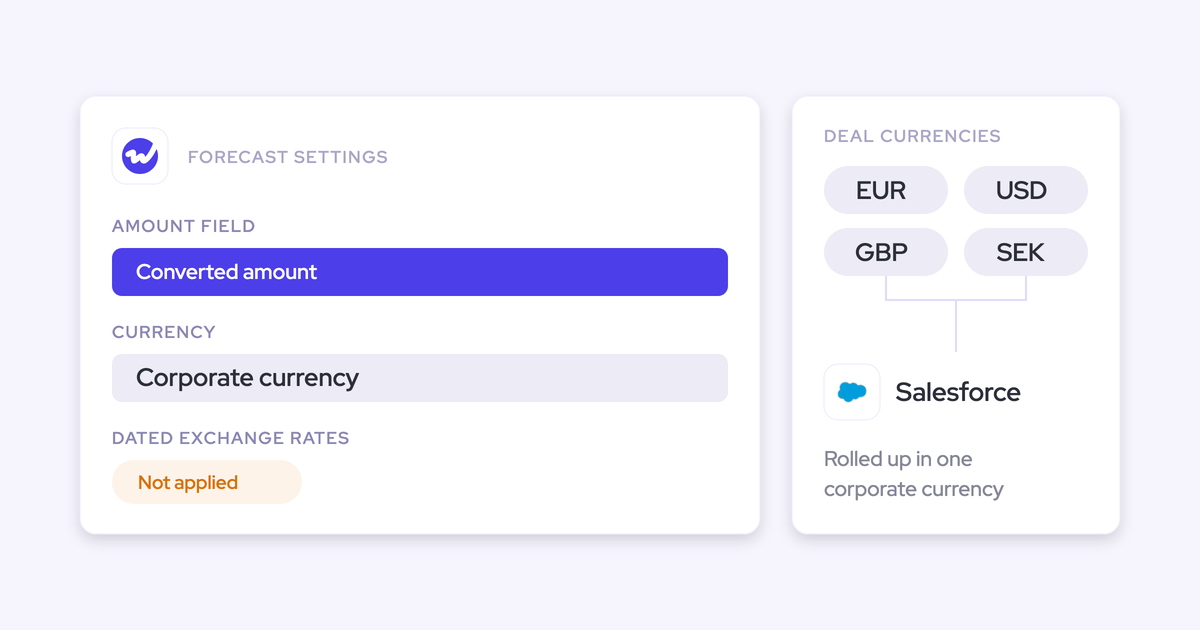
Yes. Weflow follows the fiscal year set in Salesforce, even if it doesn't start in January. Totals show in your org's default currency, and deals in another currency show both values.
Weflow converts at standard Salesforce rates, so if your team relies on dated exchange rates, forecast on your own converted revenue number instead.
How do you move off a spreadsheet forecast without losing history?
Weflow imports up to two years of deal history from Salesforce at install. Calculated columns you built in a spreadsheet or another forecasting tool can be rebuilt as formula columns.
We recommend starting with the motion you trust least (usually renewals) and running it beside the spreadsheet for one quarter.