5 Discovery Call Scorecards to Configure in Weflow: MEDDIC, SPICED, BANT, Question Quality, and Next Step
Learn which Weflow discovery scorecards to use: MEDDIC, SPICED, BANT, question quality, next step


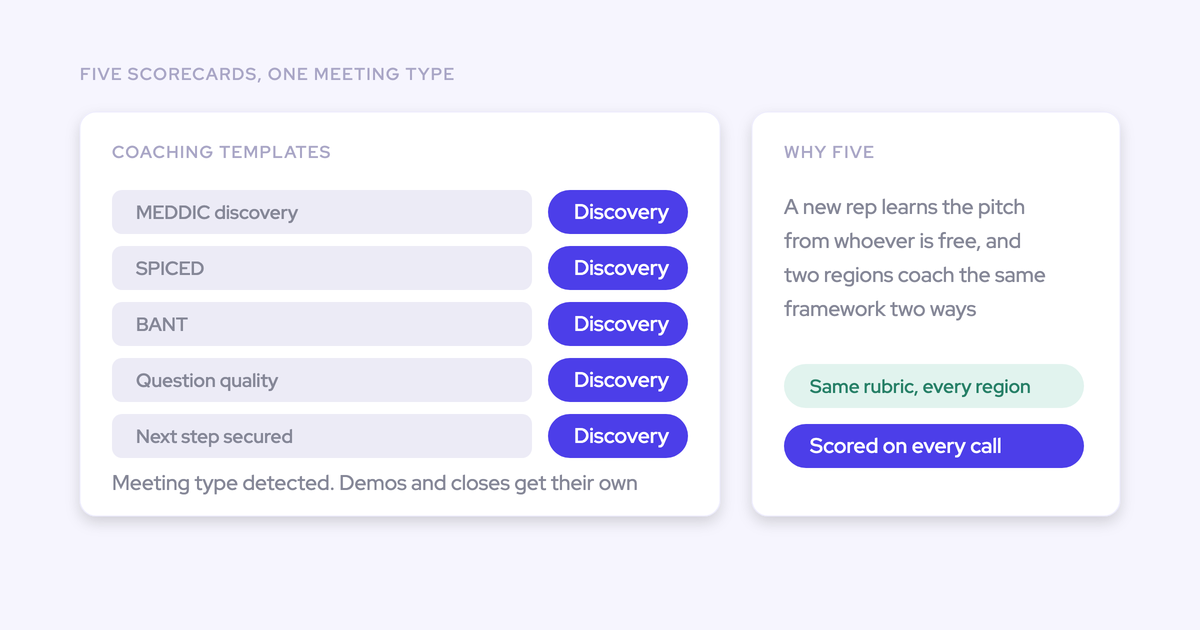

To score discovery calls in Weflow, start with the methodology your team already uses: MEDDIC, SPICED, BANT, or your own version. Configure one methodology rubric, then add Question Quality or Next Step criteria where you need more focused coaching. The five prompts below give you definitions, exclusions, evidence requirements, and coaching outputs you can adapt.
The boundary matters: score what the rep should have done in discovery, not whether the entire opportunity is qualified. A good early conversation can leave the economic buyer unidentified. Your rubric should distinguish that from a rep ignoring a relevant question, and distinguish both from a recording that doesn’t contain enough evidence to judge.
Weflow is the Revenue AI Orchestration platform for sales, customer success, and RevOps teams. Built for Salesforce teams, Weflow connects configurable post-call coaching with separate workflows for qualification-field updates and opportunity-level assessment. You can rehearse these prompts in Ask Weflow AI before handing your rubric to the admin who configures your coaching templates.
Set discovery-only rules for your Weflow scorecards
Your discovery scorecard should assess observable selling behavior within one conversation. Keep that assessment separate from the deal’s qualification status.
| Job | Scope | Question it answers |
|---|---|---|
| Call coaching scorecard | One recorded conversation | Did the seller conduct discovery to our standard? |
| Opportunity-level AI playbook | Calls, emails, activities, and CRM data across the opportunity | What qualification evidence does this deal have, and what’s missing? |
| AI Field Updates | Conversation evidence mapped to Salesforce fields | What should we add to the qualification record? |
| Rep-level trends | Assessments across comparable conversations over time | Which discovery behaviors need repeated coaching? |
Weflow coaching scorecards evaluate conversations; Weflow AI playbooks evaluate qualification across the opportunity. Mixing those scopes trains reps to force late-stage questions into early calls.
Use this shared scoring contract:
- Demonstrated: The seller met the discovery expectation, with transcript evidence.
- Partially demonstrated: The seller made a relevant attempt but left a specific, coachable gap.
- Not demonstrated: The expectation applied, the recording supports assessment, and the seller missed it.
- Not applicable: The criterion wasn’t relevant to this discovery conversation under your agreed scope.
- Insufficient evidence: Missing audio, unclear speakers, or incomplete context prevents a defensible assessment.
The prompts below request these labels as free-form output. Weflow also supports rating outputs for teams that want numeric scorecards.
Judge the seller’s work, not the buyer’s willingness to disclose information. A buyer who doesn’t know the budget can still receive good discovery if the rep explores how funding works and establishes what to investigate later.
Use one methodology scorecard for discovery calls
Choose the rubric that matches your existing standard. Your managers need one shared interpretation of MEDDIC, SPICED, or BANT, rather than three competing assessments of the same conversation.
1. MEDDIC: assess discovery without demanding full deal qualification
A discovery-stage MEDDIC rubric should prioritize pain and meaningful measures of impact. Assess buying-process exploration only where your discovery scope calls for it.
Run it: Use a free-form coaching template in Weflow Conversation Intelligence. For a manual rehearsal, open Ask Weflow AI on one recording and use the same prompt.
Inputs: A speaker-labeled transcript, your discovery expectations, and any company-specific definitions or exclusions.
Assess this discovery conversation using MEDDIC.
Evaluate selling behavior, not whole-opportunity qualification.

Inputs:
- This call's speaker-labeled transcript.
- Discovery scope: [required behaviors and deferred topics].
- Company definitions and exclusions: [insert].
- Feedback language: [insert].

Use only this transcript as evidence of call behavior.
Don't import evidence from CRM fields or other conversations.
If several sellers participate, assess their combined behavior.

Evaluate each MEDDIC element:
- Metrics: Explore a measure tied to the buyer's problem,
  business impact, or desired outcome.
  Headcount alone doesn't count as a value metric.
  A useful attempt can establish how to obtain missing data.
- Economic buyer: When in scope, explore who owns the
  business outcome or spending decision.
  Don't infer authority from a title alone.
- Decision criteria: Explore what a useful solution must
  achieve for the buyer. Don't count the seller's feature list
  unless the buyer confirms its relevance.
- Decision process: When in scope, explore how the buyer
  would evaluate and approve a change.
  Don't demand a complete procurement map in early discovery.
- Identify pain: Establish a specific problem, who experiences
  it, and why it matters. Generic dissatisfaction isn't enough.
- Champion: When in scope, explore a buyer-side person's
  motivation and ability to support change internally.
  Friendliness, attendance, and seller colleagues don't count
  as evidence of a champion.

For each element return:
- Demonstrated: the seller met the applicable expectation.
- Partially demonstrated: a relevant attempt left a clear gap.
- Not demonstrated: an applicable expectation was missed.
- Not applicable: the supplied discovery scope defers it and
  the conversation gives no reason to address it now.
- Insufficient evidence: the recording can't support judgment.

Never use Not applicable merely because a topic wasn't discussed.
Don't penalize a rep for an answer the buyer doesn't know.
Assess the exploration and handling of the gap.

Output one row per MEDDIC element:
Element | Assessment | Exact transcript evidence and speaker |
Timestamp if available | Reason | Specific coaching action

Don't invent quotations or timestamps.
For a missed behavior, identify the relevant exchange.
For insufficient evidence, name what's missing.
Finish with one behavior to practice and one follow-up question.
Don't calculate a deal-qualification score.
Example input: The buyer describes manual reporting and gives the company’s headcount. The rep moves to a demo without exploring reporting time or business consequences.
- Metrics: Not demonstrated. Headcount doesn’t establish the impact of manual reporting.
- Coaching action: Ask how much time reporting takes and what work it delays.
- Economic buyer: Not applicable if your early-discovery scope defers authority exploration and nothing in the conversation makes it relevant.
Customize: Define which buyer outcomes count as metrics in your sales motion. Write down what makes champion exploration appropriate during discovery instead of leaving each manager to decide afterward.
2. SPICED: connect buyer pain to impact and urgency
A SPICED discovery scorecard should reward connections between the buyer’s situation, pain, impact, critical event, and decision. Mentioning every topic isn’t enough.
Run it: Configure a free-form coaching template in Weflow Conversation Intelligence, or rehearse the prompt against one recording in Ask Weflow AI.
Inputs: The transcript, your discovery scope, and your definitions of business impact and a critical event.
Assess this discovery conversation using SPICED.
Judge how the seller develops buyer understanding,
not whether the whole deal is qualified.

Inputs:
- This call's speaker-labeled transcript.
- Discovery scope and deferred topics: [insert].
- Company definitions: [insert].
- Feedback language: [insert].

Use only this transcript to assess behavior.
Ignore CRM and other-call evidence for this assessment.
Assess combined selling behavior if several sellers participate.

Evaluate:
- Situation: Establish the current workflow and relevant
  circumstances. Don't reward collecting company facts
  that don't help explain the problem.
- Pain: Establish a specific difficulty in the buyer's words.
  Don't treat a seller's suggested problem as confirmed pain.
- Impact: Explore what the pain changes for the business
  or affected people. Connect consequences to the stated pain.
  Don't invent ROI or accept unrelated numbers as impact.
- Critical event: Explore why timing matters when relevant.
  A date counts as a critical event only when the buyer
  connects it to an outcome or consequence.
  The seller's quarter-end isn't buyer urgency.
- Decision: Within discovery scope, explore how the buyer
  will evaluate change, which criteria matter, and who
  needs to participate. Don't demand final approval details.

Use these assessments:
- Demonstrated: meets the applicable discovery expectation.
- Partially demonstrated: relevant exploration with a named gap.
- Not demonstrated: applicable behavior is missing.
- Not applicable: outside the supplied scope and not made
  relevant by the conversation.
- Insufficient evidence: transcript gaps or unclear attribution
  prevent judgment.

A missing topic alone doesn't justify Not applicable.
A buyer's uncertainty isn't a selling failure if the seller
explores it appropriately and identifies the remaining question.

Output:
Element | Assessment | Exact evidence and speaker |
Timestamp if available | Missing connection | Coaching action

Don't invent evidence or timestamps.
Name the evidence limitation when you can't assess.
Finish with:
- The strongest supported connection.
- The most important missing connection.
- One question the seller should practice asking.
Don't calculate an opportunity-qualification score.
Example input: The buyer describes delayed onboarding and wants a change before the next planning cycle. The rep records the date but doesn’t explore what happens if onboarding stays the same.
- Pain: Demonstrated if the rep establishes where onboarding stalls and who it affects.
- Critical event: Partially demonstrated. The conversation establishes timing without its consequence.
- Coaching action: Connect the planning cycle to a buyer outcome before treating the date as urgency.
Customize: Add your customer-success metric or a “why not” risk question if your house framework uses them. Keep those additions distinct from the core SPICED elements so managers know what they’re evaluating.
3. BANT: explore need before budget, authority, and timing
A BANT discovery scorecard should put need first. A budget figure and a senior contact don’t compensate for a conversation that never establishes why the buyer should change.
Run it: Use a free-form Weflow Conversation Intelligence coaching template. Rehearse manually in Ask Weflow AI with one discovery recording.
Inputs: The transcript, your need-discovery standard, and the buying-context questions you expect at this stage.
Assess this discovery conversation using BANT.
Prioritize need discovery, then assess buying-context exploration.
Don't judge whole-opportunity qualification.

Inputs:
- This call's speaker-labeled transcript.
- Need-discovery expectations: [insert].
- Budget, authority, and timing scope: [insert].
- Company exclusions and feedback language: [insert].

Use this transcript only, not CRM fields or earlier calls.
Assess combined selling behavior if several sellers participate.

Evaluate:
- Need: Explore the buyer's problem, affected people or process,
  consequences, and priority. Product interest alone isn't need.
  Don't infer that the seller can solve the problem without
  evidence of a relevant fit.
- Budget: When in scope, explore funding context or how the
  buyer would fund a solution. An exact amount isn't required
  unless the supplied discovery standard requires it.
  Don't infer budget from company size.
- Authority: When in scope, explore responsibility and how
  other stakeholders would participate.
  Seniority, job title, and attendance don't prove authority.
- Timing: Explore the buyer's timing and its reason.
  Don't substitute the seller's target close date for buyer timing.

Assign each element:
- Demonstrated: the seller meets the applicable expectation.
- Partially demonstrated: a relevant attempt leaves a clear gap.
- Not demonstrated: an applicable expectation is missed.
- Not applicable: the discovery scope defers the element and
  nothing in the conversation makes it relevant now.
- Insufficient evidence: incomplete recording or unclear
  speakers prevent a defensible judgment.

Don't use Not applicable just because the seller skipped a topic.
Credit useful exploration when the buyer doesn't know an answer.
Keep missing buyer information separate from missed rep behavior.

Output:
Element | Assessment | Exact evidence and speaker |
Timestamp if available | Reason | Coaching action

Never invent quotations, amounts, titles, or dates.
For missing behavior, identify the exchange where exploration
should have continued. For missing evidence, name the limitation.
Finish with one need-focused coaching priority.
Don't average commercial detail into a verdict that hides weak
need discovery. Don't return a deal-qualification score.
Example input: The buyer has approved funding and can sign, but describes only a general interest in replacing software. The rep asks about implementation timing without exploring the problem.
- Need: Not demonstrated. The rep hasn’t established a problem worth solving.
- Authority: The buyer’s stated signing responsibility supplies evidence, rather than an inference from their title.
- Coaching action: Return to what the current software prevents the buyer from accomplishing.
Customize: Specify how much funding exploration belongs in your discovery call. Don’t let an enterprise rubric penalize a transactional team, or the reverse.
Add focused coaching to your discovery scorecard
Add Question Quality or Next Step criteria when you can name the behavior you want to improve. You can incorporate those criteria into your chosen coaching rubric without adding another qualification methodology.
Weflow supports custom coaching prompts, so your rubric can reflect how you expect reps to conduct the conversation, as well as which methodology elements they explore.
4. Question quality: reward follow-up questions that deepen discovery
Question quality depends on what a question develops from the buyer’s answer. Counting questions won’t tell you whether the rep listened.
Run it: Add these criteria to a Weflow Conversation Intelligence coaching template, or rehearse the complete prompt on a recording in Ask Weflow AI.
Inputs: A transcript with speaker attribution and your team’s discovery expectations.
Assess question quality in this discovery conversation.
Evaluate how the seller builds understanding from buyer answers.

Inputs:
- This call's speaker-labeled transcript.
- Team discovery expectations and exclusions: [insert].
- Feedback language: [insert].

Use this transcript only.
Don't use CRM facts or other conversations to fill gaps.
Assess combined selling behavior if several sellers participate.

Evaluate:
- Relevance: Questions connect to the buyer's stated situation
  or the agreed discovery purpose.
- Follow-through: The seller follows meaningful buyer answers
  with clarification, an example, a cause, or a consequence.
- Depth: The seller explores why the problem matters rather
  than collecting disconnected facts.
- Confirmation: The seller tests their understanding and gives
  the buyer room to correct it.

Don't reward question volume, open-ended wording alone,
a target talk ratio, or reciting a script.
Closed questions can clarify useful details.
Don't treat leading questions as buyer confirmation unless
the buyer supplies supporting substance.
Don't infer listening quality from silence alone.

For each criterion return:
- Demonstrated: clear evidence meets the expectation.
- Partially demonstrated: useful behavior leaves a specific gap.
- Not demonstrated: a relevant opportunity existed and the
  seller missed it.
- Not applicable: the supplied scope excludes the behavior
  and the conversation creates no relevant opportunity.
- Insufficient evidence: incomplete turns or unclear speakers
  prevent assessment.

Output:
Criterion | Assessment | Exact buyer-and-seller exchange |
Timestamp if available | Reason | Coaching action

Never invent dialogue or timestamps.
For a missed follow-up, identify the buyer answer that warranted it.
For insufficient evidence, name what's missing.
Finish with one replacement question to practice.
Mark that question as a coaching suggestion, not transcript text.
Example input: A buyer explains that reporting takes most of Friday. The rep’s next question asks how many employees the company has.
- Follow-through: Not demonstrated. The seller leaves a specific operational problem unexplored.
- Coaching suggestion: Ask which work the team postpones while preparing the report.
Customize: Define the kinds of follow-up your team needs most. For one team, that’s quantifying consequences. For another, it’s asking for a concrete example before proposing a solution.
5. Next step: check for a buyer-agreed action
A useful next step records a shared commitment, not just the seller’s intention to follow up. The scorecard should identify what each person agreed to do and why.
Run it: Add the rubric to your Weflow Conversation Intelligence coaching template, or test it manually in Ask Weflow AI on one recording.
Inputs: The transcript, including the closing exchange, and your expectations for an appropriate discovery outcome.
Assess the next step established in this discovery conversation.
Judge the seller's handling of the outcome, not deal probability.

Inputs:
- This call's speaker-labeled transcript, including the ending.
- Appropriate discovery outcomes: [insert].
- Team-specific requirements and feedback language: [insert].

Use only this transcript.
Don't import a calendar invitation, CRM next step, or later email
as evidence that agreement happened on this call.
Assess combined selling behavior if several sellers participate.

Evaluate:
- Purpose: The action addresses a buyer question, problem,
  or decision the conversation established.
- Action and ownership: Participants know what will happen
  and who will do it.
- Timing: Participants agree on a date, timeframe, or explicit
  trigger for the next action.
- Buyer agreement: The buyer accepts the proposed action.
  Seller intent, silence, and generic politeness aren't agreement.

Don't reward booking another meeting when it has no clear purpose.
Sending information can be appropriate if the buyer agrees
what information they need and what happens afterward.
An explicit mutual decision to stop isn't a coaching failure.
When stopping is appropriate, assess clarity and mutuality;
mark future-action criteria Not applicable.

Use:
- Demonstrated: meets the applicable expectation.
- Partially demonstrated: agreement exists but lacks a detail.
- Not demonstrated: the expectation applies and is missed.
- Not applicable: an agreed stop or supplied scope removes
  the need for that criterion.
- Insufficient evidence: the ending is missing or ambiguous
  enough that judgment isn't defensible.

Output:
Criterion | Assessment | Exact evidence and speaker |
Timestamp if available | Missing detail | Coaching action

Don't invent commitments or timestamps.
If the closing exchange is missing, withhold judgment.
Finish with the supported commitment:
Action | Owner | Timing | Buyer agreement | Purpose
Use "not established" for missing details.
Recommend one closing behavior to practice.
Example input: The seller offers to send a pricing overview. The buyer accepts, but neither person establishes when they’ll review it or what decision it supports.
- Buyer agreement: Demonstrated for receiving the overview.
- Timing: Not demonstrated if the complete closing exchange contains no timeframe.
- Coaching action: Agree on when the buyer will review the information and which question it should answer.
Customize: Define acceptable outcomes beyond another meeting. A technical validation, an introduction, or an agreed decision to stop can all reflect good discovery when the evidence supports them.
Configure discovery scorecards in Weflow Conversation Intelligence
Give your admin a coaching specification they can configure without interpreting your methodology for you. You own the standard; your admin owns its implementation.
Your handoff should include:
- Rubric owner: The manager responsible for definitions and revisions.
- Approved prompt: Criteria, exclusions, applicability rules, and output format.
- Required inputs: Transcript, discovery scope, and team-specific context.
- Audience: Teams, regional variants, and feedback language.
- Access decisions: Who should see recordings, transcripts, and coaching information.
- Recording policy: The approved consent process for each recording method.
Assign your discovery rubric by team and meeting type
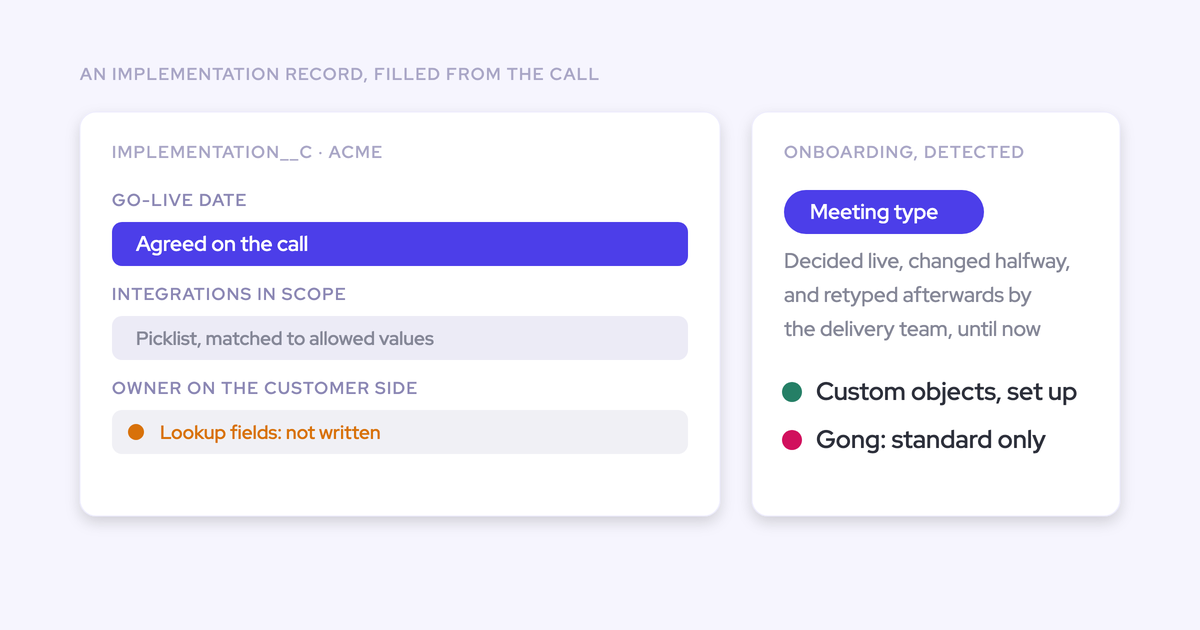
Weflow assigns coaching templates per team and can use meeting type to trigger the appropriate scorecard. That keeps a discovery standard from becoming the default assessment for negotiations or onboarding calls.
- Define your meeting vocabulary. In the Admin Console, open Conversation Intelligence, then Meeting types. Keep the types you use and add company-specific types where needed.
- Configure the coaching template. Add your selected prompt and choose free-form or rating output. The prompts above specify free-form assessments with evidence and coaching actions.
- Assign the team. Use separate versions where discovery expectations differ by segment or region. Keep a common definition wherever you intend to compare results.
- Connect discovery routing. Use the discovery meeting type to trigger the relevant scorecard. Weflow automatically classifies recorded meetings.
- Record the handoff. Keep the rubric owner, version, team, meeting type, and output format together so later changes have a clear reference.
You can use a proprietary framework instead of a standard acronym. Write each element in your own language, including what counts and what doesn’t.
Calibrate discovery scores against your managers’ reviews
Calibrate the rubric until managers can explain why an assessment is right or wrong. Agreement on a vague label won’t survive the next ambiguous call.
- Choose varied discovery conversations. Include strong calls, missed opportunities, buyer uncertainty, and incomplete recordings.
- Have managers assess independently. Use the same written rubric before looking at the AI response.
- Rehearse in Ask Weflow AI. Scope each assessment to one recording and instruct the AI to use only that transcript for call behavior.
- Compare evidence and reasoning. Separate prompt ambiguity from transcript gaps or incorrect attribution.
- Revise and repeat. Add the missing definition or exclusion, then test the revised prompt against the same conversations.
| Manager assessment | AI assessment | Disagreement | Rubric revision |
|---|---|---|---|
| Metrics partially demonstrated | Metrics demonstrated | The buyer says reporting wastes time, but the seller doesn’t explore how much or how to measure it. | Require exploration of a measure or an agreed way to obtain one. |
| Authority not applicable | Authority not demonstrated | The rubric doesn’t specify whether authority exploration belongs in this first conversation. | State the discovery-stage expectation explicitly. |
| Next step insufficient evidence | Next step not demonstrated | The recording ends before the closing exchange. | Withhold judgment when the relevant part of the call is missing. |
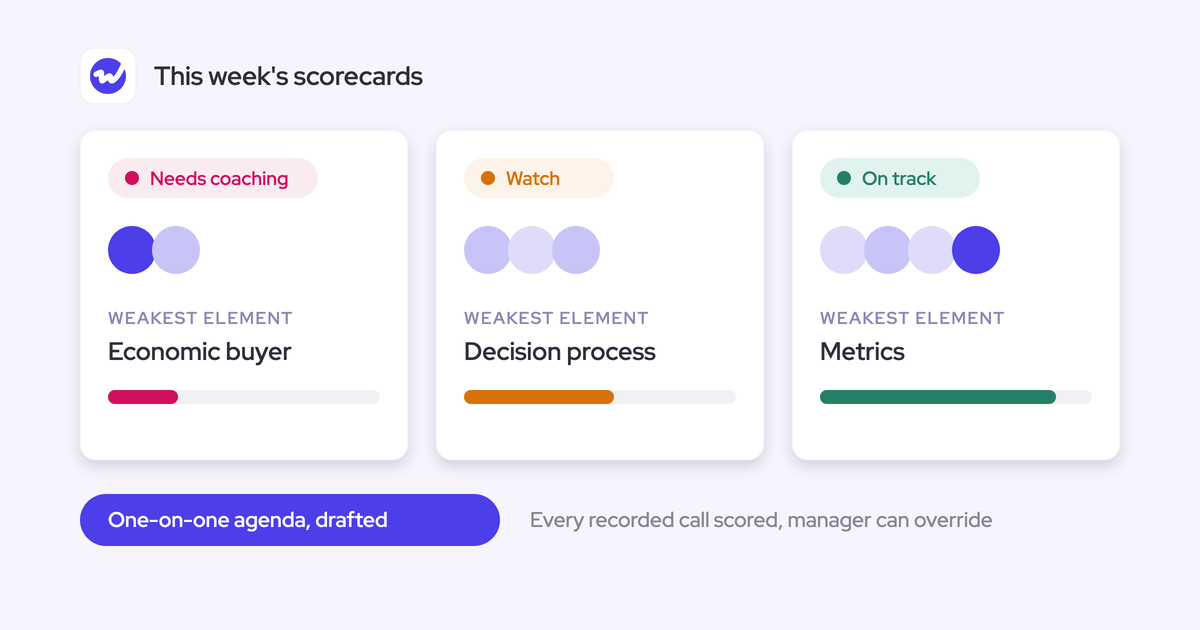
Weflow lets managers override coaching scores. Correct an inaccurate result, but also fix the criterion that produced it. Otherwise, you’ll correct the same mistake again.
Turn discovery scores into specific one-on-one coaching
Use each coaching conversation to change one observable behavior. A list of low scores gives a rep more to defend; a specific exchange gives you something to practice together.
Weflow’s coaching view brings the assessment alongside the recording so you can review the conversation behind the result.
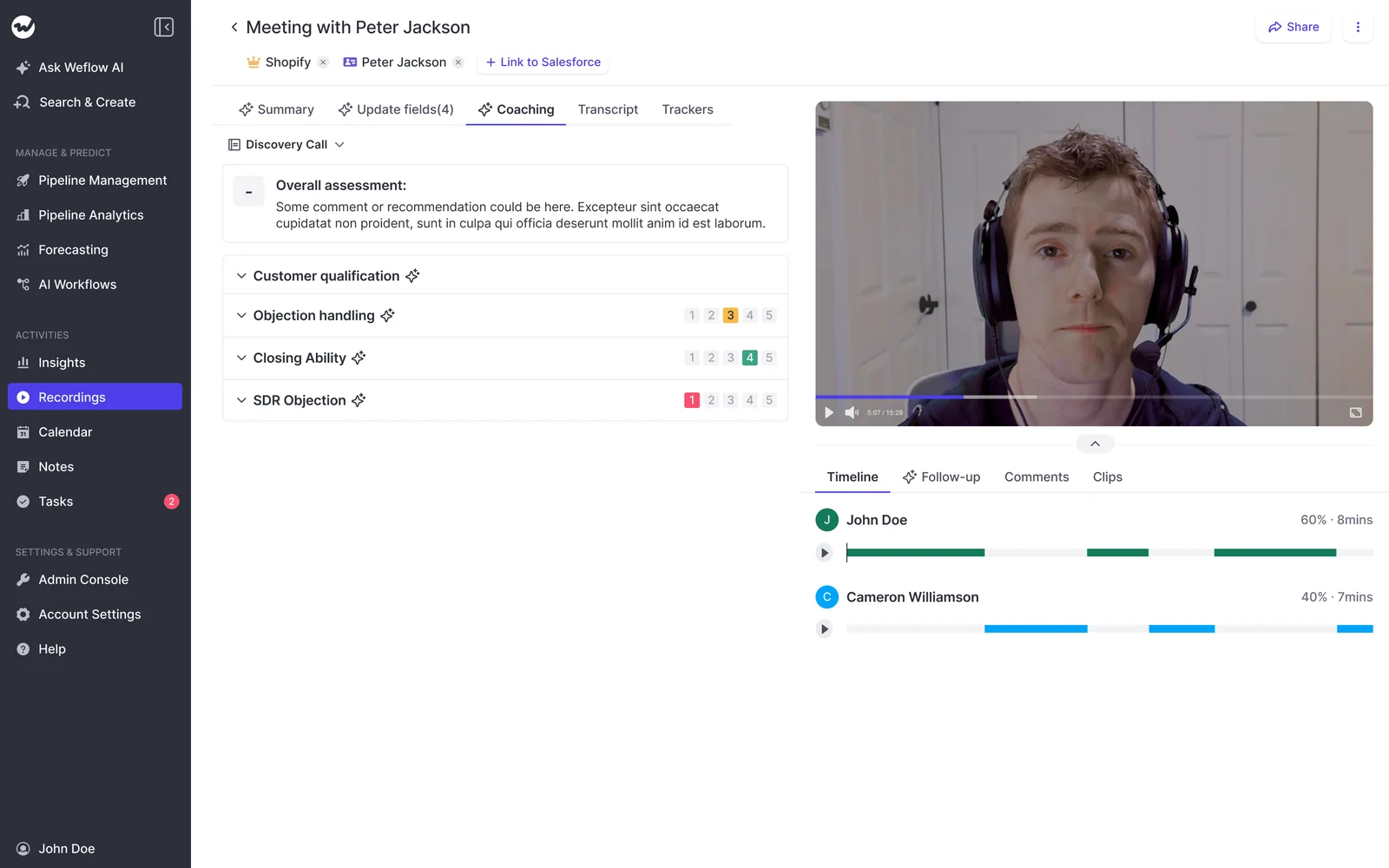
- Review the evidence. Read or listen to the relevant exchange before treating the assessment as a coaching priority.
- Correct the result where needed. Override an incorrect score and identify whether the rubric needs a revision.
- Ask for the rep’s reading. Have the rep explain what they heard and why they chose the next question.
- Practice one alternative. Rework the follow-up or closing exchange together.
- Revisit comparable calls. Look for the behavior in later discovery conversations using the same rubric version.
A worked coaching agenda: The rep consistently identifies pain but moves to the demo before exploring impact.
- Review: Open an exchange where the buyer describes manual work.
- Reflect: Ask what the rep understood about its consequences.
- Practice: Build one follow-up question about time, cost, delay, or risk.
- Follow up: Review whether the rep uses that behavior when a similar opening appears.
For rating-based scorecards, Weflow shows per-user scores and score development over time. Compare the same call type and rubric version, and read the meeting count alongside the average.
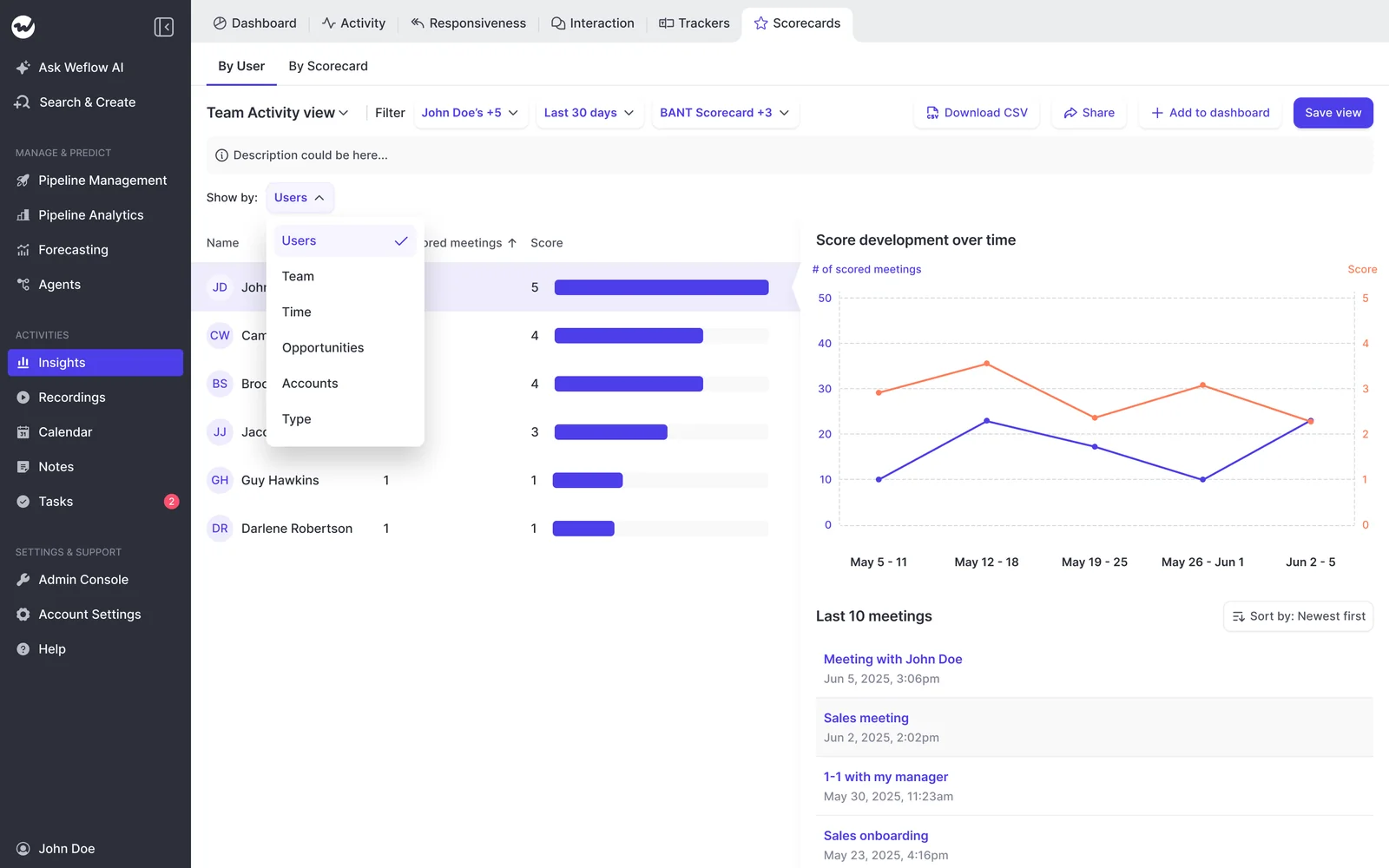
Share the rubric with reps before using it for coaching. Let them challenge an assessment with evidence. Automated scoring should remove the need to review every call, not remove the rep’s responsibility to think.
See how Weflow captures activity, updates Salesforce fields from calls, and rolls up your forecast. Book a 30-minute demo.
FAQs about Weflow discovery call scorecards
Weflow supports configurable post-call scoring, manager overrides, and separate workflows for CRM field updates. These operational details matter when you introduce the rubrics to your team.
What if Weflow assigns the wrong meeting type?
You can override the meeting type from the picker on the recording. Admins can also change the active meeting types and define custom classification rules, so the labels match your sales motion.
Can we test these prompts on past discovery calls?
Yes. Open an available recording in Ask Weflow AI and run the prompt against that call. Ask Weflow AI also loads related context, so the prompts explicitly restrict behavioral assessment to the selected transcript.
This gives you a manual rehearsal you can compare with a manager’s review.
When do reps receive Weflow discovery coaching feedback?
Weflow produces coaching feedback after the recording finishes processing, without waiting for a manager to review the call. We don’t provide live in-call coaching, real-time battlecards, or an in-meeting assistant.
How do discovery scorecards differ from Weflow AI Field Updates?
Discovery scorecards assess how the seller handled a conversation. Weflow AI Field Updates extract qualification evidence and write it into mapped Salesforce fields through a separate configuration.
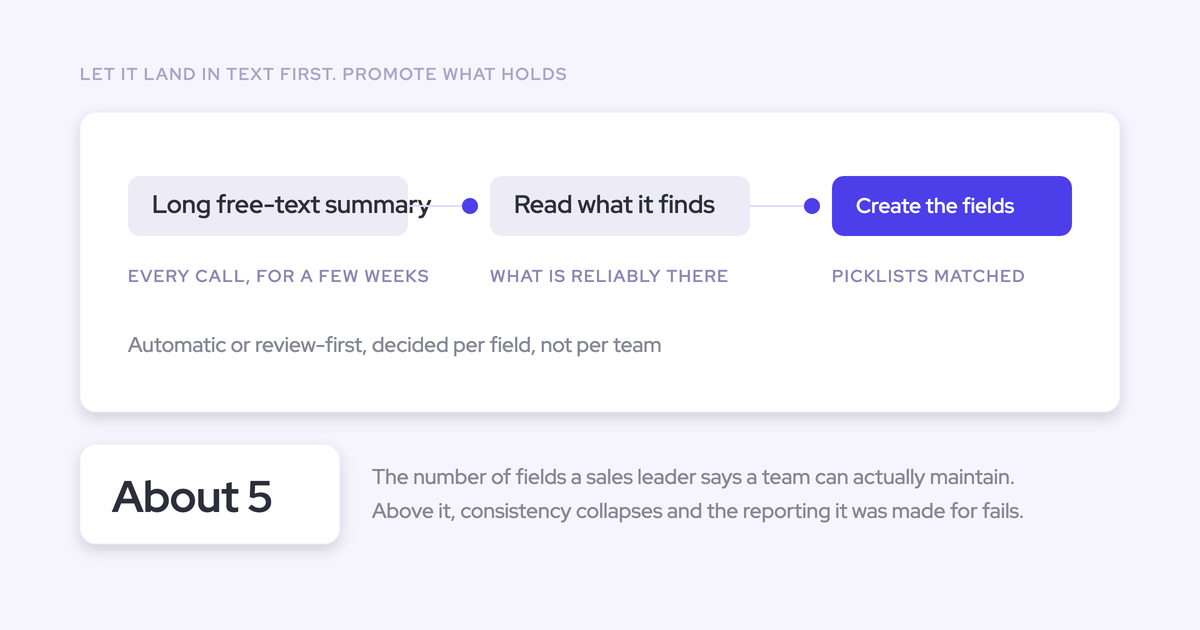
Methodology text can accumulate as the deal progresses instead of replacing earlier evidence with the latest call. Opportunity-level AI playbooks then assess qualification across the deal’s conversations, activities, and CRM data.
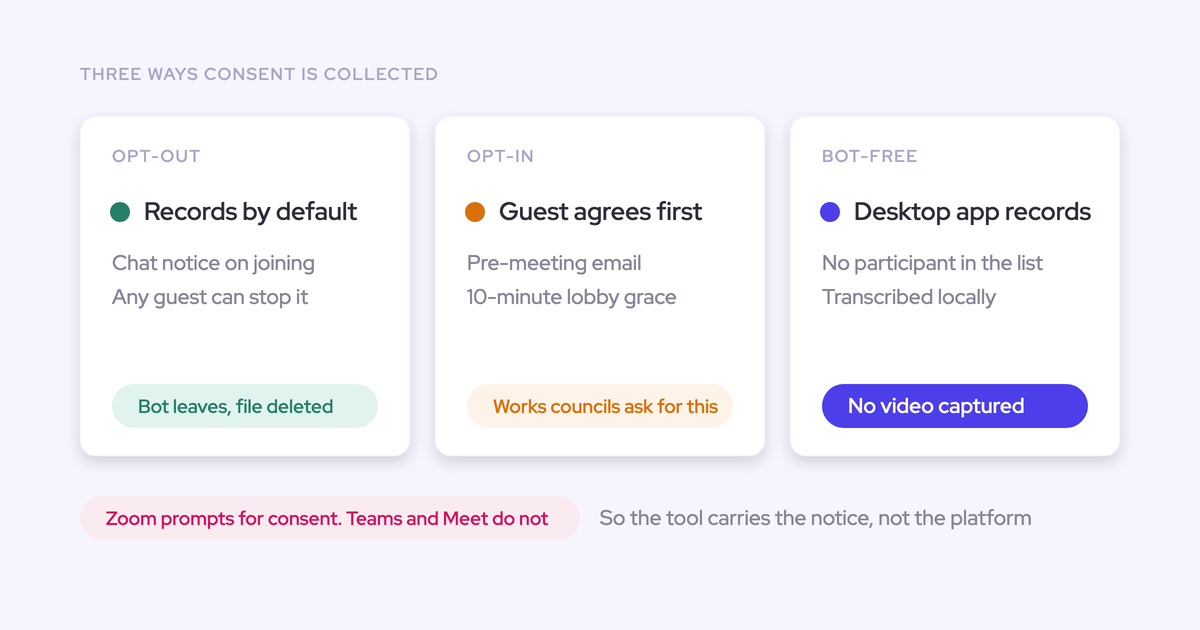
How should we handle consent for recorded discovery calls?
Your consent process needs to match the recording method and applicable legal requirements.
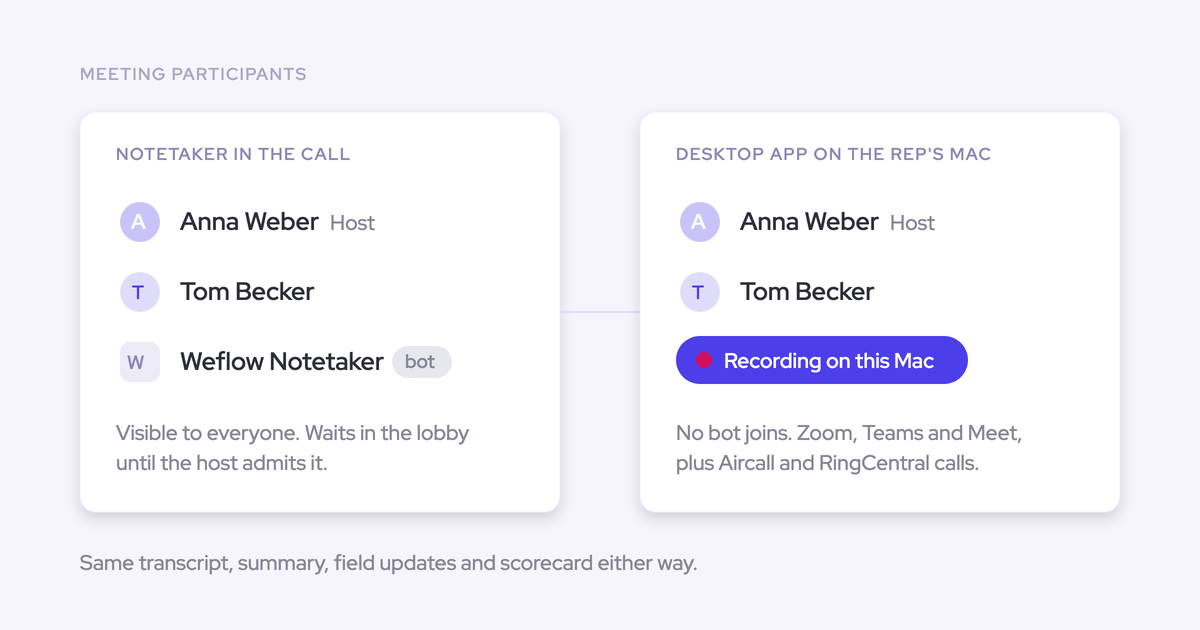
- Notetaker recording: Weflow supports configurable consent flows, including meeting notices and opt-in or opt-out options.
- Desktop-app recording: Weflow doesn’t notify participants or manage consent. The rep is responsible for obtaining consent.
Have your legal team define the recording policy before rollout, including the requirements that apply to participants in different countries.
What access should we approve before scoring discovery calls?
Decide who needs access to recordings, transcripts, and coaching information before you broaden the rollout. Those decisions affect confidentiality, not just convenience.
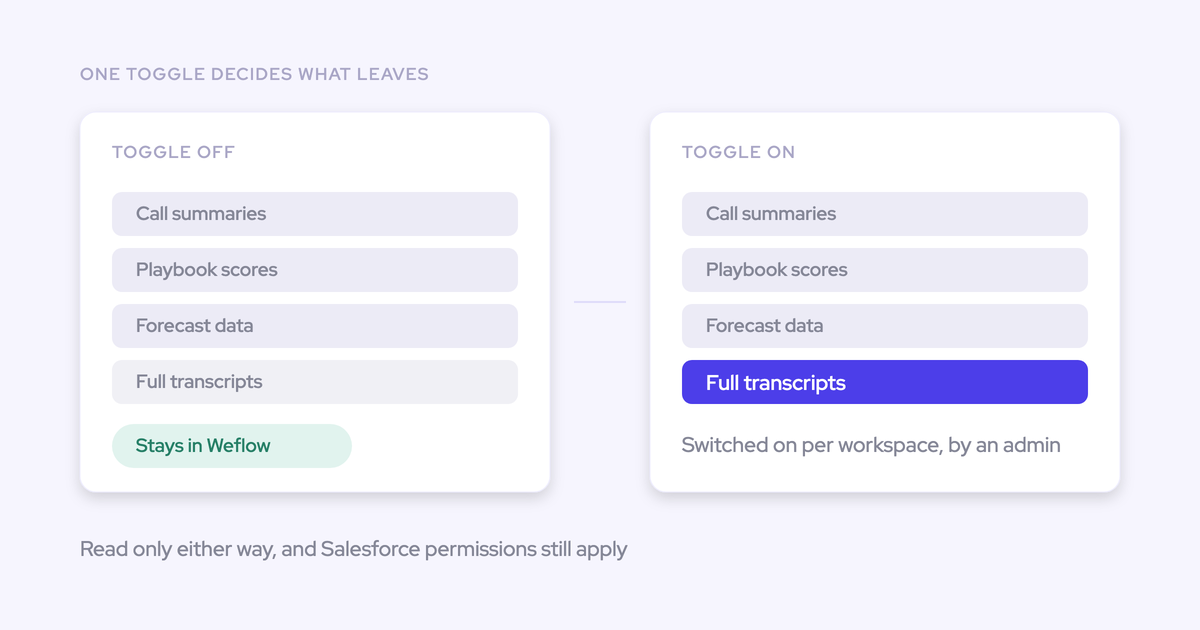
- Salesforce access: Weflow applies Salesforce permissions and role hierarchy. List-view restrictions and Lightning component visibility don’t carry over as access controls.
- Transcript access: The Weflow recording object holds the full transcript and executive summary. Review profile access to that object deliberately.
- Coaching audience: Define which reps, managers, and enablement stakeholders should review coaching information.
What does Weflow Conversation Intelligence cost?
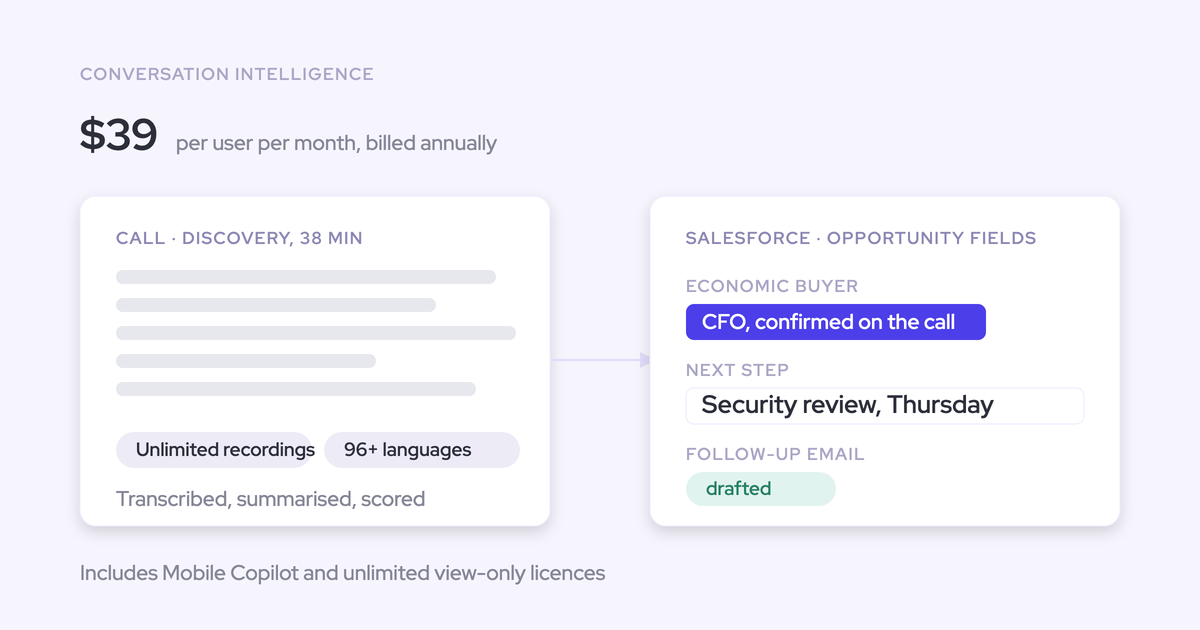
Weflow Conversation Intelligence costs $39 per user per month, billed annually, with a 10-user minimum. It includes AI coaching and scorecards, recordings, transcripts, AI Field Updates, and Ask Weflow AI Pro.
Revenue AI Foundation costs $49 per user per month, billed annually, and combines Weflow Activity & Contact Capture with Weflow Conversation Intelligence.
Recordings, transcripts, AI templates, and Ask Weflow AI prompts have no usage caps or metering. Agent Builder has separate action allowances. Unlimited view-only licenses are included.