
What Talk Ratio and Question Rate Actually Tell You (and What They Don't)
Learn what talk ratio and question rate show, miss, and when to use AI coaching scorecards.


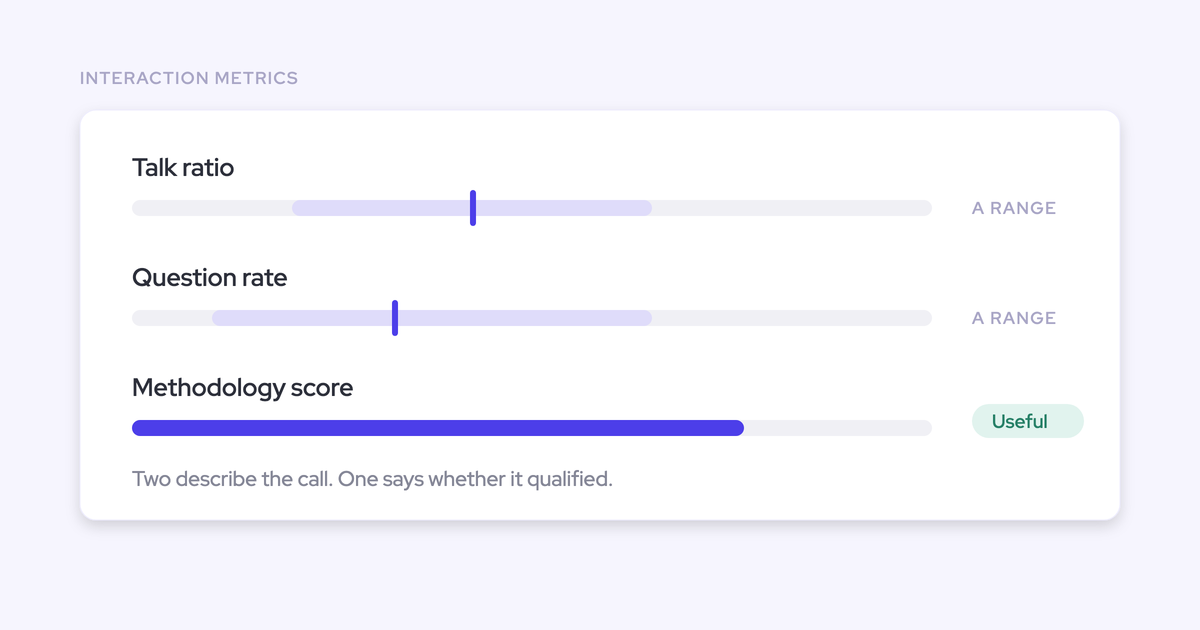

Talk ratio is the share of a call your side spoke compared to the customer. Question rate is how often the rep asked a question instead of telling. Both are computed from the transcript, both measure the shape of the conversation, and neither one tells you whether the deal is qualified or whether the rep is getting better.
That's the honest read, and it's the reason you can stare at those numbers for twenty minutes and still not know what to do on Monday.
So this piece does three things: says what each metric is genuinely good for, names what it cannot show, and gives you the signal that actually carries coaching. It comes out of building and running this in Weflow Conversation Intelligence + AI Field Updates, and out of the sales manager calls we sit on every week.
What talk ratio and question rate measure on a sales call
Interaction metrics measure the observable structure of a conversation: who spoke, for how long, in what pattern. Nothing about content.
They're derived, not judged. A transcript comes in, the speaking turns get counted, and the dashboard shows you the arithmetic. That's why they're consistent, cheap, and available on every call you've ever recorded.
The interaction metrics your dashboard shows, defined
| Metric | What it measures | How to read it |
| Talk ratio | Share of speaking time taken by your side versus the customer's | How much airtime the rep took |
| Longest monologue | The longest uninterrupted stretch one speaker held | Whether the rep pitched at someone instead of with them |
| Interaction ratio | How often speaking passes back and forth between sides | Whether it was a conversation or two presentations |
| Question rate | How many questions the rep asked in the call | Whether discovery was attempted at all |
| Meeting volume and average duration | How many meetings, how long they ran | How busy the rep's week was |
| Email responsiveness | Whether a received email got a reply inside a 24-hour window | How fast the rep closes the loop |
Each one is a single narrow measurement you could explain to a rep in a sentence. That's their strength and their ceiling.
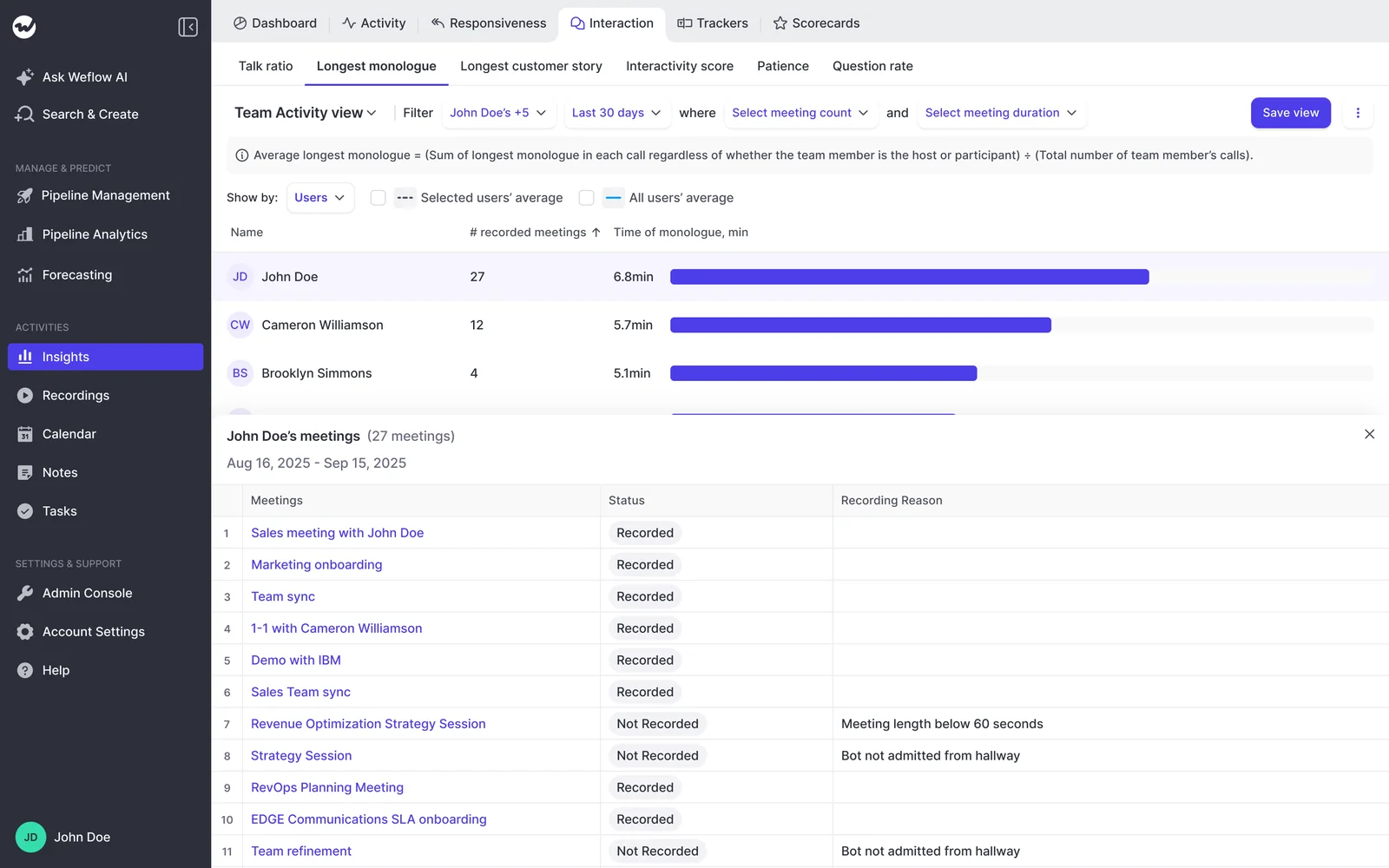
Here's what the talk ratio view looks like in Weflow, ranked per rep across recorded meetings.
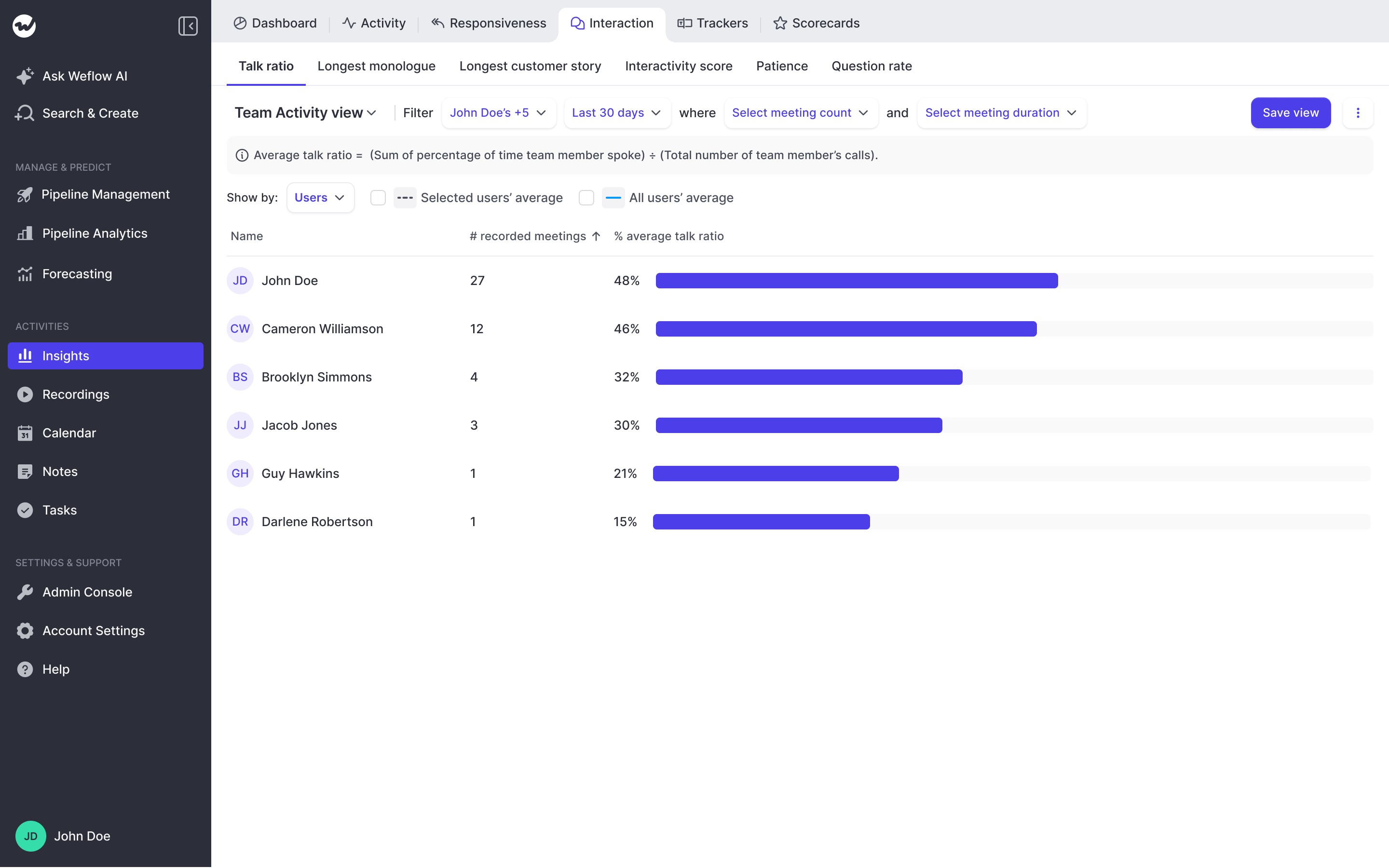
Speaker diarization: what every talk-time number rests on
A talk ratio is only as good as the speaker separation underneath it. Before anything can be counted, every voice on the call has to be labelled, and labelled as the right side of the table.
Weflow does that from Salesforce and calendar data, tagging each participant as internal or external. So when your AE, your SE and your manager are all on a call, the number you see is your side against the customer, not one voice against five.
One limit worth knowing before you try to coach from it: on a multi-rep call, Weflow doesn't score individual sellers. If three of your people are talking, the talk ratio belongs to the team, not to whoever you had in mind.
Why conversation intelligence tools lead with interaction metrics
These metrics are on the front page of every dashboard because they were the first things the technology could measure, not because they're the most useful things to know.
The first generation of conversation intelligence was built before generative AI. The mandate was simple: never lose a conversation. So what shipped was a searchable video archive with summary statistics layered on top, and talk time was the cheapest statistic available.
Then the arithmetic of that archive caught up with everyone. A manager with ten reps, each on three or four hours of calls a day, is looking at more than a hundred hours of conversation a day.
Nobody watches that.
So the archive got fronted with numbers a human could scan in ten seconds, and those numbers became the product's face.
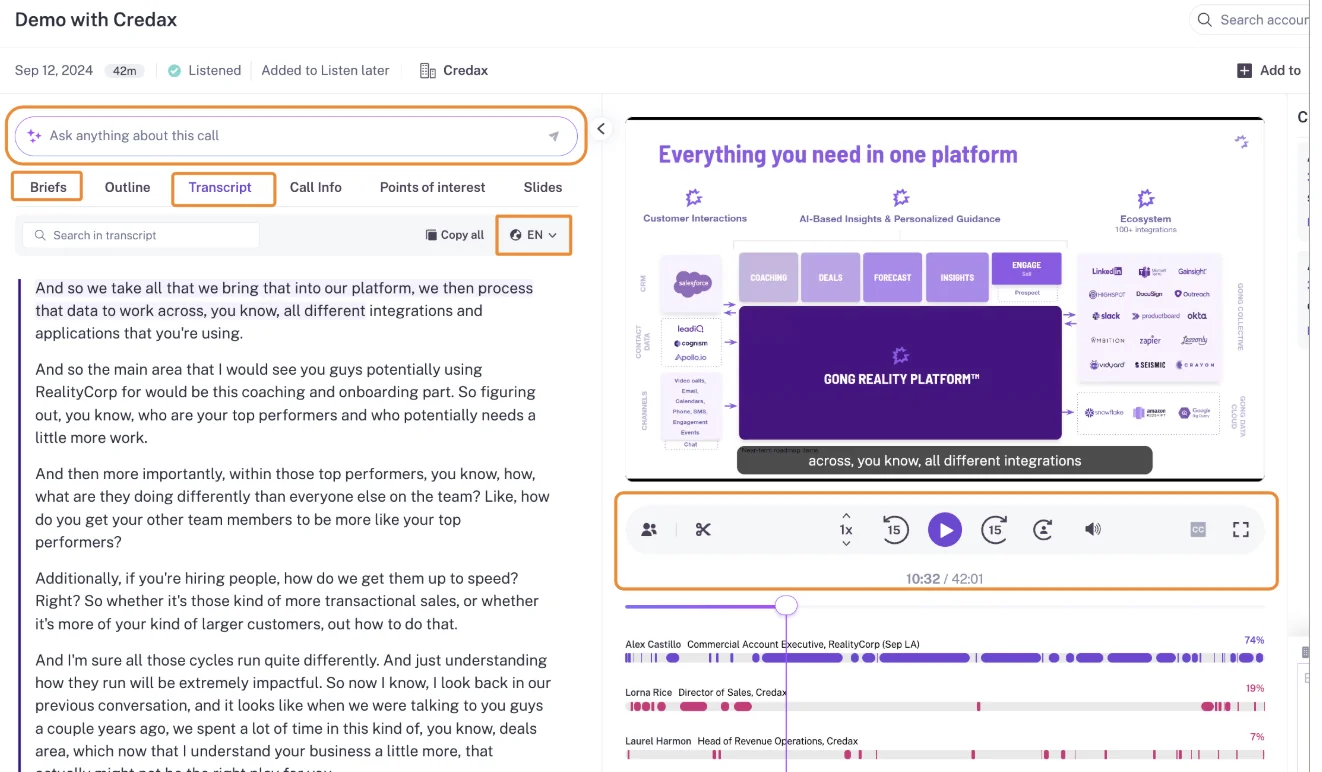
Gong invented this category and still has the deepest conversation analytics in it. Its call page gives you the per-speaker talk time timeline with a percentage against each participant, which is a genuinely well-built version of the measurement.
The position I'd argue: a vendor whose brand was built on interaction analytics has no incentive to tell you those analytics are a weak coaching signal. We can say it because our story doesn't depend on them.
Your dashboard is optimized for what was measurable in 2015. Your coaching problem is a 2026 problem.
What talk ratio and question rate genuinely tell a manager
They're a good screen. Read as a screen, they earn their place on the dashboard.
Specific patterns these metrics catch reliably:
- The rep who monologues. Longest monologue climbing over a month is a real behavioral signal, and it's visible without opening a single call.
- The discovery call that was actually a demo. Your side at 80% airtime on a first meeting tells you the call ran the wrong way round.
- The renewal conversation where nobody asked anything. A question rate near zero on a call that was meant to uncover expansion is a legitimate flag.
- Which calls to open this week. Out of sixty recorded meetings, the outliers are how you pick the three you'll actually listen to.
- Whether a rollout landed. Tracked keywords across every recorded call, rolled up by rep, team and region, turn a rumor into a number, so a competitor whose mention rate is climbing in one territory shows up as a trend rather than as one manager's hunch.
Use them to decide where to look. Don't use them to decide who's good.
What interaction metrics can't tell you about your reps
They measure the shape of a conversation, and coaching lives in the substance.
| What the metric shows | What you actually need to know |
| The rep spoke 62% of the call | Whether the customer's decision criteria came out |
| Longest monologue was seven minutes | Whether that seven minutes answered a real objection |
| Fourteen questions asked | Whether any of them found the economic buyer |
| Twenty-two meetings this month | Whether the deals behind them are qualified |
| Talk ratio improved eight points | Whether the rep is better, or just quieter |
That last row is the one that matters most, and it's the one nobody can answer from a dashboard. A rep who talks less is not the same as a rep who qualifies better.
The second gap is where your attention goes. Because the metrics can't tell you which deal is in trouble, you find out the usual way, and by then it's late.
And because coaching happens when a manager has time, which is never, it lands on whichever call you happened to sit in on. One rep gets three hours of your attention this quarter and the rest get none. At the end of it, nobody can say whether the team got better or just got busier.
The metric worth coaching on: methodology adherence per call
Score every recorded call against the framework your team already runs, and coaching stops being anecdote.
MEDDIC, MEDDPICC, SPICED, BANF, whatever you've rolled out: the qualification questions are the ones you already believe in, and the transcript already contains the answers. Scoring turns those answers into a rating per element, per call, per rep, tracked over months.
That's different in kind from a talk ratio, on three counts.
| Dimension | Interaction metric | Methodology adherence score |
| What it measures | Airtime and pattern | Whether qualification actually happened |
| What it produces | A number | A statement you can coach: no economic buyer named in three calls |
| What the trend shows | The rep got quieter | Whether one named skill moved over months |
| How the rep reads it | A measure of them | A measure of the deal work |
One tension to name honestly, because it's real and it's the objection a good manager raises straight away: if the machine fills in every qualification field, the rep stops thinking about their own deal, and thinking about the deal was the entire point of the methodology.
Our read is that automation should compute the score and still make the rep answer the questions themselves. The gap between what the rep says and what the calls say is the coaching moment. Take that away and you've removed the admin and the coaching in one go.
The second thing to hold onto: a filled field isn't a useful field. A metrics field that returns the customer's headcount is technically populated and tells you nothing. Judge a scorecard on whether it produces a coachable sentence, not on whether it produces a value.
How Weflow scores every call against your own methodology
Weflow is the Revenue AI Orchestration platform for sales, customer success, and RevOps teams. Inside it, methodology scoring isn't something a manager triggers. Every recorded meeting is scored automatically against the framework the team has configured.
The rep gets an AI coaching scorecard with ratings across the rubric sections. The manager gets a structured agenda for the one-to-one instead of a blank page.
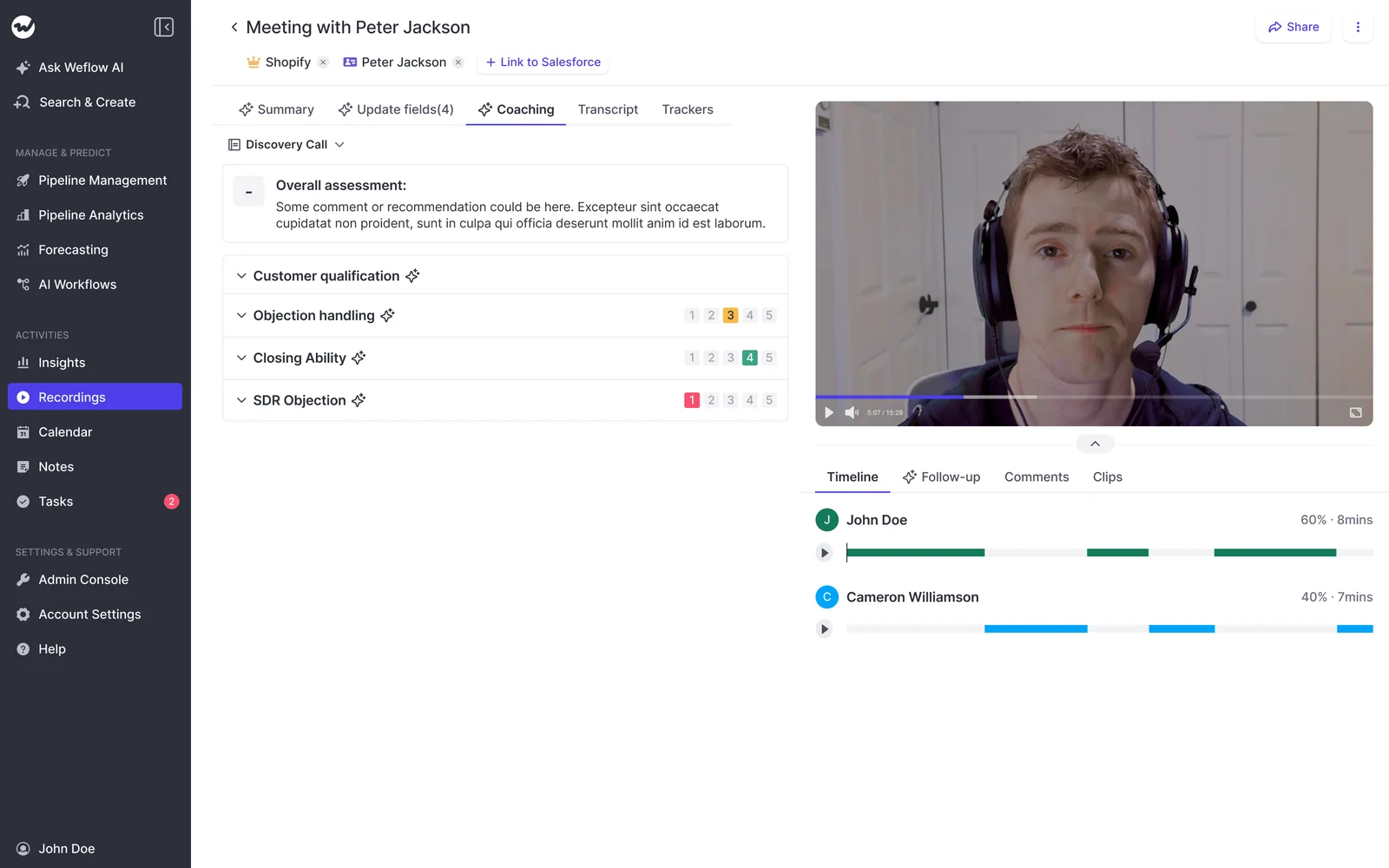
Because the score exists on every call, it becomes a trend. You can watch how one rep's economic buyer identification has moved over the last three months, then open the specific calls sitting behind the score.
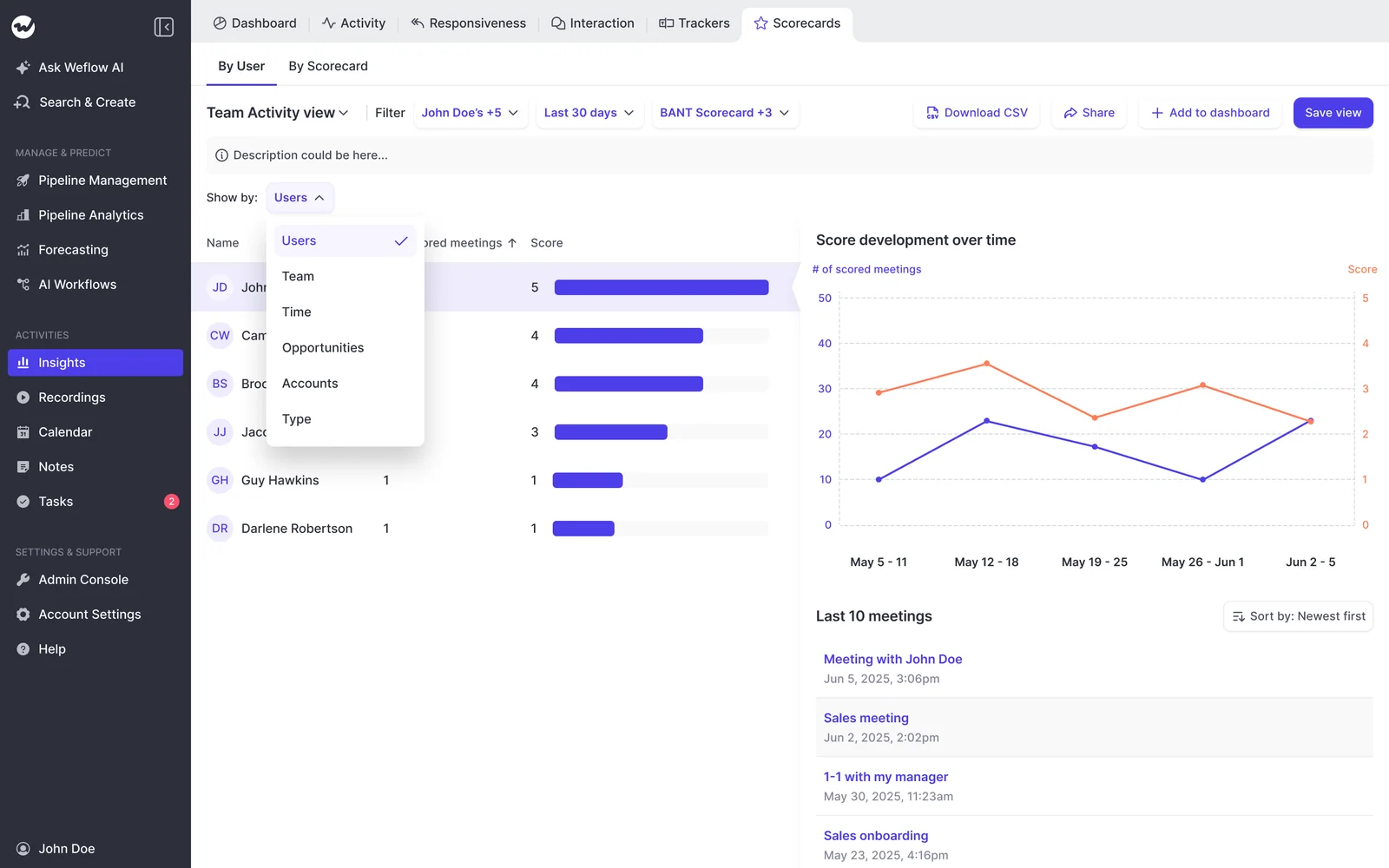
And the manager can override a score. That matters more than it sounds, which I'll come back to in the rollout.
Scorecards configured per team and per call type
The scorecard is yours to define, not ours. Coaching templates are assigned per team, with rating output or free-form output, and custom prompts you write.
The axes you configure:
- Which framework each team is scored against, so an SMB team and an enterprise team don't share a rubric
- Whether the output is a rating or narrative feedback
- The prompts behind each rubric section
- Which meeting type triggers which scorecard
- Whether internal meetings are scored at all, since scoring runs on meetings with external participants by default
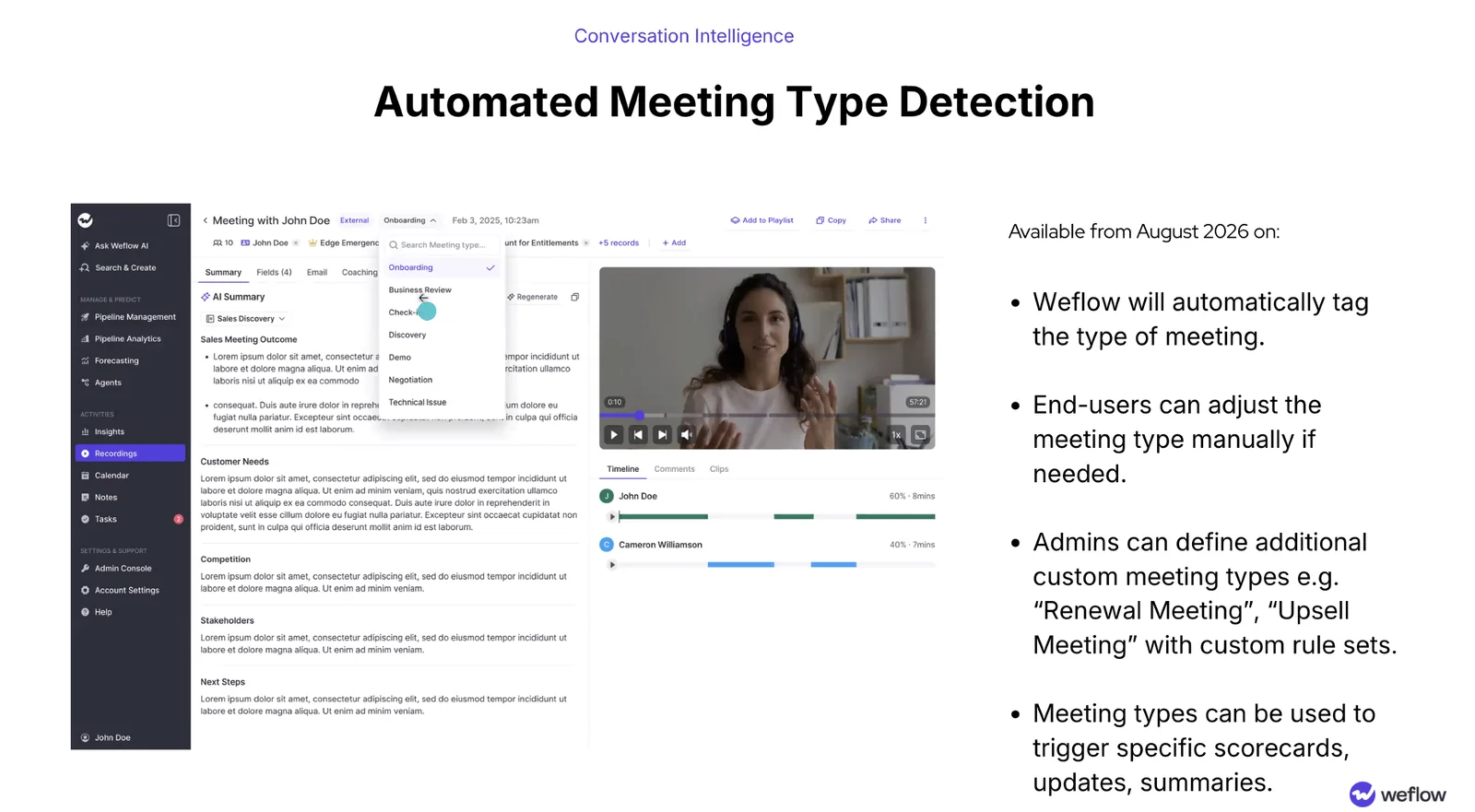
That meeting-type routing is what stops a renewal call being graded on a discovery rubric. Weflow tags each recording with its type automatically, an end user can override the tag when the AI reads a call wrong, and admins can define their own types with their own rules, like a renewal meeting or an upsell meeting.
Where talk ratio and trackers still fit in Weflow
We ship the interaction metrics too. Talk ratio, interaction ratio, longest monologue, meeting volume, average meeting duration, time spent in meetings, email responsiveness, plus keyword trackers rolled up by rep, team and region.
They sit next to the scorecard, doing the job they're good at: screening, and detecting trends across a lot of calls. Nobody here is telling you to pretend those numbers are worthless.
The drill-down is where they earn it. Open a rep's longest monologue view and you get the meetings behind the average, including why a given meeting wasn't recorded, so you can tell a coaching problem from a coverage problem.
And if you're carrying a tracker set from another recorder, it comes across, so keyword reporting doesn't restart at zero.
From call scores to deal-level methodology reasoning
A rep can look strong on the last call and the deal can still be hollow. A per-call score only ever sees one conversation.
So above the call sits the deal layer. Weflow AI Playbooks read every email, meeting, transcript and CRM field on the opportunity, produce a running rating per methodology element, write the result back into the matching Salesforce fields and return a next-step recommendation. Not "MEDDIC score 3 of 5", but "the metrics are named but not quantified" and "the economic buyer is still unidentified".
Alongside it, the deal view carries an AI summary that reasons across every meeting on the opportunity, plus communication velocity computed from the emails actually sent and received, and every person involved.
That's what makes a deal review possible at pipeline scale rather than three deals at a time.
Rolling out call scoring without it reading as surveillance
The surveillance reaction is triggered by rep-level numbers, not by scoring. Lead with the numbers and the whole deployment gets read as monitoring.
We've watched pilots die exactly there. A small group who have never been recorded, handed a dashboard of their own talk ratios in week one, turns the evaluation into a referendum on being tracked instead of a test of the product. If your team has never been recorded, do not open with rep-level metrics.
The sequence that lands:
- Turn recording on and let the reps keep the output first. Summary, follow-up email, and the Salesforce fields written from the conversation. They feel time come back before anyone asks them for anything.
- Give the rep their own scorecard before the manager sees a trend. Immediate feedback with no manager in the loop is the part reps actually like.
- Keep the manager insight views in the manager's session, with permissions set accordingly. Same data, different audience, deliberately separated.
- Agree the framework and the rubric with the team before any score counts for anything. It's their methodology; the scorecard should look like it.
- Use the override, visibly. A manager who corrects a score in front of the rep proves the number is an input to a conversation, not a verdict.
And treat this as a leadership decision about how the team runs, then support it with enablement. Putting conversation intelligence to an implicit vote by five reps who are being asked to change their behavior for four weeks is not an evaluation, it's a negotiation you'll lose.
"It kind of puts the trust back in the rep's hands to say, I trust you to tell me if you're gonna win this or not and let the robots take care of everything else."
— Mallory Lee, VP Revenue Operations at PhoneBurner
Walk through the product yourself, no call required.
FAQ: call metrics and coaching scorecards
What is a good talk ratio for a sales call?
There's no universal benchmark worth coaching to, and any single number you've seen quoted was set against someone else's call mix. Read talk ratio against the call type and against your own team's baseline instead. Your side at 70% on a first discovery call is worth opening; the same 70% on a demo is just a demo. Build the baseline from your own top performers, per call type, and treat outliers as a prompt to listen rather than a target to hit.
How much manager time does automated call scoring save?
The honest version isn't hours saved, it's coverage gained. A manager reviews a handful of calls a week and can't reach the rest, so coaching is anecdotal by default. Ten reps on three or four hours of calls a day generates more than a hundred hours of conversation a day, which no manager will ever consume. Scoring every recorded call means coaching stops being capped by listening hours, and the time you do spend goes into the calls the score pointed you at.
Can a manager override an AI coaching scorecard score?
Yes. A manager can override the score on any call in Weflow, and reps can override the methodology fields a playbook writes, with the override itself checked for plausibility against the rest of the deal. This matters for trust more than for accuracy: a score nobody can correct gets treated as a grade, and a grade nobody can argue with is where rep buy-in dies.
Do coaching scorecards work for renewal and demo calls?
Yes. Weflow tags each recorded meeting with its type automatically, from a set covering onboarding, business review, check-in, discovery, demo, negotiation and technical issue, and the type routes the call to its own scorecard, field updates and summary. Admins can define additional types with their own rules, so a renewal meeting or an upsell meeting is graded on a renewal rubric rather than a discovery one. If the AI reads a call wrong, an end user can change the type from a picker.
What does Weflow Conversation Intelligence cost per user?
Weflow Conversation Intelligence is $39 per user per month, billed annually, with a ten-user minimum. That includes Ask Weflow AI Pro, Agent Builder on the free tier with 25 agent actions a month, and Mobile Copilot, plus free view-only licenses (up to one per recording license) so leadership and enablement can read recordings and analytics without consuming a paid seat. Bundling it with Weflow Activity & Contact Capture as Revenue AI Foundation is $49 per user per month, roughly a 16% discount against buying the two standalone.
Can Weflow import calls from my current recording tool?
Yes. Weflow imports and reprocesses the recordings and transcripts held in the conversation intelligence platform you're leaving, pulling them through that platform's API, at no extra cost and in about one to two weeks depending on volume. Because the imported transcripts land in your own CRM, a question about how an objection was handled last quarter still answers after the move, and your existing tracker set carries over too. Your call history doesn't stop dead at the cutover, which is usually the real reason teams stay put.


