Why Weflow Doesn't Do AI Role-Play, and What Actually Reinforces Sales Training
Learn when AI role-play helps, why Weflow skips it, and how Conversation Intelligence reinforces training.


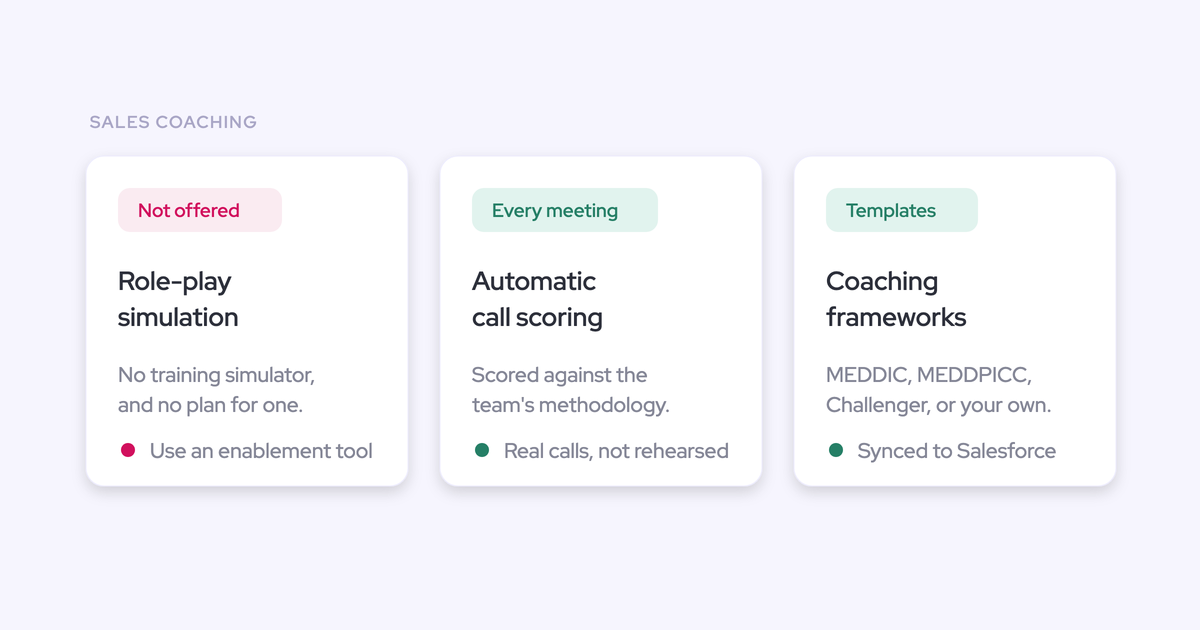

Weflow has no role-play product and no practice simulation. No AI buyer to pitch to, no scenario library, and we haven't prioritized building one. That's the honest answer to the question in the title.
It's usually not the disappointing answer it sounds like. Most managers who go shopping for a role-play tool are trying to fix something else: role-play is rehearsal, it happens before the call, against a buyer who isn't real. What breaks after a sales kickoff is reinforcement, which is feedback after the call, on real deals, often enough that behavior changes.
Weflow is the Revenue AI Orchestration platform for sales, customer success, and RevOps teams, and reinforcement is the part we own. Weflow Conversation Intelligence scores every recorded customer conversation against the methodology your team already trained on, so a rep gets feedback without you sitting in, and you see where the gap actually is.
Below is the distinction, the mechanism, and a straight answer on when a role-play tool is the right buy instead.
Sales role-play vs training reinforcement: what's the difference?
Sales role-play is rehearsal on a simulated conversation. A rep practices a pitch, a discovery flow, or an objection against a partner or an AI buyer, before any of it is used on a real deal.
Training reinforcement is feedback on real conversations. It reads what a rep actually said to an actual buyer, scores it against the framework the team trained on, and repeats that every week until the behavior sticks or the gap gets named.
Two different problems, one search box. The manager who just watched a kickoff evaporate almost always lacks the second one.
| Sales role-play | Training reinforcement | |
| When it happens | Before the call | After the call |
| What it works on | A simulated buyer and a scripted scenario | Real recorded conversations on live deals |
| What it fixes | Nerves, structure, a new talk track before it goes live | Whether the behavior from training shows up in front of buyers |
| Who has to run it | The rep, plus whoever sets the scenario and reviews the practice | Nobody, if the scoring is automatic |
Why sales training evaporates after the kickoff
Training doesn't fail at delivery. It fails at reinforcement.
The kickoff dumps a year of content into two days. Reps get no time to implement any of it, no repetition in the working week, and no chance to practice one behavior until it becomes theirs. It's going to school once a year and expecting people to have learned.
You've got to give people some time after the training to implement things.
What we hear from managers running ten reps is the same set of symptoms every time:
- Training lands in February as a vague memory and nothing in the calendar reinforces it.
- Calls only get listened to when a deal is already on fire, and by then listening doesn't help.
- Coaching lands on whoever the manager happened to sit in on, not where the gap is.
- One rep gets three hours of attention in a quarter and the rest get none.
- Nobody can say whether the team is getting better or just busier.
A methodology only becomes real when three things are true at once: the data on what was actually discussed exists, a manager looks at it, and the coaching is built around what it shows. Take any one away and the framework stays a slide deck. That's why so many companies can name their methodology and none of their deals reflect it.
Why role-play tools don't close the reinforcement gap
Role-play tools solve a real problem, and it's worth saying so plainly. Practice used to require a manager or a peer with a free hour, which meant it happened almost never. An always-available AI partner turns practice into something a rep does at the moment of need rather than a session someone has to schedule.
That's a genuine gain. It just isn't the thing that makes kickoff training stick.
| What role-play fixes | What it leaves untouched |
| A rep who has never said the new pitch out loud | Whether the rep said it to the buyer last Thursday |
| Rehearsing an objection in a controlled scenario | The objection that actually killed the deal in stage three |
| Confidence before a first live call | Whether a seller is consistently weak on decision process across twenty deals |
There's a credibility problem too, and reps feel it faster than managers do. Feedback from a simulation is feedback on a performance nobody bought from.
Every rep out there wants to be more successful, but they need to believe that it actually drives success.
— Janis Zech, Co-founder and CEO, Weflow
Then there's the arithmetic that kills every manual reinforcement plan. Ten reps in three or four hours of live calls a day produce more conversation in a week than you could listen to in a month.
You can't listen your way to reinforcement, and you can't rehearse your way there either. Something has to read every call for you.
How Weflow reinforces training from real sales calls
Reinforcement works when it's automatic, consistent, and grounded in what buyers actually heard. That's the job Weflow Conversation Intelligence does: every recorded customer meeting gets scored against the framework your team trained on, and the output goes to the rep and to you without anyone booking time to make it happen.
Three parts make that work.
AI coaching scorecards score every recorded call automatically
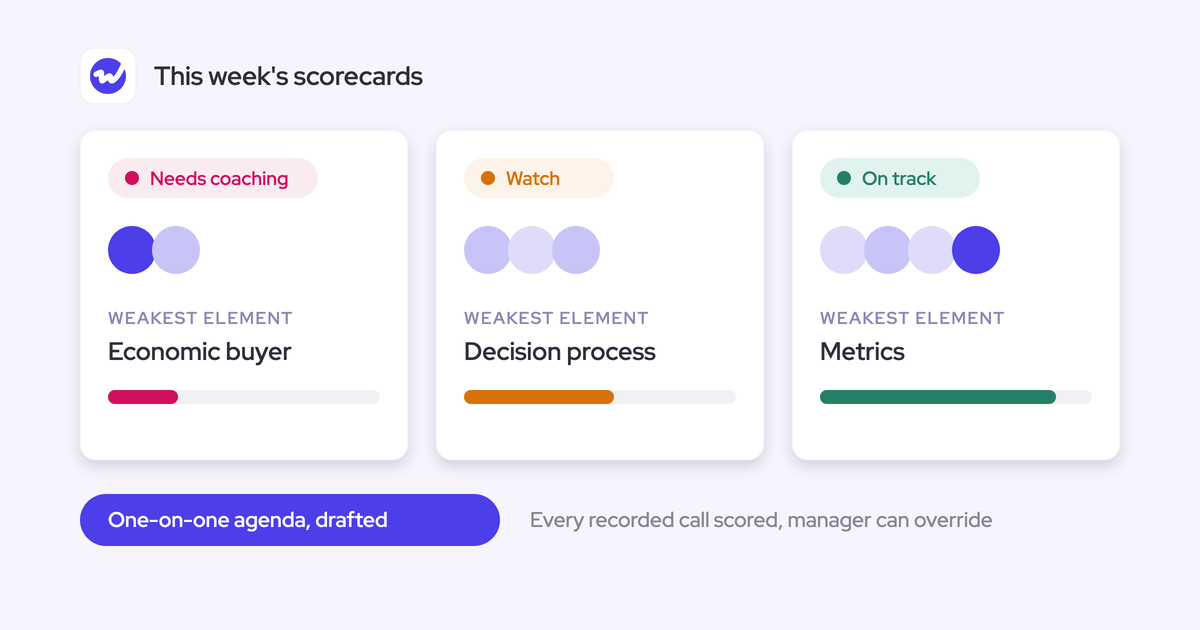
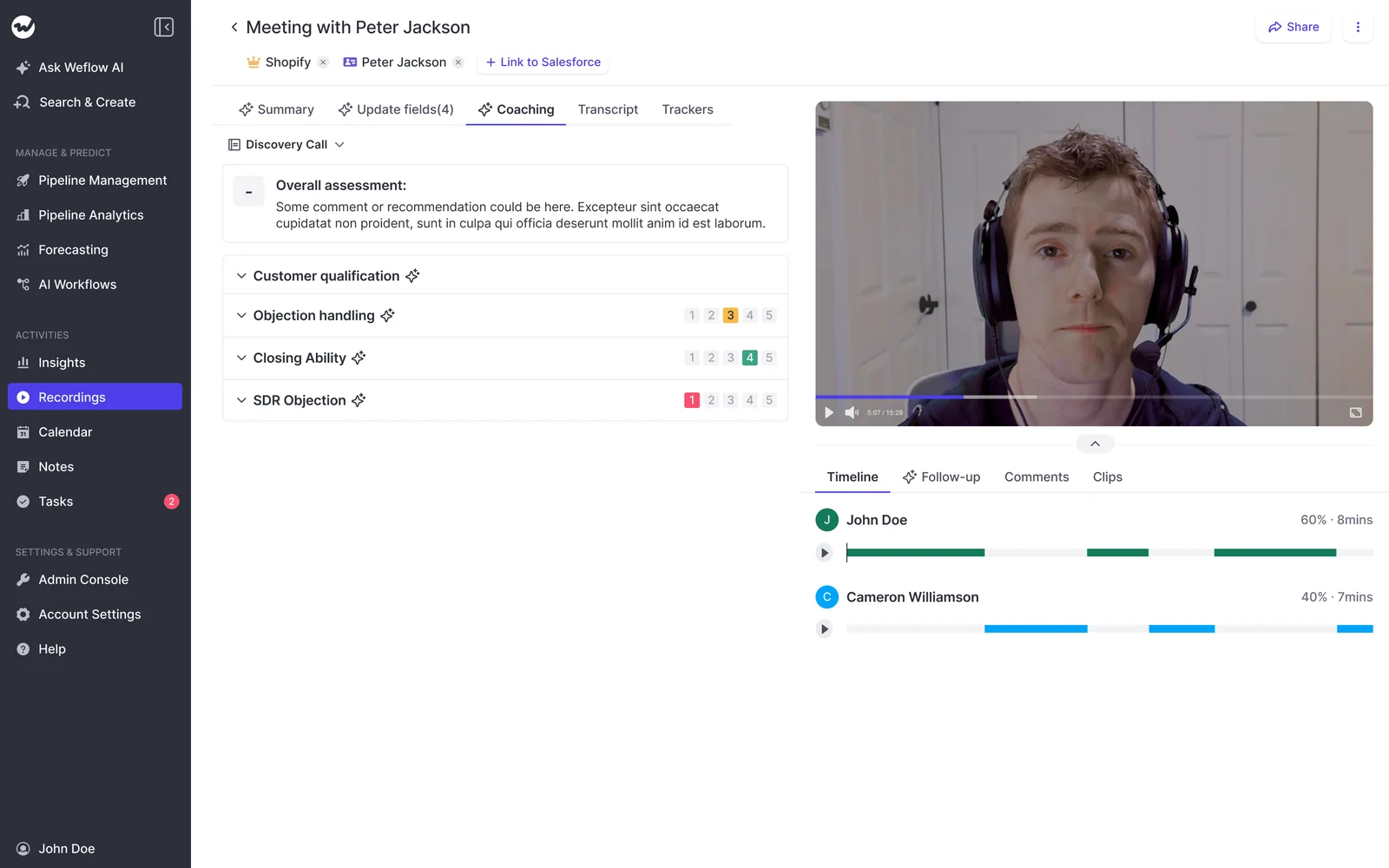
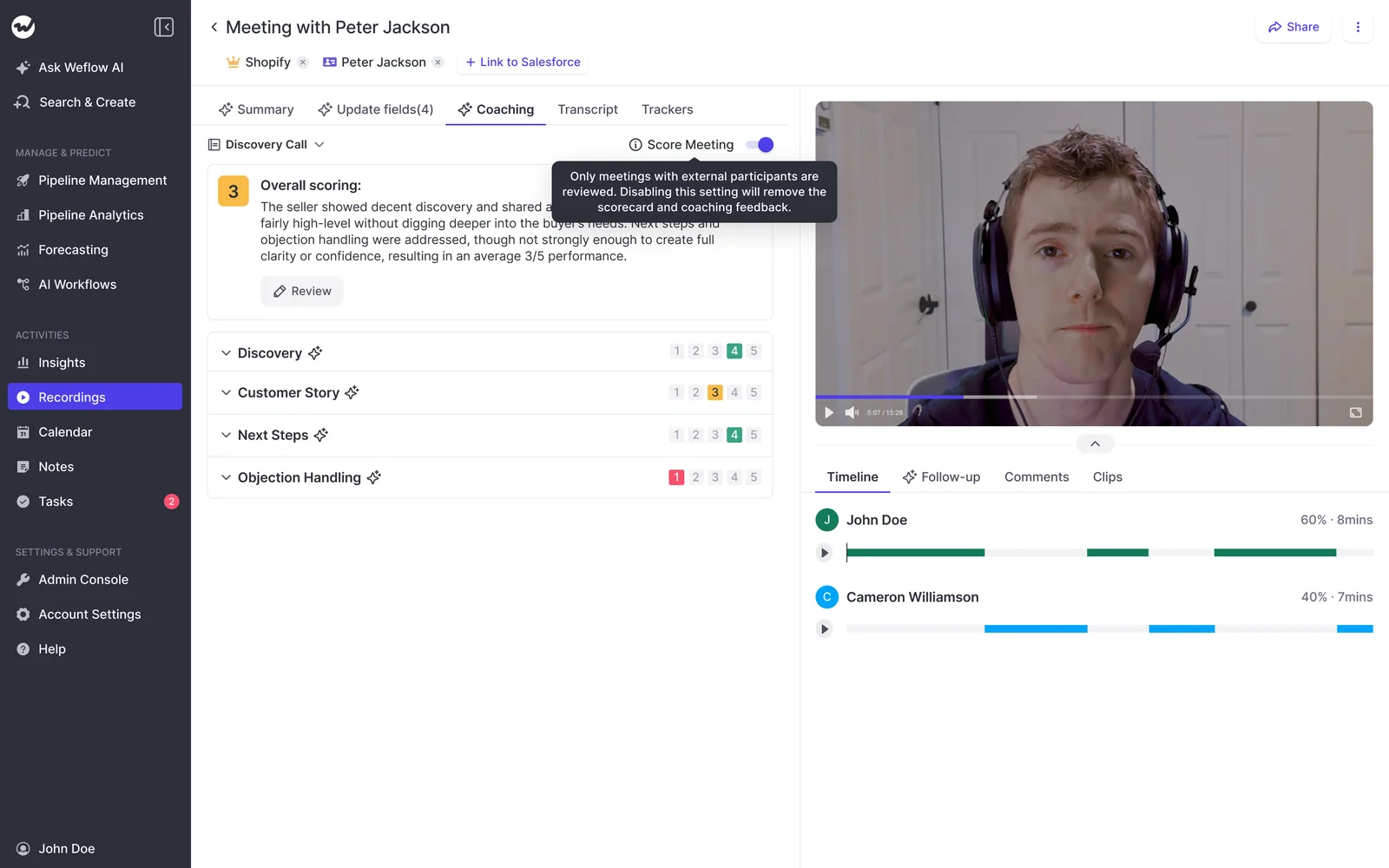
Weflow scores every recorded meeting against the methodology configured for that team, and produces an AI coaching scorecard for the rep plus a structured agenda for the manager. The rep gets feedback immediately, with no manager in the loop.
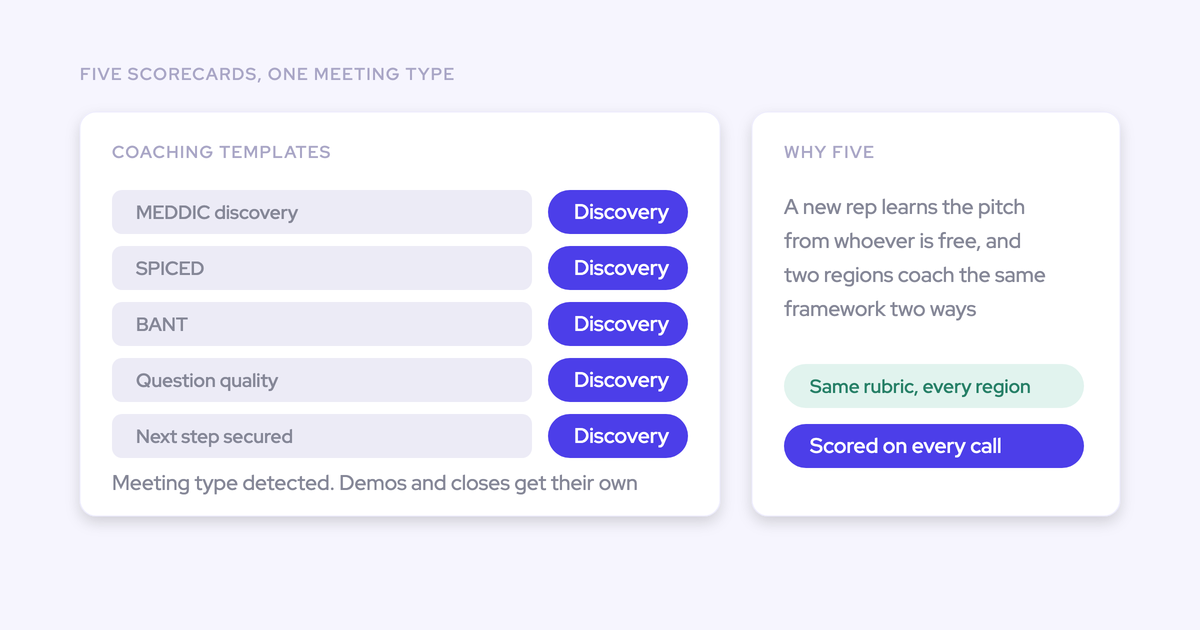
The scorecard is yours to define, not ours. Weflow ships prebuilt templates for MEDDIC, MEDDPICC, SPICED, BANT, Challenger, SPIN, and Command of the Message, and you edit them or write your own.
What you configure per team and per call type:
- The framework and the rubric dimensions the call gets scored on.
- Structured 1 to 5 ratings, or narrative feedback, or a mix.
- Custom prompts, so a discovery call and a renewal conversation aren't judged the same way.
- Which deal stages a given scorecard applies to.
- Whether the scores sync into Salesforce, if you have the corresponding fields set up there.
Only meetings with external participants are scored, and a manager can override any score the AI produced.
Scoring at three levels: call, opportunity, and rep
This is what turns coaching from anecdote into a trend, and it's the part a role-play tool structurally can't give you. Methodology scoring runs at three levels.
| Level | The question it answers |
| Single call | Did this discovery call cover the qualification we train on? |
| Whole opportunity | Is this deal qualified across every conversation on it, or does it just look good on the last call? |
| Rep across months | Where is this seller consistently weak, and are they getting better? |
The rep level is the one managers can't reach today. You see that a seller scores well on metrics and economic buyer and poorly on decision process and champion identification, month after month, across every deal they've worked.
So you coach the specific weakness instead of reviewing calls at random. And you can open the calls behind the score when the rep asks why.
Rep 360 brings a rep's coaching data together
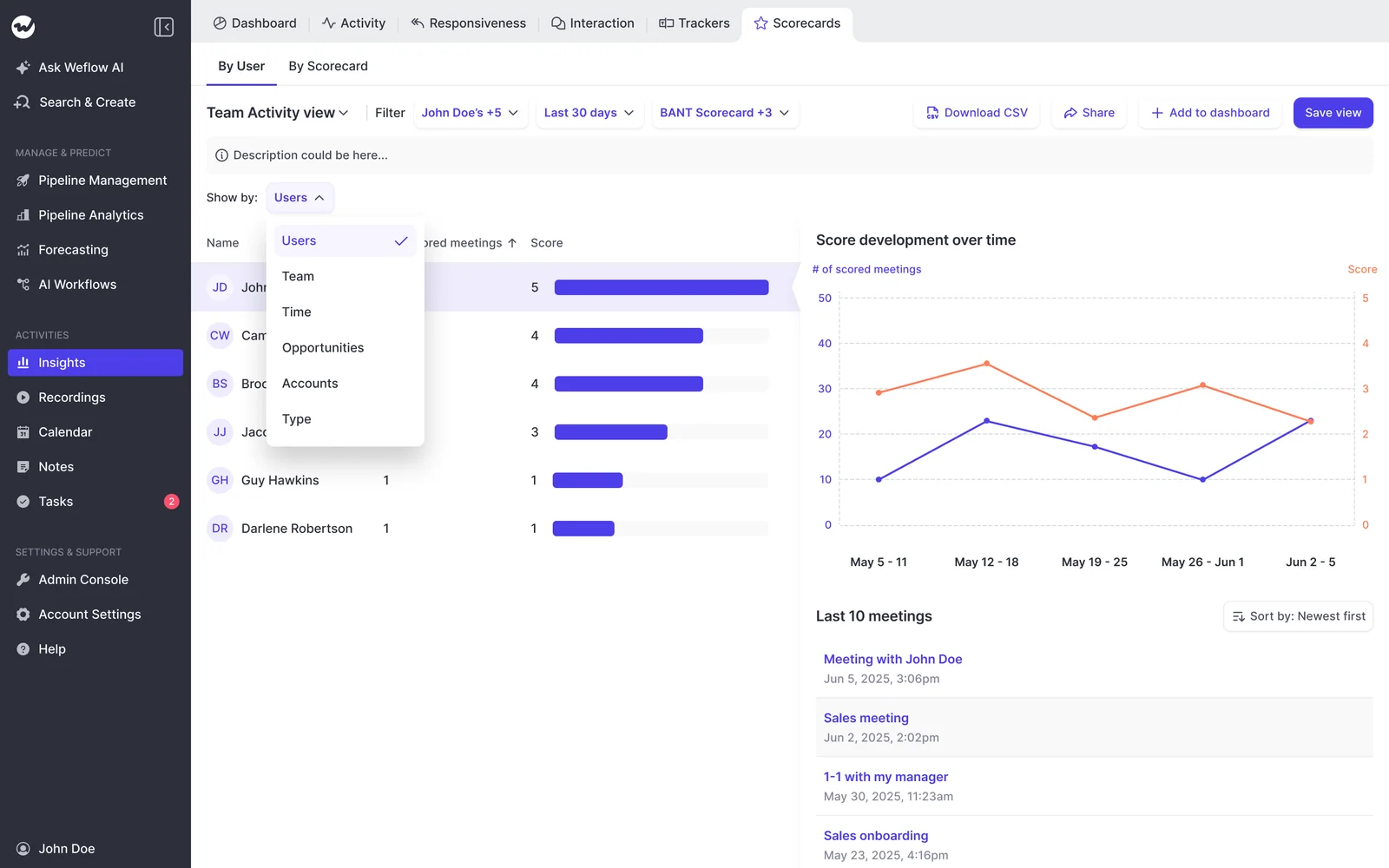
Rep 360 puts one rep's conversation and coaching data in a single view inside Weflow Conversation Intelligence.
That's your 1:1 prep. The scores, the trend, and the calls that produced them are assembled for you, so you walk in with a named gap instead of an impression from the one call you joined last week.
Reinforcement that fits the cadence you already run
The objection that kills most coaching programs isn't philosophical. It's the calendar.
Nobody is against coaching. There's just no room for it, and the development meeting is the first thing cancelled when the quarter tightens, which is exactly when reps need it.
Scored calls don't need a new session. The scoring happens whether you show up or not, so reinforcement rides the 1:1 and the pipeline review you already run.
| Coaching by calendar | Coaching by scorecard | |
| What triggers it | A free hour, or a deal on fire | Every recorded customer call |
| Your prep | Listen to a call, take notes | Open the rep's trend, pick the gap |
| What gets coached | Whatever you happened to hear | The weakness that repeats across deals |
| New meetings needed | One a week, per rep | None |
The move that makes the 1:1 worth having: ask the rep to answer the qualification questions themselves first, then put their answer next to the computed score. When they say the champion is a four and the conversations say two, that gap is the coaching conversation. Automating the scoring shouldn't automate the thinking.
When a dedicated role-play tool is the right buy
Weflow reinforces from real conversations. If you don't have real conversations yet, we're not the answer, and a role-play tool is.
Buy role-play if:
- You're onboarding new hires who have no live calls to score, and week one has to include reps saying the pitch out loud.
- You're launching a new pitch, a new price, or a new product and want it drilled before it's used on a buyer.
- You need volume repetition on a single behavior, the kind a manager would run manually if they had the hours.
Buy scored real calls if:
- Training already happened and nothing changed in live deals.
- You can't tell whether a rep is improving, only whether they're busy.
- Your reps discount enablement advice that isn't tied to what they actually did.
- You need the gap surfaced without listening to a hundred hours of calls.
Two more limits worth having before you decide. Weflow coaches after the call, not during it, so there are no live in-call prompts. And Weflow doesn't score individual sellers on calls where several reps are on the same meeting, which matters if your new hires ramp by riding along.
The two pair well and they don't substitute for each other. Misbuying one for the other is how a training budget produces a hotel bill and no behavior change.
FAQ
Can Weflow score calls recorded in Gong, Salesloft, or Fathom?
Yes. It's one of the first questions we get from teams that already have a recorder.
What are the capabilities of taking our current conversation recordings in salesloft and bringing them into weflow and doing scoring against those?
Weflow imports recordings and transcripts from the conversation intelligence platform you're leaving, pulling them through that platform's API at no extra cost, and it takes roughly one to two weeks depending on volume. Once they're in, they're scored and searchable like anything Weflow recorded itself, so your call history doesn't stop dead at the cutover.
Which Weflow product includes coaching scorecards, and what does it cost?
Coaching scorecards are part of Weflow Conversation Intelligence, at $39 per user per month billed annually, with a ten-user minimum. They're not a separate add-on and there's no metering on AI usage.
Recording lives in Conversation Intelligence too, so activity capture alone won't give you calls to score. If you want emails, meetings, and contacts flowing into Salesforce as well, Revenue AI Foundation pairs Activity & Contact Capture with Conversation Intelligence at $49 per user per month. All of it is published on our pricing page rather than gated behind a demo.
How do I roll out call scoring without it reading as surveillance?
Sequence it feedback-first. The rep gets their own scorecard directly, before any leaderboard exists, so the first thing they experience is help rather than an audit.
Three things that make the difference in practice:
- Only external meetings get scored, so internal conversations stay out of it.
- Keep the rep-level interaction metrics like talk ratio and longest monologue in the manager session, not the launch deck. Those are the numbers that make people go cold.
- Make it a leadership decision and support it with enablement. A pilot where reps have never been recorded before turns into a referendum on being tracked rather than a test of the product.
Can a manager override an AI coaching score?
Yes. A manager can override the score on any call.
That matters more than it sounds. The moment a rep believes a number is unappealable, the scorecard becomes a grade and they start arguing with it instead of working on the gap. You stay the coach; the AI does the reading.
Can coaching scorecards measure new-hire ramp?
Yes, once the new hire is running their own calls. Rep-level scoring across months is what makes ramp measurable: you see the qualification score on their first ten discovery calls, then their next thirty, against the same rubric the rest of the team is scored on.
Before that, there's nothing to read. A new hire in week one has no customer conversations, and calls where they shadow another rep aren't scored per seller. That's the window where rehearsal, not reinforcement, is the right tool.