What Happens to Outreach Kaia Call Recordings When You Leave Outreach
Learn what happens to Outreach Kaia call recordings when you leave Outreach and what you can export.


Your Kaia recordings live in Outreach, not in Salesforce. Kaia synced a summary onto the Salesforce Event and a link that points back into Outreach. When your Outreach access ends, the archive behind those links ends with it.
You can still get the valuable part out:
- Since February 2026, Outreach's public API returns Kaia transcripts with participants and timestamps.
- Kaia Daily Export ships mp4s, transcripts and metadata to your own storage, but only from the day you switch it on.
- Transcripts and their metadata are the asset. Video matters mainly if a team runs a clip library.
Below is an exit plan you can run inside a renewal window. It covers both exits: dropping Kaia while you keep Outreach for sequencing, and leaving Outreach entirely. The last step stops this from happening again. While Outreach is still running, you start recording into an archive you own, such as Weflow Conversation Intelligence + AI Field Updates.
What happens to Kaia recordings when your Outreach contract ends
If you do nothing, you can't reach them once your Outreach access ends. Kaia keeps the video, the transcript and the analysis inside Outreach. Salesforce only ever got a pointer to them.
Kaia's Salesforce sync is a pointer, not a copy.
Here's how the sync works:
- An admin maps the Kaia recording URL to an Event field.
- The admin maps the AI summary to the Event Description, because Salesforce doesn't allow custom Activity fields longer than 255 characters.
- The full transcript never syncs.
- If an admin built the optional Kaia Recording custom object, you also have summaries and metadata there.
The clock comes from Outreach's retention rules. With no retention policy set, Outreach keeps recordings for as long as the subscription runs. Access after the contract ends is less clear.
On one switch call, a buyer reported 60 days of access after the end date.
That's one report, not a published policy. Step 2 below exists to replace it with your own number.
| Asset | Lives in Outreach | Landed in your Salesforce |
|---|---|---|
| Video and audio | Yes. Daily Export can ship mp4s from the day you turn it on | No |
| Full transcript | Yes. The public API returns it since February 2026 | No |
| AI summary | Yes | Yes, in the Event Description, and on the Kaia Recording object if you built it |
| Recording link | The recording it opens lives here | Yes, on an Event field. It opens inside Outreach and needs an Outreach login |
| Topics, sentiment and in-app analytics | Yes. Analysis happens inside Kaia only | No |
| Deal Agent field values | Generated from Kaia conversations | Yes. Values already written to opportunity fields stay in Salesforce |
Credit where it's due on that last row. If you ran Deal Agent, your MEDDPICC, Next Steps and custom field values are already in your opportunities, and they stay there.
Dropping Kaia or leaving Outreach: how your exit plan changes
The Kaia rescue job is the same for both exits. The difference is telephony.
- Dropping only Kaia: Outreach's dialer stays, and another tool can record its calls.
- Leaving Outreach entirely: your phone numbers and dialer go too, so you have to replace and time them.
This matters more than it sounds. Once SDR work is centralized, we see teams keep Outreach seats for only two jobs: activity capture into Salesforce and the phone numbers.
| What changes | Dropping only Kaia | Leaving Outreach entirely |
|---|---|---|
| Dialer and phone numbers | Outreach Voice keeps running | They end with the contract, so you need new telephony |
| Kaia history | Same rescue job, same end date | Same rescue job, same end date |
| What records calls during the overlap | Kaia, or a tool that pulls Outreach dialer calls | The same until cutover, then whatever dialer replaces Outreach Voice |
| Sequencing and activity capture | Unchanged | Both need a new home |
| What the timeline has to include | Kaia export and a recorder cutover date | Kaia export, recorder cutover, telephony selection, phone numbers, sequencing and capture |
If your team loves Kaia's in-Outreach coaching and you're staying on Outreach for sequencing, see the FAQ on keeping Kaia below.
What you need before you export anything from Kaia
Line up access, a destination and the paperwork while the clock is still long. You can work through this list in an afternoon:
- Outreach admin rights. You need them for Daily Export, API apps and retention settings.
- A Salesforce admin. You need one to report on Events and to check whether anyone ever built the Kaia Recording custom object.
- The contract end date. It's the date everything below works backward from.
- The list of Kaia users. Daily Export only covers recordings made by Kaia users.
- A storage destination. Daily Export delivers to an SFTP server, an AWS S3 bucket or an Azure Blob Store that you control.
- An Outreach API app with full scope, including Kaia recordings. This is how transcripts and their metadata come out.
- Your current retention policy status. You need to know if one is on, what it deletes and when.
- The list of teams that read transcripts today. Marketing, CS and execs who never bought Kaia still lose something when it goes.
How to get your Kaia call history out of Outreach
Six steps, ordered by what the contract clock punishes first.
Step 1: Check what Kaia already wrote to Salesforce
Start with what you already own. In Salesforce:
- Report on Events where the Kaia recording link field is populated. Note the count and the date range.
- Open the Description on a handful of those Events. That text is the Kaia summary, and it's yours.
- Check whether a Kaia Recording custom object exists. If it does, report on it. It can hold the AI summary, recording link, primary account, primary opportunity, owner, duration, and whether the recording was a call or a meeting.
Every summary you find is text you keep. Every link you find points back into Outreach.
Step 2: Get your post-contract Kaia access window in writing
Turn a rumor into a deadline. Send these questions to Outreach support or your account executive, and ask for the answers in writing:
- How many days after our end date can we still reach Kaia recordings, transcripts and metadata?
- Which export routes do you support during that window: the public API, Daily Export, or both?
- Does any bulk export cover historical media, or only transcripts and metadata?
- Does anything get deleted on the end date itself, or on a schedule after it?
The 60-day figure comes from one buyer's call. Plan against the number Outreach gives you in writing.
Step 3: Turn on Kaia Daily Export today
Do this first among the export steps. Every day Kaia records without it is a day of media you may not get back.
Daily Export sends each day's Kaia recordings to your own storage as a zip. Each zip holds:
- An mp4
- A text transcript with a timestamp and speaker for every utterance
- A JSON metadata file
To set it up:
- Provision the destination (SFTP, S3 or Azure Blob) and the credentials Outreach will write with.
- If you need encryption, choose SFTP and set up PGP.
- Switch on Daily Export in Outreach and point it at the destination.
- Check the first delivery. It arrives at 1 a.m. Pacific with the previous day's recordings.
What it covers and what it doesn't:
- Forward only. It ships recordings from the day you turn it on. It doesn't backfill your archive.
- Kaia users only. Recordings from anyone without a Kaia seat don't export.
- A 48-hour retry window. If your storage is down, Outreach retries for 48 hours. After that, delivery isn't guaranteed.
- Encryption depends on the destination. SFTP exports can be PGP encrypted. S3 and Azure Blob receive unencrypted files.
As far as we know, Daily Export is the only route for Kaia media.
Step 4: Pull historical Kaia transcripts through the Outreach API
This is where you rescue the asset itself. Since February 2026, Outreach's public API:
- Lists Kaia call and meeting recordings
- Returns structured transcripts with participants and timestamps
- Fires a webhook when a new recording is created
It's the route to your back catalog. Media doesn't come through it.
- Create an Outreach API app with full scope, including Kaia recordings.
- List every Kaia recording across the full date range, not just recent ones.
- Pull the structured transcript for each recording.
- Store each transcript with its metadata in your own storage, next to the Daily Export files.
- Subscribe to the new-recording webhook so nothing recorded between now and cutover slips through.
Keep this metadata with every transcript. You'll need it to re-link calls to Salesforce records later:
- Participants, with names and email addresses where available
- Date and time of the call
- Whether it was a call or a meeting
- The linked account and opportunity. Take them from the Kaia Recording object or the matching Event if you have them.
Step 5: Decide which Kaia history you can afford to lose
Here's the permission nobody gives you: you don't need everything back.
Transcripts plus metadata carry the value, because summaries, field updates and search are all built from them. Historical video matters mainly for clip libraries, like the onboarding clip of a rep handling a pricing objection. Recover it only where a team actually uses one.
| Asset | Priority | Why |
|---|---|---|
| Full transcripts | Secure first | Every future summary, search and AI question runs on them |
| Participants, dates, account and opportunity | Secure first | Without them, transcripts can't be tied back to deals |
| Event summaries and Deal Agent values | Already safe | They're in Salesforce today |
| mp4s from Daily Export | Recover if you can | You get them from switch-on date to end date |
| Historical video before Daily Export | Let go, unless a clip library depends on it | Not through the API, and not historically as far as we know |
| Kaia topics and in-app analytics | Let go | They live inside Kaia and don't export as a dataset |
| Live Event links | Let go | They open inside Outreach, so they stop working when access ends |
Take this table to stakeholders before the end date, not after. "We kept every transcript and lost old video" is an easy conversation to have. "We lost the transcripts" isn't.
Step 6: Move new recordings to an archive in your Salesforce
Every week Kaia stays your recorder, the archive you'll have to rescue gets bigger. Move new recordings to a tool that writes the full transcript into your Salesforce, and start before the contract ends.
Hold any replacement to these criteria:
- The full transcript lands on a Salesforce record, not just a summary and a link.
- Dialer coverage, starting with Outreach Voice while it's still live.
- Re-linking to the right records, so calls attach to the account and opportunity, not just the contact.
- An access path for other teams that doesn't need a login to the recording vendor.
- Retention and deletion controls that you set.
The Weflow section below shows how we meet each one, and where we stop.
Mistakes that cost teams their Kaia history during an exit
Outreach rarely blocks an exit. Most lost history comes from avoidable sequencing errors:
- Switching on a retention policy mid-exit. When you turn on an Outreach retention policy, it deletes older data within up to 30 days, and the deletion is irreversible. Leave retention alone until your export is complete.
- Assuming Daily Export backfills. It ships from the day you turn it on. If you wait until month eleven to switch it on, you only get one month of media.
- Forgetting recordings by non-Kaia users. Daily Export only covers Kaia users. Check who recorded what before you call the export done.
- Letting the export storage go down. Outreach retries for 48 hours, then delivery isn't guaranteed. Monitor the bucket or SFTP server like production infrastructure until cutover.
- Running two bots in one meeting. Outreach tells customers to uninstall other conversation intelligence tools, especially bot-based ones, because Kaia expects to be the only recorder. Two bots means two copies of every recording. Pick a meeting cutover date.
- Leaving Kaia links as the only reference on Events. Those links stop working with your Outreach access. Store the exported transcripts somewhere a person can find them from the deal.
- Double activity sync while both tools write to Salesforce. Two systems logging the same email inflates every activity report, and nobody gets an error. Decide which tool owns which activity before go-live.
I turned the Outreach sync back on and now we are getting duplicates.
How Weflow keeps your next call archive in your Salesforce
Weflow is the Revenue AI Orchestration platform for sales, customer success, and RevOps teams. We built it for Salesforce teams, and everything we capture from conversations is written into Salesforce objects you own.
The question we hear from teams leaving a recorder is always some version of this:
If we say we use your platform but then we decided to move on, would we own those calls?
For transcripts and summaries, yes. For media, here's exactly where it lives.
Weflow records your Outreach dialer calls from day one
Outreach's dialer is an established Weflow connection, and it's available during a trial. You connect your Outreach account on Weflow's Setup and Integrations page. From then on, Weflow pulls calls from Outreach and processes them like any other recording.
Each call arrives with:
- A label marking it as an outbound call, with the name of the person called
- Audio, with speaker separation
- A full transcript
- An AI summary
- AI field updates and coaching
There's no video on dialer calls. In return, the gap stops growing from the first day you evaluate, even while Outreach is still your phone system.
What Weflow writes to Salesforce and what stays in Weflow storage
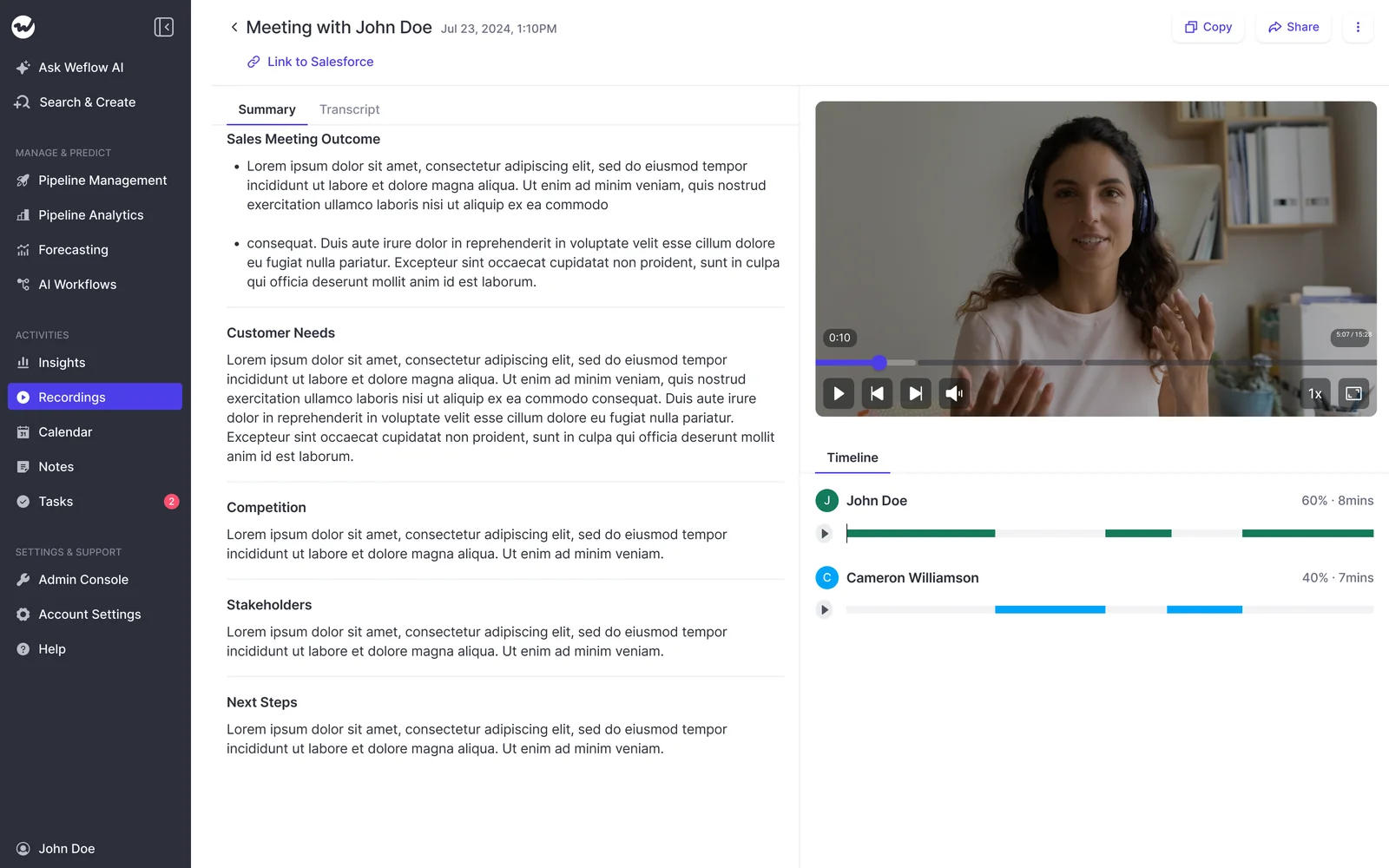
Weflow writes the summary and the full transcript to a recording record in your Salesforce. Because it's a Salesforce record, it's reportable, it follows your permissions, and it survives the end of your Weflow subscription.
Audio and video stay in Weflow storage. We keep them out of Salesforce because storing video there is expensive. They're available through our public API.
| Item | Where it lives | What that means if you leave Weflow |
|---|---|---|
| Full transcript | Your Salesforce, on the recording record | Stays in your Salesforce |
| AI summary | Your Salesforce, on the recording record and the Event | Stays in your Salesforce |
| AI field updates | Your Salesforce, on the fields you mapped | Stays in your Salesforce |
| Recording link on the Event | Your Salesforce, pointing to Weflow | The link stops working. The text around it stays |
| Audio and video | Weflow storage, reachable through the API | You pull it through the API before you go |
"We use the native objects in Salesforce. If you ever stop using Weflow, the data persists. It is your data. That is very, very important in everything we do."
— Janis Zech, Co-founder and CEO of Weflow
That promise covers the Salesforce layer: transcripts, summaries and field values. The media is the one piece you'd move through the API, which is a much smaller job than the one you're doing on Kaia now.
Can Weflow import the Kaia transcripts you export?
Kaia isn't one of the named sources in our migration documentation. Here's how our imports work:
- Gong, Chorus and Jiminny: you share an API key and we handle the import on our end, with no manual export or file upload.
- Other conversation intelligence tools: we import from files exported out of the tool. Our team evaluates the export first.
- Re-linking: imported recordings get re-linked to Salesforce records. Where the provider's API returns the Salesforce association, we use it. Where it doesn't, we run our own lookup service to match recordings to accounts, opportunities and contacts.
For Kaia, that puts you on the exported-files route. The transcripts you pull in Step 4 and the Daily Export files from Step 3 are the input our team evaluates.
We don't promise to import your Kaia audio. Plan on the transcripts and metadata as the migration, and keep the mp4s in your own storage.
Running Weflow next to Outreach without duplicate recordings or activities
You can run both until your end date without polluting Salesforce. You just need to plan two things: who records meetings, and who logs email.
| Overlap risk | How it's handled |
|---|---|
| Outreach dialer calls | Weflow pulls them from Outreach, so no second bot joins those calls |
| Video meetings | Kaia expects to be the only recorder, so you pick a cutover date and move meeting recording to Weflow on that date |
| Emails sent through Outreach | Compatibility mode delays Weflow's sync by about ten seconds, finds Outreach's tracking pattern in the email body, and skips the message so it's written to Salesforce once |
| A custom tracking domain | You add your branded domain to the exclusion patterns. You'll find it in Outreach's admin console under custom domain. Otherwise those emails get logged twice |
| After Outreach is switched off | Compatibility mode is no longer needed, which is the cleaner end state |
How marketing, CS and execs keep reaching call transcripts
Kaia recordings need an Outreach login, so the people who never bought the tool depend on someone forwarding links. Weflow gives each of those teams its own path:
- Salesforce records. Anyone with the right Salesforce permissions reads the summary and full transcript on the recording record, next to the opportunity.
- Unlimited view-only licenses. Marketing, CS, product and leadership can review recordings, summaries and transcripts in Weflow without taking a paid seat.
- The public API. Your data team can pull recordings, transcripts and AI playbook output, each tied to the Salesforce object it was matched to.
- The read-only MCP connector. Execs who already point Claude or ChatGPT at revenue data can query call summaries, transcripts, playbooks and forecast calls. An admin switches the connector on per workspace. A separate toggle decides whether assistants see full transcripts or only AI summaries.
What Weflow Conversation Intelligence + AI Field Updates costs
Weflow Conversation Intelligence costs $39 per user per month, billed annually. AI Field Updates are part of the same seat.
| Item | What you get |
|---|---|
| Price | $39 per user per month, billed annually, 10-user minimum |
| Recording and transcription | Unlimited recordings and transcripts, with no usage-based charges |
| AI Field Updates | Salesforce fields filled from call content, in review or automatic mode |
| Ask Weflow AI Pro | Included |
| Agent Builder | Free tier, with 25 agent actions per month |
| Weflow Mobile Copilot | Included, for recording in-person meetings |
| Desktop app | Included, with no separate license |
| View-only licenses | Unlimited |
| Trial | 14 days, with guided onboarding |
If you're leaving Outreach entirely, you also lose its activity capture. Revenue AI Foundation adds Weflow Activity & Contact Capture to Conversation Intelligence for $49 per user per month.
For comparison, Outreach publishes no prices. Every package is quote-only and combines seat licenses with AI credits that each action draws down.
The honest limit: Weflow has no dialer and no sequencing. If you drop Outreach entirely, you'll still need telephony and a sequencer alongside us.
See how Weflow captures activity, updates Salesforce fields from calls, and rolls up your forecast. Book a 30-minute demo.
Questions RevOps teams ask before leaving Outreach Kaia
How long can we access Kaia data after our Outreach contract ends?
Outreach doesn't publish a post-contract window. One buyer reported 60 days on a switch call, but that's one report, not a policy.
With no retention policy set, Outreach keeps recordings for as long as the subscription runs. Get your exact window from Outreach in writing and plan the export against it.
Does Kaia Daily Export include recordings made before we turned it on?
No. Daily Export ships the previous day's recordings each night from the day you switch it on, and it doesn't backfill.
For historical transcripts, use the Outreach public API, which lists Kaia recordings and returns structured transcripts.
What happens to Kaia links on Salesforce Events after we leave?
They stop being useful. The links open recordings inside Outreach and need an Outreach login.
The summary text Kaia wrote to the Event Description stays in Salesforce, and so do any Deal Agent values written to your opportunities.
Will migrated and new calls map to the right Salesforce opportunities?
For imported recordings, Weflow uses the provider's Salesforce association where its API returns one. Where it doesn't, we run our own lookup service to match recordings to accounts, opportunities and contacts.
New calls recorded in Weflow are matched to Salesforce records as they're captured.
If we leave Outreach entirely, what records our phone calls?
Weflow doesn't have a dialer, so you'll need new telephony. Weflow records calls from dialers it's connected to, and Outreach's dialer is one of them.
Connecting a new dialer we don't have an established integration for takes our team hours to days of setup. We schedule that into implementation, and it isn't offered during a trial.
Should we keep Kaia if we stay on Outreach for sequencing?
If your team relies on Kaia's in-Outreach coaching, keeping it can be the right call. That includes topic tracking by sales stage, real-time content cards during calls, and playlists.
Your job then is different. Turn on Daily Export now and pull transcripts through the API on a schedule, so the archive doesn't live only inside Outreach.
How do we fit a Kaia exit into our renewal window?
Work backward from the end date in this order:
- Inventory Salesforce and get the access window in writing.
- Turn on Daily Export.
- Pull transcripts through the API.
- Run the new recorder alongside Outreach until a set cutover date.
On the Weflow side, technical setup takes 30 to 45 minutes with a Salesforce admin and a Google Workspace or Microsoft admin. Full time-to-value takes one to three weeks, including template setup and team rollout.
Which security certifications and data regions does Weflow offer?
Weflow is SOC 2 Type II certified and GDPR compliant. We run Zero Data Retention for AI processing, and we never use customer data to train AI models. ISO 27001 is in progress, not yet certified. Outreach does hold ISO 27001.
Weflow stores data in Frankfurt, New York or Sydney. Your instance defaults to the region where your Salesforce is hosted, and you can override that. Outreach hosts on AWS in the US or in Dublin, chosen at sign-up.
Can we set retention and deletion rules on Weflow recordings?
Yes. By default, Weflow keeps recordings for as long as you subscribe, with no storage cap under fair use.
You can also have all recordings deleted after a set period, for example every 30 days. Some customers use this as a data security control.