Conversation intelligence data portability: 5 tests before you sign
Learn 5 tests to verify conversation intelligence data portability before signing with Gong or Weflow.


Legal ownership doesn’t prove you can leave a conversation intelligence vendor with usable data. Before you sign, make every shortlisted vendor demonstrate an exit: retrieve the recordings and transcripts, preserve their Salesforce relationships, and use the results without opening the vendor’s interface.
The archive usually has more owners than the sales team realizes. Marketing reads transcripts for buyer intent. Customer success needs the promises made during discovery. Product wants the original feature request. At renewal, your job is to preserve those workflows along with the files.
We’d make that exit test a purchase requirement. A successful recording demo tells you little about what happens when the subscription ends.
Weflow is the Revenue AI Orchestration platform for sales, customer success, and RevOps teams. Built for Salesforce teams, Weflow writes transcripts, summaries, and structured conversation outputs into Salesforce. That supports downstream work such as Weflow’s deal hygiene workflow, while reducing dependence on a separate conversation archive.
But hosted video needs its own exit path. Apply the same test to Weflow that you apply to Gong.
Prepare your call-data exit test
Use the same sample, destinations, and acceptance criteria for every vendor. Otherwise, you’ll compare one vendor’s prepared demo with another vendor’s hardest migration case.
- Test data: Select recent and historical conversations, multiple speakers, saved calls, clips, scorecards, and calls with ambiguous Salesforce associations. Include examples that marketing and customer success already use.
- Permissions: Arrange approved admin and API access. Include a restricted user so you can test what ordinary users can retrieve.
- Destinations: Name the Salesforce sandbox, customer-controlled storage, warehouse, and approved AI environment you’ll use.
- Stakeholders: Assign a RevOps owner, Salesforce admin, security reviewer, and legal reviewer. Give each downstream workflow an owner too.
- Documentation: Request the data dictionary, API documentation, export instructions, retention policy, deletion policy, and proposed contract terms.
- Acceptance criteria: Define required assets, acceptable mapping exceptions, migration deadlines, and costs before testing. Mark non-negotiable requirements separately from preferences.
A conversation intelligence exit test passes on evidence you can reproduce, not on a vendor’s statement that an integration exists.
1. Map where every call-data asset lives
Map each asset separately because recordings, transcripts, and structured fields can follow different storage and retention rules.
Ask the vendor to complete this inventory for your proposed configuration. Name the actual system and object or storage location. A Salesforce link to a recording isn’t a Salesforce-held recording.
| Asset | Canonical location | Duplicates or links | Storage and processing regions | Permissions | Retention | Evidence required |
|---|---|---|---|---|---|---|
| Video and audio | Identify each media store | Separate playable files from URLs | Document storage and processing separately | Playback and download access | Active and saved-media rules | Stored file and architecture record |
| Full transcript | Name the object or repository | Identify CRM and vendor copies | Include transcription processing | Read and export access | Deletion dependencies | Full text retrieved outside the interface |
| Summary | Name the stored record | Identify posted or synchronized copies | Include AI processing | Record and field access | Independent or call-linked rules | Record contents and schema |
| Clips and playlists | Identify files versus references | List shared destinations | Include copied media | Internal and external access | Saved-content exceptions | Clip file or reconstructable boundaries |
| Scorecards and annotations | Name the result store | Identify exports and shared copies | Include analysis processing | Interface versus export visibility | Call-linked or separate rules | Result, rubric, and access settings |
| Structured CRM fields | Name Salesforce objects and fields | Identify vendor-side values | Document processing locations | Object and field permissions | Customer and vendor responsibilities | Salesforce record and field mapping |
Pass: Every required asset has a named location, an access owner, and a lifecycle. Fail: The answer groups everything under customer data without distinguishing files from links.
2. Prove raw recordings and transcripts export at scale
Run an export large enough to expose pagination, download limits, and support dependencies. Downloading one call proves only that you can download one call.
- Request the retrieval paths. Ask for bulk-export instructions and the exact API endpoints for raw media and transcripts. Record which paths require support or additional permissions.
- Export your selected cohort. Include historical and saved calls. Keep a source manifest listing the expected assets and identifiers.
- Inspect the output. Open media files outside the vendor’s player. Read the transcript files and confirm they contain the full conversation rather than a summary.
- Exercise the limits. Test pagination, interrupted transfers, retries, and download-link expiration. Record missing or duplicate results.
- Measure the work. Log elapsed time, operator effort, support wait time, and charges. Ask the vendor to explain how retrieval changes at your archive’s full size.
Raw conversation export must produce reusable source material. An API response containing generated insights doesn’t satisfy a raw-transcript requirement.
- Pass: Your team retrieves the agreed assets, reconciles the manifest, and documents a feasible full-archive retrieval path.
- Fail: Required files are missing, links expire before retrieval completes, or the export depends on unspecified assistance.
- Keep unresolved: Any untested claim about archive-wide volume, throughput, export fees, or API entitlements.
3. Verify structure and Salesforce relationships survive
An export is migration-ready only if you can reconnect the conversation to the correct people and Salesforce records.
A folder of playable videos can still leave your CSM unable to find the customer’s implementation commitments. Preserve the context that makes the archive useful.
| Source attribute | Required exported attribute | Destination mapping | Reconciliation check |
|---|---|---|---|
| Conversation identity | Stable source ID, title, date, duration | Destination conversation ID | Match each source conversation once |
| Speaker structure | Speaker labels and available participant identifiers | Speaker and participant records | Confirm who said each selected passage |
| Transcript timing | Available segment timestamps and ordering | Transcript segments | Locate the same moment in the media |
| Salesforce associations | Available Account, Opportunity, Contact, Lead, and activity IDs | Corresponding destination relationships | Compare against known source associations |
| Clips and annotations | Parent call ID, boundaries, labels, comments | Clip or annotation records | Reconstruct the selected example |
| Structured outputs | Field names, values, and available source references | Salesforce fields or warehouse columns | Compare values and trace them to the call |
- Test ambiguity: Include an account with several opportunities and a participant without a clear CRM match.
- Test history: Include closed opportunities and records whose owners have changed.
- Test repeatability: Import the same batch again in a controlled environment and check for duplicate conversations or activities.
Pass: Required relationships survive, and an exception report identifies anything your team must resolve. Fail: The destination silently guesses at associations or creates duplicates.
4. Verify post-termination access and deletion
Get an asset-level timeline for cancellation, retrieval, and deletion. Active-subscription retention doesn’t tell you what happens after the contract ends.
| Lifecycle point | What the vendor must define | Evidence |
|---|---|---|
| During the subscription | Retention by asset and configurable exceptions | Current policy and workspace settings |
| Contract end | Which logins, APIs, exports, and playback paths stop | Contract language |
| Retrieval window | Accessible assets, authorized people, fees, and assistance | Exit schedule and support commitment |
| Primary deletion | Trigger, timing, and treatment of derived artifacts | Deletion procedure |
| Backup expiration | Backup lifecycle and restrictions on restored data | Backup policy |
| Exception paths | Saved calls, legal holds, and customer-controlled copies | Documented exception handling |
Require complete statements your legal team can review:
- The agreement identifies when the retrieval window starts and ends.
- The agreement names every asset available during that window.
- The vendor explains whether deletion of a call also deletes transcripts, summaries, clips, and scorecards.
- The vendor identifies which copies your organization must delete separately.
- The vendor explains whether saved content or legal holds override ordinary retention.
- The vendor distinguishes subscription cancellation, integration disconnection, and Salesforce package removal.
Pass: The retrieval window accommodates your tested migration, and the agreement defines deletion responsibilities. Fail: Access can end before your team finishes the agreed export.
5. Test CRM, warehouse, and AI access
Make each destination retrieve the data it needs through its intended production access path. A working chatbot demo doesn’t prove warehouse access or raw-data portability.
| Access path | Data to request | Raw or generated | Read/write scope | Permission test | Limits and cost | Proof |
|---|---|---|---|---|---|---|
| Salesforce | Transcript, summary, structured fields | Classify each field | Querying versus editing | Admin and restricted-user access | Storage, API, and license dependencies | Actual record contents |
| Warehouse or storage | Archive files, metadata, relationships | Require source data where needed | Extract and destination write | Service-account scope | Batch limits, connector fees, export charges | Loaded files and reconciled tables |
| External AI through API | Full transcript and source identifiers | Distinguish text from summaries | Document permitted operations | Credential and downstream access scope | Rate limits and usage charges | Saved request and response |
| External AI through MCP | Exact outputs of available tools | Inspect returned content | Read-only or write-enabled | User versus organization authorization | Request limits and credits | Tool response and consent scope |
Read-only access can fully satisfy a portability requirement. The deciding question is whether the access path returns the source data your workflow needs.
Permissions need separate testing after export. Don’t assume a file in your warehouse inherits the restrictions that protected its source recording.
Pass: Approved users and systems retrieve the required data, while restricted users remain blocked. Fail: Your workflow requires raw transcripts but the tested path returns only generated answers.
Score each vendor’s call-data exit risk
Score demonstrated behavior separately from documentation and contractual promises. An unanswered requirement must stay visible.
Use these result labels:
- Pass: Your team reproduced the required behavior.
- Conditional: The behavior works, but a defined configuration change or contract commitment remains.
- Unresolved: Evidence is missing or the test hasn’t run.
- Fail: The tested behavior doesn’t meet the requirement.
| Test and requirement | Evidence supplied | Result | Risk level | Remediation | Owner | Required contract commitment |
|---|---|---|---|---|---|---|
| Asset locations are explicit | Attach completed inventory | Record result | Assess missing assets | Resolve storage gaps | Vendor and security | Define data scope |
| Raw archive is retrievable | Attach export and logs | Record result | Assess retrieval blockers | Retest limits or missing files | RevOps and vendor | Guarantee method, timing, and fees |
| Salesforce relationships survive | Attach reconciliation report | Record result | Assess workflow disruption | Resolve mapping exceptions | Salesforce admin | Define metadata and migration support |
| Exit access supports migration | Attach lifecycle terms | Record result | Assess access-loss risk | Negotiate retrieval window | Legal and procurement | Define access and deletion timeline |
| Customer systems can use the data | Attach queries and responses | Record result | Assess dependencies and exposure | Fix access paths or permissions | Data owner and security | Define entitlements and restrictions |
Set hard-fail gates before assigning weights to preferences. A vendor shouldn’t compensate for an unusable transcript export by scoring well on less important requirements.
Apply the exit test to Gong and Weflow
Weflow’s Salesforce-held transcripts and summaries reduce dependence on Weflow’s interface. Gong’s generated-insight MCP path serves a different purpose from raw archive retrieval.
Neither distinction proves that an entire migration will pass. The table separates supported capabilities from the work your evaluation still needs.
| Exit test | Gong | Weflow | Evidence status |
|---|---|---|---|
| Map asset locations | Gong maps captured email and meeting activity into its own data structure. That activity mapping isn’t proof of Salesforce-held conversation assets. | Weflow writes full transcripts and summaries to a managed-package recording object in Salesforce. Weflow hosts video separately and streams it back. | Supported architecture; complete the inventory for your configuration. |
| Export raw data at scale | Gong’s MCP server doesn’t return raw transcripts. Test Gong’s separate API and export paths for archive retrieval. | Weflow provides API access to conversation data. Bulk-export scope, formats, throughput, and hosted-media retrieval still need confirmation. | API or MCP availability alone doesn’t establish a bulk-export pass. |
| Preserve relationships | Inspect exported Salesforce IDs and metadata rather than inferring portability from Gong’s interface. | Weflow can import historical recordings through provider APIs and use available Salesforce associations. When associations aren’t available, Weflow uses its lookup service. | Weflow migration capability supported; mapping fidelity requires buyer testing. |
| Confirm retention and exit access | Gong retains calls and related artifacts for up to three years by default. Library calls have an indefinite-retention exception. Post-termination access needs separate contractual confirmation. | Salesforce-held conversation records persist when you stop using Weflow. Hosted video requires separate retrieval and retention terms. Package removal needs its own review. | Retention and persistence supported; termination mechanics remain contract-dependent. |
| Use CRM, warehouse, and AI paths | Gong’s MCP server returns generated insights and is read-only. Programmatic AI access can consume Gong credits. | Weflow offers Salesforce-held conversation records and API access for external analysis. The Weflow MCP consent screen specifies read-only access. | Access types supported; test payloads, permissions, limits, and entitlements. |
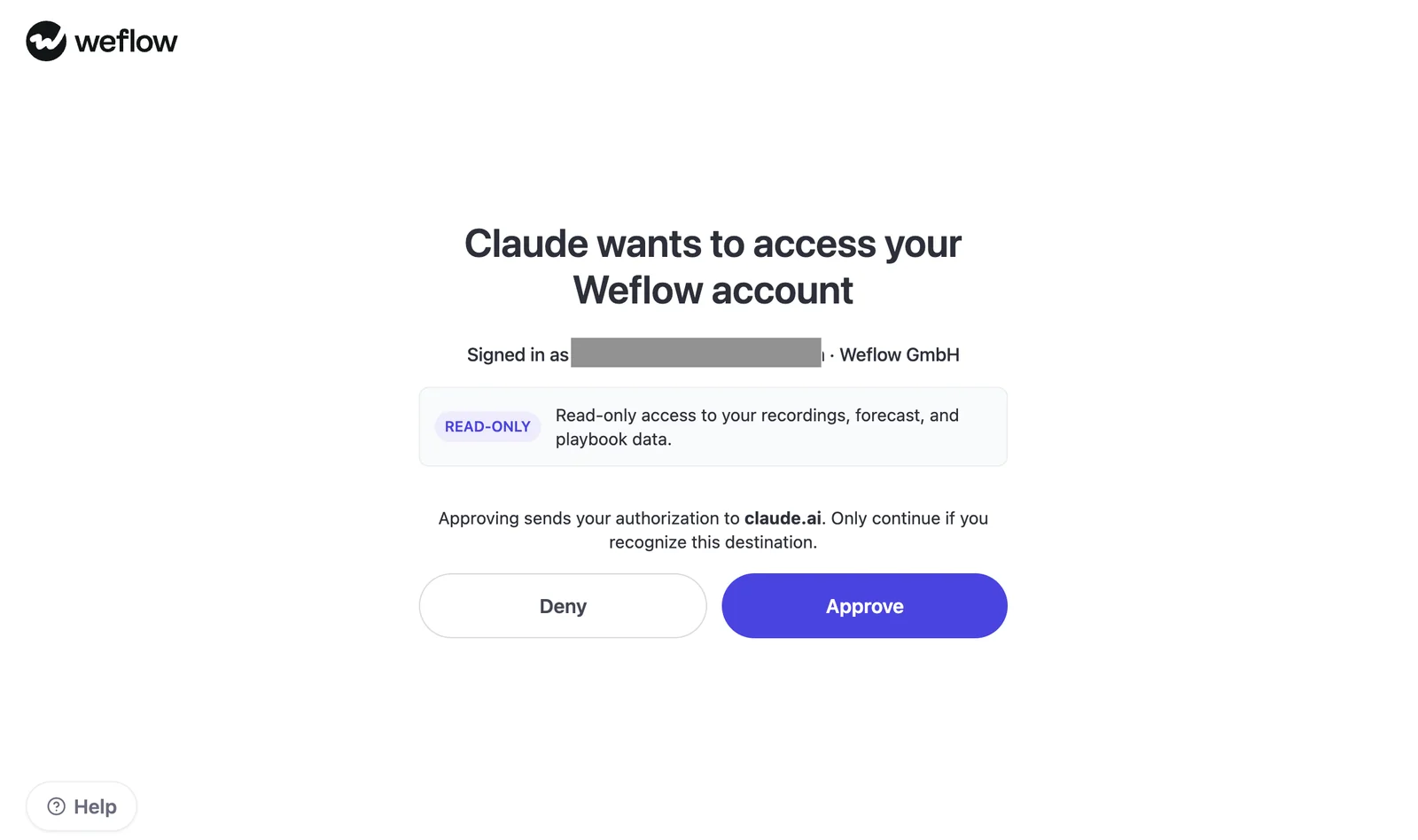
Weflow’s MCP authorization screen explicitly labels access as read-only. Check that scope before connecting an assistant, then inspect the returned data.
Gong has deep conversation analytics and a strong formal compliance portfolio. Portability concerns don’t make Gong a weak security vendor.
Weflow works exclusively with Salesforce. We don’t offer Gong’s depth of conversation analytics, and Weflow doesn’t provide live in-meeting assistance or sales engagement functionality. If those requirements outweigh CRM-held conversation data, Gong may remain the better fit.
Run an export-and-reimport drill during the POC
Follow the same conversations from source to destination during the proof of concept. The final test is whether people can still do their work without the source vendor’s interface.
- Freeze the test manifest. Record source conversation IDs, expected assets, known Salesforce associations, and authorized users.
- Run the export. Use the proposed production method. Save requests, responses, support steps, and timing.
- Inspect integrity. Compare counts and identifiers. Open media, read transcripts, and check selected speaker turns and timestamps.
- Import into the destination. Use a sandbox or approved test environment. Preserve source IDs for reconciliation.
- Reconcile Salesforce relationships. Compare actual associations with expected Account, Opportunity, Contact, and activity records. Investigate account-level fallbacks.
- Validate permissions. Test an authorized user and a restricted user across the destination, exports, and AI access.
- Repeat interrupted work. Retry a failed batch and check that the import doesn’t create duplicate records.
- Test downstream workflows. Ask customer success to find a sales commitment and marketing to retrieve the original buyer explanation without opening the source portal.
- Review exceptions and sign off. Record elapsed time, manual effort, costs, unresolved mappings, and who owns each fix.
Weflow can migrate Gong recordings through Gong’s API, but your POC should still prove the associations and access paths your teams depend on. Migration capability isn’t a guarantee that every historical record will match cleanly.
Put call-data portability promises in the contract
Turn the demonstrated exit path into written commitments before procurement closes the agreement. A successful POC doesn’t guarantee the same access at termination.
- Access: Name the customer’s rights to retrieve and reuse raw recordings, transcripts, metadata, and derived outputs.
- Export: Specify required formats, identifiers, relationships, retrieval methods, and delivery destinations.
- Fees: Identify API, export, storage-transfer, support, and migration charges. Don’t leave exit assistance priced later.
- Service levels: Define request acknowledgment, delivery timing, escalation, and responsibility for failed retrievals.
- Termination: State which accounts and access methods remain available, for how long, and with what restrictions.
- Deletion: Define triggers, asset scope, derived-data handling, and confirmation of completion.
- Backups and exceptions: Document backup expiration, restored-data handling, legal holds, and saved-content exceptions.
- Migration support: Assign responsibility for missing files, ambiguous mappings, retries, and reconciliation.
- Precedence: Have legal resolve conflicts between the agreement, order form, data-processing terms, and changeable online documentation.
Use this checklist for legal review, not as substitute contract language. The commitment should describe an executable exit, not merely repeat that the customer owns its data.
Avoid these call-data portability testing mistakes
The biggest false positive is an export that looks complete until someone tries to use it.
- Accepting ownership language as proof hides retrieval barriers. Require actual files, records, or API responses.
- Testing only one recent call conceals archive-scale limits. Include historical content and exercise pagination and retries.
- Treating an MCP answer as a transcript confuses generated interpretation with source evidence. Inspect the payload and test raw-data access separately.
- Ignoring Salesforce relationships creates disconnected files. Reconcile identifiers and associations after import.
- Omitting hosted video leaves part of the archive vendor-dependent. Test media retrieval independently from Salesforce-held text.
- Assuming interface privacy carries into exports can expose restricted content. Test export permissions and destination access controls explicitly.
- Equating cancellation with package removal overstates persistence. Review both operations and protect Salesforce-held records before changing the package.
- Counting unresolved answers as passes hides work from procurement. Assign an owner, deadline, and required commitment to every open item.
Frequently asked questions
Keep ownership, access, retention, and deletion separate in your evaluation. Each answers a different part of the exit question.
Is data ownership the same as data portability?
No. Data ownership concerns legal rights. Data portability concerns whether you can retrieve data in a usable form, preserve its context, and reuse it elsewhere.
The practical test: can your team retrieve a conversation and reconnect it to the correct Salesforce records without relying on the original vendor’s interface?
Does Gong’s MCP server return raw call transcripts?
No. Gong’s MCP server returns AI-generated insights rather than raw transcripts, message bodies, or activity lists. Gong’s MCP server is read-only and excludes private calls from results.
That limitation applies to the MCP path. Test Gong’s separate APIs and export options before drawing conclusions about raw archive retrieval.
How long does Gong retain call data?
Gong retains recorded calls and related artifacts, including transcripts and statistics, for up to three years by default. Calls in Gong’s library are exempt from that policy and remain indefinitely.
Gong lets team members add selected calls to the library in bulk. Include saved calls in your retention review because library membership changes their treatment.

Confirm your workspace settings and contract separately. Ordinary retention doesn’t establish post-termination access or deletion timing.
What Weflow call data remains in Salesforce?
Weflow writes full transcripts and summaries to a managed-package recording object in the customer’s Salesforce. Those Salesforce records persist when the customer stops using Weflow.
- Salesforce-resident: Full transcripts, summaries, and structured values that AI Field Updates write to configured Salesforce fields.
- Vendor-hosted: Weflow video recordings remain outside Salesforce.
- Configuration-dependent: Field destinations and access depend on your mapping and permissions. Confirm package-removal consequences separately from cancellation.
Are Weflow video recordings stored in Salesforce?
No. Weflow hosts video recordings outside Salesforce and streams them back. Transcripts, summaries, and configured structured field outputs follow a separate Salesforce storage path.
Ask Weflow to demonstrate hosted-media retrieval and define video access after termination. Transcript persistence doesn’t guarantee continued video playback.
Can Weflow migrate historical Gong recordings?
Yes. Weflow can import historical Gong recordings through Gong’s API and associate them with Salesforce records.
- You provide approved API access to the current provider.
- Weflow handles the import and uses Salesforce associations from the provider’s API where available.
- When the API doesn’t provide those associations, Weflow uses its lookup service to match recordings to Salesforce records.
During the POC, validate missing recordings, ambiguous matches, historical opportunity associations, and responsibility for failed imports. If API access isn’t available, Weflow must evaluate a raw-file export before confirming that route.
What should post-termination access terms cover?
Post-termination terms should define a complete retrieval window and what happens to every remaining copy afterward.
- Accessible assets, formats, metadata, and relationships.
- Authorized users, credentials, retrieval methods, and access deadlines.
- Export fees, support availability, delivery commitments, and escalation.
- Deletion triggers, backups, saved-content exceptions, and legal holds.
- Customer responsibilities for downstream copies and evidence of completion.
Have legal review the terms against your measured exit drill. Don’t sign with a required export path still marked unresolved.
See how Weflow captures activity, updates Salesforce fields from calls, and rolls up your forecast. Book a 30-minute demo.