Best InsightSquared (Mediafly Intelligence) Alternatives for Forecasting and Pipeline Analytics (2026)
Compare InsightSquared alternatives for roll-up forecasting, quota tracking, and pipeline coverage.


If you're coming up on an InsightSquared renewal, here's the good news: it still works. Mediafly owns it, runs it as Mediafly Intelligence, and still supports existing customers.
What's changed is where the vendor is headed. Mediafly now sells content, value and learning products, and forecasting doesn't appear on any of its current product pages.
That makes your renewal less about features and more about direction. Will your vendor keep investing in your forecast? Can your forecast data leave the tool? Does the roll-up fit the hierarchy you actually forecast on?
Short on time? Here's where each option fits:
- Weflow: Salesforce teams that want deal-backed roll-ups, an AI forecast range within days, API and MCP access to forecast data, and per-seat prices you can see.
- Clari: Large enterprises that need mature roll-ups and the CRO top-down view.
- Aviso: AI-forecast-led enterprises running several CRMs, including consumption revenue.
- Gong Forecast: Teams already paying for Gong Foundation.
- Stay on InsightSquared: It works, the renewal is cheap, nobody needs the data outside it, or you run HubSpot, SAP C4C or SugarCRM.
Weflow is the Revenue AI Orchestration platform for sales, customer success, and RevOps teams. We built it for Salesforce teams, and it works only with Salesforce.
If Salesforce is your CRM, Weflow Deal Intelligence and Forecasting is the product we compare below. If you're on another CRM, feel free to skip us and jump to the Aviso and “stay” sections.
Is InsightSquared still supported now that Mediafly owns it?
Yes. Mediafly documents Intelligence and Coach, patches both in its monthly change logs, and lists both on its status page. It just doesn't market them anymore.
Here's how the product got here:
- January 2022: Mediafly buys InsightSquared and sells it as Intelligence360 inside its Revenue360 suite. The same year it buys ExecVision, which becomes Mediafly Coach.
- January 24, 2023: Mediafly retires the standalone InsightSquared Sales Analytics product.
- Today: The product runs as Mediafly Intelligence, and the app still lives at app.insightsquared.com.
- Today: Mediafly's lineup is Engagement, Value, and Learning & Coaching. The old Intelligence360 page redirects to Engagement.
In practice, "Supported but unmarketed" means the tool keeps running and keeps getting fixes. What you can't get is a roadmap to show your CRO.
So at renewal, you're really buying another year of a product its owner is investing in less. That's a fine trade for some teams.
That can be a fine trade for some teams, but not if your CRO is about to ask about your AI strategy.
What InsightSquared still does well, and what you'd rebuild
To be fair, InsightSquared's core is good. That's why the best way to judge any alternative is against the views your leadership opens every week, not a feature grid.
InsightSquared's forecasting and pipeline analytics you'll want to keep
Here's what you'd need to rebuild in any other tool:
- Forecast Submission: Reps submit monthly or quarterly numbers by forecast type and segment, managers review and override them as they roll up, and every change is kept.
- AI prediction beside the team call: The CRO Forecast Review dashboard puts an AI-predicted quarter, by forecast category, next to the team's submitted forecast and the CRM weighted pipeline.
- The Flow waterfall: A pipeline waterfall between any two dates, with bars for created, won, lost, pulled-in, pushed, increased and decreased pipeline. Each bar opens the deals behind it.
- Historic reporting: Intelligence rebuilds what every record looked like on any past day from field change history, so you can report pipeline as of any date.
- 350+ prebuilt reports and the accuracy dashboard: Ready dashboards for forecast reviews, pipeline one-to-ones, win-loss and rep performance, plus a Forecast Accuracy dashboard that trends each rep's error over twelve months.
InsightSquared's integrations and the CRMs it covers
InsightSquared also reaches more CRMs than most of its alternatives. It reads Salesforce, syncs both ways with HubSpot, and also connects to SAP Sales Cloud (C4C) and SugarCRM.
Email and calendar capture runs centrally through a Google Workspace or Microsoft 365 service account, with no rep login. Coach imports calls from more than 30 call and CRM systems.
If you're on HubSpot, SAP C4C or SugarCRM, your field shrinks fast. Weflow is out, and Aviso is the main alternative here that covers SAP.
Why RevOps teams start looking for an InsightSquared replacement
Teams rarely leave InsightSquared because it's bad. They usually leave over vendor direction, trapped data and setup friction.
Mediafly no longer sells forecasting as a product
Right now, Mediafly's AI investment goes to its content products: Command Center, an assistant for the sales content library, and Command MCP. Inside Intelligence, AI is limited to report summaries and automated actions.
It's a familiar pattern of a good core with a frozen roadmap. Nothing is broken, but you can't tell your CRO whether the product will get any better.
Your InsightSquared forecast data can't reach an API or assistant
Mediafly Intelligence has no public API for its reporting data, so the only ways out are CSV exports, scheduled dashboard emails or fields written back to the CRM.
Its Command MCP (still in beta) only exposes Value Toolbuilder business cases, so no assistant can query your forecast or pipeline through it.
That's a real problem when the AI strategy question comes up. Your forecast is the number leadership cares about most, and it's the one number no AI tool can read.
One integration user and a support ticket run your setup
Intelligence syncs each CRM through a single user's connection, which means the sync stops for everyone when:
- That user's token expires, and only they can re-authorize it
- The Intelligence API cap is reached
- Salesforce API usage passes 95 percent
Any change to the machine learning models also means a support ticket through your Mediafly CSM. Even the models' accuracy report, with each feature's weight, has to be requested from the CSM instead of viewed in the product.
Mediafly team hierarchies don't fit how you forecast
Mediafly's own documentation admits its team hierarchies don't work for forecasting, so the team structure you'd build in Mediafly isn't the one Forecast Submission rolls up.
That matters because a roll-up only helps if it matches how leadership reads the number. If your CRO thinks in new logo versus customer base, or in regions that cut across managers, the roll-up has to show those lines.
You can't see the price or choose where data lives
At renewal, two procurement blockers tend to show up:
- No price to benchmark: Mediafly publishes no prices and quotes by modules, user count and integrations. InsightSquared's old pricing link now leads to Mediafly's contact form.
- US-only hosting: Intelligence is hosted in AWS US-East (Ohio), and Mediafly processes reporting data and AI features in the US whatever the hosting region. EU hosting exists only for the Engagement product.
The five questions we'd ask any InsightSquared alternative
At this stage, feature counts tell you very little. Instead, score vendors on direction, data access, hierarchy fit, continuity and adoption.
Is forecasting the vendor's core business?
This is the roadmap test, and it's the reason you're looking in the first place. Check the vendor's current product pages: is forecasting there, and is it priced as its own product or tucked into a bundle as an afterthought?
Keep in mind that any acquired suite can repeat the Mediafly pattern. Clari, for example, is now sold under the Salesloft brand, so it's fair to ask Clari the same roadmap question.
Can your forecast data leave through an API or AI assistant?
This is the ownership test. Forecast data you can't reach outside a vendor's cloud is data you don't own.
On the call, ask three things:
- Is there a REST API or bulk export path for forecast and pipeline data?
- Does the MCP connector return forecast calls and pipeline metrics, or only call insights?
- Is MCP access metered?
Does the roll-up follow your real hierarchy, not the role tree?
This is the structure test. Ask the vendor to build your actual forecast hierarchy live:
- Can you build a custom hierarchy outside the Salesforce role tree?
- Can one person sit in several teams?
- Do sub-totals work without placeholder users?
- Do managers submit their own independent call, or only edit the roll-up?
Can you rebuild the waterfall, forecast review and accuracy view?
This is the continuity test. Name the three views leadership opens weekly (the Flow waterfall, the CRO Forecast Review and the Forecast Accuracy dashboard), and ask each vendor to show all three on your own data, not a demo org.
Who will actually submit forecasts, and how many RevOps hours?
This is the adoption and backlog test. Since forecasting is a leadership motion, the real question isn't what the tool can do, but who will actually submit in it every week.
We often hear about paid forecasting seats that only a handful of executives end up using:
Our Clari license usage is at about 8%.
— RevOps leader, on a call with Weflow
The other thing to plan around is your own backlog. A swap gets approved when it comes with a fixed timeline, a clear benefit and a price, and it stalls when RevOps has to project-manage a migration during a busy quarter.
Before you shortlist anyone, check whether the vendor's products actually share data, rather than counting how many products it has. A simple test: ask which object two of its products write to, and whether one can filter on a field the other produced.
How the InsightSquared alternatives compare on forecasting and data access
On core forecasting, the tools are fairly close. Where they really differ is data access, hierarchy and pricing.
| Capability | Weflow | InsightSquared | Clari | Aviso | Gong |
|---|---|---|---|---|---|
| Forecast submissions and roll-ups | Baseline and best case tied to named deals, independent manager calls, logged overrides, custom hierarchy. Calls stay in Weflow, not a Salesforce field. | Reps submit by type and segment, managers override as it rolls up, every change kept. Mediafly team hierarchies don't work for forecasting. | Mature roll-up up to eight levels with inline editing. Tied to the Salesforce hierarchy; sub-totals need placeholder users. | Commit, best case and most likely calls with an audit trail, on hierarchies that can differ from Salesforce. | Per-category submissions with notes. Follows the Salesforce hierarchy and gets clunky across several motions. |
| AI forecast prediction | Low, middle and high range from 50+ deal signals, ready within 48 to 72 hours on 6+ months of history. | AI-predicted quarter beside the team call and CRM weighted pipeline. Model changes go through the CSM. | Takes 12 to 18 months before RevOps teams find it useful and looks three months ahead. | Aviso's own AI forecast, built from daily WinScores, beside the team's call. | Projection with a See the math panel. Needs 400 opportunities and 150 closed-won. |
| Pipeline waterfall | Created, increased, pulled in, pushed out, lost, decreased and won, each bar drilling to the deals. | Flow report between any two dates, drilling to the deals. | Partial: shows change types such as decreases, slips and losses; some teams rebuild it in BI. | Partial: Pipeline Movement waterfall per report period; any-two-date view is a Sankey chart. | Changes widget over a chosen range, counting gross movements. |
| Opportunity snapshots | Snapshots every few hours, plus 12 months of Salesforce history imported at install. | Any past day rebuilt from tracked field history. | Time Series Data Hub snapshots opportunities automatically. | Time-series copy of the CRM, about six to eight quarters back. | Partial: weekly history from CRM field history; up to five quarters backfilled on request. |
| Prebuilt pipeline metrics | 30+ metrics and dashboards, as separate views. | 350+ prebuilt reports and ready dashboards. | Salesloft deal analytics; no built-in forecast accuracy tracking. | Adaptive Metrics plus out-of-the-box reports. | Preset metrics, dashboard templates and a dashboard per business line. |
| Integrations with other tools | Partial: Salesforce, Google, Microsoft, Zoom, Slack and the Outreach dialer; API to Tableau and Looker; no native warehouse connector. | Salesforce, HubSpot, SAP C4C and SugarCRM; Coach imports from 30+ call systems. | Salesloft data layer, including Dynamics, Snowflake and Databricks. | More than 200 claimed connections. | About 450 integrations in its marketplace. |
| Access from AI assistants (MCP) | Read-only connector returning forecast calls, the gap to pipeline, targets and per-rep metrics with opportunity IDs. | Not offered: Command MCP reaches only Value Toolbuilder. | Partial: three servers; the Forecast server has no deal-level data and the Salesloft server is a paid add-on. | Not offered for external assistants; MCP runs only inside Agent Studio. | Partial: three record-scoped tools, insights only, metered credits. |
| Raw data access outside the tool | REST API bulk export as JSON or CSV to warehouses and BI tools. | Partial: Intelligence exports CSV only; Coach has a REST API on request. | REST and Export APIs, CSV forecast history, Salesloft sync to Snowflake and Databricks. | Partial: no public API; data leaves as file downloads. | API capped at 10,000 calls a day; warehouse delivery through Data Cloud, a separate purchase. |
| Pricing | Published: $39 per user per month for forecasting, bundles from $49 to $79. | Not published; quoted by modules, users and integrations. | Partial: package structure published, no seat prices; we estimate $120 to $180 per user. | Partial: licences quoted; agent work at $1 to $1.50 per outcome. | Partial: per-user licence plus platform fee, no published prices. |
CRM support is the first filter. Weflow works only with Salesforce, so non-Salesforce teams can drop that column.
Weflow: Deal-backed roll-ups for Salesforce teams
Forecasting is a core product for us, and our prices are public. For Salesforce teams, Weflow Deal Intelligence and Forecasting tackles the three biggest InsightSquared risks (vendor direction, trapped data and hierarchy fit), though it doesn't match InsightSquared's report breadth.
How Weflow Deal Intelligence and Forecasting runs your roll-up and pipeline
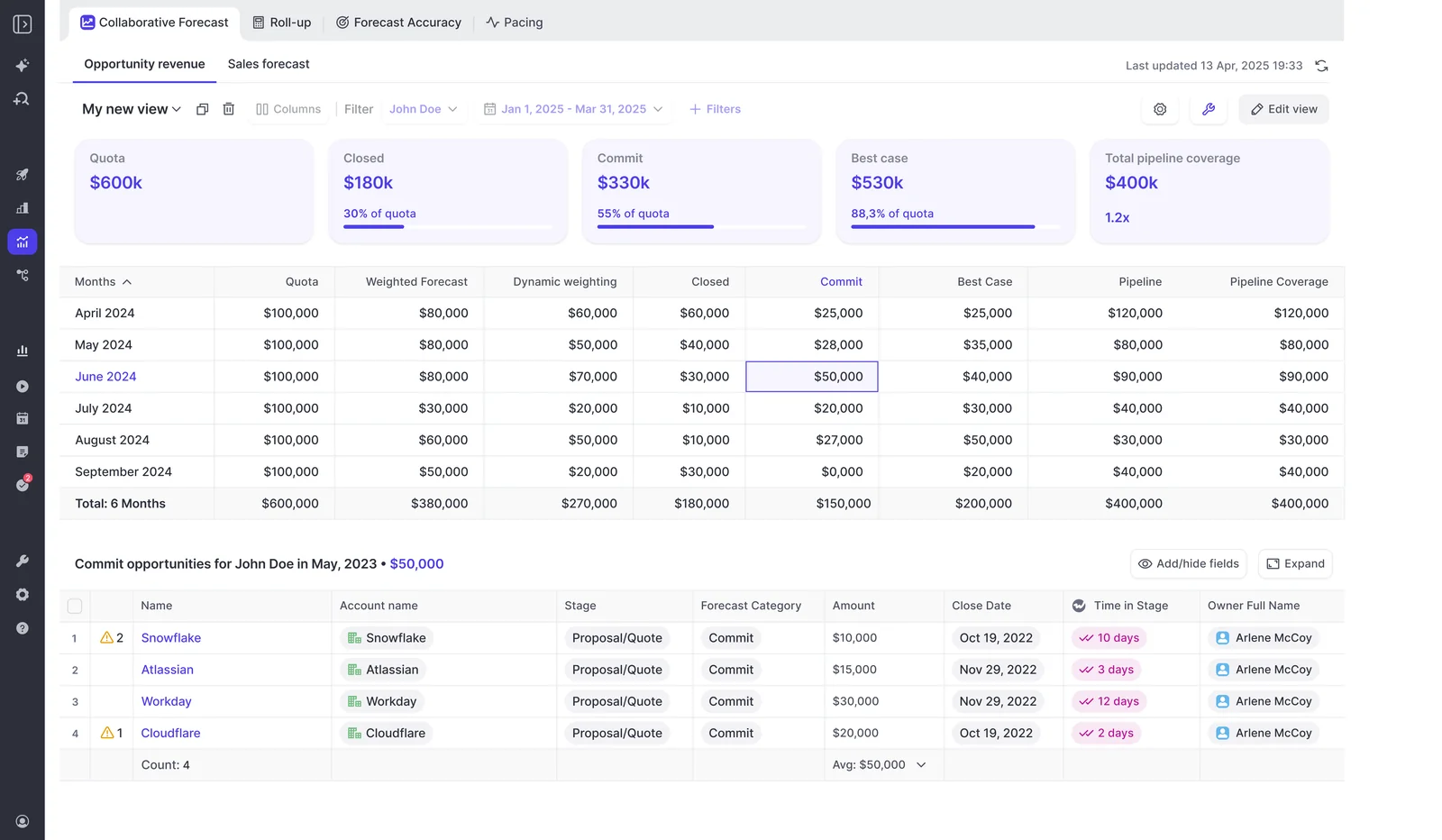
We built the roll-up for accountability, with three forecasts side by side and history from day one:
- Submissions and roll-ups: Each rep submits a baseline and a best case, either as a number or by selecting the opportunities behind it. Managers submit their own independent call, overrides are logged with a rationale, and every version is kept. You can build a custom hierarchy in Weflow by drag and drop, put one person in several teams, and show a team as its own sub-total line without placeholder users in Salesforce.
- AI projection: A low, middle and high range, shown on the pacing chart beside the roll-up and a weighted forecast that recomputes each stage's win rate from recent history. The first projection is ready within 48 to 72 hours from 6+ months of Salesforce history.
- Waterfall: Starting to ending pipeline through created, increased, moved in, moved out, lost, decreased and won, and every bar drills through to the deals behind it.
- Snapshots: 12 months of Salesforce opportunity history is imported by default, then Weflow snapshots every opportunity every few hours.
- Prebuilt metrics: 30+ metrics and dashboards, including coverage, win rate, sales cycle length, stage conversion, deals at risk and forecast accuracy by rep, manager and team.
In practice, our customer Zeotap forecasts the quarter within 7%.
How your forecast data leaves Weflow through the API and MCP
Weflow integrates with Salesforce, Gmail, Google Calendar, Outlook, Zoom, Microsoft Teams, Google Meet, Slack and the Outreach dialer. It isn't an integration platform with a catalog of connectors, and it doesn't try to be.
Your forecast reaches AI tools through our read-only MCP connector. It returns forecast calls, the live pipeline total and the gap between them, targets, and per-rep pipeline metrics with the opportunity IDs behind them.
An admin turns it on per workspace, and it works with Claude, ChatGPT or any client that supports remote MCP servers.
Raw data leaves through the REST API, which bulk-exports to warehouses and BI tools such as Tableau and Looker. For Snowflake, Databricks or BigQuery, teams use the API too, since we don't have a native connector.
Captured emails and meetings land in Salesforce as regular activity records your own reports can read.
Where Weflow fits and where it stops
Fits:
- Salesforce mid-market teams that want deal-backed roll-ups, a forecast data path to AI tools and warehouses, and prices they can put in a business case.
- Teams that want to start with forecasting alone and add Weflow Activity and Contact Capture and Weflow Conversation Intelligence later, or start with capture and add forecasting.
- Teams whose real hierarchy doesn't match the Salesforce role tree.
Stops:
- Salesforce only. HubSpot, SAP C4C and SugarCRM teams can't move to Weflow.
- We ship 30+ prebuilt metrics against InsightSquared's 350+ reports, and our pipeline reports are separate views rather than one central dashboard.
- Forecast calls live in the Weflow app and aren't written to a Salesforce field. You read them over MCP or the API.
- No opportunity splits or overlay forecasting. A shared deal counts in full for its owner.
- Deals owned by deactivated Salesforce users drop out of the roll-up, so you reconcile those by hand.
- Targets are entered in Weflow or loaded from a spreadsheet. We don't read them from Salesforce.
- Targets are amounts, so there are no count-based targets such as a number of new logos.
- Consumption revenue is a weaker fit than booking-based revenue.
- Forecasting alone produces weaker roll-up results than forecasting with activity capture and conversation intelligence underneath.
Pricing model: per seat, published, at $39 per user per month for Weflow Deal Intelligence and Forecasting.
Clari: Mature enterprise roll-ups, now sold under Salesloft
For large enterprises, Clari's roll-ups and its CRO top-down view are the most mature in this list. The trade-offs are that its forecast is tied to the Salesforce hierarchy, and the brand now sits inside Salesloft.
How Clari Forecast handles roll-ups, AI projection and pipeline history
- Submissions and roll-ups: Calls roll up a hierarchy up to eight levels deep, managers can submit on behalf of reps, and reps edit deals inline from shared views. The CRO view showing each direct report's commit and best case at a glance is the part teams expect any replacement to match. The forecast is tied to the Salesforce hierarchy, so sub-totals need inactive placeholder users, leaders see only the level directly below them, and a forecast call is a number with notes rather than a set of selected deals.
- AI projection: It tends to land close to the quarter's result, but RevOps teams tell us it takes 12 to 18 months to become useful. It looks three months ahead, so a rolling twelve-month forecast gets built outside Clari.
- Waterfall: Partial. The Waterfall view breaks pipeline change into types such as amount decreases, slipped deals and lost deals, groupable by a CRM field. Some teams still rebuild the movement analysis in a BI tool.
- Snapshots: The Time Series Data Hub snapshots opportunity, account and activity data automatically.
- Prebuilt metrics: Salesloft ships deal analytics such as win rate, sales cycle and stage conversion. Clari has no built-in forecast accuracy tracking, so teams calculate it themselves each period.
How Clari exposes forecast data through its APIs and MCP servers
Clari's integrations run through Salesloft's data layer, which syncs with Salesforce, Dynamics, Snowflake, Databricks, Gmail, DocuSign, ZoomInfo and LinkedIn.
MCP access is split across three narrow servers:
- The Forecast server returns forecast numbers and snapshots but no deal-level opportunity data.
- The Copilot server reaches call data only.
- The Salesloft server is read-only and needs the paid Agentic add-on.
For raw data, Clari has REST and Export APIs and exports forecast history as CSV. However, its forecasting and conversation intelligence don't talk to each other, so call data doesn't inform the forecast.
Where Clari fits and where it stops
Fits:
- Large enterprises, around 1,000 reps and up, that need mature roll-ups and the CRO top-down view.
- Teams whose hierarchy maps cleanly onto the Salesforce role tree.
Stops:
- Sub-totals and team splits need placeholder users in Salesforce, and a rep who changes team either carries their numbers along or loses their history under a new user.
- Overlay roles and opportunity splits need extra work.
- No built-in forecast accuracy tracking.
- Assistant access is split across products, and the forecast server carries no deal-level data.
- It raises the same roadmap question as Mediafly: one long-term Clari user told us they'd seen nothing new in years.
Pricing model: quote-only. We estimate $120 to $180 per user per month, plus professional services fees.
Aviso: AI-led forecasting for multi-CRM enterprises
Aviso is the strongest fit here for enterprises that want an AI-forecast-led platform across several CRMs, including consumption revenue. The catch is that its data only leaves as file downloads.
How Aviso handles roll-ups, WinScore and pipeline history
- Submissions and roll-ups: Commit, best case and most likely calls roll up across every rep, category and team, with an audit trail of past calls you can export. Hierarchies can differ from Salesforce's, and consolidated forecasting merges several CRM instances into one forecast.
- AI forecast: Aviso shows its own forecast beside the team's most-likely call, built from WinScores, a daily probability that each deal closes this quarter.
- Waterfall: Partial. The Pipeline Movement report is a clickable waterfall for a report period, and any-two-date comparisons show as a Sankey chart.
- Snapshots: Aviso keeps a time-series copy of your CRM, on average six to eight quarters back.
- Prebuilt metrics: Adaptive Metrics for pipeline generated, coverage, next-quarter projection, performance and renewals, plus out-of-the-box reports.
How Aviso data leaves the platform
Aviso claims more than 200 native connections across conferencing, telephony, engagement, support, learning and marketing tools.
There's no MCP server for Claude, ChatGPT or other assistants (MCP only runs inside Aviso's Agent Studio, where its own agents call other tools), and no public API either.
Deals, reports and the forecast audit trail leave as downloads, and the CRM copy lives in Aviso's store rather than in your Salesforce.
Where Aviso fits and where it stops
Fits:
- Enterprises on several CRMs, including SAP, Dynamics, Oracle, HubSpot and Siebel.
- Businesses with consumption or usage-based revenue next to traditional bookings.
- Large teams that want the AI forecast to lead the conversation.
Stops:
- Aviso's own implementation team rolls it out and builds the hierarchy and screens.
- No data path for external AI assistants and no public API.
- Quote-only licenses.
Pricing model: licenses by custom proposal, with agent work billed at $1 to $1.50 per outcome and no platform fee.
Gong Forecast: Forecasting on top of Gong Foundation
Gong has the deepest conversation analytics in the category, and Gong Forecast makes the most sense if you already run Gong Foundation, since Forecast is a separate application on top of that required core license.
How Gong Forecast handles roll-ups, projection and pipeline changes
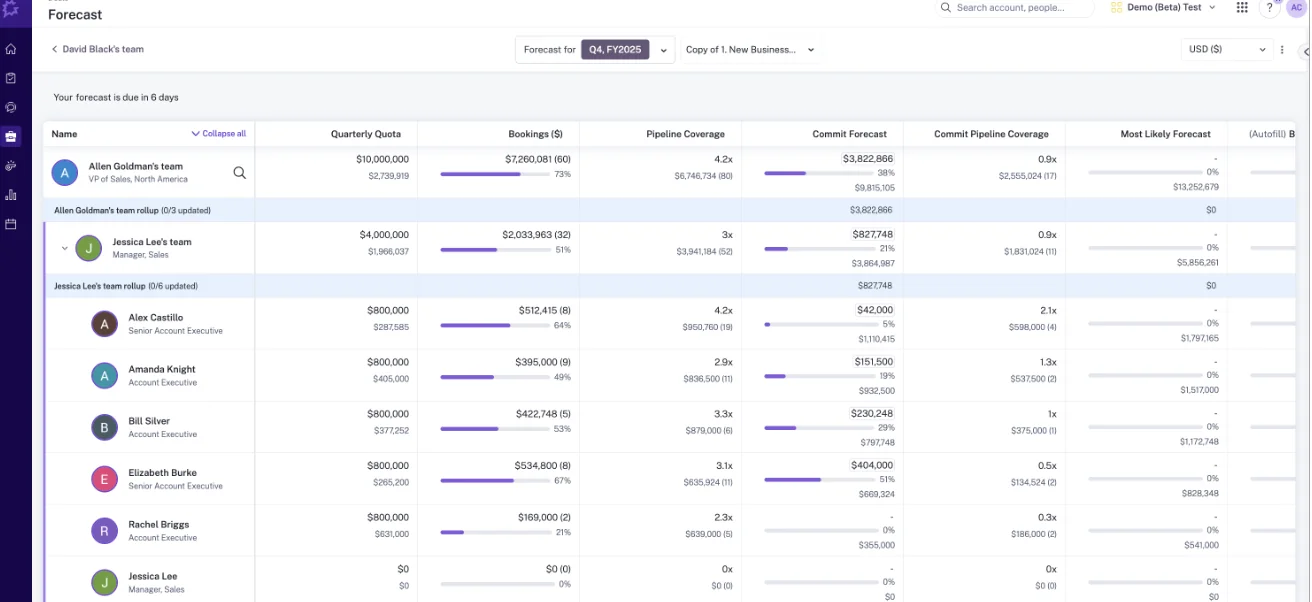
- Submissions and roll-ups: Reps submit a number per forecast category with notes, and managers see their team's totals and move up and down the hierarchy. A per-person accuracy report compares submissions with actual sales. The roll-up follows the Salesforce hierarchy, and running several motions such as enterprise, commercial and post-sale in one module gets clunky.
- Projection: Built from closed-won, pipeline weighted by historical stage conversion, and expected new and moved deals. The See the math panel shows each component. Reliable projections need 400 created opportunities with 150 closed-won across four quarters.
- Waterfall: The Changes widget runs from starting to ending pipeline over a chosen range. It counts gross movements, so a deal created and lost in the same week appears in both bars.
- Snapshots: Partial. History is weekly and comes from CRM field history, and Gong backfills up to five quarters on request through your customer success manager.
- Prebuilt metrics: Preset metrics for bookings, losses, win rate, open pipeline and deal size, plus dashboard templates and a dashboard created automatically for each business line.
How Gong data reaches warehouses and AI assistants
Gong's marketplace lists about 450 integrations and partner solutions, across CRM, dialers, meeting platforms, BI and workflow tools.
Its read-only MCP server exposes three record-scoped tools that return AI-generated insights rather than transcripts, and programmatic use draws metered credits.
The public API returns transcripts, trackers and scorecards, capped at 3 calls a second and 10,000 a day. Delivery to Snowflake, Databricks, BigQuery or Redshift goes through Data Cloud, a separate purchase.
Where Gong Forecast fits and where it stops
Fits:
- Teams already on Gong Foundation that want forecasting alongside the deepest conversation analytics.
- Leaders who want a per-person accuracy report and projection math they can inspect.
Stops:
- Forecast is a separate application on a mandatory Foundation license, and seats are assigned per application.
- If you're not already on Gong, replacing one InsightSquared contract with Gong reads internally as adding tools.
- Several motions in one forecast module get clunky.
- The projection needs 400 opportunities and 150 closed-won.
- Assistant access returns insights only, and it's metered.
Pricing model: Foundation plus the Forecast application, with a platform fee and no published prices.
What Weflow, InsightSquared, Clari, Aviso and Gong cost
Only Weflow publishes per-seat prices. Everyone else quotes.
| Tool | Published prices | What costs extra | Minimums and term |
|---|---|---|---|
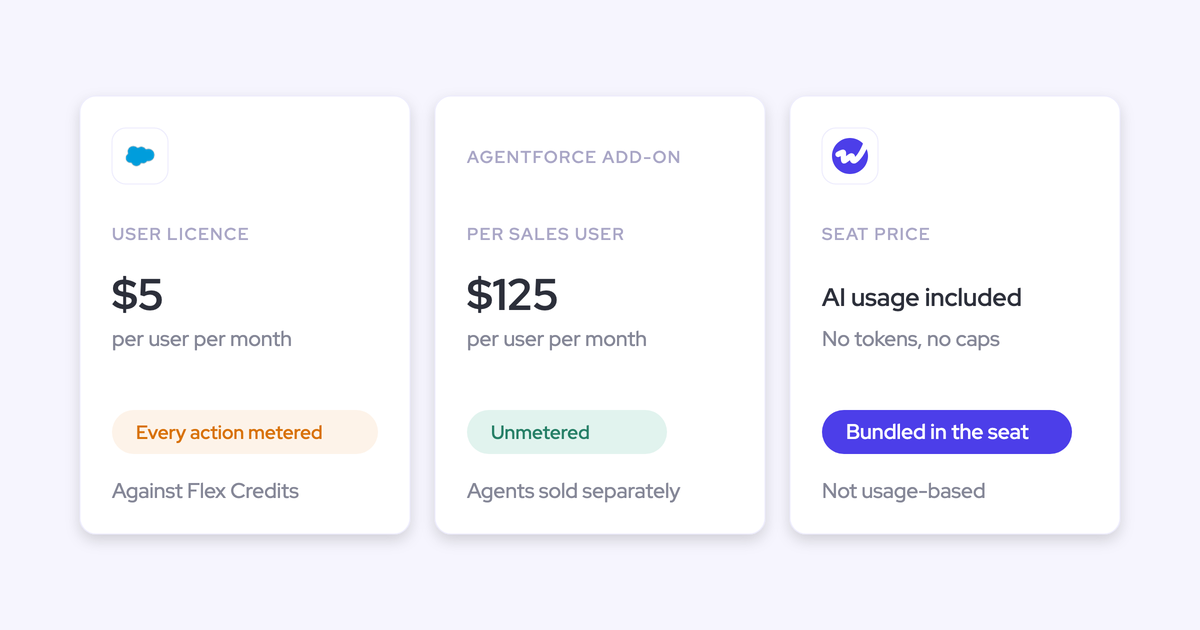
| Weflow | Per seat. Weflow Deal Intelligence and Forecasting at $39 per user per month. Bundles: Weflow Revenue AI Foundation $49, Weflow Revenue AI Business $59, Weflow Revenue AI Enterprise $79. Ask Weflow AI Pro and Agent Builder Free included. | Only Agent Builder above its free tier of 25 actions a month: $299 a month for 500 actions, $999 a month for 2,500. No platform or implementation fees. | 10-user minimum, annual billing, 12-month term. |
| InsightSquared | None. Mediafly quotes by modules, users and integrations. | Not published. | Not published. |
| Clari | None. Pricing pages lead to a Salesloft Talk to Sales page. We estimate $120 to $180 per user per month. | Professional services fees, which we estimate at $15,000 to $50,000. | Not published. |
| Aviso | Licenses by custom proposal. Aviso says it prices licenses at about half of Gong's. | Agent work at $1 to $1.50 per outcome. No platform fee. | Not published. |
| Gong | None. Per-user license plus a platform fee that scales with users. | Foundation is required before Forecast. MCP and API AI workflows draw metered credits. Data Cloud is extra, at about $5,000 a year. | Not published. |
In our experience, the business case that gets approved is one contract replacing one contract. If you also use Mediafly Coach for calls, Weflow Revenue AI Enterprise at $79 covers forecasting, activity capture and conversation intelligence in a single contract.
On the other hand, a proposal to replace one vendor with two usually dies before it reaches procurement. We hear this one a lot:
I am not sure I want to deprecate one tool to bring on two. The optics of that are never going to look good.
— EVP of operations, as relayed by a buyer on a call with Weflow
Which InsightSquared alternative fits your team
Your CRM, scale and revenue model will narrow your shortlist faster than any feature list.
| If this is you | Look at |
|---|---|
| Salesforce mid-market team that wants forecast data out of the tool and a visible price | Weflow |
| Enterprise of 1,000+ reps that needs mature roll-ups and the CRO top-down view | Clari |
| Multi-CRM or SAP team | Aviso, or stay on InsightSquared |
| Consumption or usage-based revenue | Aviso |
| Already on Gong Foundation | Gong Forecast |
| On HubSpot or SugarCRM | Stay on InsightSquared (Aviso also covers HubSpot) |
| InsightSquared works, the renewal is cheap, and nobody needs the data outside it | Stay put |
And yes, “stay” is a perfectly legitimate answer. If a maintained product does what your leadership needs at a price that doesn't hurt, renewing it is a reasonable call.
How to move off InsightSquared without losing what leadership uses
A smooth move comes down to deciding history, timing and report scope before you connect any new tool. The steps below assume you're moving to Weflow.
What forecast history comes across and what restarts
Your pipeline history comes across, but submission and accuracy history start fresh.
| Data | What happens when you move to Weflow |
|---|---|
| Salesforce opportunity history | Comes across: 12 months imported by default, more on request where field history allows. |
| Custom field history | Comes across only where Salesforce field history tracking was enabled. |
| Pipeline snapshots | Start automatically at install, every few hours. |
| Forecast submissions | Restart from the day reps first submit in Weflow. |
| Forecast accuracy trend | Restarts in Weflow, so keep an export of your InsightSquared accuracy history. |
| Targets | Entered in Weflow or loaded from a spreadsheet, which our team loads as a CSV on request. |
Pull your InsightSquared accuracy export early. Mediafly can't export reports it judges too complex, and renewal week is the worst time to find that out.
How to time the switch against your Mediafly renewal
- Work back from the renewal date: Mediafly's own implementations take 8 to 10 weeks (90 days at most), so give yourself at least that long to run both tools in parallel.
- Connect Salesforce and let history import: Weflow's AI projection is ready within 48 to 72 hours from the imported history.
- Settle the forecast configuration first: Pick the amount field, stage or forecast-category basis, and record-type filters before sellers see anything. That's because every configuration change re-runs the history import, and views show partial numbers for up to a day or two while it runs.
- Compare in private: Forecasting is a separate license, so RevOps can configure the Weflow forecast and compare it with InsightSquared before reps see it. The Weflow hierarchy holds people who've signed in once, so reps who start on capture or conversation intelligence are ready for the hierarchy.
- Move submissions when you're ready: Switching mid-quarter won't break anything, because the forecast reads the same opportunity data. You'll only lose the earlier weeks' submission history in Weflow.
Which InsightSquared reports to rebuild first
Start with the three views leadership opens weekly, then audit the rest of the 350+ library before you recreate anything:
- Flow waterfall: Rebuild it as the Weflow Waterfall view, with drill-through to the deals in each bar.
- CRO Forecast Review: Rebuild it on the pacing chart, with the AI projection, team forecast and weighted forecast side by side.
- Forecast Accuracy dashboard: Rebuild it on the Forecast Accuracy tab. InsightSquared measures error from the first forecast submitted, while Weflow records each submission against the closed amount and lets an admin choose the field accuracy is measured against.
- Everything else: List who opens each report and how often. If nobody opens it, don't rebuild it.
- Legacy fields: Decide which forecast fields die before you connect the new tool, not after.
- What stays elsewhere: A single yearly win rate or an all-time created-date report stays in Salesforce or your BI tool, because Weflow reports win rate per stage and per quarter.
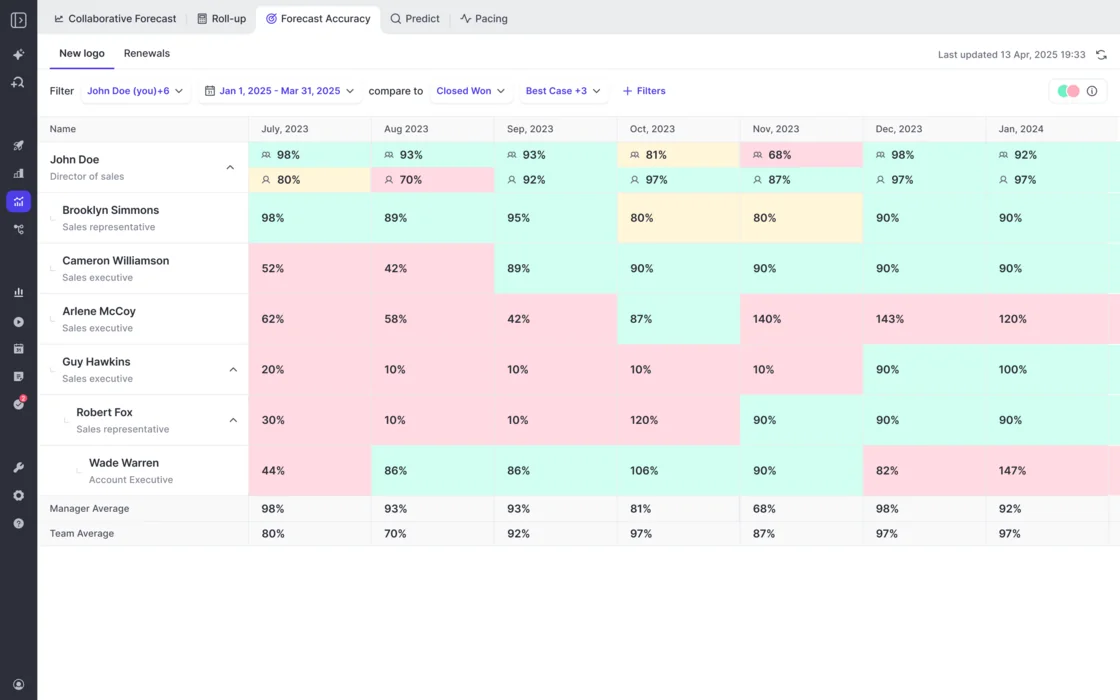
If you want to see the roll-up, waterfall and accuracy views before you talk to anyone, walk through the product yourself, no call required.
FAQ: Switching from InsightSquared
Which InsightSquared alternatives work if we're on HubSpot or SAP?
Weflow works only with Salesforce, so it's not an option. Aviso supports Salesforce, HubSpot, Dynamics, Oracle, SAP and Siebel, and can merge several CRMs into one forecast.
And since InsightSquared itself covers HubSpot, SAP C4C and SugarCRM, staying is a strong option for those teams.
Can we keep manager targets below the sum of rep targets?
Yes, and you should. Over-assignment is a standard control: a leader's number is deliberately smaller than the targets they hand out.
In Weflow, a manager's team target is set on its own, the remainder is carried on the manager so the gap is visible, and the team row shows the sum of members' targets separately without overwriting the assigned target.
Can we forecast new business, renewals and expansion separately?
Yes. In Weflow, each Salesforce opportunity record type keeps its own stage path, forecast-category mapping and roll-up. You can run one combined quota and separate targets per deal type at the same time, with a tab per deal type plus a combined view.
How much history does an AI forecast projection need?
It varies a lot by vendor:
- Weflow: At least six months of Salesforce opportunity history, with the first projection ready within 48 to 72 hours.
- Gong: 400 created opportunities with 150 closed-won across four quarters.
- Clari: RevOps teams tell us it takes 12 to 18 months before they find it useful.
- InsightSquared: About 100 opportunities a quarter per opportunity type with activity capture on, and about 300 without.
Can Claude or ChatGPT read our forecast data?
With Weflow, yes: the read-only MCP connector returns forecast calls, the gap to pipeline, targets and per-rep metrics with opportunity IDs. Clari's Forecast server returns forecast numbers but no deal-level data, and Gong's MCP returns insights only, on metered credits.
Aviso and InsightSquared offer no assistant access to forecast data.
We use Mediafly Coach for calls. Does the replacement cover that?
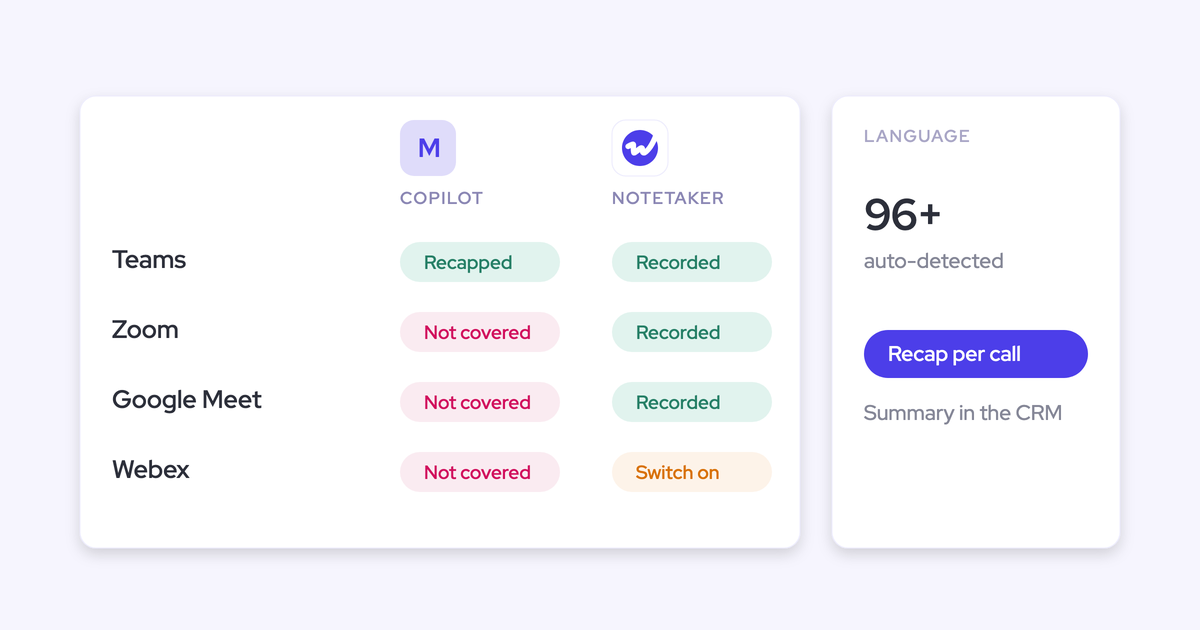
Yes. Weflow Conversation Intelligence records, transcribes and summarizes Zoom, Teams, Webex and Google Meet calls, then writes the outcomes into Salesforce fields.
Taking it in a bundle such as Weflow Revenue AI Enterprise keeps calls and forecasting on one contract. If conversation analytics depth is your top priority, Gong is the deepest in the category.
What should European teams check about forecast data hosting?
Mediafly hosts Intelligence in AWS US-East (Ohio) and processes reporting data and AI features in the US. EU hosting exists only for its Engagement product, and Mediafly says other regions are on its roadmap.
Weflow, for its part, is SOC 2 Type II certified and GDPR compliant, uses Zero Data Retention for AI processing, and never uses customer data to train AI models.
Can we exit early if the new forecasting tool doesn't land?
Weflow's standard term is 12 months, which is also the shortest we offer. That said, we can negotiate an early opt-out after three months, so you can leave if the product doesn't land. Aviso offers to buy out an existing vendor contract and migrate you for free.
Will our reps actually submit forecasts in the new tool?
Forecasting is a leadership motion, so adoption depends on managers running the cadence. To help, Weflow emails reps a reminder that links straight to their submission and flags any missing submission as a warning.
Submission happens in the web app only, not from a phone or chat tool, so plan for traveling first-line managers on deadline day.