The Four Disciplines of Execution (4DX) for Sales Teams: Lead Measures, Scoreboards and Weekly Cadence
Learn how to run 4DX for sales teams: lead measures, simple scoreboards, and a weekly cadence


4DX works in sales when your lead measure is a qualification score, like a champion score, rather than a count of calls and emails.
That's how Julien Cerutti rolled it out across Meltwater's 750-person sales org, in three steps:
- A revenue goal, such as conversion up 10%.
- A frontline manager target, such as raising the champion score by one point.
- Weekly actions the team designs itself, reviewed every Monday on a scoreboard you can read in five seconds.
Bookings and the forecast tell you how the quarter went, but not what to change this week.
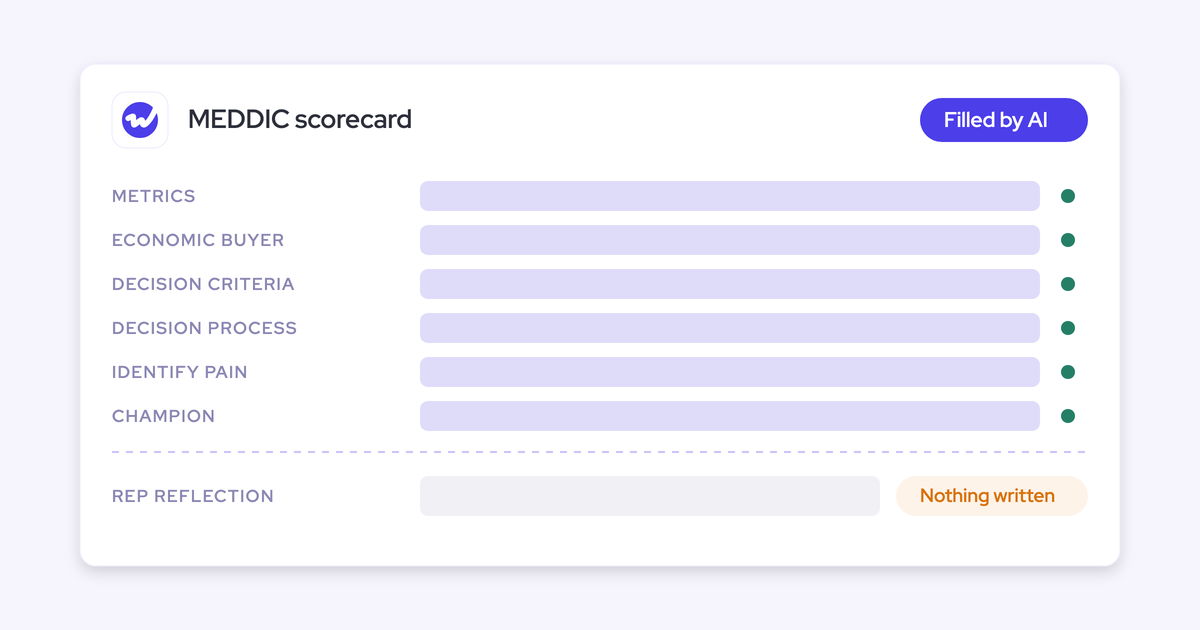
Most sales teams get stuck on discipline 2, the lead measure. And the scoreboard only holds up if the score comes from the whole deal (calls, emails and CRM fields), not from what the rep typed. That's what scoring for deal execution means in practice.
Below, you'll see how to pick your goal from your own win, slip and loss data, why activity counts fail as lead measures and how to run the cadence inside the Monday meeting you already hold. You'll also see where Weflow supplies a score your reps can't inflate.
What the four disciplines of execution mean in a sales team
The Four Disciplines of Execution (4DX) is an execution framework with four parts: one wildly important goal, a few lead measures that move it, a simple scoreboard and a weekly cadence of accountability.
Everything outside the goal is the whirlwind: the day-to-day work that still has to get done. Here's how each one translates to sales:
| Discipline | What 4DX says | What it becomes in a sales team |
|---|---|---|
| 1. Wildly important goal | Focus on the one goal that matters most | One lever from your own deal data, such as conversion, with the sales plays parked |
| 2. Lead measures | Track inputs that predict the goal and that the team can influence | Qualification-element scores such as champion, economic buyer and decision process |
| 3. Scoreboard | Keep a simple, visible scoreboard | The lead-measure score by rep and by stage, readable in five seconds |
| 4. Cadence of accountability | Hold a short weekly session to account, review and commit | A fixed slot in the Monday team meeting, not something folded into one-on-ones |
When 4DX beats dashboards, quota pressure or a coaching tool
4DX is the better choice when the problem is behavior, because it's the only option here that manages inputs rather than the lag number or the tool.
| Path | What it manages | What it misses |
|---|---|---|
| More dashboards | Visibility into pipeline and bookings | Nobody reads the extra reports, and the dashboards show outcomes, not the behavior behind them |
| Quota pressure alone | Urgency on the number | It tells reps to sell more without saying what to do differently, and coaching gets cancelled first when the quarter tightens |
| Buying a coaching tool | Call quality on recorded calls | A coaching tool only pays off when frontline managers use it, and call-level scores don't tie back to the goal on their own |
| Changing nothing | No new rollout and no change fatigue, which is a real cost after several "flavor of the month" frameworks | Hero ball continues, every manager keeps coaching the methodology differently, and underperformance shows up months late |
| 4DX | The input behavior that predicts the goal, every week | It needs a lead measure you trust and a fixed slot, and without those it decays fast |
That said, 4DX isn't the right move yet if:
- Your team has no shared methodology, so there's no qualification language to score.
- Your recording coverage is low. Fix recording first.
- You can't protect a fixed weekly slot for the review.
- Your managers aren't interested in developing reps. That's a manager problem, and no framework will fix it.
How Meltwater cascaded one goal from conversion to champion score
Meltwater's cascade works because each level states the goal in terms that level can actually control.
- Revenue leadership sets the goal at revenue level, for example conversion up 10%. Leaders can act on it because they own the system the conversion runs through.
- The frontline manager translates it into one qualification score, for example the champion score up one point. A manager can coach a champion. A manager can coach a champion, but not "convert more."
- The team and its reps design the two or three weekly actions that build a champion. Reps can do those this week, and their manager checks every Monday how many they did.
Cerutti frames the whole thing as a way to manage noise:
"Go-to-market's really noisy, and you've got so many competing priorities. Your manager's saying this, your CRO's saying this, your customers are screaming x, y, z. How do I manage all that noise?"
— Julien Cerutti, VP of Global Revenue Strategy at Meltwater
Most teams skip the third step, but it's the one that matters most: when the team designs the weekly actions together, that conversation is the coaching.
Pick your wildly important goal from your own deal data
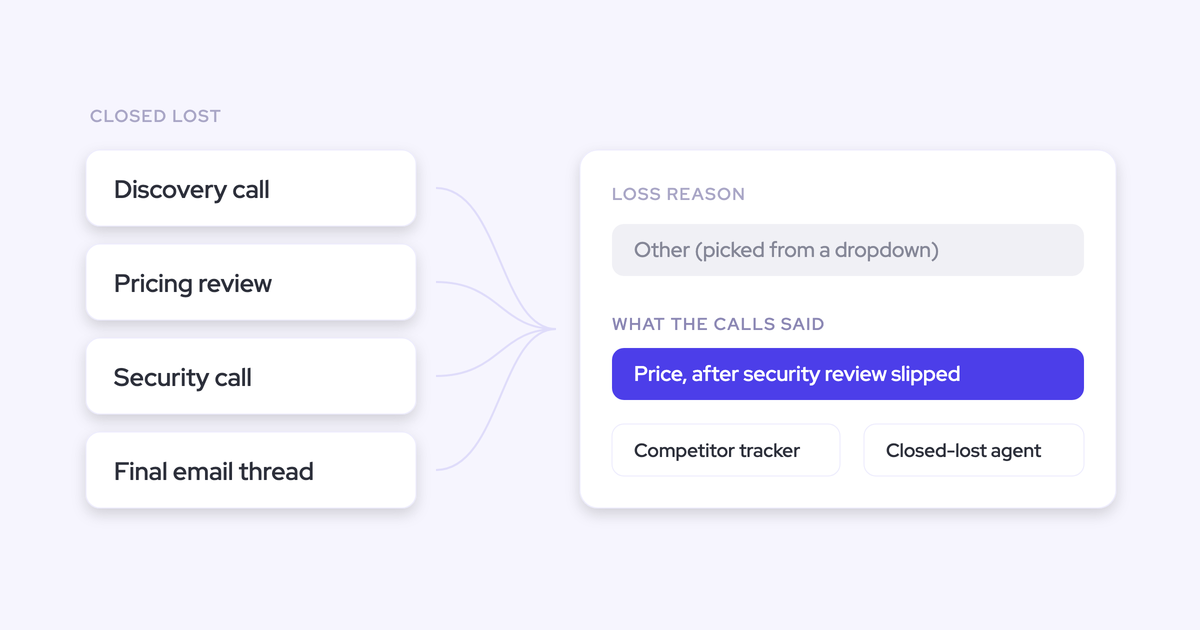
Run a win, slip and loss analysis before choosing anything
Start here, because without this analysis you're picking a goal from a book. RevOps usually owns it, and IT helps build the result into the CRM.
- Collect a sample of won, slipped and lost deals.
- Have the reps who ran each deal answer a structured question set about it.
- Analyze why each outcome happened.
- Derive a weighted score from that analysis.
- Then build the score into the CRM.
Skip the analysis and you end up with methodology fields nobody believes in. Run it first, and you get weights that reflect how your deals actually behave, plus a story your reps recognize as their own.
Read what your wins, slips and losses each point to
At Meltwater, each outcome traced back to a different qualification variable.
| Outcome | Qualification variable behind it |
|---|---|
| Won | A strong champion, who opens access to power, the economic buyer and information |
| Slipped | A missing decision process, so the deal had no mapped approval path and no reliable date |
| Lost | Undocumented decision criteria, so the team never built a reason to choose them |
Your data may tell a different story, and that's exactly why you run it. A pattern your reps can trace to their own lost deals carries more weight than any framework slide:
"This isn't generic. This isn't a book you can read. This is about real Meltwater data that tells you why you're winning, slipping, and losing deals, and the advantages you can have having that context, and what you should do moving forward."
— Julien Cerutti, VP of Global Revenue Strategy at Meltwater
Narrow five CRO priorities down to one goal and park the rest
You get to one goal by refusing the other four out loud. Pick the lever your loss data points to, and label everything else as whirlwind in front of the team.
The whirlwind still gets done, it just isn't the goal. Typical items to park include:
- This quarter's sales plays and campaigns.
- Pipeline acceleration projects.
- The CRO's other priorities.
- Customer escalations, which you still handle but don't measure the team on.
Five priorities read as no priority, and reps carry that confusion straight into customer calls.
Use qualification scores as lead measures, not activity counts
A good lead measure passes two tests: it predicts the goal, and a rep can move it this week. Qualification-element scores pass both.
| Candidate lead measure | Predicts the goal? | Can a rep move it this week? | Can it be gamed? |
|---|---|---|---|
| Activity counts (calls, emails, reply rate) | Weakly. Volume doesn't say whether the deal advanced | Easily, which is the problem | Yes. More sends and auto-replies inflate it |
| Bookings and forecast | It is the goal, so it's a lag measure | Rarely inside one week | Through sandbagging or optimistic calls |
| Qualification-element scores (champion, economic buyer, decision process) | Yes, when the weights come from your own win, slip and loss data | Yes, through specific actions on live deals | Only if the score depends on what the rep typed |
| Interaction metrics (talk ratio, question rate, monologue length) | Indirectly. They describe how a call ran, not where the deal stands | Yes, on the next call | Partly. Asking more questions raises question rate whatever the quality |
| Single-call coaching scores | Partly. They measure the rep on one conversation, not the whole deal | Yes | Less easily, but one good call can hide a hollow deal |
Why calls, emails and reply rates make weak lead measures
Activity counts are the default because your CRM already tracks them. A rep can move them in an afternoon, but they won't tell you whether a single deal got any closer to closing.
They're also easy to inflate. One RevOps leader told us about a rep who sent a hundred emails a day. Put that on a scoreboard, and you end up rewarding the shotgun approach over the targeted one.
Why a champion score predicts conversion and responds to coaching
A champion score sits between activity and bookings: it predicts whether the deal converts, and a manager can coach a rep to raise it on a live deal this week.
It also unlocks the other elements, as Cerutti explains:
"Surprise, surprise, we win deals when we have really strong champions. They're the domino effect of getting access to power, the economic buyer, and information, which is basically the decision process, decision criteria."
— Julien Cerutti, VP of Global Revenue Strategy at Meltwater
Stick to one or two lead measures. Start with whichever element your wins depend on most, and add the one behind your slips only if the team can carry both.
Where talk ratio and question rate fit as secondary inputs
Your CI leaderboard isn't a lead measure. Talk ratio and question rate are real inputs, but they aren't tied to your goal, so use them to explain why a qualification score is low rather than as the measure itself.
Here's how to read them against a gap:
- Low champion score plus long monologues: The rep is pitching instead of finding out who's invested in the change.
- Low decision process score plus a low question rate: Nobody asked how the buyer approves a purchase this size.
- Low decision criteria score plus short customer stories: The buyer never had room to explain what they're comparing.
- High question rate and a flat score: The rep asks plenty of questions, but not the ones that qualify. Question rate counts questions, but it doesn't judge them.
Let your team design the weekly actions that move the score
For a champion score, the team's list might look like this:
- "Every evaluate-stage deal gets a champion deck the champion can carry internally."
- "Ask the champion to walk us through who signs off and in what order."
- "Where the champion won't open the door to the economic buyer, send an executive-to-executive email from our side."
Write them in the team's own words. Actions handed down from above turn into compliance.
Build a sales scoreboard anyone can read in five seconds
Rank on qualification scores by stage, not on bookings
The scoreboard shows the lead-measure score by rep, split into commit and evaluate stages. At leadership level, the same scores rank frontline managers.
| Item | On or off the scoreboard | Why |
|---|---|---|
| Champion score by rep, commit stage | On | It shows whether late-stage deals have someone selling for you |
| Champion score by rep, evaluate stage | On | It shows whether the next quarter's deals are being built properly |
| Weekly actions committed against done | On | It's the commitment the team made last Monday |
| Bookings and forecast | Off | It's the lag measure, and it already has its own meeting |
| Calls and emails sent | Off | It's easy to game and doesn't predict the goal |
| Talk ratio and question rate | Off | Use them in one-on-ones to explain a score, not to rank people |
If it takes longer than a glance, it's a report, not a scoreboard:
"I actually don't want people building complex ecosystems of scoreboards. Like, it's gotta be simple, back of the napkin. I should show you the scoreboard, and it should take you five seconds to know who's doing their job, who's not, kind of thing."
— Julien Cerutti, VP of Global Revenue Strategy at Meltwater
Make sure no rep can raise their score by typing
A public ranking is only fair if the score doesn't depend on what reps type into a field. Otherwise, the scoreboard rewards filler.
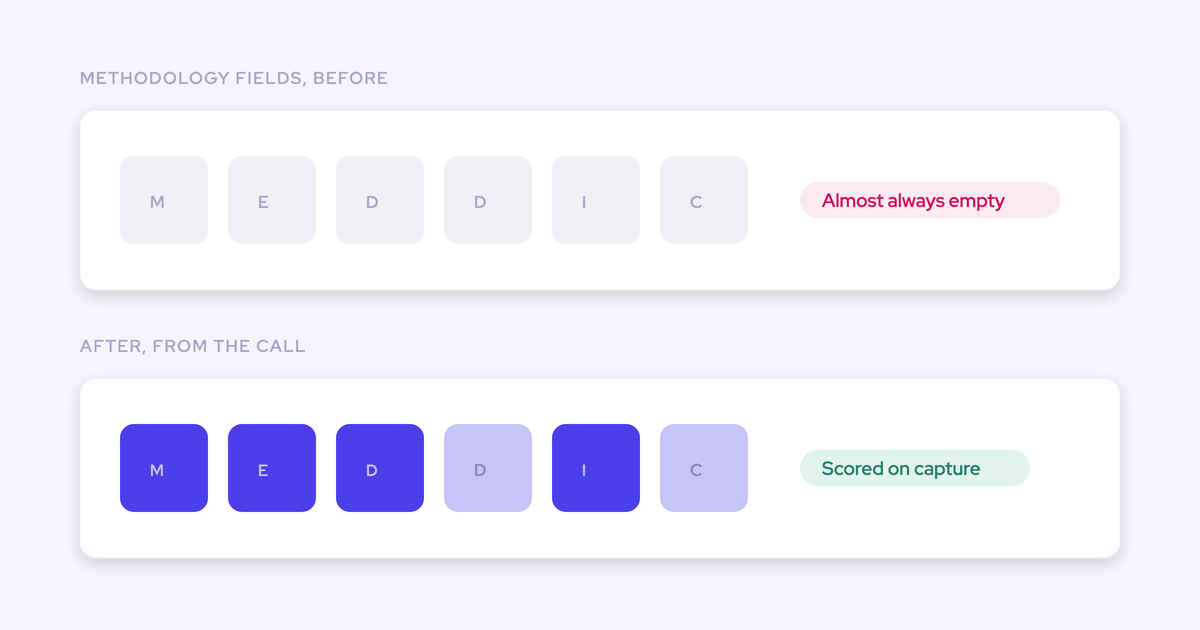
The real risk with a methodology field isn't an empty box, it's a box someone filled in just to get past a validation rule. If "Champion: Sarah, VP Ops, very engaged" earns full marks, your best typist tops the board, and every manager knows it.
Nobody wants to rank people on a score they don't trust, so the scoreboard quietly dies. That's why the score has to come from evidence on the deal: what the buyer said on calls, wrote in emails and did in the CRM record.
Decide what reps see and what managers see
When Rep-level metrics are shown to the whole team, they feel like monitoring, and reps start quietly avoiding the recorder. So separate the audiences from day one.
| Audience | What they see | Why |
|---|---|---|
| Reps | The team score and their own progress | They can find themselves on the board without feeling watched |
| Frontline managers | Rep-level detail, including interaction metrics | They need the detail to coach the gap |
| Revenue leaders | Frontline managers ranked on the same scores | It shows which manager coaches, not just which region converts |
| RevOps | The score definitions and weights | Someone has to own the model the scores come from |
Run the cadence of accountability inside your Monday team meeting
Ask every rep the same three questions each Monday
You don't need a new meeting. Just give the cadence a fixed, short block in your Monday team meeting.
- Did you do the actions you committed to last week?
- What does the scoreboard show for you and for the team?
- What will you commit to next week?
Keep it out of one-on-ones, where it competes with everything else and never gets real inspection time. If a manager says "I cover it in my one-on-ones," the cadence has already decayed.
In the end, whether this holds up comes down to the manager:
"Very often also with our own software, I think the manager is so often the make or break point when it comes to these things."
Pressure-test each rep's own score against the evidence
One risk with an automatic score is that reps stop thinking about their deals. To avoid that, have them answer the questions first: the rep scores their own champion, and then you compare their answer with the computed score.
That gap between what the rep believes and what the evidence shows is your coaching moment, and Cerutti built his deal inspection bot around it:
"I've created a deal inspection bot. Right? It knows why we win, why we lose, why we slip. It knows our scoring methodology that's all weighted, and it's a MEDDIC and SPICED coach, and it will give you a score, which a rep can say, hey, my champion's a three. I got this, this, and this, and it'll say, your champion isn't a three. You don't have these things. So it's actually pressure testing, which was a big thing I focused on in designing that."
— Julien Cerutti, VP of Global Revenue Strategy at Meltwater
Fold the goal back into the whirlwind once it's a habit
A goal ends when the behavior becomes habit. The champion work keeps happening, it just stops needing the Monday slot, and the next goal from your loss data takes over.
Chorus deserves credit here: it runs coaching scorecards as time-boxed initiatives, each with a launch date, assigned teams and a Close Initiative action. That launch-run-close shape is exactly how a 4DX goal is meant to live and end.
To check whether it stuck, compare rep's scores from 90 days ago with today's. If the element moved and stayed up without the weekly prompt, fold it back.
How Weflow scores your 4DX lead measures from the whole deal
Weflow is the Revenue AI Orchestration platform for sales, customer success, and RevOps teams, built for Salesforce.
For 4DX, it supplies the one piece the framework can't produce on its own: a lead-measure score your reps can't inflate by typing, refreshed often enough for a weekly scoreboard.
How AI Playbooks score each SPICED element across calls and emails
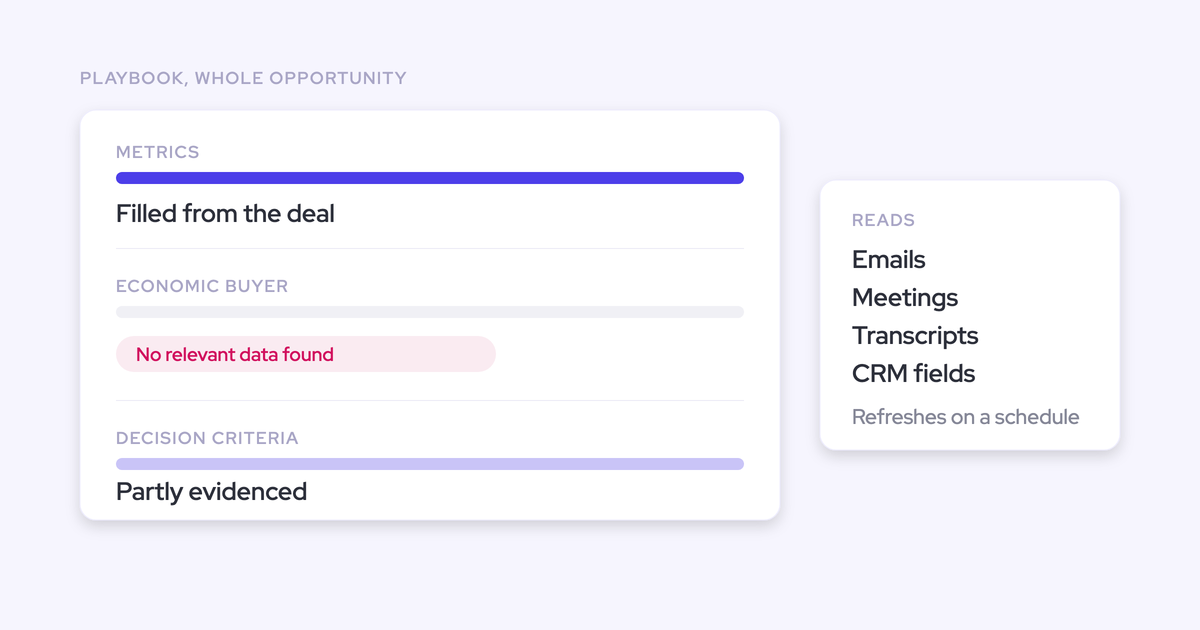
Weflow AI Playbooks score each methodology element from every email, meeting, transcript and CRM field on the opportunity, in two passes:
- The first pass fills in every element of the methodology, such as Champion or Critical Event, from the deal's evidence.
- The second pass judges how well each element is actually established, including anything a rep typed, so filler gets marked "not assessed" instead of complete.
Each element lands in one of three states:
| State | What it means for your scoreboard |
|---|---|
| Fully established | The evidence on the deal supports the element |
| Partially established | Some evidence exists, with a note on what's missing, which becomes next week's action |
| Never discussed | Nothing on the deal supports it, whatever the field says |
Email matters more than most teams expect, because champion and decision-maker details often show up only there. A call-only score would mark those champions as missing.
Playbooks rerun every two hours on any record that's changed (an edit, a new activity or a new recording) and also suggest a next step.
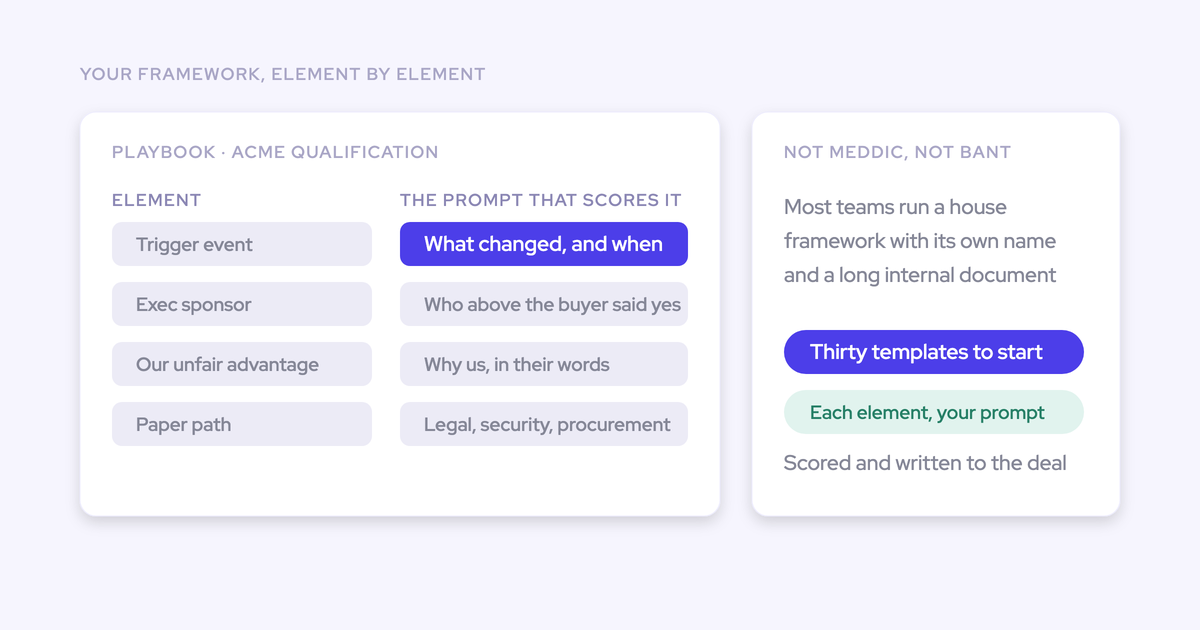
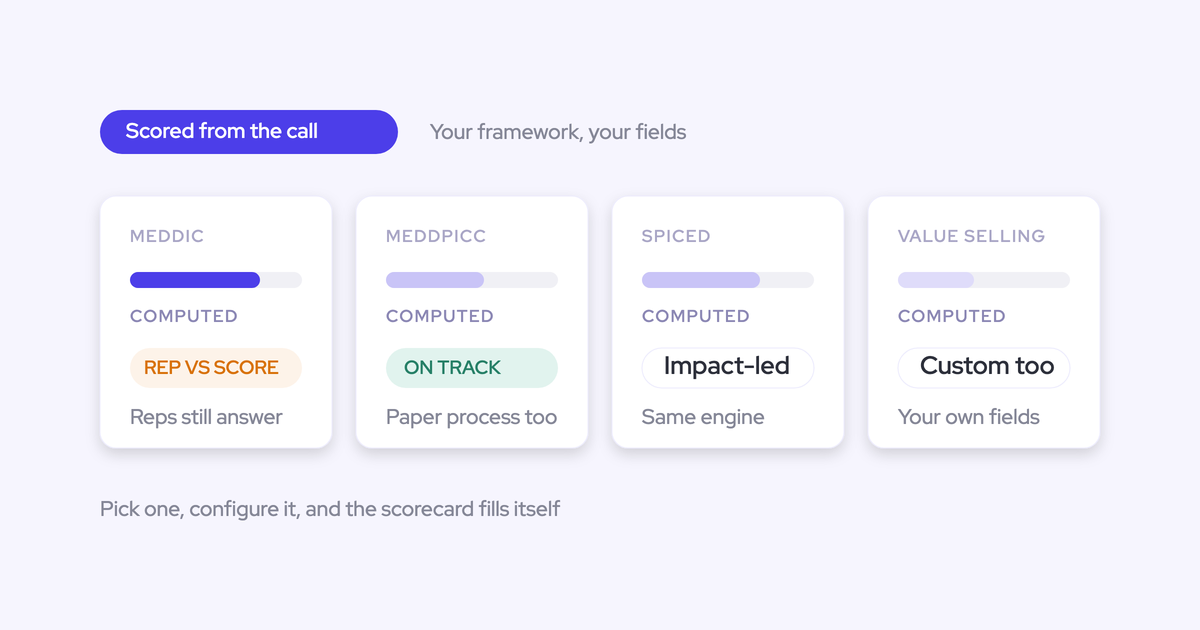
You can start from a prebuilt SPICED, MEDDIC, BANT, SPIN, Challenger, Solution Selling or Sandler template, or build your own, then assign each playbook to one or more teams.
How Weflow's call, deal and rep scores map to the 4DX cascade
Weflow scores methodology at three levels, plus a team view for leadership, and each one lines up with a level of the cascade.
| 4DX level | Weflow score | What it tells the manager |
|---|---|---|
| Team and rep, this week | Weflow Conversation Intelligence coaching templates, scoring every recorded call | How the rep ran this call against the methodology, and whether the weekly action happened |
| Frontline manager | AI Playbooks on the opportunity | Whether each deal has a real champion, economic buyer and decision process |
| Rep across months | Scores rolled up per rep over time | Which element a rep is consistently weak at, and whether it improved over 90 days |
| Revenue leadership | Team Benchmark report in Weflow Deal Intelligence & Forecasting | Win rate and deals won and lost by team, read alongside the manager scores |
Coaching templates come prebuilt for BANT, Challenger Selling, MEDDIC, MEDDICC, MEDDPICC, Solution Selling, SPARK, SPIN and Value Selling, and you can build your own. Each template is assigned per team, and a manager can override any score.
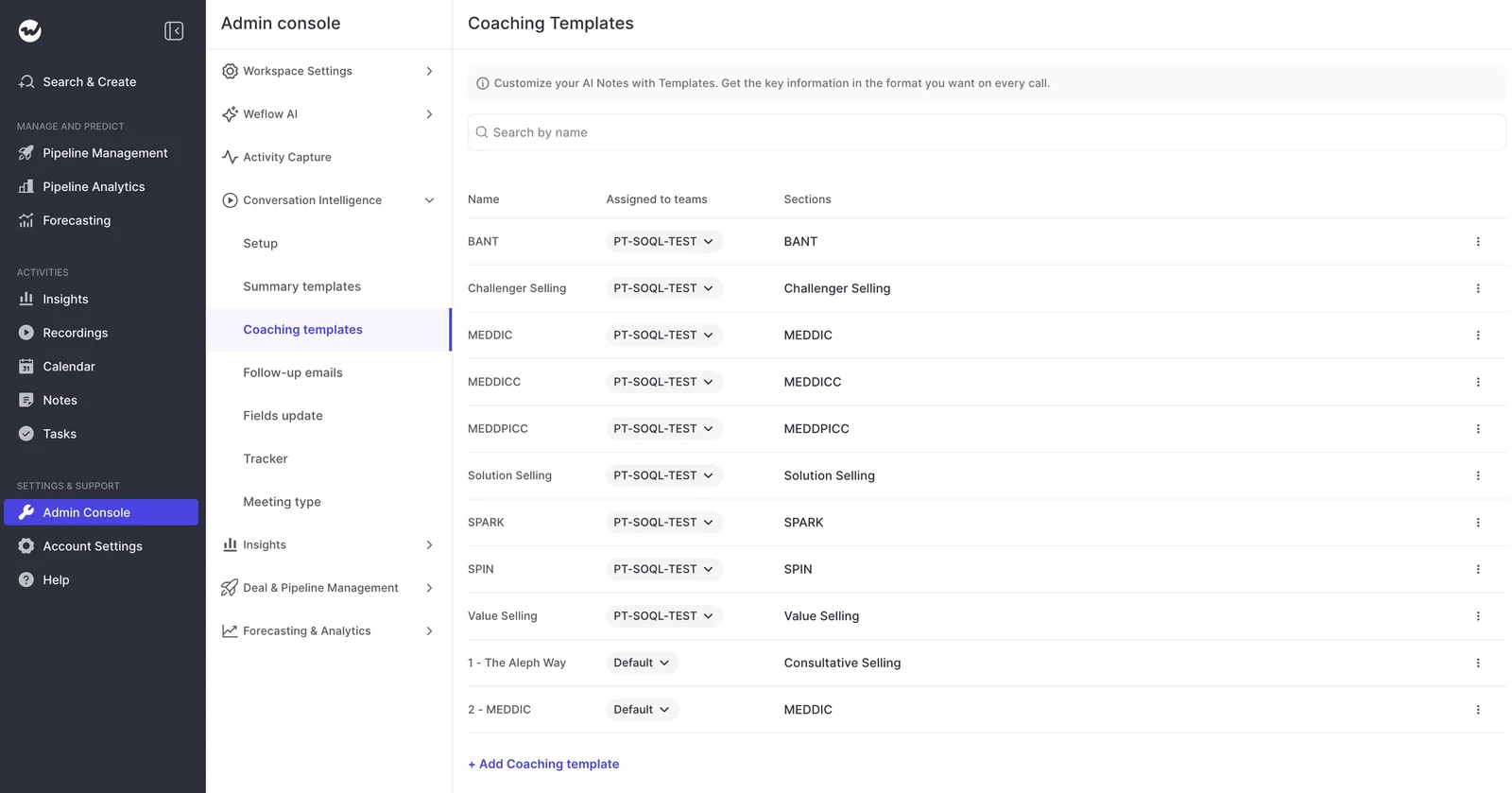
The rep-across-months view gives a lead measure what it needs: a trend, not a snapshot. It shows you, for example, that a rep is strong on metrics but weak on champion identification, so you can coach that instead of a random call.
Our CEO describes the change this way:
"There's no manual call review anymore. The AI automates that and scores every call against your methodologies and enables you to basically see over time how your sales methodology is operationalized."
How the scoreboard reaches you in Slack, email or Salesforce
You don't need to open a tool and go call by call. Weflow brings the cadence to you in four ways:
- Salesforce write-back: With write-back on, AI Playbook results land in Salesforce fields, so your scoreboard can be a Salesforce report the team already uses.
- Scheduled reviews in Slack: Weflow Agent Builder runs a scheduled review of the week's recordings and posts the findings to a Slack channel as a PDF or CSV, ahead of your Monday meeting.
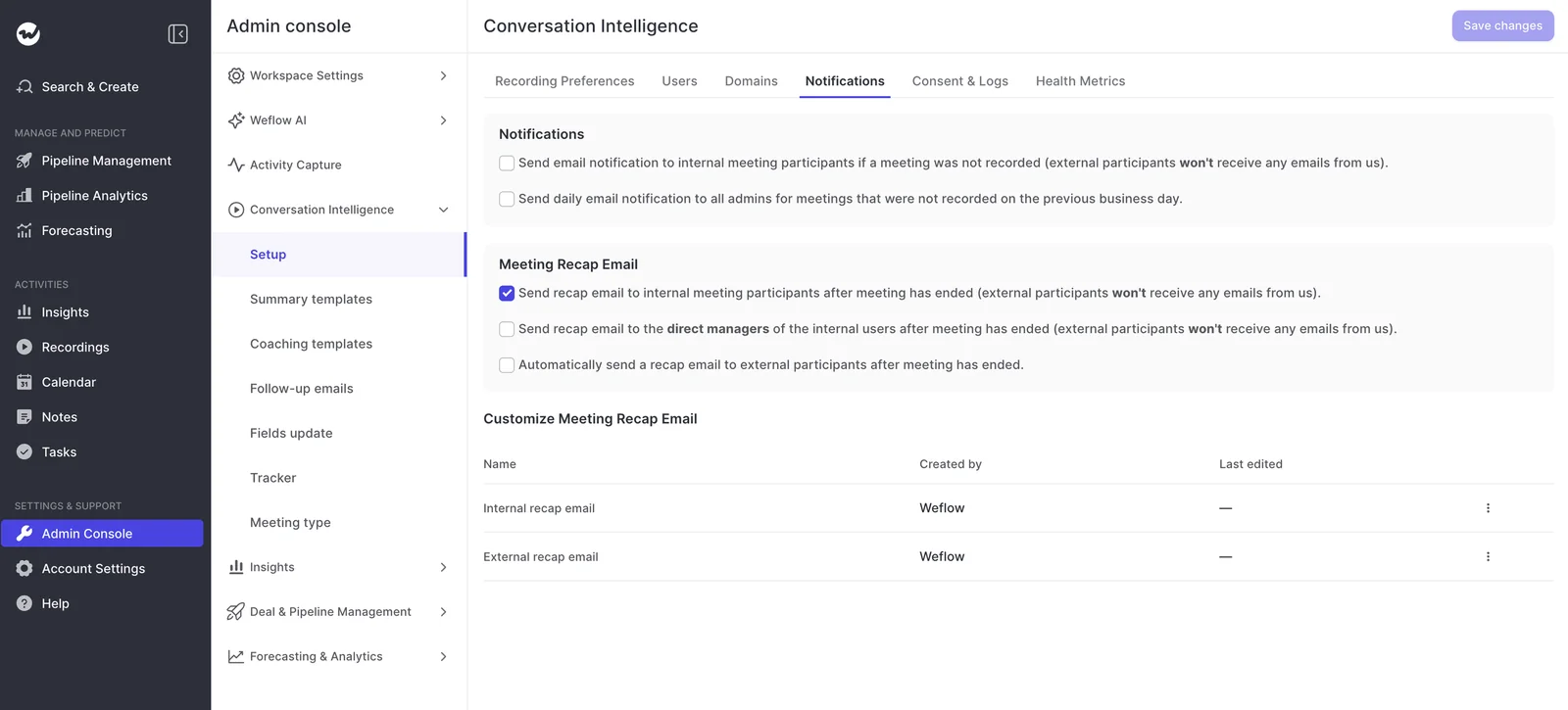
- Recaps to the manager: Weflow emails the AI recap of each recorded meeting to the rep's direct manager, as set in Salesforce, so you see what was discussed without logging in.
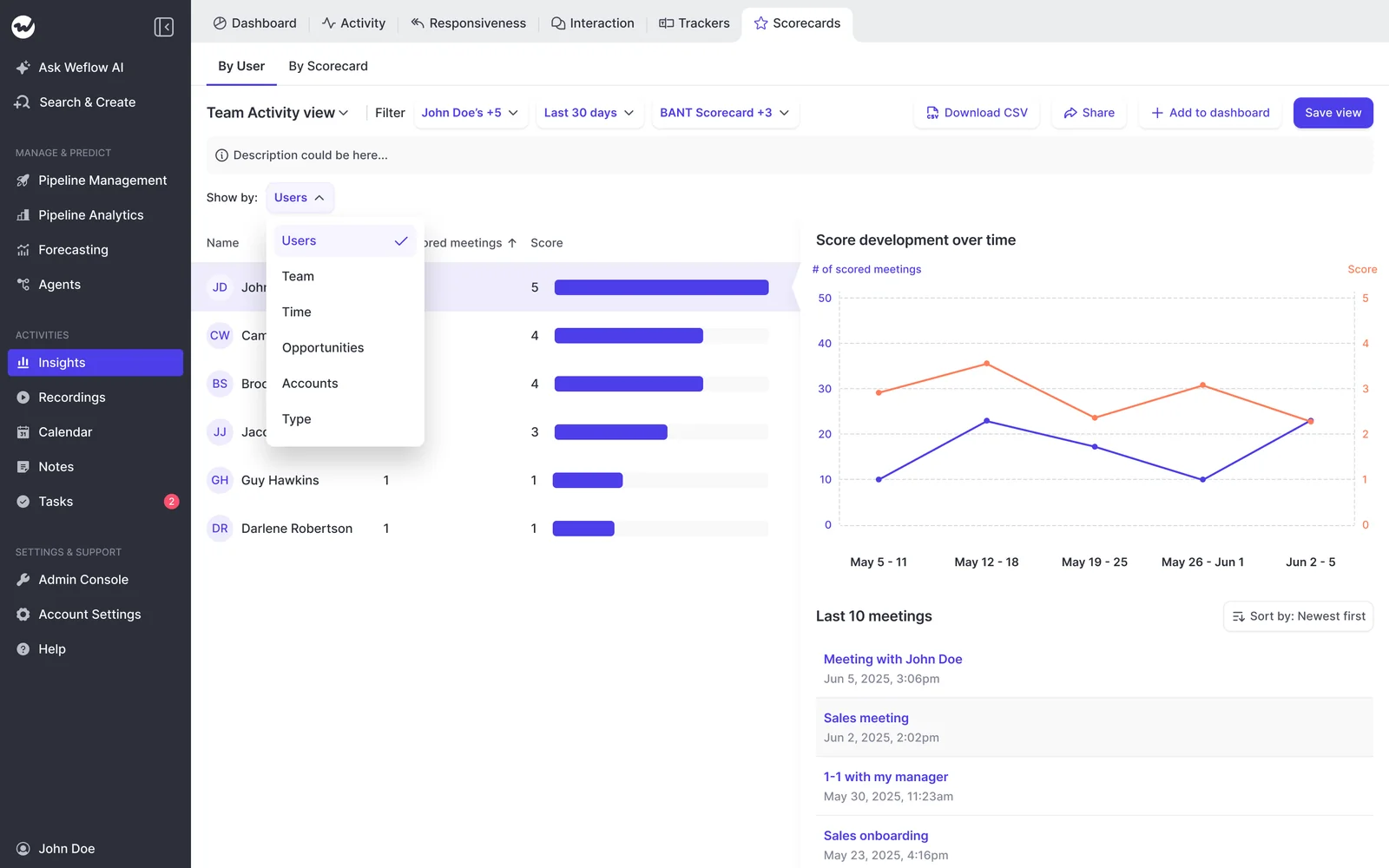
- Insights benchmarks: Weflow Insights shows any metric for a set of users and a period against two benchmarks, the selected users' average and the all-user average, and exports to CSV.
What Weflow won't do for your 4DX rollout
- Weflow has no single manager page that combines one rep's calls, scores and metrics over time. For now, you read interaction metrics in Insights and coaching scores call by call. Gong is further along on that rep overview.
- Weflow counts the questions a rep asks but doesn't judge whether they were good questions.
- Time in meetings comes from calendar events, so it counts the scheduled slot and nothing outside it.
- Weflow doesn't derive your weights from win, slip and loss data. That analysis is your work or RevOps' work, and it comes first.
- Weflow doesn't score individual sellers when several reps are on the same meeting.
- Weflow scores what's recorded and captured. If recording coverage is low, fix that before you run a scoreboard on it.
What Weflow Conversation Intelligence costs per seat
Weflow Conversation Intelligence costs $39 per user per month, billed annually. Coaching templates, interaction metrics and Insights come with it.
| What's included | Detail |
|---|---|
| Weflow Conversation Intelligence | $39 per user per month, billed annually |
| Ask Weflow AI Pro | Included |
| Weflow Agent Builder | Free tier included, 25 agent actions per month |
| Weflow Mobile Copilot and the desktop app | Included with the seat |
| View-only licenses | Unlimited, so leaders and stakeholders can read without a paid seat |
| Revenue AI bundles | Revenue AI Foundation $49, Revenue AI Business $59, Revenue AI Enterprise $79 per user per month |
All plans bill annually with a 10-user minimum, and there are no implementation fees.
Walk through the product yourself, no call required.
Spot the signs your sales 4DX rollout is decaying
You'll usually see decay in what people say and do weeks before it shows up in conversion.
| What you hear or see | What broke | What to change |
|---|---|---|
| "I cover it in my one-on-ones" | The cadence lost its fixed slot | Put the three questions back into the Monday team meeting, same time every week |
| A scoreboard nobody glances at | It grew into a report | Cut it back to the lead-measure score by stage until it reads in five seconds |
| Reps quietly avoiding the recorder | Rep metrics reached the wrong audience | Show reps the team score and their own progress, and keep rep detail for managers |
| Lead measures drifting back to activity counts | Activity was the easiest number to report | Go back to the element your win, slip and loss data points to |
| Scores rising on filler | The score depends on what reps type | Score from the evidence on the deal, and treat typed filler as not assessed |
| A second and third goal creeping back in | The whirlwind won the argument | Re-name the one goal and park the rest out loud, in front of the team |
FAQs sales managers ask about running 4DX
How long before a lead-measure score moves conversion?
We can't promise a timeframe, but you can track the rep trend: compare each rep's element scores from 90 days ago with today's. If the lead measure isn't moving, conversion won't either.
What happens if a rep disputes the AI score?
Treat the dispute as the coaching conversation, and ask the rep what evidence they think the score missed. In Weflow, a manager can override a coaching score, and a rep can override any AI Playbook field.
Weflow then evaluates the override for plausibility against the deal.
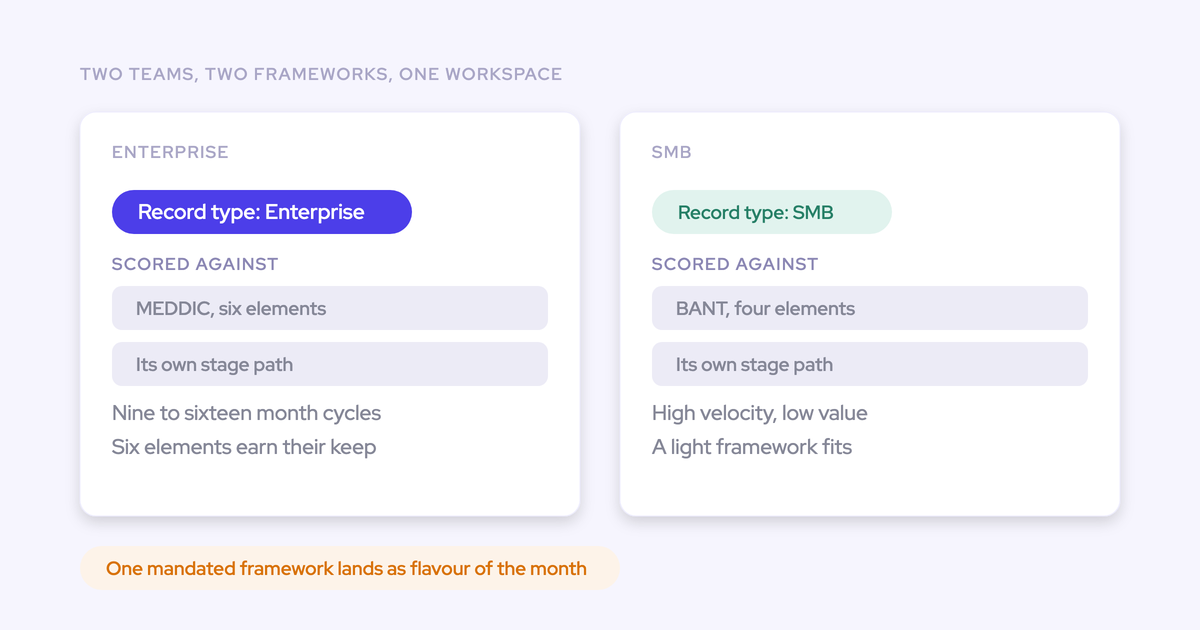
Does 4DX work for a BANT or SMB sales team?
Yes. The framework stays the same, and your lead measure becomes whichever BANT element your losses trace back to.
Cerutti found the drivers of winning, slipping and losing close to identical across enterprise, mid-market and SMB. Weflow ships BANT templates for both coaching and AI Playbooks.
How much recording coverage do I need before scores mean anything?
Treat recording as the first milestone and coaching as the second, rather than launching both at once. Until most customer meetings are recorded, a scorecard measures a sample the rep chose.
Email and CRM evidence still count toward deal scores, but coaching depends on call coverage.
We already use Gong. Do we need another tool for 4DX?
Gong is strong at the aggregated level.
Gong trackers detect whether methodology topics came up on a call, but they don't weight them against your win, slip and loss data, so teams that want a methodology score on the opportunity have to build it separately in Salesforce.
If that score is your lead measure, that extra build is what you're weighing.
How does Weflow handle recording consent and GDPR?
Weflow holds SOC 2 Type II, is GDPR compliant, uses Zero Data Retention for AI processing and never uses customer data to train AI models.
You can also set retention rules that delete recordings after a set period, and keep your data in the EU, the US or Australia.