Why Per-Call Methodology Scores Misjudge Reps on Long Enterprise Deals
Learn why per-call MEDDPICC scores misjudge reps on long enterprise deals—and what to score instead.


A per-call MEDDPICC score tells you how one conversation went. The trouble starts when you use it to answer a different question: has this rep qualified this deal?
On a nine-to-sixteen-month enterprise cycle, no single call covers every element, so the scorecard reads "not yet relevant" as "failed." A rep nails Metrics on call one and gets a 4.
On call two, Metrics is already settled, so the rep doesn't re-ask it, and the scorecard hands them a 1.
The fix isn't to scrap call scoring. It's to split the questions you're asking it to answer:
- Score calls to coach the conversation, with "not discussed" treated as neutral.
- Score the opportunity across every call, email and CRM field to judge qualification.
- Judge the rep from deal-level element ratings across their deals, never from averaged call scores.
The second layer is the qualification picture your deal reviews and one-on-ones need, and it's the one most teams are missing.
What's the difference between per-call and deal-level MEDDPICC scoring?
Per-call MEDDPICC scoring judges one conversation against the methodology. Deal-level MEDDPICC scoring judges whether the whole opportunity meets the methodology, using every call, email and CRM field on the deal.
The same split applies to MEDDIC or a house framework.
Most teams use the first to answer the second.
| Per-call score | Deal-level score | |
|---|---|---|
| The question it answers | How well did the rep run this conversation? | Is this deal qualified? |
| What it reads | One call transcript | Every call, email, meeting and CRM field on the opportunity |
| When it's right | Coaching discovery depth, objection handling and how the rep ran the meeting | Deal reviews, forecast calls and judging a rep's qualification skill |
| What it gets wrong if misused | Penalizes settled elements, ignores email, and turns stage mix into a skill score | Says little about how any single conversation went |
One enterprise deal, scored call by call and as a whole
Let's look at a typical enterprise deal: five calls over several months, with email doing a lot of the qualification work in between. Here's what each touchpoint established, how a per-call scorecard handles everything else, and where the deal stands.
| Touchpoint | What it established | What the per-call scorecard does with the rest | Running deal-level state |
|---|---|---|---|
| Call 1: Discovery | Identify Pain, Metrics quantified, a likely champion | Scores low on Economic Buyer, Decision Process and Paper Process | Pain and Metrics established. Champion partial. The rest not yet discussed |
| Email thread | The contact confirms she'll drive it internally and names who signs | Never sees it | Champion established. Economic Buyer partial: named, no access yet |
| Call 2: Demo | Decision Criteria | Scores low on Metrics, already settled on call one | Decision Criteria partial. Metrics still established |
| Call 3: Technical | Technical criteria, Competition | Scores low on Metrics, Economic Buyer and Paper Process | Decision Criteria and Competition established |
| Email thread | The champion lays out the approval steps and timeline | Never sees it | Decision Process established |
| Call 4: Business case | Economic Buyer joins and confirms the Metrics | Scores low on Pain and Champion, both settled | Economic Buyer established |
| Call 5: Negotiation | Paper Process: legal review, procurement steps | Scores low on Pain, Metrics and Champion | All eight elements established |
By negotiation, the deal is cleanly qualified, with every element established roughly in the order the buyer was ready to discuss it.
The per-call trail tells a different story. Every call scores low on something, and two elements, Champion and Decision Process, were confirmed in email, so they never reached a call score at all.
Read the call scores and you see an inconsistent rep. Read the deal and you see a rep who did the job well.
Why per-call MEDDPICC scores misjudge reps on long deals
A per-call model judges a slice of the buying cycle against the whole cycle. That creates four problems, and each one gives your reps a fair reason to push back on the number.
A settled element scores as a miss on the next call
Once Metrics is quantified and agreed, re-asking it is poor selling, since the buyer has already answered.
But a per-call scorecard has no memory of that answer, so the rep who scored a 4 in discovery gets a 1 on the demo for doing the right thing.
Discovery calls get marked down on Economic Buyer and Paper Process
A discovery call that never reaches the economic buyer, the decision process or the paper process didn't fail those elements. They just weren't relevant yet.
Score them as failures, and reps learn to force late-stage questions into early conversations. Discovery starts to feel like an interrogation built around what you need to know, not what the buyer needs you to understand.
"If I'm trying to figure out someone's budget, that's not about them, that's about me."
— Richard Harris, Sales advisor, trainer, and founder of the Harris Consulting Group
Champions and decision makers named in email never reach a call score
A lot of key qualification happens only in email. A rep confirms the champion in a follow-up thread, or the buyer names who signs in a forwarded note. A per-call model can't read email at all, so it scores the rep as if none of that happened.
Averaged call scores measure your reps' stage mix, not their skill
When you average call scores into a rep score, you mostly measure which stage that rep's deals happen to sit in. Early-stage calls can only reach a few elements, so a rep with a young pipeline averages lower than a rep closing out late-stage deals.
| Rep A | Rep B | |
|---|---|---|
| Where most deals sit | Discovery and demo | Business case and negotiation |
| Typical calls this quarter | First meetings, product walkthroughs | Economic buyer meetings, procurement calls |
| Elements those calls can reach | Pain, Metrics, early Champion | Most of MEDDPICC |
| Averaged call score | Lower | Higher |
| What it tells you about qualification skill | Nothing | Nothing |
That's why managers quietly stop trusting the number. A score your reps can argue with is worse than no score at all.
On one call with us, a sales leader went through a call that Revenue.io's AI had rated highly, criterion by criterion, and concluded it was a poor one. Once that happens, nobody trusts the scorecard again.
Why conversation tools score methodology one call at a time
This isn't a problem with your setup. It's how the category was built:
- Conversation intelligence made the recording its unit of analysis.
- Scorecards inherited the manual call-review rubric managers used to fill in by hand on a sample of calls.
- AI now runs that same rubric on every call. Gong's scorecard templates, for example, ship with automatic review switched on by default.
- Teams average those call scores into a rep score, and the methodology falls back to a slide.
Where a weighted deal score does exist, teams usually build it themselves, using call-level trackers to detect mentions and then building the score in Salesforce with RevOps and IT. That's a build cost your conversation intelligence tool didn't take off your plate.
Keep call scoring for coaching the conversation itself
That said, per-call scoring is the right tool for its own question: how did the rep run this conversation?
Discovery depth, listening, objection handling and next steps all live inside one call, and scoring every call means you coach from a trend instead of the three or four calls you had time to hear.
"There's no manual call review anymore. The AI automates that and scores every call against your methodologies and enables you to basically see over time how your sales methodology is operationalized."
— Janis Zech, CEO and Co-founder of Weflow
Two changes can make your current scorecard fairer this week.
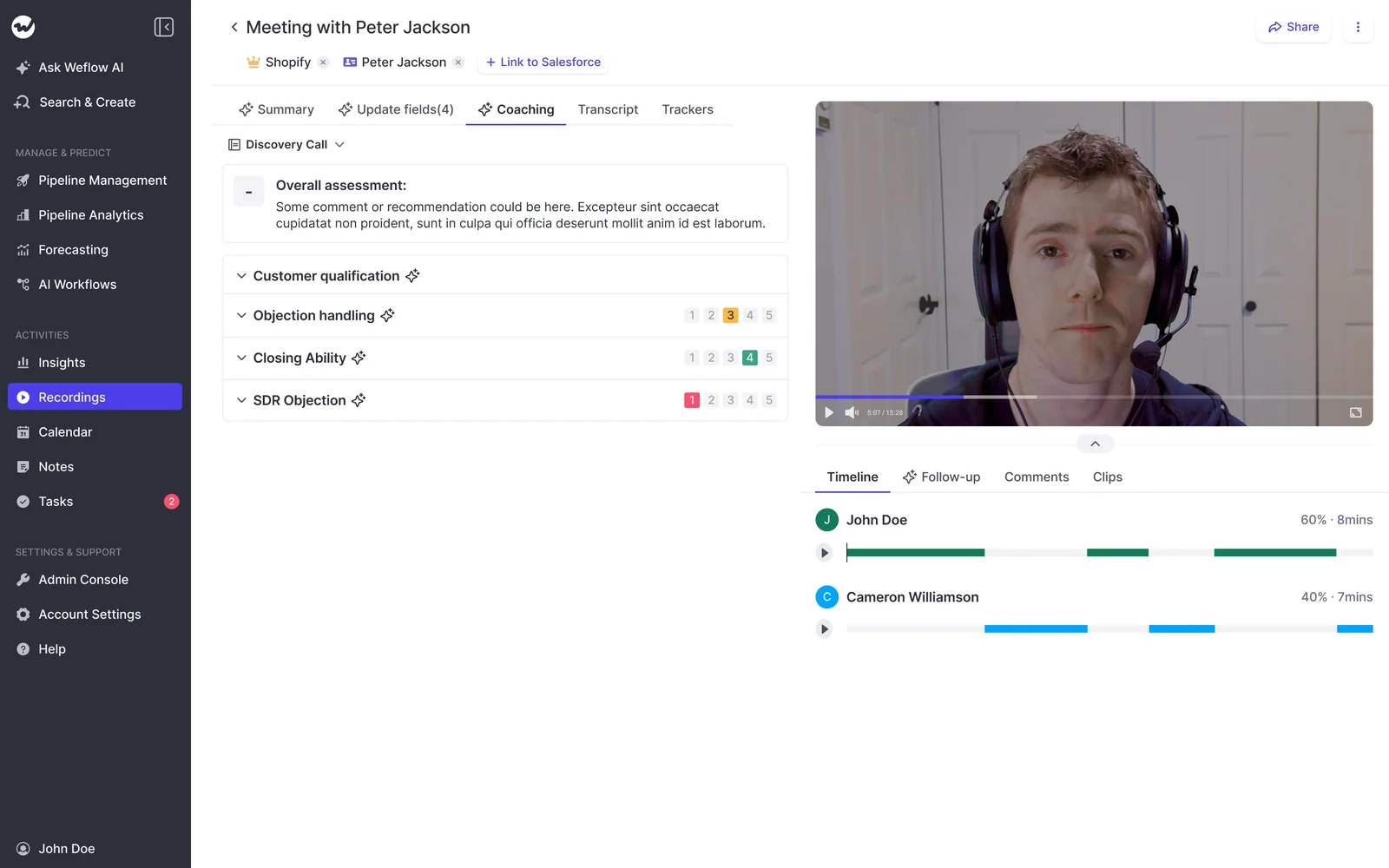
Score each MEDDPICC element separately and treat "not discussed" as neutral
A single free-form block for all of MEDDPICC gives you one judgment that's hard to act on. Separate blocks give each element its own score and reason.
- Give each element its own block, rated 1 to 5, with a written reason for the rating.
- Add an explicit rule: an element that wasn't discussed scores neutral, not low, and the output says it wasn't discussed.
- State the scale in every prompt that reports the score, including agents that summarize scores by email. Otherwise the scale drifts, and a 1-to-5 in the app turns into a 1-to-10 in someone's inbox.
For example, a block for Economic Buyer could read: "Rate 1 to 5 how well the rep confirmed access to the person who signs. If the economic buyer wasn't discussed on this call, return Not discussed and do not score it."
Let the meeting type decide which scorecard runs
Tag calls by type so discovery isn't scored on the closing rubric. That way, each type gets a scorecard built around the elements it can actually reach.
| Meeting type | Elements worth scoring there |
|---|---|
| Discovery | Identify Pain, Metrics, early Champion signals |
| Demo | Decision Criteria, Champion |
| Technical | Technical Decision Criteria, Competition |
| Business case | Metrics, Economic Buyer, Decision Process |
| Negotiation | Paper Process, Decision Process |
Weflow tags each recorded meeting with its type automatically, and the type can trigger a specific scorecard, field update and summary.
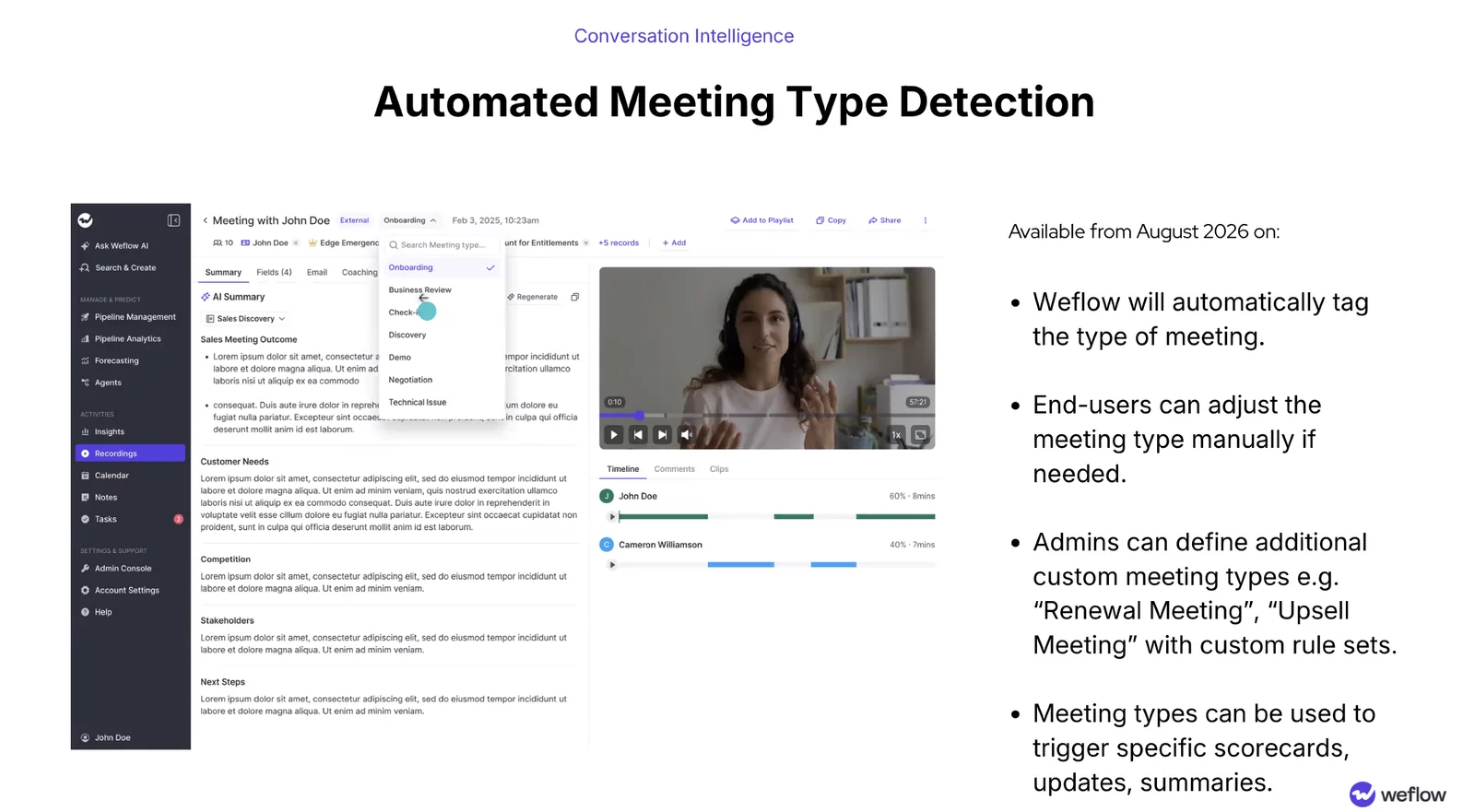
Meeting types reduce the unfairness, but they don't remove it. A demo scorecard still can't see what discovery settled or read the email where the champion confirmed. For that, you need to score the deal.
How deal-level MEDDPICC scoring reads the whole opportunity
A deal-level score pulls evidence from every source on the opportunity, judges how well each element is established, and stays current as the deal moves. Whether you build or buy, these four properties are a good way to judge any approach.
Deal-level scoring reads every call, email and CRM field
Because the unit is the opportunity, a champion named only in email still counts. A deal score needs:
- Transcripts of every recorded call on the deal.
- Emails in both directions, including threads the rep never logged by hand.
- Calendar events and meeting attendees, so you see who joins and who doesn't.
- CRM fields and related records, including the methodology fields reps already filled.
Phone-led teams are the exception. If your reps send pre-approved email templates, those emails say the same thing on every deal and carry almost no qualification signal, so the evidence comes from the calls.
Rate each element on evidence, not on whether the field is filled
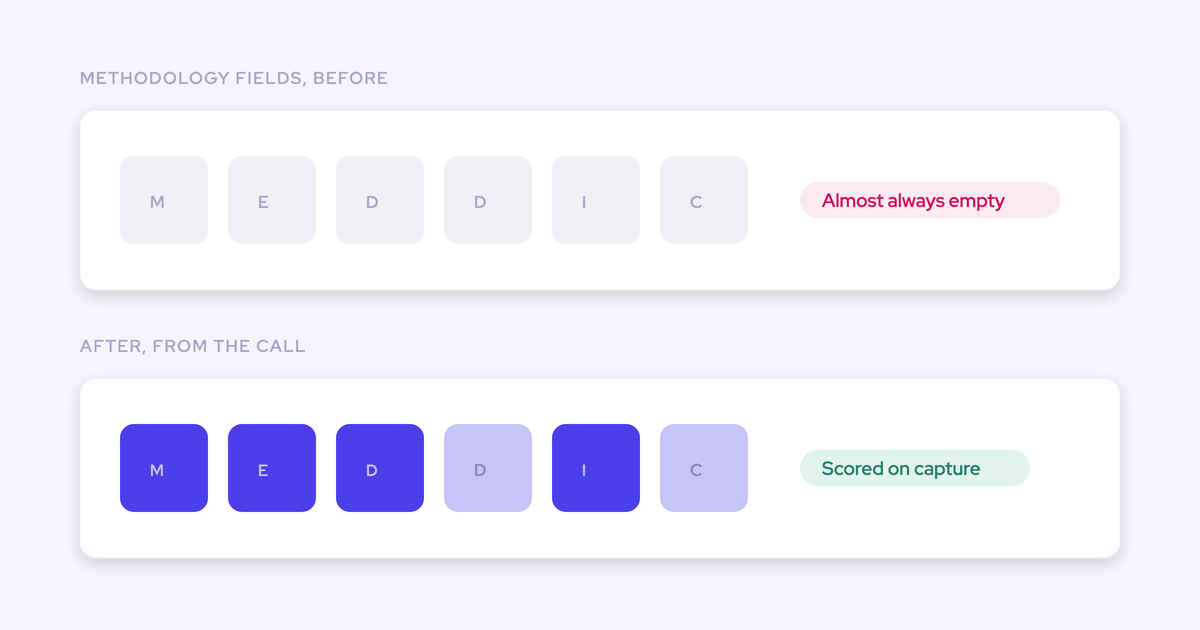
A filled field only proves someone typed something. Managers know this, which is why they distrust methodology fields.
"Did the buyer say this, or is it just a sales rep filling out a custom field in Salesforce?"
— Dan Jiao, VP RevOps at Aircall
The answer is to rate each element on what the evidence actually shows:
| State | What it means | What you do with it |
|---|---|---|
| Fully established | The evidence clearly supports the element | Move on in the deal review |
| Partial | Some evidence, with a note on what's missing | Ask the rep about the specific gap |
| Never discussed | Nothing in calls, emails or fields supports it | Check whether the stage calls for it yet |
| Rep-typed filler | Text in the field that the evidence doesn't back | Treat it as not assessed, never as complete |
The real problem with a methodology field is rarely an empty box. It's one someone filled in to get past a validation rule.
Write element criteria that say what doesn't count as evidence
When your definition lives only in people's heads, AI will fill a methodology field with something plausible and wrong. We hear versions of this on evaluation calls:
"If the metrics comes back and says they have 50,000 staff, that is a metric, but it's not relevant to what we're looking at in our sales process."
The fix is to write criteria that spell out the exclusions:
| Plausible but wrong | Criterion that prevents it |
|---|---|
| Metrics returns the customer's headcount | Metrics are quantified numbers tied to the buyer's goals. Company size and headcount don't count |
| Champion names one of your own employees | The champion works at the customer. Exclude internal people |
| Economic Buyer holds a name with no contact behind it | Established only when there's evidence of access to the person who signs, not just a name |
So rolling out deal-level scoring is partly a project to write your methodology down, and most teams find that nobody ever did.
Rerun the deal score whenever new activity lands
A deal score is only useful if it's current, so it should refresh whenever a new call, email or field change lands, and on a schedule in between.
Your existing pipeline also needs a one-time backfill. Those are usually the deals you want scored first, and they won't score themselves.
If you're writing your element criteria now, our MEDDPICC Sales Process checklist is a handy reference for what each element should look like.
How to judge a rep's MEDDPICC skill across their deals
Roll up element ratings across a rep's deals, and you get a skill pattern. That's exactly what managers ask us for:
"Salesperson A. They need to work on getting the E in med pick because they always fail at that"
Averaged call scores can't produce that sentence. Deal-level ratings can.
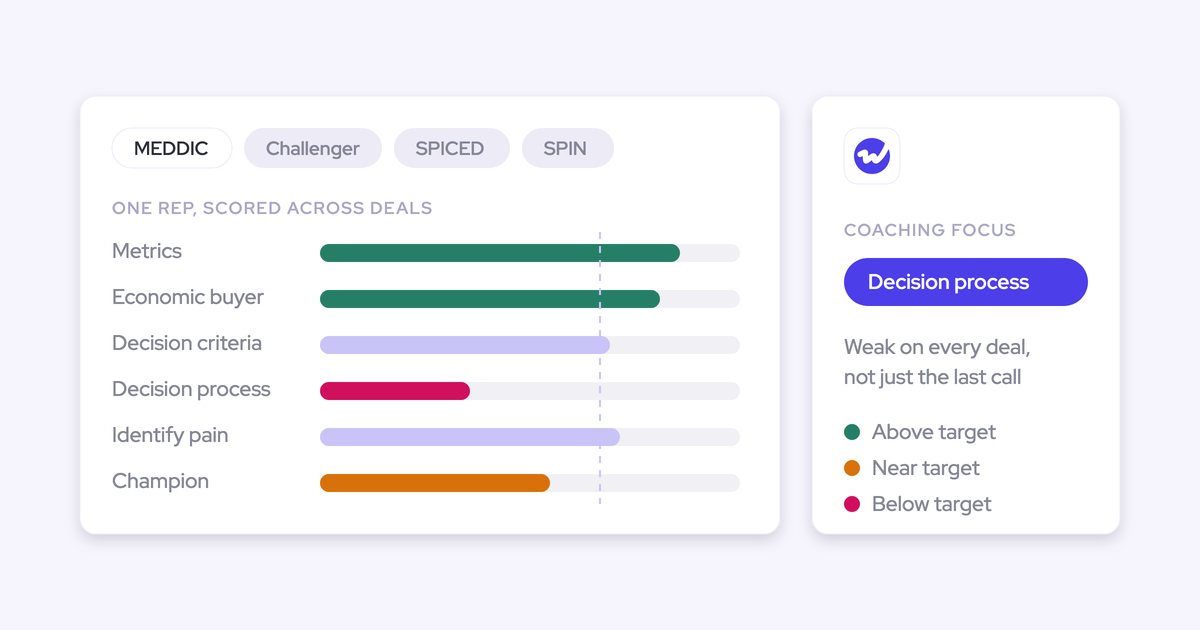
Build a rep's skill profile from element ratings across deals
Look at how each element ends up across the ten or so deals a rep runs, and a pattern shows up fast:
| Element | Rep A, across their deals | Rep B, across their deals |
|---|---|---|
| Metrics | Established on most | Partial on most |
| Economic Buyer | Partial or never discussed on most | Established on most |
| Decision Criteria | Established on most | Established on most |
| Decision Process | Partial on most | Established on most |
| Paper Process | Partial on late-stage deals | Established on late-stage deals |
| Identify Pain | Established on most | Partial on most |
| Champion | Established on most | Partial on most |
| Competition | Established on most | Established on most |
Rep A needs coaching on access to power, while Rep B qualifies the process well but keeps the pain shallow. Those are two specific coaching plans, and neither would show up in an averaged call score.
The profile also has to come to you. Managers tell us they won't dig through a tool call by call, so it should land as a summary before the one-on-one.
One caveat: use it to coach, not for comp. AI ratings vary between runs, and a wrong rating tied to pay does real damage to trust.
Make reps defend their own read against the evidence
Full automation has a cost, though. If the system fills in everything, reps stop thinking through the qualification questions, and that reflection was the whole point of the methodology.
The answer is to split the work: let the system score the deal from the evidence, then have reps answer the questions themselves and pressure-test their answers against the score.
"The bot tells the rep: your champion is not a three. You do not have these things."
— Julien Cerutti, VP of Global Revenue Strategy at Meltwater
The gap between the rep's view and the evidence is your coaching moment, and it doubles as the agenda for your forecast call.
"You're looking for what is the system telling me, and then what is my rep telling me, and what is the disconnect? So that's where I can focus."
— Kelly Lewis, RevOps and sales leadership coach; co-host, The Revenue Insiders podcast
Reps should be able to override a rating, but the override should be checked against the deal. That way, a disagreement turns into a conversation about evidence, not a contest of confidence.
Your options for scoring the deal instead of the call
Each path fixes part of the problem. The cheap ones reduce unfairness but don't give you a deal-level view, while the build paths do, at a build and maintenance cost.
| Approach | What it fixes | What it leaves unsolved | Who it suits |
|---|---|---|---|
| Rewrite the scorecard with a neutral rule | Settled and not-yet-relevant elements stop dragging scores down | Still one call at a time, no email, no deal view | Every team, starting this week |
| Tag calls by meeting type | Discovery stops being scored on the closing rubric | Can't see earlier calls or email | Teams with distinct call types and a tool that supports tagging |
| Stitch calls together by hand before reviews | An accurate picture of one deal | Doesn't scale past a few deals, so it rarely happens | A manager prepping one critical deal |
| RevOps builds a weighted deal score in Salesforce | A score on the opportunity, weighted from your own outcomes | RevOps and IT build time, ongoing maintenance, and the inputs still have to come from somewhere | Teams with RevOps capacity and a stable framework |
| Prototype in a general AI assistant such as Claude | Fast test of your criteria on real transcripts and emails | No management layer, no rep-level view, no one maintaining it | Testing element definitions before you configure anything |
| Use a tool that scores the opportunity | Deal-level ratings from every source, kept current | Subscription cost, and criteria you still have to write | Teams that want deal and rep views without building them |
Several tools score the deal well. Gong's AI Deal Reviewer ships deal-level methodology playbooks that sync with the CRM opportunity, and Gong can summarize methodology across every call on an account.
Avoma and Aviso both score deals from meeting and email evidence. If your team already uses Gong's deal-level view and trusts it, stay where you are.
How Weflow scores the call and the deal separately
Weflow is the Revenue AI Orchestration platform for sales, customer success and RevOps teams on Salesforce. We built methodology scoring as two layers, configured separately, each answering its own question.
Coaching templates score the conversation, AI Playbooks score the opportunity, and scoring runs at call, opportunity and rep level.
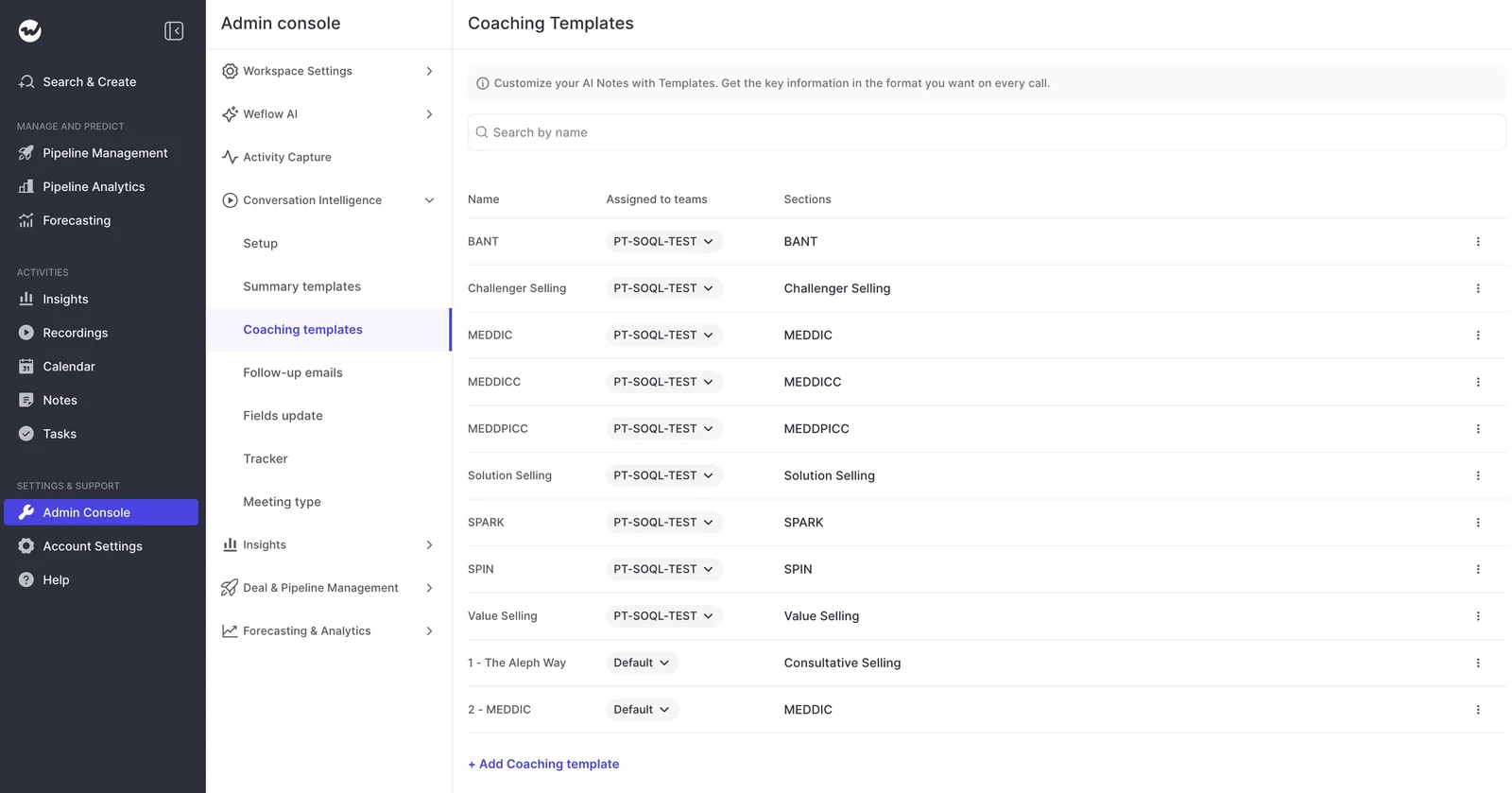
Weflow Conversation Intelligence coaching templates score each conversation
Weflow Conversation Intelligence scores every recorded call against your team's methodology, and a manager can override the score.
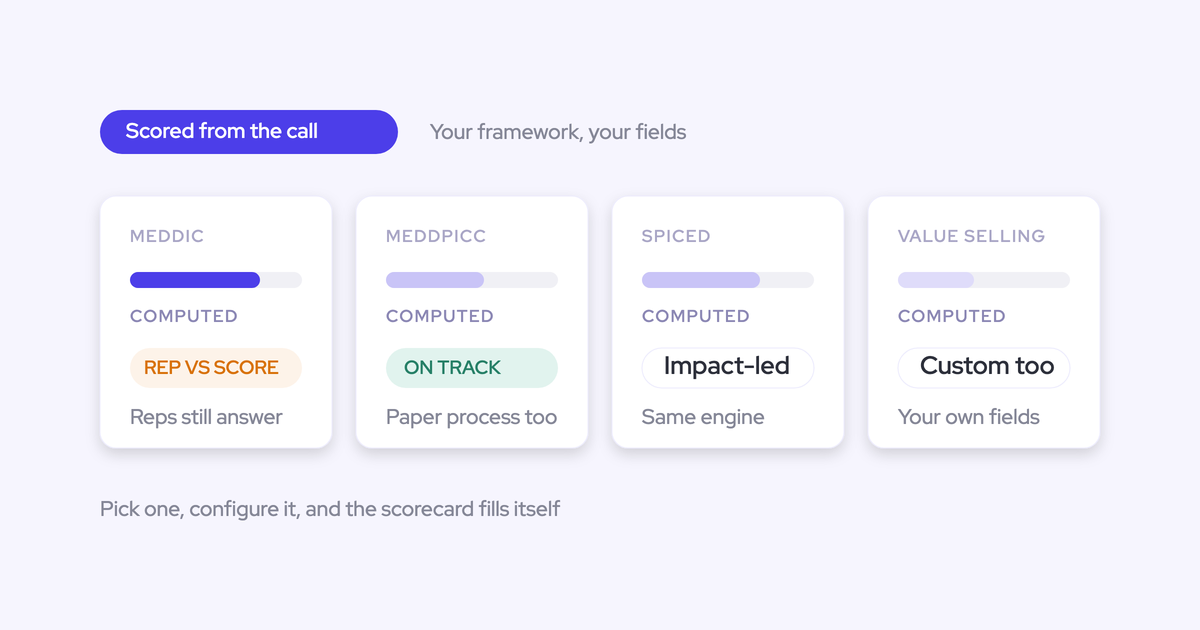
- Templates ship for MEDDIC, MEDDICC, MEDDPICC, BANT, SPIN, Challenger Selling, Solution Selling, SPARK and Value Selling, and you can build your own.
- Each template is assigned per team, so different teams get scored on different frameworks.
- You can score a methodology as a whole or element by element, with a 1 to 5 rating or free-text feedback per section.
- Admins can rewrite every prompt behind a template, which is where your neutral rule goes.
- Meeting type can drive which scorecard runs.
Weflow AI Playbooks score the whole opportunity
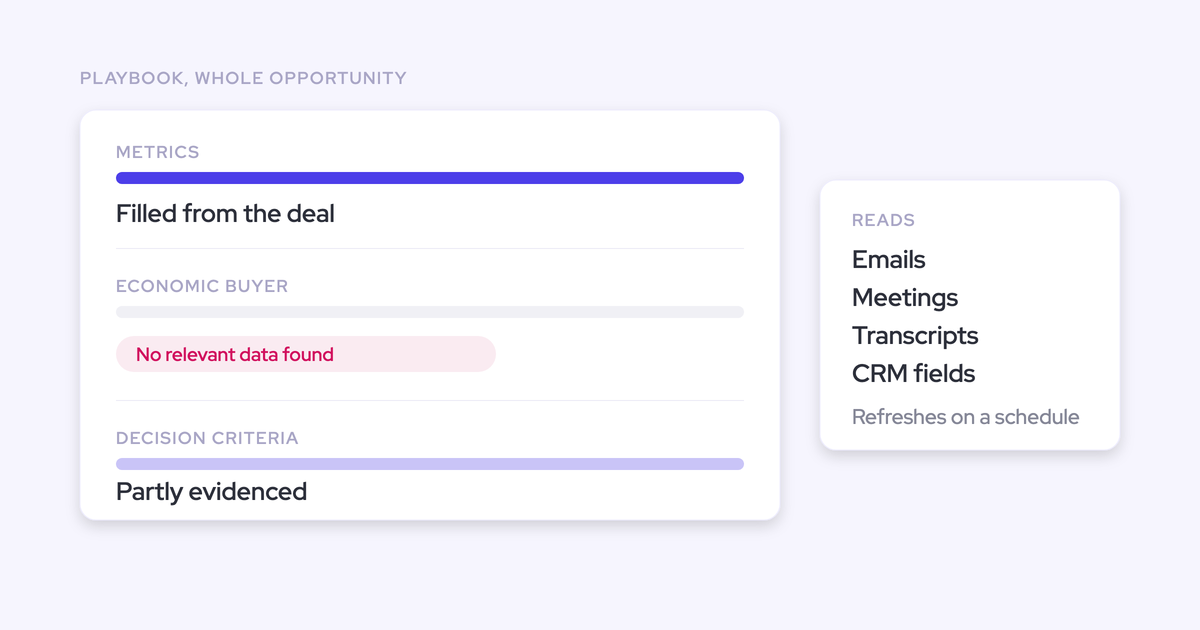
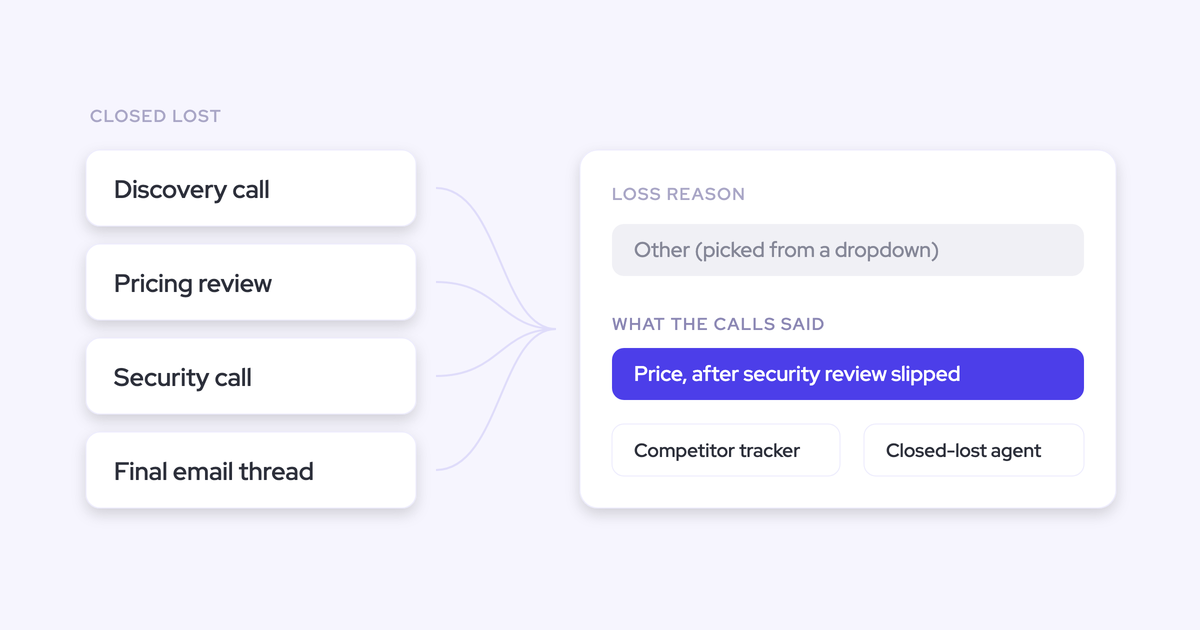
Weflow AI Playbooks read every email, meeting, transcript and CRM field on the opportunity and score the deal against your methodology. A champion named only in email counts, and a deal that looked qualified on its last call can still score low overall.
Each playbook runs two steps on every opportunity:
- It fills in each element of the methodology from the deal's evidence.
- It judges how well each element is established: fully established, partial with a note on what's missing, or never discussed. It checks rep-typed text too, so filler gets marked as not assessed.
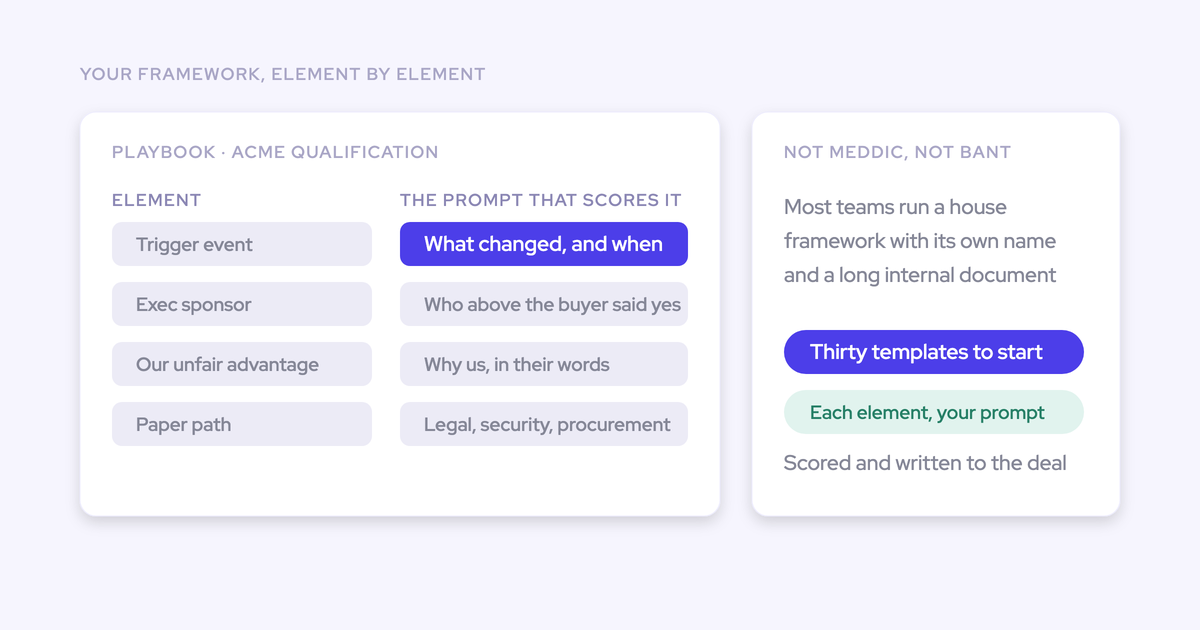
Each element carries your own evaluation criteria, describing what a properly completed element looks like and what doesn't count. That's also how house frameworks work, and around thirty methodology templates give you a starting point.
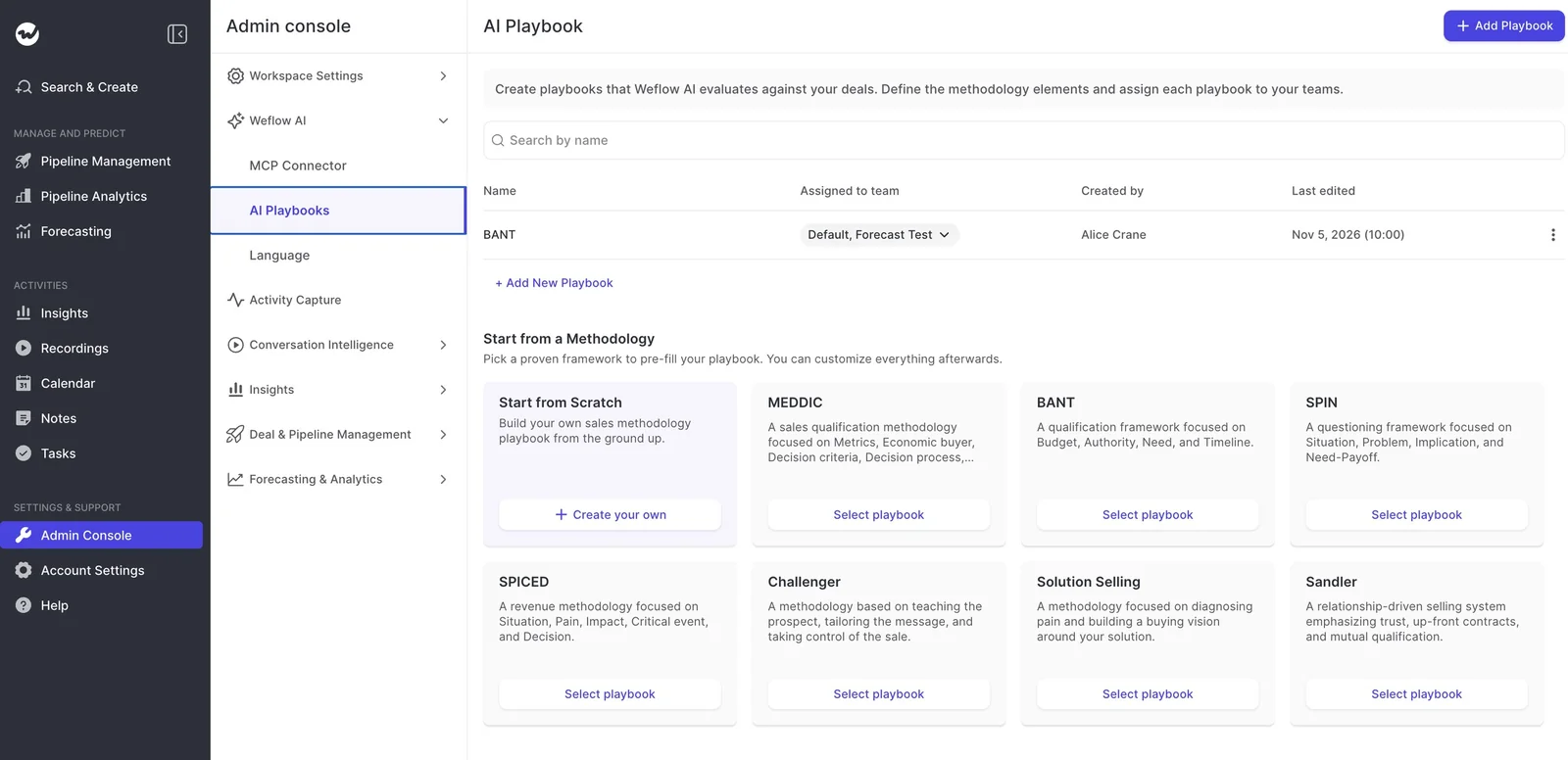
Playbooks rerun when new activity lands on the opportunity, and otherwise every three hours, for opportunities created or changed after setup. Your older pipeline gets scored in one step: select the opportunities in a list and run Generate AI Playbooks.
Reps can override any element, and Weflow evaluates the override for plausibility against the deal. The result shows per element on the deal board, so you read what's evidenced and what's missing in one place.
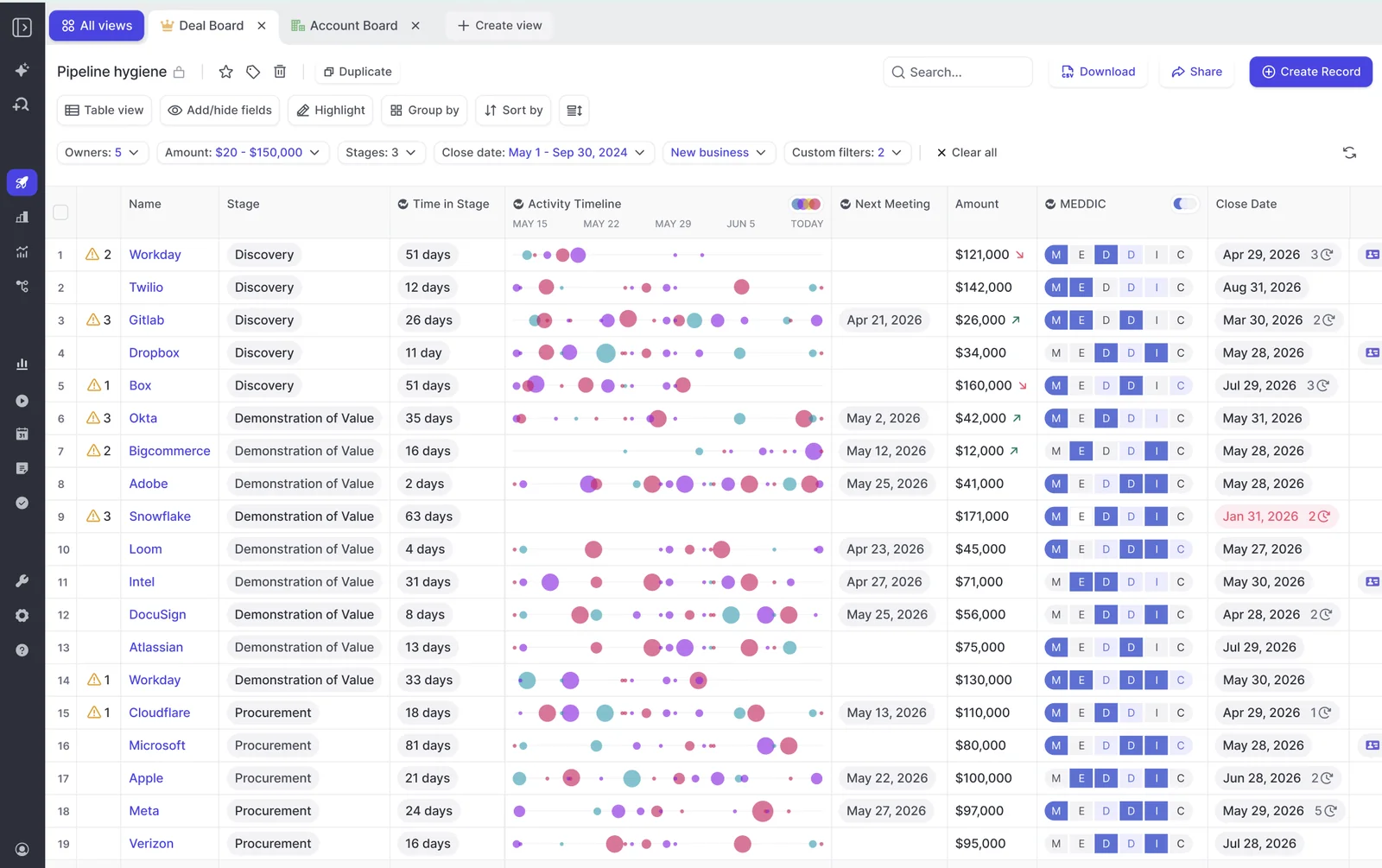
Because scoring also runs at rep level, you see which element a rep is weak at across every deal they've worked, not on one call. Ask Weflow AI and scheduled agents can deliver that to your inbox, Slack or Microsoft Teams before the one-on-one.
What Weflow writes back into your Salesforce MEDDPICC fields
Weflow writes compiled playbook element values into the MEDDPICC fields your team already has in Salesforce, once you switch on write-back for the playbook and the integration user has edit rights on those fields. Some outputs stay in Weflow:
| Output | Where it lands | What that means for you |
|---|---|---|
| Compiled element values from a playbook | Your existing Salesforce MEDDPICC fields, with write-back on | They show in your Salesforce reports and dashboards. Writes are automatic, with no approval step |
| Playbook score | Weflow field | Visible in Weflow deal views and the sidebar, not in Salesforce reports or BI tools |
| Deal warnings | Weflow field | Visible in Weflow, not reportable in Salesforce |
| Call-level AI field updates | The Salesforce fields you map | The rep approves each change by default, or you set a field to update automatically |
| Coaching scorecard results | Salesforce, once the corresponding fields exist | Call scores become reportable alongside the deal |
A new playbook starts as a reference view and writes nothing. If you want rep sign-off before values land, keep it that way or point it at separate test fields first.
Where Weflow's deal scoring stops today
- The Weflow call scorecard judges each call on its own and doesn't take earlier calls into account. Deal coverage lives in the playbook.
- AI Playbooks read transcripts only from meetings Weflow recorded. If you record with another tool, playbooks work from CRM data, emails and meeting metadata only.
- AI Playbooks don't appear in the Outlook add-in. Outlook teams use them in the Weflow app or run the Chrome extension alongside the add-in.
- The playbook score and deal warnings don't reach Salesforce reports. Only the compiled element values do, through write-back.
- Weflow has no AI roleplay or practice calls. Teams that want roleplay run a separate enablement tool, and Weflow's API and MCP can pass call data to it.
- Weflow doesn't score individual sellers when several reps are on the same meeting.
- Weflow doesn't capture VoIP phone calls today, which matters for phone-led teams.
If you run coaching as a program, Chorus is strong here. It runs scorecards as time-boxed coaching initiatives with leaderboards and trends, and if that's your operating model, it fits it well.
What Weflow Conversation Intelligence costs
Weflow Conversation Intelligence is $39 per user per month, billed annually, and includes Ask Weflow AI, Agent Builder and Mobile Copilot.
It's also part of our Revenue AI Foundation ($49), Revenue AI Business ($59) and Revenue AI Enterprise ($79) bundles, per user per month, billed annually.
All plans have a 10-user minimum and include unlimited view-only licenses.
FAQ: Per-call and deal-level methodology scoring
Does the per-call problem get worse with MEDDPICC than with MEDDIC?
It tends to, because MEDDPICC adds late-cycle elements like Paper Process that early calls can't reach, which gives a per-call scorecard more chances to mark a rep down for something that wasn't relevant yet.
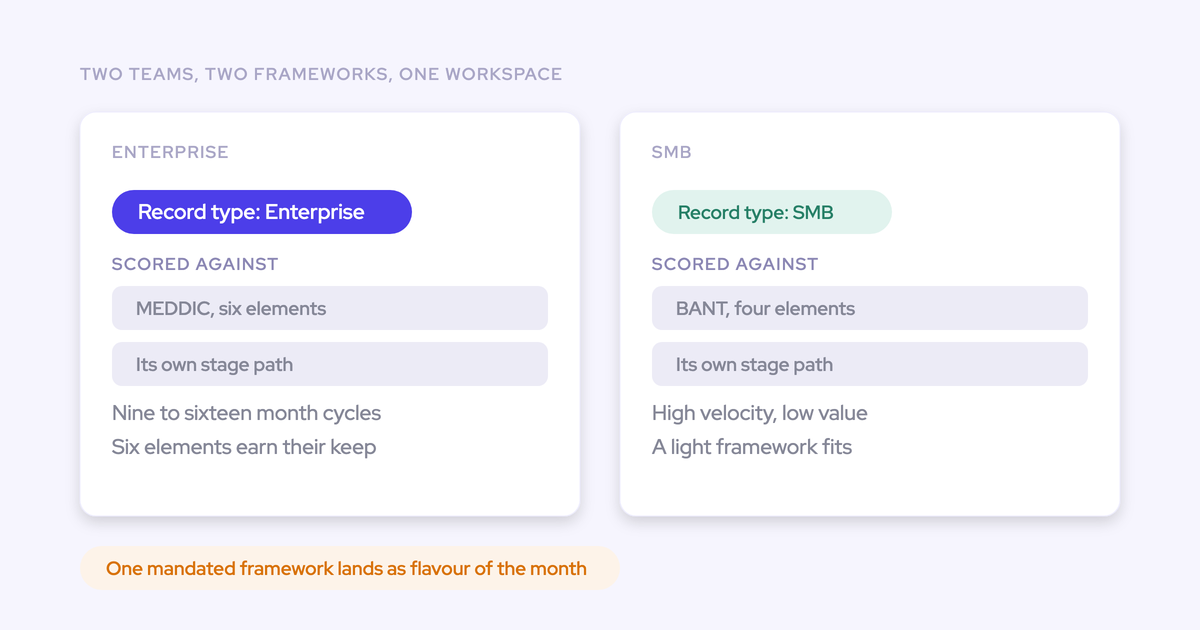
Framework depth should follow deal shape: complex enterprise deals warrant MEDDPICC, while transactional motions with no paper process do better with a lighter framework.
Can I weight MEDDPICC elements using our own win, slip and loss data?
Yes. Practitioners usually start by analyzing a sample of won, slipped and lost deals, then derive weights from why each outcome happened.
Champion often carries the heaviest weight, because strong champions open access to the economic buyer and the decision process. A score weighted from your own outcomes is one reps argue with less.
We record calls with another tool. What do we lose?
Weflow AI Playbooks won't read the other tool's transcripts, so they work from CRM data, emails and meeting metadata only. That said, Weflow does surface the methodology fields the other recorder writes into Salesforce in its deal views and sidebar.
Does deal-level scoring work for our own house framework?
Yes. Weflow AI Playbooks take custom criteria element by element, so a proprietary framework is encoded the same way as MEDDIC or MEDDPICC. Around thirty templates give you a starting point.