#125 Why Most GTM AI Strategies Fail (and How to Fix It)
with
Kelly Lewis & Tiffany Jones
,
Hosts of The Revenue Insiders
October 12, 2026
·
40
min.


Key Takeaways
- Weak AI results in go-to-market come from three connected problems, not from the AI. Janis names them: data siloed across the CRM, ERP, activity and conversation systems; reps spending 40 to 70 percent of their time on non-selling work; and quota attainment that no one can predict. Engineering doubled or tripled its output with Claude Code and Cursor, and go-to-market has not, because these three problems sit underneath every AI tool.
- Activity has to be mapped to the opportunity, not only to the account. Kelly sees accounts running seventeen opportunities at once, some worth $5K and some worth $5M. Without opportunity-level mapping, a team cannot count the touch points a deal needs, see deal velocity in a review, or notice follow-ups that nobody answers.
- Manual data entry does not work, so capture has to be automated where reps already work. Janis's design principles: plug into the systems that hold the signals (email, calendar, meetings, dialers, in-person conversations), map everything back to the CRM's own fields through its API, and stay headless so reps never leave Google, Outlook, Teams or Slack. With that in place, meeting prep drops from 15 minutes to 5.
- AI scores MEDDIC and MEDDPICC across the whole deal, then turns the scores into coaching. AI Playbooks read every call, email and deal room linked to an opportunity, fill in and score each element, and let the rep override any score. Rolled up across a rep's deals, the scores show the manager the exact skill to coach, where today a manager listens to perhaps one of the five to ten calls a rep runs each week.
- Automation makes methodology training more important, not less. Kelly and Tiffany push back that reps still need to think. Janis agrees that reps must understand the framework deeply. Kelly describes the frontline manager's new job: compare what the system says with what the rep says, and coach on the gap. Executives use the same data differently, to see what is real in the pipeline before a board meeting.
- Forecasting failed until the data pipelines existed. Weflow started in forecasting and built a machine learning prediction that did not work, because activity and conversation data had not been unified and mapped first. Janis now wants the CRO to see several forecasts side by side, the AI prediction, the manager roll-up and a RevOps prediction, and to plan inside the range they set.
- Query every transcript and email to find the real reasons deals are lost. A closed-lost note and reason field usually say nothing. Customers use Agent Builder to read every conversation for the real loss reasons, for how often a new product is mentioned and what objections it meets, and for customer success handovers. Connecting Claude to a Salesforce full of bad data gives you BI you cannot trust.
- Vibe coding your go-to-market stack is costly, slow and skips the product feedback loop. Janis likes vibe coding, but for software rolled out to 500 users, an in-house build misses the iterations that come from feedback across many customers. He also thinks handing implementation to an agency instead of the vendor makes little sense.
- For annual planning, ask whether you are AI-first or problem-first. Janis's closing question: start from the biggest problems that stop the business from growing faster, then use AI only where it is part of the answer. The hosts apply it to annual planning, which probably does not need to be AI-first.
Hosts and Guest

Janis Zech
CEO at Weflow
Janis Zech is the co-founder and CEO of Weflow. In this episode, he shares why AI in go-to-market breaks down without clean data, drawing on the lessons from scaling his last B2B SaaS company from $0 to $76M ARR as CRO.

Philipp Stelzer
CPO at Weflow
Philipp Stelzer is the co-founder and CPO of Weflow. In this episode, he joins the conversation on how revenue teams capture activity, inspect deals, and forecast inside Salesforce, bringing a practical view from building tools for modern GTM teams.

Kelly Lewis & Tiffany Jones
Hosts of The Revenue Insiders
Kelly Lewis and Tiffany Jones are the hosts of The Revenue Insiders. In this episode, they speak with Janis Zech about why AI in go-to-market fails without a clean data foundation, and they challenge ideas around critical thinking, business context, and vibe coding.


Full Transcript
Janis Zech: Hello, and welcome to another episode of the RevOps Lab Podcast. I'm Janis, and actually, I'm alone today because we are featuring an episode that we recorded with Kelly and Tiffany from the Revenue Insiders Podcast, which hosted me to talk about our journey at Weflow. So I hope this is insightful. We touch everything from automating context data capture to running agents to doing deal intelligence and podcasting. This is insightful, and wish you a great episode
Tiffany Jones: Thank you so much. Hi. I'm Tiffany.
Kelly Lewis: And I'm Kelly. And we are your revenue insiders. We are here today with Janis, and he is a special guest because he lives also in the RevOps world like me. For other RevOps leaders, you've probably had this moment where you deployed a new tool. It was everything that you were working on, and then none of the data was still in the CRM. Everyone was still asking you for updates. There were a hundred problems still going on. And I know, Janis, you and I have talked, you've experienced the same thing. You've been CRO at a few companies, but now you're CEO and founder at Weflow where you're working on solving that exact problem. AI, of course, is part of solving that. And we know all the boards are asking today how you can implement more AI, and you have a strong point of view on what you need to do first. And it's not the fun, shiny stuff necessarily. So I'm excited to get into some very meaty topics on our episode today. So welcome, Janis, to the Revenue Insiders.
Janis Zech: Welcome. Thank you so much for having me.
Tiffany Jones: It has been exciting to talk through what you are working on. It's in a busy space. It was one of the things that we were talking about. But it's a problem that you have faced, as I just mentioned, as a CRO in prior roles. I'd love to get a little bit of background from you on kind of what your roles were and how you stumbled into this problem.
Janis Zech: Yep. Yeah. Happy to give some background. So when I was twenty two, I founded my first company. Of course, it didn't work out. Then did another one when I was twenty four. I run that for eight and a half years as the CRO. And yeah, we grew to around, you know, eighty five million in gross revenue, you know, ARR, and sold it. We then run the company that bought us, which was a spec, listed that to Frankfurt. It was a public company. Bought three companies within eighteen months. And, you know, then I went out, started another company, invested in a lot of companies. And basically, the problem I always saw was, like, you know, most of the customers had Salesforce, others started using HubSpot, and the reality was, okay, it's supposed to be a system of truth, but in reality, it's not. And then AI came about, and it became very clear that the context data to your opportunities, your pipeline, you know, your coaching enablement programs is super crucial. So we essentially founded Weflow to help solve that, and yeah, happy to talk a bit more about the details, but that's like the background of, you know, who I am and what I've been up to.
Tiffany Jones: I feel this so deeply. My morning has looked like I was on a call with a client this morning already, and we were talking about doing territory reviews for the reps. And I was like, we're gonna AI this. We're gonna make it an AI first approach, and we're gonna pull data from the CRM, and it's gonna be great, and they're not gonna have to do any manual entry. And so I was like, here's a sample of what I did in Copilot. And the sales leader was just like, all of this data's wrong. None of it's right.
Janis Zech: Yeah.
Tiffany Jones: No. Like, I'm so excited. Like, we got this. And then it goes down to the fact that, like, the data was wrong. The finance system isn't talking to the CRM, and the reps aren't putting the right data into the system. So I hope you know that as we discuss this, I'm going to be listening so strongly and feeling this pain.
Janis Zech: I mean, I think everyone has lived through that problem in some version or the other. Right? And so I think the big question is a bit like, okay, how do you solve it? And I think it used to be quite hard to solve. And AI, you know, is obviously amazing and enables you to do a lot more ways to solve it. And so essentially, when you think of the problem set we are addressing, right, it's essentially three main things. One, you have a lot of siloed data in different systems, be it CRM, you know, CDPs, ERPs, right, activity data, conversation data, field data. And that data is essentially siloed and not connected and not speaking to each other. Right? So we call that the AI foundation problem. And then the second is there's a lot of time spent on kind of non-selling activities. Right? Whether that's like forty, fifty, sixty, seventy percent of time. It doesn't really matter. But if you can give time back, that's really interesting. And then the last one, which is essentially connected to these two is, like, you know, how do we make sure that our reps are headquartered and we can predictably and repeatably run our business. And, you know, that's the third one. Like, what we're trying to build is essentially what Claude Code and Cursor have done for engineering. Right? They probably doubled or tripled the productivities. But we haven't seen that in go-to-market yet. Right? It's not that quotas have doubled or tripled or, like, quota attainment has doubled or tripled, and the quota stayed the same. Obviously, nobody would do that. But, like, I think that's basically the long term vision. Right? Like, how do you build something that essentially solves all of these problems and is essentially the best way to run the most effective and efficient sales organization. And yeah, there's a lot to build, so happy to dive into the specific details of that, but that's essentially what we've been up to the last couple of years.
Kelly Lewis: So I mean, it's not a new problem to solve. Right? There are other people in the space that have been doing this long before we started talking about AI and ChatGPT and LLMs and all of that, trying to capture the Friday habits of salespeople and get them in the system faster, or more accurate, but they end up... I mean, I've worked with a few solutions in the space over the last, like, decade plus, and you end up with data not connected to the right contacts, duplicates in your system, missing contacts because something's happening in, you know, a system that's not connected to wherever you're running that kind of conversation orchestration enablement side of things. I'm curious, like, how you've approached that problem differently to think about solving it that will connect that context more concretely, so it's something that works most of the time, at least.
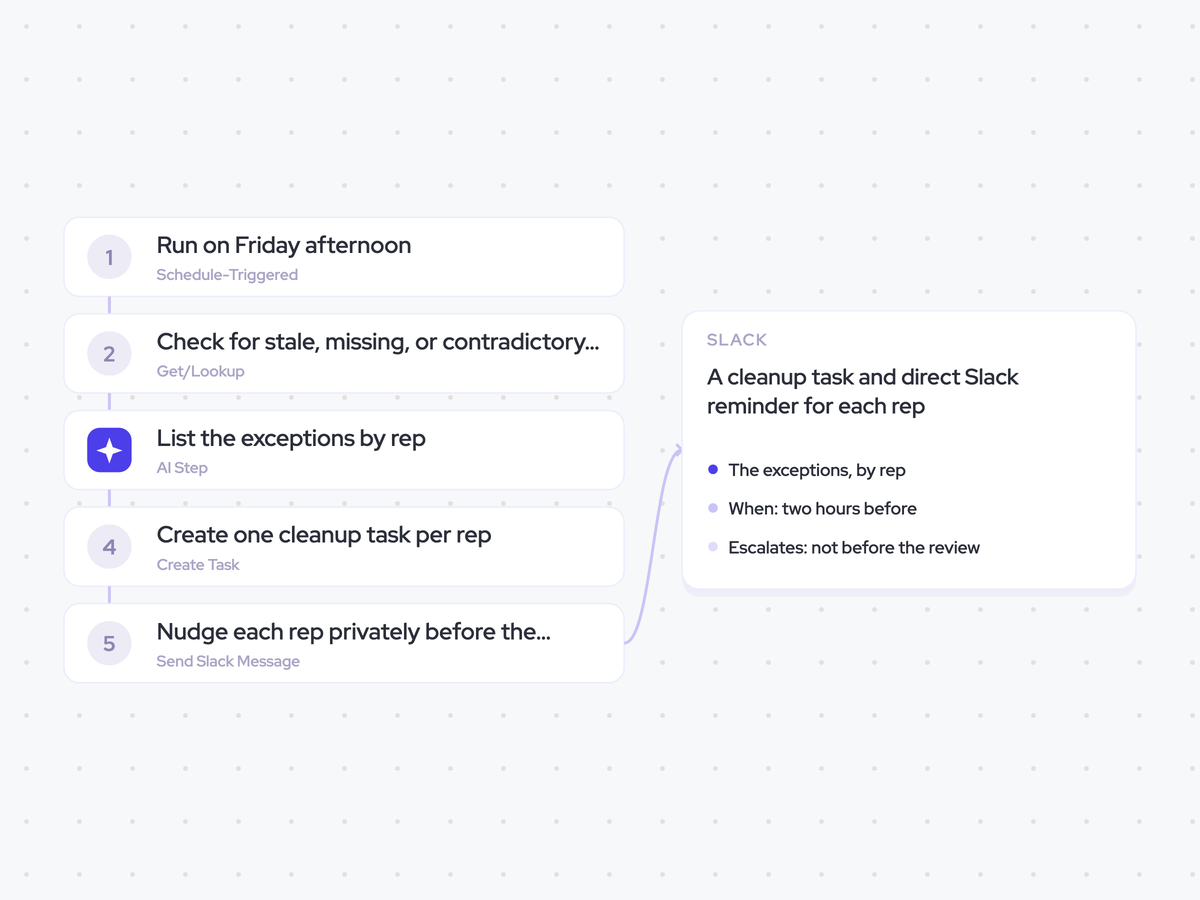
Janis Zech: Yeah. So, I mean, you know, we're not shy about talking about our competitors. So we typically compete with companies like Gong, Clari, Einstein Activity Capture. Right? So these are typically solutions that are in place. And so these were all companies that were founded in two thousand fifteen when AI was still in its infancy, or the version of AI that everybody uses these days. Right? So, you know, when you think about how to solve this problem, I think there's a few core design principles that you need to have in mind. Right? And so one is, like, you have to go from not relying on manual data entry. Everyone hates manual data entry. Right? There's no question about it. But now you can fully automate that. Right? So what we do is we have currently six products. Right? We have a product called Activity and Contact Capture. That's not a new problem. Right? Like, you essentially capture emails, meetings, and also the missing contacts that are not yet in your CRM from either Google or Microsoft. What often... You know, a lot of solutions do that, but they don't do a good job of mapping that back to opportunities. And so if you don't map it back to opportunities, it's very hard to understand, you know, how many touch points do you need to close an opportunity. You know, what's the velocity if you do a deal review? You know, do you do follow ups, but there's actually nobody replying. Right? So, like, it's little nuance details like that that are important. But then the bigger pieces are obviously, you know, the unstructured data. So we have a conversation intelligence product that, you know, is like a typical AI notetaker. You can also use a botless tool. Like, it records in the background. We have a mobile app to record in person meetings, and we also hook into the dialers. Right? So, essentially, again, the same logic. You wanna capture all that data and then map it back against your existing CRM data structure. A lot of tools have their own data structure. They don't really connect well into the CRM layer on a very detailed level. We use APIs to do that. Salesforce just announced headless. We've been doing that for five years, right, which has a big advantage because you can see all the validation rules, dependencies, permission sets. But also, you need to make sure that you map all that data well again back to the right Salesforce records in our case. And then, you know, the AI workflows that are built in are beautiful. Right? So you help reps to, you know, automate meeting prep so they don't need to spend the fifteen minutes for every meeting, but you reduce that to five. They still need to spend some time, but they essentially get a full meeting brief. And that sits in their Google Calendar or in Slack or in their email. Right? Then they basically run the meeting. They get live coaching. After the meeting, they get, you know, a follow-up email. We update the CRM fields either with a human in the loop or, you know, manually. We give the AI summary. All of that syncs back into the CRM, into native fields. You get AI coaching scorecards. Right? So this idea of, like, the manager feedback, which, I mean, of course, some managers do it, but the reality is you have, you know, five to ten calls a week, and the manager looks at maybe one if you're lucky. Right? So the AI gives you feedback on MEDDIC, MEDDPICC, SPICE, any methodology you're using, obviously configurable. And all of that data, you know, and the CRM data and the web data and your Snowflake data or different data sources, then feed the context of your deal management, pipeline management, forecast management, right, or your coaching enablement. And I think that's really, like, you know, the... Like, we learned it the hard way because we had a tool that was, like, very manual in the beginning. It was a very, very easy to use interface that reps loved, but was still very manual. And I think, you know, the reality is it just doesn't work. So you have to automate it. You need to, you know, be headless. You need to be where the reps work. Right? Like, you cannot get them away from Google or from Outlook if they work there, or Teams or Slack. So there's, you know, other design principles, but, like, I think the fundamental takeaway from, like, data capture is, like, integrate with the key signal systems and then map it back to the CRM data structure and automate that process as much as you can with guardrails in place if you want to.
Kelly Lewis: Yeah. There's so much to unpack there. I have three comments. First, I was at a thought leadership dinner last night just here in the Seattle area with a bunch of other individuals in go-to-market, and we were talking about this exact problem. And we all said, like, whoever solves this is the one that wins the race. So the race is on. Good luck
Janis Zech: Thank you.
Kelly Lewis: Two is as a former sales leader, it was interesting. I loved Gong. It was wonderful for me, but I was new business. When I moved into enablement and started working with management teams and expansion teams, I suddenly realized why that disconnect between connecting it not at the account level but to the opportunity was so important. Because you're running seventeen different opportunities at one account sometimes, and some of those are worth five k, and some of those are worth five million. And if you're saying that we're doing activities on that five million opportunity, but we're actually just doing activities on that five k opportunity, it's very different. And so if you're listening to this and you're like, I don't feel that pain, it's because you're probably in new business and don't feel the account management pain of this. And then the third point, I promise I will stop now, but this is just... I love this topic, is the coaching piece. So yeah, leaders don't often know what call to listen to or what skill to coach to. And so anything that gives them the insight on, your rep's really great at these things, but they're struggling with negotiation, or they're struggling to ask the right deep discovery questions. That gives that manager who's scrambling and can't control their calendar at least a focus. And that is how we create scale in revenue. So thank you for that.
Janis Zech: Yeah. Maybe one comment on the coaching aspect because it's something that I think is fascinating. So when you think of MEDDIC or MEDDPICC or any framework you're using, right, like, you know, in an ideal case, that is essentially a framework to run deals. And so, typically, you have dozens to hundreds of emails, you know, customer interactions. And so what the AI does very, very well is to have what we call, like... We have a feature called AI Playbooks. Right? And so it not only looks at each individual meeting to score on that specific meeting by meeting type. Right? Like, is it a disco meeting, you have that kind of feedback that you wanna give based on these exit criteria or, you know, criteria for a good discovery meeting. But what it actually does is it looks at all the related activities, conversations, right, like maybe deal rooms in Slack or Teams, and aggregates that information and then essentially auto populates your MEDDIC or MEDDPICC framework. Reps can override this. The AI looks at every element. So metrics, you know, like, gives it a score and tells you, okay, like, this is really good. This is, you know, there's stuff missing. There should be better. And then that ties back into the manager coaching. Right? So not just one opportunity, but then you actually see the score, you know, by deals, and the ten deals you run as a rep get aggregated into the manager feedback. And suddenly, what you can see is, oh, this rep is really good at, you know, maybe understanding the situation, but really poor at tying, you know, negative impact to, like, the positive business outcome. And that is, I think, something that wasn't possible before because the context data was missing. And then also, like, the ability to make sense of the context data against your framework and then aggregating that into what we have as, like, coaching insights in the platform. Right? So, like, it's a great example of, like, you know, how far we've come. And I think everyone who's introduced MEDDIC or MEDDPICC knows how difficult it is because you're in this conundrum where either you ask your reps to fill in a lot of fields, it takes a lot of time away from selling. Right? And then a lot of people do it very quickly on a Friday, and they forgot half of it, but they need to fill it in. And then how much can you trust the data? Right? And I think, like... Yeah. I think that's, like, one of those areas where I'm like, okay. This is really changing something. That's changing the game. You know?
Tiffany Jones: I'm curious. We had another guest, and I'm totally blanking on who we were talking to. Kelly, maybe you'll remember. But we were talking about the line of when you wanna use automation to populate fields versus you want someone to do it on their own. And I do think that there's a value in forcing people to, like, think about the answer to these questions and internalize it before they write it down. Kelly, I... You were probably working on the same homework assignment with your fourth grader that I have been this week, and the instructions were, like, very clear. Like, make sure your child has, like, read these things three times and can repeat back in their own words what's going on in this story. Our kids go to the same school in the same grades. But I think that that principle we've often, from a RevOps perspective, tried to apply to our sellers and say, we wanna help you, but we also want you to actually know where you're at in your MEDDPICC. Like, we want you to think about how strong your economic buyer is, not just tell you. But then the flip side of that is if you do that, then you get a Friday dump where they forgot half the information, and they're not, like, inputting things and it's stale, and you don't have the good data to run your AI QBRs that you're building and your tools. Where's your thought, Janis, on, like, the line between where you want people participating in the process versus where automation makes the most sense?
Janis Zech: Yeah. It's a great question. We have so many discussions. And the reality is, like, we see both. We enable both. So, like, you have a human in the loop approach, or you have basically an AI first approach with a human in the loop kind of override. We see both schools of thought. You know, like, me personally, right, like, I would say, right, like, why are you doing this? Right? And I think the underlying reason is, right, like, there's this, you know, kind of leadership necessity to understand, are these deals real? Are they stalling? Are they slipping? Right? Is there risk? And, you know, and so the more you can automate those processes, the better. At the same time, what you really want the reps to do is understand how the framework works. Right? Understand that, you know, it's not enough to just ask, you know, like, okay, so why is this important? Right? So I think there's, like, different levels. So, you know, I wouldn't say, like, because you can automate it, you shouldn't train your folks on MEDDIC or MEDDPICC. Right? This is a methodology you use to run deals more successfully and then it needs to be deeply ingrained in the head of an individual. But I think, you know, what we've seen more often than not is that when you ask them to manually input, you actually get that non-reality. And because often the data sources are not connected, and because you're not recording everything, and you're not, like, you know, like, you don't have that context, that is okay. And that is often then, you know, getting into a situation where there's a trust issue, where there's a lot of time spent on actually understanding what's real or not. You're in the same meetings every week, and it's annoying the reps. It's annoying the managers, and it's really painful. And so, right, like, from my point of view, it is... And it's very simple. Right? You have basically a list view, and you see, okay, MEDDPICC, and, you know, half of it is, you know, dark blue, and some of it is, like, you know, not filled in. And you immediately see, okay, this is the reality. And if a rep, you know, overrides it, you know, it might become better, and then, you know, they can explain it, and it basically uses AI to then also score the rep input to have, you know, understanding of the managers. So I think those things, you know, like, are important considerations, but it doesn't, you know, mean that, you know, you don't need to train your reps on MEDDPICC or MEDDIC when they deeply understand it. Right? So I think that's, like, how I would answer it. Yeah. I'm not sure if that's a good answer, but, like, that's how I think about it.
Tiffany Jones: Yeah. I'm curious, Kelly, for the same answer from you. Like, how does that shift your enablement processes, like, as more and more intelligent AI... Like, the context there and, like, they really don't need to put as much work into filling out those fields, or they really don't even need to double check it some of the times. Like, how does that shift how you think about the enablement for MEDDPICC or any of those methodologies?
Kelly Lewis: Super interesting. I was gonna ask Janis the same question. So we're, of course, on the same page. No surprise there. But the interesting thing, and I've been thinking about this a lot in particularly my sales leadership coaching program, and kind of two levels. I think, Janis, there's two parts. There's the senior executives that just need the data so when they go to the board, they know what's actually happening. And so they're not looking at the data for coaching. They're looking at it for, like, what is the reality of my pipeline? What is the pattern? What am I seeing? At that frontline level, it's very different. You're looking for what is the system telling me, and then what is my rep telling me, and what is the disconnect? So that's where I can focus. And that's where I think it's really important to know that AI is telling me this. When I get on my weekly forecast call and we go through the deals and I ask questions, I'm not just reading the news, I can ask better questions to understand this is where we are in MEDDPICC, and do you know what to do next because that's where you're at. Or if you disagree with what the AI is saying, give me a clear answer on why. And so I actually think understanding the frameworks becomes way more important, and the enablement of it becomes way more important. So it's the critical thinking of this is my reality. What do I do? How do I fix it? And if I disagree, why do I disagree? And what isn't the system getting that it should be to, like, put us at the same reality? So it's just... I think it's very interesting. I think the enablement piece actually becomes just much more important, but at a different level. I also think, like, wish list as I think about deploying a tool like Weflow. I think where it's going, maybe some product innovation thoughts from me. Where I think this is going is, like, it becomes a conversation typed or spoken in a ChatGPT like interface where the tool starts asking the salesperson per deal, like, what's going on with this? And it uses all of that context information to push back in the background. It's like, but this is what actually happened. Why do you say that? And that conversation is what shapes the input to those fields and the disconnect, Kelly, to your point, to, like, understand the back and forth reasoning and score those deltas. I mean, it would support the tool getting smarter on context where it got it wrong, but it forces the seller to maybe not input fields, but to, like, have a conversation and think through and use that context and data as the pushback and the challenge and the reality of the situation. Because I think both are important, and I do think we are doing a little bit of a pendulum swing with AI. I use that term a lot. But, like, we're automating so much, and maybe not in this specific space. I like the context use of how the tool works, but we're using so much AI that people are losing critical thinking skills in a lot of spaces right now. And so I always am thinking about how do we deploy something that maintains the critical thinking skills but still creates the efficiencies that we're missing in this specific area of go-to-market?
Janis Zech: Yeah. Yeah. So I think of it a lot as a layered cake. Right? So you have basically the different data sources which you need to connect and unify as your context data layer. And then you have essentially the ability to use AI to create different types of agentic workflows and, you know, to drive those. Right? So I think we are in a world where we go from a system of record to a system of intelligence to a system of, like, engagement orchestration. Right? And I think that's the kind of new wave of AI native solutions like Weflow that, you know, are open, deeply integrated, have a lot of context data. I think the question then is really like, okay. If you have all that context data about a deal specifically, right, like, how do you prompt the rep to do the next best actions? How do you prompt the managers to understand risk? Right? And then, you know, how do you use that data? Because we actually came from the forecast space. We built a, you know, machine learning AI prediction on forecasting, and it wasn't good. And the reason it wasn't good is because we hadn't done the data pipelines and, you know, the data mapping and the data unification piece. So, you know, we invested heavily into that. And so, right, like, everyone wants an accurate forecast, but then the forecast is driven by deals. Often, the deal intelligence is missing because the data is missing. And so, right, like, the CRO doesn't go into every deal like a frontline manager or, you know, coaches every rep, but wants to understand, you know, kind of, are these deals real or not? And so, right, like, if you think about sales stages and entry and exit criteria and how much they can make sense or cannot make sense. Right? Like, in the end, you want multiple numbers that give the CRO telemetry to understand, okay. This is what the AI says. This is what, you know, my roll up forecast says. Right? And basically, word on the street, you know, kind of the manager adjustments. This is maybe, you know, what you... We did as an ops... Like, RevOps prediction. And I have multiple methodologies to look at the business and say, okay. There's risk. There's stuff that's slipping that's missing. But, you know, this is essentially the corridor of where I'm ending, and this is what I'm taking to my, you know, C-level colleagues and also the board. Right? And so I think there's, like, just different interests across different persona groups within the go-to-market teams. And, like, you need to essentially serve them all to become, you know, the Claude Code of, like, go-to-market. Right? And I think that's like... That's why, you know, I think there's very few companies. Right? Like, you said this in the beginning that this is a noisy space. I agree. There's a lot of point solutions for conversation intelligence. There's a lot of point solutions for forecasting or, you know, data capture, also for building agents on top of that. You know? But, like, there's very few that actually combine all of that in a consolidated platform, and I do believe that there's a lot of reasons to do that over time. That's why we've been so viciously just building stuff. But, yeah, I mean, time will tell whether that's true or not. You know?
Tiffany Jones: Yeah. So I have a challenge or maybe we'll call it an objection. Like, if I'm a buyer and I'm thinking about this, one thing that I find all the time is that some of the context is missing. It's not the deal context, but it's my business context. Who are my personas that I sell to? What are the industries I sell to? How do they buy? What does the buying cycle look like? What are the different terms that should raise red flags that maybe not every company thinks about? How are you thinking about training your models on not just the numbers, but the additional context that is important to that business?
Janis Zech: Yeah. Yeah. It's a great question. I mean, I think, you know... So outside of this, like, deal... Like, activity capture conversations, your intelligence forecasting, right, like, we have something called, like, an agent builder, and essentially that's powered by basically an AI that's fed with the context data. And the context data is typically also the business context data. Okay. Right? So, like, typically, you... What we do in the implementation process is essentially connect to the systems or, you know, upload, you know, specific business context data that then helps the AI to, you know, like streamline. Obviously, AI also, you know, in Weflow can do web search. Right? So, like, that's pretty common. And then behind the scenes, there's more context data that we actually layer in that essentially creates more accurate results. Right? So, you know, I think there's, like, this concept of, like, you see something in the enrichment layers, but then also there's a lot of other context that you can use. And so if you think about meeting prep, right, the reality is many times you don't really have a lot of context data in your CRM or in your emails or in your conversation because you don't know them. So, like, you need to do other things to create a great experience for the users. And that's essentially... You know? So I think the context data spans across various different sources that then feed the engine.
Kelly Lewis: Yeah. I have an idea for you. Sorry. I know you want a hug, but I...
Janis Zech: Please. Please. Yeah. I love it. I love it.
Kelly Lewis: Yeah. The sales leader in you is like, wait. But one more thing. So I was talking to a company called New last week at a conference, and they are, like, the next generation of CPQ.
Tiffany Jones: Oh, yeah. You were telling me about this.
Kelly Lewis: Yeah. Let me know. Yeah. I think there's also such power in... We know. I... As a sales leader, I know. My teens don't... And reps don't always think about everything they could be selling someone. They hear one thing, and they're like, they want x product. So I'm gonna go sell them x product. But they didn't hear the four other clues for the four other products that they also probably want that would have made the deal significantly larger. And that comes into how you're going to quote the deal or what options you're gonna give in the proposal. I don't know how you work that, but, like, that is also...
Tiffany Jones: Kelly really wants to tie your contact data to CPQ. I mean, I need bigger deals.
Kelly Lewis: I mean, the reality is, though, like, the problem, Janis, that you are focused on solving in the space that is different than how everyone else has looked at it or in all the conversations I've had is the data stability around the context and, like, all the systems. And, like, that is a refreshing perspective as someone who, like, is near and... Like, data is what I've lived and breathed for most of my career and have harped on this problem. And I don't know how many rooms I've been in, especially with AI, been like, you can't just layer AI on top of everything and, like, make it efficient. It's still garbage in, garbage out like it was with SaaS solutions in the beginning. You have to focus on data. And so I hear your excitement, Kelly, because I agree. Like, any sort of agentic CPQ would be so much more powerful with the right context stitched together. So, again, challenges the salesperson says, I can give you that quote, but here's the quote that they actually are looking for. It's what they actually asked for, turns out.
Janis Zech: Yeah. I mean, look. I think the reality is, right, like... So what we see, you know, our customers building on the agent builder is exactly that. Right? So think of, you know, a typical close loss report. Right? You have a lost note and a lost reason. Right? And you try to somehow stitch the data together. And the answer typically is, like, it tells you nothing. Because what you actually need is you need to go through all the transcripts, all the, you know, emails, and you need to identify the real reasons why you're losing deals. You know, we have product teams that say, okay, we have an AI product that we're rolling out. You know, how often is that being mentioned? How is that being sold? What are the objections? What's missing? You know, you have, you know, CS handover things. Right? So, like... And so I think, you know, that is... Like, I think that all goes back to the ability to query all the different data sources at scale. Right? If you connect Claude to Salesforce today and you don't have good data in Salesforce, it's like BI with data you cannot trust. And yeah, we've all been there. We've all seen that. Right? And so I think, you know, like... Yeah. I mean, I think that's why we speak so much about it on LinkedIn, you know, in our podcast, right, like, across the board because we generally have seen that that changes the results. It's obviously... You know, look. These are tools. Right? Like, I think tools become more and more important, but it's also how do you implement the tool, how do you work with your vendors to get the most out of it. Right? Like, we work with a lot of mid-market to enterprise customers. They have their own setups. They have their own methodologies. It needs to be highly configurable. All these things... And you need also people who help you, you know, go in, train your team, and make sure that you get the most out of it. There's this common thing that people now outsource that to some agency or implementation partner. I mean, I think that's just crazy in my mind. Right? Like, why would I outsource that to someone who is not as good as we can do it in house with our customers that we wanna work with for long term as a partnership. And I think that maybe the final thing I'd say here is, you know, there's this big idea about vibe coding everything now, which is interesting, because I get why there is the idea of vibe coding a lot of things, because it has become a lot easier. But the reality is it's crazy costly. It's very slow to market. And then also there's a lot of iterations you go through to create a great product, you know, feedback from many different customers throughout the world that essentially make your product stronger and stronger and stronger. And so I think that's something that is very hard to do vibe coding stuff. So yeah, I think the way you work with folks and the way you create a long-term partnership and you help them become really successful, right? Like, I think that's really nice. And we do a lot of stuff in the RevOps space, as you know, but, like, we love it, right? When somebody works with us and then we see them getting promoted and being more strategic and, you know, coming up with deeper strategic insights to the business because they can query the data in a new way. I think that's, yeah, the highlights of my Weflow time so far, outside of working with a lot of talented people. So, yeah.
Kelly Lewis: I love that. That's amazing. And Tiffany, you can ignore my vibe coding text message.
Tiffany Jones: I wasn't going to out you. I was not going to out you.
Kelly Lewis: But I did. I was like, we need to vibe code something.
Tiffany Jones: "I have some vibe coding ideas" is the text message I got as I was trying to go to sleep. And I was like, I'll talk to her tomorrow.
Janis Zech: Look, I love vibe coding. It's great. It's great. No question. But if you want to roll out a product to five hundred users, maybe...
Kelly Lewis: Yeah, no, this would just be for the two of us. We will not try to vibe code anyone's go-to-market.
Tiffany Jones: Well, this has gone super fast, but we're at the point in our episode where we start to wrap up, and we want to ask you, Janis, to leave us and anyone listening with a question to help us form a point of view around everything we've been talking about.
Janis Zech: Yeah. Okay. Like a question. Okay. Yeah. Sorry, I already forgot about it again. I think the question I would leave everyone with is: do you want to be AI-first or problem-first? I think there's this notion that all companies want to be AI-first these days. And I strongly believe you have to be problem-first and solve them. And I think AI then typically is part of the solution, like every other technology. But really, think about what are the biggest problems that hinder your business from accelerating growth, and tackle those. And then if AI is part of that, great. If not, not so great, right? So I think that's the question I would ask everybody: are you AI-first or problem-first?
Tiffany Jones: I think that's a fantastic question, especially in the current timeframe of annual planning that everyone's going after. Your annual planning probably doesn't need to be AI-first. You need to look at the problems you're trying to solve. I like that. That's a good framing.
Kelly Lewis: Awesome. Thank you. This has been a great conversation. I love to have a fellow RevOps nerd on the episodes with us. If someone's looking to find you or Weflow, what's the best way that they reach out to you?
Janis Zech: Yeah, just ping me on LinkedIn, Janis Zech, and weflow.ai. I'm happy to chat. Thank you so much for having me.
Kelly Lewis: Yeah. Thanks for joining us.
Philipp Stelzer: Thank you for listening to the RevOps Lab podcast. If you enjoyed this episode and would like to support us, share it with a RevOps friend or drop us a five-star rating right now. And if you have feedback, questions, or guest ideas, just send a message to Janis or me on LinkedIn. Thank you, and see you next time.
Learn more about GTM & revenue operations
RevOps Lab Podcast


Free Forecast Cheat Sheet

AI Agent Templates