Automated Methodology Scoring and Rep Reflection: What Is Lost When AI Fills the Scorecard
Decide what AI should own in MEDDIC scoring, what reps should keep, and what full automation loses.


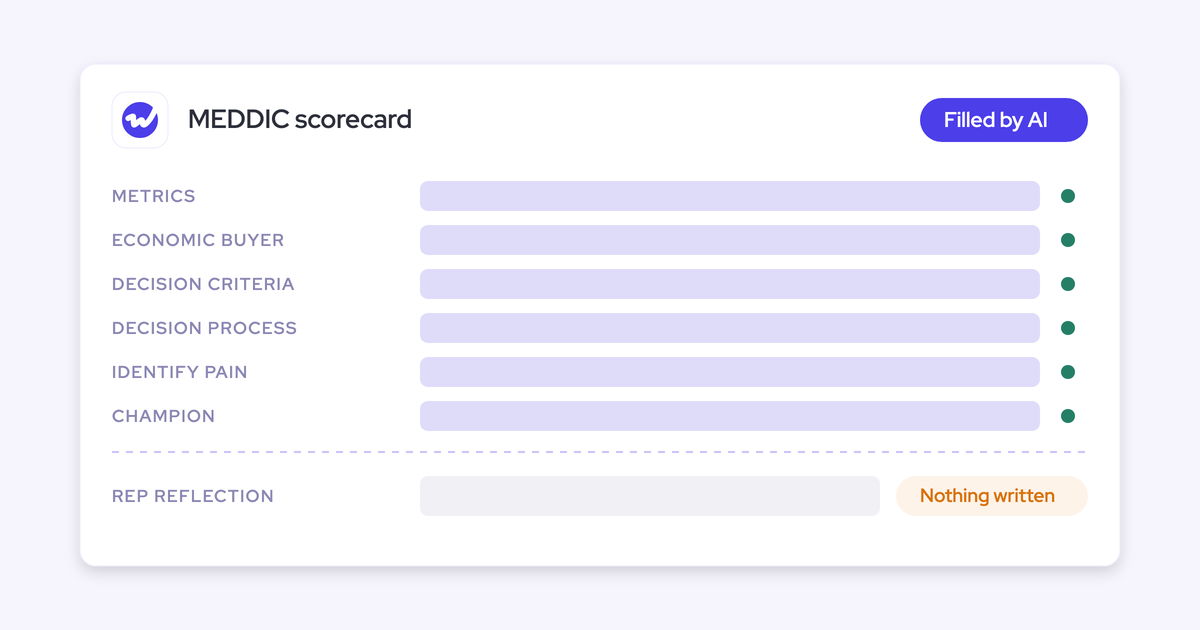

For most of your team, less than you'd fear. When AI fills in the MEDDIC scorecard, reps lose the one moment that forced them to state a view on the deal. But on most teams, that moment wasn't happening anyway.
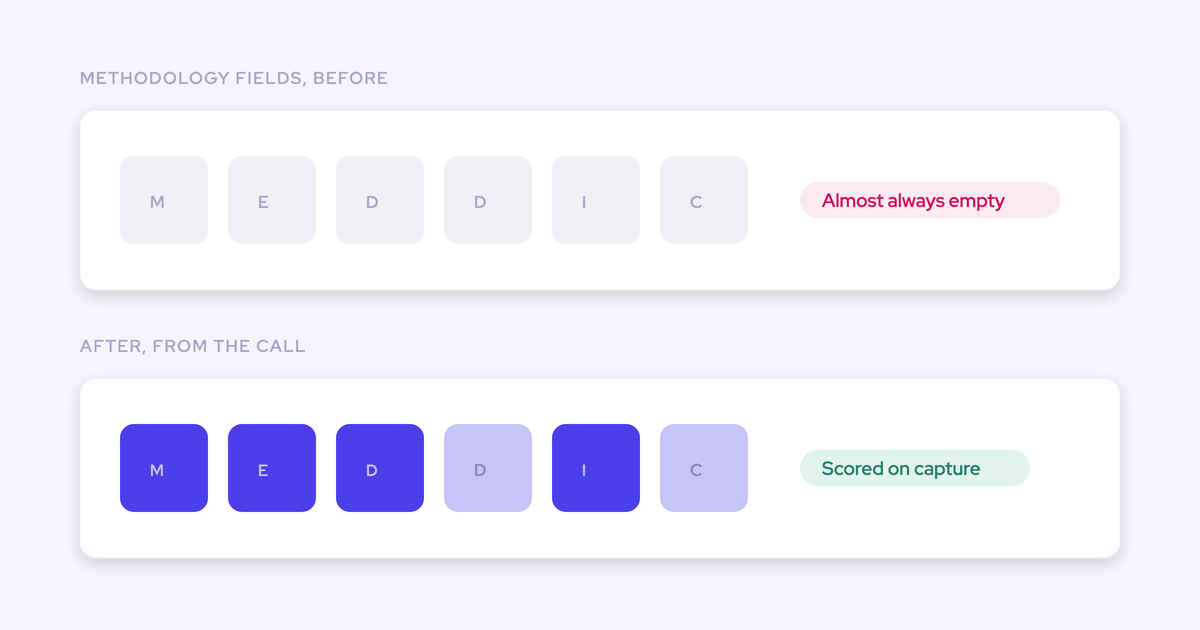
Manual methodology fields sat empty or got filled in from memory the night before the forecast call.
The loss is real for one group, though: reps who actually stopped to ask, "Do I have a champion?" They're usually your strongest sellers, and full automation takes that moment away from them.
We think the reflection was never in the typing. It happens when a rep's read of the deal meets the evidence. So the real decision is which fields the AI owns, which the rep owns, and where the two meet on the deal record, where qualification turns into deal execution.
This guide covers the four options you have, the criteria for choosing between them, the hybrid we recommend, and what that hybrid looks like in your next one-on-one.
What reps actually lose when AI scores MEDDIC for them
Reps lose the prompt to state their own view of the deal. Most of them weren't using it, and the few who were are the ones worth designing for.
Manual MEDDIC fields mostly held filler, not reflection
Our CEO sees the same pattern across the Salesforce orgs Weflow connects to:
"And what we typically see is that the sales methodology fields in Salesforce, they're almost always empty. So even the data capture doesn't work."
In practice, the fields end up one of three ways:
- Empty: The rep chose selling over paperwork. Honestly, that's the right call on any given day.
- Filler: The field holds whatever text clears the validation rule, so completion goes up and the content says nothing.
- Avoided stage: The rep keeps the deal in an earlier stage to avoid a block of criteria questions, so your pipeline looks less advanced than it really is.
None of these involves a rep thinking hard about a deal.
Richard Harris points to another reason the fields stay empty: the labels use framework language nobody says out loud. A rep asks about pains and struggles, not "Need" or "Metrics." So the answer is in the conversation, but it never makes it to the form.
Your strongest reps lose the most from full automation
Your best reps are the ones who used the form to think. When nothing asks them for their view, they lose the pause where they faced what they didn't know about the deal.
Julien Cerutti, who rolled out SPICED across Meltwater's sales org, puts it this way:
"In an agentic workflow, like I said, you don't have to fill out anything. The score automatically comes from conversations and activities logged in Salesforce, and your champion's a three or it's a two. But there is that deal inspection thing where there are questions, and I do want them to reflect."
— Julien Cerutti, VP of Global Revenue Strategy at Meltwater
That reflection is worth protecting. The goal is to keep it and drop the typing.
Call coaching scorecards and deal qualification scores measure different things
A call scorecard grades one conversation, while a deal qualification score grades the whole opportunity. When people say "AI fills in the scorecard," they often mean one but get judged on the other.
| Call coaching scorecard | Deal qualification score | |
|---|---|---|
| What it reads | One recorded conversation | Every call, email, meeting and CRM field on the opportunity |
| Question it answers | How well did the rep run this call? | Is this deal qualified right now? |
| Who it serves | The rep, as feedback while the call is fresh | You and RevOps, in deal reviews and the forecast |
| What breaks if you use it for the other job | Early calls score low on elements that weren't relevant yet, and long-cycle reps look weak | It can't tell you which specific behavior on a call needs coaching |
Mixing the two creates the long-cycle fairness problem you've probably already run into.
If a score drops because the rep did the work early, you'll stop trusting it. Worse, it trains reps to force late-stage questions into early calls.
Four ways to run methodology scoring on your team
Each of these four options is the right choice for some team, including leaving things as they are.
Keep reps filling in manual scorecards and deal sheets
Manual entry keeps reps in charge of their own view of the deal. The cost is admin time, and validation rules tend to push the content toward filler.
- Fits when: Your team is small, cycles are short, and you personally inspect every deal sheet every week.
- Doesn't fit when: You run a larger team across long cycles. Completeness drops within a quarter, and whatever's left gets written in a rush.
If you go this way, keep the number of rep-owned fields small.
Switch on full automation from calls and emails
Full automation gives you complete fields and gives reps their selling time back. The catch is that nothing asks the rep for their read of the deal. And when unreviewed writes overwrite what a rep typed, reps stop bothering to correct fields.
- Fits when: Your main problem is empty fields, your managers already run strong deal reviews, and the fields are mostly factual.
- Doesn't fit when: You rely on the methodology as a thinking tool, or your reps have already been burned by a tool that blanked their notes.
Also, watch where qualification actually happens. On many teams, the champion and decision maker only show up in email, and some teams record calls on half their opportunities at best.
Call-only field updates miss those deals entirely, so automation needs to read email too.
Design a hybrid where AI and reps own different fields
In a hybrid, AI owns the evidence and the cumulative qualification, while the rep owns a few judgment calls and a short read of the deal in their own words. You can see the gap between the two.
- Fits when: You want complete data and you want reps to keep thinking.
- Doesn't fit when: No one has decided which fields matter, or there's no manager time to look at the gaps.
Just make sure you decide field ownership up front. Otherwise, AI and reps can both write to the same field and overwrite each other.
Leave the empty methodology fields as they are
Waiting makes sense if your framework is still changing or your team hasn't decided which fields to measure. Otherwise, you'll end up automating your methodology twice.
If you wait, do it with a plan. Let everything land in a free-text AI summary first, look across transcripts for the elements that keep coming up, and create fields only for those.
Give it an end date, say one quarter. If you leave the fields empty indefinitely, your pipeline reviews will keep running on confidence instead of evidence.
How to choose between them: Six criteria that matter
Here's how the options compare. None of them wins on all six criteria.
| Criterion | Manual | Full automation | Hybrid | Leave as is |
|---|---|---|---|---|
| Rep admin time | Highest: every field typed after every call | Lowest: nothing to type | Low: about five fields plus a one-line read | None, because nothing gets filled |
| Field completeness | Low, and it decays within a quarter | High across calls and email | High: AI fills the evidence, reps fill a small set | Mostly empty |
| Rep reflection on the deal | High for top reps, compliance for the rest | Lowest: nothing asks for a view | High: the stated read meets the evidence | Whatever happens in your one-on-ones |
| Coaching signal for you | Thin and unreliable | Rich evidence, no rep view to compare it to | The rep-versus-evidence gap, per deal and per rep | The calls you happened to hear |
| Fairness in long cycles | Depends on who fills the sheet and when | Fair at deal level, unfair if call scores are used | Fair: call and deal scoring kept separate | Not measured |
| Rep trust and ability to override | Full ownership | Lowest: silent writes and no say | Rep overrides and the override gets checked | Not tested |
Weigh these against your cycle length and recording coverage. If your cycles are long, fairness matters most. If recording coverage is low, email reading does.
Why we recommend the hybrid, argued from those criteria
We recommend the hybrid because it's the only option that gives you both reflection and completeness.
Manual entry gets you reflection from a few reps but loses completeness for everyone. Full automation fixes completeness and admin time but drops the rep's read, so you have evidence with nothing to compare it to. Doing nothing loses both.
Reflection doesn't need a form. It needs a moment where the rep says what they believe and something checks it. A one-line read and a few judgment fields create that moment, and AI handles the rest.
It's also fairer, since deal-level qualification is scored across the whole opportunity and call coaching stays separate. And reps keep trusting it, because they can disagree and their disagreement gets a proper look.
The hybrid runs on three ownership rules:
- The machine owns evidence and cumulative qualification.
- The rep owns a small set of judgment calls and a stated read.
- The gap between the two becomes the manager's one-on-one agenda.
Which MEDDIC fields the AI should own and which reps keep
The simplest way to decide ownership is by field type.
| Field type | Example fields | Who owns it | Write mode | Why |
|---|---|---|---|---|
| Unambiguous facts | Website, billing address | AI | Automatic | One right answer, low risk if a call adds nothing |
| One-call answers | Next Step | AI | Automatic | One call answers it clearly, and it goes stale fast if left to reps |
| Interpretive call notes | Identify pain, champion notes from this call | Rep reviews | Review before sync | Needs judgment, and a careless write can erase earlier qualification |
| Cumulative qualification | Metrics, economic buyer, decision criteria, decision process, champion strength | AI across the whole deal | Kept current from every call, email and field | Evidence builds over many touchpoints, so the latest call isn't the best answer |
| Forecast-moving single values | Stage, close date, amount | Rep | Rep confirms after each call | One misheard sentence moves your number, and a check takes seconds |
| The rep's stated read | A short line on whether the deal is real and why | Rep | Typed in their own words | This is the reflection you want to keep |
The stated read is small on purpose. It sits beside the evidence, not in place of it, and takes a minute to write.
It may also solve a problem you're already hearing about from leadership. One team switched off manual notes, and then nobody read the AI summaries.
Instead of rolling back, they kept capture automatic and added a short summary note written by the rep. That's the hybrid in one field.
Turn the rep-versus-data gap into your one-on-one agenda
Once the typing is gone, your coaching can focus on the gap between what the rep believes and what the evidence shows, first deal by deal, then as a pattern across all their deals.
The tool shows you the gap, but turning it into coaching is still your job. That matters more than any setting you choose. As Richard Harris puts it:
"If it's not taught well, whether it's any philosophy, to be honest with you, or methodology, the problem is the leadership's not coaching to it."
— Richard Harris, Sales advisor, trainer, and founder of the Harris Consulting Group
A worked coaching moment: "My champion's a three"
Say the rep thinks the deal is fine and the CRM agrees, but it isn't.
- The rep states their read: "My champion's a three. She's pushing internally and she set up the demo."
- You compare it to the evidence: The deal-level view shows the champion arranged meetings, but never gave access to the economic buyer and never shared how the decision gets made.
- You coach the gap: Talk through what a three would really take on this deal and what the rep can do this week to get there. The score itself is secondary.
At Meltwater, Cerutti built his own deal inspection bot to force exactly this conversation:
"I've created a deal inspection bot. Right? It knows why we win, why we lose, why we slip. It knows our scoring methodology that's all weighted, and it's a MEDDIC and SPICED coach, and it will give you a score, which a rep can say, hey, my champion's a three. I got this, this, and this, and it'll say, your champion isn't a three. You don't have these things. So it's actually pressure testing, which was a big thing I focused on in designing that."
— Julien Cerutti, VP of Global Revenue Strategy at Meltwater
You don't need a custom bot for this, though. You just need the rep's read and the evidence on one screen, and the willingness to have the conversation.
What happens when a rep overrides the score
In a healthy hybrid, reps keep their say. That takes three things:
- The rep can override: Sometimes the rep knows something the data doesn't, like a hallway conversation with the CFO.
- The override gets challenged: It's checked against the deal's evidence, so "trust me" doesn't automatically become a three.
- The disagreement stays visible to you: An override is often your most useful coaching prompt of the week.
A score nobody can argue with loses trust fast. Reps either ignore it or game it, and you're back to filler.
Coach the weakness that repeats across a rep's deals
Roll up deal-level methodology scores per rep over a few months, and you'll see which element is weak on deal after deal, like decision process or champion. That's your theme for one-on-ones.
Most managers review three to five calls a week. That's a small sample, so coaching tends to land on whichever call you happened to hear.
| Coaching from sampled calls | Coaching from the per-rep pattern | |
|---|---|---|
| What you coach from | The three to five calls you listened to | Every deal the rep worked over months |
| Which rep gets attention | Whoever had a memorable call | Whoever has a consistent gap |
| What the one-on-one covers | One moment on one call | One element that's weak across deals |
| How you track progress | You can't, the sample changes each week | The element's score moves, or it doesn't |
How Weflow AI Field Updates and AI Playbooks run the hybrid
Weflow is the Revenue AI Orchestration platform built for Salesforce teams in sales, customer success, and RevOps. It supports all three ownership rules in one setup and keeps call scoring and deal scoring apart.
Two parts do the work:
- Weflow Conversation Intelligence + AI Field Updates handles call-level writes and call coaching scorecards.
- AI Playbooks handle deal-level qualification across the whole opportunity.
Set automatic write or rep review per Salesforce field
In Weflow, you choose field by field (not per team or workspace) whether an AI Field Update writes automatically or waits for review. That's the core control behind the hybrid.
So Website and Next Step can write themselves, while pain and champion wait for the rep, all in the same template. With review on, the rep sees the current value beside the suggestion and accepts, edits or discards it. Required fields stay locked.
Suggestions arrive within a minute or so of the meeting ending, while the rep still remembers the call.
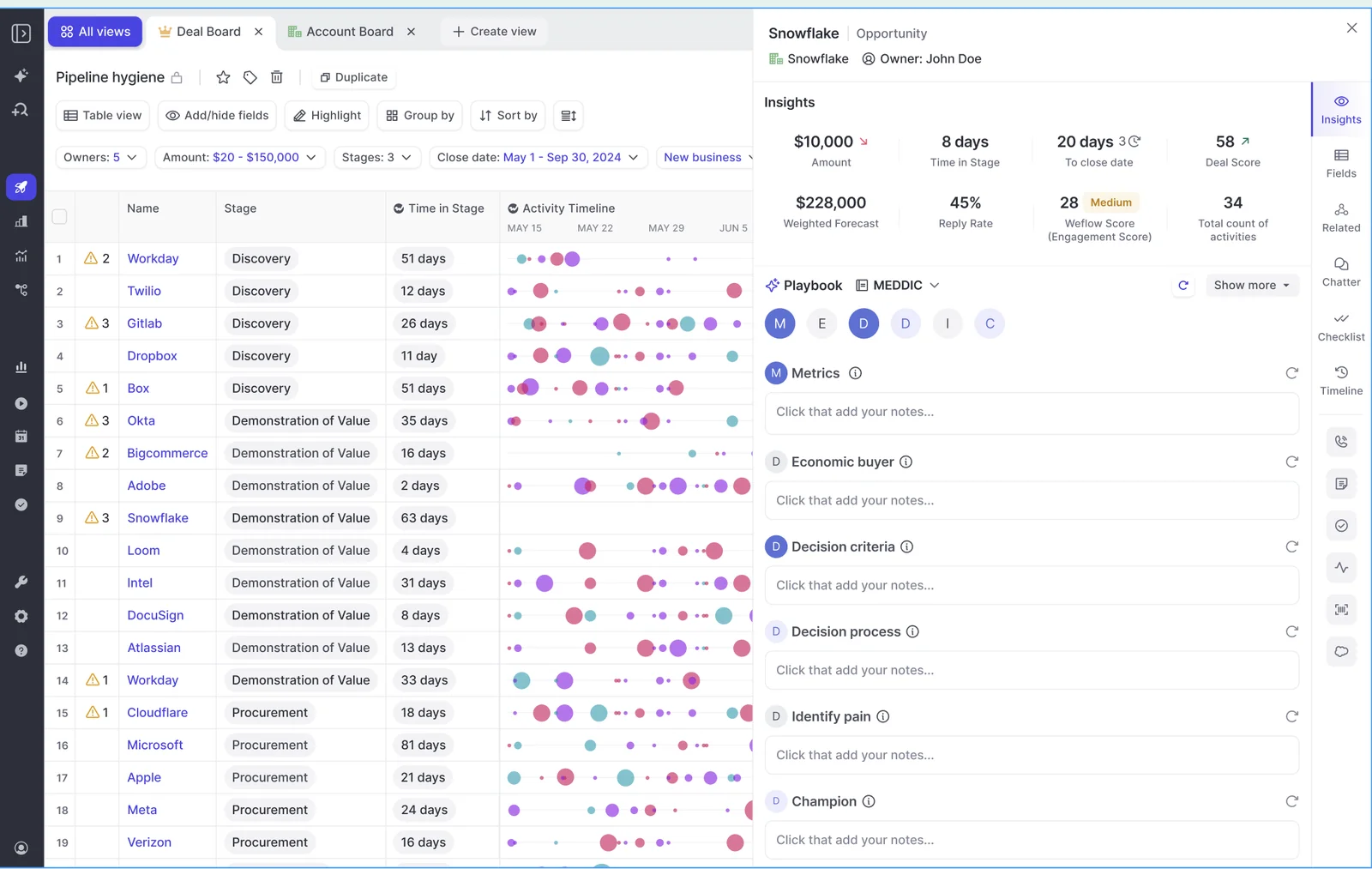
AI Playbooks mark filler in MEDDIC fields as not assessed
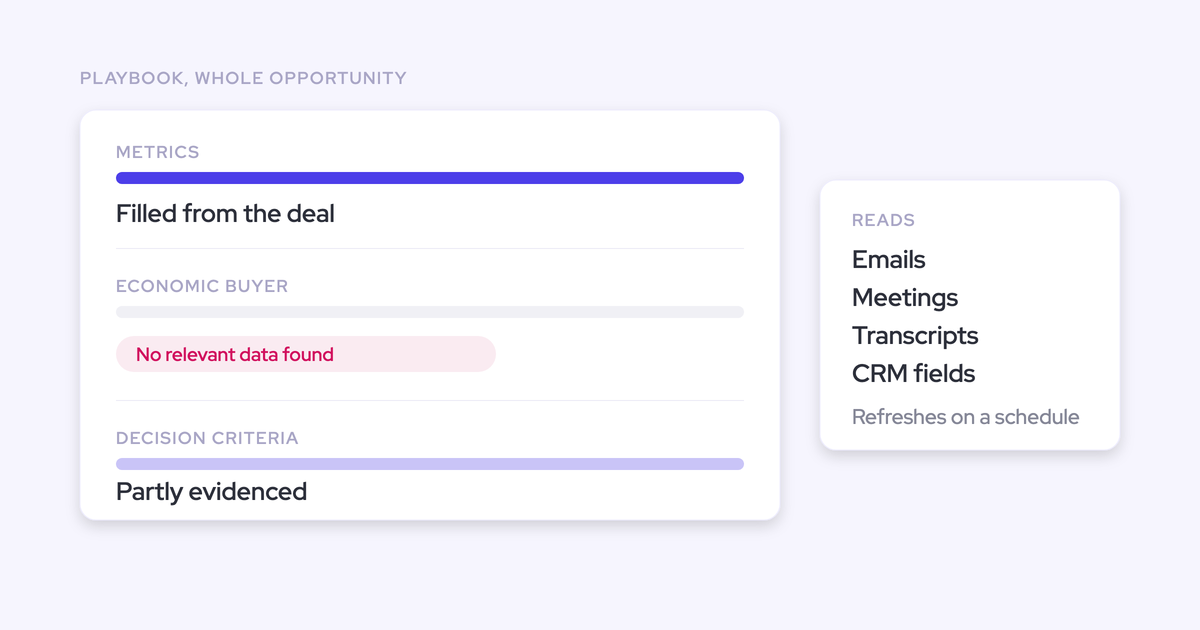
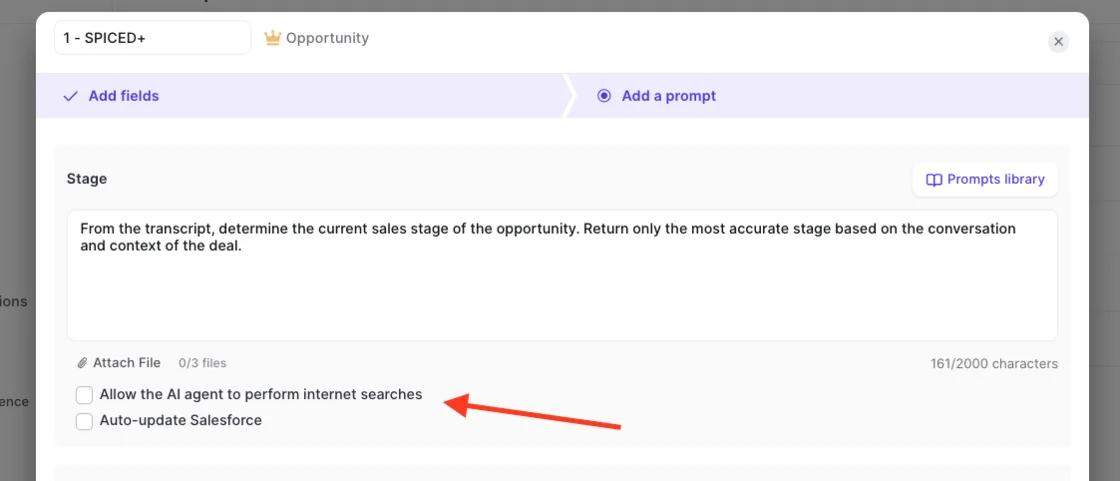
A Weflow AI Playbook runs two passes on every opportunity. The first fills in each methodology element from the deal's evidence, and the second judges how well each one is actually established, including text the rep typed.
That means a MEDDIC field stuffed with filler shows up as not assessed rather than complete. Each element lands in one of three states:
| State | What it tells you |
|---|---|
| Fully established | The evidence supports this element, so you can spend your time on another one |
| Partially established | There's something, and the note says what's missing, which gives you the coaching point |
| Never discussed | Nothing in the calls, emails or fields supports it, which is a forecast risk if the deal is late-stage |
You set the evaluation criteria for each element. For Metrics, for example, you can require specific numbers tied to the prospect's goals, so vague ones score lower.
Playbooks re-evaluate a record every two hours once something changes, like an edit, a new activity or a new recording.
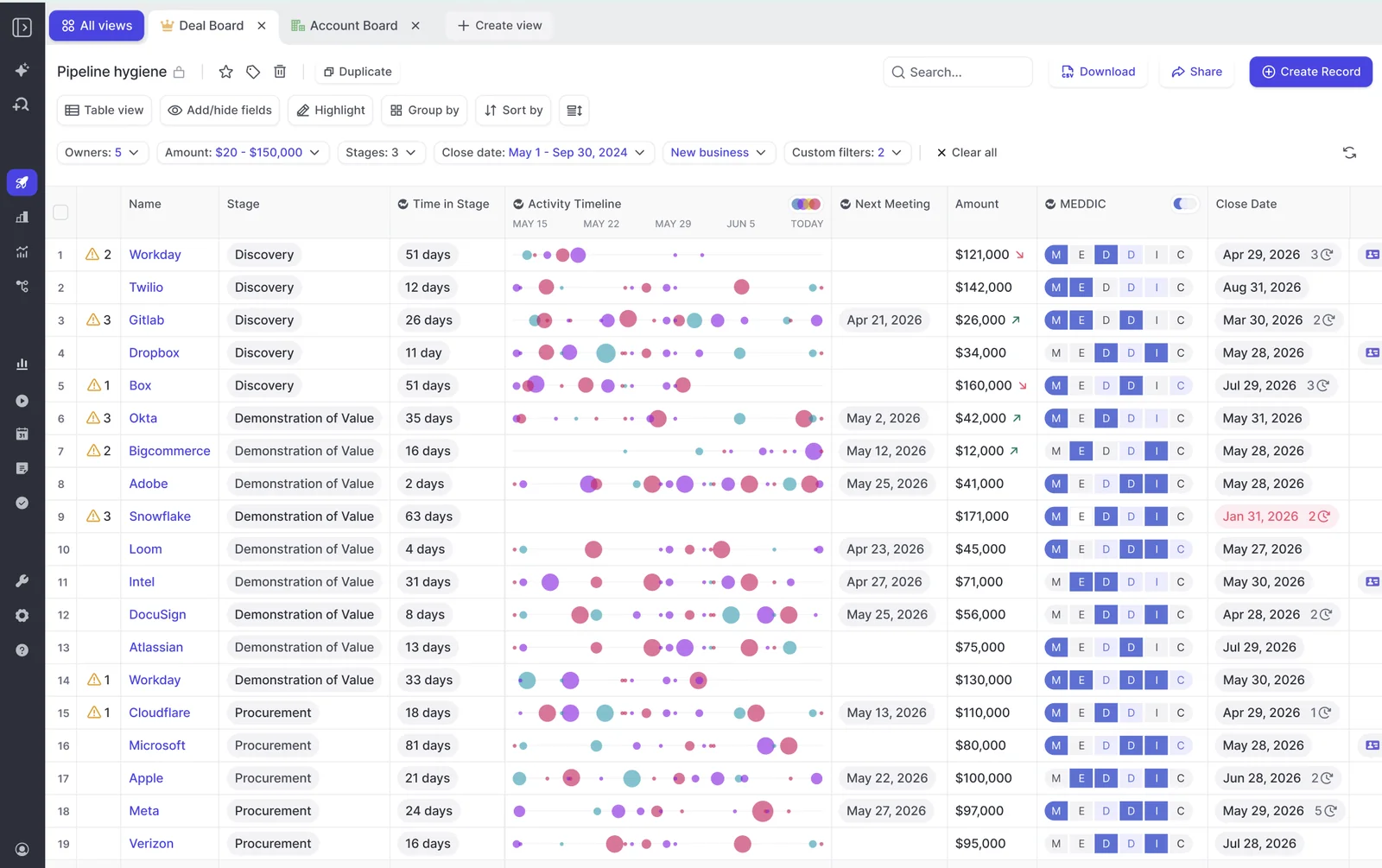
Rep overrides and notes sit beside the computed status
Reps can override any playbook field, and Weflow checks the override against the deal to see if it holds up. That's the pressure test, built in.
They can also add notes in the playbook panel next to the computed status, so their voice sits right beside the evidence when you prep for a one-on-one.
Weflow scores the call and the deal separately for long cycles
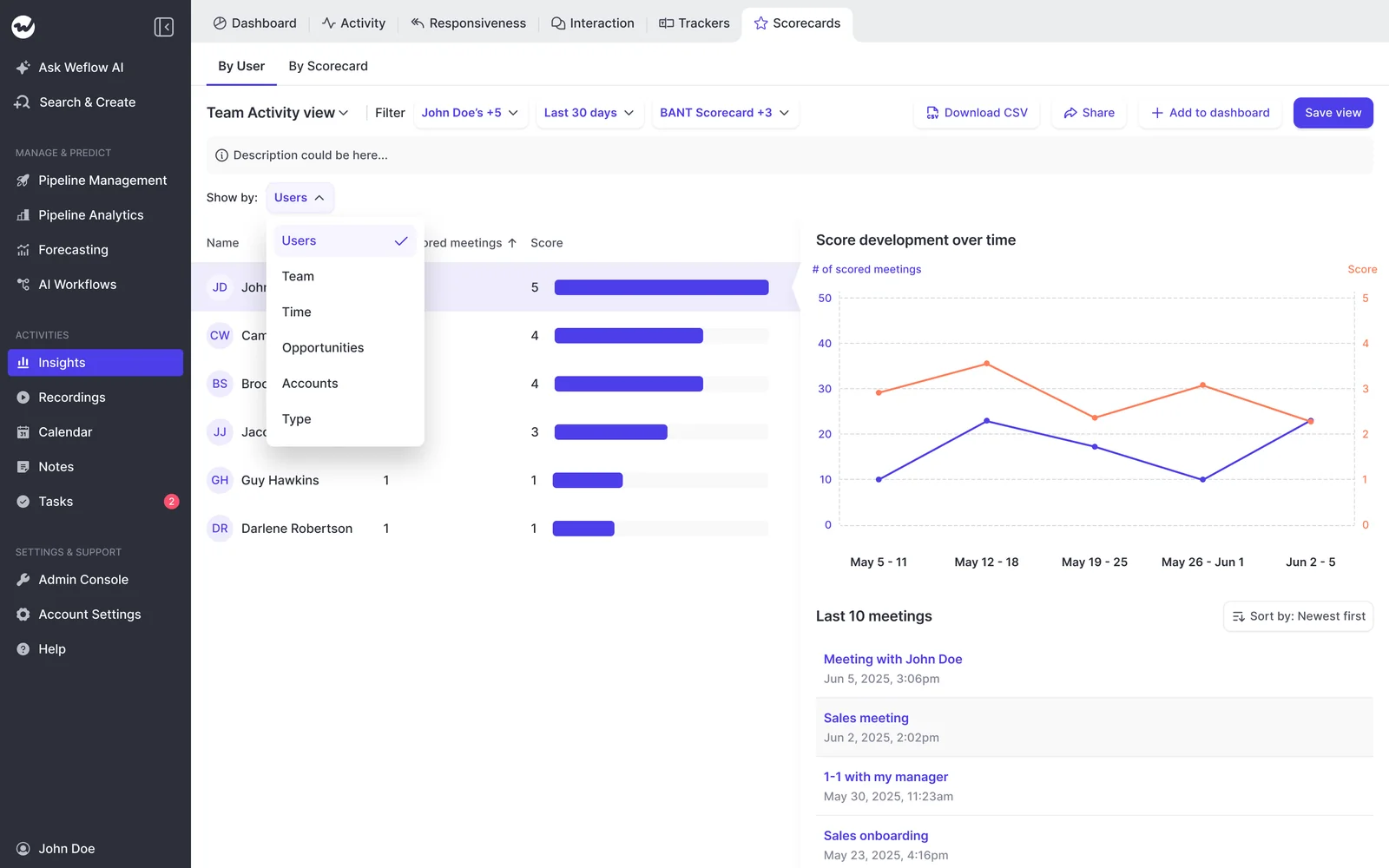
Coaching templates in Conversation Intelligence score one call, while AI Playbooks score the whole deal across every email, meeting, transcript and field.
A rep who settled Metrics on call one doesn't lose deal-level credit on call two.
Meeting type detection helps on the call side too: a discovery call, a demo and a negotiation can each trigger their own scorecard, so a closing conversation doesn't get graded on discovery questions.
Scores also roll up per rep over months, so you can coach the repeating weakness instead of the call you happened to hear.
Product tour
What Weflow doesn't do yet for methodology scoring
Here are the gaps worth planning around:
- Call-level AI Field Updates overwrite and never append: Two settings protect earlier qualification: review mode and a prompt instruction to leave the field unchanged if the call adds nothing new. Neither can merge old and new text.
- AI Playbook write-back to Salesforce has no approval step: Once you set the target fields, values land as they're generated. A newly assigned playbook starts as a read-only reference in Signals, and you can keep it there or point it at test fields until you trust it.
- Field updates don't show which source produced a value: The comparison view shows the old value, the new value and what changed, but not whether the value came from the call or a web search.
- There's no built-in "rep answers first, then compare" interview flow: Rep notes and pressure-tested overrides cover most of it, though.
- AI Playbooks need Weflow Deal Intelligence & Forecasting: A team on Conversation Intelligence alone gets call-level field updates and coaching scorecards, not deal-level playbooks.
- There's no AI roleplay: Weflow scores real recorded conversations, so for practice against a simulated buyer, you'd need a separate enablement tool.
What Weflow methodology scoring costs and which products you need
You get the call half of the hybrid with Weflow Conversation Intelligence, and the deal half with Weflow Deal Intelligence & Forecasting.
| Product | What it covers in the hybrid | List price |
|---|---|---|
| Weflow Conversation Intelligence | AI Field Updates per call, per-field auto or review, call coaching scorecards, meeting type detection | $39 per user per month |
| Weflow Deal Intelligence & Forecasting | AI Playbooks for deal-level qualification, deal board, pipeline views | $39 per user per month |
| Revenue AI Business | Activity & Contact Capture, Conversation Intelligence and Deal Intelligence, so both halves plus email capture | $59 per user per month |
| Revenue AI Enterprise | Everything in Revenue AI Business plus Forecasting | $79 per user per month |
All prices are billed annually with a 10-user minimum. There are no usage-based charges, and Weflow carries the AI cost of playbook runs.
When a different design fits your team better
If you want a manager to approve every AI score before a rep sees it, Clari Copilot is built that way. The tradeoff is that throughput depends on your time, so automatic scoring doesn't save as much manual work as it seems.
If you'd rather append to methodology fields or only write to them when they're empty, other tools offer those modes. Chorus lets you choose append or overwrite on approved updates. Momentum can write only when a field is empty.
Outreach Kaia's Deal Agent can update automatically, only when empty, or after rep confirmation, and can append instead of replace.
How to roll out the hybrid without reps feeling watched
Build trust in steps: recording coverage first, then scoring as a read-only reference, then automation field by field.
- Make recording routine before you turn on coaching: Until most meetings are recorded, a scorecard only measures the calls the rep chose to record, and early coaching feels like surveillance.
- Pilot with one visible team, with the playbook set as a read-only reference or pointed at test fields: That way, reps see what the AI concludes before it writes anything, and you see where it gets things wrong.
- Write field prompts that state what doesn't count: Headcount isn't Metrics, and the customer's own employee isn't your champion. In a way, writing these exclusions down is writing down your methodology.
- Put interpretive fields in review mode and automate only unambiguous ones: When reps see their notes respected, they keep correcting fields.
- Score your existing pipeline in bulk, starting with open deals, not just new ones: In Weflow, Generate AI Playbooks runs on up to 100 records at a time from a pipeline view.
- Move fields to automatic once their output has earned it: Review mode shows you whether extraction is accurate, so you can make the switch based on data.
- Keep per-rep AI scores out of comp and MBOs: Runs vary, and a wrong rating tied to pay does more damage than no rating.
- Shift enablement from filling fields to judging the AI's read: Reps still need to know the framework well enough to say why the AI got their deal wrong.
Want a question set your reps can use for their stated read? Grab our MEDDIC Sales Process checklist and bring it to your next one-on-one.
FAQs sales managers ask about automated methodology scoring
Will AI Field Updates overwrite what my reps typed into MEDDIC fields?
Yes. Call-level AI Field Updates replace the field's content. Review mode and a "leave unchanged if no new information" prompt protect what's already there, and AI Playbooks give you the cumulative view across the deal.
How accurate does AI qualification need to be before I trust it?
Compare it to the empty field it replaces, not to a perfect answer.
The bar is higher for a score than for a field, though, because reps need to see the reasoning and be able to push back.
What happens when the AI is confidently wrong, like headcount as Metrics?
Fix it in the prompt definition and keep the field in review. Spell out what doesn't count, for example "a company's headcount isn't a metric of value."
Can I see which call or email a field value came from?
Not on the field update itself. If you want a field filled only from the conversation, write that restriction into the field's prompt.
Should AI methodology scores feed comp or MBOs?
No, not until you have proof they're stable. One RevOps leader we work with kept per-seller AI reports out of MBO scoring because runs vary. Use the scores to set a team standard and to coach instead.
Does automated scoring work when qualification happens mostly in email?
Deal-level scoring does. Weflow AI Playbooks read emails as well as meetings, transcripts and fields, including transcripts another recorder writes into Salesforce. But call-level AI Field Updates only run on Weflow recordings, so they miss deals with no recorded calls.
Can Weflow score our house framework, not just MEDDIC?
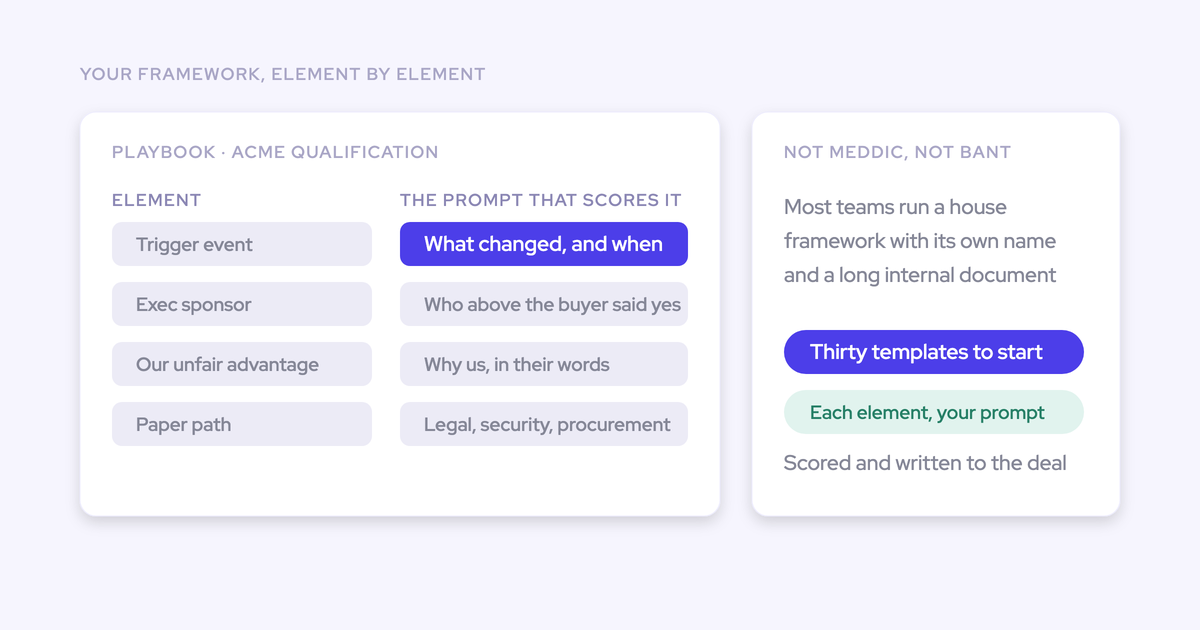
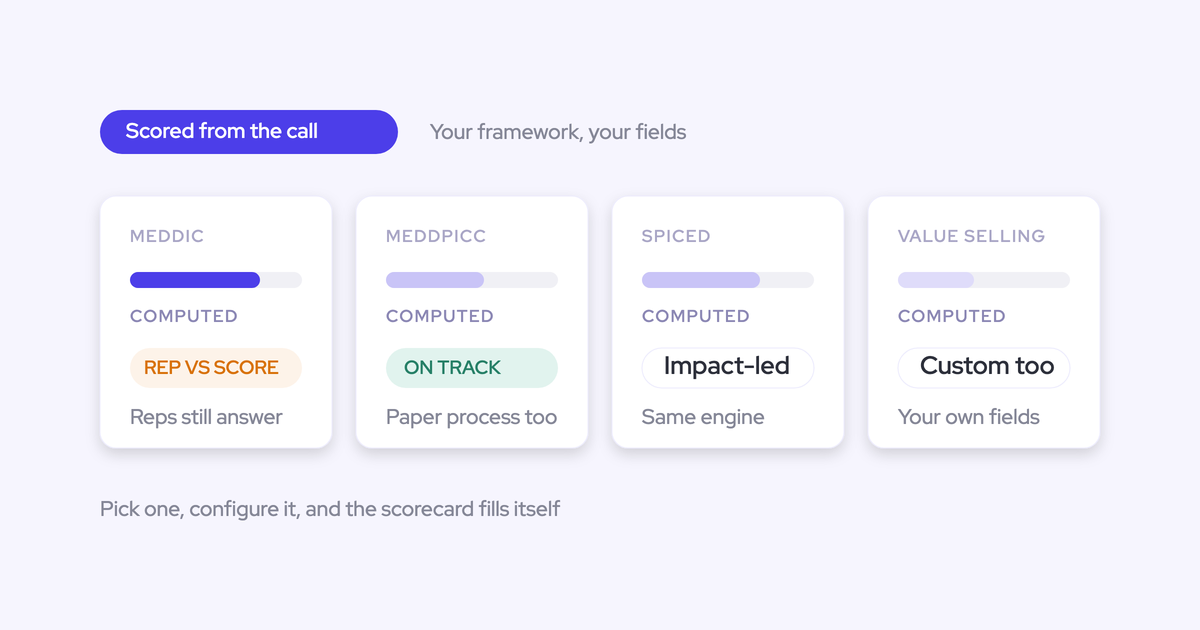
Yes. Weflow ships with around thirty methodology templates, and you can also build your own element by element with your own names and evaluation criteria.
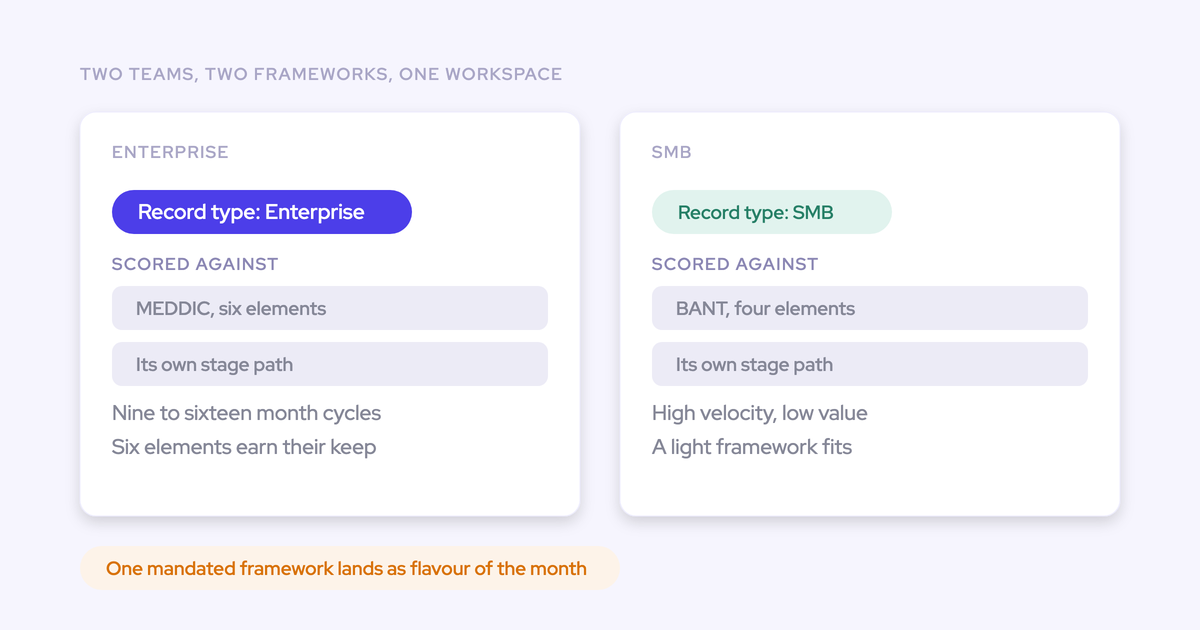
Different teams can even run different frameworks, for example BANT on transactional deals and MEDDIC on enterprise.