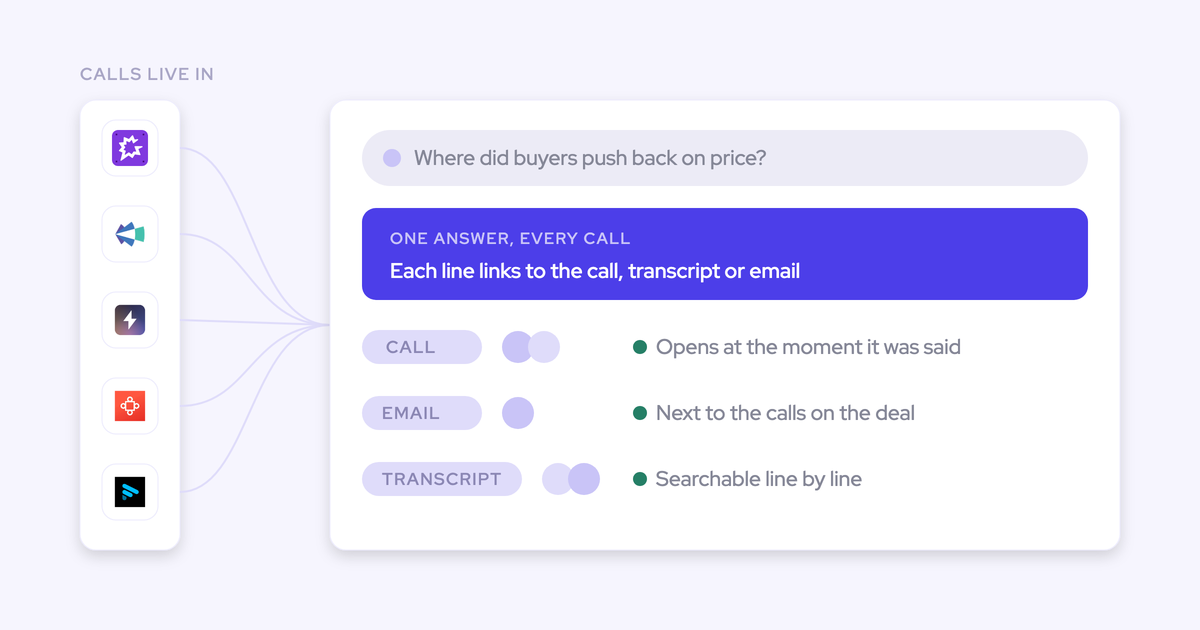
Best Tools That Detect Buyer Sentiment and Engagement in Sales Calls (2026)
Compare tools that detect buyer sentiment and deal risk from sales calls, including Weflow.


The buyer said "budget's frozen" on a call three weeks ago. Your rep heard it, pushed the close date a month, and moved on. The CRM stayed green, and you found out in the post-mortem.
That's the problem behind most searches for tools that detect buyer sentiment. Of the six tools we compare here, only two produce a literal sentiment signal:
- Avoma draws a sentiment graph for each meeting.
- Attention returns sentiment as part of its Ask Attention analysis.
Gong, Clari, Jiminny and Weflow detect risk language and deal signals instead. For a sales manager, that's the more useful unit. A mood score measures one call, and the risk sits on the deal.
So we compared Weflow, Gong, Clari, Attention, Avoma and Jiminny on the things that decide whether you hear about that deal before your one-on-one:
- Does the tool read one call or the whole opportunity?
- Can you define the warnings yourself?
- Does the score explain why it fired?
- Where does the flag land?
We build Weflow Conversation Intelligence + AI Field Updates, so we'll tell you plainly where it fits and where it doesn't. Below, we run one deal that died quietly through all six tools.
How Weflow, Gong, Clari, Attention, Avoma and Jiminny compare
On risk detection, the six tools split on four things: fixed or customer-defined warnings, scores trained on your own deals, reviewable field writes, and public pricing.
| Capability | Weflow | Gong | Clari (with Salesloft) | Attention | Avoma | Jiminny |
|---|---|---|---|---|---|---|
| Conversation metrics | Talk ratio, longest monologue, interaction, per call and rep | Talk ratio, monologue, patience, question rate, with recommended ranges | Copilot talk-to-listen, monologue, interactivity, rep leaderboard | Sentiment inside Ask Attention; no documented talk metrics | Talk time, monologue, questions; per-meeting sentiment graph | Seven metrics, including talk ratio, patience and question rate |
| Deal risk warnings | Custom AND/OR rules on deal and computed fields | 8 Gong-defined warnings, timing adjustable, none addable | Admin-built Deal Gaps on any deal field | Deal Risk Monitor flags risk phrases; custom deal indicators | Risk score, keyword alerts, risk-detection agent template | 8 rule-based triggers, thresholds set per team |
| AI deal scoring | 0 to 100 nightly, trained on your closed deals, drivers shown | Percentile rank from 300+ signals; needs a Forecast seat | Salesloft score reads Salesloft-logged activity only | Built from indicators you define, not win history | 0 to 100 risk score with factors; training basis not stated | 1 to 5 likelihood field you build yourself |
| Buying committee mapping | Everyone on the deal with engagement; roles not inferred | Per-contact activity over 21 days, suggested contacts | Relationships tab plus Salesloft stakeholder capture | Call participants listed; no documented role view | Stakeholders tagged by role and influence over time | Contacts from emails and calls; roles via a custom field |
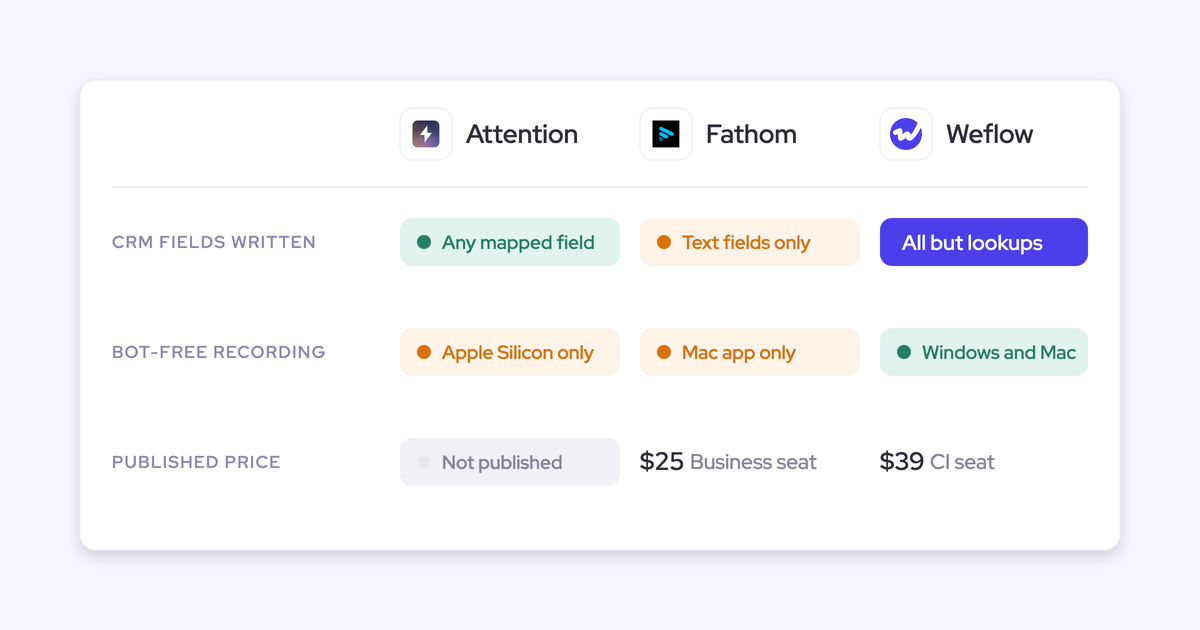
| CRM field updates from conversations | Any field type except lookups; per-field review; methodology fields append | Up to 20 admin-built extractors that overwrite old values | MEDDPICC and BANT writes, no documented review step | Prompt per field; auto sync default; prose in empty fields | Smart Topics append to mapped fields, no review step | Prompt per field; auto or rep review; fill, overwrite or append |
| Integrations with other tools | Salesforce, Google, Microsoft, Zoom, Slack, Outreach; no warehouse connector | About 450 listed integrations, about 30 dialers | Salesforce, Dynamics, Snowflake, Databricks, major meeting platforms | Workflow steps into many tools; Slack both ways | 26 native integrations plus Zapier | About 20 dialers, Zoom, Meet, Teams, Zapier |
| Access from AI assistants (MCP) | Read-only: playbooks, transcripts, forecasts; transcript toggle | Three record-scoped tools, insights only, metered credits | Salesloft server read-only beta, paid add-on, no transcripts | 68 read-write tools, raw transcripts, rate limits not credits | Reads meetings and transcripts; Organization plan or add-on | Read-only on Scale and Grow tiers |
| Raw data access outside the tool | REST bulk export of transcripts, scores, signals in JSON or CSV | API capped at 10,000 calls a day; Data Cloud costs extra | REST and Export APIs; Salesloft syncs to Snowflake, Databricks | Raw transcripts through MCP and API keys; HTTP workflow step | REST API and webhooks, 60 requests a minute | REST API opened with an admin-only org key |
| Pricing | Published: $39 Conversation Intelligence, $59 Business bundle | No published prices; per user plus platform fee | No published seat prices; book a call | Not published | Published: $19 to $39 per seat, $29 add-ons | No published prices; flat per-seat fee, no credits |
The Clari column covers Clari and Salesloft together. Since the merger, Clari Forecast and Clari Copilot keep the Clari name, and capture, engagement and deal management are Salesloft products.
Which tool would have flagged the deal that slipped quietly
Here's the kind of deal buyers describe to us on almost every evaluation call.
A six-figure opportunity sits in commit for this month. On the third call, the champion mentions that budgets are under review and a new VP is starting. The rep writes nothing down and pushes the close date to next month, then does it again. Nobody above the champion ever joins a call. The last meeting was friendly, so the rep says it's fine and the CRM agrees.
Six weeks later the deal is closed lost, and the reason field says "timing".
"I have no way to see for instance the deals that are stuck the pipe forever."
A sales leader on an evaluation call with Weflow
Here's what each tool has a documented mechanism to catch, signal by signal.
| Signal | What it looked like in this deal | Tools with a documented mechanism | Where the flag lands |
|---|---|---|---|
| Risk language on the call | "Budgets are under review", "a new VP is starting" | Weflow trackers and AI Playbooks; Gong red flag warning; Clari Copilot topics and Salesloft Key Moments; Attention Deal Risk Monitor; Avoma keyword alerts; Jiminny Themes, Nudges and competitor trigger | Weflow tracker reports and deal assessment; Gong deal board; Salesloft conversation view; Attention manager notification; Avoma and Jiminny Slack or email |
| Close date pushed | Moved twice, stayed in commit | Weflow push-count warning; Gong overdue warning; Salesloft Deal Gaps on a past close date; Jiminny Close Date Passed trigger | Weflow deal board and forecast submission screen; Gong deal board; Salesloft pipeline view; Jiminny Deal Insights |
| Single-threaded, economic buyer missing | One contact on every call | Weflow single-contact warning and playbook note that the economic buyer is unidentified; Gong not enough contacts and no power; Salesloft no stakeholders gap; Avoma single-stakeholder alert; Jiminny Single-threaded trigger | Weflow deal board, with playbook answers in Salesforce fields; each other tool's deal view or alert |
| Deal went quiet | No reply after the pushed date | Weflow days-inactive warning; Gong no activity and ghosted; Salesloft days since last activity; Avoma no engagement for 7+ days; Jiminny no response trigger; Attention stagnant deals in reporting | Each tool's deal board or pipeline view |
| How the call "felt" | Friendly, positive last meeting | Avoma per-meeting sentiment graph; Attention sentiment in Ask Attention; Weflow sentiment written to a field if you configure it | Avoma recording player; Attention analysis output; a Salesforce field in Weflow |
Look at the last row. The sentiment signal would have read positive, because the last call was pleasant.
Per-call signals measure the rep's call. Only reading across the whole deal measures the deal. The four deal-level signals above were all visible weeks before the loss, and every tool here catches at least some of them. They differ in how many you can define, and whether the flag reaches you where you already work.
"It's no longer third-party hearsay from reps or sales leaders. It's now proof in front of us – AI summaries that tell us we're not talking to the economic buyer, that we're single-threaded, whatever it might be."
— Scott Jones, SVP of GTM Revenue Intelligence & Enablement, KORE Wireless
What to check before you trust a tool's risk flag
A risk flag is only useful if it's built from what predicts slippage in your business, covers the whole deal, explains why it fired, and lands where you already work.
Three terms get mixed up in demos, so here's how we use them:
- Sentiment: tone read from a single call.
- Engagement: measured two-way activity on a deal, such as emails sent and answered, and meetings held.
- Risk language: named phrases on a call, such as budget, timing or a competitor.
Most tools here measure engagement and risk language well. Very few measure sentiment, and that's fine.
| Capability | What it tells you about deal risk | The question to ask | How to test it with your own Salesforce data |
|---|---|---|---|
| Conversation metrics | How your rep ran the call, not whether the deal is healthy | Are metrics per call, per rep, or both? | Compare a rep's talk ratio on won deals against lost ones |
| Deal risk warnings | Whether slippage patterns get caught before commit | Can I add my own warning? | Rebuild your top three slippage patterns as warnings |
| AI deal scoring | A second opinion that owes nothing to the rep | Is the score a probability or a rank, and what drives it? | Score last quarter's closed deals and check the drivers |
| Buying committee mapping | Whether you're single-threaded | Does it show roles, or only names? | Open a deal you know is single-threaded |
| CRM field updates from conversations | Whether call evidence reaches the opportunity | Can a rep review the field before it syncs? | Run one deal's calls and read every field it writes |
| Integrations with other tools | Whether phone, email and meetings all feed the flag | Which of our channels does it miss? | List your dialer, calendar and email and match each |
| Access from AI assistants (MCP) | Whether you can ask Claude or ChatGPT about a deal | Does it return transcripts or only summaries? | Ask one pipeline question from your own assistant |
| Raw data access outside the tool | Whether flags reach your board report or warehouse | Is export included or a separate purchase? | Pull one quarter of scores into your BI tool |
| Pricing | What the whole team costs, not one pilot seat | Is AI in the seat or metered on top? | Price your full team with warnings and scoring included |
Buyers in this category now line up two or three tools and run the same deals through each. That comparison tells you more than any feature grid, including this one.
How each tool reads buyer risk, and where it stops
Each tool started somewhere different, and that starting point decides what it sees:
- Call-first: Gong, Attention, Avoma and Jiminny.
- Forecast- and engagement-first: Clari with Salesloft.
- Deal-and-activity-first: Weflow.
Every entry follows the same order: what the tool is, the nine capabilities, where it stops, and who it's best for.
Weflow Conversation Intelligence + AI Field Updates: risk read across the whole deal
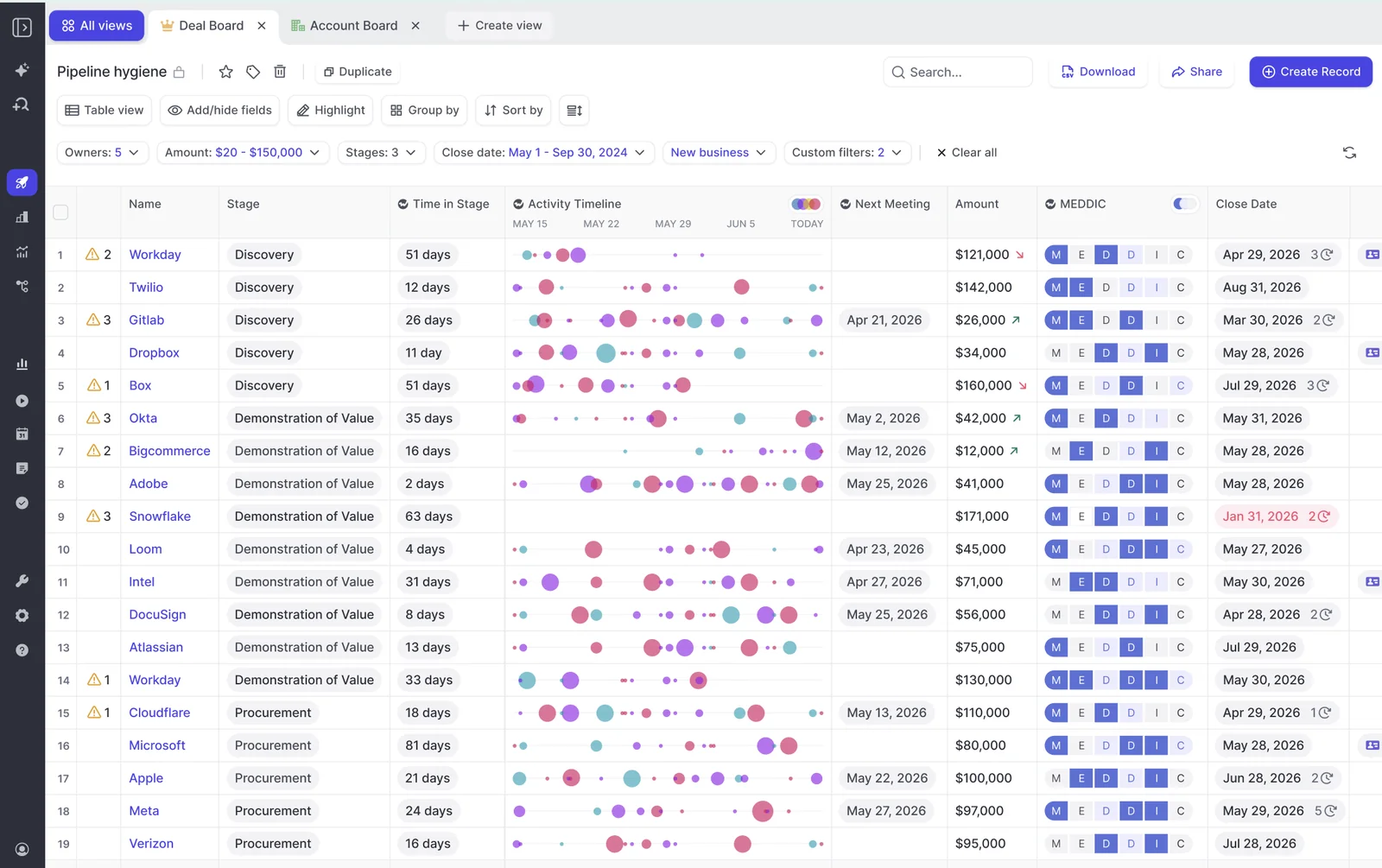
Weflow is the Revenue AI Orchestration platform for sales, customer success, and RevOps teams. It's built for Salesforce teams, with three modular products: Weflow Activity & Contact Capture, Weflow Conversation Intelligence and Weflow Deal Intelligence & Forecasting. Capture feeds every email and meeting into Salesforce, so the risk signals below read the whole deal, not only the calls that got recorded.
Conversation metrics. Weflow measures talk ratio, interaction, longest monologue, meeting volume and meeting duration per call and per rep. It labels speakers as internal or external from Salesforce and calendar data.
Trackers catch your own keywords, such as competitor names, pricing, timing and objections, and roll them up by rep, team and region. A competitor mentioned more often in one region shows up as a number, not a rumor. There's no sentiment meter. If you want sentiment, Weflow writes it into a Salesforce field from the call.
Deal risk warnings. Weflow ships more than 50 deal signals. You build warnings with AND/OR rules on any opportunity field except text fields, or on computed fields like days inactive, close-date pushes, single-threading and days in stage.
Weflow tracks days in stage and push count on every opportunity automatically, so you don't build custom fields for them. A rule like "close date pushed more than twice, forecast to close this month" is a two-minute setup.
The warnings also show up in the forecast submission screen, at the moment your rep picks which deals to commit. That's where an unhealthy deal gets stopped, instead of in a report after the number is already wrong.
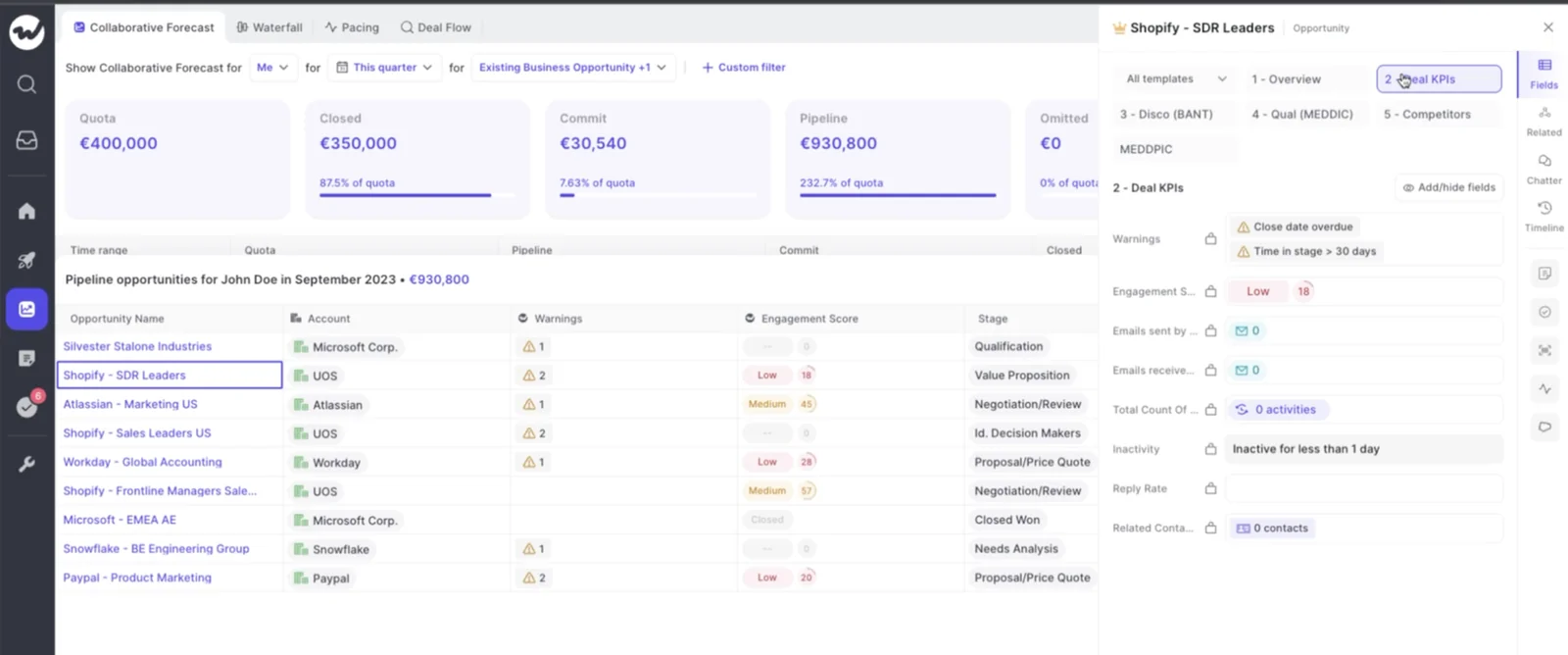
AI deal scoring. Weflow scores every opportunity from 0 to 100 on its likelihood to close, recalculated nightly. The model trains on your own closed deals and learns what separated won from lost in your business, such as time in stage, activity count and communication cadence. Each score comes with the drivers behind it.
Buying committee mapping. The deal AI summary reasons across every meeting on the opportunity and shows every person involved, with multi-threading and communication velocity. Velocity comes from the emails actually sent and received, not the rep's account of them.
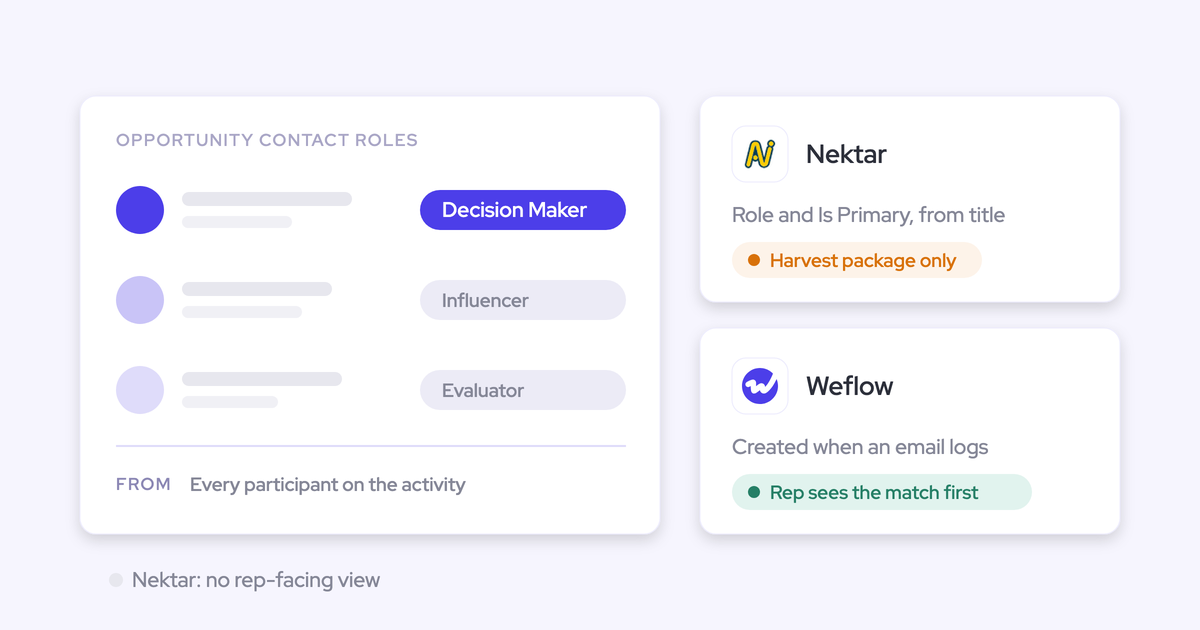
Weflow creates missing contacts from email threads and calendar invites and can attach them to the opportunity as contact roles. It doesn't infer whether someone is the champion or the economic buyer.
CRM field updates from conversations. AI field updates write call outcomes into Salesforce fields of every type except relationship lookups, including picklists, numbers, dates and multi-selects. You set each field to write automatically or to wait for rep review. A website field can update itself while a champion field waits for a human.
Methodology fields accumulate across the deal instead of being overwritten by the last call. Custom objects are supported, with setup by our support team.
AI Playbooks do the deal-level work. They read every email, meeting, transcript and field on the opportunity, refresh every few hours, write methodology results back to Salesforce fields and return a next step. On the deal above, the playbook would read "Economic buyer still unidentified" on a deal forecast to close this month. Where nothing supports a criterion, it says so rather than inventing an answer.
Integrations with other tools. Weflow integrates natively with Salesforce, Gmail, Google Calendar, Outlook, Zoom, Microsoft Teams, Google Meet, Slack and the Outreach dialer, and we keep adding more. It has no native Snowflake, Databricks or BigQuery connector. Teams move data to a warehouse through the API.
Access from AI assistants (MCP). Our official read-only MCP connector gives Claude, ChatGPT and other assistants playbook output, call summaries, transcripts, forecast calls and pipeline metrics. An admin switches it on per workspace, with a separate toggle for full transcripts. Per-rep breakdowns cap at 25 owners.
Raw data access outside the tool. The REST API bulk-exports transcripts, metadata, scores and signals as JSON or CSV into warehouses and BI tools like Tableau and Looker. Recordings export to your own storage.
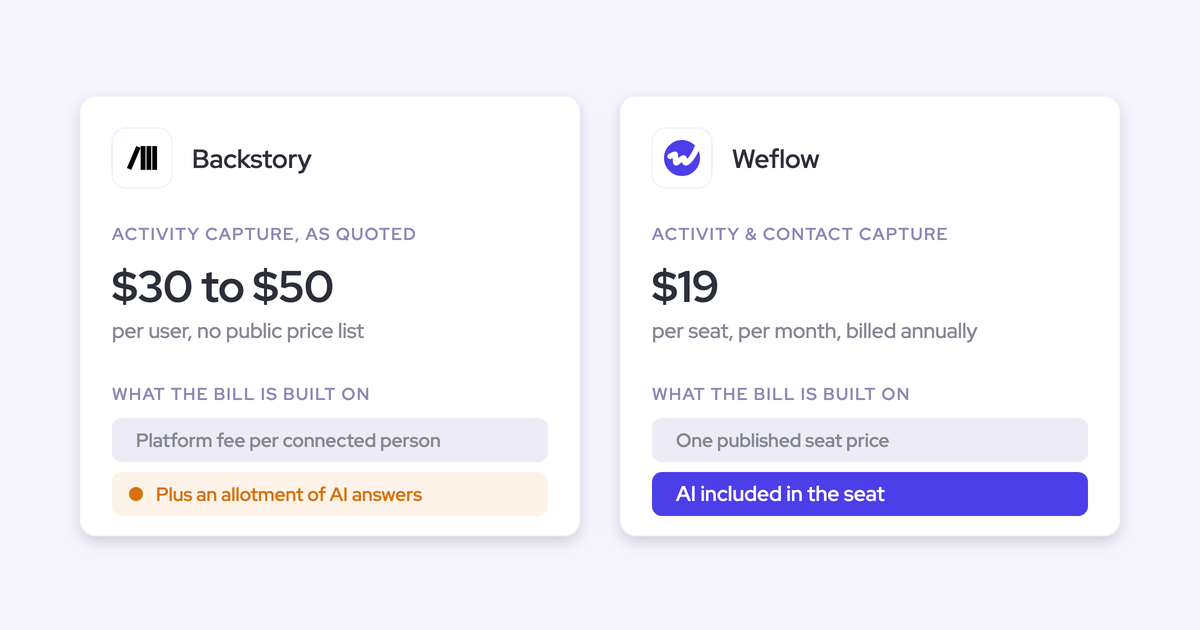
Pricing. Weflow Conversation Intelligence is $39 per user per month. Deal warnings, AI deal scoring and buying committee intelligence come in Weflow Revenue AI Business at $59, and Revenue AI Enterprise at $79 adds forecasting. Plans are billed annually with a 10-user minimum. AI features sit inside the seat price, and only Agent Builder is metered, with 25 free agent actions a month in every plan.
Where it stops
- Everything arrives after the call. There are no live in-call cues or battlecards.
- There's no sentiment graph. Sentiment is a field Weflow can write from the call.
- Deal warnings and playbook scores are Weflow fields, marked with a W in the interface. They don't reach a Salesforce or BI report unless an agent writes them to a custom field you create.
- The deal score needs about six months of closed history before it scores accurately.
- Weflow works only with Salesforce and is built for B2B selling.
- The standard minimum is 10 users per product or bundle.
- Integrations are partial: no native warehouse connectors, and Weflow isn't an integration platform.
Best for: Salesforce teams that want risk read across calls, emails and activity on the whole deal, warnings they define themselves, and a transparent seat price.
Gong: the deepest call analytics, with eight fixed deal warnings
Gong is a conversation intelligence platform that records and analyzes sales calls in its own cloud. It's sold as a Gong Foundation core license with coaching, forecasting, sales engagement and data export applications on top. Gong invented this category, and its conversation analytics are still the deepest of the six.
The deal board is why managers stay.
"The reason why I stuck with Gong was like the bubbles. You sort of get like addicted to the bubbles."
— Chris Nethercote, Head of Sales at Weflow, former Gong enterprise customer
Conversation metrics. Gong measures talk ratio, longest monologue, longest customer story, interactivity, patience and question rate, per team and per rep, on any plan. It attaches recommended ranges, such as a longest monologue under two and a half minutes.
Deal risk warnings. AI Deal Monitor has exactly eight warnings, all defined by Gong:
- No activity
- Ghosted
- Overdue
- Not enough contacts
- No power
- Pricing not mentioned
- Red flag
- Stalled in stage
You can switch each on or off and change how long before it triggers. You can't add a warning for a pattern specific to your motion, like a required partner sign-off.
AI deal scoring. The AI Deal Predictor scores each open deal from more than 300 signals, trained on your own won and lost deals, and lists the positive and negative signals behind the score.
The score is a percentile rank, not a probability. A deal scored 80 is more likely to close than 80 percent of your other open deals. It isn't an 80 percent chance of closing. In a weak quarter, your top-ranked deals still score high. Scores need a Gong Forecast seat and at least 50 closed-won and 150 closed-lost deals from the last two years.
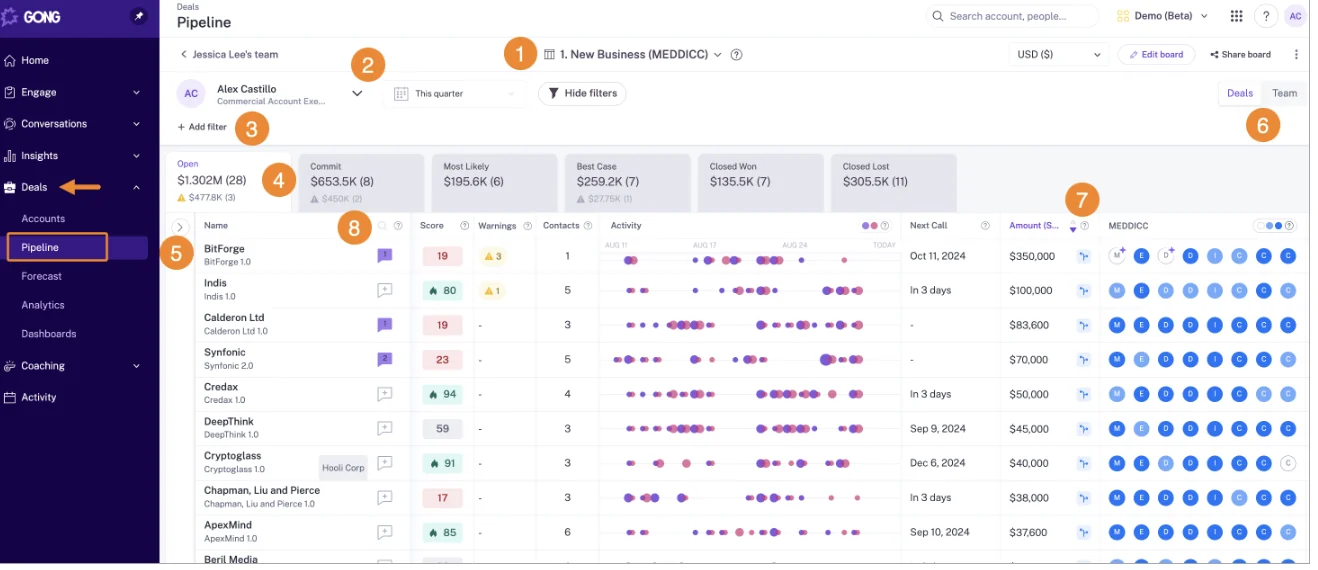
Buying committee mapping. Gong's deal panel shows who's engaged on both sides and how active each person was over the last 21 days. It recommends further contacts, and the board shows whether a deal is single- or multi-threaded.
CRM field updates from conversations. AI Data Extractor writes answers from calls into existing CRM fields automatically and overwrites the value when newer information appears. A workspace can publish up to 20 extractors, and only a business admin creates them. Deal boards can fill one text field with AI suggestions, and AI Deal Reviewer suggests playbook notes.
Integrations with other tools. Gong's marketplace lists about 450 integrations and partner solutions. Gong imports calls from about thirty dialers and records on eleven meeting platforms.
Access from AI assistants (MCP). Gong's MCP server connects Claude, ChatGPT and Microsoft Copilot through three tools, each scoped to one account, deal or contact. It returns AI insights rather than transcripts and is read-only. Requests draw metered credits, while the same brief generated by hand in Gong's interface is free.
Raw data access outside the tool. Gong's API returns transcripts, participants, trackers and scorecards, capped at 3 calls a second and 10,000 a day. Warehouse delivery to Snowflake, Databricks, BigQuery and Redshift requires Data Cloud, a separate purchase of about $5,000 a year.
Pricing. Gong publishes its model but no prices: per-user licenses, a platform fee that scales with users, and a custom proposal. AI usage is metered in credits on top, with each paid core seat adding 2,000 credits a year to a company-wide pool.
Where it stops
- You can't define new deal warnings beyond Gong's eight.
- The deal score is a relative rank, and it needs a Forecast seat plus 50 won and 150 lost deals.
- Field extractors are capped at 20 and overwrite earlier values.
- There's no published price, and AI usage draws down a shared credit pool.
Best for: teams that want the deepest conversation analytics and the deal board habit, and have the closed-deal volume for its predictor.
Clari and Salesloft: admin-built Deal Gaps and a Salesloft-only engagement score
Clari now sells under the Salesloft brand. Clari Forecast and Clari Copilot keep their names, and capture, engagement and deal management are Salesloft products. The platform centers on roll-up forecasting and pipeline inspection, with Copilot for conversation intelligence.
Conversation metrics. Clari Copilot measures talk-to-listen ratio, longest monologue, interactivity and engaging questions, and ranks each rep against the team average.
Deal risk warnings. Salesloft Deals flags risky deals with Deal Gaps, rules a team admin builds on any deal field, such as days in stage, a past close date, an empty next step or days since last activity. Admins combine criteria with any or all logic and set how many gaps turn a deal yellow or red. Only team admins can edit gaps.
On the call side, Salesloft marks Key Moments per recording in categories including competitors, decision makers, objections, and urgency and timing.
AI deal scoring. Salesloft's Deal Engagement Score rates new business deals 0 to 100 and shows the top three factors. When your history is thin, it falls back to a global model trained across Salesloft customers.
The score reads only activity logged in Salesloft, so a deal worked outside it looks colder than it is. Clari's own opportunity score is the one buyers tell us nobody reads. Once it's been wrong in front of a manager, it stops being trusted.
Buying committee mapping. Clari's Relationships tab shows who's involved in each deal and how engaged they are. Salesloft's Auto Buying Group Capture adds identified email and meeting participants as stakeholders. Salesforce contact roles still need a rep to add each one.
CRM field updates from conversations. Salesloft Deals writes MEDDPICC and BANT values from call transcripts into CRM fields through automatic sync. There's no documented step for a rep to review values before they reach the CRM.
Integrations with other tools. Salesloft's data layer syncs with Salesforce, Microsoft Dynamics, Snowflake, Databricks, Gmail, DocuSign, ZoomInfo and LinkedIn. Recording integrates with Zoom, Teams, Meet and Webex.
Access from AI assistants (MCP). The Salesloft MCP server is read-only, in beta and requires the paid Agentic add-on. It covers accounts, people, opportunities and call summaries, but not raw transcripts, cadences or forecasts. The separate Copilot MCP server reaches call data only.
Raw data access outside the tool. Clari has REST and Export APIs plus a Copilot API. Forecast history exports as CSV, and Salesloft syncs data to Snowflake and Databricks.
Pricing. Neither Clari nor Salesloft publishes seat prices. Both pricing pages lead to a Talk to Sales booking. Salesloft publishes its package structure, Advanced and Elite, with forecasting, agents and the dialer as paid add-ons.
Where it stops
- The engagement score reads only activity logged in Salesloft.
- Clari's opportunity score is widely ignored by the teams that own it.
- Methodology field writes have no documented review step.
- MCP access is a paid add-on and doesn't return transcripts.
- There's no published pricing.
Best for: teams already on Salesloft that want admin-built Deal Gaps and an engagement score, plus Clari Copilot's live battlecards during calls.
Attention: a Deal Risk Monitor agent and open transcript access
Attention is an AI-native conversation intelligence tool that records sales calls and uses the conversation data to power scorecards, CRM field updates, and AI agents and workflows. It sells itself around agents that work the pipeline, not around recording.
Conversation metrics. Attention's Ask Attention analysis identifies sentiment in a conversation, returned as part of an analysis you request rather than as a meter. We found no Attention documentation of talk ratio, talk time or question counts. Its Manager Analytics count review activity, such as calls and minutes listened.
Deal risk warnings. The Deal Risk Monitor agent scans conversations for risk phrases and notifies sales managers. Admins define their own deal indicators, which show on each deal in Deal View. The risk alerting Attention documents comes from conversations.
AI deal scoring. Attention scores each deal from the content of its calls. You build the score from indicators you define, each with written criteria for the lowest and highest score. Attention doesn't document a score trained on your own win history.
Buying committee mapping. Attention lists every call's participants and links calls to CRM contacts by matching those participants. It doesn't document a stakeholder view with roles or engagement across a deal.
CRM field updates from conversations. Attention extracts values into mapped Salesforce or HubSpot fields using a written prompt per field. Automatic sync is the recommended default, and manual sync gives the rep a per-field review tab. A field can be scoped to the deal, so it summarizes every call linked to the opportunity. New fields are mapped by hand and fill only on future calls.
When a call has nothing for a field, Attention writes prose explaining the absence into it. On Attention's own demo, the Economic Buyer field holds a paragraph saying the call didn't cover the decision maker. To every report, that reads as a filled field.
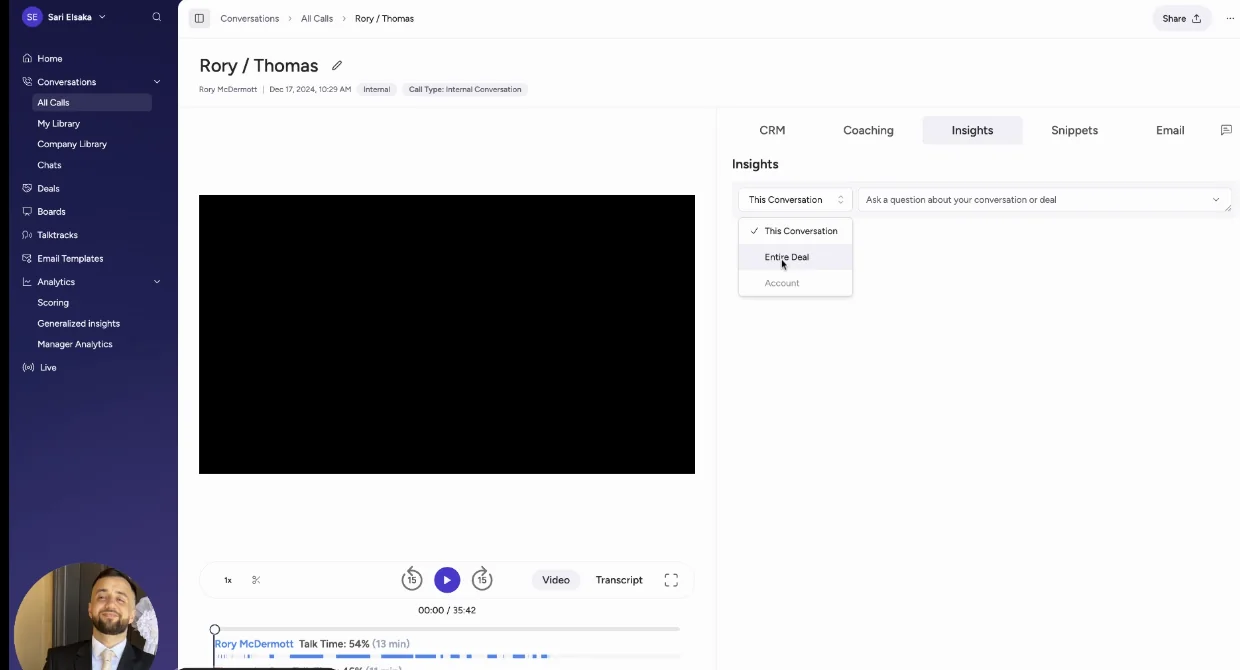
Integrations with other tools. Attention connects to Google, Outlook and Zoom calendars, imports calls from Zoom Phone and Aircall, and works both ways with Slack. Its workflow steps act inside Gmail, Google Sheets, Salesforce, HubSpot, Notion, Snowflake and more.
Access from AI assistants (MCP). Attention runs the widest MCP surface of the six: 68 read-write tools across 15 groups. It returns raw transcripts, runs analysis across up to 25 calls or a whole deal, and reaches Attention's own Super Agent. Calls run under the caller's permissions, except org-level API keys, which carry full organization access. It's governed by rate limits, with no consumption charge.
Raw data access outside the tool. Raw transcripts, scorecard results and AI insights are available through MCP and API keys. Workflows can send data to Snowflake or any API through an HTTP request step.
Pricing. Attention doesn't publish pricing.
Where it stops
- Talk metrics per call or per rep aren't documented.
- The deal score comes from indicators you define, not from your win history.
- There's no documented stakeholder role view.
- Empty fields get filled with prose about what wasn't said.
- There's no published pricing.
Best for: teams that want an agent-first approach, live in-call prompts in the desktop app, and open, raw-transcript MCP access.
Avoma: a per-meeting sentiment graph and stakeholder roles
Avoma is a meeting-first conversation intelligence tool that records, transcribes and summarizes calls, and has added CRM sync, coaching and deal features on top. It sells mainly to small businesses and solo operators.
Conversation metrics. Avoma measures talk time, filler words, longest monologue, longest customer story, and questions asked by your team and by customers. It's also the one tool here with a literal sentiment graph, shown per meeting on the recording player. It's per meeting, not per deal.
Deal risk warnings. Avoma gives each opportunity an AI risk score from its meetings, emails and CRM updates. It sends keyword alerts to Slack or email, filtered by deal stage. With the Revenue Intelligence add-on, it posts deal-risk and forecast-risk analysis into the Slack thread under a meeting alert. You can also build agents from a risk-detection template.
AI deal scoring. The risk score runs 0 to 100, with the positive and negative factors behind it and a timeline of past assessments. Avoma doesn't say the model is trained on your own won and lost deals.
Buying committee mapping. Avoma maps each deal's stakeholders from its meetings, tagging job title, role and influence level, and shows each person's engagement over time. It alerts you to single-threaded deals and to new stakeholders who appear late.
CRM field updates from conversations. Avoma writes Smart Topic notes from each meeting into admin-mapped Salesforce or HubSpot fields on opportunities and accounts, appending in real time. There's no review step before the write, and custom objects aren't supported.
Integrations with other tools. Avoma lists 26 native integrations across conferencing, CRMs, dialers and sales engagement tools, Slack, Teams chat and ClickUp, plus Zapier.
Access from AI assistants (MCP). Avoma's MCP connector lets Claude and ChatGPT read meetings, transcripts, notes, scorecard results and usage metrics, and set a meeting's outcome, purpose and privacy. It requires the Organization or Enterprise plan or the API Access add-on.
Raw data access outside the tool. A public REST API and webhooks cover meetings, recordings, transcripts, notes and scorecards, limited to 60 requests a minute, on the Organization plan and above.
Pricing. Avoma publishes per-recorder-seat prices: Startup $19, Organization $29 and Enterprise $39 a seat a month, billed annually. The Revenue Intelligence and Conversation Intelligence add-ons are $29 a seat each. Viewer seats are free.
Where it stops
- Deal risk features sit behind the $29 Revenue Intelligence add-on.
- The risk model isn't stated to be trained on your own deals.
- Field writes have no review step, and custom objects aren't supported.
- The product centers on the meeting and sells mainly to smaller teams.
Best for: smaller, budget-conscious teams that want a per-meeting sentiment graph, stakeholder mapping with roles, live answer cards and published prices.
Jiminny: eight configurable risk triggers for coaching-first teams
Jiminny is coaching-first conversation intelligence for mid-market revenue teams. It records meetings, dialer and in-person calls, scores and coaches reps, and writes call activity and AI-extracted fields into Salesforce, HubSpot and other CRMs.
Conversation metrics. Jiminny measures seven metrics on every call: talk-to-listen ratio, patience, longest monologue, longest customer story, talking speed, conversation switches and question rate. Managers see them per rep and team in Team Insights.
Deal risk warnings. Deal Insights flags risk with eight triggers, each configured by the team:
- No recent activity
- No response
- Deal value decreased
- Single-threaded deal
- Competitors mentioned
- No change in deal stage
- No future activity scheduled
- Close date passed
Nudges send matching calls to Slack or email, and you can follow a deal to get a daily email when it changes.
AI deal scoring. Jiminny has no built-in deal score. You can set up AI CRM Filling to write a 1 to 5 likelihood-to-close field with a written rationale from a deal's calls and emails.
Buying committee mapping. The deal view lists contacts who took part in emails and calls, and the single-threaded trigger flags thin coverage. Role tags like decision maker or champion come from an AI CRM Filling field you build.
CRM field updates from conversations. AI CRM Filling writes into Salesforce or HubSpot fields on deals, accounts, contacts, leads and tasks, triggered by a new call, email or stage change. Each automation runs automatically or waits for rep review. You choose fill empty, overwrite or append, and test the prompt on a real call first.
Integrations with other tools. Jiminny records calls from about 20 third-party dialers, records Zoom, Meet and Teams, reads Google and Microsoft 365 mailboxes, and connects to Zapier. It has its own dialer too.
Access from AI assistants (MCP). A read-only MCP connector for Claude and ChatGPT is available on the Scale and Grow tiers, scoped to what each user can see.
Raw data access outside the tool. A REST API, opened with an organization-level key only admins can generate, feeds a data warehouse or BI tool.
Pricing. Jiminny publishes no prices. Each tier is a flat per-seat fee with no platform fee or usage credits. The only published figure is 2 cents a minute for dialer minutes above the allowance.
Where it stops
- Risk is rule-based triggers, and likelihood to close is a field you build.
- Jiminny doesn't log emails to Salesforce. Synced emails stay inside Jiminny.
- There's no published price.
Best for: coaching-first, dialer-heavy mid-market teams on HubSpot or Salesforce that want live coaching and threshold-based risk triggers.
What each tool costs per rep for risk detection
Only Weflow and Avoma publish seat prices. For the risk features, the other four are quote-only, and some add metering or add-ons on top.
| Tool | Pricing model | Published list prices | What you need for warnings and deal scoring | What costs extra |
|---|---|---|---|---|
| Weflow | Per seat, AI included, annual, 10-user minimum | Conversation Intelligence $39; Revenue AI Business $59; Enterprise $79 | Weflow Revenue AI Business ($59) | Agent Builder beyond 25 free actions a month |
| Gong | Per user plus platform fee, Foundation required | None | Gong Forecast seat for deal scores; Forecast Essentials or Gong Forecast for deal boards | AI credits beyond the pool; Data Cloud about $5,000 a year |
| Clari (with Salesloft) | Quote-only packages, Advanced or Elite | No seat prices | Salesloft Deals for Deal Gaps; Copilot needs Advanced or higher | Forecasting, agents, dialer and MCP add-ons |
| Attention | Negotiated contract | None | Not published | Not published |
| Avoma | Per recorder seat plus add-ons | $19, $29 or $39 per seat | Revenue Intelligence add-on, $29 a seat | Conversation Intelligence add-on $29; optional onboarding $1,000 |
| Jiminny | Flat per-seat fee per tier | None | Scale tier for Deal Insights | Dialer minutes above the allowance, 2 cents a minute |
Metering and add-on gating matter more than the headline price if you want your whole team on the tool. Once every AI run draws on a shared pool, teams start rationing who gets access, and the manager who wanted every deal read ends up with some of them read.
Which tool fits your team, depending on what you need
No single tool is best for everyone. The right pick depends on the signal you need most, your CRM, your team size and your budget.
Pick by the risk signal you need most
| If you need… | Pick…, because… |
|---|---|
| Deal-level risk written to Salesforce, with warnings you define | Weflow, because AI Playbooks read the whole opportunity and warnings run on your own rules |
| The deepest call analytics and the deal board habit | Gong, because its metrics and deal board are the most mature in the category |
| Risk flags inside a Salesloft stack | Clari and Salesloft, because Deal Gaps and the engagement score read Salesloft activity |
| An agent-first approach and open transcripts | Attention, because its MCP server returns raw transcripts and supports write actions |
| A literal sentiment graph | Avoma, because it's the only tool here that charts sentiment per meeting |
| Coaching first, with risk triggers alongside | Jiminny, because scorecards and live coaching lead its product |
| Live in-call whisper prompts or battlecards | Attention, Avoma, Jiminny or Clari Copilot, because Weflow works after the call |
Pick by team size, CRM and budget
- If you run HubSpot, Weflow is off the list. Jiminny, Avoma and Attention all write to HubSpot fields, and Gong's deal scores support HubSpot too.
- If you run Salesforce and want the risk to land on the opportunity, Weflow fits, because everything it captures lands in Salesforce.
- If you're a small team on a tight budget, Avoma's published $19 entry seat is the lowest starting point here, with risk features in the $29 add-on.
- If you manage 6 to 9 AEs, Weflow's standard 10-user minimum means you'd pay for seats beyond your team size.
- If your deal volume is low, Gong's predictor needs 50 won and 150 lost deals, and Weflow's score needs about six months of closed history.
If Weflow is on your shortlist, you can see the deal board, warnings and playbooks on real screens before you talk to anyone. Walk through the product yourself, no call required.
What changed across these six tools in 2026
This year moved the category toward agents, live prompts, MCP access and metered AI. Some of those moves narrowed what you can get out of a tool.
- Weflow: automated meeting type detection arrived in August 2026. Each recording is tagged, and the type can trigger its own scorecard, field updates and summary.
- Gong: customers received AI credit allocation details in late May 2026, as Gong moved AI usage onto a metered credit pool on top of seat pricing.
- Clari: Copilot customers had to re-sync Zoom by 1 April 2026 or lose Zoom recording entirely. The June 2026 release notes put Clari Copilot in place of Salesloft Conversations. In August 2026, the Salesloft MCP server removed transcript retrieval, and Clari sold under the Salesloft brand from September 2026.
- Attention: the April 2026 release let the Super Agent search Salesforce and HubSpot and read imported email. May 2026 added AI-drafted setup suggestions, and June 2026 added live talk-track and battlecard prompts in the desktop app.
How we compared the tools, and where Weflow stands
We work at Weflow, and we built one of these six tools. Every competitor claim here comes from the vendor's own public documentation and pricing pages, or from what buyers told us during evaluations. We judged each tool on the same nine capabilities.
"Partial" means the tool does part of the job and stops somewhere specific, and we've named where. We ranked fit per reader, not overall. The fastest way to see the difference yourself is to run the same three deals through each tool on your shortlist.
Questions sales managers ask about deal risk detection tools
What does Weflow cost per rep, and what's the minimum commitment?
Deal warnings and AI deal scoring come in Weflow Revenue AI Business at $59 per user per month, which includes Weflow Conversation Intelligence. The standard minimum is 10 users on a 12-month term. Recordings, transcripts, AI field updates and Ask Weflow AI carry no usage metering, and only Agent Builder is consumption-priced. Weflow offers a 14-day free trial with guided onboarding.
How long before Weflow's deal score is trustworthy on our data?
Weflow's deal score needs about six months of closed deal history, and after that it trains within a few days. It reads as far back as your Salesforce history allows, usually two years. Gong's predictor, by comparison, needs at least 50 closed-won and 150 closed-lost deals from the last two years.
Can I get a risk flag in Slack before my one-on-one?
Weflow sends forecast-call reminders and meeting-summary notifications to Slack. Agent Builder can deliver agent reports to a Slack channel, with PDF or CSV attachments, which is how you'd get an at-risk deal list before your one-on-one. Avoma posts deal-risk analysis natively in Slack threads, and Attention posts workflow alerts to Slack channels.
Can Weflow deal warnings show up in a Salesforce dashboard or board report?
Not directly. Weflow deal warnings and AI Playbook scores are Weflow fields, so they don't appear in Salesforce reports or BI tools on their own. The workaround is an agent that writes the assessment into a Salesforce field you create. Weflow marks its own fields with a W in the interface, so you can tell at a glance what will reach a report.
What happens when the AI is confidently wrong about a deal?
Filled fields that say nothing are a fear we hear on nearly every evaluation.
"If the metrics comes back and says they have 50,000 staff, that is a metric, but it's not relevant to what we're looking at in our sales process."
A sales leader on an evaluation call with Weflow
In Weflow, you set review before sync per field, so interpretive fields like champion or pain wait for a rep. Methodology fields accumulate instead of being overwritten, and AI Playbooks state when no evidence was found. Reps can override a playbook field, and Weflow checks the override for plausibility against the deal. Gong's extractor overwrites earlier values, and Attention writes prose into fields with no finding.
Can I define my own risk keywords, like budget cut or new VP?
Yes. Weflow trackers watch for your own keywords across every recorded call and roll them up by rep, team and region. Deal warnings run on opportunity fields and computed fields, not on text fields. Keyword risk shows up through trackers and AI Playbooks, and slippage risk shows up through warnings.
Will my reps read deal warnings as surveillance?
Weflow shows warnings where your reps already work, including the forecast submission screen, where they choose which deals to commit. Reps can override any playbook field with their own view. There's no second portal to live in, because the deal data sits in Salesforce.
Does Weflow cover phone calls and in-person meetings, or only video calls?
Weflow Conversation Intelligence records Zoom, Google Meet, Microsoft Teams and Webex. The desktop app records softphone calls on tools like Aircall or RingCentral, because it captures the computer's audio, though the rep starts that recording. Weflow imports Outreach dialer calls, and Weflow Mobile Copilot records in-person meetings. Native telephony capture beyond Outreach remains a gap, so phone-heavy teams won't get full automatic coverage.
Can we bring our Gong call history into Weflow?
Yes. Weflow imports your Gong recordings, metadata and transcripts with an API key, usually in about a week, at no charge. Weflow relinks each recording to the right Salesforce records, and your existing tracker set can carry over, so keyword trends don't restart from zero.
How does Weflow handle recording consent and data residency for EU buyers?
Weflow is a German company hosted in Frankfurt. It creates your instance in the region where your Salesforce is hosted, and you can override that to keep data in the EU or UK. Weflow provides a DPA with EU Standard Contractual Clauses and holds SOC 2 Type II certification and GDPR compliance. Consent flows include a Teams pre-meeting email with an opt-out link and an in-call chat message that triggers permanent deletion on request.
Can Weflow replace the Gong deal board my team is used to?
Gong's deal board is the habit managers find hardest to give up, and we won't pretend otherwise. Weflow's deal board shows last email, last meeting, next meeting and a clickable activity timeline on each deal. It puts opportunity, account and contact fields side by side, which a standard Salesforce opportunity report can't, and every field writes back to Salesforce.
Does this work for customer success and renewal calls?
Yes. You can define custom meeting types such as renewal, so renewal calls get their own scorecard, field updates and summary instead of the discovery rubric. Renewal deals run on renewal opportunities. Weflow has no account-level board where a CSM sees the whole customer at once.