RevOps should own the system that runs revenue, not the queue of requests that lands on it. Below, you'll find the test behind each side of that line and how to get your CRO to sign off on it.
Here's what sits on the RevOps side:
- Shared definitions and the evidence behind them
- The operating rhythm and the planning mechanics
- The go-to-market operating system, run like a product
- The "how", once executives agree the "what" and "why"
- Governance of which AI agents and tools enter the stack
Here's what RevOps hands back:
- The priority order
- The ruling on whose number is right
- The how-do-I lookup desk
- Rep data entry
- Order-taking that automation can already do
If your honest answer to "what are you working on" is "whatever we were asked", the team gets labeled a reporting shop, and order-taking is the first work automation replaces.
Rep data entry is the clearest case, because you can take rep data entry off the RevOps workload instead of chasing reps every Friday.
Two caveats before we start. First, you can't simply declare this line. You negotiate it with the CRO, and it only holds when the numbers back it up. Second, no single org model has won, and the right scope shifts with your business model.
That's why you'll find tests here, not a universal org chart.
Why does every unowned request land on RevOps?
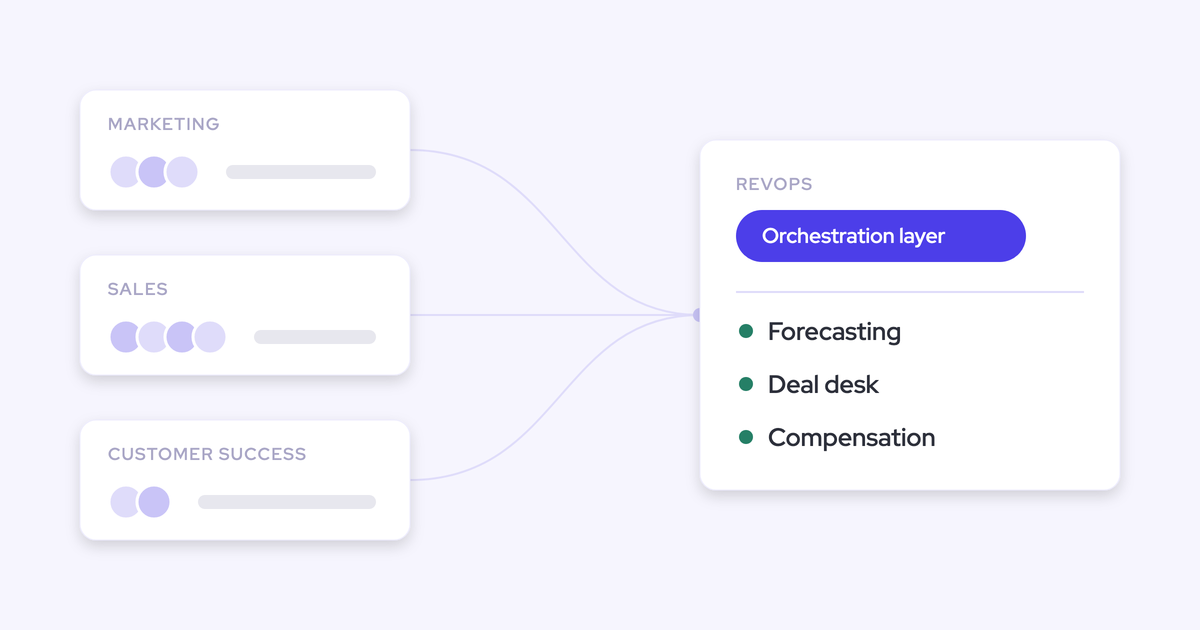
Unowned requests land on RevOps because "cross-functional" has no edge. RevOps exists to handle the alignment work no other function is built to hold, like shared definitions, regular ICP revisits and segmentation data.
The trouble is, a mandate with no boundary attracts everything else too.
"the number one priority for a RevOps org is to bring alignment across the go to market team and I would extend that to the product team for the product road map. And the only way that's gonna happen is if you have someone who is fully dedicated on doing maybe some things that might get overlooked in the other responsibilities of those orgs, which is like the single source of definition, the forcing a revisit of your ICP on a regular basis."
Here's how that plays out:
- Work with no clear owner defaults to you: tool admin, questions, reports, data chasing, political arbitration, planning, and now AI.
- The function stays small on purpose, since under efficient growth, the team without a quota doesn't get headcount.
- Without intake, priority or capacity mechanics, you can't show what a new request displaces. Urgency wins over importance, and the team looks slow.
- Reps update Salesforce inconsistently, so nobody trusts the data. Without reliable evidence, you can't stay neutral, and you get pulled into the argument instead.
- The loop closes: you're buried in admin, kept from strategy, labeled a reporting shop, and handed more admin.
"We handle pretty much all the tool stack and strategy and admin of pretty much everything. So we're a bit underwater at the moment."
If that sounds like your week, you're dealing with a design gap, not a personal failing, and the fix is a routing rule.
Four ways to route any request that hits RevOps
Every request that hits RevOps belongs on one of four paths, and a single test question decides which one. Try running your next request through this table.
| Path | The test question | Who signs | Cost of routing it wrong |
|---|---|---|---|
| RevOps owns and runs it | Is this part of the system every team runs, and is no one else built to hold it? | The RevOps leader, inside the agreed mandate | Hand it to one function and it fragments into competing versions |
| Executives decide, RevOps executes the how | Does it need a trade-off between peers, or a call on what and why? | The CRO or the executive team | Decide it yourself and you carry the political fallout with no authority |
| Automation absorbs it | Does it repeat on a schedule, or depend on someone typing what a system could capture? | RevOps, designing it once | Staff it with people and it eats the capacity your roadmap needs |
| The functional owner takes it | Does it serve one function's motion and that leader's day-to-day priorities? | The functional leader | Centralize it and you become a bottleneck for one team's local calls |
| Nobody decides (the default) | No one asks the question | Whoever shouts loudest | Everything lands on RevOps and the roadmap slides |
Living with the default can work for a quarter, as long as you know what it costs: every week you keep the lookup desk is a week the roadmap doesn't move.
What RevOps should own, and the test behind each
Each item below comes with a test that keeps it on your plate, plus practitioner proof you can show your CRO.
Shared definitions and the evidence that settles disputes
RevOps owns the single source of definitions and the facts behind them, but not the ruling between executives (more on that below). The test: if two functions would define it differently, it's yours to document and back with evidence.
This is what lets you take what Forrester's Ross Graber calls the Switzerland position: you want the right outcome for the business and the customer, and you figure out what each stakeholder needs to see to get on board.
"And if we want to make real change in our organization, I think it starts with being able to use the truth, real data, to go and influence others to do what's right, because my experience is that most of the people we're working with want to do what's right."
Here's how the difference shows up in the room:
- Holding the evidence: "Here's what the data shows, and here's what we still don't know."
- Picking a side: Cutting the numbers the way one executive wants them cut, which costs you the trust that made you useful.
The operating rhythm and the planning mechanics
As Jeff Ignacio argues on RevOps Lab, planning and the operating rhythm are the two pillars everything else in RevOps hangs off. The test: if it's a recurring cadence that spans functions, it's yours.
The rhythms you run:
- Annual planning, budget, capacity and quota
- The weekly pipeline management rhythm
- The forecasting rhythm
- Monthly and quarterly business reviews, with RevOps writing the commentary and feeding the risks it saw into the next planning session
Owning the capacity model also earns you the neutral seat in headcount fights, which is the clearest case of evidence buying authority.
"RevOps sees the capacity model. We see, like, all the data. So we bring all the insights to that conversation, and we can be a neutral referee between the CRO and GMs always wanting more headcount versus the CFO who says, let's not hire."
The go-to-market operating system, run like a product
RevOps should treat the go-to-market operating system as one product with many internal customers. That's exactly how Aircall's RevOps team works.
"I told the team that we're like a product management organization now. Right? Our product is the global go to market operating system that includes all the features of a product like annual planning, capacity modeling, territory segmentation, sales process, onboarding, and renewal and expansion process, all of those things."
The features of that product:
- Annual planning and capacity modeling
- Territory and segmentation design
- The sales process
- Onboarding
- The renewal and expansion process
This framing changes how you handle requests. When one team asks for a change, it becomes a feature request on a product every team runs, so you weigh it like a product manager would, not a help desk.
How the work gets built once executives agree why
Executives own the "what" and the "why", while RevOps owns the "how". That means solution design comes after executives align on outcomes and KPIs, never before.
"I think that often the executives, they actually don't care how you do it. They just wanna align on what you do and why you do it and what it drives in terms of measurable outcome. But then how you do it is actually up to you."
Joe Ort puts the flip side bluntly: building something the executive team doesn't believe will move the numbers is wasted time.
Which AI agents and tools enter the stack
Agent and tool governance is the newest addition to the RevOps mandate. As Alexander Müller points out, agent orchestration now appears directly in RevOps job descriptions, including at xAI.
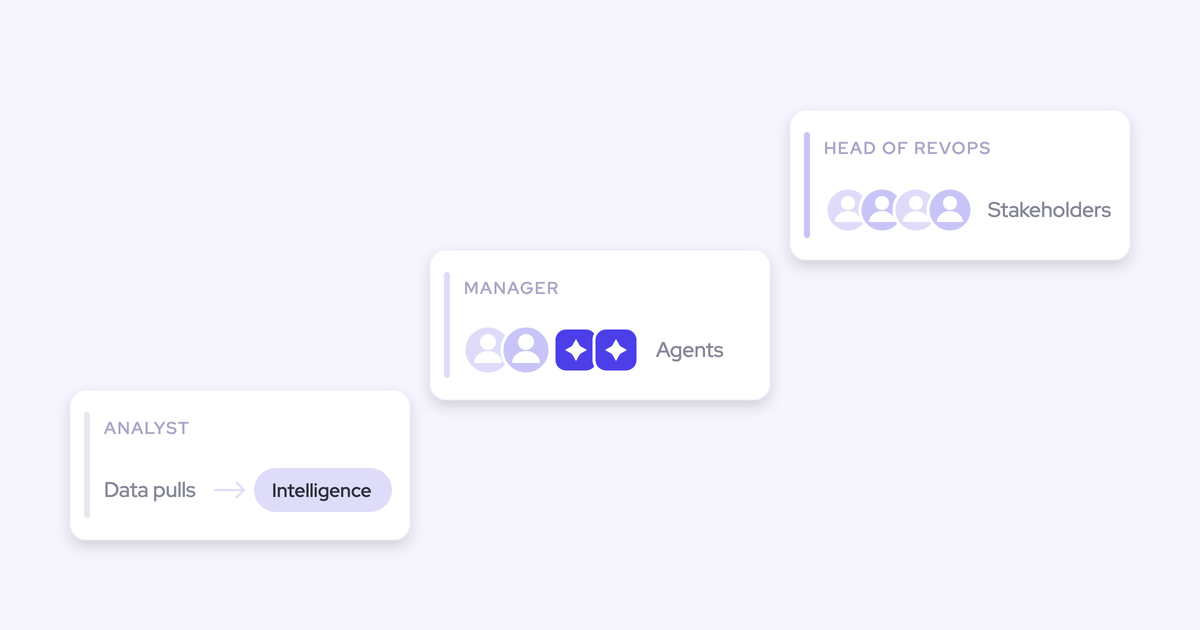
RevOps sets agents up, decides which AI tools enter the stack, and governs them. After all, reps can't manage five to ten agents each, so someone has to design the shared workflows. That's the thinking behind the RevOps Orchestration Layer.
Day-to-day running can sit with a GTM engineer, but that person still needs RevOps' context on how deals move down the funnel. Otherwise, they'll source pipeline nobody can judge.
The test: if it touches the data, tools and processes agents depend on, RevOps decides what enters.
What RevOps should hand back, and who takes it
Handing work back doesn't mean dropping it. It means moving it to whoever is built to own it, so every "no" still has a named destination.
| Work item | Who takes it |
|---|---|
| The priority order | The CRO, through one stack rank |
| The ruling on whose number is right | The executive team |
| "How do I" and "where do I find" questions | Self-serve answers RevOps curates |
| Rep data entry | Automated activity capture |
| Order-taking | Automation, while RevOps brings a point of view |
The CRO owns the priority order, through one stack rank
Without a central stack rank, the loudest stakeholder wins the RevOps roadmap. As Tessa Whittaker describes on RevOps Lab, urgency stands in for importance, so next week's board meeting outranks the work that actually moves company goals.
The fix is to hand the trade-off to the CRO, who makes it once and in the open. RevOps then executes against the rank instead of refereeing between SVPs competing for the same capacity.
The executive team settles whose number is right
The executive team fixes definitions, and RevOps brings the evidence. When marketing and sales arrive with different numbers and both want you to validate theirs, the debate needs somewhere to be settled. That place is the executive table, not your desk.
| The dispute | What RevOps brings | What executives decide |
|---|---|---|
| What counts as a qualified opportunity | Conversion data under each candidate definition | The definition everyone reports against |
| Who gets credit for sourced pipeline | Source and touch history per deal | The attribution rule |
| Which pipeline waterfall is official | A reconciliation of the competing versions | The one view leadership runs on |
| How to treat a deal that keeps slipping | Activity history and how often the close date moved | Whether it stays in commit |
Turn the how-do-I lookup desk into self-serve answers
The lookup desk is the biggest silent drain on RevOps capacity. It never shows up on the roadmap, but it eats into it anyway.
And since every answer depends on someone on your team being free, the selling org ends up waiting. Instead of answering each question personally, curate the knowledge and make it searchable inside the systems people already use.
Hand rep data entry to automated activity capture
Chasing reps to update Salesforce is exactly the kind of busywork RevOps wants gone, yet most teams keep doing it because a forecast can't run on stale records.
This is work for systems, not people. Changes also stick best when they happen in the background and reps don't have to learn anything new. And you don't need to frame it as strategic before you fix it.
"I don't think that everything always needs to be strategic. I think that's like, you know, in my mind, it's also the wrong perception. And if you create more value by making reps more efficient or automating manual data entry that they hate or, you know, providing better visibility, right, those are things that might be really hard to frame as strategic, but they actually make a huge difference for the company."
Leave order-taking to automation and bring a point of view
Taking requests and executing them is work automation can already do, before AI even enters the picture.
"being an order-taker RevOps function, forget AI, out of the box automation can take your job. Right? So having that consultative approach is going to be your differentiator as technology evolves, as you become more nuanced in both your consultative approach, but also your stakeholder management that we've been talking about. Like that's something that AI could probably get there eventually. AI can absolutely take orders and execute. So I think that's a really meaningful part of the story for the teams that I work with as well is like, do you wanna AI-proof your role? You really have to have a POV. Otherwise, you're kind of just a cog in this workflow."
— Nicole Bradshaw, leads the centralized RevOps function at PandaDoc
What's much harder to automate is a recommendation, a ranking of what matters and the stakeholder work to get it acted on. That's the part of the job worth protecting.
How to say no to stakeholders without looking obstructive
"Priority" and "capacity" sound like excuses until you put numbers behind them. One list, one stack rank and one above-the-line rule shift the conversation from your effort to the business outcome. Here's the order to build them in.
Put every request on one list with a capacity model
The first goal is to answer "what are you working on?" with something other than whatever stakeholders asked for last.
Here are the baseline mechanics, in build order:
- A single list of everything in flight.
- An effort or complexity estimate on every item.
- A capacity model in story points, by seniority.
- A sprint schedule.
- Release notes, so stakeholders see what shipped.
Once these are in place, every prioritization conversation runs on numbers. It's the same discipline a product engineering org runs, and your stakeholders already respect it there.
Get the CRO and direct reports to sign one stack rank
A separate priority list for each stakeholder won't help once three SVPs compete for the same sprint. Instead, you need one rank above all of them, built in three tiers:
- Company priorities.
- CRO priorities across the whole go-to-market.
- One cross-functional stack rank of the individual SVP asks.
Agree on the third tier in a single session, with the CRO and their direct reports in the same room. That way, everyone watches the trade-offs get made and signs off on the result. From then on, you execute against the rank instead of arbitrating it.
Agree what falls below the line when new work arrives
With capacity fixed for the sprint, anything new pushes something else below the line. The above-the-line rule makes that visible, and the person asking signs off on the trade. Here's what one of those trades looks like:
| Step | Example |
|---|---|
| The request | The VP of Sales wants a new territory report before next week's board meeting |
| Its estimate | Eight points against a sprint already at capacity |
| What drops below the line | The lead routing fix the CS leader ranked third in the stack rank session |
| Who signs | The VP of Sales and the CS leader agree the swap, or the CRO breaks the tie |
This way, you're no longer saying no. You're showing the cost and asking someone with authority to choose.
Line up support before a contested recommendation lands
Multi-thread inside your own company, the way a strong seller works an account. Before a contested recommendation reaches the person likely to push back, brief everyone with a stake in the outcome in terms that matter to them:
- Financial planning
- The data team
- Marketing and sales leadership
- Post-sale teams
- Product marketing and product
Then bring the executive your top two problems, not the full list. Nicole Bradshaw learned this from the other side of the table when she ran sales:
"I actually only care about the first two things you mentioned. Everything else, I don't have the mental capacity for it. There are so many other things in flight. There's so much else on my plate that I need my RevOps partner to actually prioritize for me and to tell me what to care about."
— Nicole Bradshaw, leads the centralized RevOps function at PandaDoc
Does it matter where RevOps reports?
Not as much as weekly discipline on the basics. When Insight Partners asked about 200 portfolio CROs whether their RevOps leader is a right-hand strategic partner, roughly 40 percent said yes.
But as Jeremey Donovan shared on RevOps Lab, the answer barely differed between top and average performers. What separated them was operational discipline on the basics.
Donovan still argues the partnership is worth having:
"But my observation — you know, being in the job for many years and then observing it now — there's just such a huge advantage to having your ops person as your right hand in whatever you do."
Both can be true: the seat gives you access, while the weekly cadence produces results. So don't spend your first quarter fighting over the box. That said, structure does change a few things.
CRO, COO, or CFO: What the reporting line changes
The reporting line shapes your proximity to the work and the scope you can take on.
| Reporting line | What it tends to give | What it tends to cost |
|---|---|---|
| CRO | Proximity to the revenue motion and the forecast call | A company-wide AI operations scope sits awkwardly under one functional leader |
| COO | Room to grow into AI operations across finance, product and engineering | More distance from the day-to-day sales motion |
| CFO | A neutral position between the CRO, CMO and chief customer officer as peers | Less of the right-hand proximity that helps ops act on a leader's priorities |
| Head of marketing | Depth in campaigns, lead management and systems | The perception trap: "if RevOps reports to the head of marketing, you're just marketing ops" |
Centralized, embedded, or hybrid: What each structure trades off
Each structure fits a different situation, and practitioners at Insight Partners, Aircall and Zapier have made different choices for good reasons.
| Structure | When it fits | What you trade off |
|---|---|---|
| Centralized under a neutral executive: one RevOps team serves sales, marketing and CS as peers | Leaders fight over definitions and you need an unbiased referee | Distance from each function's motion and priorities |
| Ops embedded with each functional leader: sales ops reports to sales, marketing ops to marketing, CS ops to CS. Systems can still sit centrally while strategy and analytics sit with the function (Donovan) | Each motion is distinct and needs a right hand who lives it | No single owner for cross-functional definitions |
| Hybrid center of excellence: a central team designs and governs standards, and business partners embed with each leader to drive adoption (Aircall) | Regions or units run their own P&L but must share one operating system | Partners can drift into local exceptions unless they report to RevOps |
| Funnel-stage pods: one owner for the inbound funnel, one for outbound, each working with marketing counterparts (Zapier) | Tool-based ownership has left nobody accountable for a conversion drop | Shared systems need coordination across pods |
How the RevOps mandate shifts with your business model
The same own and hand-back tests produce a different scope depending on how your company makes money and how it's organized, which is why a charter borrowed from another company rarely fits.
Consumption pricing pushes RevOps past closed-won
Under consumption pricing, the signed contract is only an estimate, so RevOps owns controls on both sides of the signature: before close, you substantiate the booking, and after close, you track whether usage ramps up to it.
"In a typical seat based or SaaS world, kind of the RevOps machine stops at closed won typically. It's like, okay, we booked it, we know we're gonna get this revenue. Being in a consumption based model really extends it out and extends out the responsibility and the controls and structures you need in place after closing, because that's really where most of the work is at that point."
PLG plus sales-led makes the charter unusually broad
When a sales-led motion feeds off a product-led user base, lead routing and the downstream sales process have to sit in one function. Otherwise, the customer journey breaks. At Zapier, Lindsay Rothlisberger's RevOps charter spans:
- Marketing, sales, customer success and enablement
- Tooling, automation and AI
- Lead and deal management
- Insights and analytics
- Compensation and deal desk
That breadth comes from the business model, not ambition. So if you run PLG plus sales, expect a wider mandate than the one outlined here.
A regional GM model turns RevOps into product management
When regional GMs each own a full P&L, RevOps becomes the global center of excellence and the glue between them. At Aircall, the center holds:
- Planning and insights
- Acquisition ops
- Marketing ops
- Customer ops
A RevOps business partner sits with each GM as their de facto chief of staff and runs the local operating rhythm. Partners report to RevOps with a dotted line to the GM, so they reinforce the global standard instead of drifting.
Where Weflow takes work off the RevOps mandate
Weflow is the Revenue AI Orchestration platform for sales, customer success, and RevOps teams. We built it for Salesforce teams to absorb the recurring admin that crowds out the RevOps mandate and to give you evidence nobody had to type, so you can stay neutral.
What Weflow runs so your team stops doing it by hand
Each capability below maps to one of the hand-back items above.
| Work on today's plate | What Weflow does instead |
|---|---|
| Chasing reps to log emails and meetings | Weflow Activity & Contact Capture syncs activity and contacts into your own Salesforce. A user starts capturing as soon as an admin adds them to a capture configuration, even before they've ever signed in. |
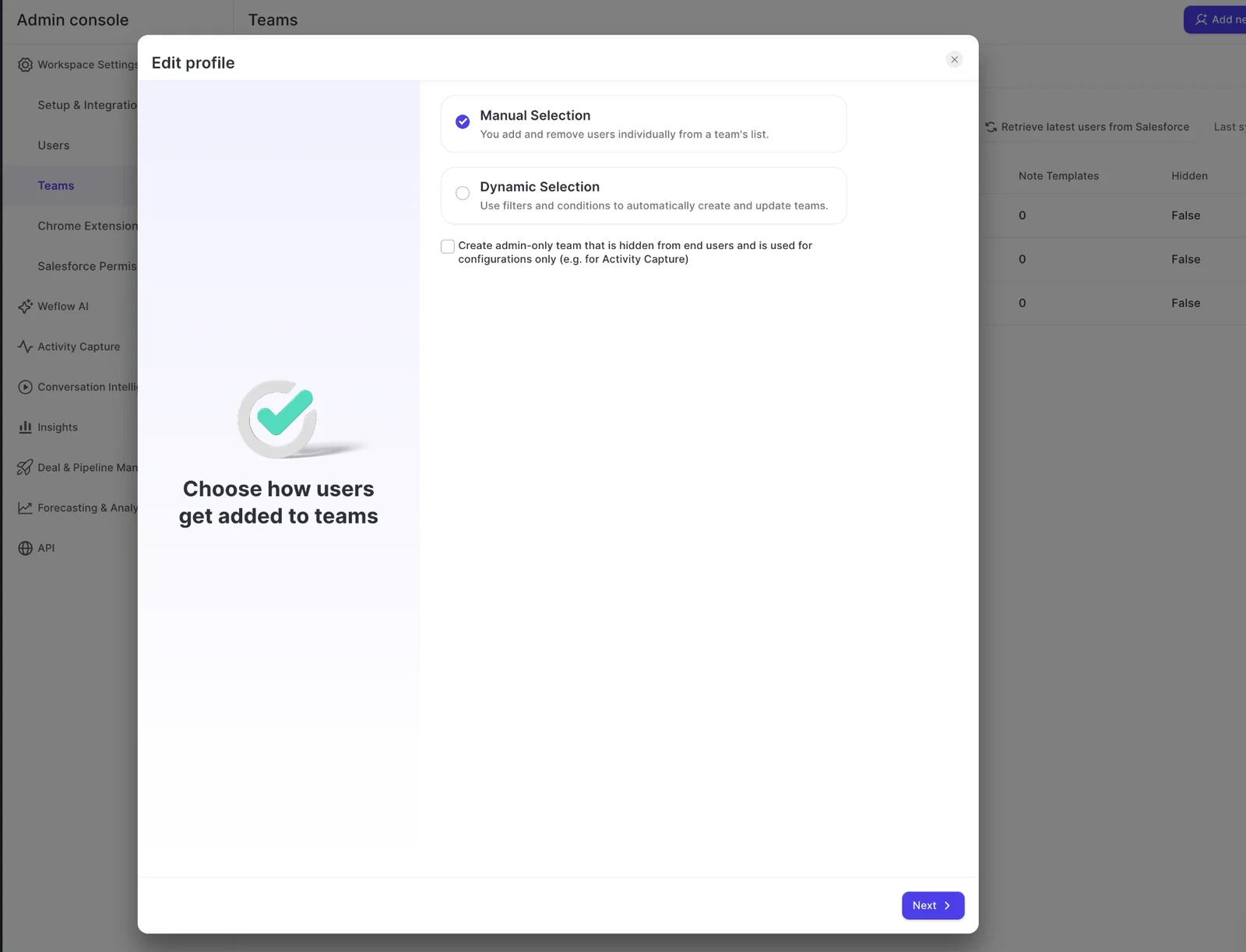
| Adding and removing users every week | Weflow builds teams dynamically from Salesforce by manager, role or field condition, so joiners, leavers and movers update automatically. |
| A queue of dashboard requests | You design Insights dashboards once and assign them to teams from the Admin Console. Each role opens the board built for it, and you revise it centrally. |
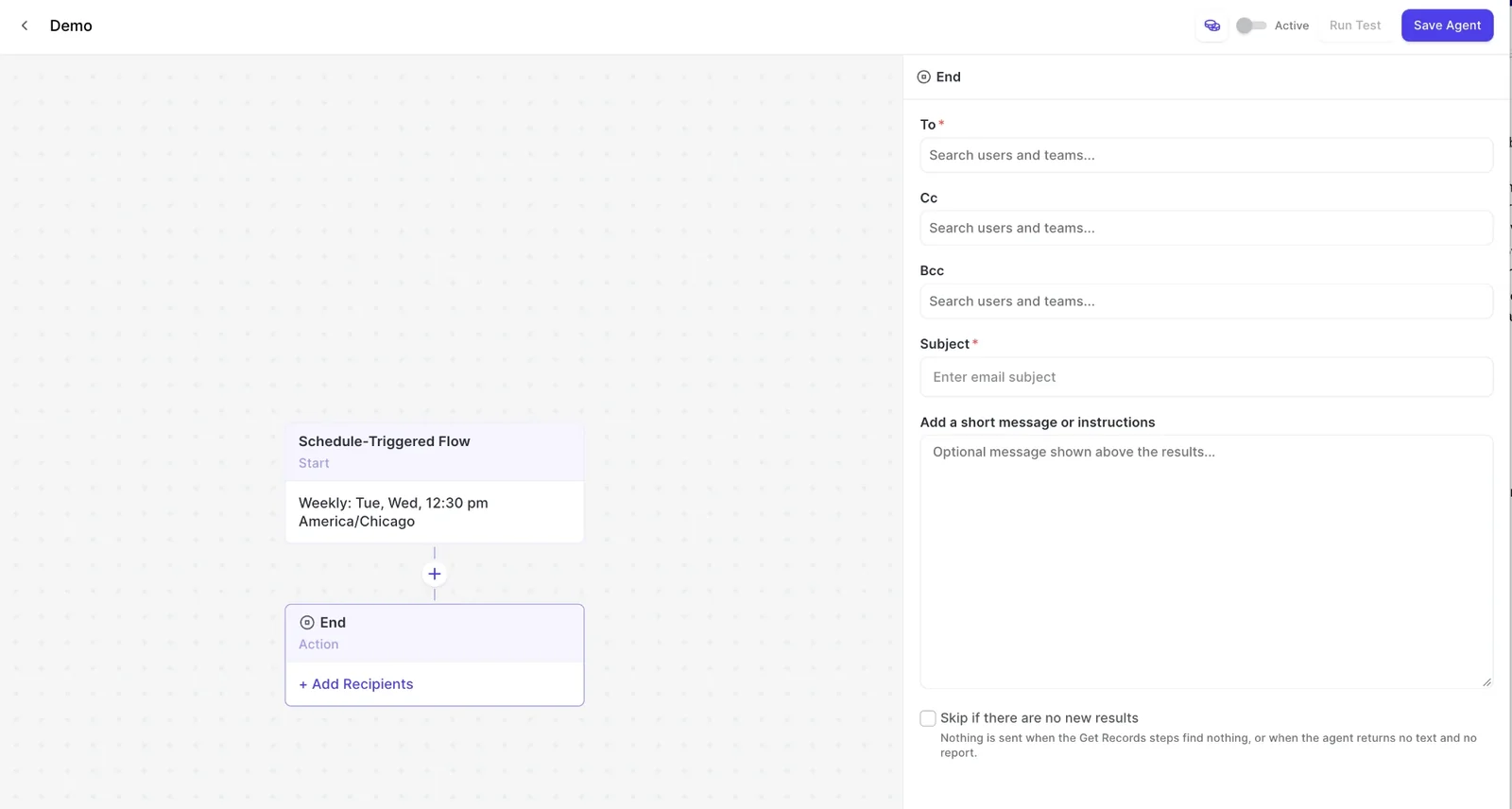
| Building the Monday pipeline deck by hand | Weflow Agent Builder flows run on a schedule, read Salesforce live, and email the result as a PDF. |
Provisioning is the one teams tend to underestimate.
Weflow's dynamic teams follow the Salesforce user logic your identity and HR systems already feed, so when a rep changes teams in Salesforce, their Weflow enrollment updates without anyone on your team touching it.
For executives, Weflow Agent Builder solves the "fewer numbers, each tied to a decision" problem. Most CROs won't log into another system, but they will read a short PDF on Monday morning.
Common plays include a Monday pass that names the deals needing action and pre-writes the follow-up, a weekly risk scan before the forecast call, and a monthly closed-lost analysis of which competitors appeared and which objections recurred.
And if a run finds nothing new, you can set the flow to skip the email.
How Weflow gives RevOps evidence nobody has to type
Weflow builds computed fields from captured activity, so reps can't game them and you don't have to chase them. You can add these fields to any Salesforce view:
- Days inactive
- A rolling four-week activity timeline
- Last and next meeting
- Per-contact engagement
- Activity velocity
You write deal warnings based on your own slippage patterns, since a fixed model can't know your cycle length. For example, a team with a 60-day cycle might flag 14 days of silence, while a team with a 12-month cycle wouldn't.
Typical triggers include a close date pushed more than twice, a single contact on the deal, a missing methodology field, and no activity in a set number of days.
In Weflow Deal Intelligence & Forecasting, warnings also appear on the forecast submission screen, at the moment a rep chooses what to commit.
All of it lives in your own Salesforce, so when two executives argue about a deal, you can bring the activity history instead of an opinion.
What putting Weflow in place costs a small RevOps team
- Onboarding is free, and our team runs it directly against a mutual action plan with named owners on both sides. Most teams go live in two to three weeks.
- A managed service option has Weflow do the heavy lifting. Your RevOps team only answers questions and unlocks access.
- Weflow works only with Salesforce, on Enterprise Edition and above, or Professional Edition with Salesforce's API add-on.
- Bundles start at 10 users.
What stays on your mandate even with Weflow
- Weflow doesn't define your mandate, settle executive politics, or create the stack rank. Those remain leadership agreements.
- Weflow Conversation Intelligence configuration (prompts, scorecards, field mappings) needs a named internal owner, or the templates go stale. That's a line item on your mandate, not off it.
- Forecasting takes longer to put in place than capture, because it encodes your operating cadence: who submits, how often, and against which quota.
How we'd set the RevOps mandate in your first 90 days
Before you try to move the business, get the RevOps team itself running like a machine. As Tessa Whittaker points out, a team running ad hoc can never execute fast enough to keep up. Here's the sequence we'd follow:
- Audit and baseline: Write down what exists today, including inherited tools whose original owners have left, and baseline every process metric before you change anything. Joe Ort calls skipping the baseline the step he most wishes he could go back and fix.
- Build the intake and capacity mechanics: Set up one list, estimates, a capacity model, sprints and release notes. Without these, every later step turns into an argument.
- Get the stack rank signed: Run one session with the CRO and their direct reports. From then on, the trade-offs belong to them.
- Agree the own and hand-back lines with executives: Use the routing table, and flag where your business model widens the scope.
- Automate the hand-back work and re-decide inherited tools: A new leader's first 90 days is often when a whole tool category gets re-decided, because overlapping tools tend to be replaced all at once or not at all.
The order matters: you can't hand back the priority order until a stack rank exists to receive it, and you can't prove automation paid off without a baseline.
Own the system, route everything else to its named owner, and let the weekly cadence carry the argument the org chart can't.
The operating rhythm is the core of what RevOps owns, so start there. Get the free Revenue Operating Cadence Guide and set up the weekly, monthly and quarterly rhythm your mandate runs on.
FAQs RevOps leaders ask about defining the mandate
Should RevOps own customer success operations and renewals?
It depends on your business model, but at minimum, RevOps should own the sales-to-delivery handover standard, because that's where the reasoning behind the deal gets lost.
If RevOps runs planning, should RevOps be measured on the plan?
Yes, at least in part. If RevOps owns the planning process but not its outcome while sales leaders have commission riding on theirs, the process owner has no reason to fight for it.
Tie some of RevOps' goals to whether the plan works, or continuous planning slides back into a document exercise when the quarter gets busy.
How do you prove RevOps impact beyond tickets closed?
Baseline before every project, then report outcomes, not activity. Mollie Bodensteiner at ZoomInfo contrasts "I did fifty-two Jira tickets" with showing that demos per rep went up. Metrics like quote turnaround only exist afterwards if someone measured them first.
What should a RevOps team of one to three drop first?
Drop the lookup desk, rep data entry and order-taking first, since automation and self-serve answers can absorb all three. Keep shared definitions and the operating rhythm, though. Drop those, and the forecast loses its footing and you're back to refereeing.
Should RevOps own AI transformation for the whole company?
RevOps can grow into it. Companies typically organize it in one of three ways: under the operations leader, through a center of excellence where each function builds for itself, or with a strict central team that embeds, builds and steps out.
Mollie Bodensteiner's test is whether the builders combine business context with technical skill.
How is RevOps different from sales ops or marketing ops?
Sales ops covers planning and the operating rhythm for the sales org only. Marketing ops goes deep on campaigns, lead management and systems, but lacks depth in deal desk, compensation and forecasting.
RevOps spans the whole customer journey and holds the cross-functional definitions that tie those functions together.