The 10 Best RevOps Tools for 2026
Compare the 10 best RevOps tools for 2026 on capture, calls, forecasting and agents for Salesforce teams.


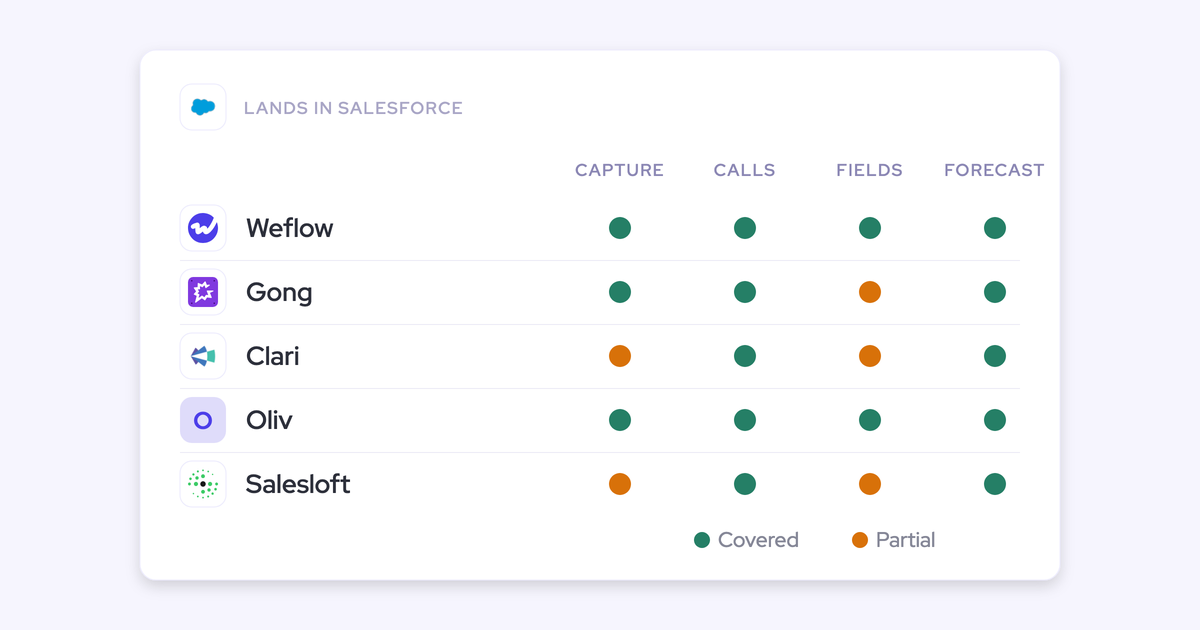

The best RevOps tools for 2026 cover the most of five jobs inside the Salesforce you own: email and meeting capture, call recording, CRM field updates from calls, forecast roll-ups and AI agents. We ranked 10 tools on that coverage, because at renewal you're deciding how many platforms it takes to cover the five jobs, and where each one stops.
Weflow comes first. Weflow is the Revenue AI Orchestration platform for sales, customer success, and RevOps teams. It covers activity capture, calls and AI field updates plus forecasting and pipeline management, at transparent seat prices.
Your stack has probably shifted under you in 2026. Clari and Salesloft are one company, and Salesforce bought Momentum and rebuilt it. The calls, emails and meetings of a typical team still sit in two or three vendor clouds, while an AI agent only reasons over data it can reach. So for each tool, we say what it covers well and where it stops.
How the 10 RevOps tools compare on capture, calls, forecasting and agents
The 10 tools differ most on three things: whether activity lands in Salesforce automatically, whether call data becomes structured fields, and whether the forecast is built from deals.
| Tool | Email capture to Salesforce | Meeting capture to Salesforce | Call recording | Field updates from calls | Forecast submissions and roll-ups | Prebuilt AI agents | Salesforce integration | Pricing | Best for |
|---|---|---|---|---|---|---|---|---|---|
| Weflow | Server side for every enrolled user, to Task or EmailMessage | Every external meeting to the Event object | Zoom, Teams, Meet and Webex, notetaker auto-scheduled | Every field type except lookups, automatic or review per field | Deal-backed calls and logged overrides, kept in the Weflow app | 3 templates, newest product | Real-time REST API, inherits custom objects and validation rules | Transparent pricing, $19 to $79 per user per month | Salesforce teams wanting capture, calls, field updates and forecasting in one platform |
| Gong | Server-side import, exported once an admin turns export on | Exported as tasks or events, external matches only | Zoom, Meet, Teams, Webex and 7 more providers | Up to 20 extractors into existing fields | A number per category with notes | 18 agents across 4 packages | Standard objects only, painful field mapping | No public pricing, Foundation licence required | Teams living in conversation analytics |
| Clari | Through Salesloft CRM sync, rep-lofted | Through Salesloft CRM sync, rep-lofted | Clari Copilot on Zoom, Teams, Meet and Webex | MEDDPICC and BANT via Salesloft Deals, Copilot after rep approval | Clari Forecast, 8 levels, tied to the Salesforce hierarchy | 5 prebuilt agents, some paid add-ons | Connector user polling every 1, 5 or 10 minutes | No public pricing | Enterprise CROs running roll-up forecasts |
| Oliv | Per user after Oliv login, logged to the CRM | Every meeting, recorded or not | Zoom, Meet, Teams and Webex | Standard, methodology and custom fields, review by default | Rep and manager submissions in Oliv's own app | Marketplace agents such as CRM Manager and Forecaster | Managed package, also HubSpot and Zoho | Transparent pricing, $19 to $79 per user plus credits | Agent-first teams on Salesforce, HubSpot or Zoho |
| Salesloft | Only emails sent through Salesloft or lofted | Calendar Sync for known Salesloft people, otherwise lofted | Zoom, Teams, Meet and Webex | Rep-applied suggestions, Deals writes MEDDPICC and BANT | Salesloft Forecast, 8 levels, Salesforce-derived | Summaries, coaching, follow-up, prep and research agents | Connector user polling every 1, 5 or 10 minutes | No public seat pricing, Advanced and Elite packages | Cadence-led teams buying calls, Deals and Forecast on top |
| Momentum | Rebuilt Momentum captures email inside Salesforce from November 2026; Legacy Momentum reads email only from Salesforce Tasks | To Event records once an admin enables Event mapping | Zoom, Meet and Teams with the add-on | Autopilot extraction, including lookup fields | None, feeds an existing forecasting tool | 6 prebuilt agents | Owned by Salesforce, managed package | Inside Salesforce editions, Max at $550 per user per month | Salesforce orgs buying Agentforce |
| Attention | Into Attention's own store, CRM logging needs a built workflow | Calendar read for recording, no documented Event logging | Zoom, Meet and Teams by bot or desktop app | A written prompt per mapped field, automatic sync by default | Forecast grid, overrides and history undocumented | More than 100 ready agents plus prompt-built workflows | OAuth app, connecting user needs Modify All Data | No public pricing | Conversation-first teams wanting prompt-built agents |
| Backstory (People.ai) | Server side for every user in scope | Logged as Events automatically | Does not record, pulls existing transcripts | Fixed engagement fields and accepted scorecard answers | Submissions, manager adjustments, weekly snapshots | SalesAI Signals on a schedule | Managed package | No public pricing, platform fee per connected person | Enterprises wanting org-wide capture and forecasting |
| Salesforce Agentforce | None itself, Einstein Activity Capture supplies it | None itself, Einstein Activity Capture and Momentum | None itself, Momentum and Einstein Conversation Insights | Pipeline Management agent, automatic or suggested | None, Sales Cloud forecasting is separate | Prospecting, SDR, pipeline, research, coaching and quoting agents | Built into Salesforce, needs Data 360 | Transparent pricing, $125 add-on, $550 Max, Flex Credits | Orgs consolidating on Salesforce |
| Clearskies | Into its Context Graph, not the CRM | Into its Context Graph, not the CRM | Mac-only Clearskies Recorder | Workflows write Salesforce or HubSpot fields, optional review | None, inspects CRM forecast categories | Skills and workflows a team composes | Reads records and stage history, writes through workflows | Transparent pricing, $0.30 per context call or from $1,250 a month | Teams building their own AI over MCP |
Only Weflow and Oliv cover activity capture, recording, field updates and forecast roll-ups as their own products. Oliv keeps capture on a per-user login and its forecast in its own app.
Salesforce Agentforce and Clearskies log no email or meetings to Salesforce themselves. Momentum, Agentforce and Clearskies take no forecast submissions, so you would pair any of them with a separate forecasting tool.
What a RevOps tool has to cover in 2026
A RevOps tool in 2026 has to cover activity capture, calls into fields, the forecast and agents, plus a Salesforce integration and a price you can defend. We judged each tool on the question that separates a strong tool from a weak one:
- Email and meeting capture should be automatic for every user, because rep-logged activity goes missing where a deal got difficult. Ask whether the tool reads the mail tenant server side or logs only what a rep lofts, and which object each email lands on. When 5 tools each write the same meeting as a Task, an EmailMessage and an Event, your meeting counts per rep inflate and nobody can reconcile the reports.
- Call recording should join every external meeting from the calendar without the rep opting in. A recorder that waits for the rep to add it misses the meetings a buyer booked.
- Field updates from calls should write any field type, because stage, close date and qualification live in picklists, dates and MEDDIC fields. Ask whether a picklist, a date and a MEDDIC field fill from the call, and whether you choose automatic or review per field.
- Forecast roll-ups should be deal-backed calls, so a manager sees the deals a number rests on. Ask whether a rep can select the deals behind the call, whether overrides are logged, and whether the hierarchy forces placeholder users in Salesforce.
- AI agents should act on your own captured data, because an agent only knows the activity it can read. Ask whether you can build an agent or only switch on a fixed catalog, and what each run costs.
- The Salesforce integration should inherit your custom objects, validation rules and permissions, so what the tool writes follows your rules.
- Pricing should be a number you can put in a business case before the first call, with AI usage stated.
"Lands in Salesforce" is the test behind all of them. Data held in a vendor cloud can't trigger a flow, can't feed your reports, and can't be read by an agent that isn't that vendor's, so your forecast keeps running on partial activity.
Why Chorus, InsightSquared and Clari Capture are no longer on the list
Chorus, InsightSquared and Clari Capture left the list because they were absorbed into other companies' products, and 3 other names changed shape in the same period.
- Clari and Salesloft completed their merger on 3 December 2025 and have operated under the single Salesloft brand since 1 September 2026. Clari Forecast keeps the Clari name for forecasting, and capture, engagement and meeting logging belong to Salesloft.
- Clari Capture is no longer sold as a product. It is now part of Salesloft Deals, and activity capture in the merged company is Salesloft's CRM sync.
- InsightSquared now runs as Mediafly Intelligence. Mediafly bought it in January 2022 and retired the standalone InsightSquared Sales Analytics product on 24 January 2023.
- Chorus sits inside ZoomInfo with no revenue forecasting beyond limited deal intelligence. ZoomInfo sells forecasting through GTM Workspace, a separate part of its platform.
- People.ai rebranded as Backstory in 2026, keeping the same product and data infrastructure.
- Momentum is owned by Salesforce, which released a rebuilt Momentum inside Salesforce in October 2026 and is rolling it out to orgs from early November 2026.
1. Weflow: capture, calls, field updates and forecasting in your own Salesforce
Weflow is the Revenue AI Orchestration platform for sales, customer success, and RevOps teams, built for Salesforce teams. Everything it captures and generates lands in your Salesforce as native records. The one exception is forecast data, which stays in the Weflow app.
What Weflow Activity & Contact Capture and Weflow Conversation Intelligence do automatically
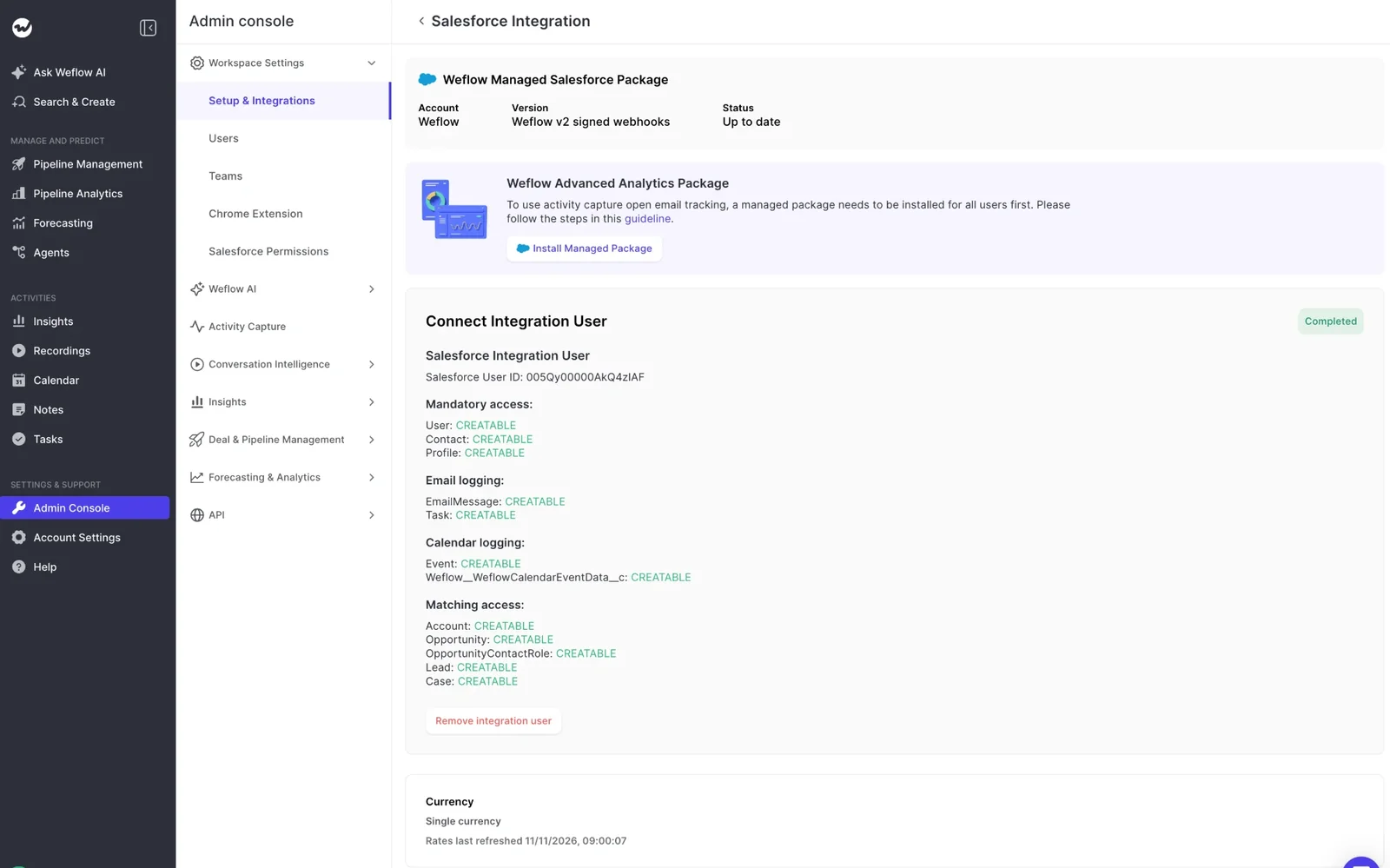
Weflow Activity & Contact Capture logs every email and meeting for every enrolled user, on any device, with no action from the rep. It runs server side through a central app in Microsoft Entra or Google Workspace. Your admin chooses whether emails land on the Task or EmailMessage object, and meetings land on Event, matched to existing Salesforce records.
Compatibility Mode keeps Weflow from duplicating what Salesloft, Outreach or Apollo already logged. Weflow delays its sync by about 10 seconds, checks the message for the other tool's tracking pattern, and skips it if it finds one.
Weflow Conversation Intelligence records Zoom, Microsoft Teams, Google Meet and Webex. The notetaker is scheduled onto every external meeting from the calendar, so it doesn't wait for the rep to start it.
AI Field Updates then write what was said into Salesforce fields of every type except relationship lookups, including picklists, dates, multi-selects and MEDDIC fields. Your admin sets each field to write automatically or wait for review.
All of it runs on Weflow's Salesforce integration, a real-time integration on the Salesforce REST API. It writes back in about 200 milliseconds and inherits your custom objects, validation rules, permission sets and role hierarchy.
How Weflow Deal Intelligence & Forecasting rolls up the number
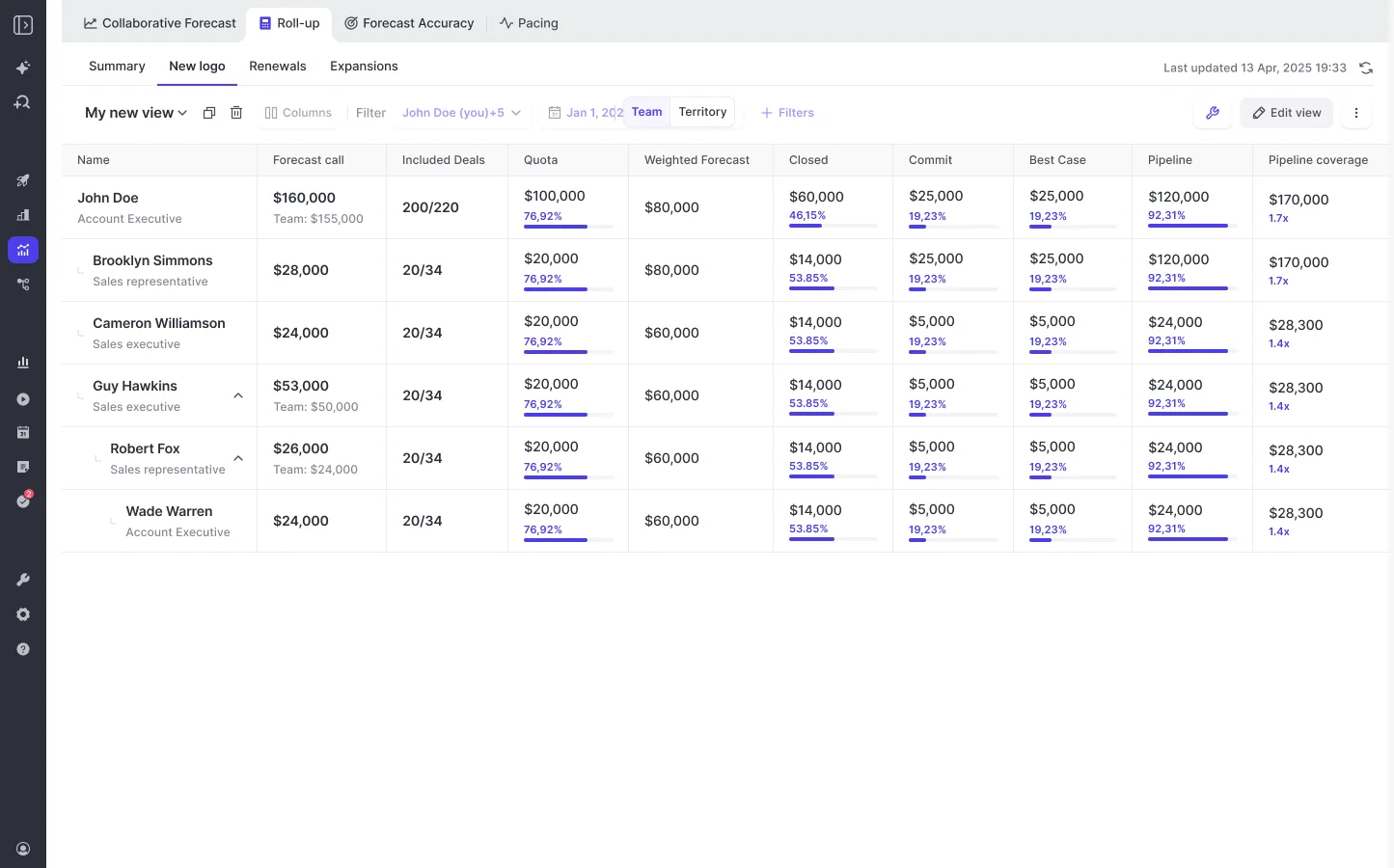
Weflow Deal Intelligence & Forecasting builds the number from deals. Your admin sets up the forecast calls, such as a base call and a best case. Each rep submits a call as a total, by selecting the opportunities behind it, or both.
Every submission is versioned. Manager overrides at deal or total level are timestamped, attributed and logged with a rationale that stays across quarters, so you can see later who changed a number and why.
The roll-up follows the Salesforce Manager field by default, or your admin arranges a Weflow hierarchy by drag and drop. A Weflow team is its own line, so a VP sees the account managers and the account executives as separate sub-totals without placeholder users in Salesforce.
Forecasting comes with 11 view types, from Collaborative Forecast and Roll-up to Waterfall, Pacing and Forecast Accuracy.
Where Weflow stops today
Weflow isn't the right fit for every team. These are its limits:
- Weflow Agent Builder is the newest Weflow product. It ships 3 templates, Pipeline Snapshot, Meeting Recap Bundle and Deal Risk PDF, with deliberately basic prompts you rewrite.
- Weflow agents deliver by email, Slack and Microsoft Teams, and a person brings their conclusions into Salesforce fields. Direct writes to Salesforce are planned.
- Forecast submissions, targets and roll-ups live in the Weflow app and aren't written to Salesforce fields. You can read them over the MCP connector.
- Pipeline analytics are separate reports, with no funnel report and no dashboard plotting target against trend, so Weflow's dashboarding is thinner than Clari's.
- Weflow does no sequencing, cadences or dialing, so it runs alongside your sales engagement tool.
- Weflow works only with Salesforce, so it is the wrong fit for a team on HubSpot, Microsoft Dynamics, Pipedrive or Zoho.
What Weflow costs and who it suits
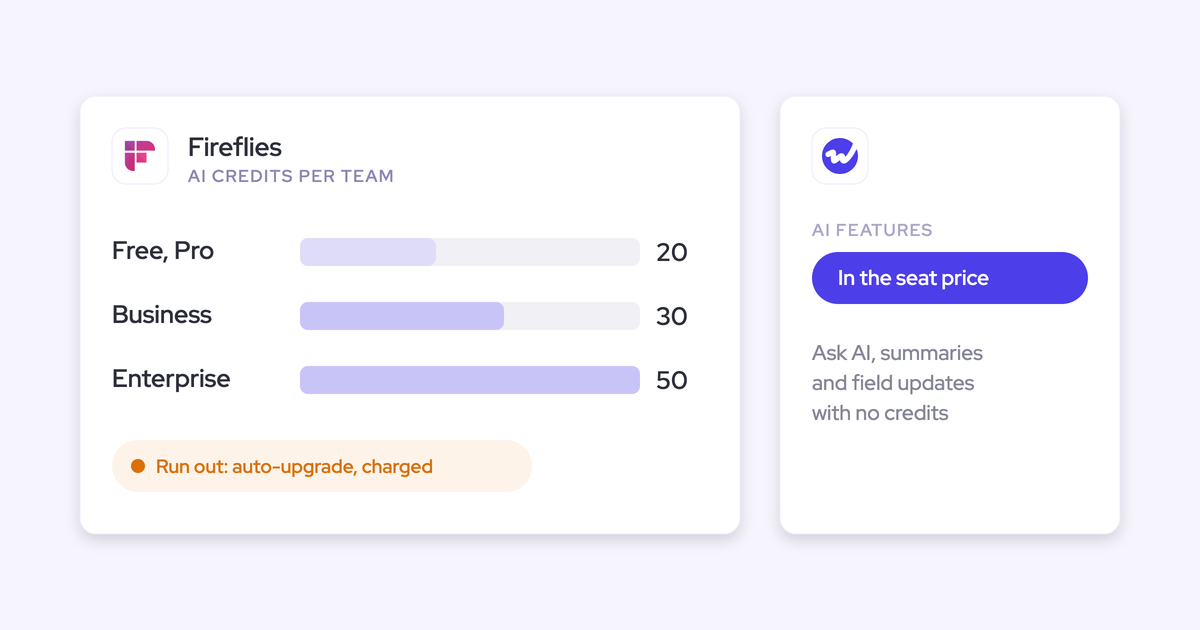
Weflow has transparent pricing per seat, billed annually on a 12-month term, with a 10-user minimum per product or bundle. Ask Weflow AI, AI summaries and AI Field Updates are included in the seat. Here is what each part costs:
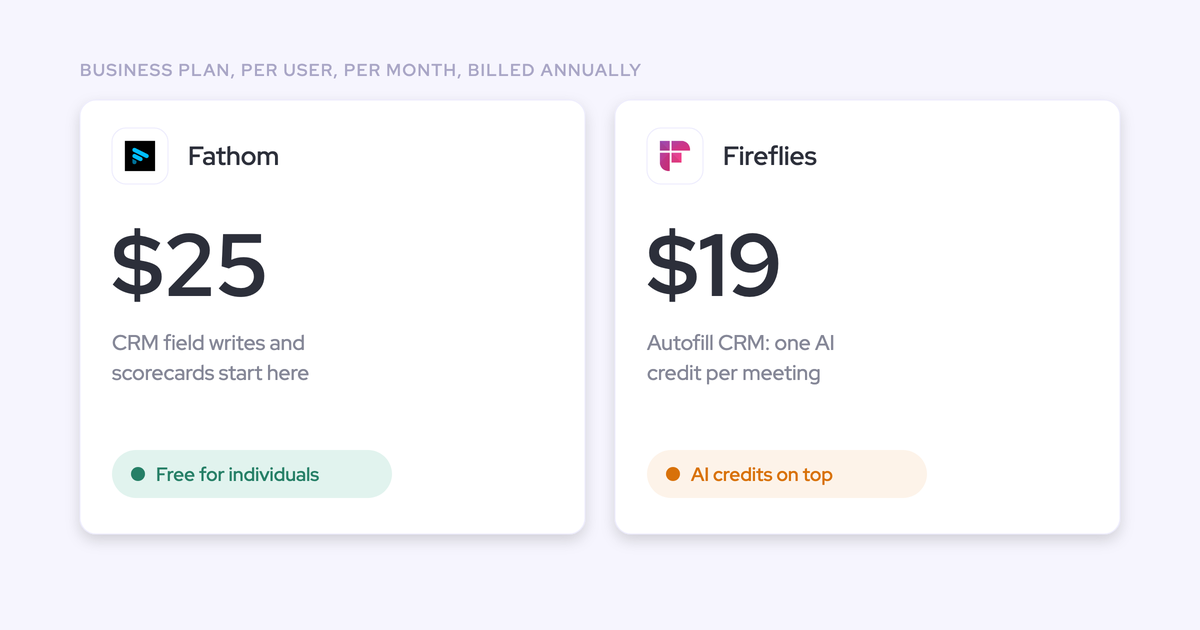
- Weflow Activity & Contact Capture costs $19 per user per month.
- Weflow Conversation Intelligence and Weflow Deal Intelligence & Forecasting cost $39 each.
- The Revenue AI Foundation, Revenue AI Business and Revenue AI Enterprise bundles cost $49, $59 and $79.
- Agent Builder is priced per workspace: 25 actions a month free on every plan, $299 for 500 actions and $999 for 2,500.
- Implementation is free and typically live in 2 to 3 weeks.
At roughly 62 seats, capture plus conversation intelligence lands around $36K a year, and the full platform around $58K.
Weflow suits Salesforce teams that want capture, calls, field updates and forecasting from one platform.
We're seeing a marked improvement after starting to use Weflow: we have much better visibility as a management team, our current quarter forecast is always up-to-date, and we are now tracking sales emails and activities a lot better. - Chris MacKinnon, VP Revenue Operations, Zeotap
2. Gong: the deepest conversation analytics, held in Gong's own cloud
Gong is a conversation intelligence platform that records and analyses sales calls in its own cloud. It is sold as a Gong Foundation core licence, with forecasting, coaching and engagement applications on top.
What Gong covers well
Gong invented conversation intelligence and still has the deepest conversation analytics of any tool here. It records Zoom, Google Meet, Microsoft Teams, Webex and 7 other providers on any plan. It can also record every Zoom call in the background with no bot, which is a big part of why reps and product teams stay attached to it.
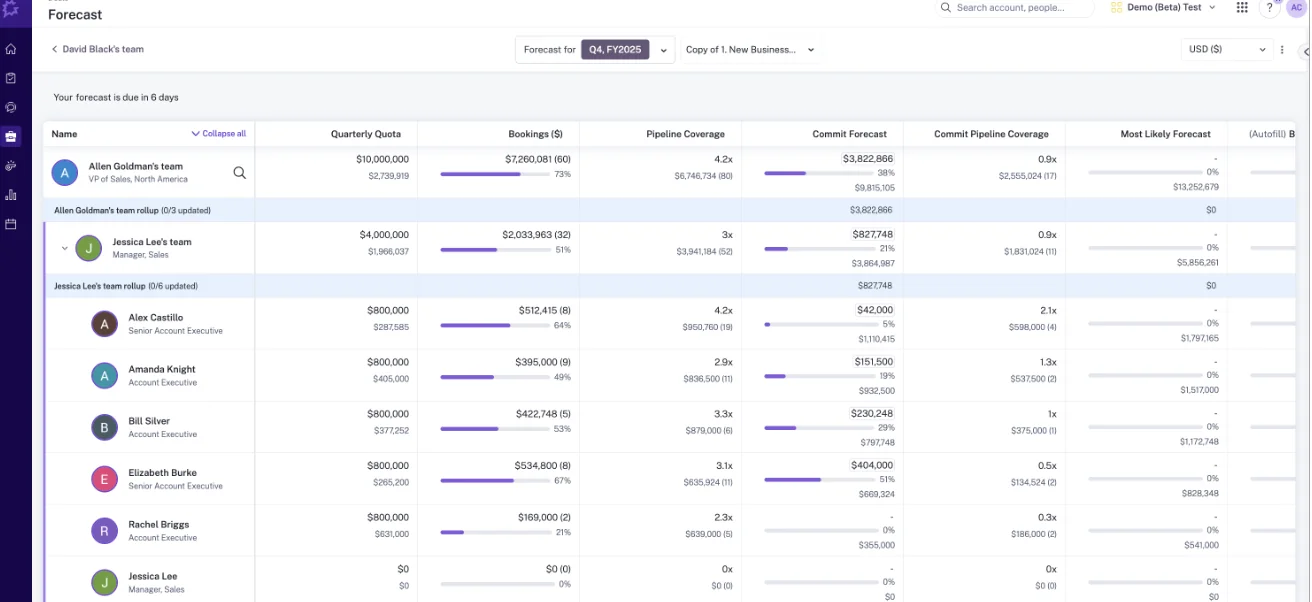
Gong Forecast is solid for a call-centric team:
- Reps submit per forecast category.
- A trend chart tracks the team's and the manager's forecast week by week.
- An accuracy report compares submissions with actuals.
- Separate boards can run new business and renewals.
Gong's own forecast roll-up moves from a VP team down to named account executives.
Where Gong stops for a Salesforce team
Gong maps what it captures into its own data structure, which leaves a Salesforce team with these gaps:
- Gong exports emails and meetings to Salesforce only after a tech admin turns export on. It exports only activity matching a Salesforce contact or lead, and email only from the day export starts.
- Gong's AI Data Extractor allows at most 20 published extractors, created only by a business admin, writing only into fields that already exist.
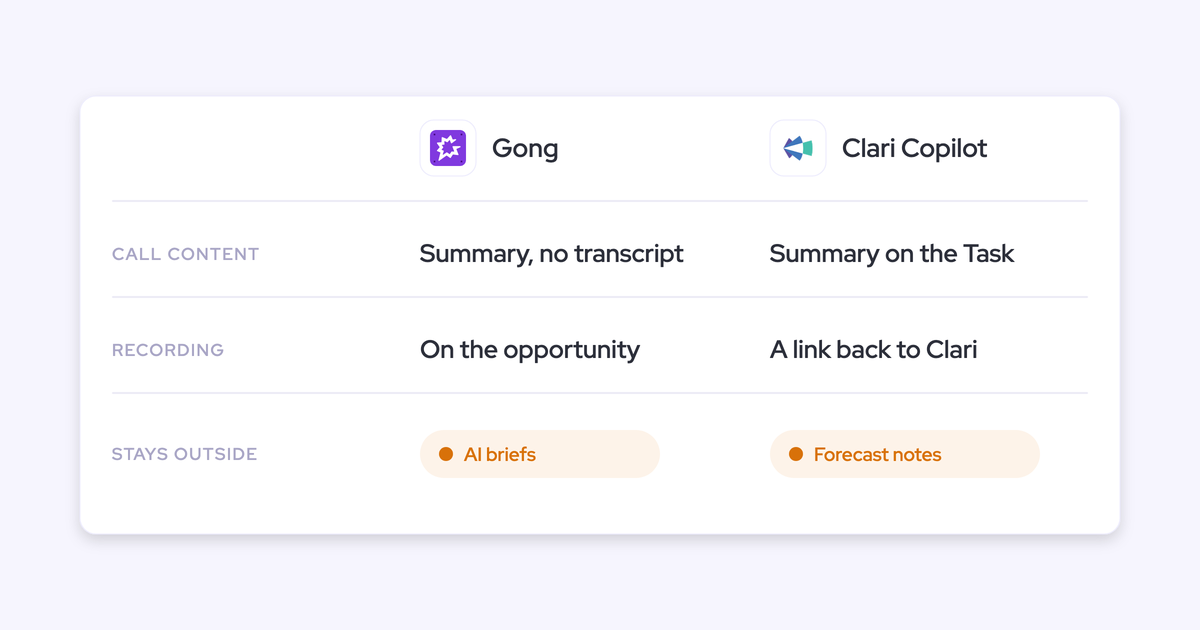
- Gong can't import custom objects directly, and its recorded conversations live on their own records apart from the activity history.
- The recorder doesn't join meetings a buyer put on the rep's calendar, and calendar sync can make it join several minutes late.
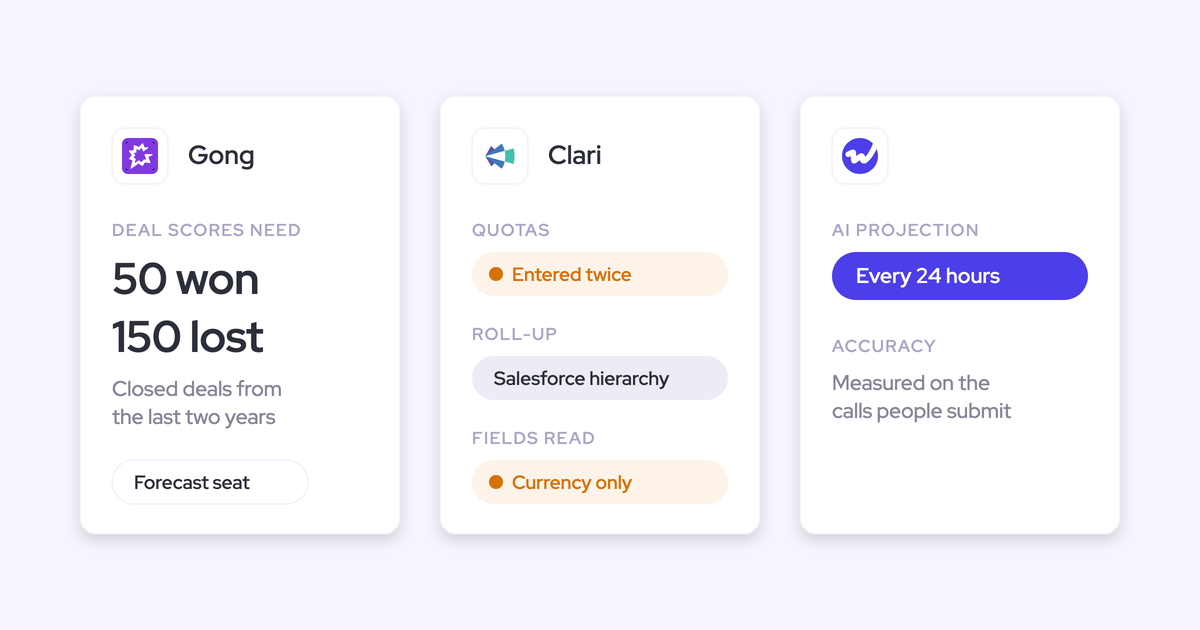
- There is no deal-by-deal forecast submission.
What Gong costs and who it suits
Gong has no public pricing. It prices licences per user plus a platform fee and quotes each buyer through a custom proposal. You need the Gong Foundation licence before any application, seats are assigned per application, and AI usage is metered in credits on top.
One renewal proposal we've seen for 45 licences came to about $80,000 a year. Against those quote-only proposals, Weflow's transparent seat prices come in at about half the price. Gong suits teams that live in conversation analytics and will pay for that depth.
3. Clari: roll-up forecasting tied to the Salesforce hierarchy
Clari, sold under the Salesloft brand since September 2026, is a revenue platform built around roll-up forecasting and pipeline inspection. It sells Clari Forecast and Inspect, plus Clari Copilot for conversation intelligence.
What Clari covers well
Clari's forecast view is what CROs keep paying for. A CRO sees each direct report's commit and best case at a glance and drills into the opportunities behind any number.
Clari Forecast rolls submissions up as many as 8 levels, lets managers submit for reps, and keeps a week-by-week history of every call. Its enterprise roll-ups, past 1,000 reps, are more mature than Weflow's.
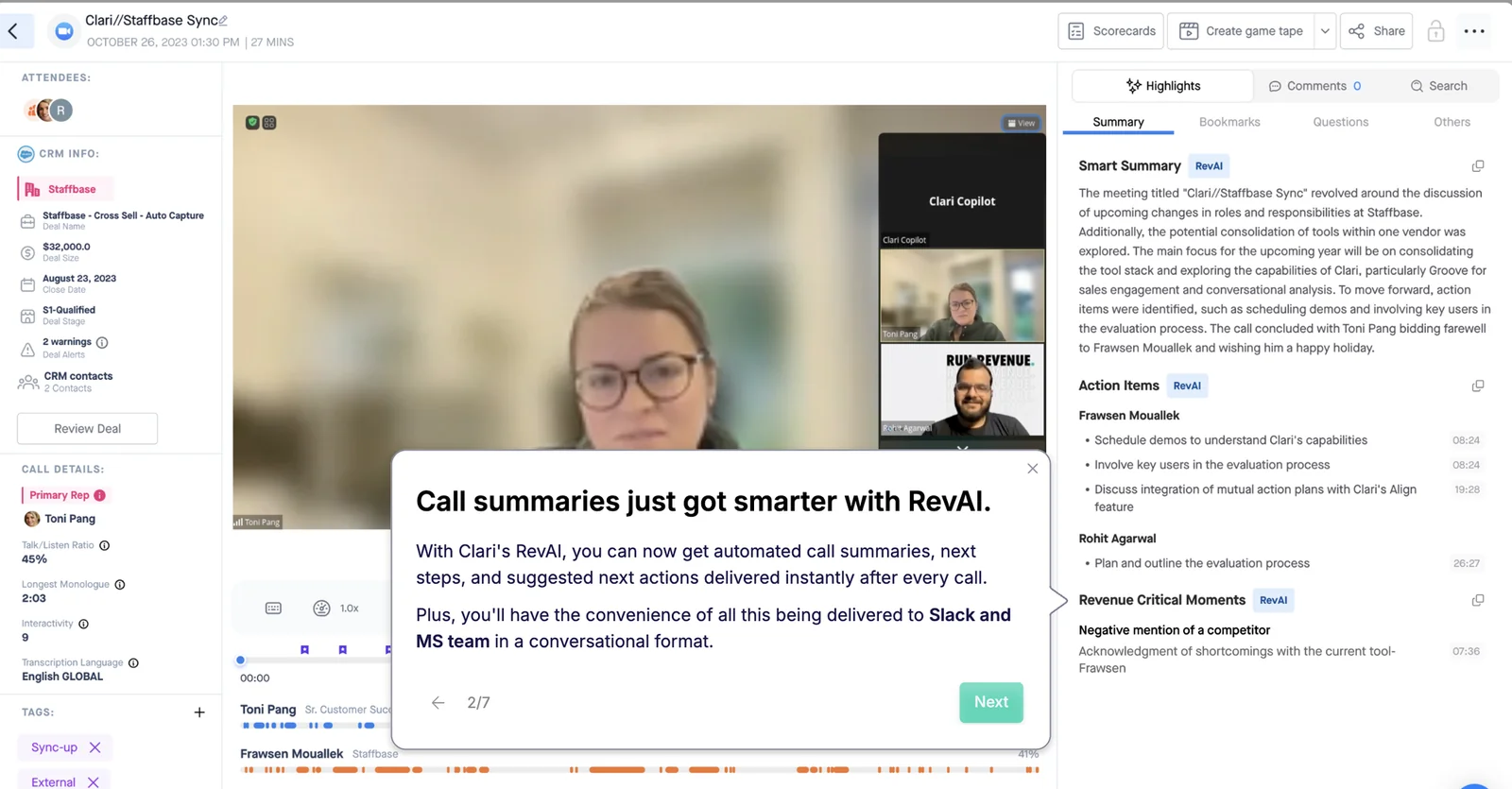
Clari Copilot transcribes in 28 languages. The Clari Copilot call page puts a RevAI summary, action items by person and revenue critical moments next to the deal's CRM data.
Where Clari stops for a Salesforce team
Clari's forecast is bound to the Salesforce hierarchy, and most of its limits follow from that:
- Clari needs inactive placeholder users in the Salesforce role hierarchy to show a VP the account managers and account executives as separate lines.
- A forecast call is a number with notes, so the forecaster lists the deals behind it in the notes field.
- Leaders see only what each direct report submitted, not where below them a number changed.
- Overlay roles and opportunity splits aren't handled out of the box, and the territory roll-up reads only Enterprise Territory Management fields.
- Capture now runs through Salesloft's CRM sync, which logs what reps loft, and Copilot writes methodology fields only once the rep approves them.
What Clari costs and who it suits
Clari has no public pricing. Its pricing address leads to a Salesloft Talk to Sales page where you book a call. Clari suits enterprise CROs running roll-up forecasts across a large hierarchy who want the most mature forecast view on the market.
4. Oliv: AI agents on Salesforce, HubSpot or Zoho, billed in seats plus credits
Oliv AI is a revenue AI platform that runs AI agents on top of Salesforce, HubSpot or Zoho. It covers all points: email and meeting capture, recording, field updates, forecast submissions, prebuilt agents, Salesforce integration and transparent pricing.
What Oliv covers well
Oliv is agent-first. A team works through named agents, and Oliv's Context Graph ties every call, email and activity to the people, account and deal it belongs to, so each agent works from the account's history.
- CRM Manager logs every meeting, call and email to the CRM against the right account, contact and opportunity, including meetings its notetaker didn't join, and creates new contacts as they appear.
- Forecaster pre-drafts each rep's forecast number before the rep submits, sets an AI forecast beside the team's, and flags the deals that slipped or moved.
- Pipeline Tracker calls reps every evening to update their pipeline and syncs notes, dates and stages back to the CRM.
- Coach scores every recorded call against coaching scorecards and recommends three goals per rep each month.
Oliv writes standard, methodology and custom fields and Opportunity Contact Roles. It holds each update for review until RevOps switches it to Auto-Pilot.
CRM Manager also keeps the account structure in order, from new contacts to parent and child accounts.
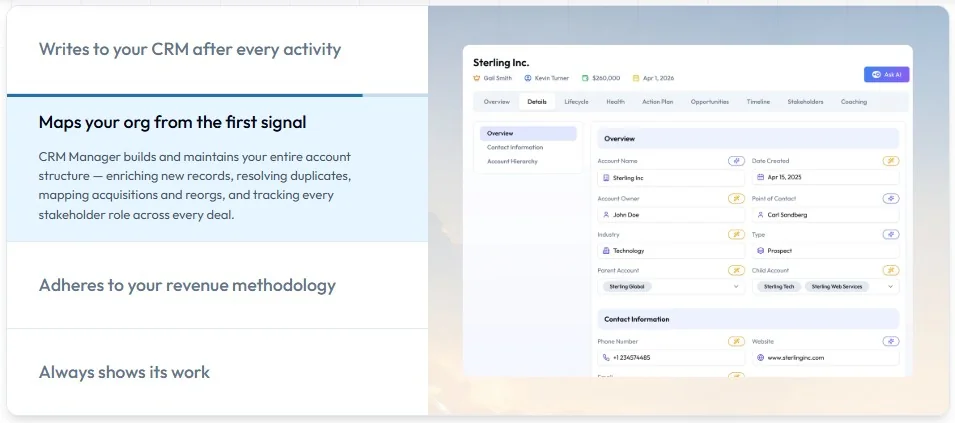
Oliv's Forecast app rolls rep and manager submissions up the hierarchy. You pick agents from a marketplace or build your own on every plan, and Oliv transcribes in more than 100 languages.
Where Oliv stops for a Salesforce team
Oliv's limits sit in where capture starts and where its data ends up:
- Oliv captures a user's Gmail or Outlook email only once that user logs in to Oliv, and email capture starts on the Sell plan.
- Forecasts stay in Oliv's own app, and forecast category and adjusted values sync back to the CRM only if configured.
- Oliv has no public API and no MCP server.
- Agent actions are billed through credits on top of the seat.
What Oliv costs and who it suits
Oliv has transparent pricing and no platform fee. Converse costs $19 per user per month. Sell, at $49, adds email capture, deal risks and the Forecast app, with 500 agent credits a week included. Grow costs $79, Amplify has no seat fee, and additional credits cost $0.01 each. Its Enable and Engage add-ons cost $29 per user per month each.
Oliv suits agent-first teams, including those on HubSpot or Zoho.
5. Salesloft: sales engagement with calls, deals and forecasting sold on top
Salesloft is a revenue platform built on sales engagement, with Cadence and Rhythm. Since its merger with Clari, it also sells Conversation Intelligence, Deals, Clari Forecast, Inspect and prebuilt AI agents on top.
What Salesloft covers well
Salesloft is built for cadence-led selling, and the merged platform puts engagement and forecasting under one contract. Salesloft Conversation Intelligence records Zoom, Teams, Meet and Webex and imports dialer calls. It writes the summary, action items and call metrics onto the Salesforce Event or Task.
Salesloft Forecast can split new business, renewals and upsells into separate segments. Its agents cover deal summaries, coaching, meeting follow-up, meeting prep and account research.
If you keep Salesloft for cadences, Weflow runs alongside it. Compatibility Mode skips the emails Salesloft already logged, so you keep your sequences and add automatic capture beside them.
Where Salesloft stops for a Salesforce team
Salesloft logs what reps route through it, which leaves gaps in the activity record:
- An email logs only when the rep sends it through Salesloft or with Loft It; the normal Send button logs nothing.
- Salesloft Calendar Sync logs a meeting automatically only when a guest already exists as a Salesloft person.
- Salesloft Conversation Intelligence is Clari Copilot inside Salesloft. It needs both a Salesloft subscription on Advanced or higher and a Clari Copilot subscription.
- Salesloft Deals doesn't integrate Salesforce custom objects, and Salesloft's agents run on batch schedules.
- Salesloft syncs through one connector user polling every 1, 5 or 10 minutes, which spends your own Salesforce API allowance.
What Salesloft costs and who it suits
Salesloft has no public seat pricing and sends buyers to a sales call. It sells 2 packages, Advanced and Elite, with forecasting, AI agents and the dialer as separate add-ons. Local dialer numbers cost $1 per number per month.
Salesloft suits cadence-led teams that want calls, Deals and Forecast from their engagement vendor.
6. Momentum: Salesforce's own call capture layer for Agentforce
Momentum is the Salesforce-owned capture and conversation layer that turns calls into structured Salesforce fields and feeds Agentforce agents. It runs on its own recorder or on top of Gong, Chorus and other recorders.
What Momentum covers well
Momentum's extraction is the strongest of the 10 tools for one reason: it writes lookup fields, so a MEDDPICC champion points at a contact record. Momentum Autopilot fills Opportunity, Account, Lead, Event and Contact fields.
Each extraction writes automatically, waits for review in Slack or the web app, or writes only when the field is empty. It can also append with a timestamp instead of overwriting.
Momentum runs on top of Gong, Chorus, Clari Copilot, Attention and Salesloft Conversation Intelligence, so you keep your recorder. It sells 6 prebuilt agents, including Deal Execution and a Coaching Agent that scores every recorded call per competency.
Where Momentum stops for a Salesforce team
Momentum depends on the rest of the Salesforce stack, and it stops before the forecast:
- Momentum takes no forecast submissions and positions itself as feeding an existing forecasting tool such as Clari or Gong.
- It requires Data 360 and Einstein Generative AI, and its processing in Data 360 can add consumption charges.
- Legacy Momentum reads email only from Salesforce Tasks. The rebuilt Momentum captures email, and it reaches orgs on a rolling basis from early November 2026.
- Momentum can't run in the same org as Einstein Conversation Insights, and it works with Sales Cloud only.
- Each Momentum licence includes up to 120 processed call hours a year, pooled, with unused hours expiring.
What Momentum costs and who it suits
Momentum comes with Salesforce's Max sales edition at $550 per user per month. It is announced for Core at $195 and Advanced at $395, and is a paid add-on on Starter Suite and Pro Suite at a quoted price.
Existing customers move onto an Agentforce SKU around their contract end. Momentum suits Salesforce orgs already buying Agentforce.
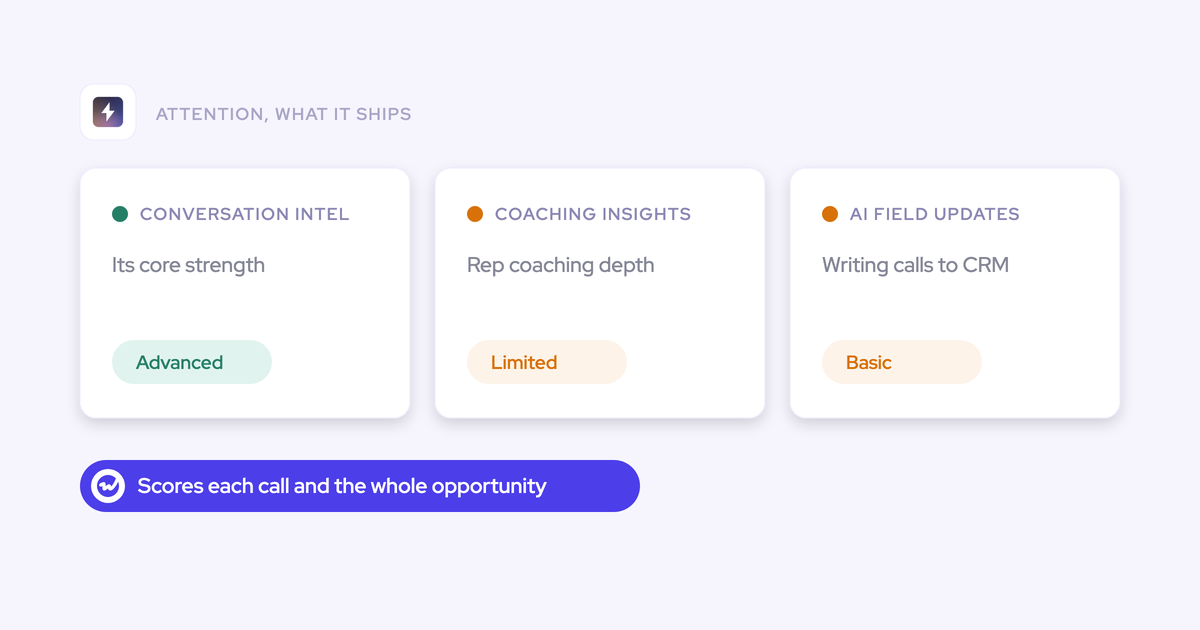
7. Attention: conversation-first AI agents and workflows
Attention is an AI-native conversation intelligence tool that records sales calls and uses the conversation data to power scorecards, CRM field updates, and AI agents and workflows.
What Attention covers well
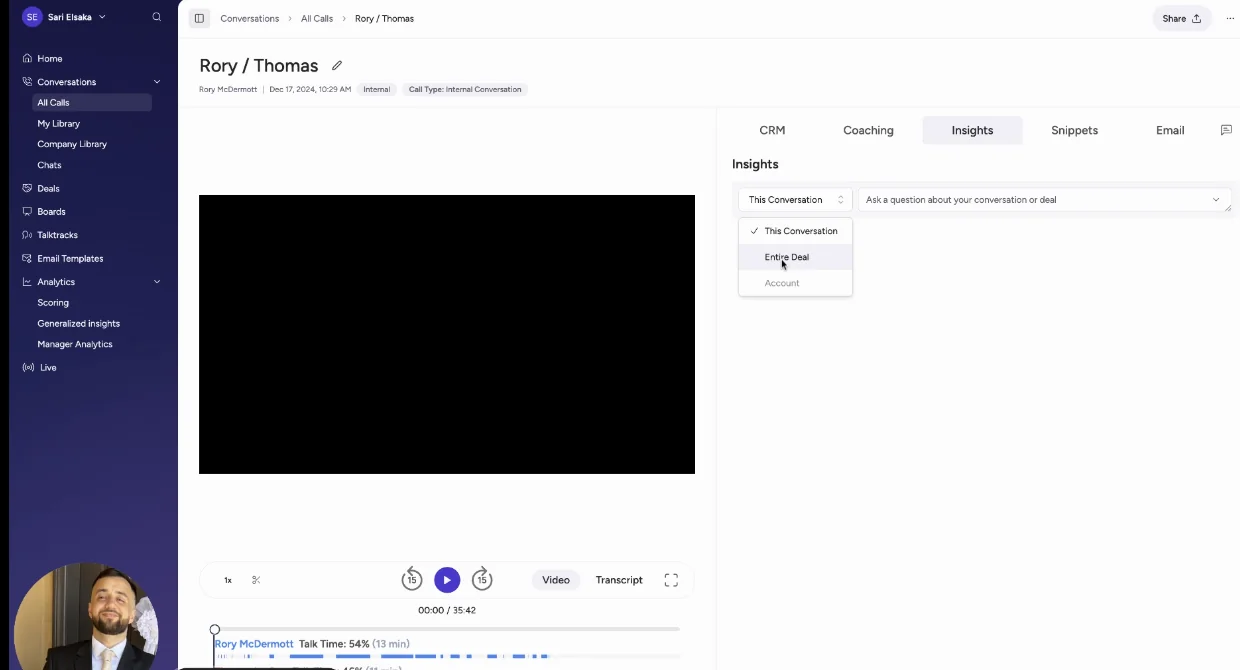
Attention is conversation-first and highly configurable. It extracts call values into any mapped Salesforce or HubSpot field with a written prompt per field. By default it syncs automatically after each call, and it offers a review tab when you sync by hand.
Attention's call page shows the extracted MEDDIC fields with a checkbox each above an Update Records button.
Attention sells more than 100 ready-made agents, such as a Deal Risk Monitor and a Follow-Up Email Automator, and its workflows can call OpenAI and Anthropic models as steps. Its Super Agent reasons over CRM data and imported email as well as calls.
Where Attention stops for a Salesforce team
Attention's capture and forecasting are thinner than its call work:
- Attention imports email into its own store and doesn't log it to the CRM unless you build a workflow on its New Email Imported trigger.
- No Attention page documents logging unrecorded meetings, or logging meetings to Salesforce as events.
- The forecast grid has user-entered and rolled-up columns, with no documented manager overrides or submission history.
- The connecting Salesforce user must hold Modify All Data, and a new field fills only on future calls after someone maps it.
- Running Attention beside a separate capture tool writes 2 records for the same meeting.
What Attention costs and who it suits
Attention has no public pricing, and attention.com has no pricing page, so you get a figure from its sales team. Attention suits conversation-first teams that want to build agents from their own prompts.
8. Backstory (formerly People.ai): org-wide activity capture without a call recorder
Backstory, formerly People.ai, is an enterprise revenue intelligence platform built on automatic email, calendar and CRM activity capture for Salesforce. It adds AI deal summaries, forecasting and an MCP server for Claude, ChatGPT, Copilot or Gemini.
What Backstory covers well
Backstory does org-wide capture properly. It reads Google Workspace or Microsoft 365 server side for every user in scope, with no rep authorization. It writes emails as Tasks and meetings as Events, and stamps engagement fields such as last email and next meeting on Salesforce records.
Backstory Forecasting runs submissions that roll up a hierarchy, with manager adjustments, weekly snapshots and several forecast types side by side, so renewals and new business forecast separately.
Where Backstory stops for a Salesforce team
Backstory stops at the call itself, and at how fast its data reaches Salesforce:
- Backstory doesn't record meetings; it pulls transcripts that Zoom, Teams, Meet, Webex and Gong already hold.
- It writes a fixed set of engagement fields and accepted scorecard answers, not values extracted from calls into fields you configure.
- The forecast hierarchy is built from a CSV, and Salesforce hierarchy changes don't sync.
- Activity syncs to the CRM within one business day.
What Backstory costs and who it suits
Backstory has no public pricing. A customer pays a platform fee for each connected customer-facing person plus a pre-packaged allotment of AI answers, while viewers use it free.
Backstory suits enterprises that want org-wide capture and forecasting and already have a recorder.
9. Salesforce Agentforce: agents that act on data other Salesforce products capture
Salesforce Agentforce is Salesforce's agent layer for Sales Cloud: prebuilt sales agents plus Agentforce Builder for custom agents. It runs on Data 360 and the Trust Layer and is priced per user or in Flex Credits.
What Salesforce Agentforce covers well
Agentforce has the broadest catalog of ready sales agents of the 10 tools: prospecting, SDR outreach, pipeline management, account research and meeting prep, coaching practice and quoting.
The Pipeline Management agent updates Stage, Next Steps and qualification fields from calls, meetings, emails and notes, automatically or as suggestions. It shows the source behind each update. Agents surface in Slack, Teams, ChatGPT, Claude and Gemini.
Weflow Agent Builder differs in where it starts. It runs on the email, meeting and call data Weflow already captured into Salesforce and is priced per workspace, while Agentforce acts on what other Salesforce products capture.
Where Salesforce Agentforce stops for a Salesforce team
Agentforce depends on other Salesforce products for its data:
- Agentforce captures no email, meetings or recordings itself; Einstein Activity Capture, Momentum and Einstein Conversation Insights supply them.
- It doesn't run without Data 360 provisioned in the org.
- It takes no forecast submissions; Sales Cloud forecasting is a separate product.
- Agentforce SDR needs 7 supporting features and every rep connected to Einstein Activity Capture.
- Deploying Agentforce through Salesforce services or a partner is quoted in the hundreds of thousands of dollars.
What Salesforce Agentforce costs and who it suits
Agentforce has transparent pricing. On Core and Advanced, Agentforce for Sales is an add-on from $125 per user per month, and only the Max edition at $550 includes the agents. Flex Credits cost $500 per 100,000, about $0.10 per action, and expire unused at term end.
Agentforce suits orgs consolidating everything on Salesforce.
10. Clearskies: a context layer for teams building their own revenue AI
Clearskies, from the team behind Scratchpad, is a context layer for revenue AI. It unifies CRM, call, email, calendar, Slack and support data into one Customer Context Graph and serves it to Claude, ChatGPT, Cursor and other AI clients over its own MCP server.
What Clearskies covers well
Clearskies is built for RevOps and GTM engineers putting AI into production. Its workflows start on a meeting, a schedule, or a Salesforce record being created or a field changing.
Those workflows can write stage, close date, next step and competitor into Salesforce or HubSpot, with an optional named reviewer. Agents run on OpenAI, Anthropic or Google models, and a workspace can bring its own keys.
Where Clearskies stops for a Salesforce team
Clearskies leaves the system-of-record work to you:
- Clearskies syncs email and calendar into its own graph and doesn't log them to the CRM.
- The Clearskies Recorder is a Mac app, so Windows users connect another recorder.
- It has no forecast submissions or roll-ups; it inspects forecast categories held in CRM fields.
- It offers skills and workflows a team composes rather than agents to switch on.
What Clearskies costs and who it suits
Clearskies has transparent pricing sized by go-to-market team, not seats. You pay $0.30 per context call pay-as-you-go, or take Unlimited Context plans from $1,250 a month for up to 10 people to $5,000 for 26 to 50.
Clearskies suits teams building their own AI over MCP.
Moving off Gong or Clari without losing call history
You can move off Gong or Clari and keep your call history, as long as the import starts early enough to finish before the old contract ends. We recommend these steps, in this order:
- Count your Gong calls and sign early, because the import runs through Gong's API one call at a time: about 2,000 to 2,500 calls a day, so around 30,000 calls take about 15 days. Weflow migrates up to 2 years of Gong call history at no charge, with the link from each call to its Salesforce account.
- List the people who left before importing from Clari. Weflow reassigns their recordings to a user you nominate, and the import starts once your team has signed in to Weflow.
- Bulk-import calls that exist only as video files, with a CSV of participants, times and titles. Weflow matches each one to Salesforce records, at roughly 180 calls a day.
- Switch on Compatibility Mode while Salesloft or Outreach is still logging, so the same email never lands twice.
- Roll out capture and conversation intelligence first, in about 2 weeks, and add forecasting later. You can keep your incumbent forecasting tool until renewal, then add Weflow forecasting for roughly $10 more per user per month. KORE ran it in 5 phases, from activity capture through to forecasting.
Which RevOps tool fits your team
The right RevOps tool depends on which of the five jobs your team needs covered in Salesforce. Sometimes the right answer is the tool you already have.
| If your team needs | Choose |
|---|---|
| Capture, calls, field updates and forecasting in your own Salesforce at seat prices | Weflow |
| The deepest conversation analytics, with reps attached to them | Gong |
| Roll-up forecasting for a CRO across a large enterprise hierarchy | Clari |
| AI agents across Salesforce, HubSpot or Zoho, priced in seats plus credits | Oliv |
| Cadences, calls and forecasting from one engagement vendor | Salesloft |
| Call extraction including lookup fields, inside a Salesforce Agentforce contract | Momentum |
| Conversation-first workflows built from your own prompts | Attention |
| Org-wide capture and forecasting, with transcripts from an existing recorder | Backstory |
| Agents on Salesforce data, bought inside your Salesforce contract | Salesforce Agentforce |
| A context layer your own engineers build AI on over MCP | Clearskies |
| A forecasting tool your sponsor standardized across the portfolio | Keep it, and add capture and calls beside it |
| A cadence-led SDR team already working in Salesloft | Keep Salesloft for cadences |
Staying put is the right call when the forecasting tool is a sponsor's standard or your SDRs run on Salesloft cadences. In both cases, you can land capture and conversation intelligence beside the incumbent first and leave the forecasting decision for renewal.
See how Weflow captures activity, updates Salesforce fields from calls, and rolls up your forecast. Book a 30-minute demo.
Frequently asked questions about RevOps tools in 2026
Can Weflow run alongside Salesloft or Outreach?
Yes. Weflow works alongside Outreach, Salesloft and Apollo and doesn't run sequences itself. Compatibility Mode skips emails those tools already logged, so Salesforce gets no duplicates. Once the other tool stops logging, you no longer need Compatibility Mode.
Can we keep Clari and add Weflow for capture first?
Yes. Weflow's packaging is built for a team blocked by an incumbent renewal. You start with Weflow Activity & Contact Capture and Weflow Conversation Intelligence and keep Clari Forecast running. Later, you add Weflow Deal Intelligence & Forecasting for roughly $10 more per user per month.
What happens to our Gong or Clari call history?
Your call history moves with you. Weflow migrates up to 2 years of Gong call history at no charge, with longer history as a paid service, and keeps the link from each call to its Salesforce account. Clari recordings import too, and Weflow reassigns the calls of people who left to a user you nominate.
How long is implementation, and who does it?
Weflow runs implementation itself, free, and time to live is typically 2 to 3 weeks. It starts with a 45 to 60 minute technical setup with your Salesforce and mail admins, moves to a configuration phase, then rolls out by role.
With the managed service option, Weflow does the heavy lifting while your RevOps team answers questions and unlocks access.
Does our data stay if we leave?
Your activity and contact data stays, because Weflow writes it to native Salesforce objects and keeps nothing of substance on its side. Weflow stores call recordings and hourly pipeline snapshots in AWS, in Frankfurt, US East 1 or Sydney, and recordings are available over the API.
Does Weflow work with HubSpot?
No. Weflow supports Salesforce as its only CRM and is built entirely on the Salesforce API, so HubSpot, Microsoft Dynamics, Pipedrive and Zoho teams sit outside its fit.