


How Weflow Structures a Three-Month Paid Pilot When Replacing Clari or Gong


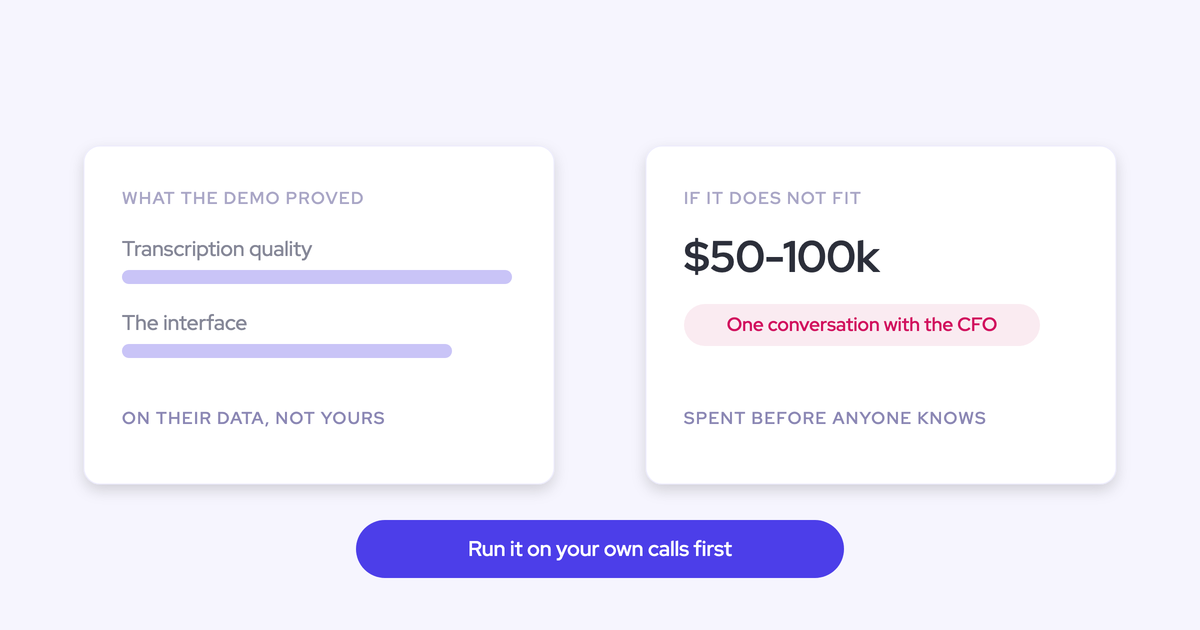
You've decided to replace the incumbent. The demo went well. And now you're stuck on the part nobody writes about: how to prove a forecasting replacement without either betting three years on an unproven vendor or running a proof so thin it proves nothing.
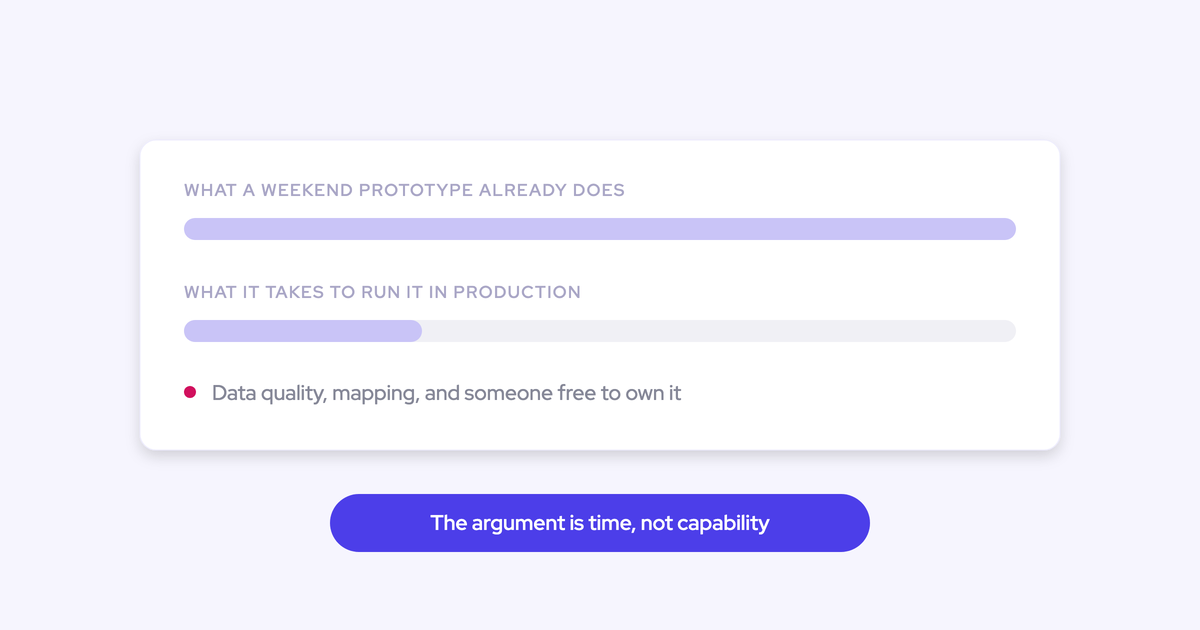
The trap is structural. A forecast motion only shows what it's worth once a cadence has run against actuals, which takes about a quarter, not fourteen days. But procurement won't sign a multi-year term on a vendor that hasn't performed yet, won't fund a months-long unpaid POC after an already-long evaluation, and legal won't let you run either one on real customer data. Meanwhile the renewal auto-renews on a date you can't move.
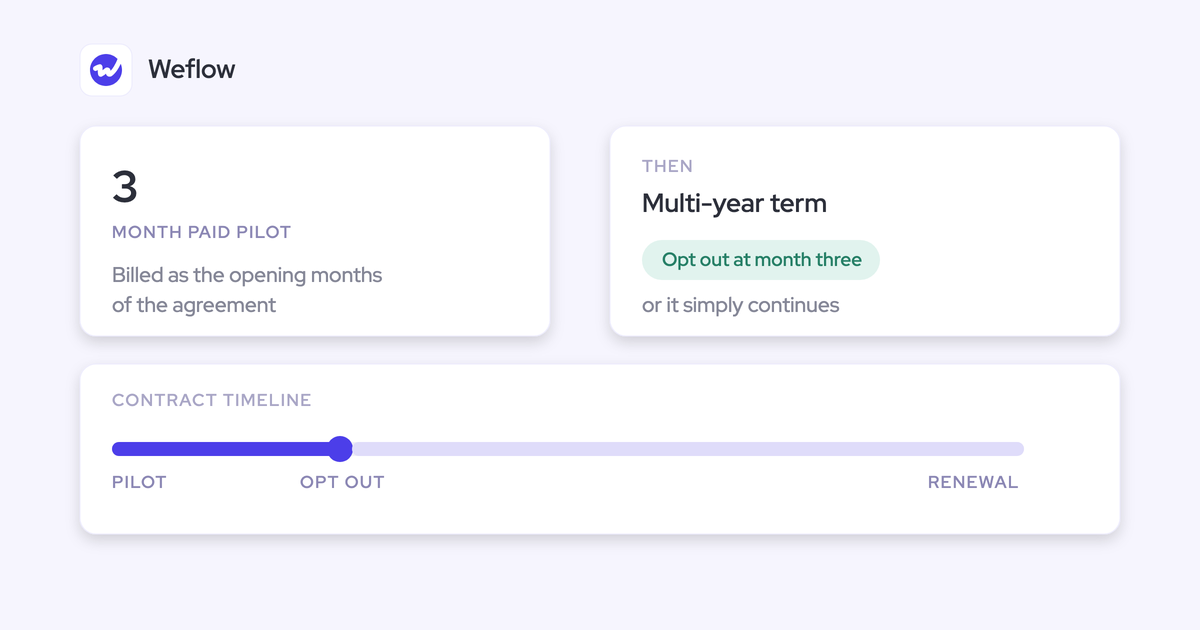
Weflow is the Revenue AI Orchestration platform for sales, customer success, and RevOps teams, and the way we resolve this for buyers replacing Clari or Gong is a contract shape: a three-month paid pilot that is contractually the first three months of a multi-year agreement, with an opt-out in writing at the end of it.
Success criteria and pricing get agreed before it starts, it runs on your own Salesforce with your own activity, and the thing it has to prove is your actual cadence, the weekly deal reviews and forecast calls, not a feature list. Here's what goes in the terms.
Why a two-week trial can't prove a forecasting replacement
Because forecasting isn't a tool topic. It's an operating cadence encoded in software, and a cadence can't be judged until it has run.
A forecast motion only proves itself across a full cycle
Capture and conversation intelligence prove out in two weeks because they act on meetings and emails that are already happening. Turn them on, and by day three there's evidence.
Forecasting has no equivalent. What you're testing is who submits, how often, at deal or manager level, against which quota and which budget. Then you have to wait for the quarter to close so you can compare what was submitted against what actually landed.
We challenge prospects on this in the first call, because plenty of teams asking for a forecasting tool don't yet have the cadence the tool is supposed to carry. If the cadence doesn't exist, a longer pilot just gives you more weeks of nothing to measure.
| What a 14-day window can prove | What a forecasting proof needs |
|---|---|
| Emails, meetings and contacts landing on the right Salesforce records | A configured hierarchy, quotas and forecast types that match how you actually report |
| Salesforce fields written from call content, including methodology fields | Managers and reps submitting through the roll-up week after week |
| Multi-threading and activity gaps becoming reportable | At least one cycle of submitted forecast versus actual, tracked by rep and manager |
| Deal warnings and AI summaries on live opportunities | Enough closed history for the AI projection to be worth arguing with |
Why procurement blocks both the multi-year term and the unpaid POC
The two default contract shapes both fail, for opposite reasons.
A multi-year term signed before anything is proven is exactly the risk your procurement team exists to prevent.
The unpaid three-month POC fails from the other side. It's hard to justify internally after a long evaluation, it has no commercial commitment attached to make anyone prioritize it, and it needs a budget line for the RevOps hours nobody has.
Then the clock removes the slow option entirely. Renewals cluster: pick in Q3, implement in Q4, be live before the new fiscal year. And your CFO will not carry two forecasting line items while you take your time, which is the single most common reason a consolidation stalls.
Three ways Weflow structures an evaluation, and when each fits
The right structure follows from what you're testing. We run three, and only one of them can carry a forecasting proof.
| 14-day free trial | Sandbox POC | Three-month paid pilot | |
|---|---|---|---|
| What it can prove | Activity and contact capture, Conversation intelligence, AI field updates | That the software installs and the screens work | Everything the trial proves, plus a forecast cadence run against actuals |
| Length | 14 days | Open-ended, in practice it stalls | Three months, with a decision point at the end |
| Cost | Free, implementation included | Free, and expensive in RevOps time | Three months of seats at the agreed rate, no implementation fee |
| Data environment | Your Salesforce, your real activity, historical sync-back on day one | A sandbox with no real reps and no real calls | Your Salesforce, your real activity, historical sync-back on day one |
| Exit terms | Nothing to exit | Nothing to exit | Written opt-out at the end of month three |
| Fit with a renewal clock | Fine, if forecasting isn't in scope | Poor, the loop has no natural end | Designed for it: signature to go-or-walk inside a quarter |
The 14-day free trial for Activity Capture and Conversation Intelligence
If forecasting isn't what you're replacing, take the trial and skip the rest of this article.
Our implementation team does the setup during the trial, so it runs on your own Salesforce and your own activity rather than a demo org, and with historical sync-back it can show months of real history on day one. Capture and conversation intelligence prove out cleanly in that window because the meetings and emails are already happening.
One caveat we'd rather say out loud: conversation intelligence trials less cleanly than capture. A small pilot group that has never been recorded may push back on the recording itself, and then you're running a referendum on being tracked instead of a test of the product.
The sandbox POC: why legal's fix breaks the test
A sandbox answers legal's concern by destroying the evidence.
Reps have no reason to work in an environment that isn't their pipeline, so they don't. No real calls get recorded, no real emails get captured, the activity data is empty, and the AI has nothing to be judged on. The evaluation then loops: legal won't approve real data, and the fake data proves nothing.
The way out isn't technical. It's contractual, and it's the terms section below: written deletion and residency commitments, negotiated between the two legal teams before the pilot starts. What you should ask a vendor for is not a sandbox. It's their counsel on a call and the deletion terms in writing.
The three-month paid pilot with a written opt-out
The pilot is contractually the first three months of a multi-year agreement, with an opt-out at the end of month three.
It runs on your Salesforce, with your reps, on your real activity, and with your forecast cadence configured the way you actually run it. Pricing for the pilot and for the full term is agreed before it starts, and so are the success criteria, so "did it work" is a test rather than an argument you have in month four.
Typical scope is one team of five to ten people. Crawl, walk, run is a perfectly reasonable way to buy this.
How the three-month opt-out pilot gets procurement to yes
Because both sides get the thing they actually need, and neither has to pretend.
You get a real proof window on real data, a written exit, and a bill measured in months instead of years. We get a multi-year term, which is where the better pricing sits, so the discount you're being quoted isn't fictional.
| What you get | What Weflow gets |
|---|---|
| Three months of live evidence on your own Salesforce, not a sandbox | A multi-year term rather than a rolling twelve-month one |
| A contractual exit at the end of month three | A committed customer if the criteria are met, with no second procurement cycle |
| Success criteria and pricing fixed before you start | An evaluation with a defined end date instead of an open-ended POC |
| Multi-year discount priced in from day one, not renegotiated later | Predictable revenue that justifies running onboarding at no charge |
That symmetry is what makes it clear to procurement rather than clever. An unpaid POC has no commitment attached and is genuinely hard to justify after a long evaluation. A paid, time-boxed commitment with a defined exit is a shape procurement already knows how to approve.
And it's the argument that survives being repeated by someone else in a meeting you're not in: fixed timeline, named benefit, a price, and a way out.
What to write into the pilot agreement before it starts
Everything that gets contested at the end of a pilot has to be written before it begins. In practice that's four clauses, and they are the whole negotiation.
Success criteria: why matching Clari is the wrong bar
Set parity as the bar and the pilot is built to fail, because parity isn't what you're buying.
An honest replacement of a mature forecasting configuration lands at roughly 80% of it. The missing 20% is the bespoke work accumulated over years: the splits, the dual-date logic, the one particular roll-up somebody built for a board deck.
So forecasting is the counterweight, not the case. The criteria that decide the pilot should center on what the incumbent can't do at all, with forecasting held to "good enough to run the cadence" rather than "identical."
Criteria we've seen hold up in a written pilot agreement:
- A stated share of customer interactions captured against the right opportunity, measured in Salesforce reporting rather than in a vendor dashboard.
- A stated fill rate on the methodology fields your stage gates depend on, written from conversations without a rep typing them.
- Every manager submitting through the roll-up for the pilot's forecast cycles, with submitted versus actual recorded by rep and manager.
- The AI projection, the weighted view and the team roll-up disagreeing usefully, so the forecast call has an agenda instead of a round of restated opinions.
- Deal warnings surfacing slipped and stalled deals before the forecast call rather than during it.
- A named list of questions your team can answer with Ask Weflow AI across calls, deals and pipeline that the incumbent cannot answer at all.
- Adoption measured without enforcement: who used it in week ten, not who was licensed in week one.
Write the numbers in. A criterion without a number is a conversation you'll lose in month four.

How the opt-out clause is worded and what walking costs
The opt-out is a contractual exit at the end of month three, not a friendly assurance from your account executive.
What matters is that both branches are explicit in the document before you sign, so nobody is interpreting anything under pressure with a renewal date two weeks away.
| If you opt out at the end of month three | If you continue |
|---|---|
| You've paid for three months of seats at the agreed rate, and nothing further | The remaining term runs at the rate already agreed, with the multi-year discount already applied |
| The deletion clause triggers on the data Weflow holds | No new procurement cycle, no re-quote, no implementation fee appearing late |
| The activity and conversation data written into your Salesforce native objects stays where it is, because it's yours | Configuration and rollout carry straight on, since the pilot ran in production |
| No termination fee | Expansion into further teams is a seat count change, not a new contract |
One thing to check in your own draft: that the exit sits at the end of the pilot period and doesn't require notice you'd have to give in week two, before you know anything.
Data deletion and residency terms that answer legal's objection
The answer to "no POC on real customer data" is a set of clauses your counsel reviews before the pilot starts. Here's what we put on the table:
- Contractual deletion of the data Weflow holds when the pilot ends and you opt out, agreed in writing rather than promised on a call.
- Data residency that follows your Salesforce region, so a Salesforce org hosted in Europe keeps its Weflow data in Europe. Video recordings are the exception: Weflow holds those and streams them back, because Salesforce is a poor place to store large files.
- Zero Data Retention for AI processing, and customer data never used to train models.
- SOC 2 Type II, GDPR, CCPA and HIPAA compliance, with a Data Processing Agreement incorporating EU Standard Contractual Clauses.
- A public sub-processor list with advance notice of changes, so your legal team can object before a change takes effect.
- Compliant with the EU AI act
- Breach notification within 48 hours.
- Login only through your Salesforce authentication, using whatever SSO your org already enforces. There's no separate Weflow password and no second identity to deprovision, so deactivating a user in Salesforce removes their Weflow access immediately.
That last one usually does more work in a security review than anything on the feature list, because it means the pilot doesn't create a new access surface for IT to manage.
How the pilot price maps to multi-year discount tiers
Weflow publishes its pricing, which is what makes the "opening months of a multi-year deal" framing checkable instead of a trick. You can do the arithmetic on the pilot before you ever speak to us.
| Component | What it is |
|---|---|
| Per-seat list price | Activity & Contact Capture $19, Conversation Intelligence $39, Deal Intelligence & Forecasting $39 per user per month. Bundles: Revenue AI Foundation $49, Revenue AI Business $59, Revenue AI Enterprise $79. |
| Minimum | 10 licenses, billed annually. Unlimited view-only licenses included. |
| Pilot bill | Three months of the pilot seats at the agreed rate. Ten seats of Revenue AI Enterprise at list is $790 a month, so a pilot at that scope is a low four-figure line item. |
| Multi-year discount | 10% for a two-year term, 20% for a three-year term, applied to the rate you're proving against, not offered afterwards. |
| Implementation | No professional services fee. Weflow runs onboarding. |
| Platform fee | None, except a variable quote-based fee on contracts under $10,000 in total value. |
| Usage | Seat-based. Recordings, transcripts, AI field updates and Ask Weflow AI are included, with no metering. Agent Builder is the only consumption-priced product, and every plan includes its free tier. |
Compare that with the incumbent economics you're leaving. Clari is quote-only with no free trial and no self-serve signup, sits in the $120 to $180 per user per month range by most accounts we hear, and carries $15,000 to $50,000 in professional services implementation fees before anyone forecasts anything.
The seat pricing matters less here than the predictability. A pilot whose full cost is knowable before signature is a pilot your CFO can approve in one pass.
Fitting the pilot inside a Clari renewal window
The clock is the hard filter, so the structure has to survive it.
Work backwards from that date. A three-month pilot that has to deliver a go-or-walk decision before the incumbent auto-renews needs to be signed roughly a quarter ahead, which usually means the contracting conversation happens one month earlier than the reader expects.
The timeline from signature to a go-or-walk decision
- Before signature: agree scope, seat count, per-seat rate, term, discount tier, the opt-out wording, the deletion clause and the written success criteria. This is the only step that can't be compressed later.
- Week one: technical implementation, a single 45 to 60 minute session with your Salesforce admin and your mail admin. Google Workspace environments move faster than Microsoft ones.
- Week one: historical sync-back lands months of real activity on the records, so the pipeline is judgeable from day one rather than from zero. Backfill runs up to 24 months as an add-on.
- Weeks one to three: configuration. Team structure and hierarchy, sales methodology, which fields AI populates, playbooks, deal warnings, forecast types, quotas and cadences. This is where the real time goes, and it's the part that decides whether the forecast is yours or a template.
- Weeks two to four: role-based rollout with separate leadership and rep training. Live in two to four weeks for most teams, four to six for a large org.
- Months two and three: run the cadence. Reps submit, managers override, the roll-up gets compared against the AI projection, and forecast accuracy gets recorded per rep and per manager.
- End of month three: the go-or-walk decision, read against the criteria written in step one. Nothing gets renegotiated at this point, which is the entire benefit of step one.
Running Weflow alongside Clari or Gong without duplicate data
Overlap is fine. Two capture engines writing to the same Salesforce org is not.
That's the actual failure mode during a pilot: the same email logged twice, and every activity count built on top of it quietly wrong. Clari reads activities out of Salesforce, so the clean pattern is one capture engine feeding the CRM and Clari consuming the cleaner data while it's still live. Both tools get better, and your activity reporting stays trustworthy through the overlap.
Where a second tool is still logging email itself, compatibility mode handles it: you name the other tool's sending domain, Weflow delays its own sync by about ten seconds, checks the message for the other tool's tracking pattern, and skips it if it finds one. The other system claims the record and Weflow steps back.
Compatibility mode is only needed while the second capture tool is live. Once you switch the incumbent off, you turn it off too, and that's the cleaner end state.
How much RevOps time the pilot actually takes
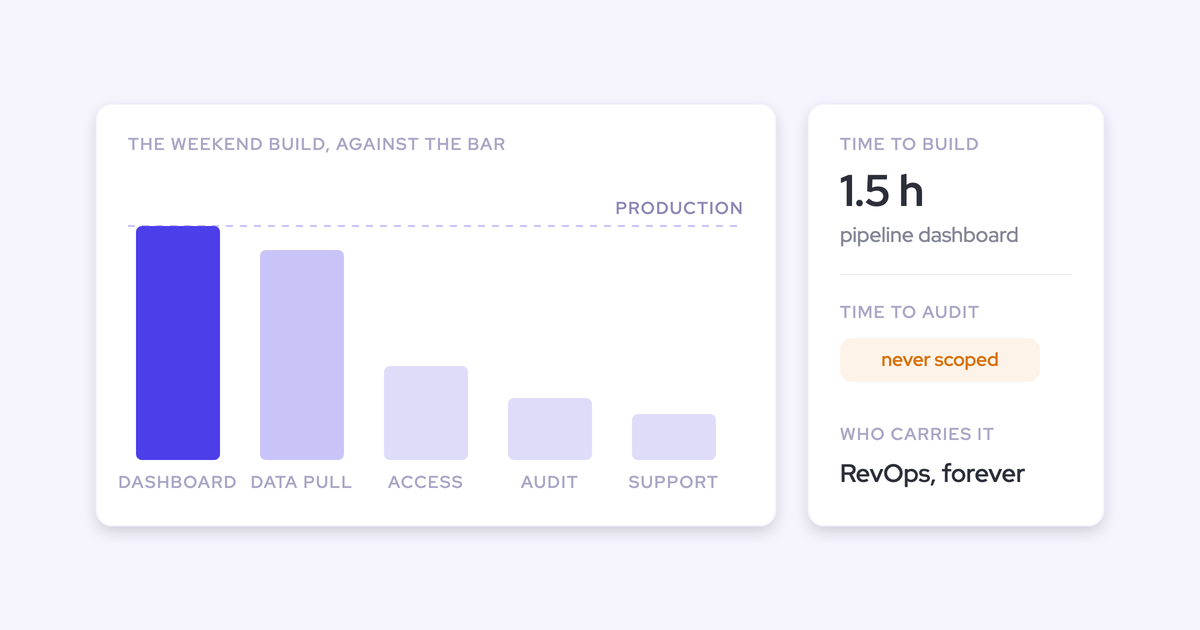
This is the objection that matters most, because the tool swap isn't competing with the incumbent. It's competing with your delivery backlog.
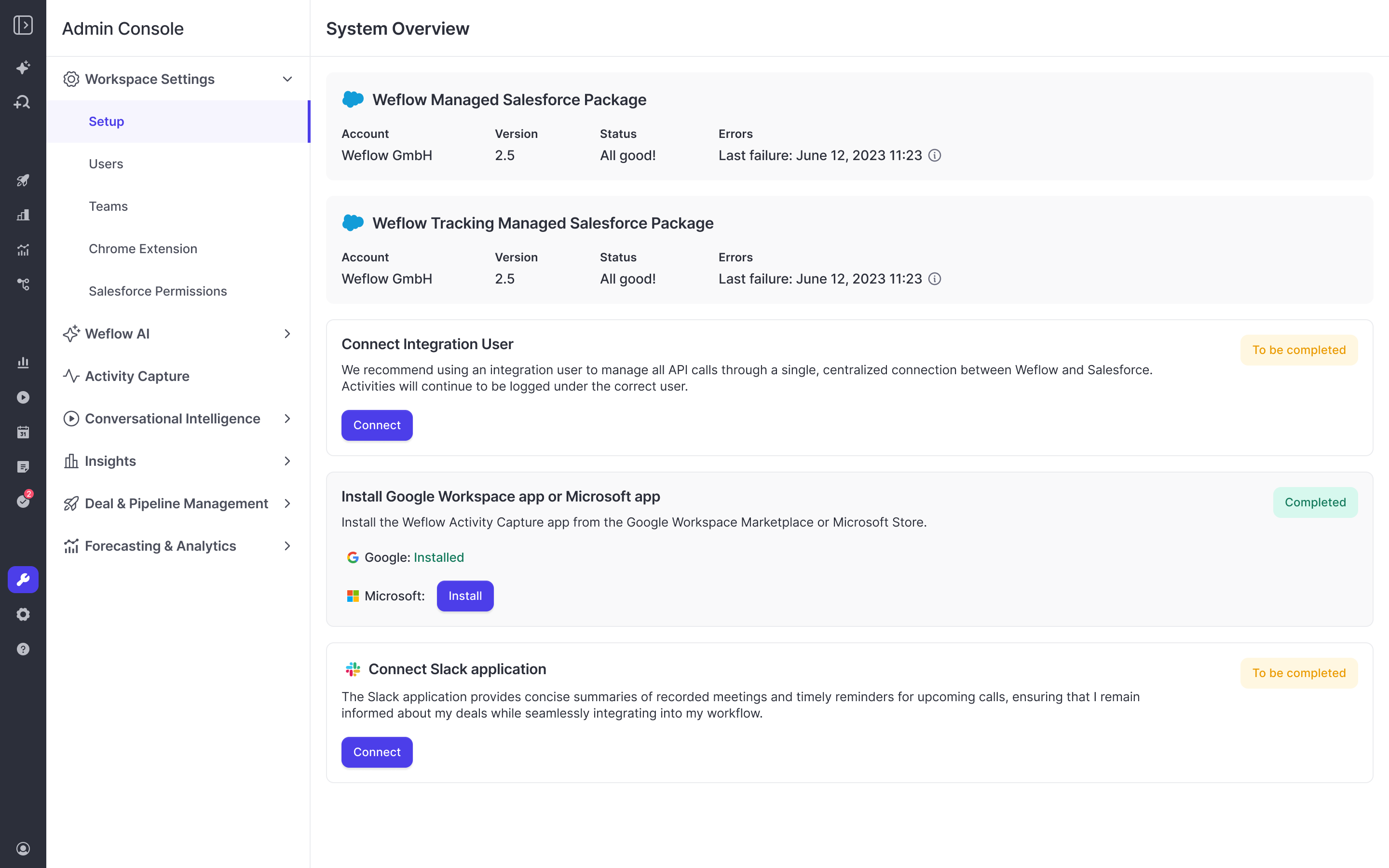
Weflow runs onboarding itself against a mutual action plan with named owners on both sides, rather than handing it to a partner, and there's no professional services fee attached to any of it. What your side actually has to do:
- Put a Salesforce admin and a mail admin on one 45 to 60 minute technical call.
- Make decisions, not builds: hierarchy, methodology, which fields AI writes, warning rules, forecast types, quotas, cadence. Weflow configures against your answers.
- Show up to the role-based training sessions, or hand them to us to run.
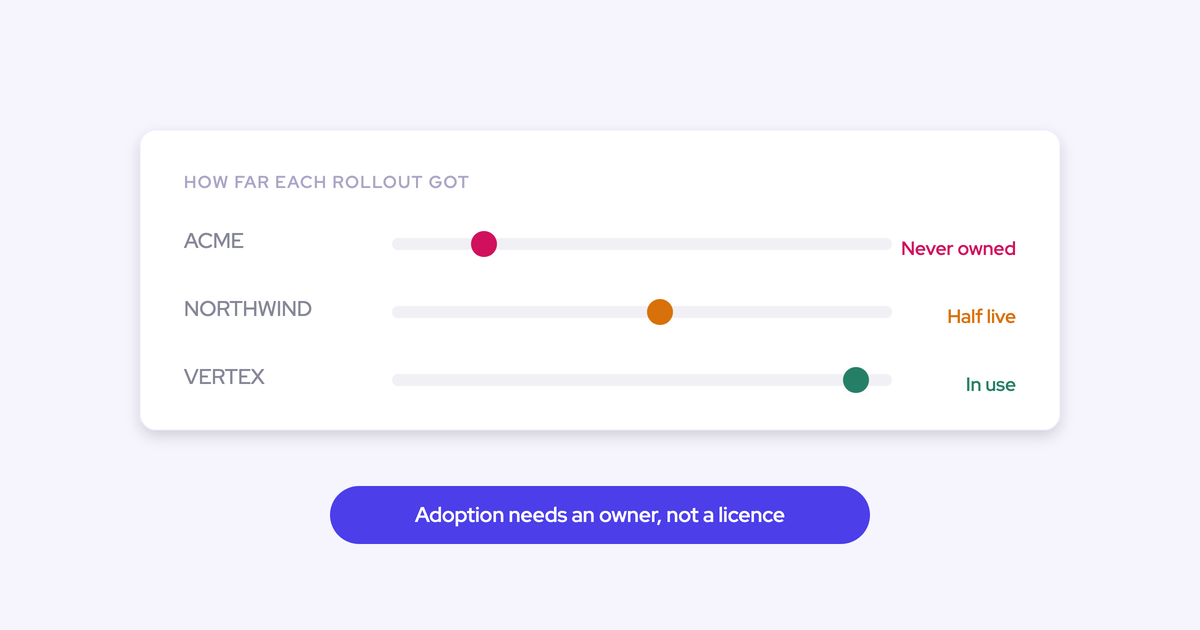
- Nominate the internal owner before the pilot starts. Not because we ask for it, but because unowned rollouts are the single most reliable way a good tool dies.
If the bandwidth genuinely isn't there, take the managed service option: Weflow does the heavy lifting and your team answers questions and unlocks access. That option exists because in most displacement deals the blocker is RevOps bandwidth, not product fit.
The limits to know before you sign the pilot
Set the criteria against things we won't do and the pilot fails on paper while working in practice. So here are the boundaries, plainly:
- Forecasting lands at roughly 80% of a mature Clari configuration, and the missing pieces are the bespoke ones built over years. Concretely: Weflow has pacing and waterfall but no pipeline flow view, and the roll-up sums the amount field you choose rather than applying stage probability inside the roll-up, so if you think in weighted terms you either forecast on a weighted Salesforce field or use the weighted view and AI projection alongside it.
- ISO 27001 is in progress with a target of December 2026, not held today. SOC 2 Type II, HIPAA, GDPR and CCPA are in place. Weflow is not FedRAMP certified, so US government contractors requiring FedRAMP are not a fit.
- The pilot is genuinely three months and genuinely paid. It is not a free-forever trial, and paid contracts start at ten licenses. A team that only wants to test capture, or wants two users in EMEA and two in North America first, should take the 14-day free trial instead.
- Weflow works exclusively with Salesforce, and there's no VoIP or phone call capture today, so a phone-heavy motion isn't fully covered by capture during the pilot.
- Conversation intelligence is the piece most likely to wobble in a small pilot group, particularly one that has never been recorded. Plan the internal message for it before week one, not after the first complaint.
FAQ: Weflow's paid pilot terms
What is the minimum seat count for a Weflow pilot?
Paid contracts start at ten licenses, billed annually, so a paid pilot is normally ten seats. Typical scope is one team of five to ten people, which is enough to run a real forecast cadence without touching the whole org. If you want to try it with one or two people first, use the 14-day free trial rather than buying a small number of seats. View-only licenses are unlimited and free, so leadership can watch the pilot without adding to the count.
Does the pilot run on our own Salesforce data?
Yes. The pilot runs on your Salesforce org, with your reps, on your real emails, meetings and calls, and historical sync-back puts months of real activity on the records from day one. That's deliberate: a demo org would invalidate the proof, because the whole point is to see whether the forecast and the deal signals hold up on your pipeline, your hierarchy and your data quality rather than on someone else's clean sample.
What happens to our data if we opt out?
The deletion clause agreed before the pilot triggers, and Weflow deletes the data it holds, including the video recordings that sit with us and stream back. The activity, contacts and conversation data written into your Salesforce native objects stay in your Salesforce, because your CRM is the system of record and that data is yours. During the pilot, Weflow's own storage sits in the region where your Salesforce instance sits, so an EU-hosted org never has data leave the EU.
Can we migrate our Gong or Clari recordings during the pilot?
Yes. Weflow imports recordings and transcripts from the conversation intelligence platform you're leaving through that platform's API, and reprocesses them through Weflow AI. There's no extra cost, and it takes about one to two weeks depending on volume. It matters during a pilot specifically: once the history is in, you can ask Weflow AI how an objection was handled last quarter and judge the AI on your own back catalogue, not on three weeks of new calls.
Does Weflow charge implementation fees during the pilot?
No. There are no professional services fees, during the pilot or after it, and Weflow runs onboarding itself rather than handing it to a third-party partner. That's the sharpest commercial contrast with the incumbent: Clari implementations are reported to carry $15,000 to $50,000 in professional services fees, and getting a Clari instance to the point where the business genuinely forecasts out of it is commonly a 12 to 18 month exercise.
See how Weflow captures activity, updates Salesforce fields from calls, and rolls up your forecast. Book a 30-minute demo.
.webp)

.webp)
.webp)