
12 Strategies to Improve Sales Productivity
Learn 12 strategies to improve sales productivity and cut admin time.




What Is Sales Productivity? (Definition and Formula)
Sales productivity measures how effectively your sales team converts resources into revenue. It answers a simple question: for every hour, dollar, or rep invested, how much output are you getting back?
The formula:
Sales Productivity = Sales Output (revenue, deals closed) ÷ Sales Input (time, resources, cost)
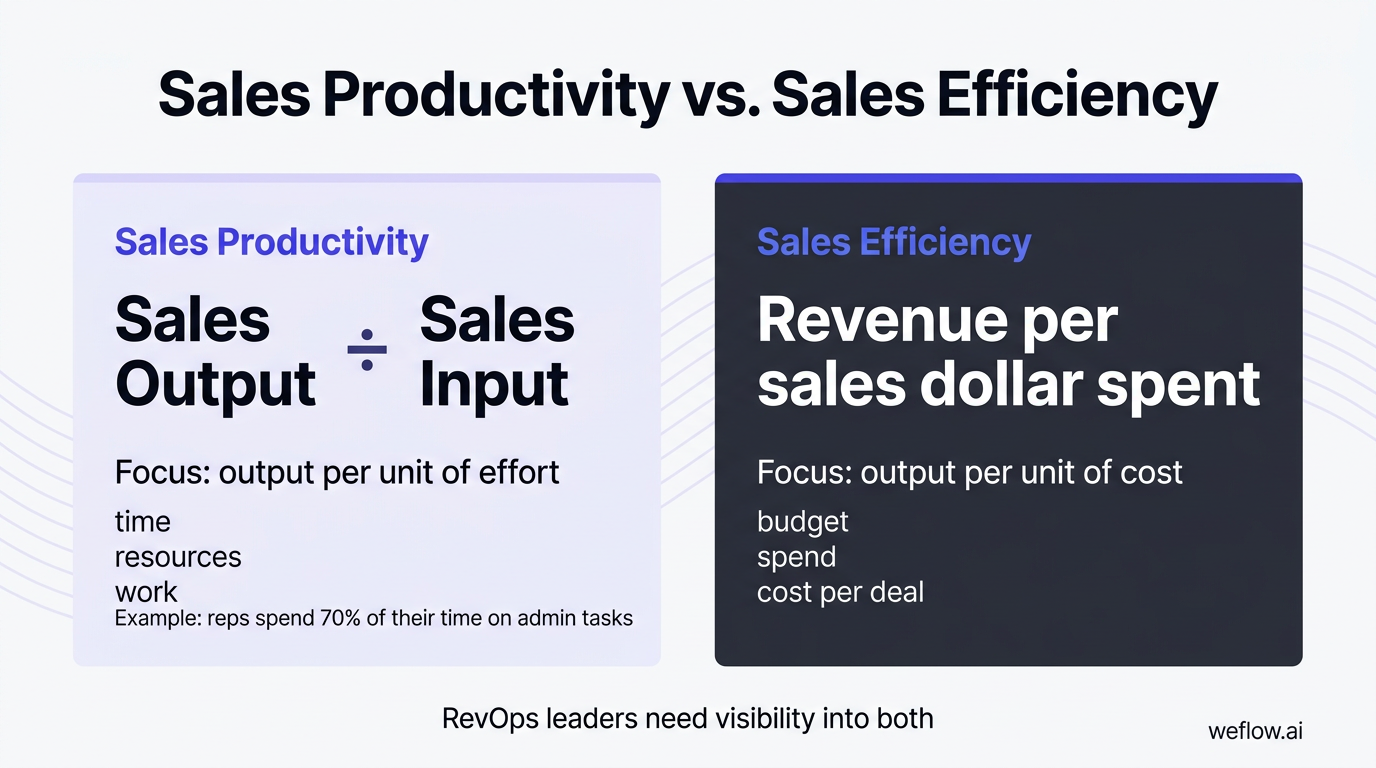
Sales productivity differs from sales efficiency, though the terms are often confused. Efficiency focuses on cost—revenue generated per dollar spent on sales. Productivity focuses on effort—output per unit of time or work. A team can be efficient (low cost per deal) but unproductive (reps spending 70% of their time on admin tasks). RevOps leaders need visibility into both: efficiency to manage budget, productivity to identify where reps lose time and where process changes will have the highest impact.
How to Measure Sales Productivity: KPIs and Metrics That Matter
Measuring sales productivity requires tracking both effort and results. Activity metrics show how much work your team is putting in. Outcome metrics show what that effort produces. The gap between the two reveals where productivity breaks down.
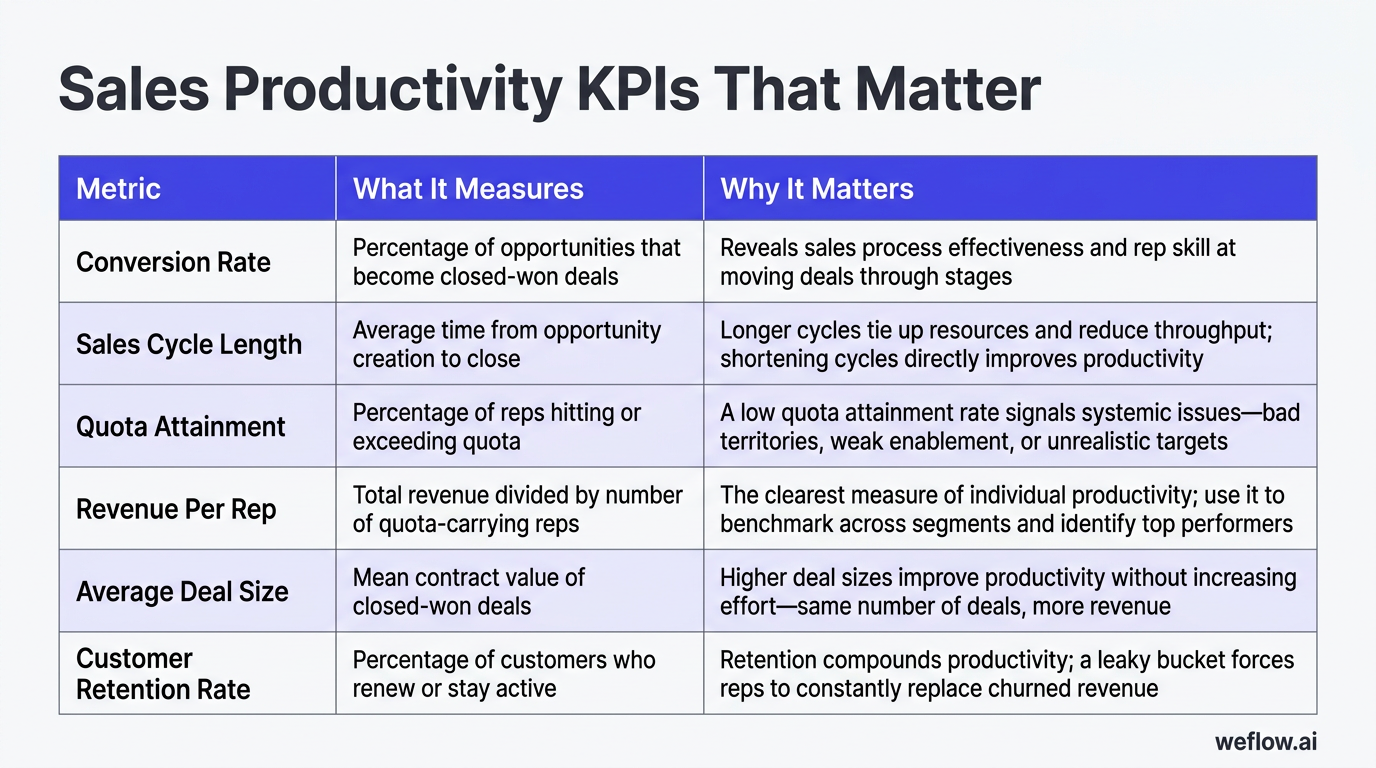
Metric | What It Measures | Why It Matters |
|---|---|---|
Conversion Rate | Percentage of opportunities that become closed-won deals | Reveals sales process effectiveness and rep skill at moving deals through stages |
Average time from opportunity creation to close | Longer cycles tie up resources and reduce throughput; shortening cycles directly improves productivity | |
Quota Attainment | Percentage of reps hitting or exceeding quota | A low quota attainment rate signals systemic issues—bad territories, weak enablement, or unrealistic targets |
Revenue Per Rep | Total revenue divided by number of quota-carrying reps | The clearest measure of individual productivity; use it to benchmark across segments and identify top performers |
Average Deal Size | Mean contract value of closed-won deals | Higher deal sizes improve productivity without increasing effort—same number of deals, more revenue |
Customer Retention Rate | Percentage of customers who renew or stay active | Retention compounds productivity; a leaky bucket forces reps to constantly replace churned revenue |
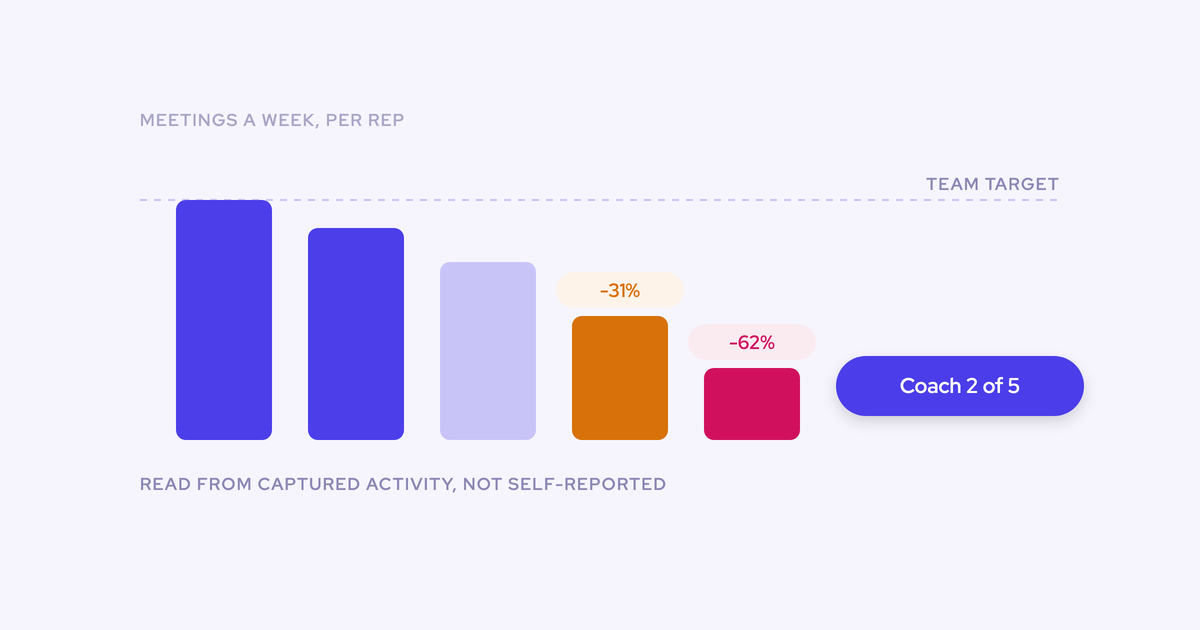
Activity metrics—calls made, emails sent, meetings booked—show effort. Outcome metrics—deals closed, revenue generated, quota attainment—show results. Track both. A team with high activity and low outcomes has a conversion problem. A team with low activity and high outcomes might be under-resourced. The ratio between effort and results is where productivity improvements live.
12 Proven Strategies to Improve Sales Productivity in 2026
Sales productivity improves when you reduce the time reps spend on non-selling activities and increase the impact of every selling hour. These 12 strategies target both sides of that equation.
1. Set Clear Sales Goals with Leading and Lagging Indicators
Quotas tied to company revenue goals give reps a target. But quotas alone don't tell you whether you'll hit them until it's too late. Leading indicators predict future performance; lagging indicators confirm past results. Track both for full visibility into whether your team is on pace.
Leading Indicators | Lagging Indicators |
|---|---|
Appointments booked | Deals closed |
Demos given | Revenue generated |
Conversations had | Clients retained |
Pipeline created | Quota attainment |
When leading indicators drop, you have time to course-correct before lagging indicators suffer. When lagging indicators drop without warning, your visibility into leading indicators is broken.
2. Audit Your Sales Process to Eliminate Bottlenecks
Bottlenecks hide in plain sight. A deal that stalls at Stage 3 for 14 days might be a rep problem—or it might be a process problem affecting everyone. Audit your pipeline to find out.
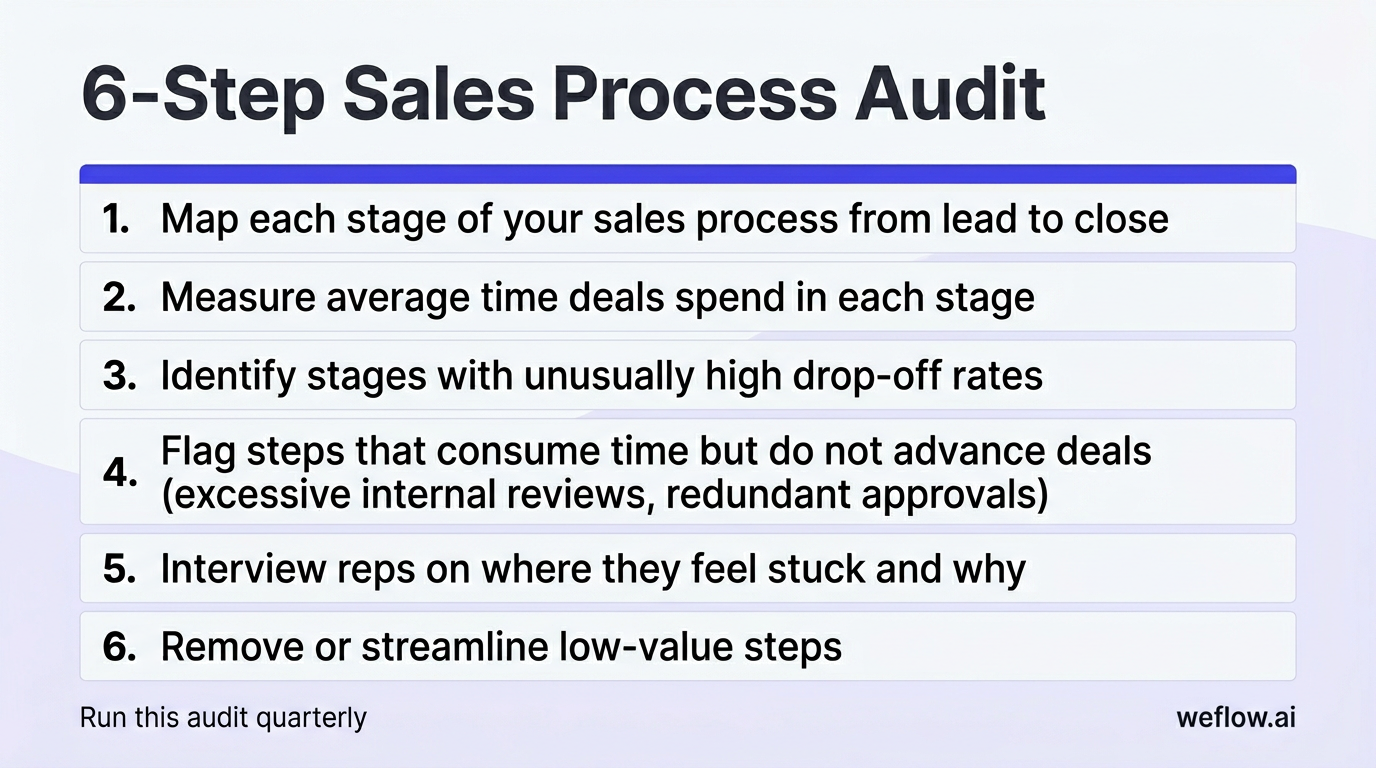
Map each stage of your sales process from lead to close
Measure average time deals spend in each stage
Identify stages with unusually high drop-off rates
Flag steps that consume time but don't advance deals (excessive internal reviews, redundant approvals)
Interview reps on where they feel stuck and why
Remove or streamline low-value steps
Run this audit quarterly. Processes drift. What worked six months ago might be creating friction today.
3. Automate CRM Data Entry, Lead Routing, and Outreach
Manual data entry is the single largest tax on rep productivity. Every minute spent logging calls, updating Salesforce fields, or routing leads is a minute not spent selling. Automation eliminates this tax.
Task | Problem | Tool Examples | Expected Impact |
|---|---|---|---|
CRM data entry | Reps spend 4+ hours/week manually logging activities | Weflow | 95%+ activity capture rate without rep involvement |
Lead routing | Leads sit unworked while reps figure out ownership | Chili Piper, LeanData | Leads routed in under 1 minute; 30%+ improvement in speed-to-lead |
Scheduling | Back-and-forth emails waste hours per week | Calendly, Chili Piper | Meetings booked in 1-2 clicks; reduces scheduling time by 80% |
Email outreach | Manual prospecting limits volume and consistency | Salesloft, Outreach | 3-5x increase in prospect touchpoints with standardized messaging |
Outbound calling | Manual dialing limits calls per hour | Nooks, Orum | 3x increase in conversations per rep per day |
Compensation management | Reps spend time calculating commissions instead of selling | Forma.ai, QuotaPath | Real-time commission visibility; reduced payout disputes |
Weflow automates Salesforce activity tracking—emails, meetings, and calls sync automatically to the right records without rep involvement. Instead of reps spending 30 minutes at the end of each day logging activities, Salesforce stays current in real time.
4. Use AI-Powered Tools for Smarter Selling and Coaching
AI transforms sales productivity by handling tasks that previously required manual effort and surfacing insights that would otherwise stay buried in data. Four AI applications are delivering measurable results:
AI lead scoring: Predictive models rank leads by likelihood to convert, so reps focus on high-probability opportunities instead of working lists alphabetically
Conversation intelligence: AI analyzes sales calls to identify coaching moments, competitive mentions, objection patterns, and deal risk—without managers listening to every recording
AI-generated email drafts: Personalized follow-ups and outreach drafted automatically based on call context, reducing email composition time from 15 minutes to 2
Predictive pipeline analytics: ML models forecast which deals will close, slip, or stall—giving managers early warning instead of end-of-quarter surprises
According to Salesforce's State of Sales report, 84% of sellers report improved performance with AI tools. Teams using AI-powered automation save 4+ hours per rep per week on administrative tasks. Weflow's AI capabilities automate CRM updates after calls, extract MEDDIC fields from conversations, and draft follow-up emails—all without rep intervention.
[banner type="download" url="https://www.weflow.ai/resources/cheat-sheets/sales-onboarding-cheat-sheet" text="Sales Onboarding Cheat Sheet" subtitle="Get new reps to quota in months, not quarters" button="Get the cheat sheet"]
5. Reduce Meeting Overload to Reclaim Selling Time
Reps spend only 30% of their time actively selling. Meetings are a primary culprit—internal syncs, forecast calls, pipeline reviews, training sessions. Each meeting has a direct cost: if a rep earns $100,000/year and attends a 1-hour meeting with 5 colleagues, that meeting costs $250+ in loaded labor.
Audit recurring meetings quarterly. Ask: does this meeting produce decisions, or just updates?
Shift status updates to async channels—Slack threads, Loom recordings, shared dashboards
Protect "selling blocks" on rep calendars. Treat these as immovable. A rep with 4 hours of uninterrupted selling time will outproduce one with 4 hours fragmented across a day
Cancel meetings that exist because "we've always had them." The bar for keeping a recurring meeting should be: what breaks if we stop?
6. Accelerate Sales Rep Onboarding with Structured Playbooks
New reps take 3-6 months to reach full productivity. Every week you shorten ramp time directly increases annual revenue capacity. Structured onboarding cuts ramp time by giving new hires clarity instead of chaos.
Provide comprehensive training materials on product, process, and tools before day one
Set explicit 30/60/90-day milestones with measurable goals (not just "get up to speed")
Assign mentors who review calls, shadow deals, and provide weekly feedback
Document your sales process in detail—discovery questions, objection handling, pricing conversations, handoff procedures
Use standardized note templates so new hires know exactly what information to capture on every call
Weflow's note templates enforce consistent information capture across the team. New reps follow the same methodology as top performers from day one instead of developing ad-hoc habits.
7. Build a Continuous Sales Coaching and Enablement Program
One-time training doesn't stick. Continuous coaching builds skills incrementally and addresses gaps as they emerge. Build a program that scales beyond 1:1 manager sessions.
Define specific, measurable training objectives tied to business outcomes (improve discovery call conversion by 10%)
Identify skill gaps through call reviews, win/loss analysis, and outcome data
Create a structured training plan with deadlines, not open-ended "development goals"
Assign coaches—either managers, senior reps, or dedicated enablement staff
Evaluate regularly using before/after metrics, not just completion tracking
AI-powered coaching tools analyze calls at scale and surface specific, actionable feedback—"You talked 72% of the time on this call; top performers talk 40-50%"—without requiring managers to listen to every recording.
8. Disqualify Low-Value Deals to Focus on High-Probability Opportunities
Not every deal is worth pursuing. Reps who chase low-probability opportunities burn time that could close winnable deals. Build disqualification into your process.
Red flags that signal a deal should be disqualified:
Revenue potential doesn't justify the sales effort required
Prospect demands excessive time (custom demos, repeated stakeholder reviews) without corresponding deal size
Customer objectives are unclear or keep shifting
Too many stakeholders involved with no clear decision-maker
Timeline is unrealistic or keeps slipping without explanation
Prospect is unresponsive but won't explicitly say no
Use a qualification framework—BANT, MEDDIC, MEDDPICC—to standardize how reps evaluate opportunities. The framework isn't the point; consistent application is. When every rep uses the same criteria, disqualification becomes objective instead of emotional.
9. Align Sales and Marketing Teams Around Shared Revenue Goals
Misalignment between sales and marketing creates friction that kills productivity. Marketing generates leads that sales doesn't follow up on. Sales complains about lead quality. Neither team owns the gap. Fix this by creating shared accountability.
Shared KPIs: Marketing is measured on pipeline contribution and MQL-to-SQL conversion rate—not just lead volume. Sales is measured on lead follow-up speed and feedback quality—not just closed revenue
Centralized content library: Marketing maintains; sales uses. No more reps building custom decks because they can't find approved materials
Regular feedback loops: Weekly or bi-weekly syncs where sales shares what's working in conversations and marketing adjusts messaging accordingly
According to HubSpot research, sellers who use enablement content are 58% more likely to exceed their sales goals. But content only works if reps can find it and trust it's current.
10. Centralize Sales Enablement Content for Faster Deal Cycles
Reps waste hours searching for case studies, pricing sheets, and competitive battlecards. When content is scattered across Google Drive folders, Slack channels, and email threads, reps either give up or create their own versions—which are often outdated or off-brand.
Consolidate all sales content into a single, searchable location
Organize by deal stage, persona, and use case—not by file type
Set content owners responsible for keeping materials current
Track usage to identify what content actually gets used and what sits ignored
Use AI-powered content recommendations that surface relevant materials based on deal context
Marketing creates and maintains; sales consumes and provides feedback. The handoff should be seamless. A rep preparing for a call should find the right case study in under 30 seconds.
If you're evaluating tools to make this happen, this list of sales enablement software covers the leading platforms worth considering.
11. Consolidate Your Sales Tech Stack to Reduce Tool Fatigue
The average sales team uses 10 different tools. According to Salesforce research, 70% of sellers say switching between applications is overwhelming. Every additional tool adds cognitive load, training time, and integration complexity.
[banner type="download" url="https://www.weflow.ai/resources/cheat-sheets/sales-enablement-cheat-sheet" text="Sales Enablement Cheat Sheet" subtitle="Make sure reps actually use the content and coaching you build" button="Get the cheat sheet"]
Audit your current stack: list every tool, its purpose, who uses it, and what data it holds
Identify redundancies—tools with overlapping functionality that could be replaced by one platform
Prioritize multifunctional platforms over point solutions. One tool that does 80% of what three tools do is usually better than three tools that each do 100% of one thing
Calculate total cost of ownership, including licenses, integration maintenance, training, and admin time
Teams that consolidate their stack report 50% cost reduction and shorter sales cycles. Fewer tools means fewer context switches, less data fragmentation, and faster rep onboarding.
12. Standardize Outreach with Sales Templates and Note-Taking Frameworks
Every prospect interaction that requires a rep to start from scratch is a productivity leak. Templates standardize quality while reducing effort.
Email templates: Pre-written sequences for common scenarios—initial outreach, follow-up after demo, re-engagement after going dark
Call scripts: Discovery question frameworks, objection responses, pricing conversation guides
Meeting note templates: Structured formats that capture required information (next steps, stakeholders identified, timeline, budget) every time
Weflow's note templates help standardize sales methodology compliance. When every rep captures MEDDIC fields consistently, managers get accurate pipeline data and reps spend less time figuring out what to write down. Templates save 15-30 minutes per prospect interaction—time that compounds across hundreds of interactions per rep per quarter.
Key Sales Productivity Metrics to Track
Improving sales productivity requires continuous measurement. Activity metrics (calls, emails, meetings) show effort and highlight reps who might be under-working. Outcome metrics (deals closed, revenue, quota attainment) show results and highlight reps who might be under-performing despite high activity. The relationship between the two reveals where your process needs work. Track both, review weekly, and use the data to prioritize where you invest in improvement.
Frequently Asked Questions
What is sales productivity and how is it different from sales efficiency?
Sales productivity measures output per unit of effort—how much revenue or how many deals your team produces relative to time and resources invested. Sales efficiency measures output per unit of cost—revenue generated per sales dollar spent. A team can be efficient (low cost-per-deal) but unproductive (reps spending most of their time on admin work instead of selling).
How do you calculate sales productivity?
The core formula is Sales Productivity = Sales Output ÷ Sales Input. Output is typically measured as revenue or deals closed. Input is measured as time (hours worked, selling hours), resources (number of reps), or cost (total sales investment). Revenue per rep and deals closed per rep are the most common productivity calculations.
What are the most important sales productivity metrics to track?
Focus on metrics that reveal both effort and results: conversion rate (opportunities to closed-won), sales cycle length, quota attainment, revenue per rep, and average deal size. Activity metrics like calls and emails matter too, but only in context of the outcomes they produce.
How much time do sales reps actually spend selling?
Research consistently shows reps spend only 28-35% of their time on revenue-generating activities like prospecting, presenting, and negotiating. The rest goes to CRM data entry, internal meetings, email, administrative tasks, and searching for information. Improving productivity means increasing that selling percentage.
How can AI improve sales productivity?
AI improves productivity in four primary ways: automating CRM data entry and administrative tasks (saving 4+ hours per rep per week), scoring and prioritizing leads so reps focus on high-probability opportunities, analyzing calls to surface coaching insights at scale, and generating email drafts and follow-ups based on conversation context.
What is the best way to reduce non-selling activities for sales reps?
Automate CRM data entry with activity capture tools that sync emails, meetings, and calls without rep involvement. Shift status updates to async channels instead of meetings. Standardize processes with templates so reps don't reinvent workflows for common scenarios. Consolidate your tech stack to reduce tool-switching overhead.
How do you align sales and marketing to improve productivity?
Create shared KPIs that hold both teams accountable for pipeline outcomes—marketing owns MQL-to-SQL conversion, sales owns lead follow-up speed. Establish a centralized content library so reps can find approved materials in seconds. Build regular feedback loops where sales shares what's working in conversations and marketing adjusts messaging.
What sales productivity tools should every team use?
At minimum: a CRM (Salesforce for mid-market and enterprise), an activity capture tool that syncs emails and meetings automatically (Weflow), a scheduling tool (Calendly or Chili Piper), and a sales engagement platform for outreach (Salesloft or Outreach). Beyond that, conversation intelligence tools provide coaching at scale, and forecasting platforms improve pipeline visibility.
Start Improving Sales Productivity Today
Sales productivity improves when you reduce the time reps spend on non-selling activities and increase the impact of every selling hour. Start with the highest-leverage change: automating CRM data entry so reps stop losing 4+ hours per week to manual logging.

.webp)