
Sales Objection Handling: Framework and 21 Example Responses
Learn a 4-step sales objection handling framework and 21 example responses for common objections.



.png)

What is sales objection handling?
Sales objection handling is the process of responding to a prospect's concerns during a deal cycle in a way that moves the conversation forward rather than ending it. An objection is a signal—the buyer is engaged enough to push back, which means they're still considering your solution. The goal isn't to "overcome" objections with pressure. It's to understand the real concern, provide the right information, and help the buyer make a confident decision.
Sales objections vs. obstructions: what's the difference?
Not every pushback is an objection. An objection is a genuine concern that needs more information—"I'm not sure this integrates with our current stack" is a real question worth answering. An obstruction is a brush-off designed to end the conversation—"Just send me an email" with no intention of reading it. The distinction matters because objections deserve a thoughtful response, while obstructions require you to re-qualify whether the prospect is a real opportunity at all.
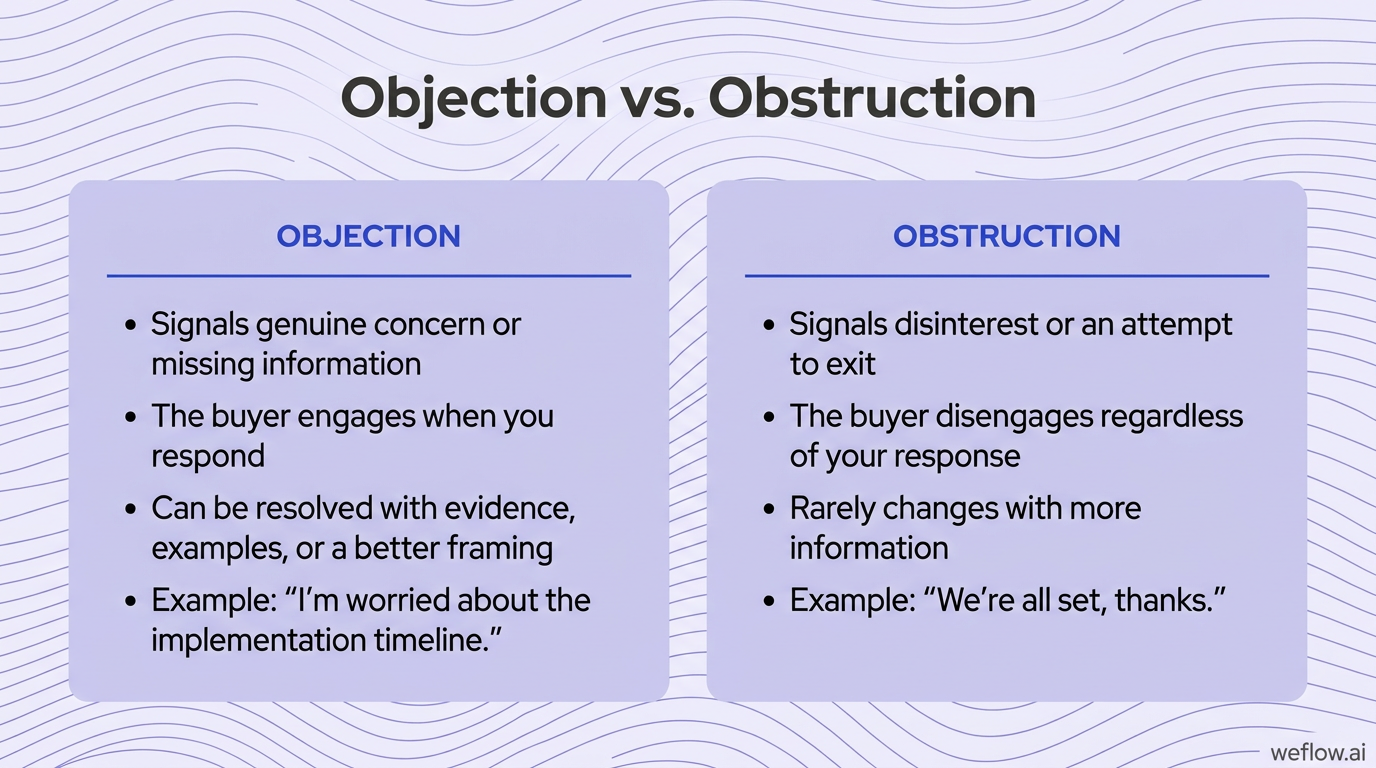
| Objection | Obstruction |
|---|---|
| Signals genuine concern or missing information | Signals disinterest or an attempt to exit |
| The buyer engages when you respond | The buyer disengages regardless of your response |
| Can be resolved with evidence, examples, or a better framing | Rarely changes with more information |
| Example: "I'm worried about the implementation timeline." | Example: "We're all set, thanks." |
The five types of sales objections
Most sales objections fall into five categories. Knowing the type helps you pick the right response strategy instead of guessing.
| Type | Example | What it signals |
|---|---|---|
| Budget | "Your price is too high." | The buyer hasn't connected cost to value, or the budget genuinely isn't there. |
| Timing | "This isn't a priority right now." | Competing priorities exist, or the pain isn't urgent enough to act. |
| Authority | "I need to check with my team first." | You're not talking to the decision-maker, or they need internal buy-in. |
| Need/Fit | "We already have a solution for that." | The buyer doesn't see a gap between their current state and what you offer. |
| Trust | "We only work with vendors we know." | The buyer doesn't have enough confidence in your company, product, or track record. |
A proven four-step framework for handling objections
Use this framework—Listen, Ask, Reframe, Confirm—every time you hear an objection. It keeps you from reacting defensively and gives you a repeatable structure that works across objection types.
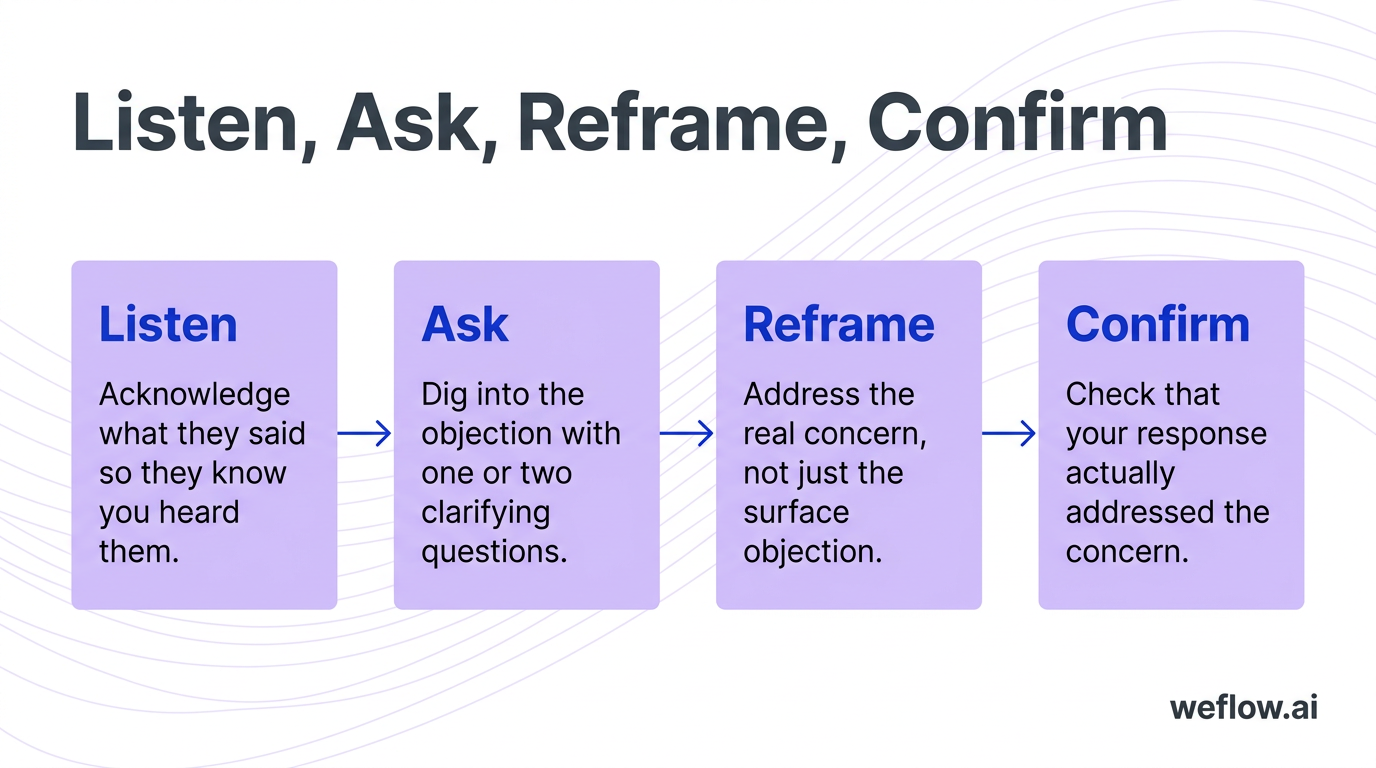
Step 1: Listen
Let the prospect finish. Don't interrupt, don't start formulating your counter while they're talking. Acknowledge what they said so they know you heard them—"I hear you, budget is a real constraint right now." This lowers defensiveness and opens the door for a real conversation.
Example: Prospect says, "We don't have budget for this." You say, "That makes sense—budgets are tight this year. I appreciate you being upfront about that."
Step 2: Ask
Dig into the objection with one or two clarifying questions. Most objections have a deeper concern underneath them—"We don't have budget" might mean "I can't justify this to my CFO" or "I don't see enough ROI." Your job is to find the real blocker.
Example: "When you say budget is tight, is that across all new tools, or is there a specific threshold where this becomes feasible?"
Step 3: Reframe
Address the real concern, not just the surface objection. Use data, customer examples, or a different angle to shift how the buyer sees the situation. Reframing isn't manipulation—it's helping the prospect evaluate your solution against the right criteria.
Example: "Most of our customers were in the same position. What tipped it for them was the ROI math—they recaptured 10+ hours per rep per week in manual CRM updates, which offset the cost within 90 days."
Step 4: Confirm
Check that your response actually addressed the concern. Don't assume silence means agreement. A simple "Does that help address your concern about budget?" closes the loop and either moves the deal forward or surfaces the next objection you need to handle.
Example: "If we could show you a cost-impact model based on your team size, would that help you make the case internally?"
20 common sales objections with example responses
Budget and pricing objections
"Your price is too high."
What it means: The prospect hasn't connected the cost to the value they'd get, or they're anchoring on a competitor's price.
How to respond: Don't drop your price—reframe the conversation around ROI. Ask what they're comparing against and what outcomes they expect. Then show how your cost maps to those outcomes with specifics.
"I get it—price matters. Can I ask what you're comparing us against? [Pause.] The reason I ask is that our customers typically see [specific outcome] within the first 90 days. When we factor in the time your team currently spends on [manual process], the math usually works out differently than the sticker price suggests. Want me to run those numbers for your team?"
"We don't have budget for this."
What it means: Either the budget is genuinely unavailable, or the prospect hasn't prioritized this spend because they don't see the urgency.
How to respond: Separate "no budget" from "not a priority." Ask when budgets reset and whether there's a way to start smaller. If the pain is real, help them build the internal case for funding.
"Understood. Is this a matter of the budget cycle timing, or is this category of spend not planned for this year? [If timing:] When does your next planning cycle start? I'd like to make sure we're in the conversation early so you can evaluate properly."
"I can get a cheaper version somewhere else."
What it means: The prospect is comparing on price alone and may not understand the differences between your solution and the cheaper option.
How to respond: Acknowledge the price difference, then shift the comparison to the dimensions that matter—implementation time, support quality, missing features, or hidden costs. Ask what criteria matter beyond price.
"That's fair—there are cheaper options out there. What I'd encourage you to compare alongside price is [specific differentiator, e.g., deployment time, support SLA, feature depth]. A few of our customers switched to us after starting with a lower-cost tool because they hit [specific limitation]. Would it help if I shared what that comparison looked like?"
"I need to use this budget somewhere else."
What it means: The prospect sees other investments as higher priority than yours right now.
How to respond: Don't argue that your tool is more important than their other priorities. Instead, ask what they're investing in and explore whether your solution supports those goals. Sometimes the spend aligns more than they think.
"Makes sense—where is the budget going instead? [Listen.] That's interesting, because a few of our customers found that [your solution] actually accelerated [their other priority]. For example, [specific example]. Would it be worth 15 minutes to see if there's overlap?"
Timing and priority objections
"This isn't a priority right now."
What it means: The pain exists, but it's not acute enough—or the prospect hasn't connected your solution to their current top priorities.
How to respond: Ask what is a priority right now and find the connection point. If there's no connection, agree on a timeline to revisit and add real value in the meantime.
"Totally fair. What's taking priority on your end this quarter? [Listen.] Got it. The reason I ask is that [your solution] has helped teams like yours [address that priority] by [specific mechanism]. If that doesn't resonate, I'm happy to check back in [timeframe]—when would make sense?"
"I'm too swamped to deal with this."
What it means: The prospect is overwhelmed and adding anything new feels like more work, not less.
How to respond: Empathize first—they're telling you the truth. Then position your solution as something that reduces their workload, not adds to it. Offer to do the heavy lifting on the evaluation.
"I hear you—this is a busy time. I don't want to add to your plate. Most of our customers came to us because they were spending too much time on [specific manual process]. If I can show you in 15 minutes how to get that time back, would it be worth it? I'll keep it tight."
"Call me back next quarter."
What it means: This could be a real timing issue or a polite brush-off. You need to figure out which one.
How to respond: Agree to the timeline, but anchor it to something specific. Get a concrete date, a reason tied to their planning cycle, and permission to send something useful in the meantime.
"Happy to do that. So I'm reaching out at the right time—what specifically changes next quarter? Is it budget availability, a planning cycle, or something else? [Listen.] Great. I'll reach out on [specific date]. In the meantime, I'll send over [relevant resource] so you have context when we reconnect."
"I'm currently under contract with someone else."
What it means: They have an existing vendor and may face switching costs or contractual obligations.
How to respond: Don't push for an immediate switch. Ask when the contract is up, how satisfied they are, and whether they'd be open to a side-by-side evaluation before renewal. Plant the seed now for a decision later.
"Got it—when does that contract come up for renewal? [Listen.] That gives us some time. Would it make sense to do a quick comparison about 60 days before renewal so you can evaluate with real data? No pressure to switch—just so you have options on the table when the time comes."
Product fit and value objections
"We already have a solution for that."
What it means: The prospect doesn't see a gap between what they have and what you're offering.
How to respond: Don't trash their current tool. Ask how it's working for them and listen for pain points they've accepted as normal. Most teams have workarounds they've stopped noticing.
"That makes sense—what are you using today? [Listen.] How's it working for [specific use case]? The reason I ask is that a lot of teams we work with thought their current setup was fine until they saw how much time they were spending on [specific workaround]. Would it be helpful to see how that compares?"
"I don't see the potential for ROI."
What it means: The prospect needs hard numbers, not promises. They can't build an internal case without them.
How to respond: Get specific. Ask what ROI metric matters to them—time saved, revenue impact, cost reduction—and offer to build a custom business case. Generic ROI claims won't work here.
"That's a fair concern. What would ROI need to look like for this to make sense—are we talking time savings, revenue impact, or cost reduction? [Listen.] Let me put together a model based on your team size and current process. Our customers typically see [specific metric], but I want to show you the math with your numbers, not ours."
"Your product is missing [feature]."
What it means: The prospect has a specific requirement you may or may not meet. They might also be using a feature gap as a negotiation tactic or a reason to default to the status quo.
How to respond: Clarify how critical the feature is to their workflow. If it's on your roadmap, say so with a timeline. If it's not, explore whether there's a workaround or whether the rest of your value proposition outweighs the gap.
"Good to know. How central is [feature] to your day-to-day workflow? [Listen.] [If on roadmap:] That's actually on our roadmap for [quarter]. I can connect you with our product team if you want more detail. [If not:] I hear you. What I'd suggest is weighing that gap against [two to three capabilities they do need]. A few of our customers made that trade-off and found that [specific outcome] more than compensated."
"I had a bad experience with similar products."
What it means: Past experience has made the prospect skeptical of this category. Trust is low.
How to respond: Don't dismiss their experience. Ask specifically what went wrong—was it the implementation, the product, the vendor's support? Then explain how your approach differs on that specific dimension.
"I appreciate you sharing that. What specifically went wrong—was it the product itself, the implementation, or the support after? [Listen.] That's a common issue with [category]. Here's how we're different on that front: [specific differentiator]. Would it help to talk to one of our customers who had the same concern before they signed on?"
"You don't understand our challenges."
What it means: You've been talking about your product instead of their problems. The prospect feels unheard.
How to respond: Stop pitching. Ask them to describe their top three challenges right now and take notes. Then connect each challenge to a specific way you can help—or acknowledge where you can't.
"You're right to push back on that—I don't want to assume. Can you walk me through the top two to three challenges your team is dealing with right now? [Listen and take notes.] Okay, here's where I think we can help with [challenge 1] and [challenge 2]. On [challenge 3], that's outside our scope, and I want to be upfront about that."
Authority and decision-making objections
"I need to check with my team first."
What it means: The prospect isn't the sole decision-maker, or they need internal alignment before moving forward.
How to respond: Support their internal process instead of trying to bypass it. Ask who else is involved, what their concerns might be, and offer to help build the internal case—a one-pager, a demo recording, or a call with the broader team.
"That makes total sense. Who else would be involved in this decision, and what do you think their main questions would be? [Listen.] I can put together a one-page summary that addresses those points specifically. Or if it's easier, I'm happy to join a quick call with the broader team so they can ask questions directly."
"I'm not the decision-maker."
What it means: You need to get to the person who controls the budget and the final yes.
How to respond: Don't treat this contact as unimportant—they're your internal champion. Equip them with what they need to advocate for you and ask for an introduction to the decision-maker.
"Got it—who typically makes this kind of decision on your team? [Listen.] Would it be helpful if I gave you a summary you could share with them? And if they're open to it, I'd be happy to set up a quick intro call so they can evaluate directly."
"We only work with vendors we know."
What it means: Risk aversion. The prospect prefers the known over the unknown, even if the unknown is better.
How to respond: Reduce the perceived risk. Offer a pilot, a free trial, or references from companies they'd recognize. Make it easy to try without committing.
"I respect that—switching vendors is a real decision. Would it help to start with a small pilot so you can evaluate us against your current setup with zero risk? I can also connect you with [reference customer in their industry] who had the same concern before they came on board."
"Send me more information and I'll get back to you."
What it means: This is often a polite exit, but sometimes it's genuine. Your job is to figure out which.
How to respond: Agree to send information, but make it specific. Ask what they want to learn and set a concrete follow-up date. Generic "more info" requests that lack specifics are usually obstructions, not objections.
"Happy to. So I send you the right thing—what specifically would be most useful? Is it pricing, a technical overview, customer case studies, or something else? [Listen.] I'll get that over today. Can we set up a 15-minute call on [specific date] to answer any questions that come up?"
Trust and relationship objections
"We don't have the capacity to implement this."
What it means: The prospect is worried about the lift required to get started—training, migration, internal change management.
How to respond: Be specific about what implementation actually looks like. Quantify the time commitment, explain what your team handles vs. what they need to do, and share examples of similar companies that deployed quickly.
"That's one of the most common concerns we hear. Here's what implementation actually looks like: [specific timeline, e.g., two weeks from contract to live]. Our team handles [specific tasks], and your side typically needs about [X hours total]. For context, [similar company] went live in [timeframe] with a team of [size]."
"We're doing fine with the status quo."
What it means: The prospect doesn't feel enough pain to change. The current process works "well enough."
How to respond: Respect their assessment, then quantify the hidden cost of the status quo. "Fine" usually means there are inefficiencies they've stopped noticing because they've been working around them for so long.
"Glad things are working. Out of curiosity, how much time does your team spend on [specific manual process] each week? [Listen.] That's pretty common. What we've seen is that teams spending [X hours] on that are leaving [specific outcome, e.g., pipeline accuracy, rep productivity] on the table. Would it be worth seeing what that gap looks like with your data?"
"I'm not ready for a buying conversation."
What it means: The prospect is early in their evaluation and doesn't want to be sold to. They need information, not pressure.
How to respond: Back off the close and shift to education. Offer something useful with no strings—a relevant resource, a benchmark, a quick insight about their industry. Build the relationship now so you're the first call when they're ready.
"No problem at all—I'm not trying to push a deal. What would be useful is if I shared [specific resource, e.g., a benchmark report, a how-to guide relevant to their challenge]. No pitch attached. When you're further along in your evaluation, I'd be glad to pick the conversation back up. Fair?"
How to build an objection handling culture on your sales team
Individual reps handling objections well is good. A team that systematically gets better at it is a competitive advantage. Here's how to build that muscle.
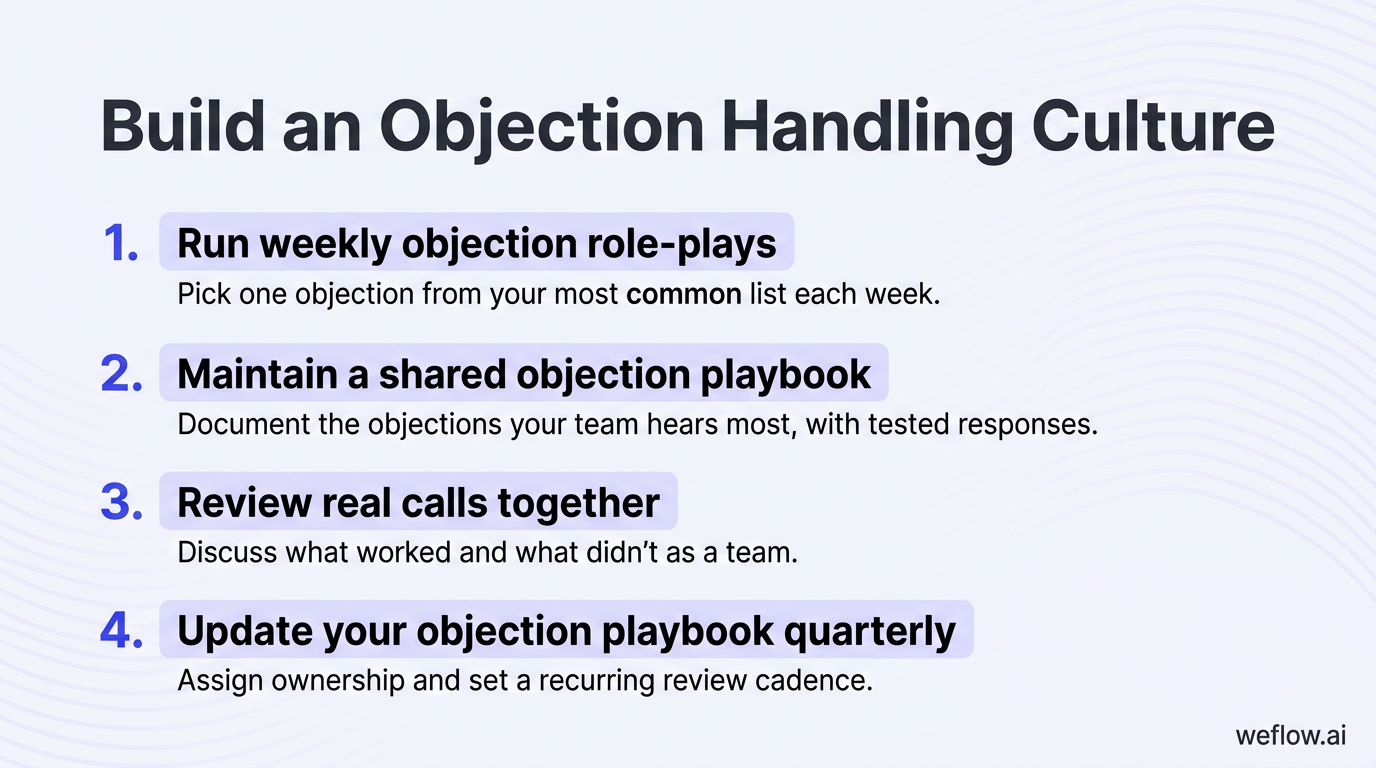
- Run weekly objection role-plays. Pick one objection from your most common list each week. Have reps pair up and practice for 10 minutes, then debrief as a group. The goal isn't to memorize scripts—it's to build the reflex of listening before responding.
- Maintain a shared objection playbook. Document the objections your team hears most, with tested responses that have worked in real deals. Update it monthly. Make it a living document, not a PDF that sits in a Google Drive folder.
- Review real calls together. Pull call recordings where reps handled objections well or poorly. Discuss what worked and what didn't as a team. Peer-to-peer feedback is more effective than top-down coaching because reps learn from scenarios they recognize.
- Update your objection playbook quarterly. Market conditions change, competitors launch new products, and buyers develop new concerns. If your playbook is six months old, it's already out of date. Assign ownership to a manager or enablement lead and set a recurring review cadence.
Frequently asked questions
What is objection handling in sales?
Objection handling is the process of addressing a prospect's concerns during the sales process so the conversation moves forward. It involves listening to the objection, understanding the real concern behind it, and responding with information or evidence that helps the buyer make a confident decision. Done well, it builds trust rather than creating pressure.
What are the most common types of sales objections?
The five most common types are budget, timing, authority, need/fit, and trust. Budget objections involve cost concerns. Timing objections signal competing priorities. Authority objections mean you haven't reached the decision-maker. Need/fit objections suggest the buyer doesn't see a gap. Trust objections mean they need more confidence in your company or product.
What is the difference between a sales objection and an obstruction?
An objection is a genuine concern that can be addressed with the right information—the buyer is still engaged. An obstruction is a polite way to exit the conversation with no intention of continuing. The test: if you respond thoughtfully and the prospect engages further, it was an objection. If they disengage regardless, it was an obstruction.
How do you handle price objections in sales?
Don't lead with a discount. Instead, reframe the conversation around ROI. Ask what they're comparing against and what outcomes matter to them. Then map your pricing to those outcomes with specific numbers—time saved, revenue impact, or cost reduction. If you can show the math, the price conversation shifts from "how much does it cost" to "what's the return."
What is the best framework for handling sales objections?
The Listen, Ask, Reframe, Confirm framework works across all objection types. Listen without interrupting. Ask clarifying questions to find the real concern. Reframe with data, examples, or a different perspective. Confirm that your response addressed the objection before moving on. It takes practice to make it natural, but it prevents the two most common mistakes: reacting defensively and making assumptions.
How can sales teams practice objection handling?
Three methods work well together: weekly role-play sessions where reps practice specific objections in pairs, call reviews where the team listens to real recordings and discusses what worked, and a shared objection playbook that documents tested responses. The playbook should be updated quarterly as market conditions and buyer concerns change.
When should you walk away from a sales objection?
Walk away when the objection reveals a genuine disqualifier—the prospect doesn't have the budget, the authority, or the need, and no amount of reframing will change that. Also walk away when an objection is actually an obstruction: the prospect has no intention of continuing the conversation. Spending time on unqualified deals costs more than losing them. Qualify early, disqualify fast, and move your energy to deals that can close.
-p-1600.png)

.png)
-p-1600.png)
-p-1600.png)
-p-1600.png)