

10 Sales Negotiation Strategies to Close Better Deals
Learn 10 sales negotiation strategies to protect margin, trade concessions, and close better deals.



.png)

Sales negotiations determine your margin, win rate, and deal health. Most reps walk into these conversations without a framework. Here are 10 strategies top performers use to close better deals on better terms.
What Is Sales Negotiation (and Why Does It Make or Break Your Deals)?
Sales negotiation is the process of reaching agreement on price, scope, timeline, and terms between a seller and a buyer. Done well, it protects your margin while solving the buyer's problem.
This matters because every percentage point you give away in negotiation comes straight off your bottom line. A rep who discounts 10% on a $100k deal just cost the company $10k in margin. Multiply that across your sales org and the impact is staggering. The difference between average and top performers often comes down to how they handle these conversations.
Key Skills Every Sales Negotiator Needs
Strong negotiators aren't born with a gift. They develop a specific set of skills through deliberate practice.
Preparation and research: Know the buyer's business, their alternatives, your walk-away point, and your ideal outcome before you enter any negotiation.
Communication and active listening: The best negotiators talk less and listen more. They hear what buyers say and what they don't say.
Value-building: Frame every conversation around the business outcomes you deliver, not the features you offer or the price you charge.
Objection handling: Treat objections as buying signals. Every pushback reveals what the buyer actually cares about.
Emotional intelligence: Read the room. Recognize when a buyer is anxious, defensive, or ready to commit. Adjust your approach accordingly.
What Are the 6 Stages of the Sales Negotiation Process?
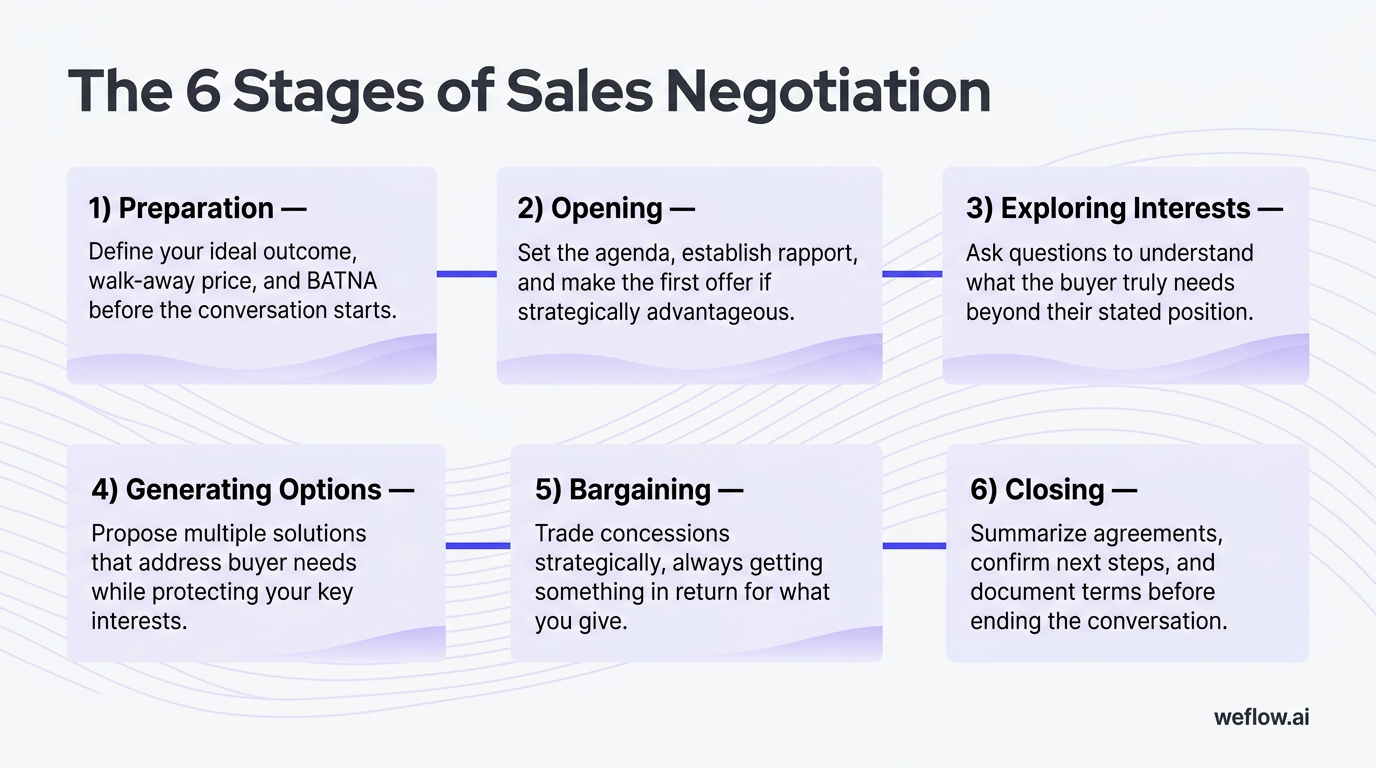
Every sales negotiation moves through six stages. Skipping any stage creates risk.
Stage | What to Do |
|---|---|
Preparation | Define your ideal outcome, walk-away price, and BATNA before the conversation starts. |
Opening | Set the agenda, establish rapport, and make the first offer if strategically advantageous. |
Exploring Interests | Ask questions to understand what the buyer truly needs beyond their stated position. |
Generating Options | Propose multiple solutions that address buyer needs while protecting your key interests. |
Bargaining | Trade concessions strategically, always getting something in return for what you give. |
Closing | Summarize agreements, confirm next steps, and document terms before ending the conversation. |
10 Proven Sales Negotiation Strategies
Know When to Walk Away From a Deal
The willingness to walk away is the single most powerful negotiating position you can hold. When you need the deal, you've already lost.
Top negotiators understand their BATNA (Best Alternative to a Negotiated Agreement) before entering any conversation. If your BATNA is strong, you can walk away without damage. If your BATNA is weak, you're negotiating from desperation.
Walking away does three things: it protects your margin on bad deals, it signals to the buyer that you have limits, and it often brings buyers back to the table with better terms. Research consistently shows that negotiators who are willing to walk away achieve better outcomes than those who approach every deal as must-win.
The rule is simple: It's OK to want the sale. It's never OK to need it.
Set Your Walk-Away Price and BATNA Before Every Negotiation

Preparation is where negotiations are won or lost. Before any pricing conversation, define three things:
Your ideal outcome: The best realistic result for your company.
Your reservation price: The minimum acceptable terms where you'd still do the deal.
Your BATNA: What happens if this deal falls through? What's your next best option?
Use this preparation checklist before every negotiation:
What is the buyer's likely BATNA? What are their alternatives?
What constraints is the buyer operating under (budget cycles, internal stakeholders, timeline)?
[banner type="download" url="https://www.weflow.ai/resources/cheat-sheets/sales-enablement-cheat-sheet" text="Sales Enablement Cheat Sheet" subtitle="Give reps the playbooks and prep they need to stop discounting on instinct" button="Get the cheatsheet"]
Where can you create value that costs you little but matters to them?
What concessions might they ask for, and what will you ask for in return?
At what point do you walk away?
Write these answers down. When the pressure of a live negotiation hits, having these anchors prevents you from making decisions you'll regret.
Make the Opening Offer and Control the Anchor
The first number mentioned in a negotiation heavily influences the final outcome. This is called anchoring, and decades of research in behavioral economics confirms its power.
When you make the first offer, you set the anchor. All subsequent discussion happens relative to that number. If you let the buyer anchor first, you spend the rest of the negotiation working up from their low number instead of working down from your target.
Data from negotiation studies shows that sellers who make the first offer achieve their target pricing more often than those who wait. The anchor creates a psychological reference point that's difficult to escape, even when both parties know about the bias.
Two keys to effective anchoring:
Anchor ambitiously but credibly. An anchor that's too aggressive gets dismissed. An anchor that's too conservative leaves money on the table.
Support your anchor with rationale. "Based on the scope you've described and the outcomes we've delivered for similar companies, the investment for this project is $150,000." The reasoning makes the anchor stick.
Lead With Value: How to Frame Offers Around Buyer Outcomes, Not Price
When a buyer pushes on price, the instinct is to defend or discount. Both are mistakes. The right response is to redirect to value.
Ask: "Help me understand what's driving the concern about price." This question does two things. It gives you information about their real constraint. And it shifts the conversation from your cost to their problem.
Buyers often push on price not because they can't afford it, but because they haven't connected the investment to the outcome. Your job is to make that connection explicit.
Loss aversion is your ally here. Research from behavioral economics shows that people feel the pain of losses roughly twice as strongly as the pleasure of equivalent gains. Frame your offer in terms of what they stand to lose by not acting:
"Based on what you've told me about your current pipeline accuracy, you're likely leaving $2M in deals on the table every quarter. This investment addresses that."
"The cost of the status quo is $500k annually in rep time spent on admin. The question isn't whether you can afford this change, but whether you can afford not to make it."
Value selling beats price competition every time. When you compete on price, you've already commoditized yourself.
Trade Concessions Strategically, Never Give Without Getting

The cardinal rule of negotiation is simple: trade, don't cave.
Every time a buyer asks for a concession, you have two choices. You can give it away and weaken your position. Or you can trade it for something you want. Top negotiators always choose the second option.
Examples of strategic trading:
"We can extend the scope to include X if we adjust the implementation timeline from 6 weeks to 10 weeks."
"We can offer that pricing if you're able to commit to a 24-month term instead of 12."
"We can include additional training sessions if you can sign by end of quarter."
"We can match that rate if you prepay annually instead of monthly."
Notice the pattern: every concession comes with a reciprocal ask. This isn't being difficult. It's protecting your value.
Another principle: make your concessions progressively smaller. If you discount 15% on the first ask, 10% on the second, and 7% on the third, the buyer learns that pushing harder pays off. Instead, start small and make each subsequent concession smaller. This signals that you're approaching your limit.
Build Rapport and Trust to Shift From Adversarial to Collaborative Negotiation
Negotiations that feel like battles usually produce worse outcomes for both sides. The best deals happen when both parties feel like they're solving a problem together.
Building rapport isn't about small talk or fake friendship. It's about demonstrating that you understand their situation and have their interests in mind.
Practical tactics:
Mirror their language. If they say "deal velocity," don't say "sales cycle time." Use their words.
Reference prior conversations. "Last month you mentioned budget approval timing was a concern. Here's how we can work around that."
Send agendas before meetings. This shows respect for their time and lets them prepare, which builds trust.
Be consistent. Do what you say you'll do. Every kept promise builds credibility for the next conversation.
Trust transforms the dynamic. When a buyer trusts you, they share information about their real constraints, their internal stakeholders, and what would make them heroes in their organization. That information is worth more than any discount you could offer.
[banner type="download" url="https://www.weflow.ai/resources/cheat-sheets/sales-onboarding-cheat-sheet" text="Sales Onboarding And Training Cheat Sheet" subtitle="Ramp new reps into negotiators who hold the line, not cave on price" button="Download free"]
Use Strategic Questions and Active Listening to Uncover Hidden Buyer Priorities
The buyer's stated position is rarely their true priority. Price objections often mask concerns about risk. Timeline pressure often signals internal stakeholder dynamics. Your job is to find what's underneath.
Open-ended questions get you there:
"What would make this decision easier for you?"
"If price weren't a factor, what else would you need to see?"
"Walk me through your internal approval process. Who else needs to weigh in?"
"What happens on your end if this project doesn't move forward?"
"What does success look like for you personally in this role?"
After you ask, use strategic silence. Let the pause sit. Buyers will fill silence with information. The urge to jump in and talk is strong. Resist it.
Active listening means more than staying quiet while they talk. It means reflecting back what you hear: "So if I understand correctly, your main concern is getting your CFO comfortable with the ROI timeline before committing. Is that right?" This confirms you've heard them and often prompts them to elaborate further.
Handle Sales Objections Without Caving on Price
Every objection is a signal. The response depends on what type of objection you're facing.
Price objections usually mean one of three things: the buyer doesn't see the value, they have a real budget constraint, or they're testing to see if you'll discount. Redirect to value first. If the budget constraint is real, explore scope adjustments or payment terms before touching price.
Trust objections ("I'm not sure this will work for us") require proof points. Case studies, references, or pilots often resolve these better than discounts ever could.
Urgency objections ("We're not ready to move yet") need qualification. Is this timing, or is it a polite rejection? Ask directly: "What would need to change for this to become a priority?"
Research from Harvard's Program on Negotiation shows that constraint rationales outperform disparagement rationales. Telling a buyer "I can't go lower because my manager won't approve it" is more effective than "I won't go lower because our product is worth more." The constraint is external and feels less like a power play.
When you do need to hold the line, be direct: "I understand price is a concern. Based on what we've discussed, this is the right investment level for the outcomes you need. I'm not able to go lower, but I'm confident this delivers value well beyond the cost."
Use Anchoring, Silence, and Social Proof to Strengthen Your Position
Three tactics that consistently improve negotiation outcomes:
Anchoring: As covered earlier, the first number matters. But you can also use anchoring beyond the initial offer. Referencing your full list price before discussing discounts anchors the buyer to that higher number. "Our standard rate for this scope is $200k. Given the timing and relationship, I can offer $175k." The discount feels bigger when the anchor is visible.
Strategic silence: After making an offer or answering an objection, stop talking. The urge to fill silence with justifications or further concessions is strong. Fight it. Silence creates space for the buyer to respond, often more favorably than if you kept negotiating against yourself.
Social proof: Reference similar deals to normalize your pricing and terms. "Most companies at your scale invest between $150k and $200k annually for this capability. What we're proposing is right in that range." This leverages the buyer's desire to make reasonable decisions and not be an outlier.
Combine these with loss-aversion framing. "Companies who delay this decision typically see another quarter of the same pipeline accuracy issues you described. That's real revenue at risk." The potential loss often motivates action more than the potential gain.
Manage Emotions, Yours and the Buyer's
Negotiations are emotional. Ignoring that reality doesn't make it go away.
Read the buyer's emotional cues. Hesitation in their voice might mean internal doubt or stakeholder concerns you haven't addressed. Defensiveness often signals they feel cornered. Sudden urgency could mean they have a deadline you don't know about. Each emotion tells you something useful.
Control your own responses. When a buyer makes an aggressive counter-offer, your first instinct might be frustration or anxiety. Don't react immediately. Take a breath. Say "Let me think about that" if you need time. The worst negotiation decisions happen when you're reacting emotionally instead of thinking strategically.
Slow down when pressured. If a buyer is pushing hard for a quick decision, that's a signal to slow down, not speed up. High-pressure tactics are often a negotiating move. Taking time demonstrates that you won't be pushed into a bad deal.
One practical technique: when you feel the pressure rising, ask a clarifying question. "Help me understand the timeline concern. What's driving the need to decide by Friday?" This buys you time, gets you information, and shifts the dynamic.
Frequently Asked Questions
What is the most important sales negotiation skill?
Preparation. Knowing your walk-away point, your BATNA, and the buyer's likely alternatives before you enter the room determines more outcomes than any technique used in the moment. Top negotiators spend more time preparing than negotiating.
How do you negotiate price without giving a discount?
Redirect to value and uncover the real objection. Ask what's driving the price concern, then connect your offer to the specific business outcomes that matter to them. If they have a real budget constraint, explore scope adjustments, payment terms, or timeline changes before reducing price. Trade, don't cave.
What is BATNA and why does it matter in sales?
BATNA stands for Best Alternative to a Negotiated Agreement. It's what happens if this deal doesn't close. A strong BATNA gives you leverage because you can walk away. A weak BATNA puts you in a desperate position. Always know your BATNA before negotiating, and try to assess the buyer's BATNA as well.
When should a salesperson walk away from a negotiation?
Walk away when the deal terms fall below your reservation price, meaning the minimum acceptable outcome you defined before the negotiation. Also walk away if the buyer is asking for concessions without reciprocating, if the deal will create problems for delivery or customer success, or if the relationship dynamic has become adversarial in a way that signals future issues.
How do you handle a buyer who keeps asking for concessions?
Every ask gets a counter-ask. "We can do that if you can commit to X." Make your concessions progressively smaller to signal you're approaching your limit. If they keep pushing after you've made reasonable trades, be direct: "I've gone as far as I can on this. This is the right price for the value we're delivering." Willingness to hold the line often ends the pushing.
What is anchoring in sales negotiation?
Anchoring is a cognitive bias where the first number introduced in a negotiation influences all subsequent discussion. When you make the opening offer, you set the anchor, and the final deal tends to land closer to your starting point. Research shows sellers who anchor first achieve better outcomes than those who wait for the buyer to name a number.
How can sales teams improve their negotiation skills?
Practice and review. Role-play negotiations with peers before important calls. Debrief after every negotiation to identify what worked and what didn't. Study frameworks like BATNA, anchoring, and concession strategy. Have experienced negotiators shadow calls and provide feedback. Preparation checklists help ensure no one enters a negotiation unprepared.
What are common sales negotiation mistakes to avoid?
Discounting too quickly without understanding the real objection. Failing to make the first offer and letting the buyer anchor low. Giving concessions without getting anything in return. Entering negotiations without a clear walk-away point. Talking too much instead of listening. Letting emotions drive decisions instead of strategy. Negotiating against yourself by filling silence with additional offers.
The best negotiators prepare a BATNA, lead with value, trade instead of caving, and know when to walk away. Pick one strategy from this list and apply it to your next deal. Then build from there.
-p-1600.png)

.png)
-p-1600.png)
-p-1600.png)
-p-1600.png)
