The 7 Sales Pipeline Stages: A Guide for B2B Revenue Teams
Learn the 7 sales pipeline stages and how B2B revenue teams move deals from prospecting to closed won.




What Is a Sales Pipeline?
A sales pipeline is a visual representation of where prospects stand in your sales process—from first contact to closed deal. It shows every active opportunity, which stage it’s in, and what needs to happen next to move it forward.
Revenue teams use pipelines to forecast revenue, identify deal risk, and allocate resources. Without a structured pipeline, you’re guessing which deals will close and when. With one, you can track conversion rates between stages, spot bottlenecks, and hold reps accountable to a consistent sales process.
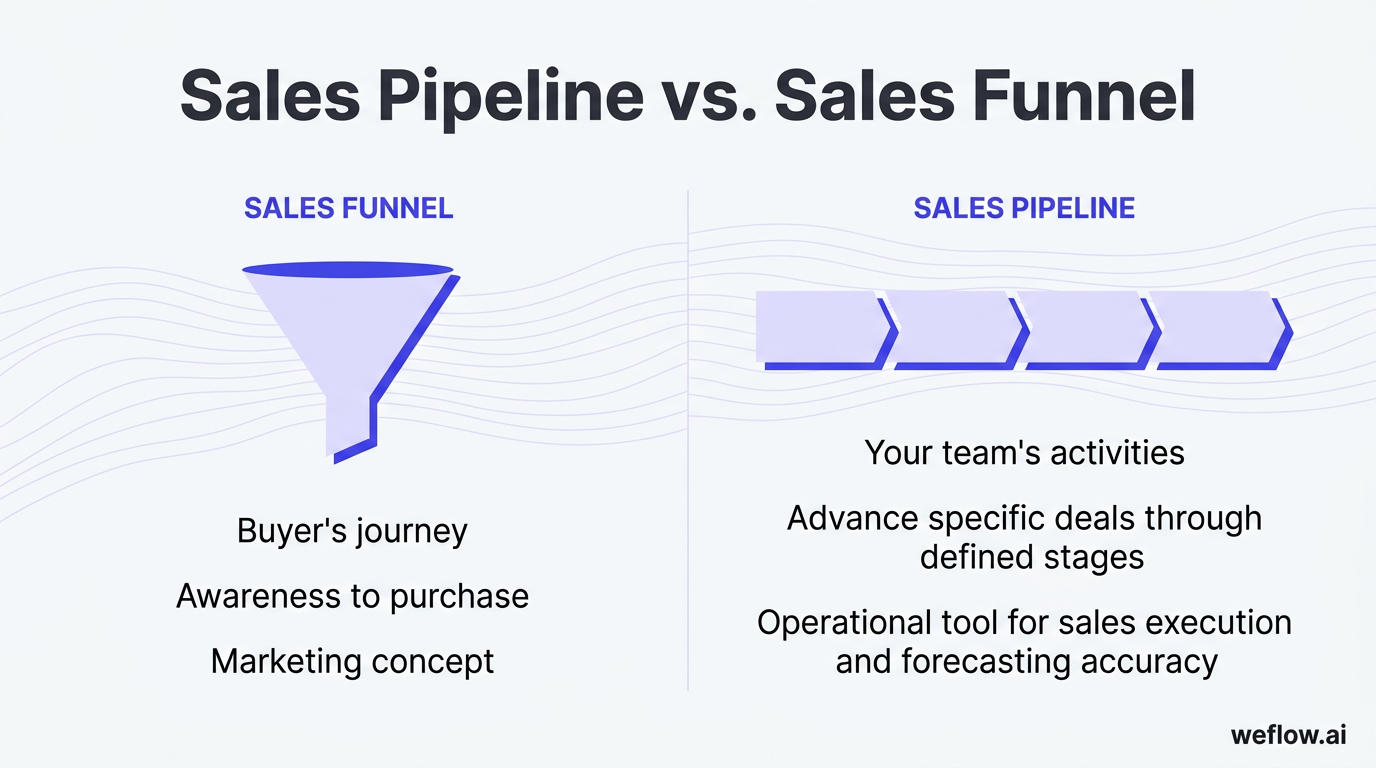
A sales pipeline differs from a sales funnel. The funnel describes the buyer’s journey from awareness to purchase—a marketing concept. The pipeline describes your team’s activities to advance specific deals through defined stages—an operational tool for sales execution and forecasting accuracy.
Sales Pipeline Stages at a Glance
The table below summarizes the seven stages of a B2B sales pipeline, what you’re trying to accomplish at each, and how to know when a deal is ready to advance.
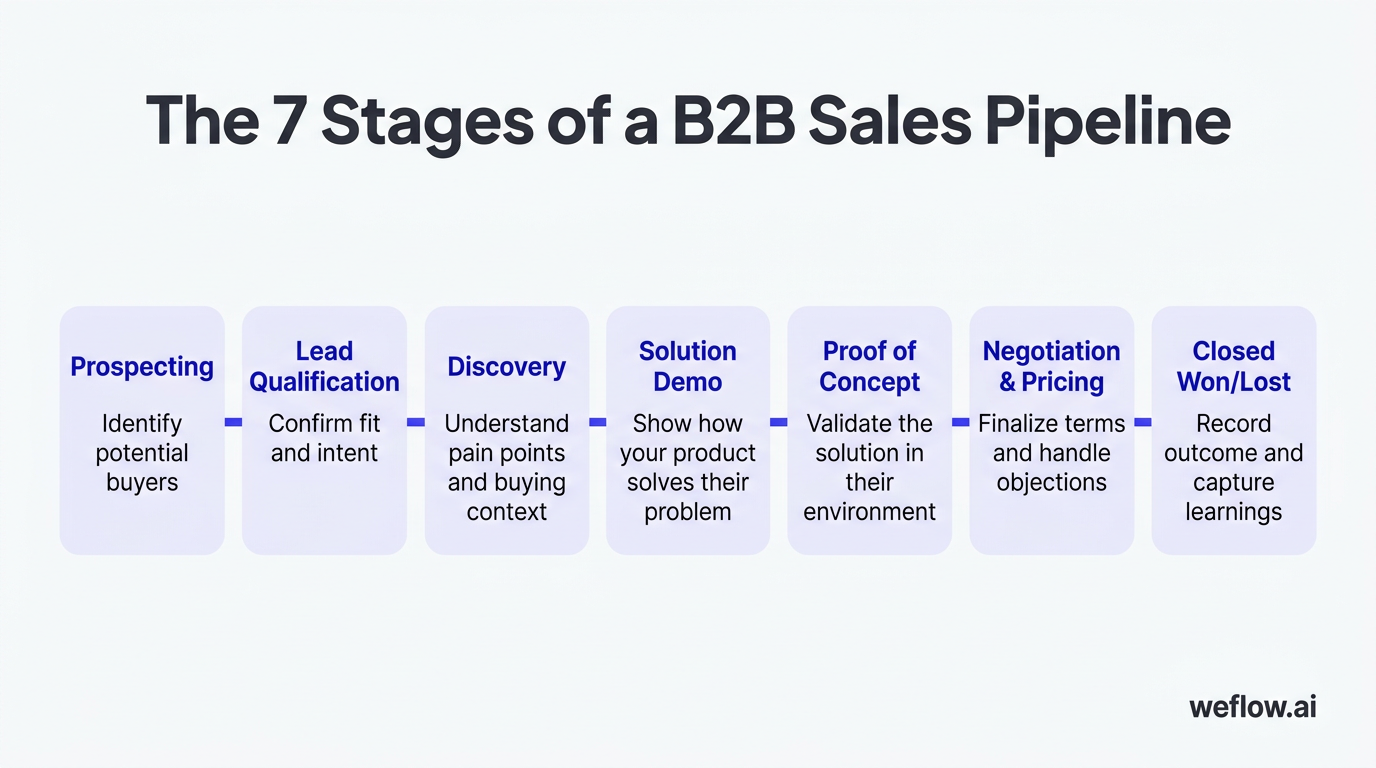
| Stage | Goal | Key Actions | Exit Criteria |
|---|---|---|---|
| 1. Prospecting | Identify potential buyers | Outbound outreach, inbound lead capture, referral requests | Contact responds or engages with content |
| 2. Lead Qualification | Confirm fit and intent | BANT/MEDDIC screening, initial discovery call | Lead meets qualification criteria; discovery meeting booked |
| 3. Discovery | Understand pain points and buying context | Pre-call research, structured discovery questions, stakeholder mapping | Pain confirmed, budget range established, timeline identified |
| 4. Solution Demo | Show how your product solves their problem | Tailored demo, ROI discussion, champion enablement | Stakeholders agree to evaluate further; pilot or proposal requested |
| 5. Proof of Concept | Validate the solution in their environment | Guided trial or pilot, success criteria tracking, weekly check-ins | Success criteria met; stakeholders ready to proceed |
| 6. Negotiation & Pricing | Finalize terms and handle objections | Proposal delivery, objection handling, contract redlines | Verbal commitment or signed agreement |
| 7. Closed Won/Lost | Record outcome and capture learnings | Contract execution, handoff to CS, loss analysis | Deal marked closed in Salesforce with reason code |
Stage 1: Prospecting and Lead Generation—Filling Your Pipeline
Prospecting is about identifying and engaging potential buyers who match your ideal customer profile. Without consistent prospecting, your pipeline dries up within one to two quarters—regardless of how well you execute later stages.
B2B prospecting splits into two channels:
- Outbound: Cold emails, LinkedIn outreach, cold calls, and account-based plays targeting specific companies. Outbound gives you control over who enters your pipeline but requires higher volume to generate qualified opportunities.
- Inbound: Website forms, content downloads, webinar registrations, and demo requests. Inbound leads often have higher intent but less predictable volume.
Effective prospecting requires clear criteria for who you’re targeting. Define your ideal customer profile by company size, industry, tech stack, and buying signals. For Salesforce-centric teams, this means tracking which leads engage with emails and content, then syncing that activity data into Salesforce for prioritization.
The prospecting stage ends when a contact responds to outreach or engages meaningfully with your content—scheduling a call, replying to an email, or requesting information. At that point, they move to qualification.
Stage 2: Lead Qualification—Separating Buyers from Browsers
Lead qualification determines whether a prospect is worth pursuing. Not every lead that enters your pipeline will buy—qualification filters out poor fits before you invest discovery and demo time.
Most B2B sales teams use a qualification framework:
- BANT: Budget, Authority, Need, Timeline. Classic framework that works for transactional sales.
- MEDDIC: Metrics, Economic Buyer, Decision Criteria, Decision Process, Identify Pain, Champion. Better suited for complex enterprise deals where multiple stakeholders influence the decision.
During qualification, ask enough questions to determine if the lead has a real problem you can solve, budget to address it, and urgency to act. If any of these elements is missing, the deal either needs nurturing or disqualification.
A lead advances from qualification to discovery when they meet your minimum criteria and agree to a deeper conversation about their challenges and buying process.
Stage 3: Discovery—How to Qualify Leads and Uncover Pain Points
Discovery is where you learn what’s driving the prospect’s interest, who’s involved in the decision, and whether you can deliver measurable value. Rushed or shallow discovery leads to misaligned demos, stalled deals, and wasted cycles.
Pre-call research
Before every discovery call, review the prospect’s company website, recent news, LinkedIn profiles of attendees, and any prior engagement history in Salesforce. You should know their industry, company size, likely tech stack, and potential pain points before the call starts.
Discovery best practices
| Best Practice | Why It Matters |
|---|---|
| Set an agenda at the start | Establishes structure and gets buy-in on what you’ll cover |
| Ask open-ended questions | Encourages the prospect to share context, not just yes/no answers |
| Listen more than you talk | Discovery is about learning, not pitching—aim for 70/30 prospect-to-rep talk ratio |
| Take structured notes | Capture MEDDIC fields, stakeholder roles, and next steps for Salesforce entry |
| Confirm understanding before ending | Summarize what you heard to validate accuracy and build trust |
Discovery questions by category
Group your discovery questions into four categories to ensure you cover the full buying context:
| Category | Sample Questions |
|---|---|
| Goals and Timeline | What’s driving this initiative now? What does success look like in 6 to 12 months? What happens if you don’t solve this? |
| Problem and Impact | What’s broken today? How much time or money does this cost? Who else is affected by this problem? |
| Budget and Buying Process | Is there budget allocated? Who else needs to approve this? What’s your typical procurement timeline? |
| Competitive Landscape | What else are you evaluating? Have you tried to solve this before? What would make you choose one solution over another? |
By the end of discovery, you should be able to articulate the prospect’s primary pain point, the business impact of that pain, who’s involved in the decision, and a realistic timeline for moving forward. If you can’t answer these questions, you haven’t finished discovery.
[banner type="download" url="https://www.weflow.ai/resources/cheat-sheets/pipeline-management-guide" text="Pipeline Management Guide" subtitle="Run deal reviews that surface risk instead of rubber-stamping commits" button="Get the guide"]
Stage 4: Solution Demo—How to Present Your Product to Stakeholders
The demo is your chance to show—not tell—how your product solves the prospect’s specific problem. Generic product tours lose deals. Tailored demos that address the pain points uncovered in discovery win them.
Demo do’s and don’ts
| Do | Don’t |
|---|---|
| Start by recapping their problem and goals | Jump straight into feature walkthrough |
| Show 3 to 4 features that directly address their pain | Demo every feature your product has |
| Use their terminology and industry context | Rely on generic examples unrelated to their business |
| Pause frequently to check for questions | Monologue for 30+ minutes without engagement |
| Leave time for ROI discussion | End the demo without tying features to business outcomes |
| Identify who will champion the deal internally | Assume the person on the call is the decision-maker |
Enable the internal champion
In B2B deals, the person on your demo call often isn’t the final decision-maker. Your job is to arm them with what they need to sell internally: a clear problem statement, quantified impact, and a simple explanation of how your solution addresses it.
Send a follow-up email after every demo summarizing what you showed, how it maps to their stated goals, and suggested next steps. Include a one-pager or short deck they can share with stakeholders who weren’t on the call.
A demo advances to the next stage when stakeholders agree to evaluate further—whether that’s a proof of concept, a detailed proposal, or a meeting with additional decision-makers.
Stage 5: Proof of Concept—Running Pilots and Guided Trials That Win Deals
A proof of concept (POC) lets the prospect validate your solution in their environment before committing. Not every deal requires a POC, but complex or high-value opportunities often do—especially when multiple stakeholders need convincing.
Guided trials vs. pilots
| Type | Duration | Best For | Structure |
|---|---|---|---|
| Guided Trial | 2 to 4 weeks | Smaller deals, single department adoption | Self-serve with check-in calls; limited customization |
| Pilot | 30 to 90 days | Enterprise deals, multi-stakeholder evaluation | Dedicated resources, defined success criteria, regular reviews |
Define success criteria upfront
Before starting any POC, agree on specific, measurable success criteria with the prospect. Vague criteria (“see if it works for us”) lead to stalled evaluations. Concrete criteria drive clear decisions.
Examples of success criteria:
- Activity capture rate exceeds 90% for all connected reps
- Salesforce opportunity fields updated automatically after each call
- Pipeline reporting accuracy improves by week 3
- User adoption reaches 80% of pilot participants
Schedule weekly check-ins during the POC to review progress against criteria, address blockers, and keep momentum. A POC advances to negotiation when success criteria are met and stakeholders confirm readiness to proceed.
Stage 6: Negotiation and Pricing—Handling Objections and Closing Terms
Negotiation is where deals are won or lost. This stage has the highest fallout rate in most B2B pipelines—not because of price, but because of unresolved objections, misaligned expectations, or slow decision-making.
Common objections and responses
| Objection | Response Approach |
|---|---|
| “The price is too high.” | Reframe around ROI: “Based on our discovery, you’re spending X hours per week on manual CRM updates. At your team’s fully loaded cost, that’s $Y annually—Weflow pays for itself in the first quarter.” |
| “We need to think about it.” | Identify what’s unresolved: “That makes sense. What specific questions do you need answered before making a decision?” |
| “We’re also evaluating [competitor].” | Acknowledge and differentiate: “Good—you should compare options. What criteria matter most? Let’s walk through how we stack up on those dimensions.” |
| “We don’t have budget until next quarter.” | Confirm timeline and stay engaged: “Understood. Can we finalize terms now so you’re ready to move when budget opens? I’ll send a proposal that holds pricing through Q2.” |
| “Legal has concerns about the contract.” | Get specific and involve your team: “What sections are they flagging? Let’s schedule a call with our legal team to address those directly.” |
Negotiation isn’t about “winning” against the prospect—it’s about removing friction so both sides can move forward. The best negotiators listen for underlying concerns and address them directly rather than pushing harder on price or terms.
A deal advances to closed when you have a verbal commitment or signed agreement. Document everything in Salesforce as you go—don’t wait until the contract is signed.
Stage 7: Closed Won or Closed Lost—Metrics to Track After the Deal
Every deal ends in one of two outcomes: closed won or closed lost. Both outcomes generate valuable data—but only if you capture it consistently.
Tracking closed won and closed lost
| Closed Won: Metrics to Track | Closed Lost: Actions to Take |
|---|---|
| Deal value and contract length | Record primary loss reason (competitor, price, timing, no decision) |
| Days in each pipeline stage | Capture secondary factors that contributed to the loss |
| Number of stakeholders involved | Note which competitor won, if applicable |
| Activities and touchpoints logged | Document what could have been done differently |
| Discount given vs. list price | Flag for future re-engagement if timing was the issue |
Common loss reasons
- No decision: The prospect chose not to act. This often signals weak discovery—you didn’t uncover enough pain or urgency.
- Lost to competitor: Another vendor won the deal. Review what they offered that you didn’t.
- Price: Your solution was too expensive relative to perceived value. This may indicate poor ROI positioning.
- Timing: The prospect wasn’t ready to buy. Add to nurture for future outreach.
- Champion left: Your internal advocate changed roles. Build multi-threaded relationships to reduce single-point-of-failure risk.
Consistent loss tracking feeds pipeline analysis and helps you identify patterns—which stages have the highest fallout, which competitors win most often, and where your process needs improvement.
Key Sales Pipeline Metrics Every Team Should Track
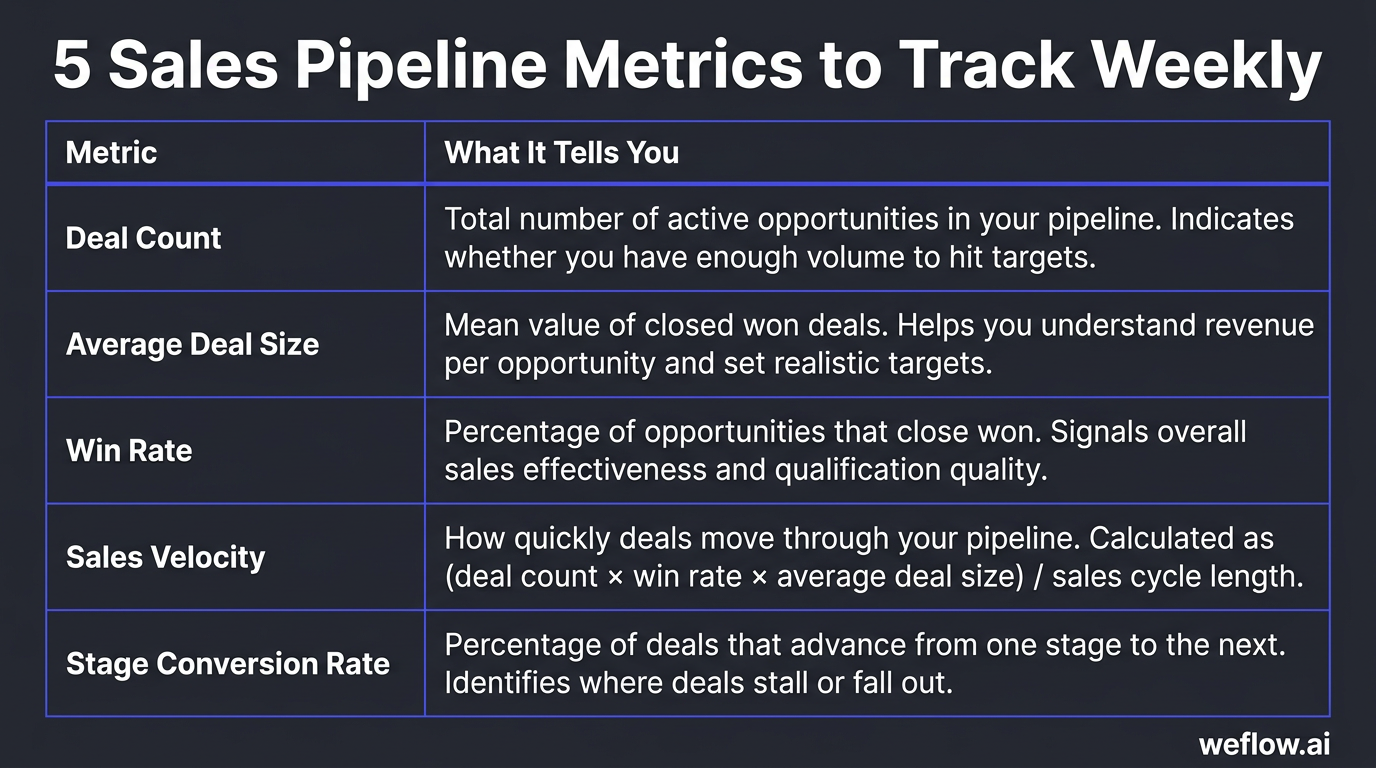
Pipeline metrics tell you whether your sales process is working and where it’s breaking down. Track these five metrics consistently to maintain pipeline health and visibility.
[banner type="download" url="https://www.weflow.ai/resources/cheat-sheets/pipeline-visibility-cheat-sheet" text="Pipeline Visibility Cheat Sheet" subtitle="Trust your pipeline numbers without chasing reps for CRM updates" button="Download cheat sheet"]
| Metric | What It Tells You |
|---|---|
| Deal Count | Total number of active opportunities in your pipeline. Indicates whether you have enough volume to hit targets. |
| Average Deal Size | Mean value of closed won deals. Helps you understand revenue per opportunity and set realistic targets. |
| Win Rate | Percentage of opportunities that close won. Signals overall sales effectiveness and qualification quality. |
| Sales Velocity | How quickly deals move through your pipeline. Calculated as (deal count × win rate × average deal size) / sales cycle length. |
| Stage Conversion Rate | Percentage of deals that advance from one stage to the next. Identifies where deals stall or fall out. |
Monitor these metrics weekly. If deal count drops, ramp up prospecting. If win rate falls, revisit qualification criteria. If conversion rate tanks at a specific stage, investigate what’s causing deals to stall there.
How to Improve Sales Pipeline Visibility with CRM Tools and Pipeline Reviews
Pipeline visibility determines whether you can forecast accurately, coach effectively, and intervene before deals slip. Without visibility, you’re reacting to problems instead of preventing them.
How often should you review your sales pipeline?
Most high-performing sales teams follow a two-tier review cadence:
- Weekly one-on-ones: Managers review each rep’s pipeline, focusing on deals that have stalled, deals with upcoming close dates, and deals that lack recent activity. The goal is early intervention and coaching.
- Bi-weekly team reviews: The full sales team reviews pipeline health, conversion rates by stage, and forecast accuracy. This surfaces patterns across the team and calibrates expectations for the quarter.
Tools like Weflow’s pipeline management give managers a real-time view of deal status, activity history, and risk signals—without chasing reps for updates. When pipeline data flows into Salesforce automatically, reviews focus on strategy rather than data cleanup.
Why clean CRM data is critical for pipeline accuracy
Your pipeline is only as accurate as the data behind it. Dirty data—missing activities, outdated stage values, incomplete contact records—leads to bad forecasts and missed coaching opportunities.
Common Salesforce data hygiene problems include:
- Reps forget to log calls and emails, creating activity gaps
- Opportunities sit in the wrong stage for weeks
- Close dates get pushed without updating other fields
- Contacts and stakeholders aren’t linked to opportunities
Automated data capture solves most of these problems by syncing emails, meetings, and calls into Salesforce without manual entry. When activity data is complete, pipeline metrics reflect reality—not what reps remembered to log.
Frequently Asked Questions
What are the stages of a sales pipeline?
A typical B2B sales pipeline has seven stages: prospecting, lead qualification, discovery, solution demo, proof of concept, negotiation and pricing, and closed won/lost. Each stage represents a milestone in advancing a deal from initial contact to signed contract.
What is the difference between a sales pipeline and a sales funnel?
A sales pipeline tracks your team’s activities to advance specific deals through defined stages—it’s an operational tool. A sales funnel describes the buyer’s journey from awareness to purchase—it’s a marketing concept focused on volume and conversion rates at each stage of the buying process.
How many stages should a sales pipeline have?
Most B2B sales pipelines have five to eight stages. Fewer than five oversimplifies complex deals. More than eight adds administrative burden without improving visibility. Choose stages that reflect natural milestones in your sales process where meaningful buyer commitment occurs.
How do you build a sales pipeline from scratch?
Start by mapping your current sales process: what happens between first contact and closed deal? Define each stage based on buyer actions, not seller activities. Set clear exit criteria for each stage. Then configure your pipeline in Salesforce with matching stage values and probability percentages.
What metrics should you track for your sales pipeline?
Track deal count, average deal size, win rate, sales velocity, and stage conversion rates. These metrics tell you whether you have enough volume, how effectively you’re closing, and where deals stall. Review them weekly to catch problems early.
How often should you review your sales pipeline?
Managers should review individual rep pipelines weekly during one-on-ones. The full team should review overall pipeline health bi-weekly. More frequent reviews catch stalled deals earlier but require good data hygiene to avoid wasting time on cleanup.
What causes deals to stall in the pipeline?
Deals stall for five main reasons: weak discovery that missed critical pain points, lack of access to the economic buyer, unclear decision criteria, competing priorities at the prospect’s company, or missing urgency. Address stalled deals by re-qualifying—confirm whether the pain, budget, and timeline still exist.
How do you calculate sales pipeline velocity?
Sales velocity = (number of opportunities × win rate × average deal size) / average sales cycle length in days. This metric tells you how much revenue your pipeline generates per day. Improve velocity by increasing deal count, win rate, or deal size—or by shortening your sales cycle.
Key Takeaways for Managing Your Sales Pipeline
- Define clear stages with exit criteria. Each stage should represent a meaningful milestone with specific actions required to advance. Ambiguous stages create forecasting problems.
- Qualify ruthlessly. Not every lead deserves a demo. Use frameworks like BANT or MEDDIC to filter out poor fits before investing discovery and demo time.
- Prioritize discovery. The quality of your discovery determines the quality of everything that follows—demos, proposals, and negotiations. Rushed discovery leads to stalled deals.
- Track metrics weekly. Deal count, win rate, and stage conversion rates reveal where your process is working and where it’s breaking. Catch problems early by reviewing data consistently.
- Automate data capture. Manual CRM entry creates activity gaps and inaccurate pipeline data. Automatic sync of emails, calls, and meetings keeps your pipeline metrics reliable and your forecasts trustworthy.