
39 Sales Interview Questions and How to Answer Them
Learn 39 sales interview questions and how to answer them with STAR examples and prep tips




How to prepare for a sales interview in 2026
Most candidates show up to sales interviews knowing roughly what they want to say. The ones who get offers show up knowing exactly who they're talking to, what that company's sales motion looks like, and how to frame every answer as evidence of capability—not just intent. Here's how to prepare at that level.
Step 1: Research the company and the role before you say a word
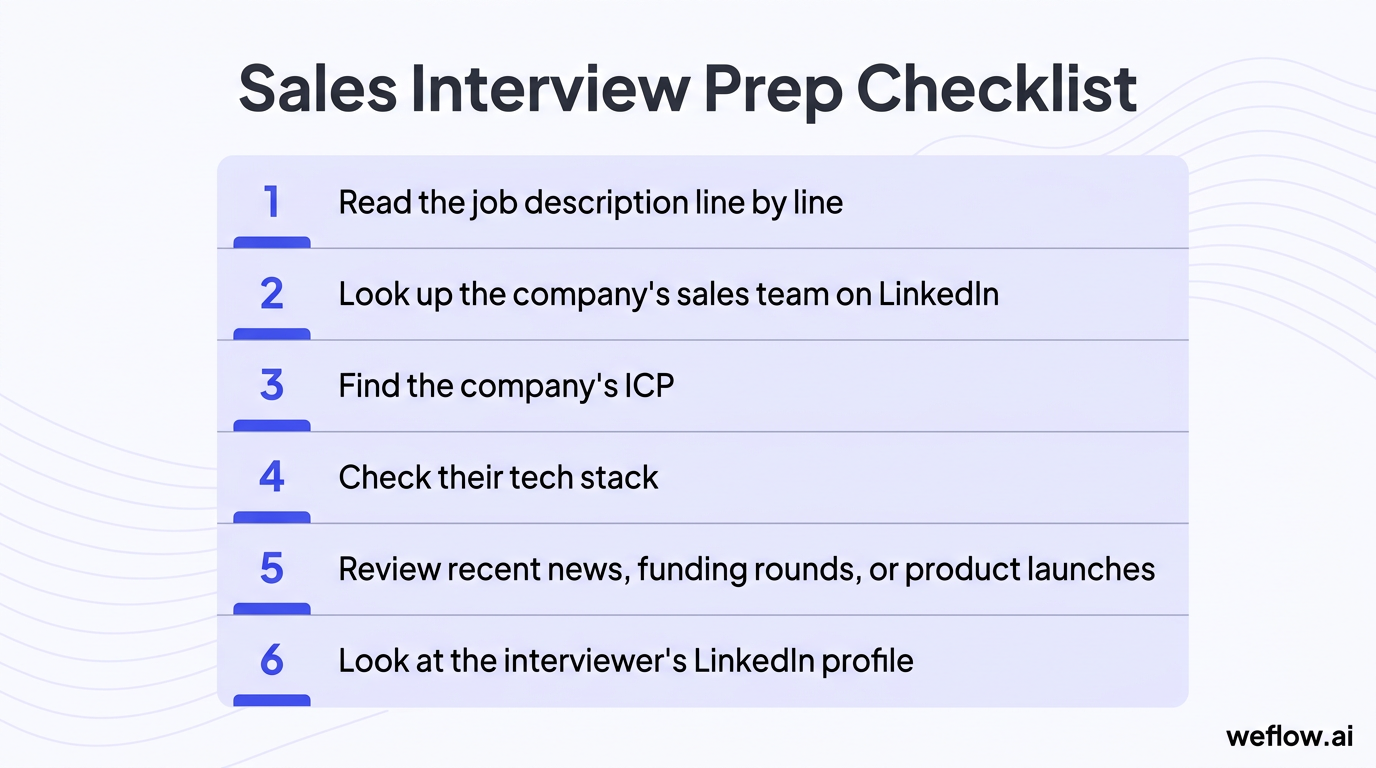
Generic preparation gets you generic results. Before the interview, work through this checklist:
- Read the job description line by line. Note the specific skills, tools, and methodologies mentioned—these are the answer frameworks you'll use.
- Look up the company's sales team on LinkedIn. What's the team size? What's the ratio of SDRs to AEs? Are there dedicated sales engineers? This tells you the structure you'd be selling within.
- Find the company's ICP. Who do their AEs sell to? What industries, company sizes, titles? Read their case studies and customer pages.
- Check their tech stack. Look for job postings—they usually list the tools (CRM, sales engagement, forecasting). Know whether they run Salesforce or HubSpot, Outreach or Salesloft.
- Review recent news, funding rounds, or product launches. Interviewers notice when you reference something from last month. It signals that you take the process seriously.
- Look at the interviewer's LinkedIn profile. Their background, what they post about, and how long they've been in the role gives you useful context.
Step 2: Learn the STAR method and use it for every behavioral question
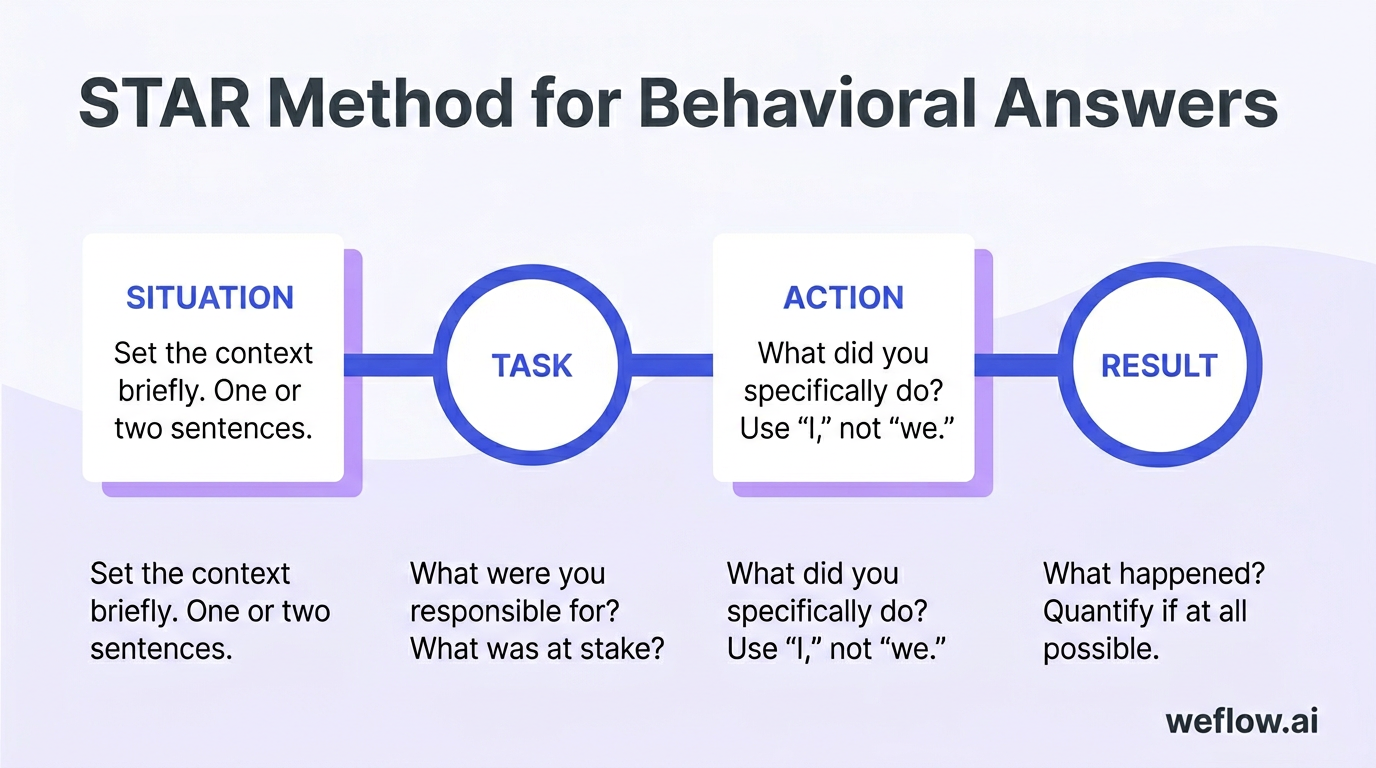
The STAR method is how you structure behavioral answers so they're credible and concise. Every "tell me about a time when..." question should follow this format:
- Situation: Set the context briefly. One or two sentences.
- Task: What were you responsible for? What was at stake?
- Action: What did you specifically do? Use "I," not "we."
- Result: What happened? Quantify if at all possible.
Worked example—"Tell me about a time you turned around a stalled deal."
Situation: "We had a mid-market deal at $80K ARR that had gone dark for three weeks after the demo. The champion had stopped responding."
Task: "I was the AE on the deal and it was my largest open opportunity at the time. Losing it would have put me 15% below quota for the quarter."
Action: "I called the champion's manager directly, reframed the conversation around a procurement deadline they'd mentioned earlier, and sent a concise one-page business case the CFO could review without scheduling another call."
Result: "The deal closed two weeks later. The business case format became our standard template for later-stage deals."
Notice what that answer does: it's specific, it quantifies the stakes, and it shows process thinking—not just outcome luck.
Step 3: Treat the interview like a discovery call
The best sales interviewers are evaluating whether you actually sell the way you say you do. The framing that works: approach the interview the way you'd approach a first discovery call with a prospect. That means:
- Ask questions, don't just answer them
- Listen actively and build on what you hear
- Connect your experience to their specific problems and motion
- Follow up with a strong close—a recap email, a thank-you with a specific insight, or a relevant case study
Step 4: Prepare your numbers
Sales interviews live or die on specificity. You should be able to answer these without hesitation:
- Your quota for the last 12 months and your attainment percentage
- Your average deal size and average sales cycle length
- Your pipeline coverage ratio
- Your win rate against the two most common competitors
- The number of accounts you managed and how you prioritized them
Step 5: Prepare five smart questions to ask the interviewer
Not asking questions signals you're not genuinely interested or that you haven't done your homework. Prepare at least five, and be ready to adapt based on the conversation. The last section of this article covers 10 specific questions worth asking.
39 sales interview questions by category (with sample answers)
The questions below are organized by category, with sample answers for the most common ones. The sample answers are starting points—adapt them to your actual experience and the role you're interviewing for.
General sales interview questions and how to answer them
These questions appear in almost every sales interview. They're broad by design—the interviewer is assessing how you communicate, how self-aware you are, and whether you understand what the job actually requires.
-
Tell me about yourself.
Keep this to 90 seconds. Cover: where you are now, what you've achieved, and why you're interested in this role. Don't recite your resume—connect the dots.
Sample answer: "I'm currently an AE at a B2B SaaS company where I've been for two years. I closed $1.2M in new ARR last year, which put me at 118% of quota. Before that I was an SDR for 18 months and ranked in the top 20% of the team. I'm looking for a role with a larger deal size and a more complex sales motion—which is why this opportunity caught my attention. The combination of mid-market and enterprise accounts, plus the Salesforce focus, maps well to where I want to take my career."
-
Why do you want this job?
Connect your answer to something specific about the company or role—not just "great culture" or "growth opportunity." Those answers tell the interviewer nothing about you.
Sample answer: "I've been following the company for about six months. Your expansion into enterprise accounts and the focus on MEDDIC-based selling is exactly the environment where I want to develop. I spoke to a few people on your sales team on LinkedIn before applying, and what they described—tight feedback loops with RevOps, good sales enablement infrastructure—matches how I work best. The territory coverage in your job posting also aligns with accounts I have existing relationships with."
-
What are your strengths?
Pick two or three and give evidence for each. Claiming a strength without demonstrating it is just a statement, not an answer.
Sample answer: "Discovery is probably my strongest skill. I can get a prospect talking about business pain quickly and accurately—I rarely get to proposal without understanding the economic impact of the problem. Second is CRM discipline. My pipeline data is always current, which means my forecasts are accurate and my manager has visibility without having to chase me. That matters in high-volume environments."
-
What is your biggest weakness?
Don't give a fake weakness disguised as a strength ("I work too hard"). Pick something real, show that you know it, and explain how you manage it. Interviewers can tell the difference.
Sample answer: "I move fast and sometimes get ahead of the customer's buying process. Early in my career that cost me a few deals because I pushed for next steps before the customer had internal alignment. Now I build a buyer map at the start of every deal and explicitly check in on internal consensus before asking for commitments. It slows the pace slightly but the close rate on deals where I do this is noticeably higher."
-
How do you deal with stress?
Sales is a high-pressure role. Show that you have a system, not just resilience. Interviewers want to know you won't burn out or become erratic when quota pressure spikes.
Sample answer: "I separate what I can control from what I can't. If I'm behind on quota, I focus on activity metrics—calls made, meetings set, pipeline generated—because those are inputs I can influence. I review my pipeline weekly to identify risks early, so I'm rarely surprised at the end of a quarter. I also make a point of separating a bad month from a bad trend—one slow month doesn't mean my approach is broken."
- Why are you leaving your current role?
- Where do you see yourself in five years?
- How do you stay motivated when you're not hitting your numbers?
- What does a typical day look like for you?
- How do you prioritize your accounts or leads?
- What's your process for managing a full pipeline?
Behavioral sales interview questions (with STAR-method examples)
Behavioral questions are designed to surface patterns of behavior, not just stated preferences. The STAR format (Situation, Task, Action, Result) is the right structure for every answer here.
-
Tell me about a time you turned around a difficult deal.
STAR example:
[banner type="download" url="https://www.weflow.ai/resources/cheat-sheets/b2b-sales-hiring-cheat-sheet" text="B2B Sales Hiring Cheat Sheet" subtitle="Know exactly what AE and sales leader interviewers are grading you on" button="Get the cheat sheet"]
Situation: "I was two weeks from quarter-end with a $65K deal that had gone quiet after the demo. The champion had stopped responding and I'd left two messages without a reply."
Task: "The deal represented 20% of my remaining quota. I needed to either re-engage or move it to a future quarter and replace that pipeline quickly."
Action: "I called the champion's manager directly—not to escalate, but to ask what had changed. Turned out the champion had left the company the previous week. I restarted the relationship with the new contact, resent the business case framed around their specific initiative, and got back in front of the team within 48 hours."
Result: "The deal closed in the following quarter at $72K—slightly larger because the new champion added a second use case. It also taught me to map multiple stakeholders earlier in every deal."
-
Describe a time you failed to hit your quota. What did you do?
STAR example:
Situation: "In my third quarter as an AE, I finished at 74% of quota. It was the first time I'd missed since being promoted."
Task: "I had to understand whether the miss was a pipeline volume problem, a conversion problem, or a deal quality problem—and fix the right thing."
Action: "I pulled my data and found that my close rate on enterprise deals was normal, but my pipeline coverage going into the quarter had been thin. I'd let prospecting slip in Q2 because I was working a large deal that ultimately didn't close. I committed to a minimum of 10 outbound touches per week regardless of pipeline status, and I started reviewing pipeline coverage ratios monthly rather than quarterly."
Result: "The following quarter I hit 112% of quota, and I haven't had a coverage issue since. The habit of tracking coverage monthly—not just at quarter-end—is now automatic."
- Tell me about your most successful deal. What did you do differently?
- Describe a time you had a conflict with a colleague or manager. How did you handle it?
- Tell me about a time you had to sell to a skeptical buyer. What was your approach?
- Describe a situation where you lost a deal you thought you'd win. What did you learn?
- Tell me about a time you had to build a new territory or book of business from scratch.
Situational sales interview questions and best responses
Situational questions describe a hypothetical scenario and ask how you'd respond. They're testing judgment and process—not just past performance. The best answers show your thinking, not just your conclusion.
-
You're two weeks from quarter-end and 30% below quota. What do you do?
Sample response: "First, I assess what's actually closeable in the next two weeks—not what I hope might close, but what has real buying signals and an identified champion. Then I prioritize relentlessly: I put every available hour into those top two or three deals. For the deals that won't close this quarter, I make sure I have clear next steps and committed timelines so they land in Q1 at the right stage. Simultaneously, I look at which prospecting activity in the last 30 days is generating replies and double down on that channel. I don't start discounting or pressuring buyers—that usually kills deals rather than accelerating them."
-
A prospect tells you your price is too high. How do you respond?
Sample response: "I treat that as a buying signal, not a rejection. First, I need to know whether it's a budget constraint, a prioritization issue, or a value gap—those require different responses. I usually ask: 'Is it that the budget isn't available, or that you're not sure the ROI justifies the investment?' If it's a value gap, I go back to the business impact we quantified earlier and make sure we're comparing apples to apples. If it's a real budget constraint, I explore whether there's a phased approach that gets them to value faster at a lower initial investment. What I don't do is drop the price without understanding the real objection."
- A high-value prospect has gone dark after a strong demo. What's your follow-up plan?
- Your manager asks you to sell a product you think has a real weakness that would affect this prospect. What do you do?
- You inherit a territory with little documentation and no warm pipeline. Where do you start?
- A deal you've been working for three months is suddenly pushed to next fiscal year. How do you respond?
Sales-specific interview questions for account executives
These questions go deeper on the actual craft of enterprise and mid-market selling—deal strategy, methodology, data fluency, and CRM discipline. Interviewers at this level expect specificity. Generic answers about "relationship building" and "being consultative" won't move the needle.
-
Walk me through your sales process from prospecting to close.
Sample answer: "My process has six stages. I start with account research—ICP fit, trigger events, org structure. Outreach is multi-threaded from day one: I don't go in through one contact if I can identify three. Discovery is where I spend the most time—I typically run two to three sessions before I go anywhere near a demo, because the demo only lands if I understand the business problem in detail. Then I build a mutual action plan with the champion so we both know what needs to happen before a decision is made. Proposal is based on what I learned in discovery—I don't send a generic deck. And I close by confirming the business case with the economic buyer, not just the champion."
-
How do you handle multi-stakeholder deals?
Sample answer: "I map the buying committee as early as possible—usually after the first discovery call. I want to know who the champion is, who the economic buyer is, who has veto power, and who's an influencer. Then I make sure I'm not dependent on a single thread. I give champions the materials they need to sell internally—executive summaries, ROI models, answers to likely objections. And I try to get direct access to the economic buyer at least once before we reach the final negotiation stage."
-
How do you use data to manage your pipeline?
Sample answer: "I track four metrics weekly: pipeline coverage ratio, stage conversion rate, average deal age by stage, and number of deals with no activity in the last 14 days. If my coverage ratio drops below 3x, I know I have a prospecting problem, not a closing problem. If deals are aging in a particular stage, I look at whether that's a qualification issue, a stakeholder access issue, or a product-fit issue. I use Salesforce to run this analysis—not spreadsheets—so my manager has the same view I have in real time."
- What CRM do you use and how do you keep your pipeline data accurate?
- How do you qualify a new opportunity? What's your framework?
- How do you handle a deal where the champion doesn't have budget authority?
- What's your approach to competitive deals? How do you handle a prospect who's already evaluating a competitor?
- How do you build a business case that holds up at the CFO level?
- What's your approach to negotiation? Where do you draw the line on discounting?
- How do you manage your territory or book to maximize coverage and minimize churn?
- Describe a deal where you had to navigate a complex procurement process.
- How do you forecast accurately? What's your process for calling your number?
- How do you approach upsell and expansion within existing accounts?
- What's your biggest limitation as an AE right now? What are you doing about it?
- How do you stay current on product knowledge and competitive positioning?
How to answer "Sell me this pen" in a sales interview
This question is a test of discovery discipline, not pitch performance. The candidates who launch straight into listing pen features miss the point entirely. The right approach: ask questions first.
Start with: "Before I tell you about the pen, can I ask you a few questions?" Then ask: Do you write often? What do you use now? What frustrates you about it? Is this for personal use or professional? Do you prefer a specific type of grip or ink?
Only after you understand the buyer's situation do you position the pen—and you position it against the specific problems they've just described, not a generic list of specs.
That's what the interviewer is actually evaluating: whether you lead with discovery or lead with pitch. Candidates who ask questions first and pitch second demonstrate exactly the behavior that wins in real sales.
Sales interview questions about AI, CRM, and your tech stack
Interviewers at most B2B SaaS companies now expect AEs and SDRs to be comfortable discussing their tech stack in concrete terms. Generic answers about "using Salesforce" or "being familiar with AI tools" won't differentiate you. Show fluency by being specific about what you use, how you use it, and what outcomes it produces.
-
What tools do you use in your current role and how do they fit together?
Name the specific tools: CRM (Salesforce, HubSpot), sales engagement platform (Outreach, Salesloft), conversation intelligence (Gong, Chorus), forecasting or revenue intelligence (Clari, Weflow), and any prospecting tools (ZoomInfo, Apollo). Explain how data flows between them and where you spend most of your time.
-
How do you use AI in your sales workflow?
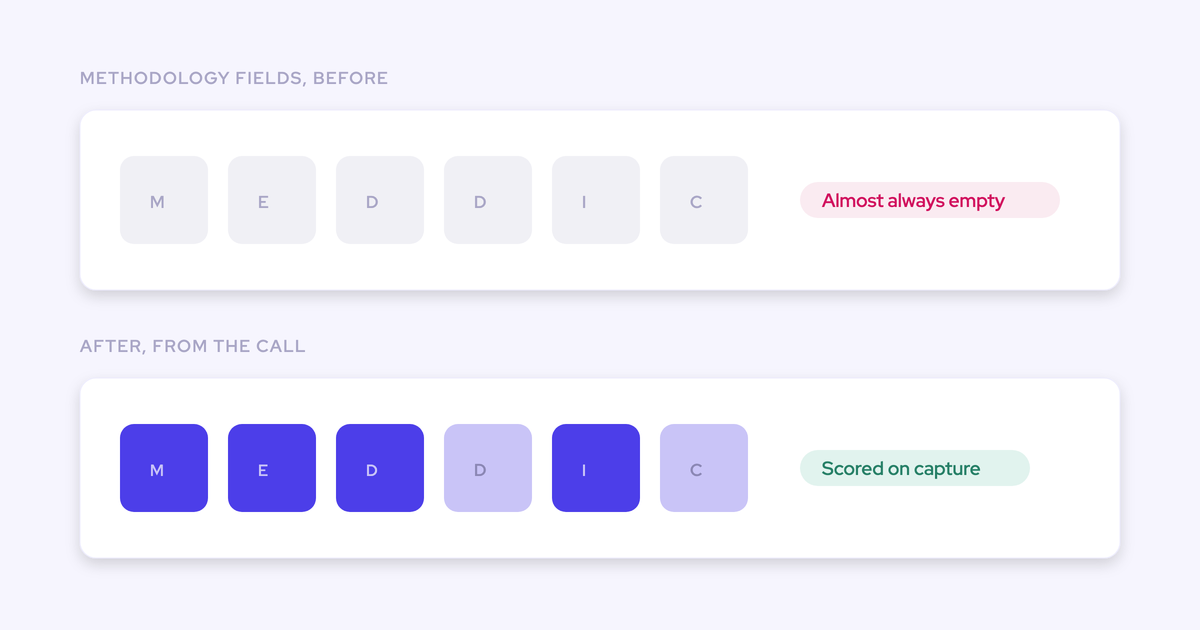
Be concrete. AI is now embedded in most sales tools—call summaries, email generation, deal risk scoring, CRM field suggestions. Describe one or two specific workflows where you use AI and what it does for your productivity or accuracy. "I use AI-generated call summaries to update MEDDIC fields in Salesforce within 30 minutes of every call" is a better answer than "I use AI to save time."
-
How do you keep your CRM data accurate without it becoming a full-time job?
This tests whether you understand the operational tension between CRM discipline and selling time. Good answers describe specific habits (updating Salesforce immediately after calls, using activity capture tools) and tools that automate parts of the workflow.
-
What's your experience with sales methodologies like MEDDIC, MEDDPICC, or SPIN?
Don't just name the methodology—describe how you actually apply it. Which fields do you capture in discovery? How do you use MEDDIC data to prioritize a deal for your forecast? Interviewers want to see the methodology embedded in your process, not just listed on your resume.
[banner type="download" url="https://www.weflow.ai/resources/cheat-sheets/sales-onboarding-cheat-sheet" text="Sales Onboarding Cheat Sheet" subtitle="Spot whether a ramp plan will set you up to hit quota or quietly sink you" button="Download free"]
-
If we gave you a new CRM tool tomorrow, how would you get up to speed?
Show that you're systematic: read the documentation, look for training resources, map the new tool's logic to the workflow you already know, and find the power users on the team to learn the shortcuts. Avoid answers that signal you'd just "figure it out as you go."
-
How do you use data to identify deals at risk before they slip?
Reference specific signals: days since last activity, number of stakeholders engaged, deal age relative to your average cycle, pending next steps without agreed dates. The more specific your answer, the more it signals that you actually manage pipeline by data—not by feel.
Sales interview questions by role: SDR, AE, and sales manager
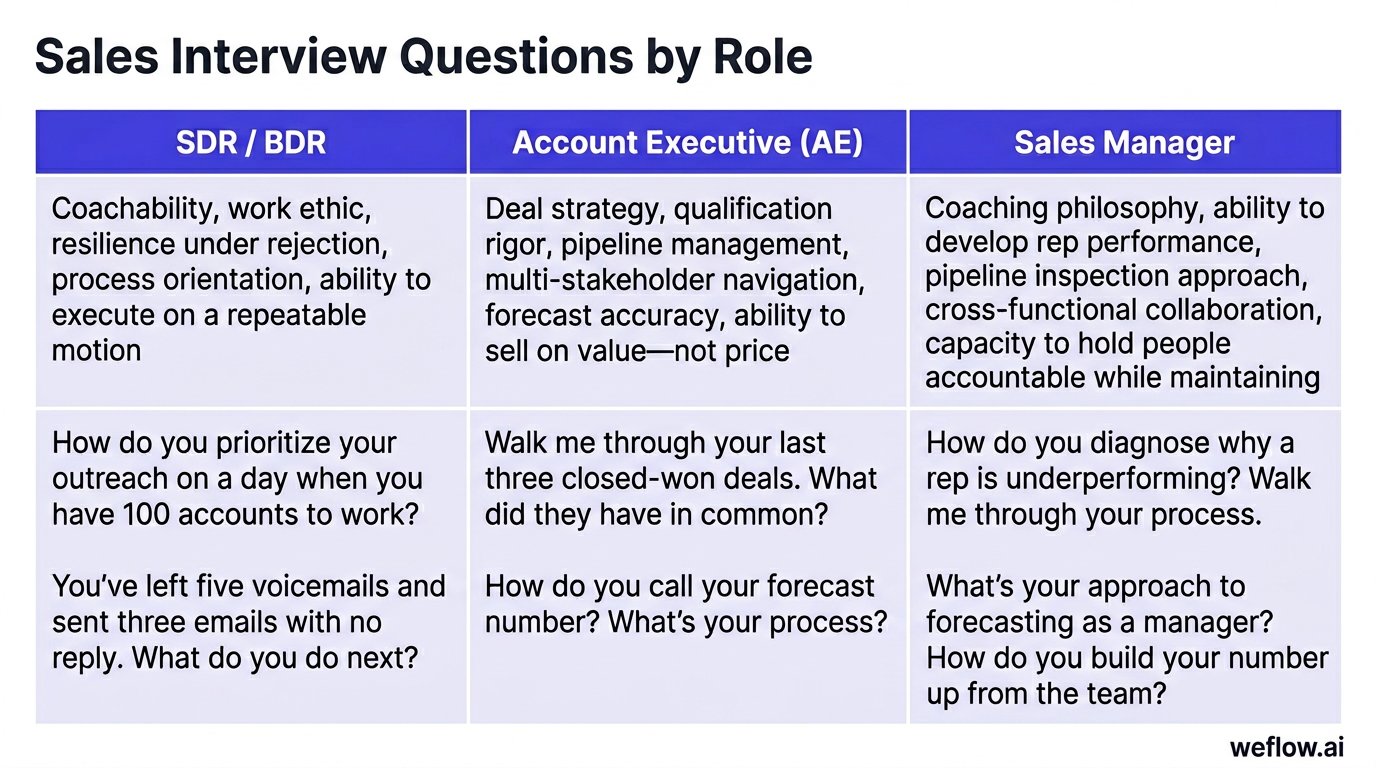
The questions you'll face and the way your answers are evaluated depend heavily on the role you're interviewing for. Here's what interviewers are assessing at each level—and the questions that reveal it.
| Role | What interviewers are assessing | Role-specific questions |
|---|---|---|
| SDR / BDR | Coachability, work ethic, resilience under rejection, process orientation, ability to execute on a repeatable motion |
|
| Account Executive (AE) | Deal strategy, qualification rigor, pipeline management, multi-stakeholder navigation, forecast accuracy, ability to sell on value—not price |
|
| Sales Manager | Coaching philosophy, ability to develop rep performance, pipeline inspection approach, cross-functional collaboration, capacity to hold people accountable while maintaining trust |
|
For SDRs: Interviewers are primarily evaluating whether you'll execute a prospecting motion consistently and improve over time. They're not expecting mastery of deal strategy—they're looking for hunger, process thinking, and the ability to handle rejection without losing momentum.
For AEs: The bar shifts to deal management, qualification, and forecast accuracy. Interviewers want evidence of a repeatable process—not just "I closed big deals." They'll probe on how you handle complex situations: ghost prospects, competitive deals, multi-stakeholder buying committees, and late-stage surprises.
For sales managers: The emphasis is on how you develop people. Interviewers want to see a clear coaching philosophy, a systematic approach to pipeline inspection, and concrete examples of reps whose performance you've improved. Strong candidates talk about their team's results—not just their own.
10 smart questions to ask your sales interviewer
Asking strong questions at the end of an interview serves two purposes: it demonstrates genuine interest and it helps you evaluate whether the role is actually right for you. These 10 questions are specific enough to generate useful answers—and to signal that you've done your homework.
-
"What does the ramp period look like for someone in this role, and what quota attainment do you typically see in months three, six, and nine?"
This tells you whether the company has a realistic ramp model or expects new hires to be fully productive immediately—and whether they're transparent about what success actually looks like early on.
-
"What's the average deal size and sales cycle for this territory?"
Understanding these numbers is essential for evaluating whether the quota is achievable given the territory's characteristics. If the numbers don't add up to a realistic path to quota, that's important information.
-
"How does the team use your CRM? What does pipeline data quality look like in practice?"
This surfaces how seriously the organization takes data discipline—and gives you early signals about the operational maturity of the sales org.
-
"What does your sales enablement process look like? How do you keep the team current on product changes and competitive positioning?"
Strong enablement infrastructure is a signal that the company invests in making their reps successful. Weak enablement often means reps are left to figure things out on their own.
-
"What's the biggest deal risk in the territory right now, and how is the team addressing it?"
This question shows strategic thinking and tells you whether the manager is candid about challenges. Interviewers who give honest, specific answers are usually better managers to work for.
-
"What separates your top performers from the middle of the pack? What do they do differently?"
This gives you a roadmap for what success looks like in the specific context of this team and company—not generic sales skills, but the specific behaviors that win here.
-
"How does marketing support the sales team in terms of pipeline generation? What percentage of pipeline is inbound vs. outbound?"
The answer tells you how dependent you'll be on outbound prospecting, and whether the marketing and sales functions are actually aligned.
-
"What does the relationship between sales and RevOps look like here? How do you handle forecast reviews?"
A healthy sales-RevOps relationship usually means better data, more useful reporting, and less manual CRM work for reps. A dysfunctional one means you'll spend significant time on administrative overhead.
-
"What's the biggest thing the team needs to improve over the next 12 months?"
Interviewers who answer this honestly are telling you where the real work will be. It also helps you position yourself as someone who can contribute to that specific improvement.
-
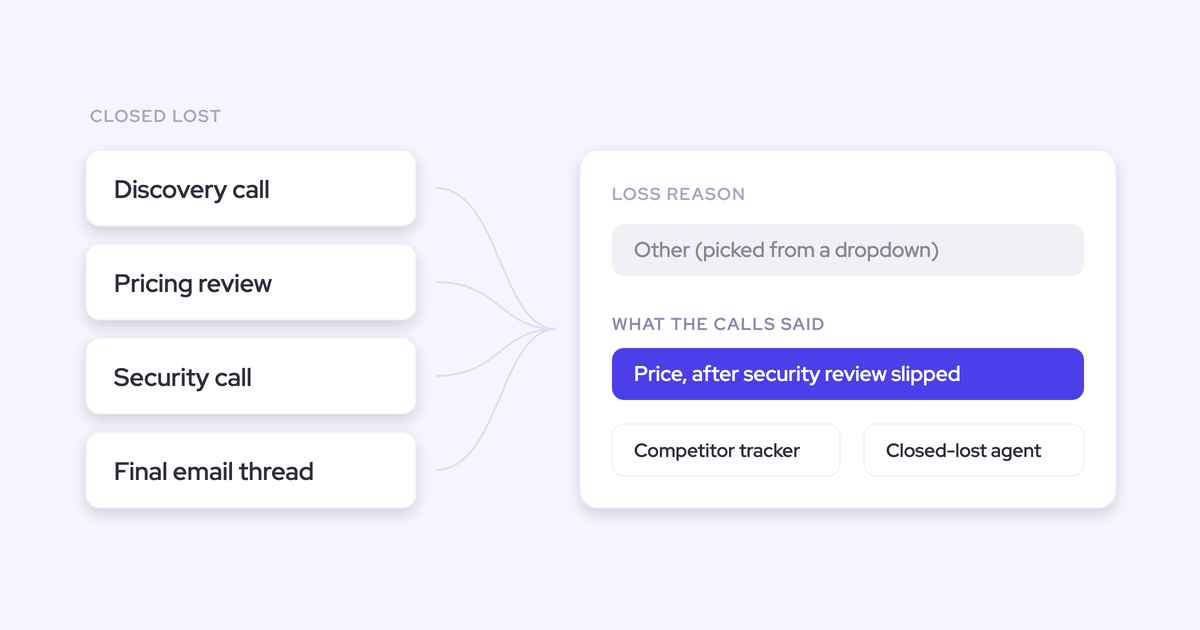
"Why do deals typically fall apart in this market? What's the most common reason you lose?"
Understanding loss patterns before you join tells you what objections you'll face most often—and whether the company has a clear, credible answer to them.
Frequently asked questions
What are the most common sales interview questions?
The most common questions across SDR, AE, and sales manager interviews are: "Tell me about yourself," "Why do you want this role?" "Walk me through your sales process," "Tell me about a time you failed to hit quota," and "Sell me this pen." Interviewers use these as starting points because they reveal communication skills, self-awareness, and process discipline quickly. Prepare structured, specific answers for each—vague answers to common questions are the most preventable interview mistake.
How do you answer "Tell me about yourself" in a sales interview?
Keep your answer to 90 seconds and cover three things: where you are now (current role and recent results), what you've accomplished (specific quota attainment or key wins), and why you're interested in this specific role. Don't recite your resume chronologically—connect the dots for the interviewer. The goal is to establish credibility and relevance in under two minutes, so they're primed to ask you better questions.
What is the STAR method for sales interviews?
STAR stands for Situation, Task, Action, and Result. It's a framework for answering behavioral interview questions ("Tell me about a time you...") in a structured way that gives the interviewer enough context to evaluate your judgment. The four components keep your answers concise and ensure you cover the most important element: what you specifically did, not what the team did. Always quantify the result if at all possible—a number anchors the story and makes it credible.
How should you answer "What is your biggest weakness?" in a sales interview?
Choose a real weakness—something that has actually affected your performance at some point. Then show two things: that you're aware of it, and that you've developed a system to manage it. The worst answers are disguised strengths ("I care too much") or weaknesses with no follow-up action. Interviewers are testing for self-awareness and growth orientation, not perfection. A genuine weakness addressed with a specific process is a stronger answer than a polished non-answer.
How do you answer "Sell me this pen" in an interview?
Start by asking questions, not pitching. Ask about the buyer's situation, what they currently use, and what frustrates them about it. Only after you've established their specific needs should you position the pen as the solution—and when you do, connect it directly to what they've just told you, not a generic list of features. This question is a test of whether you lead with discovery. Candidates who pitch immediately without asking questions demonstrate exactly the behavior that loses real deals.
What questions should you ask the interviewer in a sales interview?
Ask questions that show you've researched the role and thought about whether it's the right fit. Strong questions cover: ramp expectations and typical attainment, deal size and sales cycle, how RevOps and sales work together, what top performers do differently, and why deals typically fall apart. Avoid generic questions ("What does success look like here?") and don't ask anything that's easily answered by reading the company's website. The questions you ask signal how you think—make them count.
How do you prepare for a sales interview with no experience?
Focus on demonstrating the underlying skills that translate into sales: communication, persuasion, handling rejection, research habits, and process discipline. Draw on experiences from school projects, part-time work, athletics, or any context where you had to convince people, hit a target, or recover from setbacks. Be specific with examples—"I cold-called 40 small business owners to sell sponsorships for a university event and closed 12" is more compelling than "I've always been a people person." Show that you understand what the job actually requires and that you're ready to do the unglamorous parts of it.
What sales interview questions are asked for SDR vs. AE vs. sales manager roles?
SDR interviews focus on process, resilience, and coachability—expect questions about your outreach methodology, how you handle rejection, and how you prioritize a large account list. AE interviews go deeper on deal strategy, qualification, and pipeline management—you'll be asked to walk through deals, discuss your forecast process, and explain how you handle competitive situations. Sales manager interviews emphasize coaching philosophy, team development, and cross-functional collaboration—the questions shift from "what did you do?" to "how did you help your team do it?" Prepare role-appropriate examples for each.
-p-1600.png)

.png)
-p-1600.png)
-p-1600.png)
-p-1600.png)