

SNAP Selling Explained: Framework, Principles, and Examples
Learn the SNAP Selling framework, its 4 principles, 3 buyer decisions, and real B2B examples.



.png)

What is SNAP selling? Definition and core framework
SNAP selling is a sales methodology built for buyers who are overwhelmed, short on time, and bombarded with information. Jill Konrath introduced the framework in her 2010 book SNAP Selling: Speed Up Sales and Win More Business with Today’s Frazzled Customers. The core idea: modern B2B buyers don’t have the bandwidth to evaluate complex pitches, sit through lengthy demos, or parse 40-page proposals. If your sales process adds friction, they’ll default to “no” or go silent.
The framework organizes around four principles—Simple, iNvaluable, Aligned, and Priority—that guide how reps communicate, position their solution, and move deals forward. SNAP selling also maps three critical buyer decisions that determine whether a deal advances or dies.
Where other methodologies like MEDDIC or Challenger focus on qualification rigor or insight-driven teaching, SNAP selling focuses on reducing the cognitive load buyers face at every interaction. It’s designed for selling environments where buyers have too many vendors in their inbox and not enough hours to evaluate them all.
SNAP selling works best in mid-market and enterprise B2B sales cycles where multiple stakeholders are involved, decision fatigue is real, and the default buyer behavior is to stick with the status quo rather than take on the risk of change.
The four principles of SNAP selling: Simple, iNvaluable, Aligned, Priority
Each letter in SNAP represents a principle that shapes how you engage buyers. Here’s the quick reference:
| Letter | Principle | Core idea |
|---|---|---|
| S | Keep it Simple | Reduce complexity at every touchpoint so buyers can process your message quickly |
| N | Be iNvaluable | Position yourself as a resource buyers can’t afford to ignore |
| A | Always Align | Connect your solution directly to the buyer’s stated objectives and priorities |
| P | Raise Priorities | Make the buyer’s problem urgent enough to act on now, not next quarter |
How “keep it simple” reduces buyer friction
Frazzled buyers don’t ignore your emails because they’re not interested. They ignore them because your message requires too much effort to process. The “Simple” principle means stripping every interaction down to what the buyer needs to make their next decision—nothing more.
Key considerations:
- Limit emails to one idea and one clear ask. A three-paragraph email with two attachments and a scheduling link gets archived, not read.
- Replace slide decks with one-page summaries that map your solution to the buyer’s top three priorities.
- Use language the buyer already uses internally. If they call it “pipeline coverage,” don’t call it “opportunity health scoring.”
- Cut jargon that serves your marketing team but confuses the buyer. “AI-powered revenue intelligence” means nothing to a VP of Sales who just wants accurate forecasts.
- Make the next step obvious in every interaction. “Can we schedule 20 minutes on Thursday to review your current forecast process?” beats “Let me know if you’d like to continue the conversation.”
Example: A sales rep selling a CRM data capture tool sends a two-sentence email: “Your team logs an average of 40% of sales activities manually. We can get that to 95%+ automatically—here’s a two-minute video showing how.” No feature lists, no company overview, no 12-slide deck. The buyer clicks, watches, and replies.
Why being invaluable positions you as a trusted advisor
Being “iNvaluable” means every interaction with you teaches the buyer something they didn’t know or gives them a tool they can use immediately—even if they never buy from you. The goal is to become a resource the buyer actively wants to engage with, not someone they’re trying to get off the phone.
Key considerations:
- Share relevant benchmarks before the buyer asks. “Companies your size typically see 15–20% forecast variance. Here’s what the top performers do differently.”
- Bring industry-specific insights, not generic best practices. A RevOps leader at a 500-person SaaS company doesn’t need advice designed for a 10-person startup.
- Offer practical frameworks the buyer can apply regardless of which vendor they choose. This builds trust and keeps you in the conversation.
- Identify risks or blind spots the buyer hasn’t considered. “Most teams underestimate the Salesforce API limits when they add activity capture—here’s how to plan for that.”
- Follow up with content that directly addresses what the buyer mentioned in your last call, not a generic nurture sequence.
Example: A rep selling to a Head of RevOps sends a custom analysis comparing the buyer’s current pipeline coverage ratios against industry benchmarks for their segment, with three specific recommendations. The buyer forwards it to their CRO before the next forecast call. The rep is now part of the internal conversation.
How to align your solution with buyer goals and priorities
“Align” means connecting everything you say and show to what the buyer has explicitly told you matters. Not what your product does best—what their organization is measured on. Misalignment is the fastest way to lose a deal to “no decision.”
Key considerations:
- Map your solution’s capabilities to the buyer’s stated business objectives, not your feature list. If they care about forecast accuracy, lead with that—not your email capture feature.
- Understand the buyer’s internal metrics. What does their CRO report to the board? What does their RevOps team get evaluated on? Align your pitch to those numbers.
- Reference the buyer’s own language, internal projects, and strategic initiatives in your proposals. Generic value props get ignored.
- Adjust your message for each stakeholder. The economic buyer cares about cost per seat and ROI. The technical evaluator cares about Salesforce integration depth. The end user cares about time saved.
- If your solution doesn’t align with a buyer’s top priority, say so. Honest misalignment earns trust and saves everyone time.
Example: A buyer says their board is asking for more reliable pipeline data. Instead of demoing every feature, the rep builds a custom demo that starts with the pipeline inspection view, shows how activity data flows into Salesforce automatically, and ends with a board-ready report template. Everything the buyer sees maps directly to “better pipeline data for the board.”
Raise priorities: how to make your solution urgent
Even when buyers agree your solution is valuable and aligned, they’ll delay the purchase if it doesn’t feel urgent. The “Priority” principle means helping buyers see the cost of inaction—and making your solution the thing they need to address now, not next quarter.
Key considerations:
- Quantify the cost of the status quo. “Your team spends 12 hours per week on manual CRM updates. That’s 624 hours per year across your 10-person team—time they’re not selling.”
- Tie your solution to an existing deadline or initiative. If the buyer is rolling out a new sales methodology next quarter, position your tool as a prerequisite.
- Use trigger events: leadership changes, missed forecasts, board pressure, competitor wins. These create natural urgency you can connect to.
- Show what comparable companies achieved within a specific timeframe. “Teams like yours typically see 95%+ activity capture within two weeks of deployment” makes the timeline feel real.
- Avoid manufactured urgency. “This price expires Friday” erodes trust. Real urgency comes from the buyer’s own business context.
Example: A rep learns the buyer’s company missed its Q3 forecast by 18%. They send a brief analysis showing how incomplete activity data likely contributed to the gap, along with a case study of a similar company that reduced forecast error by 12 percentage points within one quarter. The buyer moves the evaluation timeline up by six weeks.
The three buyer decisions in SNAP selling (access, status quo, resources)

Konrath identifies three sequential decisions every buyer makes. Each one is a gate—if you fail at one, the deal stalls or dies. Most reps focus on the third decision (choosing a vendor) while losing deals at the first two.
| Decision | What the buyer asks | Your goal |
|---|---|---|
| Decision 1: Allow access | “Is this worth my time?” | Earn the right to a conversation by being relevant and simple |
| Decision 2: Initiate change | “Is this worth the effort and risk of changing?” | Make the case that the status quo is more expensive than changing |
| Decision 3: Select resources | “Which option is the best fit?” | Position your solution as the lowest-risk, highest-alignment choice |
Decision 1: Allow access. Buyers decide in seconds whether to open your email, take your call, or accept your meeting request. This is where the “Simple” and “iNvaluable” principles matter most. If your outreach looks like every other vendor’s, it gets deleted. Lead with a specific, relevant insight—not a product pitch.
Decision 2: Initiate change. Even after engaging, buyers default to the status quo. Change means risk, effort, and internal politics. Your job at this stage is to quantify the cost of doing nothing and reduce the perceived risk of switching. Show deployment timelines, migration paths, and proof points from similar organizations.
Decision 3: Select resources. This is the competitive evaluation stage. The buyer has decided to change—now they’re choosing between you and alternatives. Here, “Align” and “Priority” principles drive the decision. The vendor whose solution maps most directly to the buyer’s priorities and can deliver value fastest wins.
SNAP selling glossary: key terms every sales rep should know
Frazzled Customer Syndrome — The psychological state of modern B2B buyers who are overwhelmed with information, overloaded with vendor outreach, and time-constrained. Frazzled customers default to “no” or “not now” as a coping mechanism. SNAP selling is built specifically to reach and engage these buyers.
SNAP Factors — The four principles (Simple, iNvaluable, Aligned, Priority) that determine whether a buyer engages with or ignores a sales rep. Reps who score high on all four factors earn access and advance deals. Reps who violate any factor—especially simplicity—lose the buyer’s attention.
Buyer’s Matrix — A planning tool that maps each key stakeholder’s priorities, success metrics, hot-button issues, and the value your solution delivers to them specifically. Reps fill out the matrix before critical meetings to ensure every interaction is aligned with what each decision-maker cares about.
Go Zone — The space where your solution’s strengths overlap with the buyer’s top priorities. Deals close when conversations stay in the Go Zone. Reps who drift into features or capabilities outside the Go Zone lose buyer attention and introduce unnecessary complexity.
[banner type="download" url="https://www.weflow.ai/resources/cheat-sheets/snap-selling-checklist" text="SNAP Selling Checklist" subtitle="Run buyer conversations that stay in the Go Zone instead of getting ignored" button="Get the checklist"]
D-Zone — The “Danger Zone” where reps discuss topics, features, or capabilities that are irrelevant to the buyer’s priorities. Time spent in the D-Zone actively hurts the deal because it signals misalignment and adds complexity the buyer doesn’t want.
How to implement SNAP selling: a step-by-step guide
How to identify and engage frazzled buyers
Not every buyer exhibits frazzled behavior in the same way. Recognizing the pattern early lets you adapt your approach before you lose their attention.
| Trait | What it means | Your response |
|---|---|---|
| Anxious | Worried about making the wrong decision; fears internal backlash if the purchase fails | Reduce risk with proof points, case studies from similar companies, and clear rollback options |
| Wary of complexity | Has been burned by lengthy implementations that didn’t deliver; defaults to “too hard” | Lead with deployment speed and simplicity. Show, don’t tell: “Live in two weeks, not two quarters” |
| Distracted | Managing 15 priorities at once; your deal is one of many competing for attention | Keep every interaction short and specific. One idea per email. Clear next steps. No multi-topic meetings |
| Demanding | Expects vendors to prove value before they invest time; low tolerance for generic pitches | Bring custom insights, relevant benchmarks, and custom demos built for their situation from the first interaction |
The common thread: frazzled buyers penalize complexity and reward relevance. Every email, call, and meeting should feel like it was built for them specifically—because in SNAP selling, it should be.
How to build buyer personas for SNAP selling
SNAP selling personas go deeper than standard marketing personas. You’re not mapping demographics—you’re mapping cognitive load, decision-making patterns, and information preferences.
- Identify the decision-making unit. List every stakeholder involved in the purchase: economic buyer, technical evaluator, end users, internal champion. Each one has different priorities and different frazzle triggers.
- Map each stakeholder’s top three priorities. What are they measured on? What keeps them up at night? What did their last performance review focus on? These priorities define your Go Zone for each person.
- Document their information preferences. Does the CRO want a one-page executive summary? Does the RevOps lead want a technical architecture diagram? Does the sales manager want to see a live demo? Deliver content in the format each stakeholder prefers.
- Identify their frazzle profile. Use the trait table above to classify each stakeholder. An anxious CRO needs risk reduction. A distracted VP of Sales needs brevity. Tailor your approach accordingly.
- Define the status quo for each stakeholder. What are they using today? What would they lose by switching? What’s the personal risk of championing a change? Understanding the status quo tells you what you’re competing against—and it’s rarely another vendor.
How to fill out and apply the SNAP Buyer’s Matrix

The Buyer’s Matrix is a practical planning tool you complete before any high-stakes meeting or proposal. Here’s how to build one:
- Create a row for each key stakeholder. Include their name, title, and role in the decision (economic buyer, champion, evaluator, end user).
- Column 1: Business priorities. What is this person’s department or function trying to achieve this quarter? Be specific—“improve forecast accuracy to within 5% of actual” is useful. “Better reporting” is not.
- Column 2: Success metrics. How does this person measure success? Revenue targets, CRM adoption rates, pipeline coverage ratios, deployment timelines—whatever they report on.
- Column 3: Hot-button issues. What frustrates this person about their current setup? Incomplete CRM data, manual processes, unreliable reports, tool sprawl? These are the pain points your solution should address directly.
- Column 4: Your value to them. Map specific capabilities or outcomes from your solution to each stakeholder’s priorities and hot-button issues. This column defines your Go Zone for each conversation.
- Column 5: Proof points. List the specific evidence (case studies, metrics, demos, references) that support your value claims for each stakeholder. Every claim needs a receipt.
Use the completed matrix to prepare for meetings, customize proposals, and coach your internal champion on how to sell your solution to other stakeholders. Update it after every interaction as you learn more about each person’s priorities.
Real-world SNAP selling examples: how B2B teams apply the framework
Example 1: Selling revenue intelligence to a mid-market SaaS company
A 300-person SaaS company is evaluating revenue intelligence platforms. The Head of RevOps (your champion) is managing a Salesforce migration, a new sales methodology rollout, and board reporting—all at once. Classic frazzled buyer.
Simple: Instead of a 45-minute discovery call, the rep sends a three-minute Loom video showing how the platform captures activity data and writes it back to Salesforce automatically. The video uses the buyer’s actual Salesforce field names (pulled from their job posting, which listed “MEDDIC compliance” and “Salesforce Enterprise”).
iNvaluable: The rep includes a benchmark report comparing activity capture rates across similar SaaS companies, with specific data on what “good” looks like for a team of 40 AEs. The Head of RevOps shares it with their CRO.
Aligned: During the first call, the rep learns the board is asking for weekly pipeline snapshots. The rep builds the entire demo around pipeline inspection and board reporting—not call recording or coaching features.
Priority: The company’s Q4 planning starts in six weeks. The rep shows a deployment timeline that gets the platform live in two weeks, giving the team a full month of data before the planning cycle begins.
Result: The deal closes in 22 days—half the typical sales cycle for this deal size.
Example 2: Replacing an incumbent tool at an enterprise financial services firm
A 2,000-person financial services company is paying $200+/user/month for a conversation intelligence tool. The VP of Sales Operations is frustrated because call recordings exist but activity data still doesn’t flow into Salesforce reliably. Manual CRM updates consume eight hours per rep per week.
Simple: The rep doesn’t pitch a full platform replacement. Instead, they focus on one problem: “Activity data should live in Salesforce without reps doing anything. Here’s how.” One slide, one workflow diagram.
iNvaluable: The rep shares a migration playbook documenting how three similar financial services companies transitioned from their current tool, including timelines, overlap periods, and adoption metrics at 30/60/90 days.
Aligned: The VP of Sales Operations cares about data completeness and cost reduction. The CRO cares about forecast accuracy. The rep presents two views of the same solution—one for each stakeholder—using the Buyer’s Matrix.
Priority: The company’s current contract renews in 90 days. The rep maps out a 60-day migration plan that gives the team a full month of parallel operation before the old contract expires.
Result: The deal moves from discovery to signed contract in 47 days, and the company reduces per-seat costs by 55% while improving activity capture rates from 35% to 96%.
Example 3: Selling to a distracted sales leader during a reorg
A 600-person B2B professional services firm is going through a sales reorg. The new CRO has been in the role for three weeks and inherited a pipeline they don’t trust. Every vendor in their inbox is pitching “transformation.” The CRO is ignoring all of them.
Simple: The rep sends a one-sentence email: “Your pipeline report is probably wrong—here’s a 90-second breakdown of why, and what to check first.” No pitch, no meeting request, no attachments.
iNvaluable: The linked content is a short guide on the five most common pipeline data quality issues in Salesforce, with specific field-level checks the CRO’s team can run today. It’s useful regardless of whether they buy anything.
Aligned: When the CRO replies, the rep asks one question: “What number are you presenting to the board at the end of this quarter?” Everything that follows maps to making that number defensible.
Priority: The CRO’s first board meeting is in 45 days. The rep frames the timeline around that date: “If we start next week, you’ll have three weeks of clean pipeline data before you present.”
[banner type="download" url="https://www.weflow.ai/resources/cheat-sheets/sales-methodologies-book" text="The Book Of Sales Methodologies" subtitle="Pick the right framework for your deals instead of forcing one that doesn't fit" button="Get the book"]
Result: The CRO takes the first call within 48 hours of the initial email. The deal closes before the board meeting.
SNAP selling vs. Challenger, MEDDIC, and SPIN: which methodology fits your team?
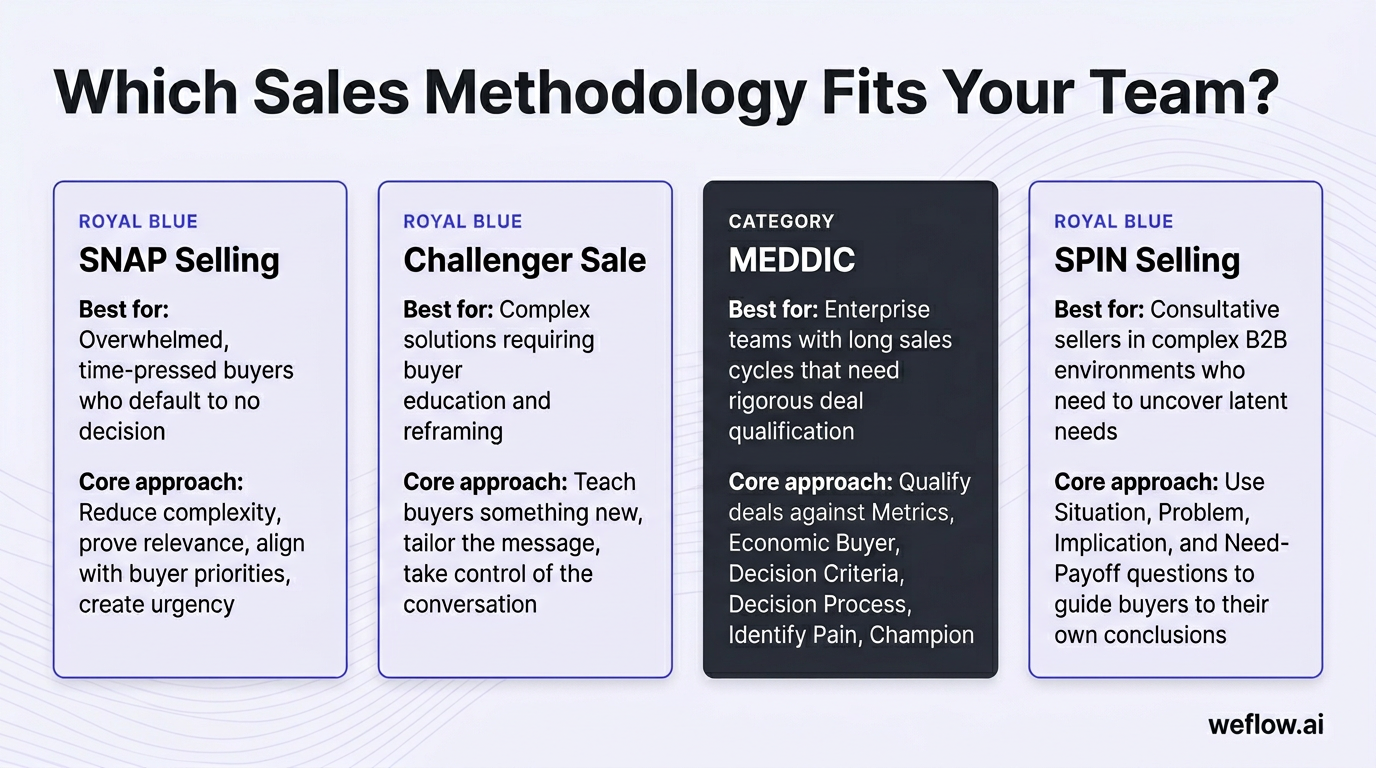
SNAP selling isn’t the right methodology for every team or every selling motion. Here’s how it compares to three other popular frameworks:
| Methodology | Best for | Core approach | Ideal buyer type |
|---|---|---|---|
| SNAP Selling | Teams selling to overwhelmed, time-pressed buyers who default to “no decision” | Reduce complexity, prove relevance, align with buyer priorities, create urgency | Frazzled mid-market and enterprise buyers managing multiple initiatives |
| Challenger Sale | Teams that sell complex solutions requiring buyer education and reframing | Teach buyers something new, tailor the message, take control of the conversation | Buyers who don’t yet understand the full scope of their problem |
| MEDDIC | Enterprise teams with long sales cycles that need rigorous deal qualification | Qualify deals against Metrics, Economic Buyer, Decision Criteria, Decision Process, Identify Pain, Champion | Large organizations with formal procurement processes and multiple stakeholders |
| SPIN Selling | Consultative sellers in complex B2B environments who need to uncover latent needs | Use Situation, Problem, Implication, and Need-Payoff questions to guide buyers to their own conclusions | Buyers who are aware of surface-level problems but haven’t quantified the impact |
Choosing the right methodology:
- Choose SNAP selling when your buyers are overwhelmed, your sales cycle is stalling at the “no decision” stage, and your team needs a framework for cutting through noise. SNAP works best when the buyer already has a problem they know about—your job is to make it easy for them to act.
- Choose Challenger when your buyers don’t fully understand the problem you solve and need to be educated before they’ll consider a change. Challenger is about teaching and reframing—it works when the buyer’s current mental model is wrong.
- Choose MEDDIC when you’re selling into large enterprises with formal procurement, long sales cycles, and deals that require executive sponsorship. MEDDIC is a qualification framework—it tells you whether a deal is real, not how to message.
- Choose SPIN when your selling motion is consultative and your buyers need help connecting their symptoms to root causes. SPIN is question-driven and works well when the buyer’s pain is latent rather than explicit.
- Combine methodologies when your sales cycle requires it. Many enterprise teams use MEDDIC for qualification and SNAP or Challenger for messaging and engagement. The frameworks aren’t mutually exclusive.
How CRM and AI tools support SNAP selling execution
SNAP selling demands that reps spend their time on buyer-facing activities—research, personalization, custom insights, and personalized follow-ups. Every hour spent on manual CRM updates, activity logging, or meeting notes is an hour not spent applying SNAP principles.
This is where CRM automation and AI tools make a measurable difference.
Activity capture eliminates the admin tax
The “Simple” principle applies to your internal processes, not just buyer interactions. Reps who spend 30 minutes after every call updating Salesforce fields, logging activities, and writing follow-up emails have less bandwidth to research buyers, build custom insights, and stay in the Go Zone.
Automated activity capture—where emails, meetings, and calls are logged to Salesforce without rep input—gives reps that time back. When CRM data updates happen in the background, reps can focus on the work that SNAP selling requires: understanding buyer priorities, preparing the Buyer’s Matrix, and crafting relevant outreach.
Deal intelligence helps reps stay aligned
The “Align” principle requires reps to know what each stakeholder cares about and track how priorities shift throughout the sales cycle. AI-powered deal intelligence tools can surface signals from call transcripts—what the buyer mentioned, what concerns they raised, which competitors they referenced—and map them to deal stages and next steps.
This isn’t about replacing rep judgment. It’s about giving reps structured data so they can fill out the Buyer’s Matrix with real information instead of guesses.
Conversation intelligence supports the iNvaluable principle
Being invaluable means bringing insights the buyer doesn’t have. Conversation intelligence tools that analyze call patterns across your entire deal pipeline can surface benchmarks, common objections, and winning talk tracks. Reps can use this data to bring relevant, specific insights to every buyer interaction instead of relying on generic messaging.
Forecasting tools make priority conversations credible
When reps raise priority with buyers (“here’s what inaction costs you”), they need accurate data to back up those claims. Pipeline inspection and forecasting tools that pull real activity data from Salesforce—not self-reported updates—give reps the credibility to make specific, defensible claims about timelines and outcomes.
Weflow, a Salesforce-native revenue AI platform, combines activity capture, conversation intelligence, and pipeline inspection in a single tool built around Salesforce. For teams running SNAP selling, this means reps spend less time on CRM admin and more time on the buyer-facing work that moves deals forward—research, personalization, and staying in the Go Zone.
Frequently asked questions about SNAP selling
What does SNAP stand for in sales?
SNAP stands for Simple, iNvaluable, Aligned, and Priority. These four principles guide how sales reps engage with overwhelmed buyers. The methodology was created by Jill Konrath and published in her 2010 book SNAP Selling.
How is SNAP selling different from Challenger Sale or SPIN Selling?
SNAP selling focuses on reducing buyer friction and making it easy for overwhelmed buyers to say yes. Challenger is about teaching buyers something new and reframing their understanding of the problem. SPIN uses a structured questioning technique to help buyers discover and quantify their own pain. SNAP is most useful when buyers already know they have a problem but are too overloaded to act on it.
When should a sales team use SNAP selling?
Use SNAP selling when your deals stall at “no decision” rather than losing to competitors. It’s built for environments where buyers are overwhelmed with vendor outreach, manage multiple priorities, and default to the status quo because change feels like too much effort. Mid-market and enterprise B2B teams with complex sales cycles see the most benefit.
What are the three buyer decisions in SNAP selling?
The three decisions are: allow access (deciding whether to engage with you), initiate change (deciding whether the status quo is worth leaving), and select resources (choosing between you and alternatives). Most deals die at decision one or two—buyers either ignore the rep or decide it’s not worth changing.
What is the Buyer’s Matrix in SNAP selling?
The Buyer’s Matrix is a planning tool where reps map each stakeholder’s priorities, success metrics, hot-button issues, and the specific value your solution delivers to them. Reps fill it out before meetings to ensure every interaction stays in the Go Zone. It’s one of the most practical tools in the SNAP framework because it forces preparation and alignment.
Can SNAP selling work for inside sales and remote selling?
Yes—SNAP selling is well-suited for inside and remote sales because the principles translate directly to digital communication. The “Simple” principle is especially relevant when your primary channels are email and video calls, where attention spans are shorter. Remote sellers can apply SNAP by keeping emails concise, using short video messages instead of long decks, and making every virtual meeting focused on the buyer’s priorities rather than product features.
How do CRM tools support SNAP selling execution?
CRM and AI tools support SNAP selling by automating the admin work that competes with buyer-facing time. Automated activity capture logs emails, meetings, and calls to Salesforce without rep input. Deal intelligence surfaces buyer priorities and objections from call transcripts. Pipeline tools give reps accurate data to quantify the cost of inaction when raising priority with buyers. The net effect: reps spend more time on research, personalization, and alignment—the activities SNAP selling requires.
When to use SNAP selling (and when to choose a different methodology)
SNAP selling fits specific selling environments. Choosing the wrong methodology wastes training time and creates friction between how reps are told to sell and how their buyers actually buy.
Use SNAP selling when:
- Your buyers are overwhelmed, time-pressed, and defaulting to “no decision” more often than choosing a competitor.
- Your sales cycle stalls at the top of the funnel—buyers won’t engage or go silent after initial conversations.
- You sell in crowded markets where buyers receive dozens of vendor pitches per week and your team needs to stand out through relevance, not volume.
- Your solution requires change management, and buyers resist change because it feels risky or complex—not because they don’t see value.
- Your reps have strong product knowledge but struggle with positioning and messaging that resonates with specific buyer priorities.
Consider a different methodology when:
- Your buyers don’t know they have a problem yet. SNAP assumes the buyer has an identified need—if they don’t, Challenger’s teaching approach may work better.
- You sell into enterprises with formal procurement and multi-month evaluation cycles. MEDDIC’s qualification rigor is more appropriate for tracking complex, multi-stakeholder deals.
- Your sales motion is deeply consultative, and buyers need extensive discovery to understand the scope of their problem. SPIN Selling’s question-driven approach is designed for these conversations.
- Your product is low-ACV and transactional. SNAP selling’s preparation requirements (Buyer’s Matrix, stakeholder mapping, custom insights) don’t justify the investment for $5,000 deals with a single decision-maker.
The practical approach: Most B2B sales teams don’t run a single methodology in isolation. SNAP selling works well as a messaging and engagement layer on top of a qualification framework like MEDDIC. Use MEDDIC to qualify whether a deal is real. Use SNAP to determine how you communicate with the buyer at every stage. The frameworks address different problems—qualification vs. engagement—and they reinforce each other when used together.
-p-1600.png)

.png)
-p-1600.png)
-p-1600.png)
-p-1600.png)
