

Baseline Selling: The 4-Stage Sales Methodology Explained
Learn Baseline Selling's 4 stages, milestones, and how it compares to SPIN and Sandler.




What is Baseline Selling? Dave Kurlan's baseball-inspired sales methodology
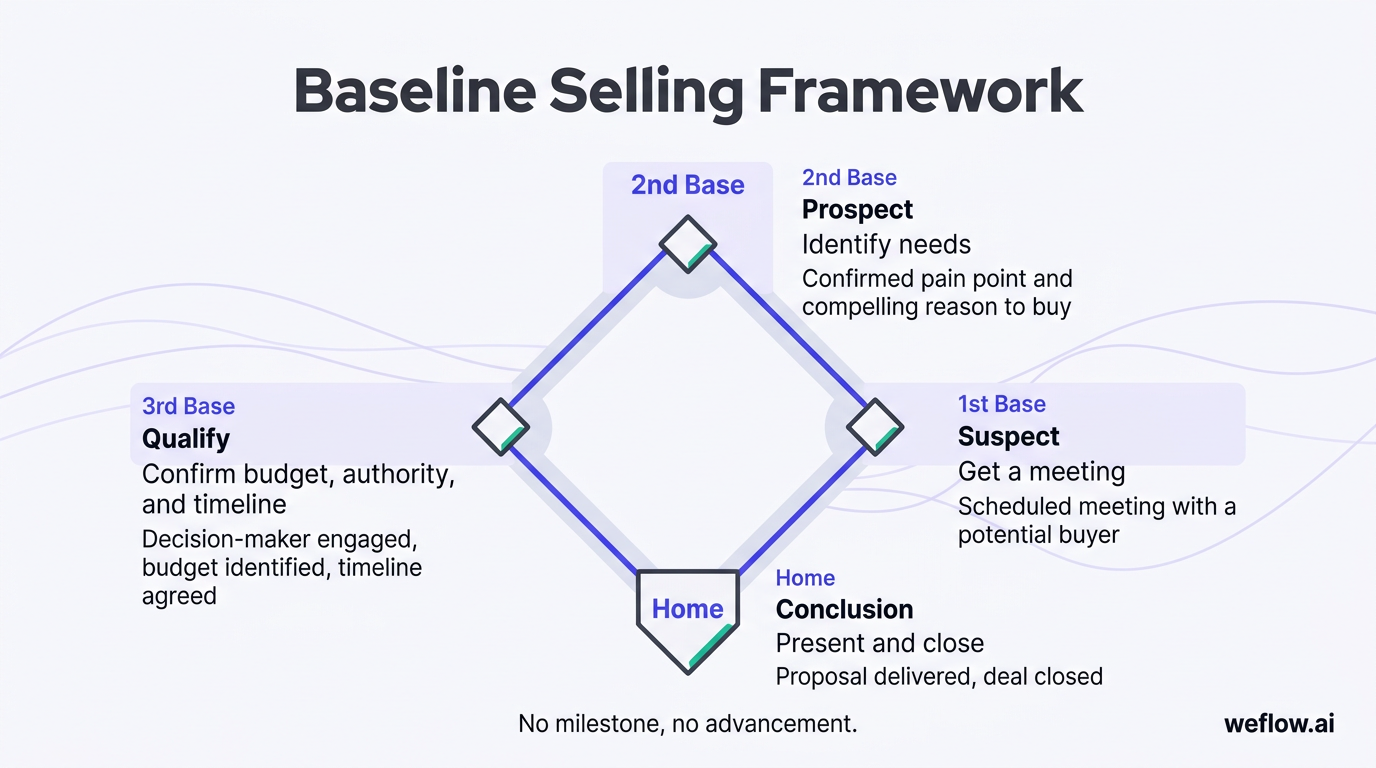
Baseline Selling is a four-stage consultative sales methodology that maps the sales process to a baseball diamond. Each base represents a milestone your deal must reach before advancing. No milestone, no advancement—simple as that.
Created by Dave Kurlan, founder of Objective Management Group (OMG) and Kurlan & Associates, the methodology gives sales teams a repeatable, visual framework that's easy to learn and hard to forget. Most reps understand baseball's base-to-base progression intuitively, making the model stick faster than abstract sales frameworks.
Here's the framework at a glance:
| Base | Stage name | Goal | Key milestone |
|---|---|---|---|
| 1st Base | Suspect | Get a meeting | Scheduled meeting with a potential buyer |
| 2nd Base | Prospect | Identify needs | Confirmed pain point and compelling reason to buy |
| 3rd Base | Qualify | Confirm budget, authority, and timeline | Decision-maker engaged, budget identified, timeline agreed |
| Home | Conclusion | Present and close | Proposal delivered, deal closed |
The baseball metaphor gives managers a shared vocabulary for pipeline reviews. When a rep says a deal is "on second base," everyone knows what's been accomplished and what still needs to happen.
6 benefits of Baseline Selling over traditional sales methodologies
| Benefit | What it means in practice |
|---|---|
| Repeatable | Every deal follows the same base-to-base progression. Managers can diagnose where deals stall and coach to specific milestones instead of guessing. |
| Simple | Four stages, four milestones. New reps can learn the framework in a single training session and start applying it the same week. |
| Visual | The baseball diamond gives teams a shared mental model. Pipeline reviews become faster because everyone pictures the same progression. |
| Conversational | Baseline Selling emphasizes natural dialogue over scripted pitches. Reps ask questions to uncover needs rather than delivering feature dumps. |
| Structured | Each base has clear entry and exit criteria. Deals don't advance on gut feel—they advance when specific conditions are met. |
| Broad coverage | The methodology spans prospecting through close, including pre-prospecting (on-deck circle) and post-close (scoring). Most frameworks cover only a slice of the sales cycle. |
The 4 stages of Baseline Selling: from suspect to close
Baseline Selling is milestone-driven. You don't move a deal forward because time has passed or because a rep feels good about the conversation. You move it forward because a specific, verifiable condition has been met at each base. Here's how each stage works.
First base: how to identify and engage suspects
The goal at first base is simple: get a meeting. A "suspect" is anyone who fits your ideal customer profile but hasn't yet agreed to a conversation. Your job is to turn them into someone who'll give you 20 to 30 minutes.
Channels that work at this stage:
- Cold calls—still effective when paired with a strong positioning statement
- Referrals—the highest-conversion channel for most B2B teams
- LinkedIn outreach—targeted connection requests followed by value-first messages
- Marketing leads—inbound requests, content downloads, webinar attendees
The key tool at first base is your positioning statement: one sentence that names the prospect's likely problem and the emotional outcome of solving it. It's not a pitch. It's a hook that earns the meeting.
Example: "We work with VP Sales leaders who are frustrated that their forecast changes every week because reps aren't updating Salesforce. We help them get a forecast they can defend to the board without chasing reps for updates."
A suspect becomes a prospect—and you've reached first base—when you have a meeting on the calendar.
Second base: how to qualify needs and build urgency
Second base is where you shift from "getting attention" to "understanding the real problem." The goal is to identify a genuine need, build urgency around it, and differentiate your approach from competitors.
Surface needs vs. actual needs. Prospects often describe surface-level symptoms: "We need a better CRM." The actual need is underneath: "Our reps spend three hours a day on data entry instead of selling, and our pipeline data is unreliable." Your discovery questions should peel back the surface to find the real pain.

Discovery questions that work:
- What prompted you to take this meeting today?
- What have you tried so far to solve this problem?
- What happens if nothing changes in the next six months?
- Who else is affected by this problem, and how?
- What does success look like for you personally?
The compelling reason to buy. Baseline Selling pushes reps to find the emotional and financial motivation behind the purchase. Without a compelling reason, deals stall. Here's how to identify it:
| Buying motivation | Consequence of inaction | Example question |
|---|---|---|
| Making money | Lost revenue or missed growth targets | "What revenue are you leaving on the table because of this problem?" |
| Saving money | Wasted budget or unnecessary costs | "How much are you spending on manual workarounds today?" |
| Saving time | Wasted hours, slower execution | "How many hours per week does your team spend on this?" |
| Reducing risk | Compliance gaps, security exposure, forecast misses | "What's the risk to the business if your data stays unreliable?" |
| Addressing a human need | Burnout, turnover, low morale | "How is this problem affecting your team day-to-day?" |
Differentiation. Once you understand the need and urgency, position your solution against the alternatives the prospect is already considering:
- Reframe the problem—show the prospect an angle they haven't considered. If they think it's a "CRM adoption" problem, help them see it's actually a "data capture" problem.
- Use their language—repeat the exact words they used to describe the pain. This signals that you listened and understood.
- Contrast approaches, not features—instead of listing what your product does, explain how your approach differs from what they've tried before.
Quantify the cost of the problem. Don't pull out a calculator and run ROI models for the prospect. Instead, lead them to estimate the cost themselves. Ask: "If each rep spends three hours a day on CRM updates, and you have 50 reps, what does that cost you per quarter?" When the prospect does the math, they own the number—and the urgency.
You've reached second base when the prospect has confirmed a real need, articulated a compelling reason to buy, and understands why your approach is different.
Third base: how to qualify budget, authority, and timeline
Third base is where deals either solidify or die. This is pure qualification—confirming that the prospect can actually buy, not just that they want to. Baseline Selling consolidates all qualification criteria into six areas:
[banner type="download" url="https://www.weflow.ai/resources/cheat-sheets/sales-methodology-cheat-sheet" text="Sales Methodology Cheat Sheet" subtitle="Pick the framework that fits your deal size, cycle, and team maturity" button="Get the cheat sheet"]
| Area | Key question | What you're looking for |
|---|---|---|
| Commitment | "If we can solve this problem within your budget and timeline, are you prepared to move forward?" | A verbal or written commitment to act, not just interest |
| Decision-maker | "Who else needs to be involved in this decision, and what's their role?" | Direct access to—or a clear path to—the person who signs |
| Timeline | "When do you need this solved by, and what's driving that date?" | A specific date tied to a business event (quarter-end, board meeting, fiscal year) |
| Criteria | "What are the three things this solution must do for you to move forward?" | Explicit decision criteria you can map your solution against |
| Budget | "Do you have budget allocated for this, or will we need to build a business case?" | Confirmed budget or a realistic path to securing it |
| Competition | "Who else are you evaluating, and how far along are those conversations?" | Awareness of competitive dynamics so you can position accordingly |
You've reached third base when all six areas have clear answers. If any area is missing, the deal isn't qualified—regardless of how enthusiastic the prospect seems.
Home base: how to present your offer and close the deal
By this point, you know the prospect's problem, urgency, budget, timeline, decision-maker, and criteria. The presentation connects those dots—not introducing new information.
Lead with value, not features. Frame your presentation around the prospect's specific situation. Reference the pain they described, the cost they estimated, and the outcomes they care about. Use case studies or examples from similar companies to show what's realistic.
Example: "You mentioned your team spends 15 hours per week on manual data entry, and that's costing you roughly $200K per year in lost selling time. Here's how [Company X], a similar-sized team, eliminated that problem and saw a 20% increase in pipeline coverage within 90 days."
Present the offer. Keep it focused on value and outcomes, not technical specifications. The proposal should map directly to the criteria the prospect gave you at third base. If they said they need three things, your proposal should address those three things—in that order.
The inoffensive close. This is one of Baseline Selling's most distinctive techniques. Instead of a high-pressure close, you ask a question that lets the prospect say "no" without discomfort—while making "yes" the natural path:
"Based on everything we've discussed—the problem you described, the timeline you need, and the budget you've outlined—I think this is a strong fit. Would it make sense to move forward with the proposal I've outlined, or is there something I've missed that we should address first?"
This works because it's low-pressure, it references the prospect's own words, and it opens the door for objections without making the prospect feel cornered. If they say no, you learn exactly what's still unresolved. If they say yes, you've closed without resorting to manipulation.
Follow-up confirming questions. After a verbal yes, lock down the details:
- "When would you like to start the implementation?"
- "Who should I send the contract to?"
- "Is there anything on your side—legal review, procurement—that we need to plan for?"
- "What does the internal approval process look like from here?"
These questions keep momentum moving and surface any hidden obstacles before they derail the deal.
On-deck circle and scoring: pre-prospecting and post-close stages
Baseline Selling extends beyond the four bases with two stages that bookend the process.
The on-deck circle (pre-prospecting). Before you start reaching out to suspects, you need to know who's worth contacting. The on-deck circle is your prospect profiling stage, where you build a target list using firmographic and technographic criteria:
- Firmographic—company size, industry, revenue, geography, organizational structure
- Technographic—tech stack, CRM platform, existing tools in the category, contract renewal timing
- Trigger events—recent funding, leadership changes, mergers, product launches, earnings calls that mention relevant pain points
The on-deck circle prevents wasted effort. If you're calling companies that don't fit your ideal customer profile, you'll burn through first base without ever reaching second.
Scoring (post-close). Closing the deal isn't the end of the Baseline Selling process. Scoring covers everything that happens after the verbal agreement:
- Finalizing the proposal and contract terms
- Navigating legal review and procurement processes
- Handling last-minute objections or scope changes
- Coordinating the handoff to customer success or implementation teams
- Setting expectations for onboarding timeline and first-value milestones
Deals that stall between "verbal yes" and "signed contract" are more common than most teams realize. A defined scoring process keeps momentum and reduces last-minute losses.
Baseline Selling vs. SPIN, Sandler, and other sales methodologies
Baseline Selling isn't the only consultative framework out there. Here's how it compares to the methodologies you're most likely evaluating:
| Methodology | Core approach | Best for | Complexity | Learning curve |
|---|---|---|---|---|
| Baseline Selling | Four-stage, milestone-based progression using a baseball diamond metaphor | Teams new to formal sales methodology; mid-market B2B deals | Low | 1–2 weeks |
| SPIN Selling | Question-based discovery framework (Situation, Problem, Implication, Need-Payoff) | Complex solution selling where discovery drives the sale | Medium | 3–4 weeks |
| Sandler Selling System | Buyer-qualifying framework with emphasis on mutual commitment and pain discovery | Longer sales cycles where buyer qualification is the bottleneck | Medium–High | 4–8 weeks (ongoing reinforcement) |
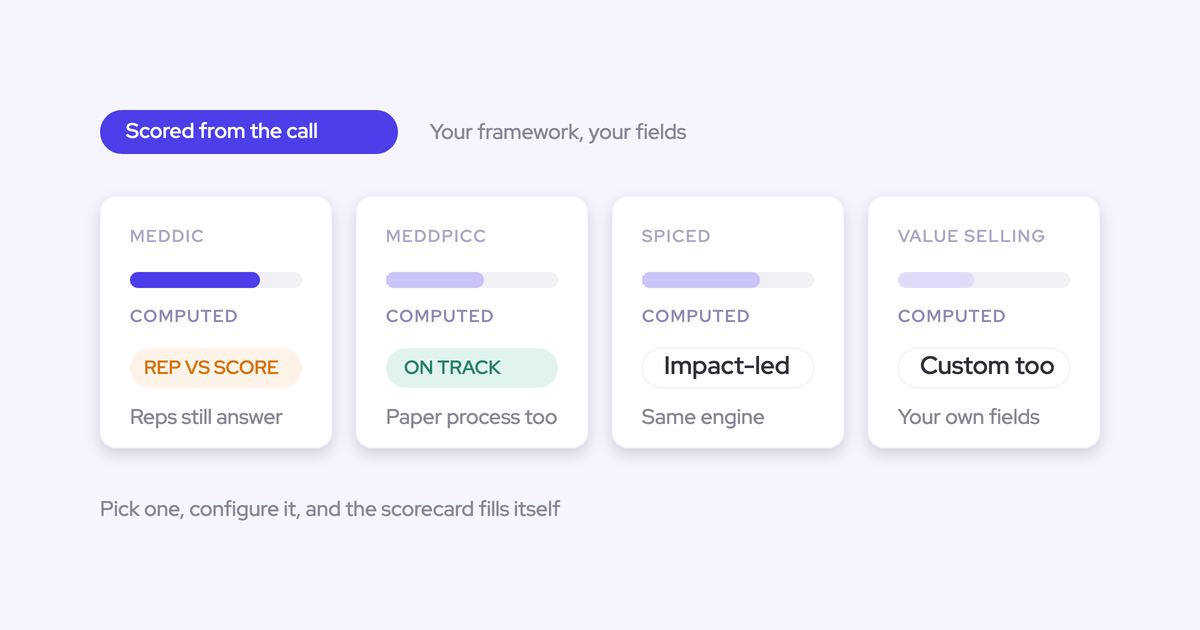
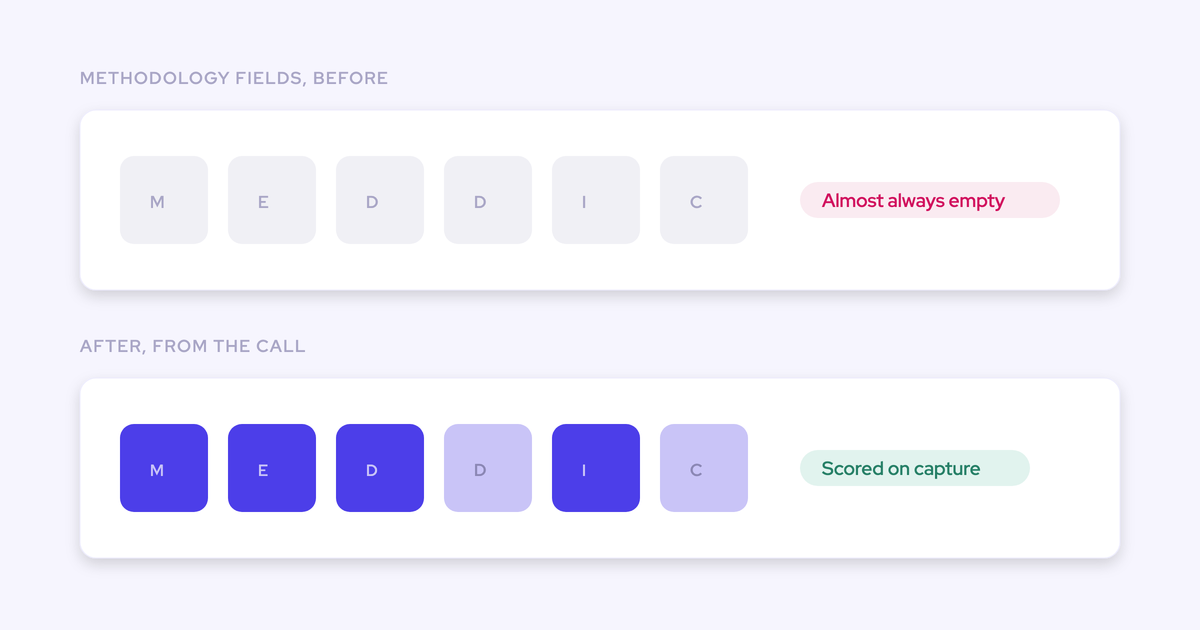
| MEDDIC | Six-criteria qualification framework (Metrics, Economic Buyer, Decision Criteria, Decision Process, Identify Pain, Champion) | Enterprise sales with long cycles, large deal sizes, and multiple stakeholders | High | 4–6 weeks |
| Challenger Sale | Teach-tailor-take control approach where the rep reframes the buyer's thinking | Commoditized markets where differentiation comes from the sales conversation itself | Medium–High | 4–8 weeks (requires cultural shift) |
Key differences. Baseline Selling covers the full sales cycle from prospecting to post-close, while SPIN and Challenger focus primarily on the discovery and presentation phases. MEDDIC is a qualification framework, not a full methodology—many teams use it alongside Baseline Selling or Sandler. Sandler's approach is the deepest in terms of psychological techniques, but it also takes the longest to internalize.
[banner type="download" url="https://www.weflow.ai/resources/cheat-sheets/sales-methodology-guide" text="Sales Methodology Implementation Guide" subtitle="Roll out a methodology your reps actually use past week two" button="Get the guide"]
If your team has never used a formal sales methodology, Baseline Selling is typically the fastest to deploy and the easiest to coach against. If you're selling into enterprise accounts with 12-month sales cycles and eight-person buying committees, MEDDIC or Sandler may be a better fit.
When should you use Baseline Selling? (best-fit sales contexts)
Baseline Selling is a strong fit when:
- Your team is adopting its first formal methodology. The baseball metaphor and four-stage structure make it the most intuitive framework to roll out. Reps with no methodology training can start applying it within days.
- You sell moderate-complexity B2B deals. Deals with one to three decision-makers, sales cycles of two to six months, and deal sizes in the $10K–$250K range are the sweet spot.
- You need fast adoption. Baseline Selling's simplicity means you can train a team in a single session and see behavioral changes within weeks—not quarters.
- Your pipeline reviews lack structure. The base-to-base model gives managers a consistent vocabulary for diagnosing where deals stall and what's needed to advance them.
- You're building a sales playbook from scratch. Baseline Selling provides enough structure to define your process without being so prescriptive that it can't adapt to your specific market.
Baseline Selling is less ideal when:
- You're running highly complex enterprise sales. Deals with eight-plus stakeholders, 12-plus-month cycles, and $500K+ deal sizes often need the deeper qualification rigor of MEDDIC or the psychological depth of Sandler.
- Your market requires a teaching-led sale. If differentiation comes from reframing how the buyer thinks about their problem—not from discovering existing pain—the Challenger Sale approach may deliver more value.
- Your team already uses a mature methodology. Switching from Sandler or MEDDIC to Baseline Selling would be a step backward in qualification depth. In that case, it's better to refine what you have.
How to implement Baseline Selling on your team
Here's a practical implementation plan.
Training approach. Start with a single half-day training session that covers the four stages, the baseball metaphor, and the key techniques at each base (positioning statement, compelling reason to buy, qualification checklist, inoffensive close). Follow the session with role-play exercises where reps practice discovery conversations and closes in pairs.
Map milestones to your CRM pipeline stages. Align each base with a stage in your CRM:
| CRM pipeline stage | Baseline Selling base | Entry criteria |
|---|---|---|
| Meeting Scheduled | 1st Base | Suspect has agreed to a meeting |
| Discovery Complete | 2nd Base | Need confirmed, compelling reason identified |
| Qualified | 3rd Base | Budget, authority, timeline, and criteria confirmed |
| Proposal / Negotiation | Home Base | Proposal delivered, decision pending |
| Closed Won | Scoring | Contract signed, handoff initiated |
This mapping makes pipeline reviews concrete. Instead of debating whether a deal is "qualified," you check whether the rep has answers to all six qualification questions from the third-base checklist.
Coaching cadences. Use milestone reviews in your weekly one-on-ones and pipeline calls:
- Weekly one-on-ones: Pick two to three deals per rep. Walk through which base each deal is on and what's needed to advance. Focus coaching on the specific skills required at that stage.
- Team pipeline reviews: Sort the pipeline by stage and look for clusters. If 60% of deals are stuck at second base, you have a discovery problem. If deals are dying between third base and home, your reps need help with presentations or closing.
- Deal clinics: Bring one stuck deal to a group session. Have the team diagnose what's missing using the stage criteria, then brainstorm approaches to advance it.
30-90 day adoption timeline:
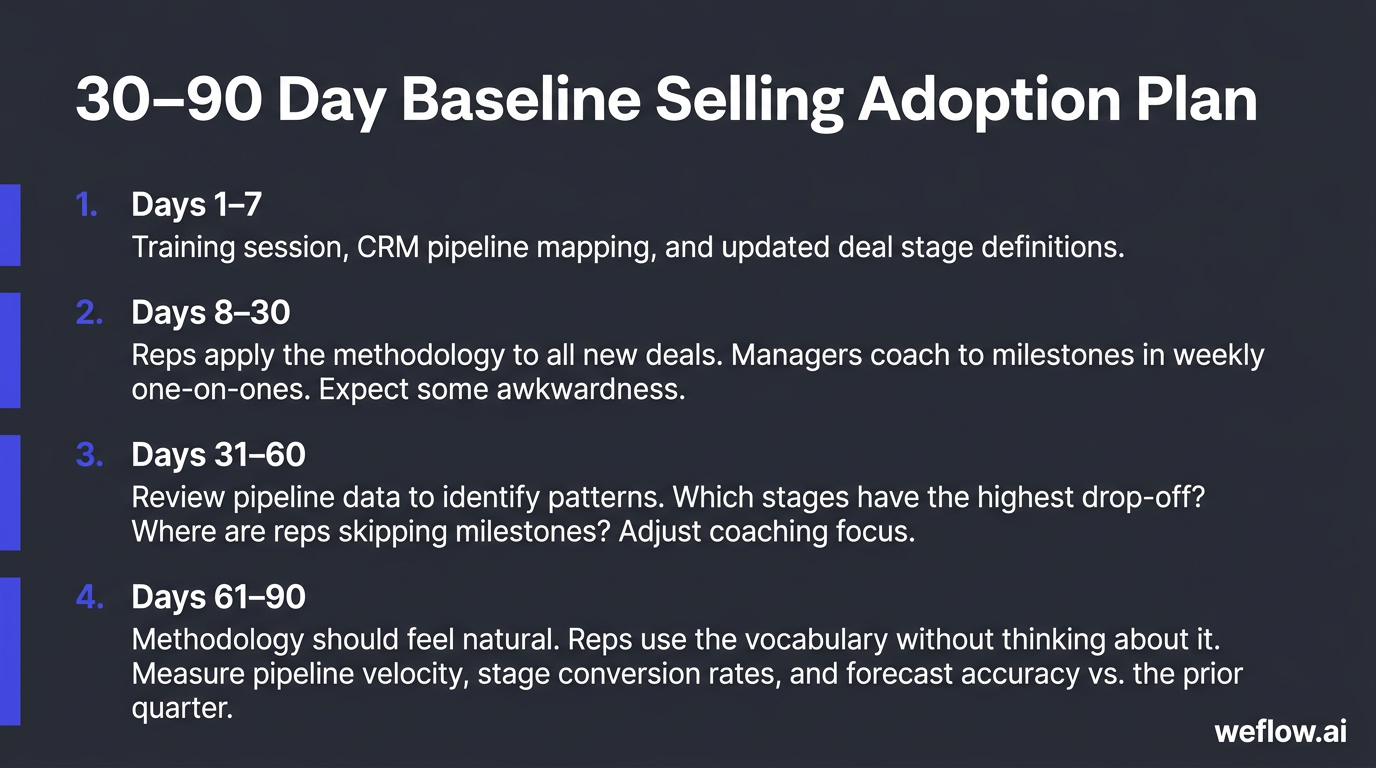
- Days 1–7: Training session, CRM pipeline mapping, and updated deal stage definitions
- Days 8–30: Reps apply the methodology to all new deals. Managers coach to milestones in weekly one-on-ones. Expect some awkwardness—this is normal.
- Days 31–60: Review pipeline data to identify patterns. Which stages have the highest drop-off? Where are reps skipping milestones? Adjust coaching focus.
- Days 61–90: Methodology should feel natural. Reps use the vocabulary without thinking about it. Measure: pipeline velocity, stage conversion rates, and forecast accuracy vs. the prior quarter.
Frequently asked questions about Baseline Selling
What is Baseline Selling?
Baseline Selling is a consultative sales methodology that maps the sales process to a baseball diamond. It breaks the sales cycle into four stages—suspect, prospect, qualify, and close—with clear milestones at each stage that determine when a deal advances.
Who created Baseline Selling?
Dave Kurlan created Baseline Selling. He's the founder of Objective Management Group (OMG) and Kurlan & Associates, and he published the methodology in his 2005 book Baseline Selling: How to Become a Sales Superstar by Using What You Already Know About the Game of Baseball.
How is Baseline Selling different from SPIN Selling or Sandler?
SPIN Selling focuses primarily on the discovery conversation using four question types. Sandler is a deeper psychological framework that emphasizes buyer qualification and mutual commitment. Baseline Selling covers the full sales cycle—from prospecting to post-close—with a simpler structure that's faster to learn and easier to coach.
What are the four stages of Baseline Selling?
First base (suspect): get a meeting. Second base (prospect): identify needs and build urgency. Third base (qualify): confirm budget, authority, timeline, and decision criteria. Home base (conclusion): present your offer and close the deal.
What types of sales teams benefit most from Baseline Selling?
Teams that are new to formal sales methodology, sell moderate-complexity B2B deals ($10K–$250K), and need a framework they can adopt in weeks—not months. It's also effective for organizations where pipeline reviews lack consistency and managers need a shared language for coaching.
What is the "inoffensive close" in Baseline Selling?
The inoffensive close is a low-pressure technique where you summarize what you've learned, confirm the fit, and ask whether it makes sense to move forward—or if there's something you've missed. It avoids high-pressure tactics while making "yes" the natural next step.
Can Baseline Selling work alongside a CRM?
Yes, and it works best when mapped directly to your CRM pipeline stages. Each base becomes a pipeline stage with defined entry criteria. This makes pipeline reviews objective—deals advance when milestones are met, not when reps feel optimistic.
How long does it take to implement Baseline Selling?
Most teams can train on the methodology in a single half-day session and start applying it to new deals immediately. Full adoption—where the vocabulary and milestones feel natural and pipeline data reflects the methodology—typically takes 60 to 90 days.
-p-1600.png)

.png)
-p-1600.png)
-p-1600.png)
-p-1600.png)
