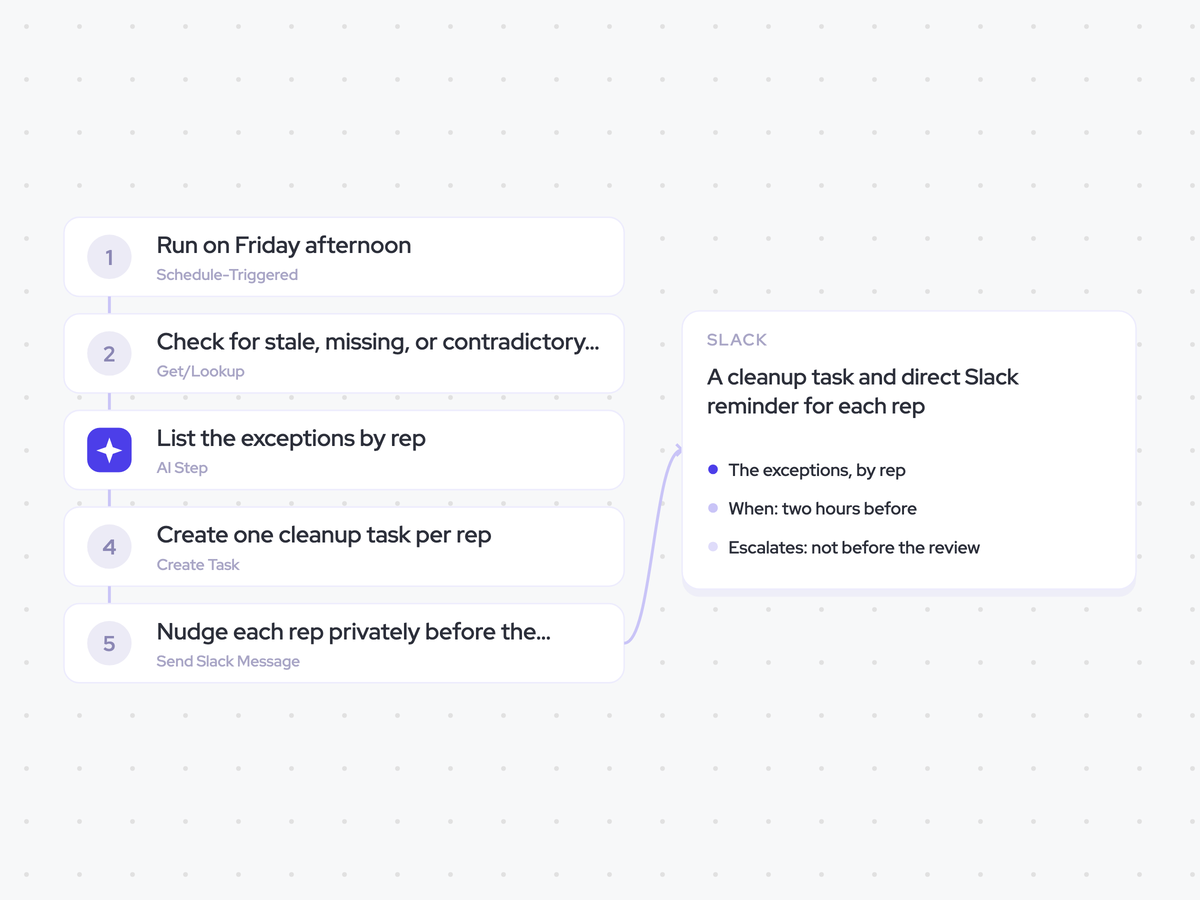
#126 Stop Building Agents, Design Workflows Instead
with
Ravi Parimi
,
GTM & RevOps Leader
October 26, 2026
·
40
min.


Key Takeaways
- Agent-first works for experiments, but production needs a workflow-first design. Ravi uses agents to test what the technology can do and to expose edge cases. Once something goes to production, the workflow is the unit of design: map the inputs and outputs, then decide which steps an agent runs and which a human owns.
- The edge cases decide whether an agent can run a process. In lead routing, the hard parts are account ownership disputes, strategic accounts and non-standard terms. Those are where humans apply judgment today, and an agent needs deterministic rules for each of them or its answers will not be accurate.
- Treat an agent as a digital worker in the talent mix, not as another tool. Agents are strongest at high-volume synthesis, such as reconciling data across systems and drafting documents. Humans are strongest at relationships, high-stakes judgment and arbitrating conflicting evidence. Workflow design assigns each step to the right one.
- Autonomy should work like a driver's license. A license lets you drive certain vehicles under certain conditions. Agents need the same scoped permissions: what they may decide, under which conditions, and where a human takes over. Full autonomy and checking every single step both miss the point.
- The work does not stop at launch. If RevOps wants to own agents across the revenue org, it owns agent operations too: speed, quality, cost, latency and ongoing improvement. Ravi wants RevOps to run workflows like a product manager, with a roadmap, versions and two- to three-week release sprints.
- The CROs of the future may come from RevOps and field engineering. The revenue org is becoming a system of humans and agents, with a different speed, cadence, compliance and risk profile. Leaders who think in systems and process design are best placed to run it, and judgment and taste become the skills that carry a premium.
- The operating model change is what the industry underestimates. Ravi's unpopular opinion is that RevOps is already one of the hardest jobs, and agents add complexity no single leader can absorb. Adding AI tools to the stack changes little; AI-native companies that rebuild the operating model will ship changes in days and weeks.
Hosts and Guest

Janis Zech
CEO at Weflow
Janis Zech is the co-founder and CEO of Weflow, and previously scaled his last B2B SaaS company from $0 to $76M ARR as CRO. He brings a sales operator’s view on why workflows, not agents, need to sit at the center of revenue teams.

Philipp Stelzer
CPO at Weflow
Philipp Stelzer is the co-founder and CPO of Weflow, focused on helping revenue teams capture activity, inspect deals, and forecast inside Salesforce. He adds a product lens to the episode’s conversation about human-agent handoffs, guardrails, and how RevOps should manage agents after launch.

Ravi Parimi
GTM & RevOps Leader
Ravi Parimi is a GTM and revenue operations leader with more than 20 years of experience in revenue operations and GTM strategy. His background includes roles at AWS, VMware, Cisco, Zendesk, and ServiceTitan, as well as a stint as an executive in residence advising a16z portfolio companies.


Full Transcript
Janis Zech: Hello, and welcome to another episode of the RevOps Lab podcast. I'm here with Philipp. Hey, Philipp.
Philipp Stelzer: Hello. Hello. How are you doing?
Janis Zech: Yeah. Doing well. Monday. I think we last recorded on Friday, so it's back to back these days because we're always late on recording. But, yeah, super excited about our guest today, Ravi Parimi. I hope I pronounced this correctly. Yeah. Welcome to the RevOps Lab.
Ravi Parimi: Thanks, Janis, and thanks, Philipp. Appreciate you having me here.
Janis Zech: Yeah. I mean, you have a long history of RevOps experience and, also, you were a partner at Andreessen Horowitz for the go to market area. Right? But maybe before I, you know, completely, you know, like, misguide your introduction, maybe you can say a few words about yourself, your background, your experiences. And then, yeah, I think we have a really interesting topic today. Really loved the prep talks, so very excited about today's episode.
Ravi Parimi: Yeah, thanks for that. So my experience has been sort of like, you know, revenue operations, working in, of course, like highly scaled companies like AWS, VMware, Cisco, I think those are the really large companies and I've worked for a couple of SaaS companies as well, Zendesk and ServiceTitan. I think the one that you mentioned about Andreessen Horowitz, unique role. I think in being a resident, like an EIR, like an executive in residence, like being the go to market specialist, advising portfolio companies on how to scale their operations and of course how to think about their go to market strategy as they think about scaling from founder led sales to like really kind of like establishing like a, like a core motion when it comes to selling. I've been in the industry for more than twenty years. Most of my, if I think of the first half of my career, about the first five to seven years of my career is mostly focused on strategy operations, implementations, really kind of like getting hands on, being in consulting at Deloitte and PwC. And right after that, I think even in the role that I've taken at Cisco was mostly in engineering operations, and towards the tail end of when I was leaving Cisco, when I transitioned over to go to market, really working with the, like a sales and marketing and the partner teams when it comes to operations, so that's been an enablement. That's when I've transitioned since then and on, since twenty twelve, twenty fourteen, I think, you know, I have completely transitioned over to GTM ops.
Janis Zech: Yeah. It's fascinating when the... We had, I think this is the hundredth, fifteenth or twentieth episodes. We had many RevOps leaders on the podcast, and it's always interesting to hear, you know, what the background is. I mean, you have a CS background, and in our prep tour, I could definitely feel that very much. So, today's topic is, you know, how AI is deployed in the enterprise, what's going wrong and right, especially. So maybe, like, jumping into the first question, you know, I mean, I think, you know, everyone in RevOps hears this these days. Right? Like, we have to build agents. We have to build agents. We have to build agents. Right? Like, it's the thing that the board transitions into the executives and the executives lay it out, you know, like, and everybody wants agents. You know, you have a, I think, kind of a interesting opinion on this, which I very much share. You know, what is in your mind and in your experience wrong with that agent first mindset?
Ravi Parimi: Yeah. I think, you know, the initial wave of, I mean, this is classic RevOps, right? I think anytime we get a request or anytime a CRO is asked to develop like an AI strategy, the first thing that we go naturally or inclined to is like to come up with a tool or come up with some technical solution. I think agent first mindset works in experimentation. Like if you're experimenting on what works, what is the capability of this technology? How, what are the limits to be? If you are testing the limits of like what an agent can do, I think, you know, of course that mindset is useful. But once you think of like deploying this into production, I think it is just never going to work because when you think about like what actually is deployed in production, it is all about workflows. A workflow is, I mean, at the core, is the unit of design for any business. Like, I mean, I think, you know, there are people, there are sequence of processes with inputs and outputs. There are people who are actually doing it on a certain things. And of course there are systems and tools, etcetera. When we bring a digital worker, like an agent, really kind of thinking it like another tool is, I think is the wrong mindset, number one. Number two, I think as we think about production, you know, you are talking about, like, for example, if you take lead routing process, if it's like very subjective, if it is something that has been in existence with only humans being in the, sort of like at the wheel, kind of like basically automating a process that is highly, not only inefficient, but it's very, very not, very much not taken into account with the agents being in the mix. Like even if, like if we take CRM as an example, I mean, if you put agent on top of CRM, it's like, a CRM can be like a dumpster fire of like a lot of different things with so many different fields. How you should reimagine sort of like, you know, having agents in the mix, especially in the context of workflow first mindset is super important. I often think like agent first and workflow first are two different sort of like questions asking for two different stages. If you're experimenting stuff on like, hey, I want to test like, what is an agent capability? What are the things that will expose in our, in my business, where we need, where we need some human on the loop for exceptions, where we need some human involvement for making the process work, when we see conflicting evidence. Like, I mean, really kind of hit the surface to understand those use cases. I think it's important to have some experimentation with agents, but once you have an idea like that you're going to be pushing this into production, it's, I think you really need to think like, what is the end to end workflow, but really mapping out the input output contracts, and having an idea of like, you know, where you would place a human and where you would have an agent, and what is that interplay between like how, which ones the agent would execute and which ones to sort of like, you know, a human would be at the wheel, right? So that's, for me, I think that's one of the fundamental sort of like, sort of like a mindset shift, I think needs to happen as companies think of deploying agents into production.
Philipp Stelzer: Yeah. Just just a a a question there to to follow-up on, just so I, you know, correctly understand it, is basically what you're saying is, hey. Look. An agent really is is like a tool to solve, like, a certain job, and, you know, a job needs to have a certain outcome. Or, like, you basically want to get to, like, a certain outcome, jobs that you need to be done, right, in the org no matter like what team or departments or etcetera. And so what people should really basically start with is to think about, okay, what are sort of like the jobs we need to take care of in our business? What kind of, like, workflows and processes do we have in place today? And and then basically start from there and to assess, okay, how could we involve an agent in that workflow to help us to be more successful, or could an agent even potentially replace the humans that are taking care of this workflow at the moment? I think lead routing is, like, a great example. Right? Like, nowadays, you have many tools that do lead routing, some well, some less well, right? I think you still need to fix it every now and then. It's never perfect, but is that like a fair summary?
Ravi Parimi: Yes, it is. I think, I mean, think a lot of the first generation of agent development has been task based. Like, I mean, hey, I want to sort of, I want to do this X, Y, Z task. And of course, an agent would help to be able to write an email, summarize a draft, or sort of like write a document, etcetera. But once you think of like, to your point about like thinking from outcomes and really kind of like, what are the jobs to be done? It really involves a series of steps for you to be able to execute. And in that sequence, gotta think about like how agents fit. Even in lead, even if you take lead routing as an example. What if there is a dispute on account ownership? What if there is like in strategic accounts? I mean, would you just use your standard lead routing process for doing strategic account routing as well? Like what if there are like non standard terms? Like, I mean, are, there are things that one has to really think about. What are the exception cases? What are the things where you would think that you have it solved by just autonomously asking agent to do it, but unless you really kick tires and be able to sort of like understand what could be the edge cases, what could be the non standard ways of doing things and how, where the way should humans be involved? Those are the kinds of things I would, I would really, that's why I was advocating for really think about workflows, because once you think about workflows, you would, you would have a good understanding of like what the edge cases are, where you think you will have some conflicting information, where the humans are really applying judgment to make the process work, because you have to be highly deterministic in terms of your rules when you feed it to the agent for it to do its job without any hallucination. Otherwise, you're gonna just, you know, your answers are not gonna be very sort of accurate.
Janis Zech: Yeah. Yeah. Sorry. Go ahead. Just just a question on... So so the way I understand this, essentially, the workflow is the higher level of... And and and typically involves the agent and humans that, you know, take certain tasks. Right? So, like, I'm curious, like, you know... And I I really, really like that I I really subscribe to that. I I think you could also say, let's, you know, analyze what is the process, right, we want to improve end to end, and then, you know, let's think about, you know, is it a technology? Is it, you know, a change management process? Is it, you know, certain trainings that we need to involve to essentially have a better outcome? I'm I'm curious, you know, what you see today. Right? Like, is it... Is is that mindset in the stakeholders, is that something you generally see or is that something that is, you know, like, you know, because everybody's so excited about the power of agents, you know, is kind of missing? Do you see that in data points now?
Ravi Parimi: Yeah, yeah, I think it's a part of it is, of course, some of it is leaders kind of like, you know, driving their teams to kind of like creating the sense of urgency to deploy certain things. And of course, RevOps and a lot of other teams, not just in RevOps, even across other functions, see this natural tendency to kind of like to use it like a tool, of course, but also not having or not recognizing how complex it is to deploy agents into production. What I mean by that is, when you think about like, you know, workflows in general, like how you think about process, like you have to have, think of it like a workplace, like just, think equally, these workflows are not new. I mean, AI didn't introduce workflows. We've been doing this for like decades, right? But the idea that having a process centric approach to design, workflow design is super important. The, oftentimes people kind of think that it's, I have an existing process, like, I mean, for lack of a better word, and then I'm going to just have an agent on top of it and just let it execute. I mean, that's like, I mean, an agent can do like things ten thousand times faster. It can, you know, query ten databases in five seconds. Like, I mean, nobody is prepared to kind of like that process, that amount of process acceleration. So really, even you think about process, you really have to unpack to see where you see things, where an agent can play a huge role, and where you see that things where a human can play a role. I think for example, like, I mean, there are certain use cases where agents have an extraordinary advantage when it comes to really kind of like a high volume of synthesis, like data synthesis. Like, I mean, being very sort of like, you know, being able to reconcile data across multiple systems and being able to sort of like, you know, write complex series of like, whether it's documents or content generation. And there are so many use cases like that. And there are use cases where humans are very sort of equipped to be very, very effective, whether it's relationships, whether it's applying high judgment, whether it's like being very strategic, sort of like a, sort of like arbiter of things when you have conflicting evidence. So a lot of those, like you have to think about, like when you take a process mindset and it comes to workflow design, you have to really, now you have a digital worker in the mix. Now, just like any other sort of employees, when you think about talent mix, there are certain things that you would consider that role would do and the other, there are things that you would ask that some other role would take on. So you really have to think about probably almost like an agent to be a digital worker in the mix rather than some tool. Yes, it is a tool at the end of the day, but you really have to, when you think about workflow design and process steps, you really think about, yeah, think about like what is an agent capability versus a human capability.
Philipp Stelzer: Yeah, yeah. One thing that makes me think about is, you know, with Anthropic, one of the things that they... I'm not... I I don't think it was just a marketing stunt, but, like, earlier this year, you know, they talked about, okay, we have this, like, moral compass that that we've given Claude, and they actually hired, like, philosophers to also write that. Right? Like, I forgot, like, the exact term that they're using for this, but it's basically like a moral compass, like a constitution, you can say. That is ingrained into Claude, you know, better or worse, I'm not sure. And and it gives it like some some guidelines, like, you know, this is how, you know, we want to behave. This is, you know, what we believe in, sort of like those are, like the the different philosophies we subscribe to. And I think that that... That's what it reminds me about now what what you just said. Right? Like, you you basically have a job description when you when you publish like a job. Right? Like, you have a job description, and then in the job description, there might be some traits and requirements and things that you, you know, should be able to do. And then, you know, during the interview process, what you do with that person that you wanna hire is you also test them for, like, cultural fits. You know? Do they have the right mindset? You know? Do you think they would be a good fit to the team? How do they think about problems and stuff like this? Obviously, right, that's not exactly what you would be doing with an with an agent. Right? But you would try to basically write down the skills. You would try to create, like, a feedback loop, and that you... That's what you would use to basically ingrain that, like, you know, that sort of, like, perspective that this agent should have on how to do the work and and what matters, what's important, what needs to be prioritized, etcetera. It's pretty similar or like, or or how would you put it?
Ravi Parimi: Yeah. Yeah. It's it's sort of similar. I think, I mean, I think, you know, I've... On one spectrum, companies think that agents are like this superpower. It has all the superpowers. It can be completely autonomous. That's one end of the spectrum. The other end is like, you know what? I need to have human in the loop for everything, which is like, you know, I don't trust it, which is like, you know, I'm gonna ask, ask it to do something, and of course, I'll go check it. I'll verify every single step. There's no point in this, it's like two ends of the spectrum. I understand autonomy comes, autonomy is like, should have a renewable license when it comes to like, you know, agent, which is like, you know, it has to have a certain scope when it comes to permissions. Should be clearly defined in what conditions it is allowed to decide, in what conditions it is allowed to sort of like, you know, execute certain steps. I mean, I think if you think about it, right, I think it does make sense. If you think, if you apply for a driver's license, I mean, you don't get to drive every vehicle under every condition. I mean, they test for it, okay, you're allowed to drive a car, or if you're driving like an eighteen wheeler, of course it's a different thing. So everything comes with like a set of permissions under which you are allowed to sort of like execute and perform. So I think, you know, that's sort of, you know, the agent sort of like, you know, really understanding the scope of responsibility of an agent and how you sort of like allow it to sort of be in the mix of humans, I think super important.
Janis Zech: One thing I'm curious about... I mean, so you start with a workflow. Right? Like, I mean, can you actually, you know, build agents into existing workflows? Do you completely have to rethink them? And, you know, like, what does change for the human when agents are in the loop? Because, obviously, the velocity is potentially so much higher, right, that, like, you even need to think... Rethink your org design sometimes because suddenly there's so much stuff happening, so the velocity is a lot higher. So you might actually find out that you need a lot more humans in the loop because in a specific workflow, I'm curious how you think about that.
Ravi Parimi: Yeah. Like, I mean, that's that's actually goes to the crux of like really the whole agentic design. I mean, it's I mean, if there are like low sort of like complexity use cases, meeting prep, research, like in a summarization, like, you know, like a, you know, in sort of like generating insights from, through an MCP, those are, like, you don't have to really think about a workflow because those are specific tasks that would augment, that would serve, that would make a rep or anybody 10x productive. Like that, I mean, those are obvious. When we really think about workflows, it really kind of, I think, thinking like lead routing, qualification, like, I mean, so deal, sort of a forecasting, like a deal risk, I mean, really kind of like core capabilities within RevOps, if you will. But my main, I think in the, one of the things that folks are not really paying attention in this agentic design, especially with, even with workflows, is the work doesn't really stop at launch. I mean, I think, you know, you're just deploying something in production doesn't mean that your work is done. I think, you know, there is, I mean, who's responsible? I mean, if RevOps want to be in that, in that, in that ownership chair to hold the responsibility for like, agents in the, across the revenue organization, you also have to take responsibility for agent operations post launch. What that means is like, like all the, like not only being responsible for it's like a speed, quality, cost, latency, everything, like all the things that come with it, and of course the ongoing improvement that comes with it. I think that comes from a state of mind where one has to think about more product centric, which is like, like how you think about releases, how you think about like, you know, roadmaps, how you think about almost like a DevOps mindset, which is like what the engineering has run through, through DevOps, where you have to really think about like, you know, agile workflows, I mean, agile release process in a, like a two week or a three week sprints to be able to deploy changes to production and somebody taking ownership or roadmap, in this case, a workflow, and somebody has to have that sort of like, you know, ownership or benchmarks and of course, performance metrics. And those are the kinds of things that I don't see today. I think, you know, we have a lot of momentum and a lot of energy on sort of like, you know, deploying agents and just pushing there, but not really taking ownership for operations of, of, of the, of the agents itself, because that's where the real power comes in. I mean, the way how I think about it is like, for workflows, you have to have a process mindset. I mean, you really think, need to think like from a process standpoint, but when it comes to delivery and operations, and of course, anything that comes post launch, you have to think like a product manager. Like, I mean, it's like, well, what is it? How, what, what did we deploy? How do you sort of like, what's working, what's not working? What are the items that need to be on the roadmap for the workflow to be sort of like workflow V1 versus workflow V2, workflow V3. So how do you sort of, how do you think of iterating that from a product standpoint? I think that's how I should think about it.
Philipp Stelzer: Yeah. Yeah. I think this whole concept of like, you know, like, just having an agent deploying it and then basically be done with it, like, after deployment, I think that's that's so so critical and I think is is is also a lot where, like, this whole discussion around, like, security in the realm of, like, AI is about at the moment. Right? Like, if you think about a piece of software, right, like, you test it before you release it, right, to production because otherwise, like, you might, like, break, like, a lot of important things for your customers or yourself, and and you do that every step for, like, the development of, like, a, you know, like, a feature update or just a general release update or whatever. And I think the same should be should be true for anything else you do with AI, like, with an agent. Like, you need to actually have, like, a testing environment. Ideally, you have, like, some kind of, like, closed system. Maybe you can test it first and where you have the security layers to really, you know, make sure that nothing nothing gets broken because I think we've all heard those stories now, you know, where, like, an agent, you know, if it has, like, a lot of flexibility to do certain things and you push it a lot, right, like, it sometimes does things that you don't want it to do and it doesn't tell you about. And I don't wanna be, you know, like, a fearmonger. Like, that's not my my intention here. But I think it's just, a a really good mindset to have. I think you can control it, but you need to build that system around it to allow for those feedback loops. And I fully agree, Ravi. I I think those don't exist. Right? Like, you look at solutions like, I don't know, n8n or, like, there's many workflow builders, and I think many have not really done, like, the due diligence to make sure, okay. Hey. Here's your sandbox environment. It's super secure. Here's, like, the feedback loop system. You can give it to train it further. I think you see, like, the first nuances of that, but I think, overall, you know, we as an industry, I think it's fair to say, have not gone to that step yet. Right? Yeah. Yeah. It's just something I think every... Everyone needs to work on that to, you know, catch up on it. Not blaming anyone in particular. Right? Like, it's all it's all good. It's moving very fast. Right? Like...
Janis Zech: It's moving very fast. And these guardrails need to be need to be built. But they... I mean, I think, you know, it's different to say whether we die in ten years versus, you know, agents are hacking systems, which is already the case and happening as of today. Right? So the whole compliance and permission sets of an agent will play a much bigger role. And I think people are, you know, like, waking up to it, hopefully not the hard way. Right? I think nobody... I wish no one, you know, a reality where an agent went out and, you know, suddenly deleted your CRM data also. Right? Like... But, I mean, you know, that's exactly, I think, why these guardrails should be in place and the, like, you know, the mindset of... Or not just the mindset. Right? The the the reality of a product development process needs to, you know, grow. And and and also, you know, I think we speak a lot about this, like, you know, can RevOps become the AI operators? Right? Should they, you know, take that leap of faith? And I think that then goes beyond go to market. Right? That's finance ops, engineering ops. Like... And, you know, is the right path kind of the CRO or, like, the COO path or, you know, where where does it go? Right? I think it's something very interesting. But, yeah, I I love that love that perspective. I'm curious what you think of that. Right? Like, you know, when you think of the future of RevOps, like, you know, if you're kind of a head of RevOps, director of RevOps these days, right, like, do you think this is important to learn? Do you think this is worth, you know, jumping into this to accelerate your career, or would you rather look somewhere else?
Ravi Parimi: Yeah, I'm highly bullish on RevOps. I think this is one of those rare opportunities. I think, you know, I may, I'll take a leap of faith. I think if you have spent time in sales, and you have done as a rotation in RevOps, I think you would never go back to sales again. I think this is, the future of RevOps, or in general revenue organization, is going to be much more around systems rather than people. I think, you know, if you look at the charter of any future modern CRO, they have to build a system which has a combination of agents, humans in that mix, in labor mix. And, and, and, and the, the key difference between what they used to manage and what, what it is coming towards them is, I mean, I think you were talking about different speed, different cadence. You're talking about different evaluations in terms of performance. You're talking about different levels of compliance and risk, the way which you need to report to the board, and of course, your sort of CEO, etcetera. So I see, I think, probably SEs, like somebody, like a VP of field engineering or a solution engineering, VP of RevOps are the two that are highly bullish to really be in the leadership chair, even be the CROs of the future. I think the days of really being very relationship oriented only as the Rolodex and having some understanding of the sales process along with sort of like, you know, insights and analytics through your sort of like, you know, expecting from your RevOps organization. I think those days will pretty soon come to an end. I think I'm not saying that a lot of those are not important, they are important, but I think the operating model need to be, will look much different than what it is today. Operating model, to the point that I just mentioned about the cadences that you, at which you kind of like, you know, look at your business, the speed at which you have to make decisions, the level of automation that's required, and the risk that you sort of like assess in different parts of your business with a whole different lens. I think a lot of that is, I don't, most of the CROs, I don't think are prepared for that world. I think it's, but another, from a skill set perspective, RevOps being very close to systems, very close to the process design, very close to insights, and really being that sort of like an interpreter of the state of the business, I think is a unique, is in a unique position. Another role that I could see that could be very impactful is the field engineering. Somebody who are very technical, who understand the customer, but at the same time has a good understanding of like, in general, sort of like, you know, the, how the sales process works, and of course, you know, how they think about systems in general. So systems thinking and sort of like what I call as, this is a, like, I mean, this is a huge responsibility. I don't, like, to be able to sort of like, you know, be sort of like running a revenue organization that's running at warp speed. I don't think a lot of folks will be ready for the transition, but that day will come eventually, but I mean, depends on how soon you wanna transform your go to market.
Philipp Stelzer: Yep. I think we are, as a, like a society, are not ready, you know, to some extent. Yeah. Yeah. I think one thing that resonates with me also here is, like, the field engineering. Right? Like, to be... I know, like, a common term now is forward deployed, I think, is what it's called.
Ravi Parimi: Forward deployed. I mean, it's more of like it's a modern cool name for professional services. That's the way how I think about it. I think in a field, I mean, see, field engineering is like classic sales engineering, like, I mean, SEs or solution engineers. I mean, at least more on the presale side is what I'm thinking. I think those are, those tend to be like very technical, of course. Are very product experts, but at the same time you have, they also understand like, you know, systems and systems thinking, architecture, like they are very, so that's how their minds work. So I think, you know, that is an area that I could see some leaders coming from that side to really be the CROs of the future.
Philipp Stelzer: Yeah, interesting. That's definitely like a hot take, but I love it because I think it depends on the product. Right? But if you have like a very technical product that goes deep and also beyond just like being technical but might also have like a change management impact on the organization that that you're selling to, then I think, like, a solution engineer that really, like, goes above and beyond, like, the technical piece but understands, okay. This is sort of, like, you know, again, back to, like, the jobs to be done. This is sort of like what we're solving, you know, for the customer. This is how it will impact their organization. Right? Like... Because I I think with some of these things, you know, you you introduce, like, a new tool or you introduce, like, an agent workflow, right, like, with a customer organization or, like, within your own organization, quite frankly, it can have the impact that, like, certain, like, positions, you know, kinda, like, lose in value and sort of, like, what they contribute to the company's overall goals, whatever they are. And I think, like, a good solution engineer is sort of, like, aware of that and is is, you know, is not just, here to implement, like, here's, like, a a flow, right, that does this now, but, like, but they understand, hey. Okay. Hey. Look. You know, this is like the people we need to get involved for this, and this is sort of like the impact that it can have, and, you know, this is like the training and stuff like the the things we need to do to create acceptance for it. And... Yeah. Yeah. So it it... I'm I'm passionate about it because I think it's also something that we at Weflow think about and do a lot. Right? Like, with forecasting just as an example. Right? Like, that can have a huge impact. Right? Like, you have, a forecasting agent. It summarizes a lot of, like, different information from different sources. You might have, like, a BI team with, three people who who who do nothing but just that. Right? So that's a a big thing if you introduce then like a solution like that. You might still have like a need for those BI people, but like, you know, sort of like their role is changing with this. Yeah. So.
Ravi Parimi: Yeah, all roles, I mean, a lot of the roles will change for sure. I think, you know, the premium on having judgment and taste is gonna be at the level with the agents being in the mix. I think, you know, if, I mean, judgment of course comes from experience through solving problems, critical thinking, all of those things over the years that you build. But I think, you know, as you think about like, you know, an agent gives an answer, like whether it's forecast or whether it's churn risk or whatever it is, being able to sort of like, you know, ask questions, like really question like the underlying assumptions and seeing the whole picture and connecting the dots, and really kind of like applying the lens of the business, whether it's by segment, whether it's new versus expansion customers, whether it's like, like whatever the vector that you want to look at, but having that sort of like, you know, acute lens of how to judge the answers and what are the things that that you would... I mean, I think, I mean, in the future, you might even have agents do that, which is like agents being the, they will be the judge of the other agents' work or outputs,
right. So I think, you know, the roles definitely will change. I think if I think about RevOps, it's one of those, I think even if you think about RevOps and IT and enablement, a lot of these things, I think they will hopefully, I think, you know, converge a little bit in terms of like even when I think about future of RevOps, I don't think it will be RevOps, it will be more like revenue architecture and systems or something like that. of the most of the work is going to be like managing sort of like a production system that has really kind of like instrument. I mean, I think your day in the life of RevOps manager in the future should be what am I automating today? Like what are the things that what are the signals that I'm getting? What are the things that need to be automated? You have to be in the continuous automation train, not like a quarterly or a monthly release And it has to be like a much more different thing.
Janis Zech: It feels a bit like we have to invite you back. There's so much cool stuff. And we are absolutely off script these by now, but that's awesome. Yeah, I think let's do that maybe that's, you know, whenever you have time, this is a standing invitation. Philipp, what's our closing question these days?
Philipp Stelzer: Yeah. So for those who have not heard the last two episodes, we changed it around a little bit. So now we're going for the rage bait. No, but Ravi, what is an unpopular opinion you think you have around the RevOps function, the realm of RevOps at the moment?
Ravi Parimi: Yeah, I think RevOps is one of the most complex, toughest job that there is. The reason why I say that is it's asked to do many things. It is asked to kind of re-engineer the sales process, really kind of be on top of what's happening in the business when it comes to analytics and sort of what I call as insights and whatnot, being very proactive, not really kind of sitting back and being the sort of order taker. And you are also responsible for tech stack and a lot of these things. I'm like, that's a lot. That's a lot of stuff to actually find in one person or even a group of people to be able to do that. And I think a lot of, you know, there is no one leader actually who can do all those things effectively, even without agents. Now you have agents in the mix. Now you are talking about the level of complexity that is highly, highly sort of unmanageable, people, even if you have a team of people, I think the level of naivety when it comes to an operating model change that's required to be able to drive this transformation is so underestimated in the industry. I think people are just in the old RevOps mindset, which is like, hey, I need XYZ tool to do this and what are the latest AI tools that I'm going to just put all these things in the tech stack and see how it works. I think it fundamentally, I think, and I've been saying this for a long time, if you're not thinking about operating model change with agents and humans in the mix, I think no matter how many agents you have, it doesn't really matter. There will always be AI-native companies who will be deploying changes in weeks, days, and who will have really working at a speed that you wouldn't even be able to compete. I think that that is a calling card, at least for the ones which have bond and shares, not even in the traditional enterprise environments. But they have to really think about how they transform the operating model from the inside out.
Janis Zech: Mm-hmm. I love that. Ravi, this was awesome. Really appreciate it. So many great things. Yeah. And I'll ping you on finding time whenever it's good for you. Three months, six months, 12 months. We'd love to have you back. Thank you so much for joining.
Ravi Parimi: Yeah. Thanks for having me. Appreciate it. Thank you, Philipp. And thank you, Janis.
Philipp Stelzer: Thank you.
Learn more about GTM & revenue operations
RevOps Lab Podcast


Free Forecast Cheat Sheet

AI Agent Templates