
How to Take Better Sales Notes: Templates, Examples, and CRM Tips
Learn what to capture in sales notes, use templates and examples, and sync notes to your CRM.




Sales notes are the record of prospect pain points, objections, next steps, and commitments captured during sales calls and meetings. They're the connective tissue between conversations and closed deals—the difference between a rep who remembers every detail and one who shows up to the next call asking questions the prospect already answered.
For B2B sales teams running on Salesforce, sales notes serve three purposes: they preserve context that would otherwise evaporate within hours, they enable handoffs between reps, SDRs, and customer success without friction, and they feed the pipeline data that RevOps and leadership need for accurate forecasting. Without structured notes, your Salesforce records become a graveyard of incomplete opportunity data—technically compliant but practically useless.
This guide covers everything B2B sales reps, managers, and RevOps leaders need to build a note-taking practice that actually closes deals: what to capture, how to format it, where to store it, and how to automate the parts that don’t require human judgment.
Why sales notes close more deals
Sales notes don’t close deals by themselves. They close deals by preventing the information loss that kills momentum, enables personalization, and surfaces patterns that would otherwise stay hidden in individual rep conversations.
How notes prevent lost details after discovery calls
The average B2B sales rep handles 25-50 active opportunities at any given time. After a discovery call, you might feel confident you’ll remember the prospect’s budget constraints, their timeline concerns, and the specific pain point that made them take the meeting. You won’t.
Research on memory decay shows that people forget roughly 50% of new information within an hour and 70% within 24 hours. For sales, this means the objection the CFO raised about implementation timeline, the competitor they mentioned evaluating, and the internal champion’s name you didn’t write down—all of it fades before your next call.
Structured notes captured within five minutes of hanging up preserve these details exactly when they’re freshest. When you return to that opportunity two weeks later for a follow-up, you’re not guessing what mattered to them—you’re reading it.
How sales notes enable cross-team handoffs
Every sales organization has handoff points: SDR to AE, AE to solutions engineer, AE to customer success. Each handoff is an opportunity for context to disappear.
When an SDR books a meeting and the AE shows up asking the same qualification questions the prospect already answered, the deal starts on the back foot. When a solutions engineer walks into a demo without knowing the specific use case the prospect cares about, they demo features nobody asked for. When customer success inherits an account without knowing what was promised during the sales cycle, renewal becomes a firefight.
Sales notes that live in Salesforce—attached to the right contact, opportunity, and account records—solve this. The next person in the chain reads what happened before they engage. No information lost, no repeated questions, no erosion of trust.
Using notes to prepare personalized follow-up meetings
Generic follow-ups get ignored. “Just checking in” emails have a 1-2% response rate. What works is specificity: referencing the exact objection they raised, the metric they mentioned caring about, the internal blocker they’re worried about.
This specificity comes from notes. Before your second call, you review what happened in the first. You see that the VP of Sales mentioned forecast accuracy is a board-level concern. Your follow-up opens with: “Last time we talked, you mentioned your board is asking hard questions about forecast accuracy. I wanted to share how other companies in your situation have approached that.”
That’s not a template. That’s a note you wrote two weeks ago, working for you now.
How note-taking feeds pipeline insights and coaching
Individual notes help individual deals. Aggregated notes reveal patterns.
When sales managers review notes across their team’s opportunities, they see which objections come up repeatedly, which competitors appear most often, which deal stages have the most slippage. This turns anecdotal “I feel like pricing is an issue” into documented “pricing objections appeared in 34% of lost deals last quarter.”
For RevOps leaders building forecast models, structured notes provide the qualitative context that pipeline stages alone can’t capture. Two deals at the same stage with the same dollar amount might have completely different close probabilities based on what’s in the notes: one has budget confirmed and a signed mutual action plan, the other has vague interest and no next steps defined.
What to capture in every sales note
Effective sales notes follow a structure. Unstructured notes become walls of text nobody reads. Structured notes become searchable, actionable records that serve you and your team months later.
Here’s what to capture in every call:
| Category | What to note | Example |
|---|---|---|
| Pain points | The specific problems driving this evaluation—not generic industry challenges, but what keeps this person up at night | “Reps spend 5+ hours/week on CRM admin. VP Sales frustrated that pipeline data is always stale by forecast call.” |
| Objections | Concerns raised about your solution, pricing, implementation, or switching costs | “Worried about change management—just rolled out new sales methodology. Doesn’t want another tool adoption project.” |
| Decision makers | Names, titles, and roles in the buying process (champion, economic buyer, technical evaluator, blocker) | “Sarah Chen (Dir RevOps) = champion, owns eval. Mike Torres (CFO) = economic buyer, signs off on anything over $50k. IT security review required.” |
| Next steps | Specific actions with owners and deadlines—not “follow up next week” but exactly what happens next | “Send ROI calculator by Friday. Sarah to schedule 30-min call with Mike for budget conversation. Demo for sales managers on 3/15.” |
| Timeline | When they need to make a decision and why that date matters | “Contract decision by end of Q2. Current tool renewal in July—need 30-day notice to cancel.” |
| Budget signals | Any indication of budget range, approval process, or financial constraints | “Budget allocated for ‘revenue intelligence’—$40-60k range. Over $50k needs CFO approval. Under $50k Sarah can sign.” |
Not every call surfaces information in every category. A discovery call focuses heavily on pain points and decision makers. A demo call surfaces objections. A negotiation call confirms budget and timeline. The framework stays consistent; what you capture varies by stage.
Sales note examples: good vs. bad (with comparison table)
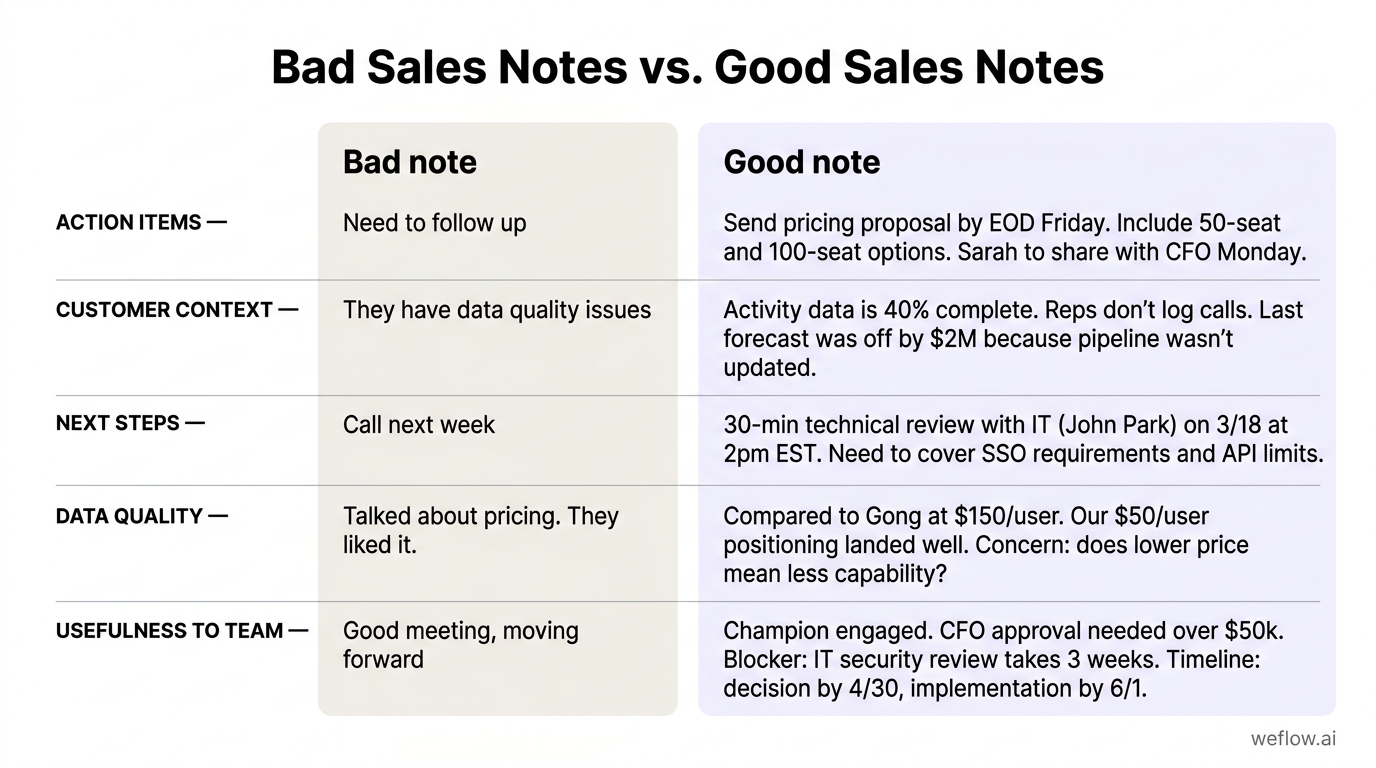
The difference between notes that help you close deals and notes that waste storage space comes down to specificity, structure, and actionability.
Here’s a side-by-side comparison:
| Aspect | Bad note | Good note |
|---|---|---|
| Action items | “Need to follow up” | “Send pricing proposal by EOD Friday. Include 50-seat and 100-seat options. Sarah to share with CFO Monday.” |
| Customer context | “They have data quality issues” | “Activity data is 40% complete. Reps don’t log calls. Last forecast was off by $2M because pipeline wasn’t updated.” |
| Next steps | “Call next week” | “30-min technical review with IT (John Park) on 3/18 at 2pm EST. Need to cover SSO requirements and API limits.” |
| Data quality | “Talked about pricing. They liked it.” | “Compared to Gong at $150/user. Our $50/user positioning landed well. Concern: does lower price mean less capability?” |
| Usefulness to team | “Good meeting, moving forward” | “Champion engaged. CFO approval needed over $50k. Blocker: IT security review takes 3 weeks. Timeline: decision by 4/30, implementation by 6/1.” |
Bad notes capture that something happened. Good notes capture what happened, what it means, and what needs to happen next. A colleague reading a good note can pick up the deal tomorrow without asking you a single question.
Sales note templates: frameworks for discovery, demo, and follow-up calls
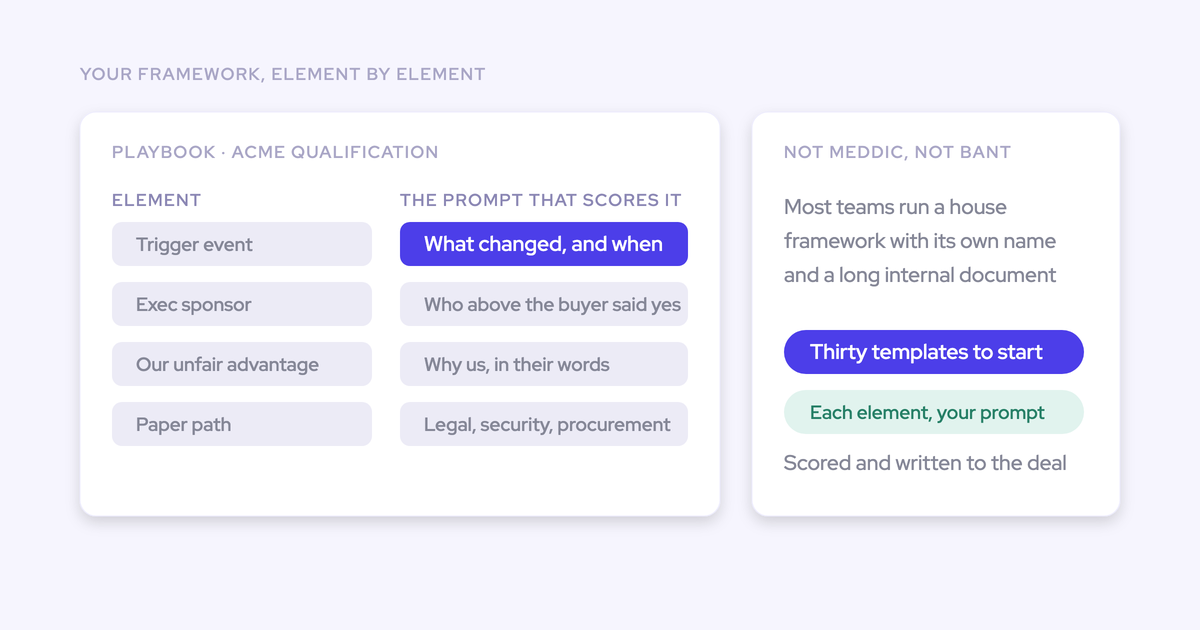
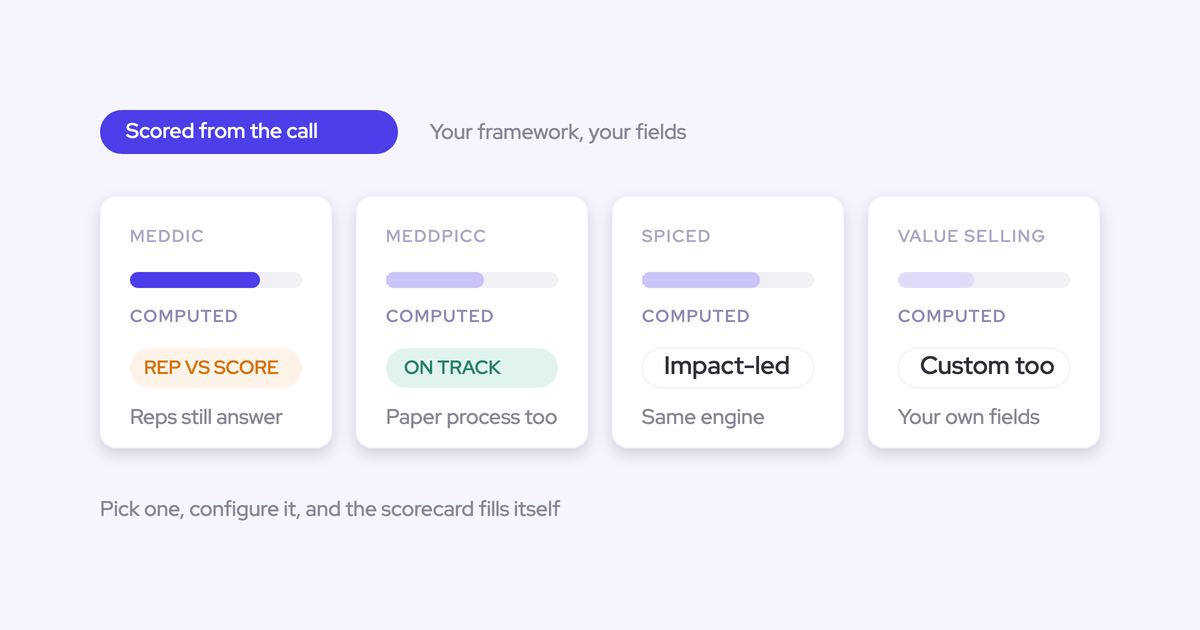
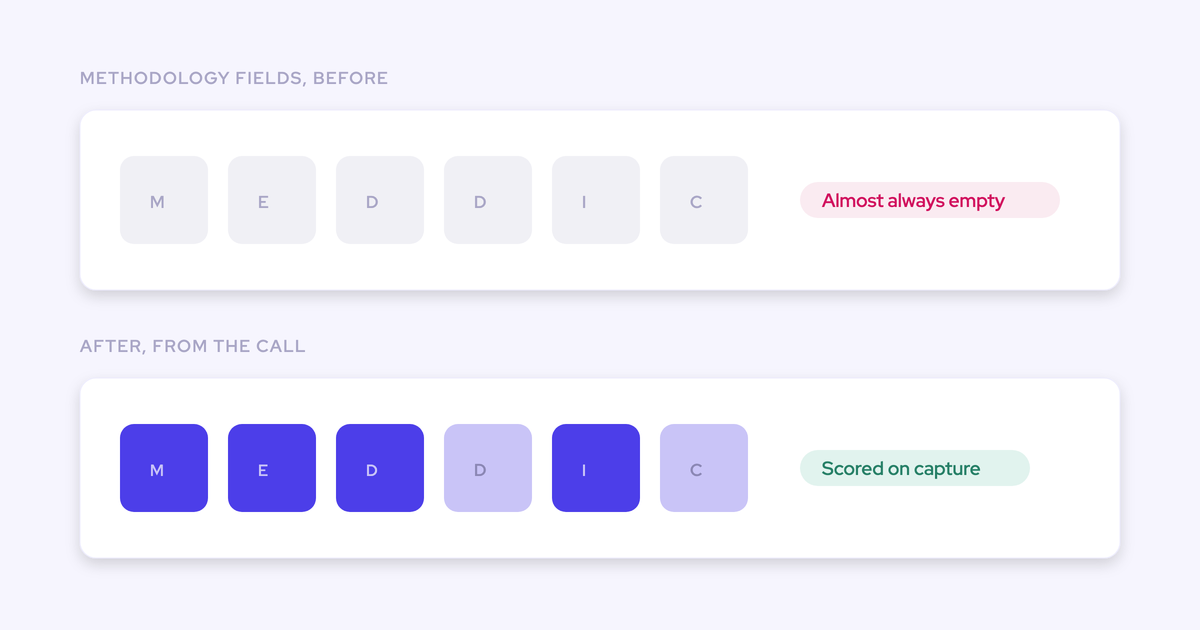
Templates reduce cognitive load. Instead of deciding what to capture during every call, you fill in a structure. Here’s a MEDDIC-based template that works across call types:
Universal sales note template (MEDDIC framework)
Call date: [Date]
Attendees: [Names and titles]
Call type: [Discovery / Demo / Technical review / Negotiation / Other]
Metrics: What quantifiable outcomes are they trying to achieve?
- [Metric 1]
- [Metric 2]
Economic buyer: Who signs off on budget?
- Name: [Name]
- Approval threshold: [Amount]
- Engagement status: [Met / Scheduled / Not yet engaged]
Decision criteria: What factors will determine their choice?
- [Criterion 1]
- [Criterion 2]
Decision process: How will they make this decision?
- Steps remaining: [List]
- Timeline: [Date]
- Blockers: [If any]
Identify pain: What problems are driving this evaluation?
- [Pain point 1]
- [Pain point 2]
Champion: Who is advocating internally?
- Name: [Name]
- Why they care: [Reason]
- What they need from us: [Support required]
Objections raised:
- [Objection 1]: [Your response / status]
- [Objection 2]: [Your response / status]
Next steps:
- [Action] — Owner: [Name] — Due: [Date]
- [Action] — Owner: [Name] — Due: [Date]
Competitors mentioned: [List]
This template works for any call type. In discovery, you’ll fill in Metrics, Identify Pain, and Champion heavily. In demos, you’ll add Decision Criteria and Objections. In negotiation, Economic Buyer and Decision Process become the focus.
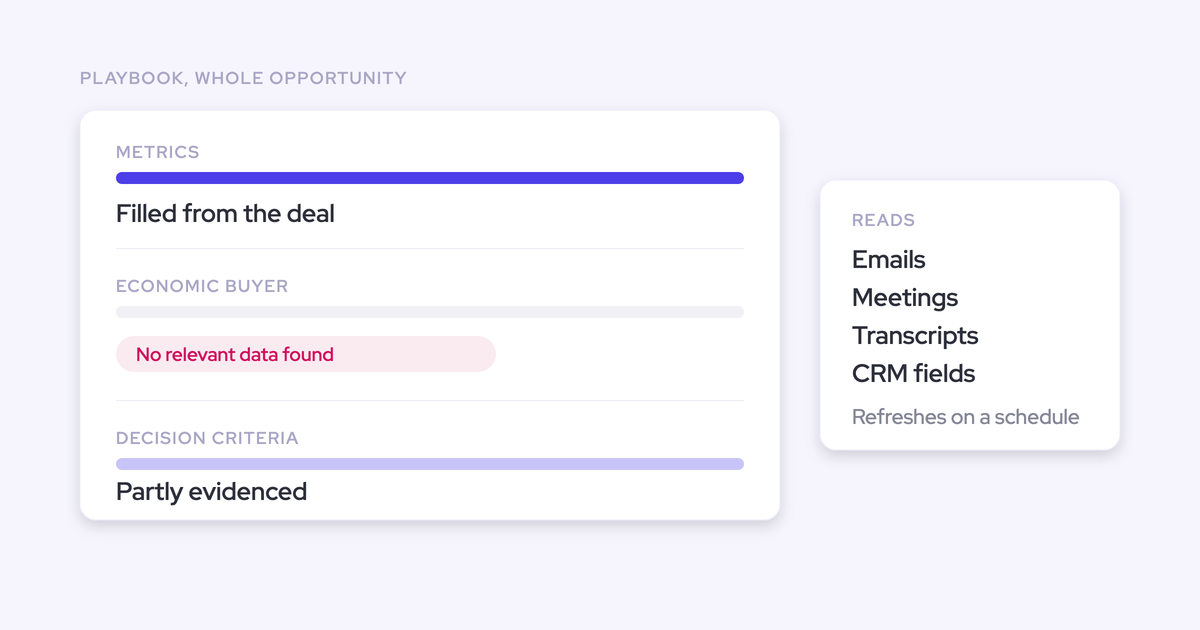
For teams using Weflow, note templates can be configured directly in Salesforce, pre-populating fields and automatically syncing completed notes to the opportunity record. This eliminates the copy-paste step that causes most notes to never make it into CRM.
How to sync sales notes to your CRM automatically
Notes that live in a Google Doc, a Notion page, or a sticky note on your monitor don’t help your team. They don’t show up in pipeline reviews. They don’t inform handoffs. They don’t feed forecasting models. Notes need to live in Salesforce, attached to the right opportunity and contact records.
The problem: manual CRM data entry is the single biggest adoption barrier in B2B sales. Reps know they should log notes. They don’t because it takes 10-15 minutes after every call to open Salesforce, find the right record, and paste in their notes. Multiply that by eight calls a day and you’re asking for two hours of admin work daily.
The solution is automatic sync. Tools that capture notes and write them directly to Salesforce fields—no copy-paste, no “I’ll update it later” that becomes never.
[banner type="download" url="https://www.weflow.ai/resources/cheat-sheets/salesforce-data-hygiene-cheat-sheet" text="Salesforce Data Hygiene Cheat Sheet" subtitle="Stop forecasting off stale notes and half-updated opportunity records" button="Get the cheat sheet"]
This is where Weflow’s CRM automation helps: notes captured during or after calls sync to Salesforce Task and Event records automatically, linked to the correct opportunity and contact. Reps take notes; Salesforce updates itself. RevOps gets complete data without chasing reps for updates.
How to write concise sales notes without losing key details
More is not better. A 500-word wall of text after every call creates notes nobody reads. The goal is 5-8 bullet points per call—enough to capture what matters, short enough that future-you (or a colleague) will actually read them.
The before/during/after workflow
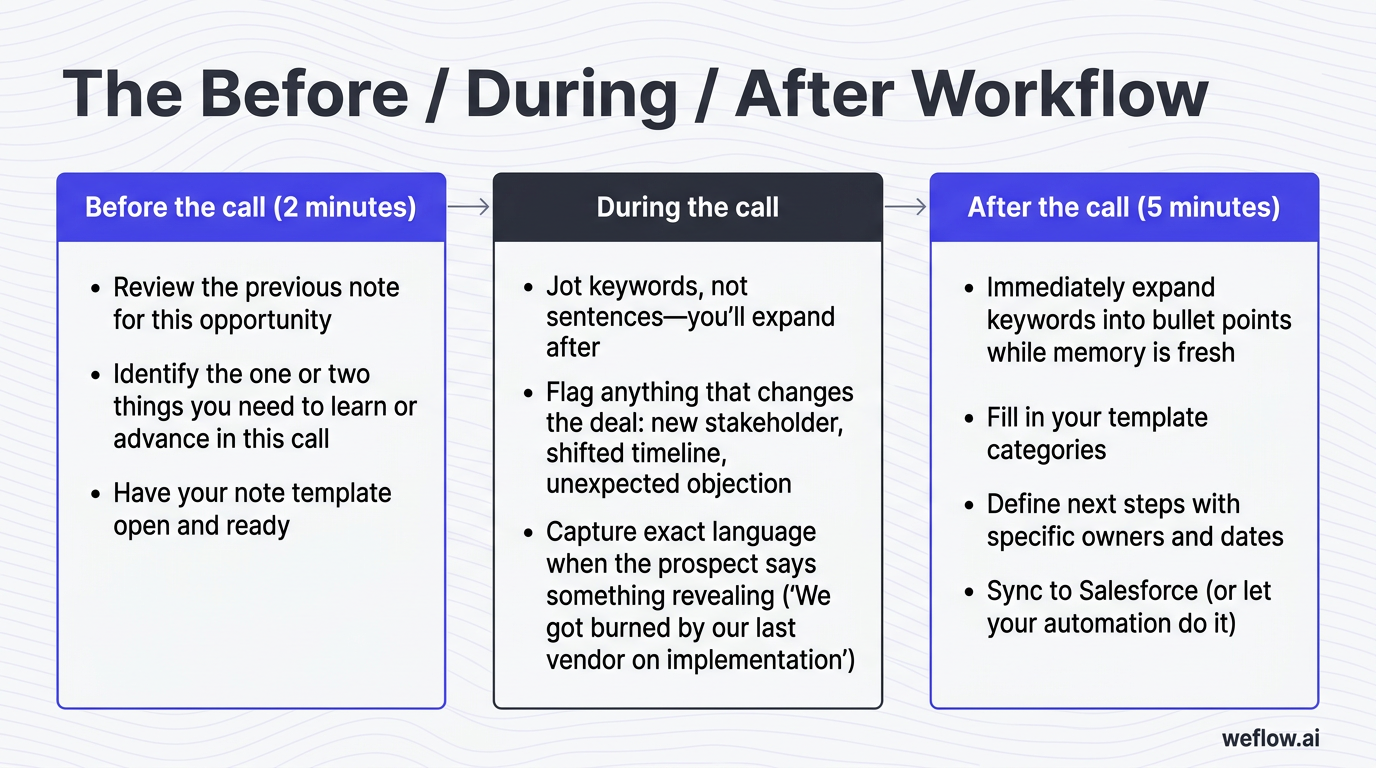
Before the call (2 minutes):
- Review the previous note for this opportunity
- Identify the one or two things you need to learn or advance in this call
- Have your note template open and ready
During the call:
- Jot keywords, not sentences—you’ll expand after
- Flag anything that changes the deal: new stakeholder, shifted timeline, unexpected objection
- Capture exact language when the prospect says something revealing (“We got burned by our last vendor on implementation”)
After the call (5 minutes):
- Immediately expand keywords into bullet points while memory is fresh
- Fill in your template categories
- Define next steps with specific owners and dates
- Sync to Salesforce (or let your automation do it)
Writing tight bullets
Each bullet should answer: what happened, why it matters, or what happens next. Cut anything that doesn’t serve one of those purposes.
- Cut: “We discussed their current situation and they explained some of the challenges they’re facing with their existing tool.”
- Keep: “Current tool (Gong) costs $180/user. Main complaint: activity data doesn’t flow into Salesforce cleanly. They spend 5 hours/week fixing data.”
The first is a summary of a conversation. The second is actionable intelligence.
Writing sales notes for deal handoffs and team visibility
Write every note as if a colleague will read it tomorrow without any context. Because at some point—when you’re on vacation, when you leave the company, when another rep takes over the account—that’s exactly what will happen.
The team-friendly checklist

Before marking a note complete, verify it answers these questions for someone who wasn’t on the call:
- Who was on the call? Names and titles, not just “the team”
- What’s the current status? Stage-appropriate summary (evaluating vs. negotiating vs. stalled)
- What are the open objections? Listed explicitly, not buried in narrative
- Who are the key stakeholders? Champion, economic buyer, technical evaluator, potential blockers
- What are the next steps? With owners and dates
- What’s the timeline? When do they need to decide and why
- What competitors are involved? Named explicitly
If your note answers all seven, anyone on your team can pick up the deal. If it doesn’t, you’ve created a dependency on your memory that will eventually fail.
AI note-taking tools for sales teams: what to automate and what to keep manual
AI-powered note-taking tools have changed what’s possible. Gong, Fathom, Fireflies, and others can transcribe calls, identify speakers, extract action items, and summarize conversations without rep involvement. The question isn’t whether to use AI—it’s what to automate and what requires human judgment.
What AI handles well
- Transcription: Converting speech to text with high accuracy, including speaker identification
- Action item extraction: Identifying commitments and next steps mentioned in conversation
- Topic tagging: Flagging when competitors, pricing, or specific features are discussed
- Summary generation: Creating a baseline summary of what was covered
- CRM field population: Mapping extracted data to Salesforce fields automatically
What humans should add
- Deal context: How this call changes your assessment of close probability
- Relationship signals: Was the champion enthusiastic or going through the motions?
- Reading between the lines: What did they not say that matters?
- Strategic next steps: Not just what was agreed, but what you should do based on what you learned
- Competitive intelligence: Nuanced interpretation of how the competitor is positioned
The best approach combines both: AI captures the mechanical work (transcription, extraction, CRM sync), and reps add the 30 seconds of human context that turns a transcript into actionable intelligence.
Weflow takes this approach by combining conversation intelligence—call recording, transcription, and AI summaries—with automated Salesforce sync. The AI captures what was said; you add what it means. Activities, notes, and AI-extracted insights flow directly to native Salesforce objects without manual data entry.
How to use sales notes for coaching and pipeline forecasting
Sales notes aren’t just for reps. Managers and RevOps leaders can extract significant value from structured, consistent notes across the team.
How managers use notes for coaching
Effective coaching starts with observation. But most sales managers can’t sit on every call. Notes are the next best thing—a window into how reps are running their deals.
In weekly 1:1s, managers can:
- Review note quality: Are reps capturing the right information? If notes are vague (“good call, moving forward”), that’s a coaching opportunity on discovery technique.
- Identify patterns: Is this rep consistently missing decision maker information? Do they struggle to surface objections?
- Spot deal risk early: Notes that show stalled next steps, unclear timeline, or no champion engagement signal deals that need intervention.
- Recognize strong execution: Notes that show tight MEDDIC coverage, clear next steps, and multi-threaded relationships indicate reps who are running deals well.
The conversation shifts from “How’s the deal going?” (which gets you optimistic guesses) to “I read your notes—let’s talk about the CFO’s budget concern” (which gets you productive coaching).
How standardized notes feed forecasting
Pipeline stage alone is a weak forecasting signal. Two deals at Stage 3 might have completely different close probabilities based on what’s actually happening.
Structured notes add the qualitative layer that improves forecast accuracy:
- Is the economic buyer engaged? Notes that show CFO conversations indicate real buying intent.
- Are next steps defined? Deals with vague next steps have longer cycles and lower close rates.
- What objections are unresolved? Open objections are risk factors.
- Is timeline real? Notes that capture why the deadline matters (contract renewal, board meeting, fiscal year) versus arbitrary dates help prioritize accurately.
RevOps teams can build scoring models that weight these factors, using note data to adjust pipeline probabilities beyond what stage alone would predict.
Common sales note-taking mistakes that cost you deals
Avoiding these five mistakes will put your note-taking practice ahead of most B2B sales teams:
1. Taking no notes at all
Surprisingly common, especially among experienced reps who trust their memory. Memory fails. Every call should produce a note, even if it’s brief. “No update—prospect rescheduled to next Tuesday” is better than nothing.
2. Writing vague summaries instead of specific details
“Great call, they’re interested” tells you nothing useful. What are they interested in? What concerns do they have? What happens next? Vague notes are almost as useless as no notes.
3. Delaying note-taking until later
“I’ll update Salesforce at the end of the day” becomes “I’ll do it tomorrow” becomes never. Memory decay is real. Notes written within five minutes capture 3x more useful detail than notes written the next day.
4. Never reviewing notes before the next call
Notes you never read again are wasted effort. The two minutes of review before a follow-up call is where notes deliver their value. Make it a habit: before every call, read the last note.
5. Keeping notes outside the CRM
Notes in Google Docs, Notion, or paper notebooks don’t help your team. They don’t show up in pipeline reviews or handoffs. They don’t inform forecasting. If it’s not in Salesforce, it doesn’t exist for anyone but you.
Your sales note-taking action plan
You don’t need to overhaul your entire process tomorrow. Start with these three steps:
- Adopt a template. Use the MEDDIC framework above or create one that fits your sales process. The structure matters more than the specific format. Having any template beats improvising every time.
- Commit to the five-minute rule. Within five minutes of every call ending, your notes should be written and synced to Salesforce. Put it on your calendar as a recurring event. Block the time. Make it non-negotiable.
- Review before every call. Before you dial in, read the last note. Two minutes of review makes every follow-up call more effective. This is where the ROI compounds.
For teams that want to automate the CRM sync, reduce manual data entry, and capture call insights automatically, explore what Weflow can do for your Salesforce workflow.
Frequently asked questions
What should I include in my sales notes?
Capture four things: pain points, objections, commitments, and next steps with deadlines. These are the details that matter for advancing deals and enabling handoffs. Everything else is optional context that you can add when relevant—competitor mentions, budget signals, stakeholder information.
How long should sales notes be?
Five to eight bullet points per call. Long enough to capture what matters, short enough that you’ll actually read them before the next call. If your notes are consistently longer, you’re probably writing narrative instead of actionable bullets.
What is the best format for sales call notes?
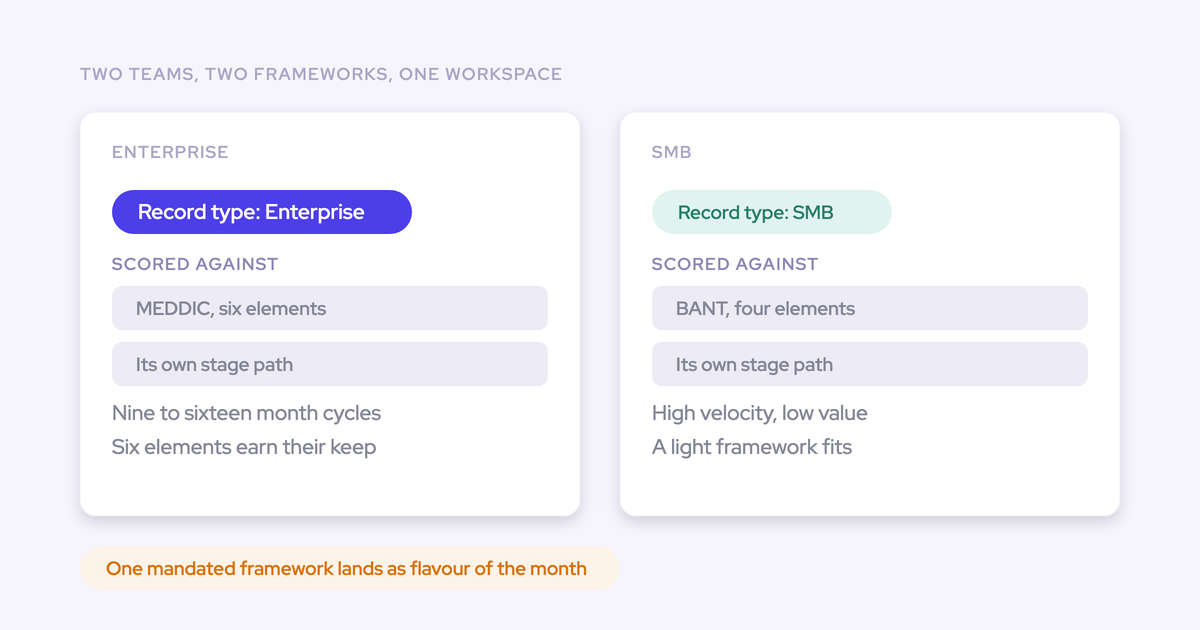
A structured template using the MEDDIC or BANT framework. Templates ensure you capture consistent information across calls and make notes easier to scan later. The specific framework matters less than having a framework—pick one and use it consistently.
Should I use AI to take sales notes?
Yes for mechanical capture—transcription, action item extraction, CRM field population. Add human context for tone, deal likelihood, and reading between the lines. AI handles what was said; you add what it means for the deal.
How do I organize sales notes in a CRM?
Link every note to the correct contact, account, and opportunity records. Use tags or categories if your Salesforce org supports them. The goal is findability: anyone should be able to locate all notes related to a specific deal or account without knowing where to look.
When should I write my sales notes?
Within five minutes after the call. Memory decays rapidly—notes written the same day capture 3x more useful detail than notes written the next day. Block five minutes after every call on your calendar and treat it as non-negotiable.
How can sales managers use rep notes for coaching?
Review note quality in 1:1s. Look for patterns: are reps capturing decision maker information? Are they surfacing objections? Are next steps specific? Note quality is a proxy for discovery quality—weak notes usually indicate weak discovery conversations.
What are common sales note-taking mistakes?
Taking no notes, writing vague summaries (“good call, moving forward”), delaying note-taking until you forget details, and never reviewing notes before the next call. Any of these breaks the value chain that makes note-taking worth the effort.
-p-1600.png)

.png)
-p-1600.png)
-p-1600.png)
-p-1600.png)