
How to Align Sales and Customer Success: 7 Best Practices
Learn 7 best practices to align sales and customer success for better handoffs, renewals, and NRR.



.png)

What customer success and sales alignment actually means — and why it drives revenue
Customer success and sales alignment is a revenue problem, not a culture problem. When Sales closes a deal on inflated promises and CS inherits an account with mismatched expectations, the outcome is predictable: a churned customer, a lost expansion opportunity, and two teams pointing fingers. According to Forrester, companies that align their revenue teams see 2.4x faster revenue growth and double the profitability of those that operate in silos.
The fix isn't a Slack channel or a quarterly sync. It's shared data, defined handoff processes, joint KPIs, and a structural understanding of where each team's accountability begins and ends. This guide covers the specific practices that B2B SaaS revenue teams — VPs of Sales, CS leaders, CROs, and RevOps managers — use to close that gap.
Sales vs. customer success: key differences and shared goals
Sales and CS are built around different motions, different metrics, and different incentives. That's by design. The misalignment happens when those differences aren't bridged — when Sales treats the closed-won notification as the finish line and CS treats the kickoff call as the starting gun, with nothing in between.
| Dimension | Sales | Customer Success | Where they overlap |
|---|---|---|---|
| Primary goal | New logo acquisition, expansion deals | Retention, adoption, renewal | Net revenue retention (NRR) |
| Core metric | ARR bookings, win rate, quota attainment | Churn rate, NRR, CSAT/NPS | Expansion revenue, time to value |
| Customer relationship | Pre-sale: prospects and opportunities | Post-sale: active accounts | Handoff period, renewal cycle, upsell motion |
| Success horizon | Quarterly — focused on what closes now | Annual — focused on long-term health | QBRs, renewal planning |
| Data they own | Opportunity data, contact history, deal notes | Usage data, support tickets, health scores | Account record in Salesforce |
| Comp structure | Commission on new ARR and expansions | Variable tied to retention and NRR | Expansion quota (when structured correctly) |
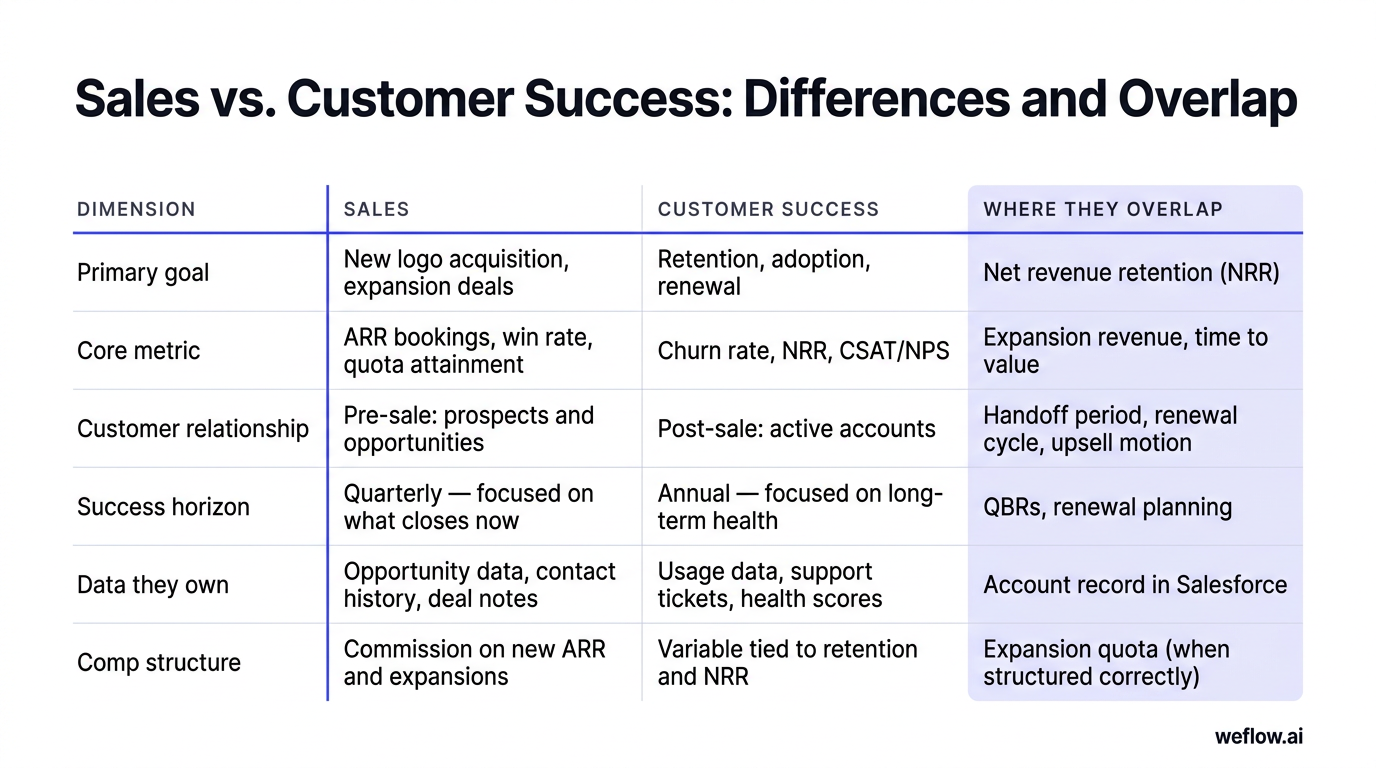
The overlap column is where alignment lives. NRR, expansion revenue, and account health are outcomes neither team can hit alone. Sales needs CS to protect the base so it can upsell. CS needs Sales to set accurate expectations so customers don't arrive angry. When both teams understand this, the dynamic shifts from handoff tension to shared accountability.
Why customer success and sales alignment drives revenue growth
Alignment isn't a soft goal. It has a direct, measurable effect on the three revenue levers that matter most to CROs and CS leaders: growth rate, profitability, and customer lifetime value.
| Benefit | How it works | Business impact |
|---|---|---|
| Faster revenue growth | Sales closes the right customers; CS retains and expands them. The growth loop compounds instead of leaking. Forrester data shows aligned revenue teams grow 2.4x faster. | 2.4x faster revenue growth; double the profitability vs. siloed teams (Forrester) |
| Improved customer experience | Customers move from sales cycle to onboarding without a jarring context switch. The CSM already knows their goals, use case, and key stakeholders — because Sales documented and shared them. | Higher NPS, faster adoption, lower early-stage churn |
| Better renewal and upsell handling | CS surfaces expansion signals early and loops in Sales before the renewal window. Sales brings relationship leverage; CS brings usage data. Both need each other to close. | Higher NRR, shorter expansion sales cycles, reduced churn surprise |
| Faster time to value | When CS receives a complete handoff — goals, stakeholders, technical environment, contract specifics — onboarding moves in days, not weeks. There's no re-discovery period. | Faster product adoption, earlier renewal conversations, reduced early churn |
Best practices for aligning customer success and sales teams
Involve CSMs before the deal closes
The handoff problem starts before the deal closes. By the time a CSM receives an account, the customer has already formed expectations — based on what Sales told them. If CS wasn't part of that conversation, they're inheriting commitments they weren't consulted on.
Early CSM involvement changes that dynamic. The model that works in high-performing B2B SaaS orgs looks like this:
- CSM joins the deal at a defined stage — typically late-stage (Stage 4 or 5 in most pipelines) after technical fit is confirmed.
- CSM attends the final demo or proof-of-concept review to understand what was promised and to begin building rapport with the economic buyer and key stakeholders.
- CSM participates in scoping calls where custom implementation work, integrations, or specific onboarding timelines are discussed.
- CSM co-signs the success plan — a documented agreement on what outcomes the customer expects in the first 90 days — before the contract is signed.
The outcome: CS starts onboarding with full context, customers don't repeat themselves, and the relationship starts from a foundation of trust rather than scrambled re-introductions.
Build a sales-to-CS handoff playbook
An informal handoff — a Slack message or a half-completed Salesforce record — is where CS alignment breaks down in practice. A structured handoff playbook eliminates ambiguity about what gets transferred and when.
A complete handoff checklist covers:
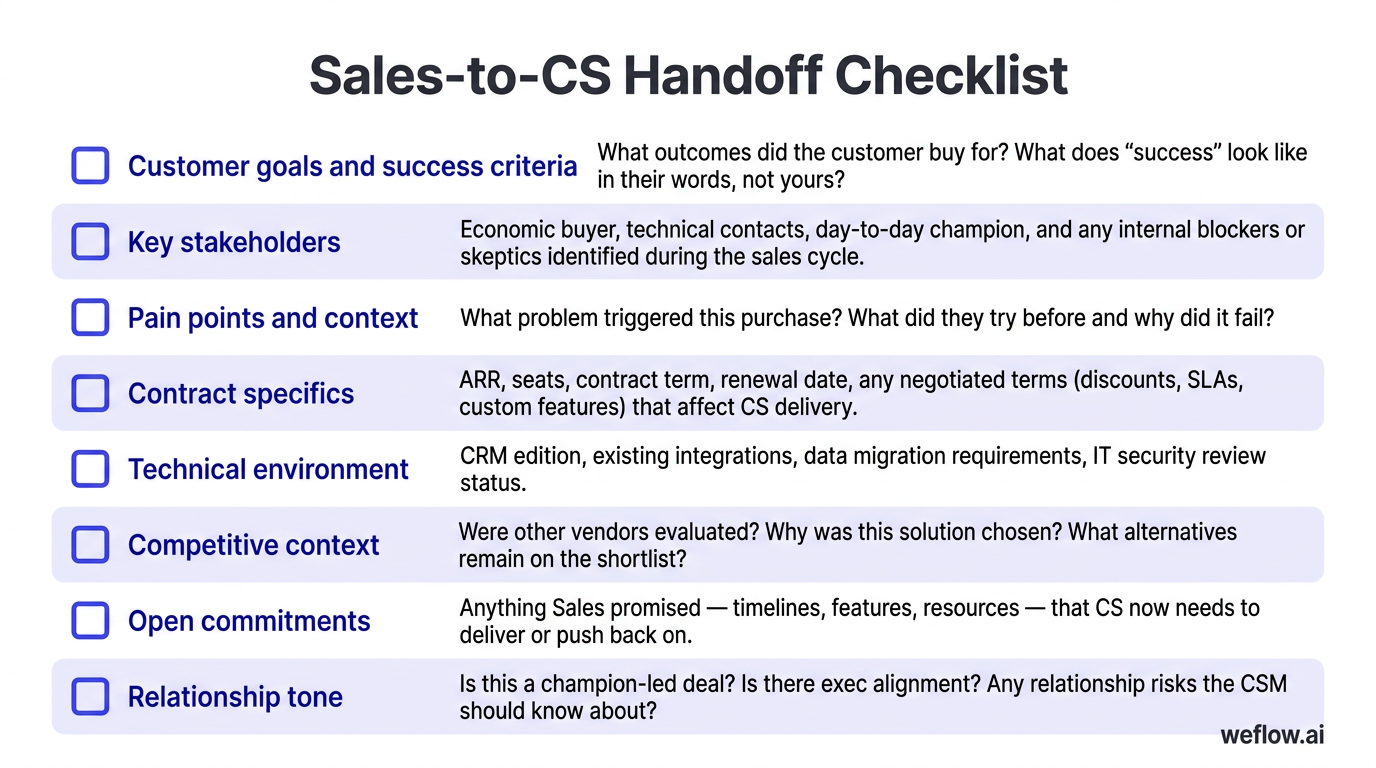
- Customer goals and success criteria: What outcomes did the customer buy for? What does "success" look like in their words, not yours?
- Key stakeholders: Economic buyer, technical contacts, day-to-day champion, and any internal blockers or skeptics identified during the sales cycle.
- Pain points and context: What problem triggered this purchase? What did they try before and why did it fail?
- Contract specifics: ARR, seats, contract term, renewal date, any negotiated terms (discounts, SLAs, custom features) that affect CS delivery.
- Technical environment: CRM edition, existing integrations, data migration requirements, IT security review status.
- Competitive context: Were other vendors evaluated? Why was this solution chosen? What alternatives remain on the shortlist?
- Open commitments: Anything Sales promised — timelines, features, resources — that CS now needs to deliver or push back on.
- Relationship tone: Is this a champion-led deal? Is there exec alignment? Any relationship risks the CSM should know about?
This documentation lives in the Salesforce account record or a shared workspace — not in someone's head or a separate tool. The joint kickoff call (AE + CSM + customer) happens within five business days of contract signature, using this documentation as the agenda foundation.
Set a bi-weekly sales and CS alignment cadence
One-off syncs don't fix structural misalignment. A standing bi-weekly meeting between Sales and CS — at the team level, not just the management level — creates a regular forcing function to surface friction before it becomes churn.
[banner type="download" url="https://www.weflow.ai/resources/cheat-sheets/cs-ops-cheat-sheet" text="Customer Success Ops Cheat Sheet" subtitle="Wire health scores, renewals, and handoffs into Salesforce so Sales and CS work from one record" button="Get the cheat sheet"]
Sample agenda for a 45-minute bi-weekly alignment meeting:
- At-risk accounts (15 min): CS reviews 2–3 accounts with health score drops or usage declines. Sales identifies whether a relationship conversation is needed. Agree on who owns the next outreach.
- Expansion pipeline review (10 min): CS shares accounts showing expansion signals — increased usage, new stakeholders, growing team size. Sales confirms whether there's an active opportunity or if one should be created.
- Upcoming handoffs (10 min): Sales previews deals expected to close in the next two weeks. CS flags capacity constraints or accounts that need special onboarding treatment.
- Process issues (10 min): Open forum for either team to flag recurring friction — incomplete handoffs, miscommunicated expectations, renewal coordination gaps.
The meeting owner rotates between Sales and CS leadership each quarter. Meeting notes and action items go into a shared Salesforce task or a project management tool that both teams can access — not buried in a calendar invite.
Use a RACI matrix to define sales vs. CS ownership
Most handoff conflicts aren't about attitude — they're about ambiguity. Both teams assume the other team owns something, and nobody acts. A RACI matrix removes that ambiguity by assigning a specific role to each team for each stage of the customer lifecycle.
| Activity | Sales (AE) | Customer Success (CSM) | Sales Manager | CS Manager / RevOps |
|---|---|---|---|---|
| Lead qualification | Responsible | Informed | Accountable | Consulted |
| Onboarding kickoff | Consulted | Responsible | Informed | Accountable |
| QBR (Quarterly Business Review) | Consulted | Responsible | Informed | Accountable |
| Renewal | Consulted | Responsible | Informed | Accountable |
| Expansion / upsell | Responsible | Consulted | Accountable | Informed |
RACI stands for: Responsible (does the work), Accountable (owns the outcome), Consulted (provides input), Informed (kept in the loop). Each activity should have exactly one Accountable owner.
Note that expansion sits with Sales as the lead — but CS is the source of the signal. This is intentional. CS identifies the opportunity through account health data and usage trends; Sales closes it. Neither team can do it alone.
Align compensation and shared KPIs across sales and CS
Behavior follows incentives. If Sales is compensated solely on new ARR and CS is compensated solely on NPS, you'll get exactly the behavior those metrics reward: Sales closing whoever they can, CS focused on satisfaction scores rather than revenue outcomes. Shared KPIs create shared accountability.
The most effective shared metrics between Sales and CS:
- Churn rate: Make Sales accountable for customer fit, not just contract signature. If churn within 90 days of close is tracked back to the originating AE, deal quality becomes a Sales metric, not just a CS problem.
- Net revenue retention (NRR): The single metric that ties both teams to the same outcome. NRR above 100% means expansion is outpacing churn — which requires Sales and CS working together. Target NRR above 110% for most B2B SaaS orgs.
- Time to value (TTV): How long it takes a new customer to reach their first defined success milestone. Slow TTV is often a Sales problem (incomplete handoff) as much as a CS problem (poor onboarding). Track it jointly.
- Expansion revenue: CS should have an expansion quota — not just Sales. When CS is compensated on expansion, they actively surface upsell signals instead of waiting for Sales to ask.
On compensation structure: usage-based expansion comp (CS earns on expansion driven by product adoption) tends to align behavior better than pure seat-based comp. If CS earns on seats alone, there's no incentive to drive the usage that makes expansion feel natural to the customer. Usage-based comp rewards the behaviors — adoption, integration depth, stakeholder expansion — that create renewal and expansion conditions.
Integrate your CRM and customer success platform as a single source of truth
Sales teams live in Salesforce. CS teams often live in a separate customer success platform — Gainsight, Totango, ChurnZero, or similar. When those systems don't talk to each other, alignment breaks down at the data level: Sales doesn't see health scores, CS doesn't see pipeline context, and both teams make decisions based on incomplete information.
A single source of truth means one place — ideally Salesforce — where both teams can see:
- Account health scores and usage metrics, surfaced in the Salesforce account record
- Open support tickets and escalations, linked to the account and visible to the AE
- Renewal date, ARR, and contract terms — not siloed in a CS tool
- Expansion signals: feature adoption milestones, new stakeholders added, seat growth trends
- Handoff documentation: the structured notes, success criteria, and commitments that transferred from Sales to CS at close
If your CS platform doesn't write data back to Salesforce natively — or if that data ends up in custom objects that aren't visible in standard reports — you have a data quality problem that no alignment process will fix. The architecture matters. CS health scores need to be readable by the AE in the same account view where they track pipeline. If that requires three extra clicks and a separate login, it won't happen.
[banner type="download" url="https://www.weflow.ai/resources/cheat-sheets/revenue-cadence-guide" text="Revenue Operating Cadence Guide" subtitle="Run a Sales and CS rhythm that catches at-risk accounts before they show up in churn reports" button="Get the guide"]
Use AI-powered insights to predict churn and expansion
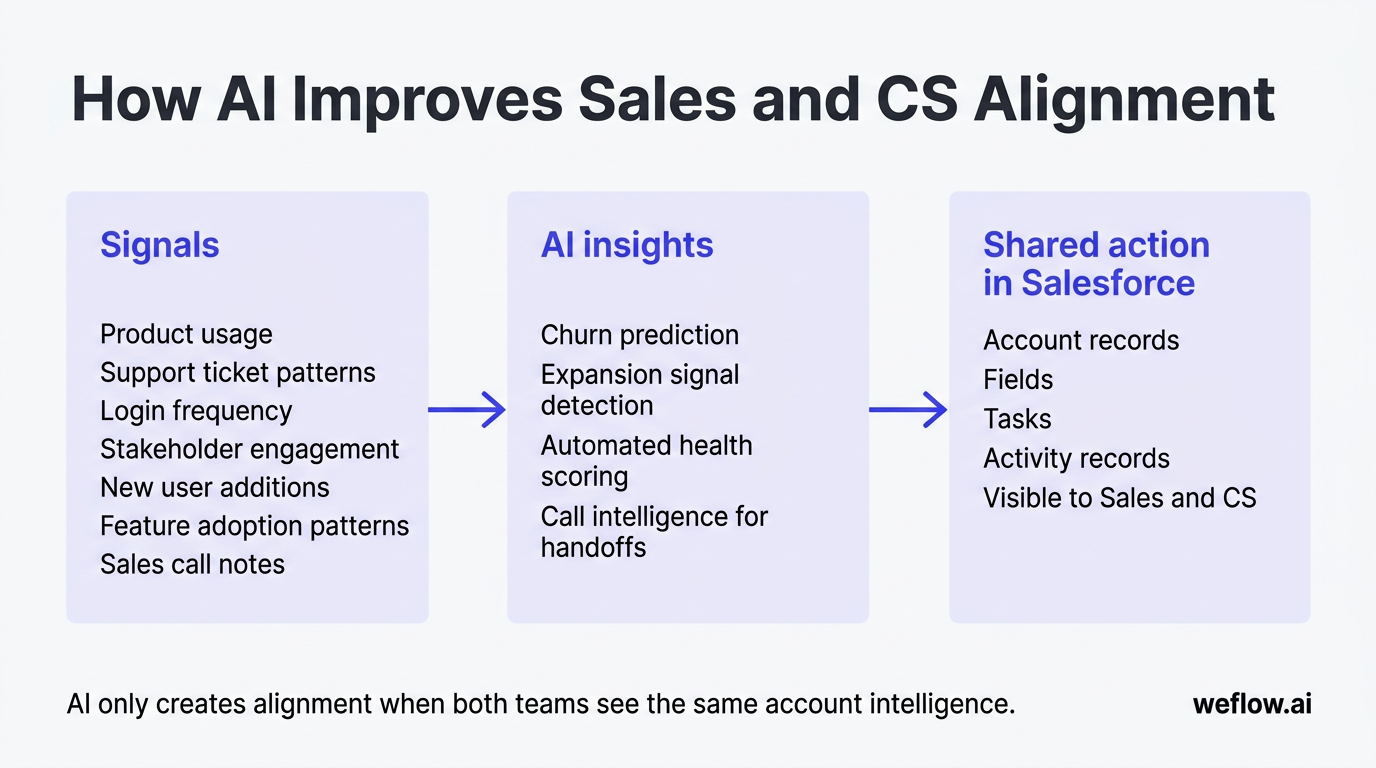
The alignment gap between Sales and CS is often a timing problem: CS sees a churn risk two weeks before it becomes a crisis; Sales sees an expansion opportunity six months after CS already flagged the signal. AI closes that gap by surfacing both signals proactively — before they require escalation.
Where AI delivers the most value for Sales and CS alignment:
- Churn prediction: AI models trained on product usage, support ticket patterns, login frequency, and stakeholder engagement can identify at-risk accounts weeks before the customer says anything. That early warning is only useful if it's visible to Sales, not just CS.
- Expansion signal detection: Usage growth, new user additions, and feature adoption patterns are leading indicators of expansion readiness. AI can surface these signals automatically so CS doesn't miss them — and so Sales can act on them before a competitor does.
- Automated health scoring: When health scores update manually or infrequently, they're stale by the time Sales sees them. AI-driven health scoring that updates in real time — based on actual usage and engagement data — gives both teams a shared, current view of account status.
- Call intelligence for handoffs: AI-summarized sales call notes give CSMs full context on what was discussed, what was promised, and what objections were raised — without requiring the AE to write a novel in the handoff form. Tools that auto-populate Salesforce with call summaries and key topics reduce handoff friction and increase information quality at the same time.
The key architectural requirement: AI insights need to live in the same system both teams work in. If churn predictions are in a CS-only tool and Sales never sees them, the alignment value is lost. Platforms that write AI-generated insights directly to Salesforce account records — as fields, tasks, or activity records — close the visibility gap without requiring Sales to adopt a new tool.
Frequently asked questions
What is customer success and sales alignment?
Customer success and sales alignment is the process of getting both teams to work toward the same revenue goals by sharing customer data, coordinating handoffs, and tracking shared KPIs like churn, net revenue retention, and expansion revenue. When aligned, Sales focuses on acquiring the right customers while CS ensures those customers achieve their goals and renew.
Why do sales and customer success teams need to be aligned?
Misalignment leads to poor handoffs, unmet customer expectations, and higher churn. According to Forrester, companies that align their revenue teams see 2.4x faster revenue growth and double profitability compared to those that operate in silos.
What are the most common friction points between sales and CS?
The three biggest friction points are: rushed or incomplete handoffs after close, misaligned expectations from overpromising during the sales cycle, and poor communication during renewal cycles where Sales pushes upsells while CS focuses on satisfaction without coordinating.
How should sales hand off accounts to customer success?
A structured handoff includes four elements: early CSM involvement before the deal closes, a documented knowledge transfer (customer goals, pain points, stakeholders, contract terms), a joint kickoff call with the AE and CSM present, and a shared workspace or CRM record that both teams can access.
What KPIs should sales and customer success share?
The most effective shared KPIs are: churn rate (makes Sales accountable for customer fit), net revenue retention (ties both teams to expansion outcomes), time to value (measures onboarding efficiency), and expansion revenue (incentivizes CS to identify upsell opportunities and Sales to close them).
Should sales and customer success report to the same leader?
Many high-performing SaaS companies place both teams under a Chief Revenue Officer (CRO) to eliminate competing priorities. If a shared leader isn't feasible, a Revenue Operations (RevOps) function can provide the unified data layer and process governance needed to keep both teams aligned.
How can AI improve sales and customer success alignment?
AI tools can auto-summarize sales calls so CS has full context at handoff, predict churn risk based on product usage and support ticket patterns, surface expansion signals from customer behavior data, and automate health scoring so both teams work from the same account intelligence.
What is a RACI matrix and how does it help alignment?
A RACI matrix defines who is Responsible, Accountable, Consulted, and Informed for each stage of the customer lifecycle — from lead qualification through renewal. It eliminates ownership ambiguity, especially in post-sale stages where Sales and CS responsibilities often overlap.

.webp)